Movie of the Month: Women on the Verge of a Nervous Breakdown (1988)

Every month one of us makes the rest of the crew watch a movie they’ve never seen before and we discuss it afterwards. This month Hanna made Boomer,  Britnee, and Brandon watch Women on the Verge of a Nervous Breakdown (1988).

Hanna: Sometimes the universe has to shove you into art before you’ll pay any attention to it; this was the case with me and Pedro Almodóvar. I vaguely remember my mother talking about Broken Embraces and admiring Penélope Cruz on the poppy-covered poster for Volver when I was a teenager, and The Skin I Live In floated across my radar when I was in the habit of seeking out macabre media as a protest against the Midwestern values of Minnesota, but for some reason I wasn’t compelled to watch any of those movies. I didn’t see an Almodóvar film until my first year of college, by force, in my Spanish Media class; that film was Women on the Verge of a Nervous Breakdown (1988), and it shoved me (very happily) into the Almodóvar canon.

The primary Woman on the verge of a nervous breakdown is Pepa Marcos (Carmen Maura), a TV actress and film dubber. Her ex-lover and co-dubber, Ivan—an older, spineless lech with a mahogany voice—left her a week ago; he is going on a trip (with another woman), and is asking her to pack him a suitcase. Pepa is inconsolable. She wolfs down sleeping pills, spiking her gazpacho with barbiturates. She sleeps through the alarms of the 30-odd clocks littered around her apartment. She accidentally lights her bed on fire. She leaves Ivan desperate voicemails, insisting that she has something important that they need to discuss and becoming increasingly irate. No matter what Pepa does, she is always just catching up to Ivan’s ghost: finding that he left the studio a minute before she arrives, or that he called her apartment just before she walked in the door. When the phone does ring for Pepa, Ivan is never on the other line. Eventually, through a series of fraught coincidences, chaos seeps into Pepa’s apartment through her friend Candela, Ivan’s ex-wife Lucía, Ivan’s son Carlos, and Carlos’s fiancée Marisa, shattering the spell of her obsessive despair over Ivan.

Of the Almodóvar films I’ve seen, Women on the Verge is probably the lightest fare – the least political, the least subversive, and the least confessional. It never seems to bubble over in the way that madcap comedies usually do, even in its final stretch (which is still, in my opinion, a jaunty little thrill ride). Regardless, there is something about this film that totally entrances me. First of all, for being a breezy, highly stylized black-comedy melodrama, Women On the Verge of a Nervous Breakdown was confoundingly successful; it was the highest-grossing Spanish film of all time when it was released and is still Almodóvar’s 4th highest grossing film (not adjusting for inflation, which would boost it up even higher). The cinematography is characteristically gorgeous, tactile and vibrant, and some of the images are still splintered into my brain from the first watch (specifically, the scenes of Pepa and Ivan dubbing Johnny Guitar and Pepa looking out of her apartment through that huge slatted peephole). I’m consistently delighted by the film’s comic serendipity: the near-misses, close calls, and coincidental injuries (shoes and records are the universe’s guided missiles, launched unintentionally by people in fits of rage or despair). If nothing else, this movie has given me the Mambo Taxi driver, one of the purest and most absurd characters in cinema; his attention to the provisions of amenities in his taxi was genuinely touching.

One of my favorite things about Almodóvar is his embrace of multiple genres; he has touched comedy, drama, autobiography, and horror, and his films are usually a chaotic blend of two or three. In the case of Women on the Verge, I do think the comic elements could have been pushed even further. Britnee, what did you think about the balance of comedy and drama in Women on the Verge? Did the tone work for you, or do you wish the film had pushed more in one direction or the other?

Britnee: Right now, we are all living in a pretty dark world, and my primary escape from all the insanity has been reality TV and, of course, movies. For some reason, I’ve been finding myself binging old made-for-TV Lifetime films with pretty intense plots. While I thought these films were helping me unwind and relax, I was actually subconsciously adding to my already high stress levels. Women on the Verge basically got me out of this horrible funk because of it’s wonderful blend of the drama that I crave while giving me the light comedy that I so desperately needed. From the Mambo Taxi driver (“Thank You For Smoking”) to Candela’s moka pot earrings, there are many eccentricities sprinkled throughout the film that brought me so much joy and laughter. And don’t even get my started on how much I loved that kitschy apartment setup! I definitely think Women on the Verge leans more towards being a comedy than a drama, but I actually admire how it holds back from going too far in a comic direction. It somehow makes all the funny moments more special and memorable.

Pepa is constantly surrounded by the mysterious Ivan, be it through the many characters who pop up in her life who have various connections to him or through her own obsession with finding him to tell him “something.” The drama that Ivan brings into her life without him actually physically being a part of her life is the kind of drama that I find fascinating. Boomer, do you think the film would have benefited from having Ivan physically appear in more scenes? Like, if there were even more scenes that focused on what Ivan was up to while Pepa was going through all of her apartment-contained insanity?

Boomer: I prefer Ivan as—as Hanna puts it—a ghost in the film. There’s something so smarmy and gross about him, from the way he distances himself emotionally from his son and his lover by giving them autographed photos as if they were fans, to his callous movement from one lover to the next with careless disregard for the damage he leaves in his wake, to his uneven application of secrecy (Pepa clearly never knew about Lucía or Carlos, indicating that Ivan intentionally hid the fact that he was a divorced father, while Paulina Morales clearly knows who Pepa is from the moment the latter walks into the former’s office, treating her with open hostility). He’s such a cad that he has no shame about asking his former lover to pack a suitcase for him but can’t face her in order to collect it. The fact that, as you mentioned, he brings so much drama into the piece without being present for much of it is part of the fun for me. He’s mysterious: a clear heel in every way, and yet able to be such a focal point of the attention of women are all too good for him, but who find themselves caught in his wake against their better judgment. If there was one thing that I wanted more of, however, it was Pepa’s role as the mother of the Crossroads Killer in her TV show. What is that program even about?

Brandon, you and I have spoken in the past about the relationship between comedy and mystery and how they both occupy the same kind of space in the mind: the set-up of joke and punchline is not entirely dissimilar from mystery and revelation, and there’s actually a fair amount of that at play here. Although this is first and foremost a comedy, the mystery element (who is Ivan going away with?) is still omnipresent. The relationship between planting and payoff may have its most triumphant example on film here, as we first see Ivan dubbing over Sterling Hayden’s voice in Johnny Guitar while we can’t hear Joan Crawford’s dialogue at all, only to later see Pepa in the studio performing her half of the scene, not against silence as Ivan had, but against his voice. Even in this, he is a ghost. What were your two favorite planting-and-payoff revelations here, comedic and mysterious?

Brandon: I love the idea of breaking this film down into individual moments & punchlines, because it’s practically a feature-length pilot for a sitcom.  I could happily watch these characters burst into & out of Pepa’s candy-coated apartment forever, even if they were dealing with more mundane day-to-day conflicts than the high-stakes farce staged here.  It’s comforting to know that Almodóvar heavily reuses the same actors & crew for most of his pictures, because it was heartbreaking to leave these outrageous women behind just because the credits rolled.  Ivan, I could live without.  If he were made to be even more of a ghost and was only talked about but never shown, the movie would have worked just was well.

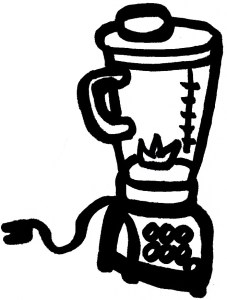
My favorite payoffs—both comedic and mysterious—resulted from the Hitchcockian tension of the poisoned gazpacho.  When Pepa first loads Chekhov’s Blender with gazpacho & sleeping pills, her intentions are opaque.  She’s distraught enough over Ivan’s infidelity that it appears she’s planning to kill herself in a deliciously complex manner, but it’s later revealed to be a long-game murder attempt (Ivan loves gazpacho).  Instead of either tragedy unfolding as planned, the gazpacho litters Pepa’s apartment with the unconscious bodies of an exponential number of hungry fools who sneak a taste: first Carlos’s bratty girlfriend (the fascinating-looking Rossy de Palma), then the meathead cops who seek to bust Pepa’s naïve bestie, then practically every other character on the cast list in a giant impromptu slumber party.  It’s a hilariously wholesome escalation of a plot point that first promised to be nastily lethal (although delicious).

My other favorite payoff is more aesthetic & superficial: the matter-of-fact presentation of this world’s surreal artificiality.  The exterior shots of Pepa’s apartment building are represented in fake, plastic miniatures, and the skyline outside her apartment is an old-school painted backdrop.  Given her work at a movie studio, you’d expect those images to be a winking joke that the movie pulls away from to reveal the “real” world behind that artifice.  Instead, they’re just allowed to exist on screen as-is, entirely matter-of-fact.  I found that choice just as rewardingly delightful as any of the madcap complexities of the plot.  There are many comedies that are just as funny as Women on the Verge, but there are very few, if any, that look this fabulous.

Lagniappe

Britnee: I had no idea who Rossy de Palma was until I watched this movie, and I am totally obsessed with her now. She is mesmerizing!  I am especially loving the photos from her modeling career. The looks she served when wearing Thierry Mugler are absolutely stunning. Also, she apparently makes an appearance in Robert Altman’s Prêt-à-Porter, which I’m pretty excited to watch now.

Boomer: My absolute favorite bit was Pepa’s laundry commercial. It’s just so perfect: the self-identification as the Crossroads Killer’s mother, her presentation of the detergent, the reaction of the cops to the lack of viscera on her son’s freshly washed clothing. Just ::chef’s kiss::.

Brandon: This might be my favorite Almodóvar movie I’ve seen to date, mostly because it’s fully immersed in the things he excels at best (Gorgeous Artifice & Complex Women) while also sidestepping a lot of the darker, more violent tones of his work (which is an odd thing to say about a movie that occasionally dabbles in murder & suicide).  It’s a perfectly constructed little screwball comedy throwback populated by wonderfully over-the-top women and set in a world so beautifully artificial it’s practically Pee-wee’s Playhouse. It’s perfect.

Hanna: Almodóvar has said that women make the best characters, and he absolutely delivers that here. We have deranged women, compassionate women, cruel women, calculating women, funny women, tired women, angry women, all revolving around one barely-present man who doesn’t deserve their attention. If this movie were made in the US, I think Pepa would have ended up with some doting hunk in the end; instead she burns her bed, reclaims her beautiful loft apartment, and moves on with her life. Glorious.

Upcoming Movies of the Month
October: Brandon presents Monster Brawl (2011)
November: Boomer presents Passion Fish (1992)
December: Britnee presents Salome’s Last Dance (1988)

-The Swampflix Crew

Bat Pussy (197?)

Bat Pussy has proudly earned two distinguishing titles in the annals of schlock history. It’s believed to be both the first feature-length Porn Parody film and the absolute worst porno ever made. The first claim is the most difficult to verify since no one knows exactly when Bat Pussy was made or who was involved in its production. The film was discovered in a Memphis porno theater store room in the 1990s. The only indications of its time of production are a 1970 issue of Screw Magazine featured heavily in its opening scenes and the fact that it was a contemporary spoof of the Adam West-starring Batman television show, which ended in the late 60s. Thus, the exact whos, whens, wheres, hows, and whys of Bat Pussy are likely never to be solved, other than in vague estimations like “sometime in the early 70s” and “somewhere in the American South.” What’s much easier to verify is that it is, in fact, a spectacular failure of a porno film and very likely the worst of its kind to ever achieve theatrical projection (and decades-delayed home video distribution through AGFA & Something Weird).

A bitter married couple have fumbling, non-starter sex after finding foreplay inspiration in an issue of Screw. They are aggressively Normal people working mostly unscripted, obviously just having a goof. As the couple feebly attempts to mutually perform oral sex, the man struggles to maintain an erection while the woman frets over the tussle’s damage to her beehive up-do. Unsure what to say or do as the sex is obviously going nowhere, they riff in a faux-agro banter, like a shittily improvised spoof of Who’s Afraid of Virginia Woolf? where every other word is “motherfucker.” They’re incredibly Southern and likely just as drunk. The bedroom set where they’re fooling around echoes as if it were a cavernous warehouse instead of a private home. 35 minutes into the 50-minute runtime, the titular superhero Bat Pussy arrives to rescue the audience from these hostile, lazy sex acts. She’s immediately stripped of her superhero costume and joins the couple for an equally uninspired threeway, which continues until the production abruptly runs out of celluloid.

Obviously, the main attraction of this pioneering Porn Parody is Bat Pussy herself. The second she’s announced as Dora Dildo, aka The Mighty Bat Pussy, it registers as a huge relief, as her far-off Pussy Cave (later revealed to be an outhouse) is our only locational reprieve from the frustrated sex in the married couple’s “bedroom.” The hope is that Bat Pussy will break up the proceedings with some much-needed levity, but the reality is she takes her sweet time getting there. Apparently, her crime-fighting motivation is an urge to stop all citizens of Gotham from making “fucking movies” unless she is involved herself. Superpowered vaginal twitches alert her that the married couple is planning to make a porno without her involvement, so she dresses in her knockoff Batman costume (an awkward ceremony we watch in real-time), and speeds off to the couple’s “bedroom” via an exercise bouncy ball while nondescript surf rock drones in the background. It’s a hilariously vicious prank on the audience, then, that she’s immediately stripped of her costume once she arrives at the couple’s bed, joining the impossibly shitty sex instead of putting a stop to it.

Dora Dildo is too limited of a player here to totally save the movie from its aggressively unerotic tedium, so the remainder of its entertainment value lies in its Ed Woodian incompetence. The most alarming, memorable moments are when the three actors are unsure about what to do next in bed, and fearfully look to the crew behind the camera for direction (which is sometimes audibly shouted back to them mid-scene). Those frequent fourth wall breaks feel like a violation of an unspoken artist-audience agreement and add an even more sinister tone to the endlessly awkward sex that eats up most of the runtime. My favorite moment of the entire picture results from the mean-drunk husband repeatedly referring to Dora as “Batwoman” in the midst of their threeway, until his costars finally can’t take it anymore and correct him, “It’s Bat Pussy!”. Then they all laugh. It’s moments like that and the bouncy-ball Pussymobile that make me want to hail this film as classic underground schlock, but the eternal belligerent improv that fills the gaps between them are too torturous to fully forgive. Bat Pussy may very well be the worst porno film I’ve ever seen, bless its drunken Southern heart.

-Brandon Ledet

Adele Hasn’t Had Her Supper Yet (1977)

I often talk about how there’s no movie more difficult to enjoy than a comedy that isn’t funny and about how comedy is the genre that translates the least well across cultural barriers. That’s why I’m surprised to find myself so fascinated with the 1970s curio Adele Hasn’t Had Her Supper Yet – a corny, unfunny broad comedy that relies heavily on Czechoslovakian cultural tropes to sell its humor. Usually, when a comedy isn’t funny there just isn’t much else to chew on; the genre is almost entirely reliant on eliciting laughter from its audience to justify its existence. Adele Hasn’t Had Her Supper Yet is an unusual beast, though, as it pours just as much effort into its visual artistry as it does into delivering zany Jokes. Even though it isn’t the hi-larious good time it so desperately wants to be seen as, the artful visual craft of its buffoonery makes the experience totally worthwhile. The movie plays more like a comedic tangent from the tail end of the Czech New Wave than it does the Czech equivalent of Paul Blart: Mall Cop, even if its humor is on the same broad frequency.

Adele admittedly does attempt to bridge the cultural divide for American audiences by spoofing our own nationalistic sensibilities. The movie stars “America’s greatest detective from America’s greatest city” (NYC), throwing back to a macho Dick Tracy-style dime store crime novel archetype straight out of American pulp fiction. This modern Yankie cad version of Sherlock Holmes is hired by a Czech noblewoman to pursue a missing-person case in Prague. The only thing is that the missing person is her dog. And all the local Prague cops are good for is escorting him to local pubs with the best sausages and beer. Cue the Benny Hill-level musical jaunts to constantly remind the audience “This is hilarious!” at every step, even though the jokes themselves feel like Mel Brooks on one too many sleeping pills. There’s almost something adorable about the “Americans are like this, Czechs are like that” structure that guides film’s sense of humor, but the actual gags delivered through that apparatus are only really worth an occasional eye-roll and a “woof.” It’s cross-cultural Dad Humor.

Where the movie gets interesting is in the visual splendor of its mad-scientist villain’s evil deeds. You see, the noblewoman’s dog wasn’t kidnapped at all; it was eaten by a mad scientist’s carnivorous plant, which he trained to eat flesh on command to the sound of classical music. We visit the wicked doctor in his lab where he plays violin to woo mutant eyeball plants, who in turn weep at the beauty of the music. It’s all very Little Shop of Horrors, right down to the giant carnivorous plant being named Adele, which is not too far off from Audrey. It’s just so goddamn beautifully rendered, though. A mixture of traditional puppetry, hand-drawn animation, and stop-motion trickery (contributed by visual wizard Jan Švankmajer) is conjured to animate the plant-monsters as they perform the scientist’s commands, so that the central conflict feels more like it belongs in an surreal dream more than a broad, pre-ZAZ comedy. As the American detective catches onto the mad scientist’s evil deeds, he has to escalate his own crime-fighting tactics, which involves an exponentially complex array of Seussian steampunk contraptions. Their final showdown together eventually does reach the sense of comedic mania the film attempts to achieve via its Jokes throughout, and the movie ends on its strongest, funniest imagery as their rivalry gets increasingly out of hand.

The only movie I can think to compare Adele Hasn’t Had Her Supper Yet to is the Russian sci-fi comedy curio Ivan Vasilievich Changes Profession. Both films suffer a little of the cultural & contemporary disconnect of being comedies out of their place & time (at least from a modern American perspective) but overcome those barriers through a surrealist sense of visual whimsy. It’s that kind of overcompensating visual artistry that makes the corny jokes it’s in service of feel more adorable than unendurable. I can’t say that the film had me genuinely laughing, but I can say that I was thoroughly amused from start to end. My only real complaint is that I would’ve preferred to spend more time with the plant-monsters than with the cunning detective, but I suppose that’s what we have Švankmajer’s directorial outings for.

-Brandon Ledet

The Lavender Hill Mob (1951)

After falling in love with two other major works in the Alec Guinness canon of post-War comedies for Ealing Studios, I was not at all prepared for the wholesome, crowd-pleasing sentiments of The Lavender Hill Mob. Whereas The Ladykillers and Kind Hearts & Coronets are viciously acerbic—if not outright sadistic—in their densely written wit, The Lavender Hill Mob is light-on-its feet, effervescent. It’s not my favorite film of the trio, but it’s certainly the most streamlined, and maybe the one with the biggest laughs in its final payoff. While I was shocked to find it so bubbly & sweet, I was not surprised to learn that it was the most popular of Guinness’s works for Ealing, even earning an Academy Award for Best Writing, Story and Screenplay.

Guinness stars as an absurdly bland, milquetoast man who’s assigned to supervise the transport of freshly-minted gold bars from the refinery to the bank. Perceived to have no ambition or imagination by anyone around him (and maybe not even himself), Guinness deduces that he’s perfectly suited to steal the gold from under the bank’s nose, undetected. More of an adorable doofus than a criminal mastermind, the mild-mannered nothing of a man must navigate a world of crime beyond his limited comprehension. We watch him bumble through assembling a crew of thieves and then smuggling the stolen gold as novelty Eiffel Tower-shaped souvenirs, increasingly charmed with his buffoonish naivete at every step. Of course, his scheme eventually blows up in his face in a spectacularly farcical fashion; that’s to be expected. What caught me off-guard was how much he genuinely falls in love with both thievery itself and his small crew of fellow criminals. While The Ladykillers & Kind Hearts are deeply misanthropic works about greed & exploitation, The Lavender Hill Mob is a wholesome goof-em-around where the only true villains are the asshole cops who spoil the criminals’ fun.

I assume this was a highly influential work that just happened to slip past my radar until now. It’s difficult to imagine wryly funny heist comedies like A Fish Called Wanda or Soderbergh’s Ocean’s series existing in their current form without Lavender Hill paving the way. It’s a very simple, straight-to-the-point comedy in a lot of ways, but it manages to pack in many distinguishing details in under 80 minutes of runtime: a spiral staircase chase scene that rivals the visual trickery of Hitchock’s finest illusions; an all-timer of a gag that tricks a cop into oinking like a pig for the audience’s amusement; a single-scene walk-on role for a pre-fame Audrey Hepburn, billed simply as “Chiquita”, etc. The vicious misanthropy of Kind Hearts & Ladykillers speaks more directly to my own sensibilities, but I totally get this one’s broader appeal and I very much believe it to be worthy of their company.

-Brandon Ledet

Lagniappe Podcast: Star Trek IV – The Voyage Home (1986)

For this lagniappe episode of the podcast, Boomer and Brandon discuss the unlikely fan-favorite Star Trek sequel The Voyage Home (1986), aka “The One With the Whales.”

You can stay up to date with our podcast through SoundCloud, Spotify, iTunes, Stitcher, YouTube, TuneIn, or by following the links below.

– Mark “Boomer” Redmond & Brandon Ledet

Butt Boy (2020)

I am saddened to report that the prestigious motion picture Butt Boy is the absolute worst new release I’ve seen so far this year. That’s right; the festival darling that’s been earning such accolades as “a constipated would-be cult comedy” & “a strained, clenched exercise in fanny fiction” didn’t turn out to be as worthwhile of an experience as I expected, by which I mean I felt like Michael Bluth opening a sandwich bag labeled “DEAD DOVE Do Not Eat!” It’s a shame too, because Butt Boy’s over-the-top premise could have easily been deployed for something delightfully, memorably absurd, only for that potential to be deflated by its lethal overdose of hipster irony & edgelord humor. Butt Boy has a great logline & title, which is a small consolation for the 100 minutes of poisonous tedium that follows that initial delight.

A desperately bored office drone finds a new, highly addictive joy in life: sticking increasingly risky objects up his butt – starting with bars of soap & television remotes and gradually escalating to entire human beings. This supernatural, rectal crime spree is disrupted when he is assigned to be the AA sponsor of an alcoholic police detective who improbably uncovers his evil supernatural deeds. It’s an unashamedly idiotic premise that the film plays straight, as if it were a very special episode of CSI: Uranus, which at least saves it from fully treading into Sharknado-infested “bad”-on-purpose waters. Still, the movie doesn’t have anything especially fresh or nuanced to say about addiction, prostate pleasure, or midlife ennui. Beyond the novelty of it functioning as a Macho counterpoint to the recent body horror chiller Swallow, the entire film is basically one joke repeated over & over again: “Isn’t it hilarious when cis men shove things up their ass?” Spoiler: it’s not.

I should have been wise enough to bail within the first ten minutes of Butt Boy. At the very least, an early scene where the titular antihero discovers the pleasures of anal play when a doctor aggressively assaults him during a prostate exam should have been a tip-off that this film was not coming from a good place. Its penchant for latent homophobia & edgelord provocation only worsens from there, as it takes cheap shots at such delightful topics as cerebral palsy, suicide, and child abduction for easy shock humor. Way to punch up, assholes. I could probably also get worked up over the way the film (unknowingly?) equates prostate play with pedophilia, considering how the protagonist moans in pleasure whenever inserting objects into himself—including multiple young boys—but fully taking offense would be giving the film more effort than it’s worth. It’s thinly considered in both its writing and its execution, so I guess my engagement with it should remain just as shallow.

Butt Boy stinks. I suppose I’m somewhat glad I watched it just to I confirm that I still have standards, as most reviews on this site tend to range from positive to ecstatic. Otherwise, it was the movie equivalent of being locked in a hot car with Dad Farts and rolled-up windows: an excruciating experience only a bully would put someone through.

-Brandon Ledet

Extra Ordinary (2020)

It was only a matter of time before Taika Waititi’s brand of sweet, understated humor started registering as a direct influence on other comedic media. I already felt that influence last year on the minor Kiwi comedy The Breaker Upperers (which was produced by Waititi and featured several of his regular collaborators), but this year’s Extra Ordinary feels like evidence that it’s now reaching out even further into the ether. Borrowing a humble, reserved approach to the horror comedy genre that Waititi previously explored in What We Do in the Shadows, Extra Ordinary is an absurdly polite, underplayed farce about ghost hunters in small-town Ireland. It’s not quite as comedically successful as Waititi’s modern-day vampire comedy (nor the What We Do in the Shadows TV show, nor its closest competitor Los Espookys), but it does nail the lowkey charm that made it such a success. This is an adorably sweet, character-driven comedy about relatable people dealing with a seemingly insurmountable crisis they don’t deserve to suffer; that crisis just happens to involve demons, ghosts, and other supernatural phenomena.

A meek, reclusive driving instructor with a past as a paranormal medium (Maeve Higgins) is drawn out of her shell to help stop a washed-up rock star (Will Forte) from completing a Satanic sacrifice that would revive his career. The ghosts she encounters along the way are mostly pretty mundane, taking the shape of animated electrical appliances, squawking birds, and a domestically abusive, chain-smoking housewife. She reluctantly gets back into the rhythm of interacting with these apparitions for the sake of saving her nemesis’s intended virgin sacrifice. That sounds like a heroic cause in the abstract, but the process mostly involves making her equally shy love interest vomit up a semen-like ectoplasm after briefly engaging each ghost in a polite chat. Even the Satanic ritual at the climax is undercut from achieving anything genuinely Cool or Horrific by mundane interruptions like minor traffic accidents, bickering couples, and Chinese food delivery. It’s an extremely silly, absurd movie when considered in totality, but in the moment everything is so aggressively pleasant that its cartoonish qualities don’t immediately register.

It takes a minute for Extra Ordinary’s sense of humor to fully heat up, by which I mean that it takes the audience a minute to adjust to its characters’ peculiarly muted wavelengths. The film is plenty funny once it builds that momentum, though, and it eventually stages a hugely satisfying farcical payoff in its final Satanic showdown that makes everything that preceded feel like a movie-long setup to a remarkably solid punchline. It traffics in grotesque, horrific scenarios involving demonic possessions, domestic abuse, and paranormal sex fluids, but the characters who navigate them are so quietly sweet that you hardly notice how harsh or over-the-top the whole thing feels from afar. It’s close enough to the Waititi formula that you recognize the influence, but specific enough in its own characterizations that it succeeds at being its own distinct thing. It’s also the kind of comedy that likely rewards repeat viewings, since it centers remarkably sweet characters you can’t help but want to spend more time with once you get to know them.

-Brandon Ledet

VHYES (2020)

I’m frequently surprised by how little respect sketch comedy anthology movies get in general, but something about VHYES‘s muted reception feels especially egregious. Structurally, the film harkens back to the channel-surfing absurdism of 1970s cult classics like The Groove Tube & Kentucky Fried Movie, tying together a collection of unrelated, retro-styled comedy sketches by mimicking the uneven rhythms of a home-made VHS “mixtape”. Combining spoofs of assorted late-80s cable access garbage with a fictional home movie wraparound, the film is on its surface a shameless indulgence in retro VHS-era nostalgia. The individual gags are solid, though, and are elevated by the participation of LA comedy scene goofballs like Thomas Lennon, Kerri Kenni, Charlyne Yi, John Gemberling, and Mark Proksch. What really distinguishes VHYES, however, is how it uses its wraparound structure to give those sketches a surreal, menacing sense of purpose. As a whole, the film evokes the eerie delirium of flipping channels past midnight, blurring the border between what’s onscreen and what’s an oncoming dream. It’s a loose collection of varyingly successful sketches the way most anthology comedies are, but the unexpected sincerity & deft of its wraparound story breaks through that classic structure to uncover something freshly exciting & praiseworthy that’s rarely achieved in the genre.

Filmed entirely on actual VHS & Betamax deadstock, the comedy sketches that comprise most of VHYES are a collection of parodies of late-80s ephemera: Bob Ross painting tutorials, violently paranoid Security System commercials, QVC shopping showcases, Cinemaxxx era softcore, etc. The wraparound story initially exists as an excuse for all these vintage spoofs to commingle. On Christmas Day, 1987, a child is gifted a VHS camcorder and unknowingly begins recording experiments with the format over his parents’ wedding tape. Amazed that he can record live television to watch later at his convenience, the boy sets out to make the ultimate VHS mixtape, creating a Burroughs-style cut-up montage by surfing channels late into the night, filming sub-America’s Funniest Home Videos pranks with his buddy, and unknowingly leaving blank space for his parents’ wedding to interrupt his D.I.Y. art project. The bizarre rhythm of these images alternating in a believable, disorienting cycle is outright hypnotic. And once the movie has you in a state of late-night channel-surfing delirium, it crashes all three levels of its taped reality (the “found footage” sketches, the pranks, and the wedding) into one subliminally horrifying nightmare. Early in the film, one of the sketches warns that the VHS camcorder’s ubiquity in the home will inspire a newfound, wide-scale techno-narcissism that will incite the fall of mankind. By the end, I was nearly convinced that was true and that we’re just now reaching Phase 2 of that downfall.

VHYES is post-Adult Swim filmmaking at its finest: lean, strange, and menacingly absurd. Anyone who’s spent more than ten minutes watching a Tim & Eric or PFFR project will be familiar with the kind of delirious, weaponized nostalgia on display here. If it were just a loose collection of gross-out, retro-styled sketches I wouldn’t be praising it so emphatically. (Okay, if Kuso is any indication, maybe I would be.) I really do feel like the unconventional wraparound narrative of this film transcends the conventions of its channel-surfing sketch comedy genre, if not only for feeling more sincere & purposeful than what’s typically pursued in these anarchic goof-arounds. I don’t expect that it’s enough of a revolutionary paradigm shift to warm skeptics up to the sketch comedy film as a genre, but if you do tend to skip over these films because they appear to be aimless freewheeling frivolities, this one might be worth a closer look.

-Brandon Ledet

Palm Springs (2020)

It’s a certification that has been in motion for a few years now, but Palm Springs has officially solidified the Groundhog Day time-loop plot as its own independent movie genre. Over the past few years, we’ve seen the repeated-day time loop story pioneered in the Harold Ramis classic mutated by a wide range of genre films that have switched up its very specific high-concept premise by plugging it into outlandish sci-fi & horror scenarios: Happy Death Day, Edge of Tomorrow, Russian Doll, Triangle, etc. With Palm Springs, the genre has now come full circle, forgoing the need to alter the Groundhog Day formula in any way and instead just repeating it wholesale. This is a lightly absurdist romcom in which an SNL veteran (Andy Samberg instead of Bill Murray) plays a directionless, disillusioned grump (amusingly described in this instance as a “pretentious sadboy”) who falls in love with an unlikely suitress while learning to care about other people and life in general. And it easily manages to be its own thing, completely independent of Groundhog Day‘s own cynicism-melting loopiness, which is why this feels like the exact moment the genre became its own self-contained entity. We no longer need alien invasions or King Cake Baby slasher villains to distinguish these time-loop movies from their Groundhog Day inspiration source. There’s a wide enough playing field now that a novelty angle on the material is no longer necessary.

What I appreciated most about Palm Springs‘s participation in the Time Loop romcom formula is that it pushes the genre forward by acknowledging the audience’s familiarity with it and jumping into the flow of things way downstream. We join Samberg’s delirious supernatural rut thousands of years into the never-ending cycle, long past the point where his sanity or determination could be expected to be maintained. It’s like joining Groundhog’s Day deep into its second hour, when Murray has long gotten past any attempts to rationalize his way out of his time prison and instead entertains himself with meaningless pranks like teaching the titular groundhog how to drive. Samberg’s helped out of this maddening rut (and led through a series of escalating for-their-own-sake gags) by a love interest (Cristin Milotti) who finds herself at the start of the same go-nowhere journey, which does revert the film back to the time-loop romcom’s original narrative template in some ways. Still, by jumpstarting Samberg’s time-loop delirium thousands of cycles ahead of the opening credits, the movie allows for more bizarre & more immediate payoffs than it would if it belabored the explanation of how he got there. We’ve all seen Groundhog Day; we get it. If we’re going to keep endlessly repeating that same story into infinity, we might as well acknowledge that cultural familiarity and push the premise to its most absurd extremes.

It’s worth pondering why this such an often-repeated story template (besides the fact that Groundhog Day is often taught to future filmmakers in Screenwriting 101 courses). Palm Springs seems to believe that the time-loop scenario is an excellent metaphor for flawed, depressive characters who are stuck in a never-ending personal rut, which is more or less exactly how it was originally applied to Bill Murray’s cynical grump archetype in the first place. This is ultimately a romcom about two stuck, go-nowhere people whose self-destructive internal ruts become external & literal due to a supernatural phenomenon (until they inevitably help each other out the loop by falling in love). There’s an element of that exact metaphor in each central character of the Groundhog Day facsimiles I’ve seen to date, though. If Palm Springs really clarified anything about the time-loop premise’s metaphorical relatability, it’s in how similar this absurd supernatural scenario is to our mundane everyday lives in the real world. It might be the COVID-19 incited rut we’ve all been living through while socially distanced in our homes over recent months that has me thinking this way, but reliving the same goddamn day in the same goddamn space over & over again doesn’t sound like an outlandish sci-fi scenario right now; it just sounds like life. I have even come to a lot of the same philosophical conclusions Samberg’s time-rattled character has much further into his loopy rut than I am: nothing matters; there is no god; causing pain to others for your own amusement is spiritually unfulfilling; and you might as well find love where you can, because nothing is worse than going through this shit alone.

Given the genre’s apparent never-ending adaptability and its resonance with the mundane routines of everyday life, I doubt Palm Springs will be the last of the repeated-day time loop romcoms we’ll see this decade. If anything, the film feels like it’s normalizing the act of repeating Groundhog Day‘s formula wholesale instead of attempting to discover a fresh angle on the material, so it’s essentially opening the floodgates for other participants in the genre to rush through. It may prove to be one of the more consistently funny & surprising repetitions of the formula, though, thanks to its willingness to immediately dive into the deep end of what this outlandish premise can allow instead of just toeing the water. It may also prove to be one of the better-remembered specimens of its ilk too, since it has a literally captive audience stuck at home with nothing much else to do except watch the new Andy Samberg comedy on Hulu. Popstar was much wilder & funnier in its own participation in a much-repeated genre template, but hardly anyone actually watched it. This has a much bigger chance of actually making a cultural impact just because we’ve all been forced into a never-ending collective rut thanks to the pandemic.

-Brandon Ledet

Mangoshake (2018)

For the first half-hour of Mangoshake, I was convinced it was a potential cult classic, the kind of unfairly overlooked no-budget gem that falls through the cracks of festival circuit & self-publishing distribution when it should be making laps at midnight movie slots in every major city. I was sad to lose that excitement as the film continued. Mangoshake is a textbook case of “This should have been a short,” since it has no interest in changing up its methods or sense of purpose after its characters & setting are established in the first act. There comes a point in a lot of movies (especially comedies) where the excitement of entering a new world starts to dull and the story & dialogue need to actually earn every minute of the runtime that follows. Capping your film off at under 40 minutes is an easy way around that necessity, but the problem is that nobody really goes out of their way to watch shorts (unless they’re included as a pre-feature primer at a festival or your friend is the director and begs for clicks on their Vimeo). In that way, I’m glad Mangoshake pushes on to feature length long after it has anything meaningful left to do or say, because I likely never would have given it a chance otherwise and it really is an endearing vision of youthful chaos in its opening stretch.

To the film’s credit, its lack of purpose or narrative momentum registers as being intentional. It functions as a middle finger to the clichéd film fest circuit coming-of-age comedy as a genre, dedicated to “every person who watches a coming of age movie and feels worse after.” The premise is written-on-a-bar-napkin simple: a group of late-teens losers waste a summer hanging around a mango smoothie stand. That’s it. Some romantic jealousies and petty rivalries arise around this low-stakes set-up, but the movie is actively disinterested in pursuing them. In fact, it’s prideful to not explore any one thread that could complicate its central scenario with emotion or meaning, instead fully dedicating itself to evoking the sunbaked boredom of post-high school summers. When a love triangle threatens to form, the mango smoothie stand’s operator interrupts on a bullhorn to chide “This is not Degrassi!”, immediately cutting the tension. When the stand’s cofounder breaks off the friendship that inspired the mango smoothie business in the first place, he only goes as far to open a rival chow mein stand mere feet away from his ex-bestie, so that they’re practically still hanging out. It’s an aggressively purposeless, inert film, which is amusing until it isn’t.

Mangoshake almost gets away with its directionless slackerdom the way a lot of films do: it’s funny. Every character reads their mundane, petty dialogue about go-nowhere romances and subpar mango smoothies with explosively nervous energy, as if the crew’s acting coach was the Chester puppet from The Sifl and Ollie Show. There’s also a distinct Jackass-flavored pranksterism that occasionally cuts through their anxious mumbling, often with an eardrum-destroying spike in volume. It’s as if the film is actively making fun of its own existence, like it resents having to go through the motions of the coming-of-age comedy template just so it can tell some inside jokes. The charm of that bratty insolence can only carry it so far, though. I still laugh every time I watch Paul Rudd throw a sassy temper tantrum about having to clear his cafeteria tray in Wet Hot American Summer, but I doubt I’d ever revisit the film if that were the central gag in every scene. Mangoshake made me laugh quite a bit before my enthusiasm waned. After that point, I was just waiting for it to be over, like a sweaty summer where nothing interesting’s happening and all my friends are on their worst behavior.

I wish I could be more enthusiastic about Mangoshake as an overlooked gem. It’s the exact kind of no-budget D.I.Y. filmmaking I strive to champion. It’s a film that seemingly doesn’t want to be loved (or to even exist), though, and I have to respect that self-loathing thorniness for what it is. It likely could be edited down into a tidy little summertime prank comedy at half its length, but then it would no longer be its misanthropic, Indie Film-spoofing self and might lose some of its charm in the process. It’s probably best that it’s imperfect and overlong, then, even if that quality keeps the audience at an arm’s distance.

-Brandon Ledet