Krewe Divine’s Maiden Voyage

EPSON MFP image

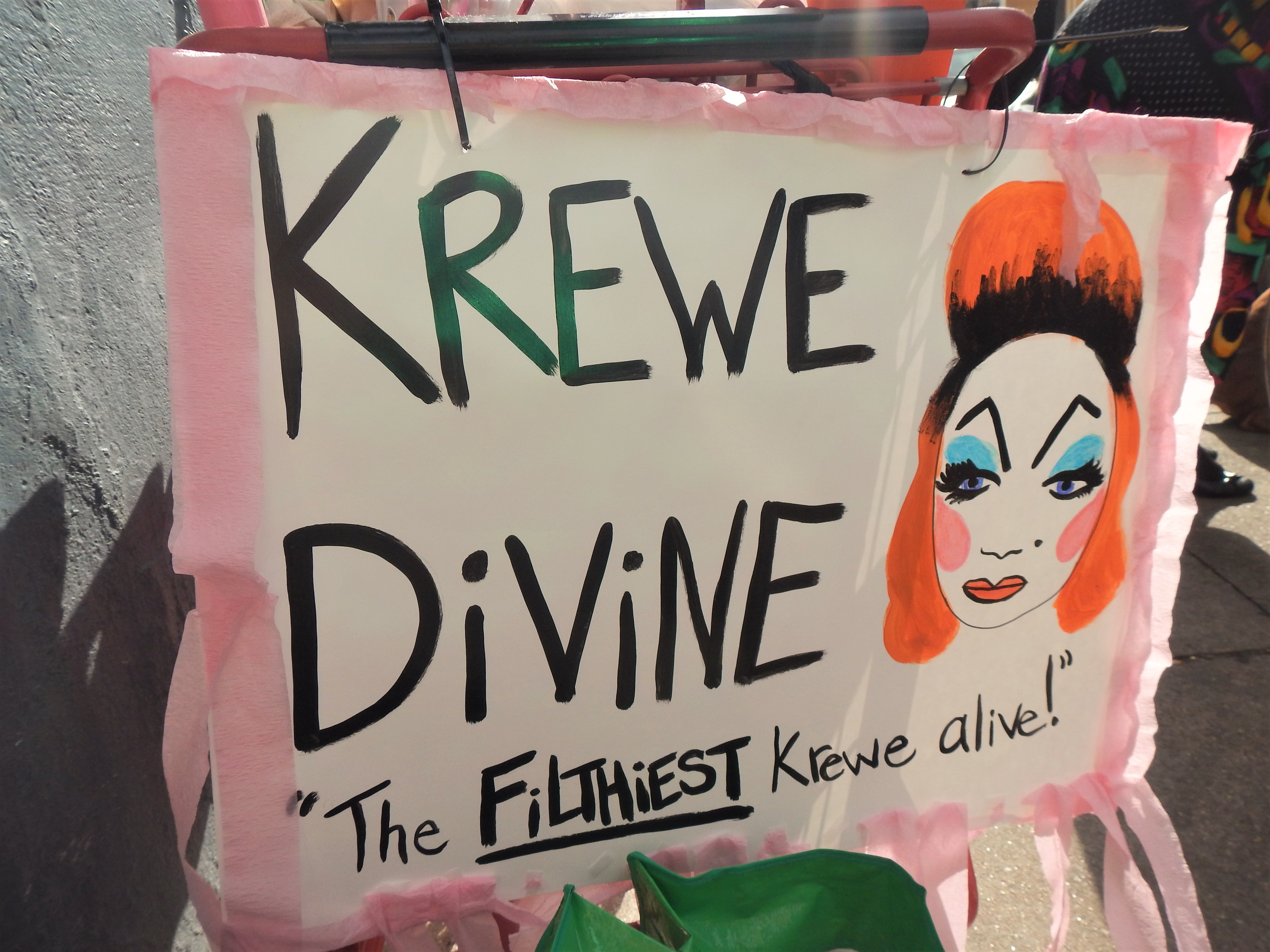
There comes a time in your adult life when maturity & experience leads you to making tough decisions and strengthened dedication to the things that matter most. That’s why a few of us here at Swampflix have decided that it’s time to get serious about Mardi Gras. Every Carnival season there’s always some kind of personal crisis about what to wear or what themes to play off of while costuming in the Quarter, but that’s something that never seems to be a problem for krewes that stick with a consistent theme in their annual masquerading. Those revelers always seem to have their shit together. Since Swampflix was launched two years ago, we’ve tried our best to find the ways cinema is represented in Mardi Gras festivities, whether by covering the Star Wars celebrations of Chewbacchus or by costuming as the titular plague from the Vincent Price classic The Masque of the Red Death. It never quite feels like enough, though. As it’s time to get serious about how we can contribute to cinema’s presence in Mardi Gras festivities, we’ve decided to find our own sense of dedication & consistency in forming a new costuming krewe that celebrates one of our all-time favorite onscreen performers: Divine.

Arguably the greatest drag queen of all time, Divine was the frequent collaborator & long-time muse if one of our favorite filmmakers, John Waters. Her influence on the pop culture landscape extends far beyond the Pope of Trash’s Dreamlanders era, however, emanating to as far-reaching places as the San Franciscan performers The Cockettes, the punkification of disco, RuPaul’s Drag Race, and Disney’s The Little Mermaid. We hope to honor the Queen of Filth in all her fabulously fucked up glory by forming a new Mardi Gras tradition in Krewe Divine, a costuming krewe meant to meet in the French Quarter on every Fat Tuesday from here to eternity. Our initial krewe is a small group all made of Swampflix contributors: site co-founders Brandon Ledet & Britnee Lombas, podcast co-host CC Chapman, and former podcast guest Virginia Ruth. There’s no telling how Krewe Divine will expand or evolve from here as we do our best to honor the Queen of Filth in the future, but for now, enjoy some pictures from our 2017 maiden voyage as Swampflix’s official Mardi Gras krewe:


-The Swampflix Crew

Multiple Maniacs (1970)

EPSON MFP image

fourhalfstar

campstamp

I’ve seen a few John Waters classics like Desperate Living & Pink Flamingos projected on the big screen before, usually with a midnight crowd, but I’ve only had two experiences watching his work for the very first time in a proper movie theater: 2004’s A Dirty Shame & the 2016 restoration of his 1970 forgotten gem Multiple Maniacs. Surely, there’s a bias factor that should be considered when reviewing a work from your favorite director/artist/human being after experiencing it for the first time large & loud with a receptive film fest crowd. My personal devotion to Waters aside, though, Multiple Maniacs is still an excellent slice of go-for-broke shlock cinema. A smaller, arguably nastier provocation than Pink Flamingos, it answers a question I’m not sure I ever would’ve dreamed to ask: what if John Waters made a horror film? It’s impossible to divorce the context from the content in this case, because Waters is such a highly specific stylist & works so closely with a steady cast of nontraditional “actors,” but even if the director had never made another feature in his life I believe the world would still be talking about Multiple Maniacs all these decades later. Horror films this weird & this grotesquely fun are rarely left behind or forgotten and, given the devotion of Waters’s more dedicated fans, I’m honestly surprised it took this long for this one to get its proper due.

I guess I should clarify up front exactly what I mean when I call Multiple Maniacs a horror film. Unlike the subversive horror comedy leanings of Serial Mom, this is horror in the way titles like Spider Baby & Mudhoney qualify. It’s a grimy uncovering of an outside-of-society crew of murderous weirdos, the kind of picture that eventually lead to more conventional slasher genre space carved out by The Texas Chainsaw Massacre, but didn’t quite have its own established tradition at the time of its release. Waters displays no shame in his getta-load-of-this-freakshow dynamic, opening his film with a literal freakshow: Lady Divine’s Cavalcade of Perversions. A carnival barker advertises “acts against God & Nature” to entice the audience & passersby inside the tent, all while feigning mock disgust. There’s gleeful puke-eaters, bicycle seat humpers, and actual real-life homosexuals (the horror!); but the real star of the show is Divine herself, Waters’s most infamous collaborator and, arguably, the greatest drag queen of all time. Divine’s freakshow act is simply her own fabulous being. She holds her audience at gunpoint, bullies all of her employees, and lounges nude in the mirror to give full reverence to her own beauty & divinity. Her turbulent romance with David Lochary’s carnival barker, with its cop-killing violent streak & dual indulgences in adultery, drives the isolated freakshow into the general public, where Multiple Maniacs turns into a legitimate monster movie. Not only does Divine herself transform into an inhuman monster with a formidable body count, the film also makes room for an appearance from a giant monster movie-style lobster just for the sake of it.

It’s tempting to believe that this early glimpse at John Waters’s regular crew of degenerate collaborators, The Dreamlanders, would mostly benefit the already-converted. Surely it’s exciting to see these weirdos in their artistic infancy. Edith Massey seems particularly fresh & unpolished in her natural habitat as a barkeep. It’s weird to know that David Lochary’s look as Raymond Marble in Pink Flamingos was something he exuded all the time. Mink Stole, Cookie Mueller, and Divine are all playing prototypes of the characters who would later be cartoonishly exaggerated in other Dreamlander collaborations, with Divine’s monstrous transformation in particular being explained in-film with the line “Every minute she’s alive she’s getting worse & worse!” Waters even draws conscious attention to this “cavalcade of perversions” by naming the characters after their real life counterparts: David, Mink, Cookie, Edith, etc. There’s no doubt that longtime fans of the director’s work would get a kick out of this overlooked gem’s babyfaced cast that newcomers might not tend to care about in any particular way. However, the film does have a recognizable appeal as a genre film artifact even outside of that context and it’s a dynamic largely due to its nature as deliberately campy horror.

Seeing Waters’s “cavalcade of perversions” at work so early in his career is valuable both to fans & newcomers alike because it calls attention to the fact that The Dreamlanders were straight up punks in the era of hippies & suburban sprawl. The surf rock soundtrack, beat-up Cadillacs, crossdressing, and leopard print get-ups of Multiple Maniacs construct a rock & roll nightmare incongruous with its then-current counterculture of hippie niceness. This is a playfully mean movie, one crawling with cartoonish rape humor, gleeful violence, and the single most blasphemous use of a prayer rosary imaginable. It’s no wonder that in Divine’s final moments of mania she’s treated like a Godzilla-esque monster complete with fleeing crowds & an armed military response. The world wasn’t quite ready for her particular brand of perversion and her very existence reads on the screen as a criminal act, one amplified by the film’s microfilm-reminiscent opening credits scroll. That shock value even holds power today, somehow, as I’ve never attended a John Waters screening that didn’t inspire at least one walk-out. Even in a film festival environment there were three hurried walk-outs during Multiple Maniacs. I don’t know if that speaks more to Waters’s reputation as The Hairspray Guy, the aggressive specificity of his sense of humor, or his unique ability to push buttons, but it’s honestly kind of incredible that any film from 1970, before the grindhouse heights of drive-in grotesquery, can disgust people into fleeing in horror in 2016, especially one this unabashedly silly.

Waters is obviously an inexperienced filmmaker in Multiple Maniacs. He catches his players wildly out of focus, he wears his influences proudly on his sleeve (including a poster for Russ Meyer’s Vixen!), he relies heavily on details like nudity & (absurdly unrealistic) rape scenarios for easy shock value, etc. However, the film holds up surprisingly well as a proto-punk provocation, maybe even one with wider commercial appeal than the more consistently celebrated Pink Flamingos, due to its genre thrills as an eccentric horror comedy of sorts. I’ll likely have very few more chances to catch one of his films for the very first time in a public audience environment & this one did not disappoint in the slightest. In an ideal world all of Waters’s back catalog would get this careful restoration treatment.

-Brandon Ledet

Cuddles Kovinsky as the Ultimate Edith Massey Performance

EPSON MFP image

The almighty Divine is John Waters’s most infamous collaborator (even if that means her name is unfortunately synonymous with eating dog shit in a broad cultural context). Mary Vivian Pierce is the only Dreamlander (as Waters’s recurring cast is often known) to appear in every one of the director’s features. Mink Stole is, perhaps, the coolest kid in the room, the one with the most adaptable talent & willingness to commit. There’s an argument to be made, however, that Baltimore personality Edith Massey was Waters’s most readily fascinating featured player, his most consistently striking & bizarre screen presence. There’s no one else in all of cinema quite like Massey. The only actor who even comes close is Waters’s idol Russ Meyer’s frequent collaborator Princess Livingston (not surprisingly, the two women were discovered while working as a bartender & a motel manager, not as actors), but even Livingston’s bizarre charisma couldn’t quite match the weird energy & depth of content Massey brought to the screen in her decade-long stint as a Dreamlander. Massey’s odd, snaggle-toothed visage helped define who John Waters is as a filmmaker with a striking, idiosyncratic specificity that makes him my favorite living artist, if not person.

A lot of the shock value humor of Waters’s early, transgressive films often outshines the more even-tempered work he delivered later on in his “mainstream” titles like Hairspray, Cry-Baby, and (the utterly perfect) Serial Mom. Waters is often misunderstood in the context of shock cinema due to his earliest provocations, most notably Pink Flamingos, and the weirder trash-art surreality of his work is sometimes overlooked because of his youthful pranksterism. Massey was with Waters from day one during these formative provocations, putting in the bulk of her work as an actor in the director’s so-called “Trash Trilogy.” Easily, Massey’s most iconic role is her turn as Divine’s mother, The Egg Lady, in the aforementioned Pink Flamingos. The Egg Lady was an underwear-clad humanoid who demanded a constant supply of eggs at all times of the day: a strange, unsettling image that afforded Massey a lifetime of celebrity & provided the name of her short-lived punk band Edie & the Eggs. Massey’s screentime & command of Waters’s strange brand of humor grew in her two subsequent roles as villains in Desperate Living & Female Trouble (two films that are far more attention-worthy than Pink Flamingos, as much as I adore that scrappy filth fest). Massey devours scenery in these two wicked roles, whether she’s coaching her beloved nephew on the lifestyle benefits of “turning queer” or sentencing an entire village to death before her royal firing squad. Much like Waters’s overall aesthetic, however, I’m not convinced that Massey’s work reached its pinnacle in the wild, punk days of the “Trash Trilogy”. Her work wouldn’t meet its peak absurdity until it was juxtaposed against the much more mundane avenues of suburban America (and because we’re talking Waters here, I guess that specifically means suburban Baltimore).

The film that bridged these two halves of John Waters’s career, the trashy & the suburban-surreal, was his 1981 feature Polyester. Presenting Douglas Sirk by way of Russ Meyer, Polyester is a wonderfully strange slice of American pie, one molded & poisoned by melodramatic fits of adultery, alcoholism, teenage delinquency, and sexual perversion. Both halves of Waters’s career have endless merit in my eternally gushing eyes & it’s wonderful to watch the way Polyester can teeter totter on both sides of that divide without ever losing track of what makes either half special. Additionally, this is where I find Edith Massey’s most outrageous, knee-slappingly funny performance to be. Massey’s performance as Cuddles Kovinsky is her finest work as a Dreamlander, a true tour de force of delightfully terrible acting that somehow steals a film from a top-of-her-game Divine, which is no small feat. Watching Massey do her weird, off-putting thing in films like Pink Flamingos & Desperate Living is one thing, but her transgressive screen presence made total sense in the context of those films’ early punk depravity. In Polyester, she’s presented as a normal human being, an upstanding member of regular society, and it’s an outrageously ill-fitting role for a foul-mouthed, snaggle-toothed bartender with her braying style of line delivery to fill. Waters & Massey both knew exactly what they were doing when they airdropped Cuddles Kovinsky into an unsuspecting suburbia and it ended up being both a pivotal turning point in Waters’s trajectory as a filmmaker as well as the pinnacle of Massey’s work as a Dreamlander. Unfortunately, it would also prove to be their final collaboration due to Massey’s escalating health problems and inevitable death.

Cuddles Kovinsky is a wealthy heiress & former housekeeper of Divine’s much put-upon housewife archetype Francine Fishpaw. As Francine’s life spins out of control due to her teenage children’s hedonism & her husband’s flagrant adultery, Cuddles’s own path hits a rags to riches upswing. Cuddles lives the lavish fantasy of the nouveau riche, traveling around Baltimore in a limousine with a boy toy European driver behind the wheel, shopping for fashion’s high end designer finery (none of which looks at all natural or comfortable on her weird, little egg-shaped body), rubbing elbows with Baltimore’s country club elite, and just straight up murdering the French language with a never-ending recital of high society clichés & platitudes. Cuddles is the ever-optimistic ying to Francine’s depressive, alcoholic yang and Massey plays her with the exact right tone of complete obliviousness. When Francine passes out on the floor blind drunk her best friend Cuddles mews, “You’re so cute when you’re tipsy!” When Francine attempts to hang herself to end the pain, Cuddles exclaims, “We’re going on a picnic!” Polyester is mostly centered on Francine’s struggle to find happiness in a world where its existence seems unlikely at best, but Cuddles is perfectly happy throughout, concerned only with what she’s going to wear to her debutante ball at the country club. Divine & Massey’s performances compliment each other nicely, but it’s near impossible to take your eyes off Cuddles anytime she graces the screen. Even her over-the-top pantomime reactions to every syllable of someone else’s lines are attention-grabbing in a completely absurd, living cartoon kind of way. Of all of Massey’s wonderfully weird onscreen creations, Cuddles stands out as her most arrestingly unique & distinctly out of place.

I don’t mean to downplay the early works of either Waters or Massey here. The “Trash Trilogy” is pure cinematic chaos, a hedonistic whirlwind of freaks & weirdos I don’t know where I’d be without. I love each of those films & Massey’s performances in them dearly. With Polyester, however, the degenerate duo (with the help of Divine & other Dreamlanders, of course) struck upon something much more subversive. Watching Massey don leather dominatrix gear or wax poetic about the virtues of cocksuckers fit in very closely with what you’d expect from her image & her gaudy barroom personality. There’s something much stranger & more unexpected going on with Cuddles Kovinsky, a character that allows Massey to wear French schoolgirl & horse riding outfits and bray lines like, “There must be a God. Everything is so beautiful!” It’s all too easy to picture Massey fronting a punk band or tending bar, but gleefully praising God & enjoying a picnic in the woods? That’s some weirdly subversive shit. Waters capitalized on that taking-the-circus-to-suburbia aesthetic more or less for the remainder of his career, but unfortunately Massey wasn’t able to come along for the ride. Polyester ended up being Waters’s final collaboration with the actor and after a role in the forgotten schlock title Mutants in Paradise, she died. At least we can say her career as a Dreamlander ended on top, though, as Cuddles Kovinsky brought some of her weirdest, most unexpected energy to the silver screen, helping reshape the trajectory The Pope of Trash’s career would take in the decades to follow. At least we’ll always have Cuddles

-Brandon Ledet

Polyester (1981)

EPSON MFP image

fourhalfstar

campstamp

Polyester was not John Waters’ first feature, but it was the first to garner any significant amount of mainstream interest. Following his first forays into feature films with Mondo Trasho and Multiple Maniacs, Waters worked on what he dubbed the Trash Trilogy, consisting of Pink Flamingos, Female Trouble, and Desperate Living. To say that these films pushed the envelope and seemed design to induce faintness and nausea is an understatement; to say that they were in poor taste, or were made as an exploration of “good bad taste,” does the films’ shameless vulgarity a disservice. The films were confrontational, characterized by notoriety, and generally just gross for the sake of it.

Polyester was an altogether different animal. It still featured many of the actors who made up Waters’ “Dreamland” repertory troupe, but it features a much more linear narrative than his previous works. Taking its inspiration from films of the exploitation genre known as “women’s pictures,” especially those of Douglas Sirk, the film concerns the dissolution of the family unit of overweight matriarch Francine Fishpaw (Divine). Francine discovers that her husband Elmer (David Samson), the proprietor of an adult movie theater, is having an affair with his secretary Sandra (Mink Stole); her mother (Joni Ruth White) is an abusive cokehead obsessed with wealth and class; her daughter Lu-Lu (Mary Garlington) is sneaking out to have sex with her delinquent greaser boyfriend Bo-Bo (Stiv Bators); and her son Dexter (Ken King) is a glue-sniffing weirdo who has been skipping school in order to stomp the feet of unsuspecting women, dubbed the Baltimore Foot Stomper by the press. Her only friend is Cuddles (Edith Massey), the Fishpaw’s (possibly mentally handicapped) former housekeeper who is now quite wealthy after inheriting a tidy sum from another family for whom she once worked as a domestic servant. After her children face their own demons and become (relatively) well adjusted citizens, Francine struggles to overcome the alcoholic despair into which she has fallen, finding a new potential love in Todd Tomorrow (Tab Hunter).

The Baltimore of Polyester is a wondrously delirious place, full of odd characters and strange circumstances. From the nuns at the unwed mothers’ home that Lu-Lu is sent to, who force the pregnant women in their care to participate in a hayride in the middle of a thunderstorm, to the older choir woman who commandeers a bus in order to chase down the delinquents who swatted her as they drove by (ending with her stopping their escape by biting a hole in their vehicle’s tire), every person is an exaggerated caricature of reality. Hyperbole is Waters’ currency, and Polyester is one of the most accessible of his films for a mainstream audience. This is perhaps best demonstrated by the immersive experience he crafted for the movie: the original theatrical release of the film featured interactivity in the form of an “Odorama” card, with numbers appearing on screen to indicate when audience members should scratch the cards and smell the same thing that Francine does. I was lucky enough to attend a screening of the film at the Alamo Drafthouse, complete with a recreation of these cards; more often than not, the scents on the card simply smell like chemicals, but that doesn’t detract from the glory of the attempt. This is a delightfully hilarious movie, and I hesitate to say more in order to ensure that you get the maximum number of laughs from it. Suffice it to say: as long as you don’t take yourself too seriously, you will love this movie.

-Mark “Boomer” Redmond

The Little Mermaid (1989)

EPSON MFP image

fourstar

(Viewed 8/21/2015)

The Little Mermaid is a movie that I’ve carried with me for my whole life. I can’t remember the first time that I watched it . . . it must have been as a two-year-old on the VCR in living room, embraced by the blue-gray arms of the La-Z-Boy. So perhaps writing a review of this movie is unfair in a way. I’m certainly filtering it through the lens of nostalgia.

By way of review, there’s not much to say that hasn’t been said. The Little Mermaid is gorgeously animated, the songs are catchy, and the plot and pacing are sprightly. This movie is good enough to have resurrected Disney’s animation empire after decades of decline. It won two Oscars.

Watching the movie as a kid, The Little Mermaid was a beautiful fantasy. My guess is that you couldn’t get a little girl near a body of water without a reenactment breaking out. I seriously considered becoming a mermaid when I grew up.

It turns out that there are in fact a handful of professional mermaid gigs in the United States.

For adult audiences, The Little Mermaid presents some food for thought and entertainment. Ursula’s vampy, campy brand of evil, performed with oodles of moxie by Pat Carroll, draws from Divine’s drag performances. Ursula oozes through her lair, winking at the audience over her Faustian deals and feminine wiles. King Triton is actually doing his best to protect and discipline his teenage daughter, and is in fact an old softy under all of the yelling. Ariel is scrappy and adventurous, but learns no lesson from her risky choices and gets a fairytale ending handed to her by her pops. Prince Philip, in an interesting inversion of cinematic gender roles, is almost an empty character and more of a plot device to allow for Ariel’s growth as a character.

The Little Mermaid as a whole is entertaining. The music is catchy and fun, the animation is luscious. I can recommend this movie in good faith to anyone looking for a break from Frozen . . . but you might check in with your kids about things like consequences of your actions and expectations about romantic relationships.

-Erin Kinchen