The latest of many actor/director co-credits from Mélanie Laurent, The Mad Women’s Ball, is a solemn period drama set in a prison-like mental institution in 19th Century France. It’s a formulaic film in a lot of respects, touching on every dramatic cliché you’d expect in its women’s sanitorium setting. There’s nothing new here you won’t see in goofier, better-publicized works like Girl Interrupted, Cosi, Unsane, or your local drag scene’s cabaret parody of One Flew Over the Cuckoo’s Nest. And yet, those clichés are all performed so earnestly in The Mad Women’s Ball that their familiarity hardly matters. At the risk of repeating a cliché observation myself, Mélanie Laurent’s extensive background as an actor shows in her filmmaking’s focus on performance & characterization, two details that add enough specificity & emotional impact to the central drama that it avoids backsliding into tedium.
It helps that the ghost story half of The Mad Women’s Ball actually does manage to feel novel, in that it takes the existence & presence of “spirits” seriously without forcing an illustration of them onscreen or tipping the tone into horror. Our POV character (Lou de Laâge) is the kind of stubborn, free-thinking intellectual who would routinely get institutionalized for “hysteria” by their embarrassed, cold-hearted families in this era. Except, she also suffers the burden of constant communication with spirits of the dead which, as you can imagine, are in no short supply in her new asylum/prison/home. She slowly earns her way out of confinement by proving her supernatural connection with these spirits to her nurses & guards (including Laurent as her sole kind-hearted advocate), helping them reconnect with ghosts of their past in exchange for the promise of freedom. Meanwhile, she finds uneasy, unlikely sisterhood with her fellow “patients,” who range from genuinely ill to politically troublesome, like herself.
As the title implies, The Mad Women’s Ball culminates in a grand masquerade where the local wealth class is invited on asylum grounds to gawk at (and sexually violate) its patients as they dressed in costume – apparently a very real, very fucked up tradition in some mental institutions at the time. Until that physical convergence of life inside & outside the asylum, Laurent contrasts their parallel timelines with an aggressive crosscutting effect, her one major stylistic imposition on the plot. Otherwise, the film’s aesthetic recalls the melancholic Bates-in-prison episodes of Downton Abbey, with the chaotic echoes of unwell women resisting “therapy” (i.e., torture) echoing throughout its dank, joyless hallways. This is a long, somber, delicate film with only occasional flashes of musical accompaniment. The contrasting crosscuts between life inside & outside the asylum are absolutely essential to giving it a sense of vibrancy, and it makes total sense that its narrative would have to resolve with those two worlds crashing into each other.
Outside those crosscuts, I’m not sure Laurent does much to call attention to her craft as a filmmaker here. She mostly just provides a stage for her characters & performers to shine, treating their individual quirks & personae with full respect – whether they’re a bipolar pickpocket with a wicked mean streak or a spiritual medium whose genuine talent for communication with the dead is misunderstood for madness. Laurent chose to direct a film set in a time that was brutally unkind to women, seemingly so she could extend kindness & empathy to them in retrospect. It’s surprisingly heartwarming, despite the institutional cruelty & cultural familiarity of its setting.
In the abstract, giving The Exorcist a found-footage update for the 2020s sounds tedious, but The Medium manages to feel freshly upsetting & emotionally engaged while never drifting outside those genre boundaries. It helps that the film was produced by Na Hong-jin, director of 2016’s The Wailing – the last great Exorcist-scale possession horror to rejuvenate the genre. In the early stages of development, Na proposed that Thai filmmaker Banjong Pisanthanakun collaborate with him on a direct sequel to The Wailing (presumably on the strength of Banjong’s breakthrough hit Shutter), but the concept gradually spiraled out into its own unique horror epic separate from that source of inspiration. Considering the limitations of its initial concept, the general over-saturation of body-possession & found-footage horror media, and its 30-day shooting schedule, The Medium is impressively massive in its scope & imagination. This is big-scale blockbuster horror achieved on a scrappy indie budget, and it still manages to be scary as hell.
The Exorcist looms too large in horror iconography for any possession story to avoid the comparison, but The Medium does more to stray from Friedkin’s genre blueprint than simply exporting it to international religious contexts outside the original’s Catholicism. Stretching its legs with a 131min runtime helps create enough space for the film to distinguish itself from that ancestry, as does its modern-documentary framing device (which obviously triggers its own preloaded horror canon comparisons). We get to know the mockumentary’s subjects for a long while before the supernatural terror escalates to a fever pitch, which helps lay a solid emotional foundation most modern horrors don’t bother building. It’s the story of a small family in the rural region of Isan, Thailand, whose women pass down the spirit (and professional occupation) of a shaman through generational inheritance. While the current shaman’s niece seems to be inheriting that spirit as the next natural successor, it turns out the spirit taking root in her body is something much more sinister. Deadly hijinks ensue, despite the shaman-aunt’s best efforts to exorcise the unwanted presence from her innocent niece’s body.
For all its ambitious scale & intimate familial drama, The Medium is most impressive for its efficiency in delivering every possible genre payoff it can squeeze into its spacious runtime. It attempts eerie atmospheric dread and cheap-thrills jump scares. It genuinely engages with the emotional drama at the core of its spiritual inheritance story and indulges in squirmy cultural taboos that would turn off most horror naysayers. It’s also not afraid to invite comparisons to iconic touchstones of the found-footage canon – including the shaky-cam nature runs of The Blair Witch Project, the night-vision security footage of Paranormal Activity, and the vertical smartphone aspect ratios of the genre’s current “screenlife” era. Still, it throws so much supernatural mayhem at the screen in its go-for-broke third act that it manages to do things I’ve never seen in any found footage movie before, especially in the way its possessed victims directly, violently interact with the camera crew & their equipment. The actual possession half of its hybrid-genre is less surprising in its execution, but it’s remarkably upsetting & brutal all the same.
I’m glad we were gifted The Medium instead of The Wailing Part II: Possession Boogaloo, as initially planned. Then again, I would’ve also been skeptical of the final product’s “found-footage Exorcist” premise had I not seen the results. This is one of those shining examples of how little a movie’s chosen genre template actually affects its overall quality. It’s all in the execution, and this particular Exorcist deviation is executed with both fury & elegance.
It takes all the strength in my body & soul not to turn this blog into a total schlockfest. My natural inclination when selecting what to watch is to reach for the shortest, trashiest genre pic available, which constantly threatens to backslide Swampflix into a bargain-bin horror blog. I do like to challenge myself, though, especially coming out of October’s horror-binge rituals where I indulge in my preferred cinematic junk food for a month solid. And so, I find myself contemplating and writing about Uncle Boonmee Who Can Recall His Past Lives, winner of the 2010 Palme D’or. Like previous detours into the works of Jarman, Tarkovsky, and Ozu, Apichatpong Weerasethakul is a beloved arthouse auteur who I’m underqualified to assess, comprehend, or even appreciate. Still, I crave the brain-cell alarm bells these alienating filmmakers set off in my brain; I can’t get by on a diet of Roger Corman cheapies & Chucky sequels alone.
Uncle Boonmee is the kind of calm, quiet, meditative cinema that always challenges my attention span and intellect. Like Albert Serra’s The Death of Louis XIV, it’s a slow-cinema mood piece about a man dying in real time – in this case a Thai farmer succumbing to the gradual decline of kidney failure. Static shots of the wealthy man’s inner circle & dialysis technicians sharing meaningful silences are scored only by whispers of waterfalls, car engines, and chirping bugs. Harsh digital cinematography frames these exchanges with all the pomp & circumstance of a straight-to-YouTube documentary. I am told that this is a deeply emotional film about life & the great mystery that follows it, but I don’t see the modern arthouse Ikiru in it that others are latching onto. I mostly just felt as if Apichatpong were daring me to fall asleep with each lingering shot of meditative non-action & white noise.
To be fair to my emotionally distanced (and self-declared Communist killer) Uncle Boonmee, this movie at least met me halfway with some absurdly polite ghosts & magical creatures, who gather around the titular farmer as he approaches the gates of the spirit realm. Death is not the end of the human spirit in this reality; Boonmee’s deceased family hold his hand through the transition into his next state of being, calmly sitting beside him along with his surviving acquaintances. His dead wife appears as a classic, transparent ghost, materializing at the dinner table as if she had casually walked through the front door. His dead son appears as a primate-hybrid “monkey-ghost” with glowing C.H.U.D. eyes. I appreciated their magical-realist intrusions into the “plot”, since ghost stories typically are the kind of cinema I can comprehend. They just did very little to disrupt the quiet calm of Boonmee’s slow demise.
I don’t know that I’ll ever revisit this film unless I can see it in a proper theater; I genuinely struggled to feel immersed & overwhelmed by it at home. It was mostly worth the struggle, though, and it did often remind me of films I love that were likely influenced by Apichatpong’s meditative filmmaking style – namely the psychedelic ayahuasca dramaIcaros: A Vision & Laurie Anderson’s memorial-doc Heart of a Dog. There are individual images & ideas from Uncle Boonmee that will likely stick with me for a long time, especially its non-sequitur vignette in which a travelling princess makes love with a talking catfish. If nothing else, that detour will stick with me as an all-timer of a sex scene. My go-to horror schlock rarely reaches such glorious highs, even if they’re easier to digest en masse.
Our current Movie of the Month, 1973’s Lisa and the Devil, is a supernatural murder mystery set in a haunted mansion full of creepy mannequins. As usual with Mario Bava, it’s consistently beautiful & eerie while wildly inconsistent in its central mystery’s internal logic. Parsing out what’s really going on in Bava’s films is always miles beside the point; they thrive on vibes and vibes alone. So, what really sets this loopy-logic Bava mystery apart from the rest of his catalog is its haunted castle setting, which vividly contrasts the moods & tones of his filmmaking style against other Gothic horrors of his era from The Corman-Poe Cycle and Hammer Studios. It’s in that contrast where Lisa and the Devil‘s twisty dream logic and harshly artificial color gels really shine as something special.
I knew I was going to use November’s Movie of the Month selection as an excuse to clear out a few of my Mario Bava blindspots. What I didn’t know is that so many of those major blindspots would also be set in haunted castles (as opposed to the bloody couturiers of Blood & Black Lace or the eerie alien landscapes of Planet of the Vampires). As I dug further into Bava’s catalog this month, I really started appreciating how his haunted castle movies boast all of the spooky atmosphere of Hammer Horror at its best, boosted with a lurid Technicolor sleaze that satisfies in a way Hammer rarely does – if ever. Nearly every one is a Masque of the Red Death-level knockout, which is rare for the genre. To that end, here are a few recommended titles if you enjoyed our Movie of the Month and want to see more Mario Bava classics set in haunted castles.
Black Sunday (1960)
I guess I shouldn’t be surprised that Mario Bava spent so much of his career playing with camera equipment in spooky castles, since that setting is exactly where he made a name for himself at the start of his career. Bava’s debut feature credit as a director, Black Sunday (a.k.a. The Mask of Satan) crams in as many haunted-castle spooks & ghouls as it can possibly fit in an 87min runtime: vampires, witches, Satanic rituals, an overachieving fog machine, etc. Even in black & white—devoid of Bava’s trademark color gels—it clearly stands out as the very best of the director’s haunted castle horrors. If anything, the harsh black & white lighting offers a vintage Romero sheen that feels like a novelty in Bava’s larger Technicolor catalog.
If actors dress up in ritualistic costumes and repeat the word “Satan” enough, I’m automatically going to be charmed. It still helps when it’s someone as electrically intense as Barbara Steele. In her breakout, career-defining performance(s), she stars as both a vampiric witch who’s punished for her allegiance to Satan and as the innocent descendent she plans to drain of her blood & youth. Steele’s haunting screen presence (conveyed most fiercely through her intense eye contact) is what makes the movie enduringly iconic, but Bava’s background as a cinematographer heightens every frame with a stark beauty & terror. It’s not Bava at his most idiosyncratic (given that it’s drained of his usual indulgences in color & disregard for plot), but it might be Bava at his best.
The Whip and the Body (1963)
Barbara Steele is not the only horror legend who cut their fangs working with Bava. Christopher “Dracula” Lee collaborated with the Italo-auteur on both the dark fantasy epic Hercules in the Haunted World and in the haunted-castle chiller The Whip and the Body. It’s The Whip and the Body that really leans into the strengths of Lee’s sultry screen presence, casting him as a BDSM ghost who haunts a modest seaside castle (and the masochistic woman he used to adulterize with when he was alive). It’s never much of an exaggeration to say that Christopher Lee was pure sex in his handsome youth, but in The Whip and the Body that statement isn’t even a figure of speech. He haunts the castle as the personification of sadistic sex just as much as he’s the ghost of a cruel pest who even his mistress despised.
The ghostly psychosexual terror of Lee’s kink-ghost is the perfect mechanism for Bava’s usual indulgences in atmosphere & aesthetics. It’s customary for haunted castle movies to feature menacing gusts of howling wind, but here Bava gets to mix in sounds of Lee’s leather whip to pervert that trope into something freshly upsetting. The film haunts a lovely middle ground between the classic gothic horror of Black Sunday and the Technicolor fairy tale horrors of Lisa and the Devil (complete with a dagger in a bell jar as its fairy tale version of Chekov’s gun).
Baron Blood (1972)
Like The Whip and the Body, Baron Blood is about a craven misogynist who haunts his family castle as a menacingly horny ghost. Like Black Sunday, it even dabbles in an undercurrent of witchcraft for counterbalance; the sexist ghost is resurrected from the dead as revenge from a witch who wants to see him tortured for eternity instead being allowed to rest. Unfortunately, this late-in-the-game middle ground between those two classics doesn’t stack up to Bava’s usual standard. It’s conveyed in muddy 1970s browns, and the stoney-baloney pacing of that era is in no rush to get anywhere.
So yeah, Baron Blood is by far the weakest entry of this haunted-castle Bava set. It has its own laidback 70s charms, though, including occultist rituals, rusty torture devices, and a fiendish ghoul with sopping hamburger meat for a face. All it really needed to be a Lisa and the Devil-level stunner was a peppier sense of urgency and a few color gels. Save it for a lazy weekend afternoon, so it’s not such a big deal if you take a nap in the middle of it.
Every month one of us makes the rest of the crew watch a movie they’ve never seen before and we discuss it afterwards. This month Hanna made Brandon, Boomer, and Britneewatch Lisa and the Devil (1973).
Hanna: I didn’t know anything about Mario Bava the first time I saw Lisa and the Devil (1974). It was two or three Halloweens ago, when streaming services pepper their suggestions with every horror movie in their arsenals, especially Argento & Bava films from the 70s with irresistible, colorful covers. The film has persistently clung to my mind since then because of its totally bizarre ending and its resplendent, House of Usher-esque mansion. I don’t know if it held up for me on a second viewing, and it has a gross depiction of sexual assault at ~1:14:00 that I had completely forgotten about, but I still overall enjoyed Bava’s spooky dreamscape.
At the outset of Lisa and the Devil, Lisa—a German tourist played by Elke Sommer—is climbing off a tour bus in Toledo, Spain. The very first stop of the tour brings her group to a mural of the Devil carrying the dead away, with a face that “expresses a quality which reflects the very soul of pleasure and evil.” Lisa seems struck by this mural, and inexplicably leaves her friend behind with the tour group to go wandering through the small Spanish village alone. She’s drawn into an antique shop and finds herself mesmerized by a sort of box-less music box/turntable with six rotating figures (if somebody could tell me what this thing is called, I would be much obliged – it’s extremely cool). She interrupts the shopkeeper’s conversation with the lone customer in the shop, who’s fussing over the particularities of a large wooden doll, to purchase the object. The customer turns to look at Lisa, who realizes that he bears a striking resemblance to the “very soul of pleasure and evil” plastered on the mural. From that point on, Lisa is lost; she dashes from the shop and wanders hopelessly through the deserted streets of Toledo, finding it impossible to return to the town square and repeatedly running into the menacing man from the mural (played by Telly Savalas) and the human manifestation of his life-size wooden doll. Eventually night falls, and she’s picked up by a tense couple and their driver in a lovely green car. Lisa is hopeful that this is the end of her nightmare, until the car breaks down in front of a sprawling Spanish villa of an elderly blind countess (Alida Valli) and her odd son Maximillian (Alessio Orano). The villa is staffed, of course, by Leandro, who continues to drag around his giant wooden doll for a mysterious purpose.
The rest of the film slowly unfolds into a visually striking festival of murder. The long shots of Lisa wandering throughout the remote village and the rich, green grounds of the villa are fantastic, and the interior of the villa oozes with a thick, decrepit opulence (I love the rotting cake room). I mostly found the performances a little lackluster, especially Sommer (who, despite being the leading lady, has about 10 lines of dialogue), but Telly Savalas is a pleasure to watch as a puckish devil butler who’s perpetually sucking on lollipops.
Britnee, I think I’m a Bava newbie compared to the rest of the Swampflix crew. I’ve heard some people say that this one is especially strange and dream-like, but it was the first Bava film I ever saw, so I didn’t have much of a reference for his body of work. How do you think Lisa and the Devil stacks up against his other films?
Britnee: I’ve actually only seen a couple of Bava films, but there was something different about this one. The other films I’m thinking of—Blood and Black Lace (my first Movie of the Month choice!) and Kill, Baby…Kill! in particular—weren’t as dreamlike for sure, but even more so, none had a character as comical as Leandro. Bava’s characters tend to be dark, mysterious, and serious – just not the type of characters that you really connect with. In no way is that a bad thing, because I’ve never watched a Bava movie for the cast. Bava movies are beautiful, bloody treasures about creepy sickos, and I expect nothing more. Leandro caught me off guard because I expected him to be terrifying since he’s basically the Devil. I thought he was going to terrorize Lisa from the moment she ran into him in the antique shop, but he felt like more of a guide instead – guiding Lisa and the audience to and around the castle while making clever comments and sucking on lollipops. He felt more like a witty uncle than Satan.
My absolute favorite thing about Lisa and the Devil are all of the creepy mannequins. The first one we see that continuously reappears is a mannequin of Carlos, the dead lover of the dead woman who Lisa resembles. But we eventually get introduced into a room filled with them! It seems that everyone who’s murdered by this bizarre castle family is transformed into a mannequin. This becomes apparent when Leandro takes Lisa’s measurements after she faints. I was hoping for some satanic ritual where Leandro turns the dead bodies into mannequins before our eyes, but it never goes down that road.
The ending of this film is so unexpected. Just when we think that Lisa is free and leaving Spain, she’s trapped on a plane with corpses and Leandro. This is where she turns into a mannequin and essentially dies. Brandon, what are your thoughts on the ending? Should Lisa have lived or died on the castle grounds instead?
Brandon: I don’t have any strong opinions about whether Lisa should have survived this film un-mannequined, but I do appreciate that she got to escape from the castle grounds after sunrise. At first, the shifting geography of the city and Lisa’s role as a silent observer had me thinking of this movie as a dream-logic story, but her return to the modern world outside the castle helped me re-contextualize everything as fairy tale logic, which is its own distinct thing. The way the castle feels untethered to the modernity, the way its decadent food is used as bait to lure in outsiders, and the way Bava constantly frames its inhabitants through mirror reflections all feel traditional to fairy-tale storytelling – something that didn’t dawn on me until the castle receded back into its own temporal limbo at, well, dawn. I loved seeing Lisa emerge from that fairy tale realm to return to her modern-tourist reality, and by then I was pretty much down for however Bava wanted to wrap it up. Maybe she couldn’t fully escape the castle because she ate the food and drank the wine: a classic fairy tale blunder.
As always with Bava, Lisa and the Devil is consistently beautiful, and parsing out the whats & whys of ~what’s really going on~ in its plot is miles beside the point. What I love most about this film is how much it resembles a standard haunted castle horror movie (maybe with more shapeshifting mannequins than usual) but the longer you grapple with its internal sense of logic the less familiar it feels. The car troubles that lead a foursome of naïve passersby to the film’s haunted castle are clichéd almost to the point of conscious parody, and yet the Technicolor surrealism they encounter inside is something you’ll be hard-pressed to find in any of the Hammer Horror or Corman-Poe movies it recalls. Boomer, what do you think Bava brings to the creepy-castle horror movie as a genre? Is his filmmaking or storytelling style particularly suited for this generically spooky setting in any way?
Boomer: One thing that I thought was notable here is that, when we think about Mario Bava, we mostly think about his earlier directorial work, starting with 1957’s I, Vampiri, then peaking in the early-to-mid 1960s. That’s the era with perennial classics like Black Sunday (1960) and Black Sabbath (1963) as well as movies that we’ve mentioned above: Blood and Black Lace (1964) and Kill, Baby, Kill (1966). After that, we get things like Hatchet for a Honeymoon (1970), which I did not care for, and 1972’s Baron Blood, which I got on VHS many years ago and managed to sit through precisely once. When we talk about Bava, we always talk about him as a horror or giallo director, and although that makes up the bulk of his filmography, we rarely talk about his sword-and-sandals swashbucklers (Hercules in the Haunted World, Erik the Conqueror), his non-giallo crime thrillers (like Danger: Diabolik), or his westerns (The Road to Fort Alamo, Roy Colt & Winchester Jack), and even his non-horror sci-fi The Day the Sky Exploded usually gets lumped in with his horror sci-fi like Planet of the Vampires and Caltiki – The Immortal Monster. But what’s really missing from this list are references to his comedy pictures, like spy spoof Dr. Goldfoot and the Girl Bombs and sex romp Four Times That Night.
Strangely, I think it’s the last of these that has the most influence on Lisa and the Devil, as it allows for a little levity in the proceedings. I don’t think any actor I’ve seen in a Bava film has been as magnetic and fun as Telly Savalas is here, hamming it up and clearly having a good time. The scene in which he bums a smoke from one of the visitors and then loudly chastises the man for smoking indoors when the blind countess enters the room is an inspired gag, as are his seemingly improvised moments, like when he dances with one of the mannequins. Italian horror movies are littered with scenes in which a person gives exposition to a bound or unconscious figure (Profundo rosso comes to mind), but Savalas manages to turn even this into a lively and comparably electric scene. I’ve often said that comedy and mystery “live” in the same mental space; what is a punchline if not a resolution that makes you laugh? What is the answer to a riddle if not the solution to a mystery? That Savalas is an American amidst these Europeans (most of whom probably learned their lines phonetically or were dubbed, both of which were in fashion at the time) also contributes to a separation between himself and makes him appear much more lifelike and composed. All too frequently, casting is treated as something that’s purely matter-of-fact in films; Dune is about the dangers of trusting a white savior and deconstructing that narrative of white messiahs, but that also means it’s about a white twink savior, so of course the current film adaptation has the whitest and twinkiest of currently working actors. Here, the casting of Savalas contributes to the tone, which I found fascinating.
To circle back on Bava’s storytelling style, the gothic is definitely where his powers reign supreme, and I don’t think that anyone else could have helmed this movie and captured that energy and atmosphere as well as he does here. Comparing this film to the body of work of his two major contemporaries, Dario Argento and Lucio Fulci, both of them made their own dreamlike haunted house stories within a few years, with Suspiriafor the former and The Psychic for the latter, although the reasons for the house/school being/seeming haunted in each of those films is decidedly different, both from one another and from Lisa and the Devil. Lisa is also a much more successful counterposing of the modern and the gothic than the aforementioned Baron Blood. In that film, a modern (for 1972) American co-ed visits his ancestral home in Austria and resurrects a murderous aristocratic forefather, while Lisa is a modern (for 1974) tourist thrust into a decaying relic of a home inhabited by murderous aristocrats. That they both exist, were released a mere 2.5 years apart, and that Bava wrote both in addition to directing them, says something about his interest in contrasting those two things later in his life, and I do wish we could have seen more of that before he passed away in 1980. Interestingly, although Suspiria is largely considered Argento’s masterpiece and The Psychic was a film I heard discussed in certain circles with frequency, Lisa and the Devil is one I had never heard of before this viewing.
Shudder’s interface describes this as “Bava’s strangest film” (emphasis added), presumably because it boasts a more dreamlike atmosphere than his other horror fare, but I can’t say that I necessarily agree. Although the ending leaves much to the imagination and interpretation, this is a film that makes explicit early on that the narrative takes place in a timeless non-time on a carousel that loops. We first see the animated music box thing in the shop as soon as Lisa wanders away from her tour group, and it immediately captivates her, with the six figures depicted representing the characters that we will meet as well as the fact that, although they may be in motion and constantly moving away from one another, they are nonetheless in a closed loop that ends where it begins. We are also let in on the fact that the ghosts or spirits that reside in the villa are not necessarily bound there, as Lisa meets Carlos for the first time far from the Countess’s home; it’s here that he drops his watch, breaking it in such a way that the clock’s hands do not lie over its face, cluing us in that not only is this a loop, but one in which time has no meaning. Full size mannequins weren’t really a thing until the mid-1750s, when they were made of wicker. Wicker mannequins gave way to those made of wirework, which were supplanted with papier-mâché mannequins, which were themselves replaced with wax figures, which eventually gave way to the plastic mannequins—with which we are mostly familiar—in the 1920s. The figures here appear waxen to me, which immediately pegs them as being outmoded and out of time by half a century in the film’s contemporary 1970s setting.
Lagniappe
Hanna: Besides the gorgeous, lustrous cinematography, I will forever treasure Lisa and the Devil as the only film I know of with a haunted European villa and a haunted plane. I would 1000% watch Lisa descend further into madness in a surreal plane-centric sequel.
Britnee: I thought Leandro was strangely similar to the bald, lollipop sucking detective from the popular 70s detective show Kojak. Well, it turns out that they’re the same person. Telly Savalas is both Leandro and Kojak! Kojak premiered shortly after Lisa and the Devil, so this lollipop habit crossed over between the two as they were most likely being filmed at the same time.
Boomer: Telly Savalas is best remembered as TV’s Kojak or as one of many Blofelds (he’s the one in On Her Majesty’s Secret Service, for the record), but for me, he will forever be remembered as the stepfather from the Twilight Zone classic “Living Doll.” He’s also in The Alfred Hitchcock Hour‘s “A Matter of Murder” with Darren McGavin, meaning it’s the only time outside of their respective series that Kojak and Kolchak worked together, so stick that in your back pocket to whip out as trivia for your relatives at Thanksgiving this year.
If this film’s ending was a chiller to you, I also recommend the short story “Showdown,” by Shirley Jackson. Although spooky season as defined by the Gregorian calendar may be officially over, if you believe, you can carry it with you in your heart all year, and this short story, which was previously mentioned in our Lagniappe episode about 2020’s Shirley, remains one of the most chilling ghost stories to ever stir my soul.
Brandon: We cannot let this conversation go by without acknowledging the bizarre existence of 1975’s The House of Exorcism. Since contemporary distributors weren’t sure how to market Bava’s loopy nightmare in America as-is, they re-edited Lisa and the Devil into a cash-in knockoff of Friedkin’s wildly popular The Exorcist, titled The House of Exorcism. In that cut, the haunted castle sequences of Lisa and the Devil are recontextualized as hallucinations Lisa suffers while writhing in a hospital bed, possessed by Satan (there are also some additional nude scenes shoehorned in to up the titillation factor for the drive-in crowd). It’s a bizarre viewing experience if you’ve already seen Lisa and the Devil, simulating the horror of watching a shitty movie you remember being great – like revisiting the original King Kong only to find half the scenes replaced by clips from Bela Lugosi Meets a Brooklyn Gorilla.
Bava was rightfully appalled by the production of House of Exorcism, and successfully had his name removed from the project. It’s embarrassing as a standalone film, but I will say there’s a welcome novelty in seeing the horror master’s usual laidback pace properly sped-up in the edited-to-shreds clips it uses from Lisa and the Devil. It’s maybe the closest I’ve ever gotten to understanding disrespectful youngins who “speedwatch” everything at 1.5x.
Upcoming Movies of the Month December: Brandon presents Lifeforce (1985) January: The Top Films of 2021
In retrospect, I was being redundant when I described last year’s The Twentieth Century as feeling like “watching Guy Maddin direct an especially kinky Kids in the Hall sketch that stumbles out into feature length in a dreamlike stupor.” That assessment still rings true, but I could’ve lightened my wordcount by just saying it felt like “watching a Guy Maddin movie”. I’m used to seeing playful flashes of violence & vulgarity in Guy Maddin’s work, but something about Matthew Rankin’s kink-soaked debut doubled down on both in a way that really spoke to my juvenile sensibilities. It turns out my oversight was in comparing The Twentieth Century to the statelier, well-respected Maddin of recent years, the one who’ll interject a Sparks music video about a man’s addiction to “derrieres” in the middle of his narratives but will stop short of fixing his camera on an ejaculating cactus for a minutes-long visual gag. Guy Maddin was once a young button-pusher himself, though, something that should have been obvious to me even before I made the time to watch his own early-career kink comedy Cowards Bend the Knee. It turns out I was just a few years too late in my Guy Maddin appreciation to catch him in his prime as a juvenile provocateur.
In Cowards Bend the Knee (or The Blue Hands), Guy Maddin reimagines (and improves!) the silent horror classic The Hands of Orlac as a kinky sex comedy about hairdressers, prostitution, abortion, hockey, and revenge. Instead of a morally simplistic body horror about a concert pianist who becomes murderous when his hands are surgically replaced with a serial killer’s, Maddin abstracts his version in a Russian nesting doll story structure that’s long been familiar to his features. We start with scientists examining a sperm specimen under a microscope, revealing in close-up that the sperm cells are hockey players competing on ice. The star player is Guy Maddin as “Guy Maddin,” the team captain and son of the distinguished announcer who calls the games. He’s pulled aside from his championship victory celebrations by a distraught girlfriend who’s just discovered she’s pregnant, which leads the couple to a hair salon & brothel that triples as an illegal backroom abortion clinic. Maddin leaves his girlfriend mid-abortion for the madame’s beautiful daughter, who will not let him touch her body until her father’s death is avenged. Her plan for retribution, of course, involves her father’s severed hands being surgically attached to her new lover’s body to guide his way. Also, his old girlfriend is now a ghost who works at the salon.
Like all of Guy Maddin’s movies, Cowards Bend the Knee is deliberately aged & battered to look like an authentic curio from the earliest years of silent cinema. Images often stutter & repeat in harsh jags as if the projector is struggling to feed the deteriorating film from reel to reel. That antiqued image quality offers a great contrast to the shameless sexual fetishism of the film’s winding Greek tragedy plot. Despite its title’s mention of legs, this is a film that’s fixated on the perversity of hands in particular. From the more obvious kink acts like incest, fisting, and female-dominant wrestling to the unexpected eroticism of a haircut, the film presents the shape & use of hands as if they were the filthiest appendages on our bodies. And maybe they are. Maddin even accentuated the film’s sexual transgressions by premiering it as an art instillation where viewers watched each six-minute chapter as individual vignettes through key holes, as if peering into a bedroom (or a sex dungeon). It’s all very silly and tongue-in-cheek, but it’s also surprisingly thoughtful & genuine in its presentation of sexual fetishism and the way its magnetic pull can lead you to making desperate, self-destructive decisions.
The Saddest Music in the World taught me that Guy Maddin is a goofball prankster despite his work’s formalist exterior. Dracula: Pages from a Virgin’s Diary taught me that he’s a bit of a luddite with a loving eye for the tones & textures of German Expressionist horror. The Forbidden Room taught me that he works best in short-form vignettes that pulls the audience deeper into exponentially smaller worlds. All of those aspects of his work were already firmly set in stone as early as Cowards Bend the Knee, but that one still taught me something about him that made me fall even further in love with his art: he’s also a filthy pervert.
Here we have a low-budget British body-possession horror about a religious zealot nurse with a mysterious past and a deeply damaged relationship with human sexuality. It’s the stylish debut feature from a young woman filmmaker, and it clocks in under 90min. And somehow I’m not describing Saint Maud??? The Power actually might work especially well for people who wish Saint Maud was more of a straightforward horror film. For me, they’re about equally great, but The Power‘s definitely a lot more immediately satisfying in delivering the genre goods and a thematic sense of purpose. The beauty of genre filmmaking is that both can be appreciated for their variations & idiosyncrasies without stepping on each other’s toes.
If nothing else, you can’t fault The Power for not having a knack for spooky atmosphere. Set during a series of planned power blackouts amidst labor disputes in 1970s London, the film is mostly staged in total darkness – save a few candles, cigarettes, and the red glow of generator lights. Even spookier, it’s entirely contained in a pitch-black hospital, during what the nurses on staff have deemed “The Dark Shift.” Our protagonist is an adorable, sweet humanitarian who’s immediately tossed into the spooky abyss of The Dark Shift her first day on staff. Her determination to Do Good and speak her mind in the face of a rigid, long-established bureaucracy immediately puts her in danger as soon as she enters the hospital – especially since her morally righteous prodding uncovers systemic sexual abuses committed by her higher-ups that have long gone unchecked & undisciplined. The ghostly happenings that result from that shakeup are both a supernatural repetition of that abuse and a means of revenge against it – a tactic foreshadowed by a fellow staffer reading Steven King’s Carrie in her downtime before the mayhem is unleashed.
I was a little worried in its first half that The Power would become a tedious exercise in atmosphere & metaphor. Once its more traditional haunted hospital scares emerge from the darkness, however, my patience was greatly rewarded. Its horror genre processing of childhood sexual abuse is just as righteously angry and viscerally upsetting as anything you’ll see in this year’s erratic gross-out The Queen of Black Magic; it’s just a little more careful to establish a main character the audience actually connects with before Going There, so we’re even more affected by her downfall. Looking beyond the surface details of their parallel thinking & timing, there isn’t much thematic or iconographic overlap between The Power & Saint Maud to make their dual existence redundant. Both films share a kind of 1970s auteur-horror worship that’s rampant these days but repurpose those same building blocks for entirely different ends. I’d mostly recommend Saint Maud if you’re looking for a deeply strange, off-putting characters study. The Power, by contrast, is for when you want an effectively chilling, old-fashioned ghost story.
Back in our early days of film blogging (five whole years ago!), I found myself a little baffled by the ecstatic critical reception of the indie horror pic We Are Still Here. It was a decent enough genre exercise, one that indulged in the exact kind of 1970s nostalgia that would make its surface aesthetics immediately attractive to horror nerds. Still, it was excessively faithful to the structure & tropes of A Haunted House Movie to the point where I wasn’t sure what distinguished it as anything special. I wrote: “Every haunted house cliché you can think of makes an appearance in its brief 84-minute runtime. Strange noises spook new homeowners. Photographs move seemingly on their own. An old town of creepy local yokels conspire against haunted newcomers. A skeptical husband doubts his legitimately-spooked wife’s concerns. A séance backfires. A monster appears in the backseat of a moving car. Innocent house guests are possessed by demons. Creepy children get involved. The film even has the nerve to show a baseball slowly rolling down basement stairs. It’s all here.”
I’m looking back to that early Swampflix review because I am once again confronted with a critically beloved indie horror that’s rigorously faithful to the tropes of the haunted house genre. His House does not repeat every single haunted house cliché from We Are Still Here, but it comes pretty damn close. In terms of tone & narrative its payoffs are familiar to that genre tradition going at least as far back as 1927’s proto-Old Dark House horror The Cat and the Canary. However, I did find it much easier to determine what makes this movie special within that larger tradition than I did back when this happened in 2015. When thinking about the going-through-the-motions scares of We Are Still Here, I asked “Are there any ways left for the haunted house genre to surprise us?” His House answers that question decisively, with the same tactic that titles likeBlood Quantum, Zombi Child, and The Girl With All the Giftsused to reinvigorate the similarly overworked tropes of the zombie genre: by shifting the cultural POV and the purpose of the central metaphor. You’ve seen these exact story beats & jump scares before, but never in this exact cultural context.
His House repurposes the basic components of A Haunted House Movie by recontextualizing them within a Sudanese refugee story, something I’d be surprised to learn has been done before. Two Sudanese victims of civil war (Sope Dirisu & Wunmi Mosaku) seek asylum in England, where they’re treated like prisoners on parole before they’re fully allowed to assimilate into the culture of their new “home.” They’re restricted by the government in where they can work, how they can publicly behave, who they can associate with and, most importantly, where they can live. The shitty, vermin-infested apartment they’re assigned by the government isn’t haunted by the colonialist crimes of their new homeland, but rather by the horrors that they narrowly escaped in their journey to asylum. Fellow refugees who didn’t complete the voyage violently haunt the couple, both as an expression of general survivor’s guilt and as revenge for undignified betrayals they committed along the way out of desperate self-preservation. They arrive in England with everything they own in a couple gnarled trash bags, hopeful that the horrors of their journey are behind them. Instead, their recent past haunts them in vicious, unrelenting stabs; and they’re expected to smile through the pain when in public so as to appear affable to their new, xenophobic neighbors.
To be clear, His House is not only thrilling for its purposeful application of Haunted House tropes to a newfound metaphor. Its scares are genuinely, consistently effective throughout, offering up some of this year’s most memorably creepy horror imagery as the couple is tormented by visible, persistent ghosts. It’s just that applying those traditional scares to a clear thematic anchor really does set the film apart from fellow traditional Haunted House exercises like We Are Still Here. I never had to ask myself what the purpose of repeating & reshaping those well-worn genre tropes was here, because the film is open & explicit about what it’s doing from the start. I don’t know that it’s one of my personal favorite horror titles of 2020 or anything, but I do understand its thematic purpose & critical reception this time around. At the very least, it’s got to be one of the best films to date that addresses the cultural horrors of Brexit-era immigration bigotry. It’s right alongside Paddington 2in that regard, at least in terms of delivering something much more emotionally & thematically potent than what you’d expect given the recency of its subject and the familiarity of its genre’s tones & tropes. Unlike Paddington 2, however, it’s also scary as fuck.
Most movie nerds participate in some kind of annual ritual every October, whether it be attempting to cram in (at least) 31 new-to-them horror films over the course of the month or just slightly, generally shifting their viewing habits towards #spookycontent. My own personal project this year was to clear out my stack of unwatched horror DVD & Blu-ray purchases that have been gathering dust since last Shocktober, something I unexpectedly accomplished halfway into the month. That kind of single-genre overload can be a fun, celebratory way to commemorate one of the calendar’s best holidays (second only to Mardi Gras), but it also has a way of flattening the distinguishing details of individual titles. Catching up with a somber, stylistically restrained classic during these annual horror binges is always somewhat risky, as they’re often drowned out by the zanier, more attention-grabbing films you bookend them with. All of that is to say that I finally watched the beloved ghost story The Changeling this month and I did not get much out of the experience. Despite its reputation, I found it merely okay.
A lonely music professor—played with a severe grimace by George C. Scott—grieves a recent tragedy in his family by renting out an Old Dark House near the university where he works and haunting its hallways all by his lonesome. While sulking around this echoing, dusty Gothic palace, he uncovers another familial tragedy from decades past: the murder of a young disabled boy whose ghost becomes his roommate and partner in crime. The professor may not be able to heal the wounds of the abrupt tragedy that wrecked his own family life, but he can at least distract himself from the pain by pursuing justice for this drowned ghost-boy. The resulting vigilante mission is one of somber self-reflection and unexpected political intrigue, pitting the pitiful old man against corrupt politicians and the even more intimidating biddies of The Historical Preservation Society. A few haunting images of underwater phantasma, flaming staircases, and animated wheelchairs occasionally cut through the oppressively quiet, lonely misery that hangs over the house, but for the most part everything remains excessively morbid & low-key.
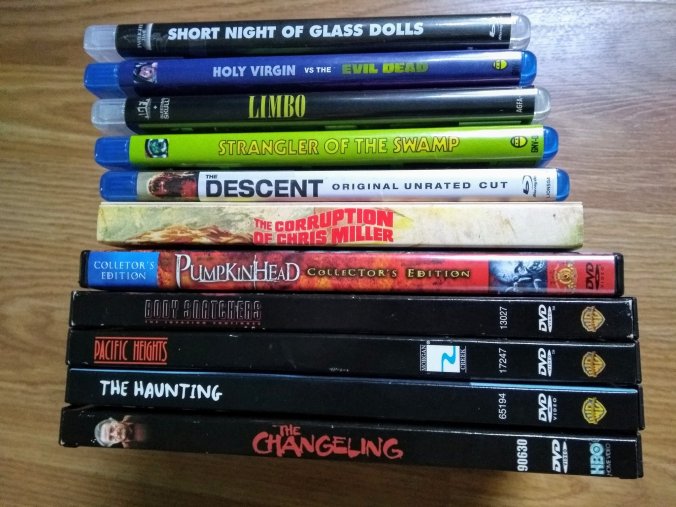
The other canonized title that The Changeling reminded me of the most was The Exorcist. That may read as a high compliment, but what I mean is that I found it an admirable drama but a boring horror film, unable to see the Exquisite Classic it is in others’ eyes. Weirdly enough, I do get a huge kick out of The Exorcist III, which also stars George C Scott. Go figure. It’s possible that had I seen The Changeling outside of the annual cram-session horror binge of Shocktober rituals, it might have made more of an impact. However, I can’t make too many excuses for it in that context, considering that my favorite new-to-me discovery this month was the 1963 adaptation of Shirley Jackson’s The Hauntingof Hill House, which isn’t exactly a gag-a-minute riot. Regardless, The Changeling is a film I can’t muster much enthusiasm for outside discussing it in terms of this year’s Halloween season viewing docket. In that spirit, here’s a picture of what my to-watch stack looked like at the start of the season and a best-to-worst ranked list of how much I enjoyed each title.










 Swampflix