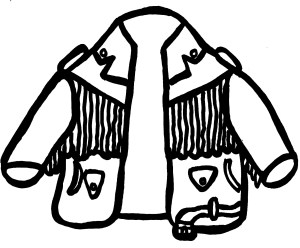
1. Deerskin – Quentin Dupieux’s absurdist thriller about a man’s obsession with a fringed deerskin jacket is consistently funny, but also incredibly vicious when it wants to be. Despite indulging in the ridiculous, high-concept genre of Killer Objects horror (think Death Bed, In Fabric, Christine, or the director’s own Rubber), it’s a surprisingly thoughtful film about the inadequacy that mediocre men face at middle age, and their psychotic efforts to overcome that deficiency. Jean Dujardin previously charmed American audiences in Best Picture-winner The Artist, but here he’s a sad, pathetic grifter who has to scam people just to hang out with him. It’s a hilarious joke at the expense of male vanity (including the vanity of making an entire movie about a deerskin jacket in the first place).

2. Color Out of Space – Richard Stanley returns to the director’s chair after decades of mysterious exile to adapt an H.P. Lovecraft short story about a meteor crash and a malignant color. Most criticism has fixated on Nic Cage’s over-the-top lead performance, but those antics aside this is a harrowing film about loss & cancer, fearing not just the disease but also its emotional erosion of familial relationships, interpreted through the powerful medium of cosmic horror.
3. The Invisible Man – A genuinely scary film that operates in a realm of traditional horror tropes. For a lot of its audience, it’s doubly scary because of its domestic violence aspect, capturing the feeling of the ground being pulled from under you when you realize your abusive relationship is not the loving one you initially pictured it to be. That realization happens before the film even opens, but we’re made to live through its terrifying aftermath.

4. The Twentieth Century – This pseudo-biography of a real-life Canadian politician is a gorgeous, absurdist fantasy piece that retells the history of Canadian governance as “one failed orgasm after another.” History says its events are set in Canada, but what’s onscreen is some nowhere nether-reality of dry ice and matte paintings, populated by caricatures rather than characters. It’s like Guy Maddin directing an especially kinky Kids in the Hall sketch, stumbling out into feature length in a dreamlike stupor.
5. The Wolf House – A nightmare experiment in stop-motion animation that filters atrocities committed by exiled-Nazi communes in Chile through a loose, haunting fairy tale narrative. It’s got all the trappings of a pre-Brothers Grimm folktale: the sour ending, the moralistic behavioral warnings, the magic that is both beautiful and cruel. It’s a relentlessly grotesque display, one that fully conveys the hideous evils of its allegory’s real-life parallels even if you aren’t familiar with that particular pocket of fascism history.

6. Possessor – This techno body horror from Brandon Cronenberg feels like the cursed love child between his father’s eXistenZ and his own Antiviral. It’s a compelling psychological battle between its characters to gain possession of the corporeal vessel they share (a battle powerfully performed by Christopher Abbott & Andrea Riseborough). A truly shocking film, both beautiful and disgusting.

7. Birds of Prey – A wonderfully stylized, deliriously hyperactive superhero movie that doesn’t drag or feel laboriously obligated to comic book backstory or pathos. It steps on other superheroes’ capes, soaring in its own unique, chaotic way (a power seemingly fueled by Vodka-Red Bulls).

8. Bacurau – A Brazilian film that mutates familiar details inspired by “The Most Dangerous Game” into a surreal sci-fi-horror-western genre meltdown. It uses familiar tropes & techniques to tell a story we’ve all heard before in a new style & context that achieves something freshly exciting with those antique building blocks. In other words, it’s genre filmmaking at its finest.

9. Swallow – An eerie, darkly humorous descendent of Todd Haynes’s Safe, in which a newly pregnant woman is compulsively drawn to swallowing inedible objects, much to the frustration of her overly-controlling family & doctors. It’s a subtle but highly stylized psychological horror about bodily autonomy, class warfare, and trauma, illustrating the complete lack of control you have over your own body & destiny if you’re born on the wrong end of class & gender dynamics.

10. His House – Reinvigorates haunted house genre tropes with the same tactics that titles like Blood Quantum, Zombi Child, and The Girl With All the Gifts used on the similarly overworked tropes of the zombie genre: by shifting the cultural POV and the purpose of the central metaphor. This bold debut feature from screenwriter and director Remi Weekes tackles topics of grief, disenfranchisement, loss, immigration, and cultural disconnection – all framed within the traditional scares of the haunted house horror film.
Read Boomer’s picks here.
Read Brandon’s picks here.
Read Britnee’s picks here.
Read CC’s picks here.
See Hanna’s picks here.
Hear James’s picks here.
-The Swampflix Crew


 Swampflix