Carnival Revelry: The Intergalactic Krewe of Chewbacchus in 2015

EPSON MFP image

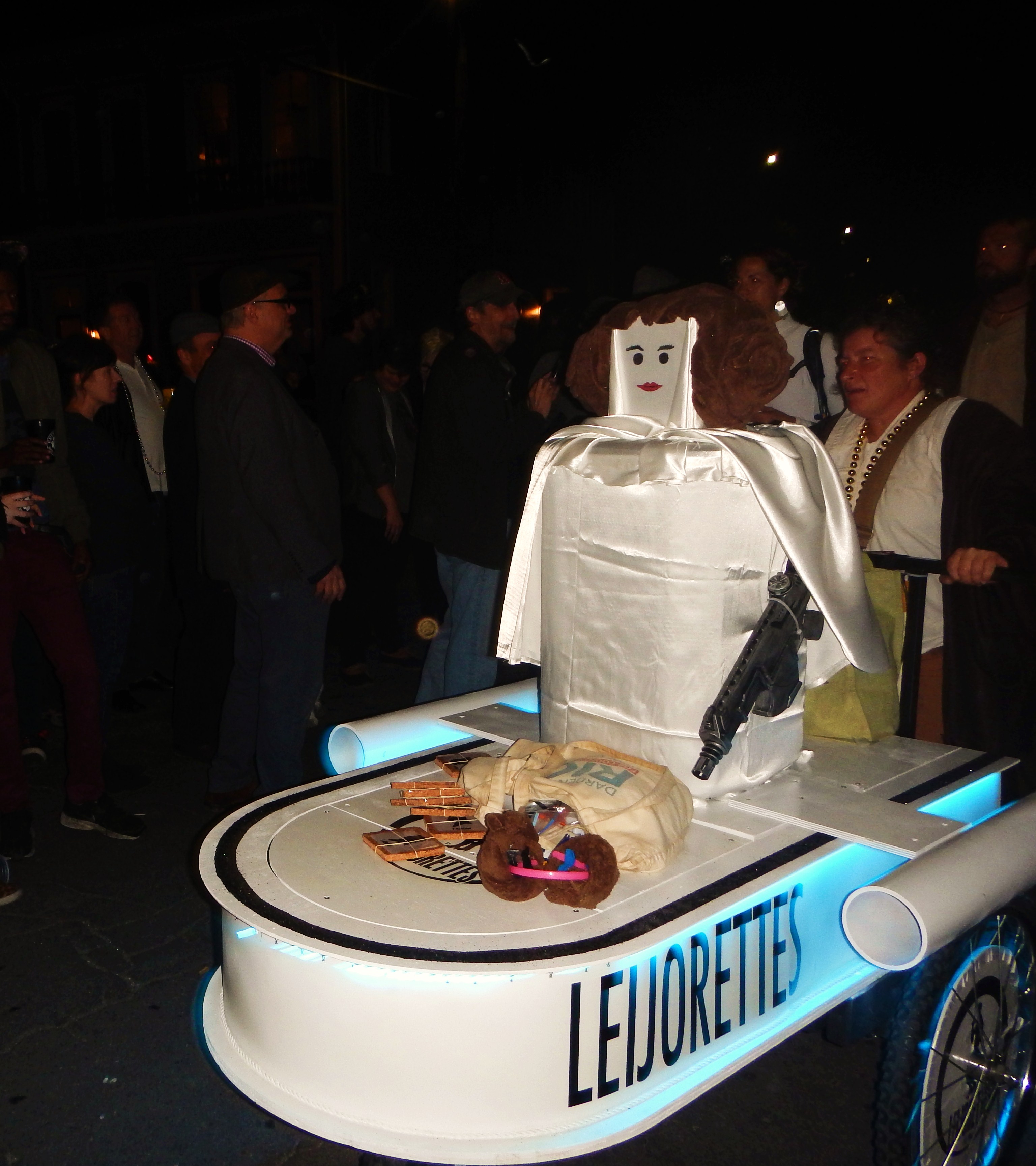
This past Saturday was the annual turning point for me when Mardi Gras stops being a vague concept I hear about on the radio & Facebook feeds and becomes an experience I’m living. Although the Phunny Phorty Phellows’ annual streetcar ride on Twelfth Night is the official start to Carnival season, it’s one I typically miss. Mardi Gras never feels real until I’m finally misbehaving in the thick of it & Krewe du Vieux is my usual starting point for the revelry, but I missed that parade this year as well. 2015’s Chewbacchus celebration was that magical moment when everything clicked and I thought “This is it. This is Mardi Gras.”

The Intergalactic Krewe of Chewbacchus is a relatively young parade that rolls hand-made, people-powered contraptions through the French Quarter & Marigny while the larger, gas-powered floats roll elsewhere across town. Although their nerdy umbrella has expanded to include all kinds of sci-fi goofiness, they’re the only parade I can think of that’s specifically designed to celebrate a movie franchise: Star Wars. Despite the inclusion of other sci-fi properties like Doctor Who, Star Trek, E.T. and (most recently) Guardians of the Galaxy, it’s still a mostly Star Wars-themed affair, one that lauds the “drunken Wookie” Chewbacca as its monarch. Real-life Chewbacca Peter Mayhew himself has even lorded over the parade the past couple of years, revelers treating him like nerdy royalty. The parade’s haphazard, DIY aesthetic perfectly matches the DIY practical effects of the original Star Wars trilogy. Star Wars’ endless parade of odd-looking weirdos and handmade sets & costumes serves as a fitting platform for New Orleans’ own endless parade of odd-looking weirdos & their personal creations, even if they’ve come to incorporate other fandoms as the years march on.

Wasting away a drunken afternoon in the Quarter and then capping off the night with Chewbacchus’ Imperial Stormtroopers & Jedi Knights was my personal introduction to the 2015 Carnival season. It was a great feeling to ring in my favorite time of the year while celebrating one of my other favorite activities: watching movies. Here are a few pics to help solidify the memory.

DSCN0999

DSCN1000

DSCN1001

DSCN1003

DSCN1004

DSCN1005

Have a great, safe Mardi Gras, y’all! And may the Force be etc, etc.

-Brandon Ledet

Movie of the Month: The Masque of the Red Death (1964)

masque
Every month one of us makes the other two watch a movie they’ve never seen before & we discuss it afterwards. This month Brandon made James & Britnee watch The Masque of the Red Death (1964).

Brandon:
The Masque of The Red Death is one of eight films in the Corman-Poe cycle: a series of Edgar Allan Poe adaptations directed by B-movie legend Roger Corman for American International Pictures. The Masque is widely considered the best of the Poe cycle as well as one of Corman’s best films overall, a sentiment I wholeheartedly agree with. There’s so much about The Masque that’s firmly in my wheelhouse: over-the-top set design, an early glimpse of 60’s era Satanic psychedelia, Vincent Price taking effete delight in his own cruelty, a fatalistic ending that doesn’t stray from the pessimism of Poe’s story, Corman pushing the limits of what he can get away with visually on a shoestring budget. I love it all.

What struck me most on this recent viewing of The Masque is how well it’s suited for the Carnival season. With Fat Tuesday looming around the corner, it was impossible not to see aspects of Carnival in the masquerade ball hosted by Prince Prospero (Vincent Price). The cheap costumes & mockery of opulence is very much reminiscent of Mardi Gras parades. There’s even a scene where Prospero literally throws beads from a balcony shouting “Gifts! Gifts!” and scoffs at the greed of the people below. As the threat of The Red Death plague becomes increasingly severe, the masquerade takes on a “party while the ship is sinking” vibe New Orleans knows all too well. Horror films are usually tied to Halloween, but The Masque of the Red Death is distinctly akin to Mardi Gras in my mind.

James, do you also see Carnival in The Masque’s decadence, or does the Satan worship overpower that influence?

James:
Man, The Masque of the Red Death was awesome. The bold stylistic choices that Corman made on a limited budget and limited time (the final masquerade scene was filmed in a day) are astonishing. Some of the images in the film (The Red Death himself being the starkest) are mesmerizing. I think the film should also be noted for its pitch-perfect tone. Despite its macabre images, philosophical discussions of Satanism, and Prince Prospero’s nastiness, what could have been a dreary chore is instead a blast throughout.

In regards to the presence of Carnival in the film, I do think the masquerade ball scenes in particular have a very Mardi Gras feel to them. Masks with feathered beaks, gorilla suits, and a child masquerading as a little person don’t feel too far removed from the typical Carnival season debauchery. The Carnival feel also deepened a central theme of the film: lost souls celebrating a kind of momentary victory over Death. Ultimately, the film seems to have a nihilistic attitude towards Death, implying that the celebration is indeed a momentary victory and whether Christian, Satanist, or Atheist, we will all have to eventually confront an indifferent Death. But it also seems to find solace in our ability to shape our own existence while we are alive. This is echoed The Red Death’s climactic statement “Each man creates his own God for himself – his own Heaven, his own Hell.”

Britnee, what was your interpretation of the film’s philosophy on Death? Is it wholly negative?

Britnee:
This was my first time viewing The Masque of Red Death, and I have to say that I was blown away. Vincent Price as Prince Prospero was dynamite. I was so close to hiding under the covers during the close-ups of his signature evil stare, but seconds later, I was imagining what it would be like to have a conversation & afternoon tea with him in one of those seven colored rooms. Also, one of my favorite things about the film was the set and costumes. I know the look was supposed to have a Medieval vibe, but I really felt that I was at a Satanic drug dealer’s mansion party in the early 60s. All that was missing was the orange shag carpet.

As for my interpretation of the film’s philosophy on Death, I’m honestly not 100% sure. Death has always terrified/interested me, and I caught myself really falling into some deep thoughts about it while watching this film. The Christians and Satanists in Masque both experienced violent deaths, and neither of their higher powers swooped in to save them or give them a miraculous second chance. I guess the film is trying to show that Death cannot be avoided, regardless of power or faith. In the end when The Red Death states “Sic transit gloria mundi,” which literally means “Thus passes the glory of this world,” everything sort of hit me. Life can be very short & leave without warning, whether you’re a Christian villager living in poverty or a wealthy Satanic prince; it’s coming for us all!

Something else that stuck out was the interesting relationship between Prospero and Francesca. After sparing Francesca’s life, Prospero brings her to his castle to make her his consort and gives her a taste of his world. He becomes very intrigued with Francesca’s innocence and faith. As for Francesca, there are times where it seems as though she is giving in to temptation, but simultaneously she is in constant focus on her escape.

Brandon, what themes do the relationship between Prospero and Francesca bring to the film?

Brandon:
It’s reasonable to assume that Prospero wasn’t always the cruel tyrant we meet in the picture. He didn’t emerge from the womb executing peasants and cursing God. Prospero’s poisonous personality was likely the result of a gradual corruption of his soul, an evil born of his prosperous upbringing. Raised with untold wealth & influence, he came to rule over his fellow human beings like an unforgiving deity. Unsatisfied with the power his privilege as Earthly nobility affords him, he reaches even further beyond this realm and makes a deal with Satan in an attempt to overcome Death. Yet, there’s a little speck of good left in Prospero’s heart, which I think is what we see in his treatment of Francesca. At times he tries to prove that even her innocence can be corrupted because he wants to be assured that his own wickedness can be found in every person’s heart. He even asks her to join him in mocking the greed & decay in the guests at the masque, because he believes all people to be as amoral as he is. At other times, he goes out of his way to protect her and spare her life, an instinct that surprises even The Red Death. The only other glimpse of good we see in Prospero is when he asks his guards to spare a baby’s life at the gates. Although he is beyond redemption, (not that redemption matters in the eyes of Death,) Francesca affords Prospero his last chance to act like a true human being.

Then there’s the fact that the actress who plays Francesca, Jane Asher, was just achingly beautiful. So beautiful, in fact, that she was in a relationship with & at one time engaged to Sir Paul McCartney in the 60s. She was attractive enough to snare a Beatle during the fever pitch of Beatlemania, so surely a demented prince who can’t even cheat Death wouldn’t stand a chance against her charms. Perhaps simple lust spares her life. I think Francesca stands out here as a hip youngster (maybe it’s all in those bangs?) and helps add to that 60s drug dealer mansion party vibe mentioned above. So much of the film feels rebellious in an anachronistic way. Prospero’s philandering is out of control. Lines like “Satan rules the universe!” and “Each man creates his own god for himself” are pretty edgy for 1964, even coming from the villains. Keep in mind this is still years before the New Hollywood, a movement Roger Corman cannot be praised enough for influencing.

James, how do you see the balance between the movie’s setting and the era in which it was filmed?

James:
The movie definitely has an edge that makes it still creepy and blasphemous over 40 years later. I wonder how much Corman was in tune with the counterculture of the time because, despite it being a British production, the film feels more like a deranged product of the 60’s San Fransisco hippie movement, like a horror version of Beyond the Valley of the Dolls; its macabre decadence fueled by lust and greed. It’s also most likely no coincidence that the epicenter of the hippie movement was the same place that the Anton Lavey established the Church of Satan in 1966. Themes like the destruction of social norms and an openness to sexual and spiritual experiences seem to be shared by The Masque of the Red Death, Satanists, and the hippies; “Each man creates his own god for himself” is THE basic philosophical statement of Satanism. I also think this is reflected in the dark, psychedelic imagery that The Masque of the Red Death and Satanist rituals share. (Photo for example)

satanist

Britnee, How strongly do you think the psychedelic aesthetic of the 60’s influenced The Masque of the Red Death? Any specific examples that stick out to you?

Britnee:
I think that The Masque of the Red Death was as psychedelic as it gets, at least for a horror film based in Medieval times. An example that really sticks out to me is the colors used throughout the film, most importantly, the use of red. Red usually represents blood, gore, and all the good stuff horror movies are made of, but when I also think of the term “psychedelic,” red is usually the color that comes to mind. After doing a little research, I found that the color red has a pretty long wavelength and very low vibration; this pretty much explains how the red tint that is present in multiple scenes really gives off this warm, draining feeling. Sounds a bit like the feeling you get after taking a hallucinogen or two, right? Also, all of those gaudy colors in the castle & clothing of Prospero and his pals can’t go without mention. While I’m not a Middle Ages expert or enthusiast, I’m almost positive that the colors of clothing and décor weren’t as bright and vibrant during that era as they are in the film. It’s obvious that the 60’s psychedelic aesthetic heavily influenced those hues.

Lagniappe

Brandon:
I’d just like to point out one last time just how early this film was released. A lot of what we think of as the hippie-dippie 60s came very late in the decade. The era-defining Summer of Love was in 1967, the same year Roger Corman dropped acid for the first time and fictionalized his experience in the film The Trip. The Masque‘s 1964 release positions the film as years ahead of its time. Corman was pulling off the Satanic psychedelia vibe the same year that Mary Poppins & My Fair Lady were huge cultural hits. I’m not saying Masque was particularly a major influence on the countercultural swell that was to come, but it at least was somewhat visually intuitive. And Corman himself did have direct influence on the later films that typified that counterculture, films like Easy Rider and Bonnie & Clyde. Even back then, when “don’t trust anyone over 30” was a motto to live by, he was the hippest geezer in the room and a filmmaking rebel.

Britnee:
After the discussion with The Swampflix Crew, so many ideas and thoughts about The Masque of the Red Death were brought to the surface. It gave me an excuse to watch the film a couple more times, and I fell in love with it more each viewing. The movie also got me hooked on the Corman-Poe films, so I’m currently trying to get my hands on all of them. The Masque of the Red Death was just a great balance of horror, suspense, and drama that gave me some really unsettling thoughts & a case of the willies. Great job, Corman!

James:
Really enjoyed the discussion of The Masque of the Red Death. Watching the film a second time and taking into account all the points you guys made deepened my appreciation and understanding of the film. Definitely want to see more Corman, especially the Poe films. As Brandon pointed out, Corman seemed to have his hand on the pulse of the counterculture and was always one step ahead of mainstream Hollywood. Truly a filmmaker ahead of his time.

-The Swampflix Crew

Upcoming Movie of the Months
March: James presents The Seventh Seal (1957)
April: Britnee presents Blood & Black Lace (1964)


Tangerine Dream & the Nightmare Sounds of Sorcerer (1977)

EPSON MFP image

Edgar Froese, the founding member and creative mastermind behind the prolific German band Tangerine Dream, passed away this past Tuesday, January 20th. The news broke yesterday via the band’s Facebook page, with a brief message announcing that his death was sudden & unexpected. Tangerine Dream’s long history dates back almost 50 years, 20 musicians and more than 100 releases. They were an experimental, mostly instrumental band that pioneered the forefront of psychedelia, krautrock, and synthpop, pushing the limits of their music through each new evolution. As the only continuous member of the group, Edgar was there for it all.

Arguably, Tangerine Dream’s most significant contribution to music was their soundtrack work on films in the 70s & 80s. The moody synth scores that are making a comeback in recent films like Drive, The Guest, and Cold In July owe just as much of a debt to the band as they do to John Carpenter, perhaps even more. Their score for Michael Mann’s debut feature Thief perfectly updates the film’s gritty noir for a 1981 aesthetic. Their music gave Ridley Scott’s fantasy epic Legend an otherworldly atmosphere to work in. Their synthpop provided a sense of dangerous fun in Kathryn Bigelow’s vampire Western Near Dark. Tangerine Dream’s scores not only elevate the movies they’re featured in; they become intrinsic to their mood & quality. This is especially true with their score to William Friedkin’s cult classic thriller Sorcerer.

Sorcerer was Friedkin’s loving retelling of the 1953 film (or at least the same novel adapted by) Wages of Fear, a French-Italian thriller about desperate men risking their lives to transport the delicate explosives necessary to snuff an oil well fire. Hot off of his career-high success with The Exorcist, Friedkin allowed his hubris to inflate the film’s budget and shooting schedule. It was a dangerous & expensive film to make, but one Friedkin thought worth the trouble, as he hoped it would be his legacy. That’s not exactly how it worked out. Initial critical reception was mixed and the box office numbers were even worse. It’s been speculated that the film failed because of its unfortunate debut alongside the first modern blockbuster Star Wars. Its commercial failure has also been attributed to audience’s confusion with seeing a film called Sorcerer from the same director as The Exorcist and understandably expecting a supernatural horror instead of the tense, gritty thriller that was delivered. Friedkin was expecting Sorcerer to be his greatest accomplishment, the one he’d be remembered by. Commercially speaking, he failed.

The film has rightfully earned a more long-term success critically, though, gradually earning cult classic status in the decades since its initial release. It was restored for a home & brief theatrical release in early 2014 to commemorate its reappraisal. Sorcerer’s tense sense of impending doom may have not been a surefire commercial venture in the summer of 1977, but remains as potent as ever as the years go on, particularly in the film’s awe-inspiring centerpiece: “the bridge scene”. It’s an unsettling picture that slowly cranks up its existential dread over what’s got to be the most nerve-racking road trip story I’ve ever seen on film. A lot of the film’s achievement in tone is surely do to the forceful, synth-heavy score from Edgar Froese’s Tangerine Dream.

In his memoir The Friedkin Connection, Friedkin tells the following story of how he discovered the band at a show in an abandoned church in their native Black Forest, Germany: “The concert began at midnight and they played long, rhythmic, sensuous chords, somewhere between classical music and the new pop sound. They performed for three hours in darkness, outlined only by the twinkling lights of their own electronic instruments, and along with a large audience of stoned young people, I was mesmerized.” He approached the band after their set to ask if they would collaborate with him on his next film. Working with only the screenplay Friedkin provided them and not a minute of footage, Tangerine Dream sent him two hours of recordings while the film was still in production. Friedkin says he & the film’s editor cut the picture while listening to random passages of the soundtrack for inspiration. Their music had a very significant hand in the shape & the tone of Sorcerer.

Tangerine Dream had a hand in the tone of many films, including ones they didn’t directly work on. Sorcerer, however, is the film that’s most inseparable from their work. It’s undeniable that the movie would not have been the same without them, as their music literally guided the shape of the final product. Edgar Froese’s passing leaves a massive legacy in its wake. Sorcerer is just one note on an extensive list of accomplishments, but it’s a note that deserves to be highlighted.

In the band’s farewell Facebook message Froese is quoted as saying “There is no death, there is just a change of our cosmic address.” Let’s hope that before he made the journey to his new address, he was well aware of the impact he made on this one.

-Brandon Ledet

The Exterminating Angel (1962) and the “Party Out of Bounds” Story

exterminatingangel

One of my favorite types of stories, especially when told on stage or on the screen, is what The B-52s would call the “party gone out of bounds”. I love it when guests at a fictional party stop celebrating and start having a truly shitty, life-changing catastrophe of a time, but decide to stick around and see it through instead of taking the logical step out of the door. It’s a familiar feeling, that late hour biterness that arises when alcohol’s social lubrication takes a toxic turn and the vile, dangerous aspects of human nature start bubbling to the surface. Civility dissolves and our feral natures emerge. The “Party Out of Bounds” story is one I’ve lived many times before, mostly in the drunken hours of early morning when I should’ve gone to bed, but instead felt compelled to stay up and argue “important”, hurtful things I didn’t always mean. I take strange pleasure in seeing these repellent impulses reflected back at me in my entertainment media, particularly in movies & plays.

Part of the allure of “Party Out of Bounds” story is the motivation for sticking around. What compels someone to remain at a party when “situations degenerate, disgusting things you’d never anticipate”? In the genre’s most easily recognizable example, Who’s Afraid of Virginia Woolf?, it’s clear that the central couple George & Martha loathe their marriage and the make-believe required to keep it afloat, so their motivations for destroying each other’s delusions are fairly straightforward. But why do the younger couple, Nick & Honey, stick around once the tone gets sour and focused on destroying them as well? In Cat on a Hot Tin Roof, it’s understandable why Maggie wants Brick to snap out of his sullen state and actively engage with life, but why does Brick allow the evening to go on endlessly, Maggie & his father digging deeper into his painful past? In The Boys In The Band, Michael allows his own self-loathing & alcoholism to tank the birthday party he throws for his friend Harold, but why do the other guests allow themselves to get sucked into his emotional black hole? The instinct to tough it out and see the awful thing through is fascinating to me.

Some “Party Out of Bounds” stories side-step the issue of motivation by confining their characters with literal barriers, some physical and some metaphysical. It’s A Disaster & Coherence are both great recent examples of this tactic, using chemical warfare & a supernatural occurrence to bottle their partygoers at a disastrous brunch & dinner party, respectively. This approach to the genre is more metaphorical than the one detailed above, but belongs all the same. Although an external force is trapping the characters, it’s their internal failings that drive the parties out of bounds. Both situations would have soured with or without the outside help.

Surrealist master Luis Buñuel’s 1962 film The Exterminating Angel plays both sides of this coin beautifully. There is an external force that keeps the film’s aristocratic partygoers trapped in a single cramped room of an expansive mansion, but it is a force than cannot be explained. The characters are compelled to remain in the mansion’s music room as if there were a force field blocking them at the door. At first the guests seem to remain at the dinner party out of nervousness & etiquette, like little kids waiting anxiously for someone to take the first dive at a pool party. Each time someone makes a motion to leave, they find a flimsy excuse to stick around: a forgotten purse, a cup of coffee. As with Coherence & It’s A Disaster there’s an external authority confining the partygoers to the music room, but the fact that this authority cannot be seen or even understood links the movie to the compulsion detailed in the classic examples listed above. The Exterminating Angel is the ultimate “Party Out of Bounds” story: the instinct that coerces its partygoers to see the awful thing through is given tangible power. It is an ugly compulsion materialized, a masochistic urge physically manifested.

As the ultimate “Party Out of Bounds” story, The Exterminating Angel starts with the wealthiest, most civilized party guests and ends with them reaching a feral state, fighting for food & water like wild animals. More than any other film listed above, the party starts at the greatest height of good manners before plummeting into murkiest depths of depravity. Civility more than dissolves here. It’s erased so completely that you begin to question whether it was present in the first place. As the days stretch on in the music room and the guests turn on each other one by one, the opulence & etiquette on display in the early scenes take the shape of a thin veneer, just barely covering the seething vulgarity under the surface. At the film’s beginning, the guests were already full of hatred, already committing adultery, already prone to frivolous cruelty, but were much better at covering up their indiscretions. Getting trapped in the music room merely forces them to display their true natures openly & honestly.

The debasement is gradual. At first guests become fatigued and take cat naps on various chairs & couches, but it’s fatigue that can be attributed to food, alcohol and the late hour of the party. Then they begin to undress from their tuxedos & gowns and clear places to sleep on the floor. As they wake from their makeshift slumber party, they start looking disheveled, unkempt. The reality of their inability to leave slowly dawns on them and they lose their self-control one by one. Those who initially remain calm consider themselves superior to the other guests, but that leverage doesn’t last long. Over time they come to blame each other for getting them in the bizarre predicament, pace at the doorway’s invisible barrier, cry, slip into comas, fight, fuck, commit suicide, hallucinate, insult each other’s hygiene and break into fits of hysterical laughter. When the story begins the characters are embarrassed to be caught acting like human beings. By its end they’re killing sheep with their bare hands and breaking apart furniture & musical instruments for firewood.

Yes, there are sheep roaming the house. There’s also a bear than begins to scale the mansion’s columns as if climbing a tree in plain view of the music room, seemingly mocking the party’s return to nature. The bear and the sheep were acquired for after-dinner entertainment that never arrived. There’s some symbolism to be made of the sheep’s presence (phrases like “mindless sheep” & “like lambs to the slaughter” come to mind), but what are we to make of the bear? And then there’s other details that beg to be picked apart: the vases the guests use as toilets are portals to an open-air outside world, there’s a severed hand that crawls across the floor like The Addams Family’s Thing, the rules of who can and who cannot cross the music room’s barrier becomes increasingly convoluted, the mansion itself is located on Providence Street, etc. It’s all, for a lack of a better word, perfectly surreal. Applying logical analysis to these images is a fool’s errand in my opinion, like the doctor at the party who tries to understand the music room phenomenon through reasoning and ultimately gets nowhere, just like his fellow partygoers.

It’s tempting to read into each of these images separately, but they’re better served when left at face value. Any of the larger ideas that need to get across are fairly plain without too much analysis. The aristocracy is like a gang of helpless infants without its serving staff. The barrier that keeps the affluent trapped in their mansion’s most frivolous room mirrors the way wealth can isolate a person from the “real” world outside and the common people who occupy it. Most importantly, though, civility is really a façade for the snarling beasts lurking within us. As characters begin to violate “the most basic concepts of good etiquette” and fail to “remember their upbringing”, one character calls it “the very end of human dignity.” I say good riddance to that dignity.

Getting back to the B-52s song in question, I’d like to answer the line “Who’s to blame when parties really get out of hand?” Only ourselves, buddy. Just us. Well, maybe us and alcohol. There’s a lot of great “Party Out of Bounds” stories out there and their conflict is always the same: a drunken, joyous celebration is derailed by repressed impulses & inherent, hideous aspects of human nature once civility is no longer there to keep them at bay. Buñuel’s The Exterminating Angel pushes this conflict to unmatched extremes that are somehow just as amusing as they are terrifying. It’s an incredible feat of filmmaking and the crown jewel of a genre I love.

-Brandon Ledet

The Meta Experience of Prytania Screening Cinema Paradiso (1989)

paradiso

I was washing dishes this Thursday afternoon when I was unexpectedly alerted that Prytania Theatre was going to screen Cinema Paradiso for free in a half-hour’s time. I dried my hands, crated the dog and sped Uptown just in time to take my seat among the little old biddies and stray college students just before the movie began. With no time for Google or IMDb before I ran out the door, I went into the movie completely blind. All I knew was that it’s one of those foreign titles synonymous with phrases like “Oh man that’s a classic” and “How have you not seen that yet?” Oh man. It was a classic. How had I not seen that yet?

Cinema Paradiso is a movie about movies, cinema about a cinema, art about art. It’s one of those rare films that attempts to provoke every possible response in its viewers (laughter, tears, heartbreak, frustration, unbridled joy) and succeeds consistently. As the audience watches the story young boy grow into an old man, they also watch a history of how audiences have engaged with film over the course of decades. When we watch Cinema Paradiso, we watch the way people watch movies. At the beginning of the film the Cinema Paradiso’s audiences basically riot throughout the pictures. Towards the end they sit in rapt silence.

The audience at Prytania that day was anything but silent. They weren’t the masturbating, shit slinging, drunken near-rioters of Cinema Paradiso, but there was some audible chatter throughout the movie in the seats behind me and a full-on celebration in the lobby that could easily be heard through the dividing curtains. The Prytania was screening free movies that day and was gearing up for an afternoon block party to commemorate its 100th anniversary. As the oldest operating cinema in New Orleans and the only one in its neighborhood, it’s way too easy to draw connections between the Prytania Theatre and the titular Cinema Paradiso. Just as the Cinema Paradiso grows with & serves its Sicilian village, Prytania is a cultural mainstay of Uptown New Orleans. They planned on screening the film a second time later that night at the block party, the same kind of outdoor community screening Alfredo stages in the film.

Before the afternoon screening I attended began, Prytania’s 93 year old operator Rene Brunet told the following anecdote: When the one-screen theatre first ran Cinema Paradiso in 1989 it played for over six weeks, upsetting the locals (presumably the college kids) enough to picket the theatre to finally move on & play another movie. It’s the exact kind of episode that would’ve happened in the film itself, although presumably more tame.

The meta experience doesn’t stop there. When Cinema Paradiso was first released to an American audience, the undisputed king of cinematic self-sabotage Harvey Weinstein cut a full 51 minutes of footage from the Italian original (a tactic he almost repeated with last year’s Snowpiercer). The streamlined cut is the one that played at Prytania this Thursday, but it’s also the one that played in its original extended run at that cinema, as well as the one that earned the Oscar for Best Foreign Film. Oddly enough, Roger Ebert himself contended that the Weinstein cut is “a better film than the longer.” Whether or not that is true, it’s still hilarious to me that drastic edits were made to a film that depicts a priest making drastic edits to other films as one of its thematic lynchpins.

The programming choice to celebrate Prytania’s century long history with Cinema Paradiso was wholly perfect. It was the story of New Orleans’ most significant one-screen cinema examining itself by revisiting the most significant story of a one-screen cinema around. They could’ve played a more tragic (but just as potent) work of cinematic navel-gazing like 1971’s The Last Picture Show or last year’s Life Itself, but that would’ve undermined the reason we were all there: a celebration. Commemorating Prytania’s first 100 years with Paradiso left me with the hope that it will last at least 100 more. There was no  better way possible to celebrate the movies than to watch people watch movies.

-Brandon Ledet

“Unedited Footage of a Bear” & The Year of the Doppelgänger

bear

After posting a too-long article trying to make sense out of last year’s surge of doppelgänger movies earlier this week, someone pointed out to me that I missed a major one: “Unedited Footage of a Bear”. “Unedited Footage” is a horror/comedy short from the same Adult Swim Infomercials program that produced the 2014-defining “Too Many Cooks”. (Did I get that song stuck in your head again? I am so sorry.) Where “Cooks” deconstructed an impressive range of television formats and worked them into a singular slasher film, “Unedited Footage” did the same with a much narrower genre: allergy medicine commercials. Using the fine print listed side effects of medication commercials & the intense artificiality of advertising in general to its disturbing advantage, “Unedited Footage” tells a tight, effective horror story in its fleeting ten minutes. A horror story that hinges on 2014’s biggest pet obsession: doppelgängers.

Although it plays on the popular doppelgänger obsession of last year’s features, “Unedited Footage of a Bear” isn’t a feature film itself. It isn’t even unedited footage of a bear. The entire doppelgänger/slasher storyline is framed as a tangent that distracts from the titular bear, but since it eats up all but 30sec of the runtime & the film never returns to the bear, the doppelgänger plot is the bulk of the film in every sense. Although it acts as the initial framing device, the bear is the tangent. The doppelgänger is the heart.

Despite the arrival of “Unedited Footage” at the December finish line & its depiction of a doppelgänger murder story, it’s hard for me to justify an addendum including it on that 2014 list. My intention with the “2014’s Doppelgänger Movies & Their Unlikely Doubles” article was to make sense of last year’s varied approaches to that genre by finding those film’s own doppelgängers in other seemingly unrelated movies. Besides the fact that I honestly forgot about “Unedited Footage” at the time, the problem with including it there is that I can’t think of its own double. I can’t think of another film that allows a single tangent to dominate the narrative in that way. (The only one that really comes to mind is that extended dream sequence towards the end of Romy & Michele’s High School Reunion where Lisa Kudrow’s Michele is sleeping in the passenger seat of a convertible, but believes she has gone into the reunion, expertly schmoozed her old classmates by convincing them that she invented the glue on the back of Post-it notes, fails to drag Mira Sorvino’s Romy away from a make-out session, gets hit by a limo, starts her own make-out session in that limo, loses her blouse, accepts an award in her bra, and grows old & wealthy still disconnected from her best friend before she finally wakes to discover it was all just a dream and she hasn’t even left the car. But that doesn’t even come close, really, because that dream only dominates a few minutes of the movie, which soldiers on after it concludes, the same way this article will soldier on after this tangent concludes. Also, I just saw Romy & Michele for the first time a couple nights ago so that’s totally why it’s fresh in my mind.)

2014 saw an unusual excess of new entries for the doppelgänger genre. The idiosyncratic “Unedited Footage of a Bear” deserves to be remembered among them, if not only because any film featuring an original score & brief cameo by Dan Deacon deserves to be remembered. It’s just unclear to me what the movie’s own doppelgänger in this world is, but I’m sure it’s out there, waiting to murder it. (Unless it actually is Romy & Michele, in which case it’ll most likely take it shopping or force-feed it junk food or make it watch Pretty Woman, like, 36 times, which is its own form of death.) Oh, it’s out there.

-Brandon Ledet

Britnee’s Top 5 Staircase Tumbles

stairs

Who doesn’t love a good tumble down the staircase? They’re just so dramatic and over-the-top! I love them so much that I’ve decided to share my Top 5.

1. Death Becomes Her (1992) – Meryl Streep is better than everyone at everything, even falling down the stairs. Although there is more than one scene where her character, Madeline Ashton, takes a dive down a flight of stairs, the first fall takes the cake.

2. Hush…Hush, Sweet Charlotte (1964) – As Velma Cruther (Agnes Moorehead) is being very vocal about ratting out the film’s antagonist to the sheriff, a chair is smashed over her head and down she goes. Should’ve kept that mouth of yours shut, Velma.

(Note: that tumble takes place @1min30sec in that clip, but there are plenty of other great falls included there as well – even some from this list).

3. Kiss of Death (1947) – Ma Rizzo (Mildred Dunnock) is violently pushed down a stairwell in a poorly- constructed wheelchair. The wheelchair is so crappy that it falls apart before making it to the bottom. That poor “lyin’ old hag!”

4. Maternal Instincts (1996) – “Sorry? It’s too late to be sorry!” Delta Burke’s tumble down a set of industrial steps is the highlight of the film.

5. Fried Green Tomatoes (1991) – Ruth Jamison (Mary-Louise Parker) gets kicked down the stairs by her repulsive husband, and while it’s one of the films saddest moments, never has a fall been so graceful!

-Britnee Lombas

2014’s Doppelgänger Movies & Their Unlikely Doubles

doppelganger

2014 saw the wide release of an unusual bounty of films about doppelgängers. Besides comic book superheroes it had to be the most common cinematic topic of the year. As early as Spring there was a heap of press citing similarities between Enemy & The Double, two doppelgänger movies based on doppelgänger novels both titled The Double (one by José Saramago & one by Fyodor Dostoyevsky). I joked that if they shared a distributor (they don’t) they should be released on home video as a combo pack. It turns out that besides one (admittedly major) detail in premise the two films actually have very little in common. As the year went on I found the true spiritual doppelgängers of Enemy & The Double in highly unlikely places, as well as a few more doppelgänger movies & their own unlikely partners.

Of course there are possible spoilers for all titles listed in bold below.

The Double (2014) & Joe Versus The Volcano (1990)
Although Richard Ayoade’s The Double didn’t deliver the similarities to Enemy that I expected, it wore other, stranger influences on its sleeve. It not only boasted visual cues picked up from David Lynch’s oeuvre, but also intentionally mirrored Terry Gilliam’s Brazil. The Double’s similarities with Brazil are so purposeful Ayoade’s film could be considered a long-form homage. What’s infinitely more surprising to me is the similarities it shares with the Tom Hanks/Meg Ryan comedy Joe Versus The Volcano.

There’s a good deal of humor lurking under the surface of the Lynch & Gilliam influences Ayoade pulls from, but The Double is more of an unambiguous black comedy, its own dark humor resting in plain view. Its sinister amusement with depression & the grim life of an office drone positions it as more of a modern descendent of Joe in terms of genre. The Double’s Jesse Eisenberg’s work life is so surreally awful the only character in cinema I can compare it to is Tom Hanks’ Joe. The set design in both characters’ offices are achievements in over-the-top blandness. They both ache with yearning for coworkers who don’t know they exist. They even both serve clueless megalomaniac bosses portrayed by gifted character actors (Wallace Shawn & Dan Hedeya, respectively).

Admittedly, the resemblance fades after the first half of Joe. When the plot catalyst hits Joe (a life-threatening “brain cloud”) the protagonist gets to escape his oppressive life as a faceless worker & embark on a grand adventure in search of the titular volcano. The Double doesn’t allow its catalyst (a second Jesse Eisenberg, one less akin to George Michael Bluth) to shake things up in the same way. Ayoade instead forces his protagonist to see his grim, thankless life through to a bitter end.

Enemy (2014) & Stranger By The Lake (2014)
James & I once got in a particularly nerdy argument in a dive bar about the merits of Enemy. He was a huge fan of the film (it made his Top Ten list for the year after all), while I found it interesting, but far more self-serious than it needed to be (or maybe than I wanted it to be). Trying to discern what aspect of our personalities split us on the film (probably his love of & my aversion to philosophy), I brought up another recent release we were split on: Stranger By The Lake. In my attempts to defend Stranger in that conversation I noticed a common theme between it & Enemy. Both films feel like cryptic allegories for the dangers of carnal desire.

In an unfairly linear (& likely false) synopsis of Enemy, the protagonist’s libido tempts him to stray from intimacy with his pregnant wife to the point where his personality is split into two dueling halves. This split (again, in a deliberately simple analysis) leads the doppelgänger Jake Gyllenhaals into a deadly world of adultery & spiders. The protagonist in Stranger By The Lake, a man who regularly cruises for sexual activity on a gay nudist beach, feels a similar carnal pull. His two closest relationships, an unlikely friendship with a schlub he finds physically uninteresting but personally magnetic & a sexual affair with a very attractive man he knows to be a murderer, split his time in the same libido-driven downfall that corrupts the Gyllenhaals.

When viewed in a certain context, Enemy & Stranger can be interpreted as spiritual doubles in the parables they tell. Whether you value one over the other or not is, of course, a manner of personal preference.

Coherence (2014) & The One I Love (2014)
Two of 2014’s biggest surprises were the read-too-much-about-them-and-you’ll-ruin-them Coherence & The One I Love. Of the pair, Coherence was more of the critical darling, while The One I Love was more-or-less thought to be an interesting picture that couldn’t stick the landing. Personally, I believe The One I Love to be just as great (if not better) than Coherence. Both films push their supernatural left-turn premises to outlandish places while remaining grounded & emotionally potent. Together they help carve out a modern Romantic Horror genre (within which they’re the tiny indie equivalents to the major studio RomHorror Gone Girl).

Common assumption would suggest that Coherence’s rightful doppelgänger would be a Twilight Zone episode (particularly the classic “The Monsters Are Due On Maple Street”) but it’s inseparable from The One I Love in my mind. This may not be the most surprising pairing on this list, as The One I Love also owes a hefty debt to The Twilight Zone. Enjoyment of both movies is ideally enhanced by an ignorance of their basic plots, something so delicate I fear I’m wrecking it by including them here. They both do a lot with a little, squeezing impressive mileage out of small budgets & a few great actors.

Again, my preferences & James’ were at odds over these titles, as Coherence appeared on his best of the year list & The One I Love appeared on mine. In this case we both liked both movies a good deal, though. There was no nerdy dive bar discussion necessary.

Honeymoon (2014) & Slither (2006)
Speaking of Romantic Horror, the under-the-radar Honeymoon works like Invasion of the Body Snatchers by way of Safety Not Guaranteed. Its calm, pragmatic approach to its supernatural my-wife-is-not-my-wife plot recalls the vibe of Coherence & The One I Love more than any other doppelgänger pairing on this list. All three films make the most extraordinary plots feel like conceivable relationship troubles that every couple goes through from time to time. Honeymoon is not alone in this world & the comparisons to Body Snatchers are especially well deserved, but I found other surprising similarities in the central relationship of James Gunn’s 2006 slapstick horror Slither.

Besides its own debt to Body Snatchers, Slither is wildly different from Honeymoon in tone & intent. Where the escalation in Honeymoon is calm & measured, Slither throws everything (including buckets of viscera) against the wall to see what sticks. However, the gradual escalation of unignorable changes in a spouse’s behavior binds them together. In Slither, the antagonist Grant Grant (played by world-class creep Michael Rooker) initially seems a bit out of it to his wife following an incident in the woods. The changes in his behavior spiral out of control in the most horrifying (and shockingly funny) ways imaginable. Honeymoon’s horror hinges on its own in-the-woods behavior altering event, but the results are decidedly a quieter form of terror, as opposed to Slither’s fever-pitched absurdity.

These movies aren’t broadly linked in their approaches to horror, but instead in the detail of their threats’ gradual revelations to the ones they love.

The Face of Love (2014) & Birth (2004)
The least successful film on this list artistically, The Face of Love attempts the grounded approach to the paranormal Coherence & The One I Love achieve, but ultimately falls short. Despite an interesting premise & some great performances from familiar faces Annette Benning, Ed Harris, and Robin Williams, the film never breaks through the trappings of an undistinguished trifle. Part of the problem is that an eerily similar plot has been executed so well before in Jonathan Glazer’s Birth.

The Face of Love mirrors Birth’s story of a woman who improbably meets her husband after his death, but takes it to less ambiguous, less visually striking territory. It’s not a bad movie exactly, but instead a mediocre version of its superior double. Both movies tackle the grieving process in an unusual manner, but Birth does it better. There are images & moments from Birth that will stick with me my entire life. I expect I’ll forget most of The Face of Love within the month.

It’s a bit unfair to include a movie here only to suggest that there’s a better version of it out there, but in the end it’s the doppelgänger’s job to kill its weaker double. It’s only natural.

-Brandon Ledet