Hush…Hush, Sweet Charlotte (1964)

It’s no secret that, when it comes to director Robert Aldrich’s collaborations with Bette Davis, What Ever Happened to Baby Jane? is the film that everyone remembers and talks about, while Hush…Hush, Sweet Charlotte is normally regarded as a bit of an afterthought. After all, the former has Davis up against Joan Crawford, an onscreen tour de force that captures the energy of their offscreen antipathy, a rivalry with such a legacy that it’s been turned into entertainment several times itself. It’s a well-known piece of trivia that the role of cousin Miriam in Charlotte, which was ultimately played by Olivia de Havilland as a favor to Davis, was to have been Crawford’s. Although I love de Havilland in this role, I can’t help but think that the Davis/Crawford second feature would have reversed this, with Charlotte as the preeminent psychobiddy picture and Baby Jane as the footnote. 

At a roaring party at Big Sam Hollis (Victor Buono, who had also appeared in Baby Jane)’s plantation home in the 1920s, the man himself warns John Mayhew (Bruce Dern) that he is aware that John has been carrying on an affair with Sam’s daughter Charlotte (Davis) and intends to run off with her and abandon his wife Jewel (Mary Astor), and that he will not allow this to happen. John goes to the grounds’ gazebo to break things off, only to be murdered, with his head decapitated and one of his hands lopped off. We then cut to the present of 1964, which finds Charlotte now a shut-in living in a dilapidated mansion with only the company of sourpuss maid Velma Cruther (Agnes Moorhead) and the occasional visits from childhood friend Drew Bayliss (Joseph Cotten), a doctor. Charlotte’s house is set to be torn down by the highway commission, but her repeated deferral of the impending date comes to a head when she hot-temperedly pushes a large stone planter off of her balcony, coming close to killing the demolition foreman, and she’s been given ten days to vacate. Charlotte’s recluse status is reiterated by the fact that there’s a persistent urban legend that Charlotte killed John Mayhew and got away with it because she was rich, with children daring each other to go up to the nearly abandoned house as if an old witch lived there. For her part, Charlotte believes that her father killed John, but in spite of this she blames Jewel Mayhew for exposing the affair and causing everything to fall apart, and part of her stated aversion to moving away is because she doesn’t want Jewel Mayhew to “win,” since her house isn’t in the way of the highway. Despite Velma’s doubts, Charlotte’s attempts to get her businesswoman cousin Miriam (de Havilland) to come to the old house are successful, although Miriam knows that she’s there to get Charlotte out, not stop the bulldozers. Her arrival in town comes at the same time as a British insurance agent’s, who has a special interest in the Mayhew case. 

I programmed this movie for the third of five “spooky season” Friday screenings for Austin’s Double Trouble, a North Loop spot that I frequent and adore (the first two were Rosemary’s Baby and Ginger Snaps, with Paprika coming up on the 24th and Cherry Falls on Halloween night, both at 8 PM). In my ad copy for Charlotte, I described it as “Grey Gardens meets Gaslight,” and given that it had been a little while since I last saw it, I forgot just how much that latter film this one liberally cribs from. I’d go so far as to argue that, if the play and film Gaslight had never been produced, the psychological term that we take from it would instead be called “Sweet Charlotting” or “Hush Hushing.” Poor Charlotte Hollis really gets put through the wringer in this one, blaming her father for John Mayhew’s death for decades and hating Jewel Mayhew for exposing the affair, when neither of those things are really true, and that’s before she finds herself psychologically terrorized by phantoms of John and discovering evidence of a potential haunting. Davis is doing some of the most truly compelling work of her career here, and I’ve been haunted by this performance ever since my first viewing of this movie when I was a teenager. Maybe I’m biased and the Louisiana setting and the frequent mentions of Baton Rouge endear this one to me more than Baby Jane, but I really do find the Southern Gothic feel of this one makes it more special (even if the script occasionally flubs and mentions a “county commissioner,” as counties are something that Louisiana does not have). That having been said, I can’t pretend that Baby Jane isn’t a tighter film; although their individual runtimes are within minutes of one another (133 minutes for Charlotte and 134 for Baby Jane), Charlotte feels longer, as there’s a little too much denouement going on after the film’s villains are revealed. This allows for Davis to continue to act her ass off, but it’s not terribly exciting, even if it also gives some time for one or two more twists. 

Although the film is decades old, I’ll give the standard warning here that I’ve got to delve into spoilers to discuss it further. This gets a big enough recommendation from me that I used a platform I was given to show movies to the public to make this one more visible, so that’s all you really need at this juncture if you want to go in unspoiled. Ok? Ok. I love seeing Joseph Cotten and Olivia de Havilland really play against type in this one. I think I remember reading somewhere once that it was only in this film and Dark Mirror in which she portrayed a villain, and in that earlier role she was playing a set of good and evil twins, so that’s a net zero, really. She’s fantastic here, and even though some audience members may find themselves fatigued by the film’s long ending, I wouldn’t trade the opportunity to see de Havilland relish delivering Miriam’s backstory for a shorter run time (even if I would trade it to see Crawford tear into this monologue). Miriam reveals that her resentment toward Charlotte was born the day that she was first brought to the Hollis House to be raised by her uncle following her father’s death, and that old Sam Hollis’s perfunctory hospitality to his niece while he doted on his daughter drove her into a jealous rage. It was Miriam who exposed Charlotte and John Mayhew’s affair, and when Jewel Mayhew killed her husband in a jealous rage, it was Miriam who blackmailed Jewel about it for decades while allowing Charlotte to blame her father, destroying their once close relationship. Miriam’s envy took everything from Charlotte except her house, and now Miriam has come back for that, too (or at least whatever money Charlotte’s entitled to via eminent domain reimbursement), with Dr. Drew as her confidante. His motivation is merely money, which is less interesting, but it’s still nice to see the hero of Gaslight take on the role of accessory gaslighter in this film. 

I’ve barely mentioned her, but I also want to draw attention to the fantastic performance of Agnes Moorhead as Velma. The moment that something spooky seems to be happening, the audience’s initial suspicion must fall on Velma, as the person with the most access to the house and the one who seems most antagonistic toward Miriam, who has yet to be revealed as the villain and seems to truly desire to help. Velma is irascible and her ability to maintain the great old house alone is minimal at best, but she’s also a true and faithful companion for Charlotte despite the fact that she seems to be going feral (when her murdered body is left in her backyard, the authorities say of her place that “I’d hardly call it a home,” which makes it sound like she’s living in a shack). Moorhead really was one of the greats, and she’s just as fantastic here as Davis is. 

-Mark “Boomer” Redmond

The Exotic Ones (1968)

I don’t know how useful this review of the 1968 creature feature The Exotic Ones (aka The Monster and the Stripper) will be to anyone reading it, since the film is very precisely my exact personal brand of trash. This locally-set novelty attempts to combine the Roger Corman rubber-suit monster movie with the post-Russ Meyer nudie cutie into one perfect swinging-60s trash pile. It has so much fun establishing a nonstop party atmosphere on its French Quarter strip club set that it goes to Matt Farley levels of effort to delay the inevitable disruption of its horrific monster – almost a full hour into its 90-minure runtime. This movie has nothing on its boozy, lingerie-clad mind beyond ogling as many burlesque performers as it can before it must sober up and deliver the horror genre payoffs promised on its poster. It’s a sloppy, horny, locally flavored party film with no clear themes or purpose beyond the cheap, simple pleasures of Bourbon Street hedonism; it’s also my new best friend.

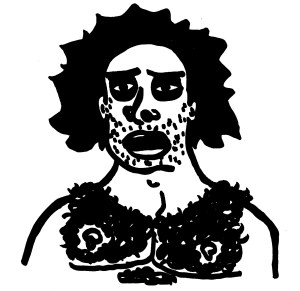
Bourbon Street mafia types abduct a swamp-dwelling sasquatch known as The Swamp Thing from the Louisiana bayous (played by rockabilly musician Sleepy La Beef) and force him to perform onstage as part of a cheap strip club act. In color! You can pretty much guess how the story plays out once the “monster” (a shirtless, hairy oaf with vague caveman features) is displayed for the public, assuming you’ve seen any monster-in-captivity movie released since 1933’s King Kong. The Exotic Ones delays those tedious plot concerns for as long as it can manage, though, saving the entirety of its creature feature narrative for its final half hour. Everything that precedes that third-act genre shift is just a parade of go-go dancers, burlesque performers, and various other salacious sideshow acts. Some slight attention is paid to fabricating a rivalry between the club’s newest act (a shy R&B singer who’s reluctant to strip for tips) and its long-established queen bee (a daredevil stripper with flaming titty tassels and drag queen eyebrows), but it doesn’t amount to much. You can guess which one the monster falls in love with once he arrives to the scene, can’t you? And which one taunts him into a rage? You’ve pretty much already seen this movie, outside the specific quirks of its strip routines, and the producers wisely pack the screen with as large of a variety of them as possible to keep you alert & entertained.

The Exotic Ones very quickly won me over as a fan with its opening newsreel-style introduction to New Orleans as a city – a rapid-fire montage that was clearly inspired by Russ Meyer’s strip club “documentary” Mondo Topless. Machine gun-paced cuts of strippers & French Quarter storefronts assault the audience as a beat-reporter narrator invites us onto “a street they call Bourbon” in a city that’s “sleepy by day, psychedelic by night.” It’s not exactly hyperbole when he describes Mardi Gras as “a time of reckless abandonment,” but the monologue is still deliciously overwritten & tonally chaotic – harshly juxtaposing a “Get a load of this filth!” moralism with tantalizing shots of naked, gyrating flesh. I personally loved seeing local 1960s sleaze-joints documented with the same reverent, drooling eye that was typically reserved for notorious prostitution hotspots like Amsterdam’s “Red Light District” or New York City’s 42nd Street porno theater strip. I don’t know that a New Orleans-specific remake of Mondo Topless disguised as a dirt-cheap monster movie is exactly the movie most audiences needed in their lives, but it is exactly the one I needed in mine.

Judging by most genre nerds’ boredom with the Ed Wood-penned Orgy of the Dead (a film I’m personally fond of, to my discredit), this movie’s 5% monster mayhem, 95% strip routines mixture will likely not win over everyone. The go-go strip routines and the surprisingly gory violence are both far more enthusiastically wild & erratic than those in Orgy, but you must already be on the hook for that genre imbalance for the formula to work on you. It seems that even the film’s own producers—June & Ron Ormond—weren’t entirely sold on the artistic merits of this kind of amoral hedonism. Shortly after The Exotic Ones‘s release (and a life-threatening plane crash) the couple shifted into making fire & brimstone Christian propaganda meant to scare audiences away from the temptations of Hell. Oh well. I personally could have watched a hundred Bourbon Street monster movies in this same vein, but no party lasts forever – not even the “reckless abandonment” of Mardi Gras.

-Brandon Ledet

Episode #104 of the Swampflix Podcast: Children of Paradise (1945) & New Orleans French Film Fest 2020

Welcome to Episode #104 of The Swampflix Podcast! For this episode, the podcast crew discusses all eight features they caught at the 2020 New Orleans French Film Festival, with a particular focus on the 1945 epic melodrama Children of Paradise – which is often cited as “the greatest French film of all time”.  Enjoy!

You can stay up to date with our podcast through SoundCloud, Spotify, iTunes, Stitcher, TuneIn, or by following the links on this page.

-James Cohn, Hanna Räsänen, CC Chapman, and Brandon Ledet

Krewe Divine 2020

In 2017, a few members of the Swampflix crew decided to finally grow up and get serious about Mardi Gras. We collectively shed our annual personal crises about what themes to include in our Fat Tuesday costuming by pooling our resources to pray at the altar of a single cinematic deity: Divine. Arguably the greatest drag queen of all time, Divine was the frequent collaborator & long-time muse of one of our favorite filmmakers, John Waters. Her influence on the pop culture landscape extends far beyond the Pope of Trash’s Dreamlanders era, however, emanating to as far-reaching places as the San Franciscan performers The Cockettes, the punkification of disco, RuPaul’s Drag Race, and Disney’s The Little Mermaid. Our intent was to honor the Queen of Filth in all her fabulously fucked-up glory by maintaining a new Mardi Gras tradition in Krewe Divine, a costuming krewe meant to masquerade in the French Quarter on every Fat Tuesday into perpetuity.

Our initial krewe was a small group of Swampflix contributors: site co-founders Brandon Ledet & Britnee Lombas, regular contributor CC Chapman, and repeat podcast guest Virginia Ruth. We were later joined by local drag performer Ce Ce V DeMenthe, who frequently pays tribute to Divine in her performances. There’s no telling how Krewe Divine will expand or evolve from here as we do our best to honor the Queen of Filth in the future, but for now, enjoy some pictures from our 2020 excursion, our fourth year in operation as Swampflix’s official Mardi Gras krewe:

Eat shit!
❤ Krewe Divine ❤

#NOFF2019 Ranked & Reviewed

Here we are almost two full months since the 30th annual New Orleans Film Festival concluded and I’m finally gathering all of titles I caught at the fest in one spot. CC & I already recorded a more fleshed-out recap of our festival experience on Episode #95 of the podcast, in case you’re interested in hearing about the goings-on at the handful of downtown theaters where the festival was held and the various short films that preceded some of those screenings. This list is a more bare-bones kind of recap: a ranking from the best to the . . . least best of the features we managed to catch at this year’s festival.

This year we focused entirely on boosting the profile of micro-budget indies that are unlikely to get wide theatrical distribution, skipping the New Orleans premieres for bigger titles like Jojo Rabbit, Knives Out, and Harriet. Each title includes a link to a corresponding review. Enjoy!

1. Swallow Appearing like a scared child in June Cleaver housewife drag, Bennett conveys a horrific lack of confidence & self-determination in every gesture. Her fragility & despondence under the control of her wealthy, emotionally abusive family make you want to celebrate her newfound, deeply personal path to fulfillment, even though it very well might kill her. As she snacks on fistfuls of garden soil while watching trash TV instead of obeying her family’s orders all I could think was “Good for her!”‘

2. Recorder: The Marion Stokes Project As Stokes’s D.I.Y. archive is an extensive cultural record of American society over the past thirty years, the list of trends & topics that could be explored in their own full-length documentaries are only as limited as an editor’s imagination. This film is an excellent primer on the cultural wealth archived in those VHS tapes, as it both explores larger ideas of how media reflects society back to itself and does full justice to the rogue political activist who did dozens & dozens of people’s work by assembling it.”

3. Gracefully “Smart to never allow the flashiness of its craft to overpower the inherent fasciation of its subject. When it does get noticeably artful in its framing & imagery, it’s only ever in service of its subject’s dancing—often showing him performing in pitch-black voids as if his D.I.Y. glamor was the only thing in the world that matters.”

4. Jezebel “Perrier doesn’t shy away from the exploitation or desperation that fueled her online sex work as a cash-strapped, near-homeless teen, but she’s equally honest about the joy, power, and self-discovery that line of work opened up to her at the time, making for a strikingly complex picture of an authentic, lived experience.”

5. A Great Lamp “Feels akin to the aimless slacker comedies of yesteryear – the kind of deliberately apathetic, glibly existential art that put names like Jarmusch & Linklater on the map back when Independent Filmmaking was first becoming a viable industry. It’s got the handheld, high-contrast black & white look of a zine in motion (and I’m sure many a Clerks knockoff from festivals past), evoking a bountiful history of D.I.Y. no-budget art. However, in both tone & sentiment there’s no way the film could have bene made by previous generations of artful slackers, as its heart is clearly rooted in a 2010s sensibility.”

6. Hunting for Hedonia “Most valuable for its ability to explain the full scope of Deep Brain Stimulation’s history in concise layman’s terms. It covers the horrific past of its abuse, the promising present of its success in the therapy field, and the terrifying future of its rapid, unavoidable escalation in a modern capitalist paradigm.”

7. The World is Full of Secrets “Plays like Are You Afraid of the Dark? reimagined as a traumatizing stage play or audio book – with long takes of sub-professional teen actors struggling to conquer unnecessarily complex monologues. What’s amazing about this set-up is that the film not only finds room to establish a genuinely creepy mood, but it’s often prankishly hilarious and light on its feet despite its potential for academic pretention.”

8. Pier Kids “Its personal, intimate documentation of a new, specific crop of homeless queer kids is just as essential as any past works – if not only as confirmation that the epidemic is still ongoing. These children are still out there taking care of themselves & each other with no end or solution to this cycle in sight. I do hope there will be a day when these documentaries are no longer such a regular routine, but only in the sense that I hope for a future where they’re no longer necessary. We’re not there yet.”

9. Reži “Even if the film is overall too frustrating to merit a hearty recommendation, the combatively prankish attitude it performs in every frame is too infectious to fully ignore – like so many festering stab wounds.”

10. Singular Whatever faults this might have as an overly reserved document of a wild, punches-throwing artist, it does have plenty of net benefits in pushing Cecile McLorin Salvant in front of an even wider audience. I imagine if you’ve never heard of her before this doc could play as a revelation that a Nina Simone-level genius is alive & working in plain sight, waiting for your eyes & ears. The contrast between her work & the doc’s reserved nature might even unintentionally emphasize her art’s subversive playfulness, which seeps through the concert footage despite the buttoned-up style of the interviews.”

-Brandon Ledet

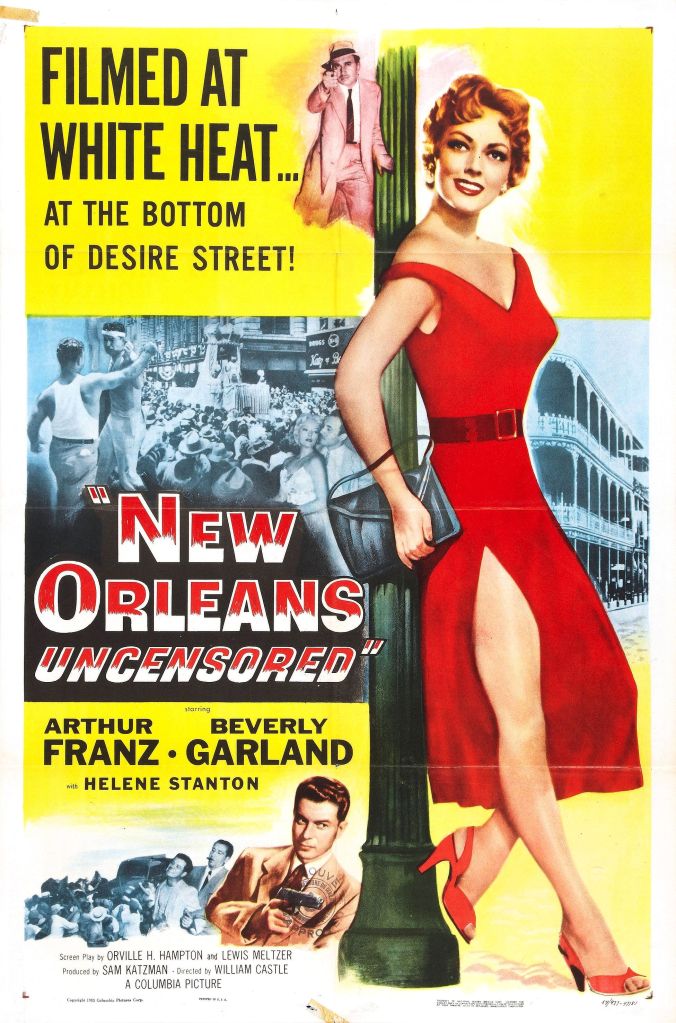
New Orleans Uncensored (1955)

The Prytania has been running an unofficial William Castle retrospective over the past few months as part of their ongoing Classic Movies series. That programming choice made a lot of sense around October, when Castle’s iconically kitschy team-ups with Vincent Price – The Tingler, The House on Haunted Hill, 13 Ghosts, etc. – where a perfect celebratory lead-up to Halloween. One Castle title just before that run stood out like a sore thumb, though, as it predated his infamous theatrical horror gimmicks and instead fell into a genre Castle isn’t often associated with. New Orleans Uncensored is a cheap-o, locally shot noir about corrupt shipping dock workers, much more in tune with films like Panic in the Streets than anything resembling the Percepto! or Emergo! horror gimmickry that later made Castle a legend. The director does find stray chances to exhibit his eye for striking, attention-grabbing imagery throughout the film, but for the most part his presence is overpowered by New Orleans itself, making the film more of a worthwhile curio for locals than it is for Castle fanatics.

Originally titled Riot on Pier 6, this film mostly concerns the organized crime rackets that had quietly, gradually overtaken hold of the second largest port in the U.S. Amazingly, it frames the suggestion that New Orleans government & business might be susceptible to corruption as a total shock; sixty years later it’s as obvious of a fact as the sky being blue. The docks themselves are portrayed as gruff working-class playpens where fistfights often break out en mass to the point where workers are recruited for professional boxing careers and assigned nicknames like “Scrappy.” This wild, bully-overrun schoolyard is controlled from behind the scenes by a few Dick Tracy-level mobster archetypes who tend to fire bullets instead of throwing punches, the cowards. We watch a naïve outsider who hopes to start his own legit shipping business at the docks get seduced by the power & convenience the existing mafia structure offers him instead; he then eventually helps the fine folks at the NOPD take those criminals down once he realizes the full scope of their corruption & violence. It’s all very surface-level, familiar noir territory.

The one distinguishing element of New Orleans Uncensored is the visual spectacle of its locale – a 1950s New Orleans backdrop that looks almost exactly the same half a century later. Whereas Panic in the Streets was a document of local faces & personalities, Castle’s film is actively interested in documenting the physical locations of the city like an excited sight-seeing tourist. Panic in the Streets was mostly contained at the shipping docks and backrooms that concerned its plot, while New Orleans Uncensored goes out of its way to capture as many of the city’s cultural hotspots as possible: Pontchartain Beach, The Court of Two Sisters, Jackson Square, French Quarter nightclubs, Canal Street float parades, etc. In one particularly egregious indulgence in sight-seeing, a couple shares a nightcap beignet at Café du Monde, claiming the ritual is “a traditional New Orleans way of saying goodnight.” It’s practically a tourism board television ad. Of course, as the title suggest, the appeal of this local sightseeing to outsiders is the city’s national reputation for sin & debauchery. The film’s plot about corrupt shipping dock companies getting their due punishment for their transgressions against social order is mostly an excuse for displaying as much sex, drunkenness, and Cajun-flavored merriment as the Hays Code would allow. That becomes a major problem in the snooze of third act when the tourism is sidelined to resolve the much less engaging mafia plot, but it’s fun while the good times last.

There isn’t much room for William Castle to show off this unique touch for attention-grabbing gimmickry & cheap-o surrealism while ogling “The Mistress of The Mississippi.” Outside an opening credits graphic where a disembodied hand stamps the word “UNCENSORED” on a map of the city and a drunken montage depicting an all-nighter of a couple partying until dawn in French Quarter nightclubs, Castle is fairly well behaved in his visual stylings. The closest the film comes to touching on his iconic gimmickry is the way the movie is presented as if it were a documentary instead of a fictional drama – bolstered by stock footage & news reel voiceover. However, that choice often reads as an Ed Woodian means of cutting financial corners more than some deliberate artistic vision. If anything, the movie does function as a genuine documentary, as its sightseeing record of a 1950s New Orleans is far more valuable & purposeful than its criminal conspiracy drama or its William Castle visual play. The history & personality of the city is far more pronounced than Castle’s here, and if the movie maintains any value as a cinematic artifact it’s in that local tourism.

-Brandon Ledet

Movies to See in New Orleans This Week: 2019 Persistence of Vision Horror Fest Edition

Persistence of Vision: A Three-Day Horror Film Event will be making its debut as a local film festival this weekend at the Three Keys venue inside The Ace Hotel. In collaboration with Creepy Fest, the weekend-long horror marathon will be screening a ton of classic genre titles (including The Descent, Poltergeist, Hocus Pocus, Shaun of the Dead, and An American Werewolf in London), along with new-to-New Orleans independent short films. The promoters explain on the event’s Facebook page, “Inspired by our current political climate—and our, like, actual real-life climate—we decided that the only way to make it to 2020 is to: #1 Feel all our feelings—like through catharsis while watching horror movies! #2 Gain a better understanding of the world of the world, and the part(s) we play in it.”

Listed below are the few films we’re most excited about that are screening at the festival, as well as a few other stand-out genre films screening throughout the city this weekend.

Selections from Persistence of Vision

Get Out (2017) – Swampflix’s favorite movie of 2017 is a staggeringly well-written work that has convincingly captured the current cultural zeitgeist, becoming instantly familiar & iconic in a way few movies have in our lifetime. It’s a horror film that families should watch together, especially if you have some f those white “I’m not racist, but” family members. Let it flow through you and inform you about the daily experiences of people of color in our country. Let it teach you a lesson about the power of cell phone video as a liberator, and about the frequent hypocrisy of white liberalism. Let it be the light for you in the dark (and sunken) places. Screening Friday 8/23, at the Ace Hotel

The Thing (1982) – John Carpenter’s classic cosmic horror is best experienced with a crowd in a proper theatrical environment, which is how I saw it for the first time at The Prytania in 2015. From my review after that screening: “The movie’s visuals are on-par with the best the director has ever crafted. The strange, rose-colored lighting of emergency flares & the sparse snow-covered Antarctica hellscape give the film an otherworldly look backed up, of course, by the foreign monstrosity of its titular alien beast.” Screening Friday 8/23 at the Ace Hotel

Vampire’s Kiss (1988) – The most absurd, bewildering, hilarious, upsetting, and absolutely essential Nic Cage performance to ever make it to the screen, which is no small feat. Preempts a lot of American Psycho’s themes & tones by casting Cage as a sociopathic businessman brute who gradually becomes convinced that he is, in fact, a vampire – a descent into madness that only looks more & more deranged from the outside looking in. Worth seeing alone for proof that Nicolas Cage can make even the simple act of reciting the alphabet the most compelling thing you’ve ever seen. Screening Sunday 8/25 at the Ace Hotel with live comedic commentary

Carrie (1976) – An iconic adaptation of Stephen King’s debut novel about a telekinetic teenage loner who’s pushed beyond her breaking point by her high school bullies and her extremely religious, abusive mother. Elevated by the auteurist vision of a young Brian De Palma and a stunning lead performance from Sissy Spacek. Screening Friday 8/23 at the Ace Hotel

Other Genre Films Playing Around New Orleans This Week

Phantasm (1979) – A late-70s indie horror cheapie (most recognized for its killer floating orb) that somehow earned a strong enough cult following that it spawned four sequels (the most recent of which was released in 2016). Screening in a new crisp digital restoration in the BYOB midnight slot at The Prytania on Friday 8/23 and Saturday 8/24

Desperate Living (1977) – My personal favorite John Waters film, and maybe the punkest thing about 1977. From Boomer’s review: “There are a lot of laughs to be had here if you’re in the right mood, and there’s also a lot of fetish fuel if you’re into that sort of thing, what with all the mesh shirts and leather pants floating around. Still, this is not a movie for the weak of stomach, or anyone who would find the detachment of a vestigial phallus odious. Recommended for lovers of the weird.” Screening free to the public (with donations encouraged) Thursday 8/22 at the LGBT Community Center of New Orleans as part of their ongoing Queer Root series.

Ready or Not Samara Weaving continues her delightfully over-the-top genre work after the underappreciated Netflix novelty The Babysitter & her brief appearance in Monster Trucks with this new high-concept schlock piece about a young bride who’s hunted on her wedding night by a wealthy family of board game industry tycoons she married into in a deadly game of Hide & Seek. Playing wide.

Scary Stories to Tell in the Dark A Guillermo del Toro-produced anthology horror adapted from a series of short stories that freaked us all out as children in the 80s & 90s. Playing wide.

-Brandon Ledet

Belizaire vs. Big Oil

While our current Movie of the Month, the 1986 historical drama Belizaire the Cajun, has been mostly lost to time in the outside world, Britnee reports that it remains a cult classic among Cajun communities down the Bayou. That’s presumably because Belizaire is one of the few large-scale movie productions to ever represent Cajun culture on the big screen, at least in a positive light. Many Louisiana Cajun archetypes who appeared onscreen pre-Belizaire were portrayed as scary backwoods local yokels who presented a danger to their respective protagonists but had no inner lives themselves. As writer-director Glen Pitre is himself from Cut Off, Louisiana, his approach in Belizaire the Cajun was naturally much more empathetic & intimately knowledgeable when focusing on representing Cajun people on the big screen. Belizaire the Cajun is a favorite among Cajun locals because it is a film about Cajun locals from a Cajun local, something that’s much more commonly seen in documentaries than it is in narrative features. It was not, however, the first film to empathetically portray Cajun people on the big screen at feature length. It was only the first to do so with out exploiting those people for the benefit of a major oil company.

The 1948 “docudrama” Louisiana Story is a much earlier and, unfortunately, much better-known film than Belizaire. Nominated for an Oscar in Best Writing and awarded a Pulitzer Prize for its musical compositions performed by the Philadelphia Symphony, the film was very much respected in its day. It was even recently restored by the Library of Congress to preserve its historical legacy. That prestige is likely due to the film’s director, Robert H. Flaherty, who had a reputation for making factually inaccurate but historically significant “documentaries” like Nanook of the North. Much like how Nanook of the North shamelessly fudges the facts of Inuit culture to increase its own value as an anthropological curio, Flaherty’s “documentation” of Louisiana Cajun culture in Louisiana Story from an outsider’s perspective is entirely a work of fiction. It’s on even shakier moral ground than Flaherty’s other “docudramas,” though, since it wasn’t merely lying about Cajun culture to increase its own entertainment value. It was also lying to Cajun people (and the world at large) about the cultural & environmental impact of drilling for crude oil in rural locales. Presenting itself as a document of a real-world truth was a boldfaced lie, as anything Louisiana Story documented about the Cajun lifestyle was an incidental result of its true mission: generating good PR for Standard Oil.

Louisiana Story actively attempts to cultivate the perception that it is merely a slice-of-life document of a rural Cajun community’s harmless, but awkward interactions with the industrialized modern world. An early title card self-describes the plot as “Being an account of certain adventures of a Cajun (Acadian) boy who lives in the marshlands of Petite Anse Bayou in Louisiana.” That’s true to a point, as much of the film follows a young boy travelling with his beloved pet raccoon on a pirogue in gator-infested swamps. The boy is non-verbal almost to the point of being feral, and long stretches of Louisiana Story play like a Silent Era nature documentary as a result. What that description doesn’t convey, though, is the funding Standard Oil poured into the production to promote happy feelings toward the concept of local oil drilling. The “certain adventures” this boy & his leashed raccoon embark on almost all revolve around the arrival of an oil rig in their local swamp. After his father allows an oil company to drill on family property, the boy finds himself both curious & terrified of the giant machinery that slurps oil out of the “ground” beneath him. Naturally, he’s gradually reassured of the drilling’s safety and local yokels everywhere are reassured that oil drilling puts food on families’ tables and a shiny new rifle in every young boys’ hands. God bless Standard Oil and God bless America.

What’s fascinating about Louisiana Story is that its greatest merits are in direct opposition with its oil-friendly message. In its best moments, it’s a gorgeous work that documents wetland environments that have been steadily disappearing over the seven decades since it was filmed. The irony there is that the oil industry is directly responsible for much of that wetlands erosion, which has left the state much more vulnerable to hurricane damage and loss of seafood & wildlife. This the exact kind of brilliantly executed, vile propaganda that does real-world damage, because it tricks people into believing corporations are our friends, that they have our best interests in mind. The Library of Congress was justified in finding this film worthy of preservation & restoration as its casting of long-gone local faces & landscapes is invaluable. Still, Louisiana Story only pretended to have an interest in empathetically portraying Cajun people on the big screen, when its true Standard Oil-approved mission was even more harmfully exploitative than contemporary genre films’ depiction of Cajuns as dangerous backwoods types. No wonder Belizaire the Cajun felt like a breath of fresh air in the limited lung capacity of Cajun pop media. It may not be as artistically refined as Louisiana Story or as continuously entertaining as other outsider views of Cajun culture strewn about various crime thrillers, but it did offer something to Cajun people no other narrative feature had before: respect.

For more on May’s Movie of the Month, the 1986 historical drama Belizaire the Cajun,check out our Swampchat discussion of the film, this look at its modernized counterpoint, Dirty Rice (1997), and last week’s examination of an IMAX-scale Katrina documentary from its director.

-Brandon Ledet
Movies to See in New Orleans This Week: The Overlook Film Fest Edition

Last year’s sudden appearance of the Overlook Film Festival on the local calendar was an unholy, unexpected blessing. There are only a few substantial film fests that are staged in New Orleans every year, so for an international horror film festival with world premieres of Big Deal genre movies to land in our city was a major boon, almost too good to be true. I attended the festival as a volunteer, catching three artsy-fartsy creature features (all directed by women) and a couple live podcast recordings over the course of a few days, hungry (bloodthirsty?) for more. This year, Swampflix will be attending Overlook with legitimate press credentials, meaning we’ll be able to cover even more films playing at the fest – a prospect I’m incredibly excited about.

The trick is knowing what films to cover. There are 23 features and 18 shorts from 11 different countries screening at the festival over the course of a single weekend. It’s overwhelming. Self-described as “a summer camp for genre fans,” The Overlook is centrally located, corralling all of its movie screenings to just a few venues: Le Petit Theatre for its more prestigious premieres, the UNO Performing Arts Center for a repertory screening of The Faculty (with Robert Rodriguez in attendance), and what is now the ghost of the old Canal Place theater for the bulk of its heavy-lifting. That means you can pack in a lot of movies in a very short time. You just need to know how to narrow down your selections.

Personally, I like to use film fests as an opportunity to see smaller films that are unlikely to get wide theatrical distribution otherwise, as opposed to bigger movies I know I can see at a corporate multiplex just a few weeks later. It’s incredibly cool that The Overlook will be hosting early screenings of Jim Jarmusch’s The Dead Don’t Die, the follow-up to Goodnight Mommy (The Lodge), and the upcoming Octavia Spencer psychobiddy revival Ma, but I plan on catching those a little later down the line. Listed below are ten genre films I’m incredibly excited about that are screening at The Overlook Film Festival this weekend but most likely will not play in a proper New Orleans cinema otherwise. Take advantage of this super cool genre film extravaganza before they leave us for another city (which is entirely possible, given the recent death of the Canal Place theater) by catching something offbeat & adventurous that you wouldn’t be able to see projected large & loud in any other context.
In Fabric : “At the height of winter sales in a modern UK department stores, a cursed dress passes from owner to owner, leaving a path of destruction in its wake in this wry, visionary comedy from the director of Berberian Sound Studio and The Duke of Burgundy.Friday, May 31st – 4:30 PM – Le Petit Theatre & Saturday, June 1st – 7:15 PM – Canal Place

Greener Grass : “Writers, directors and stars Jocelyn DeBooer and Dawn Luebbe create a hilariously deadpan hellscape of competitive suburbia with a boldly stylized absurdist chain of events that unfurls with increasing fervor after one soccer mom asks her best friend for her baby.” Friday, May 31st – 8:00 PM – Canal Place & Saturday, June 1st – 9:45 PM – Canal Place

One Cut of the Dead : “In one of the year’s most crowd-pleasing surprises, this twisty horror comedy sees chaos ensue when a low-budget film crew, hard at work on a zombie flick in a WWII bunker, comes face to face with real terror lurking outside.” Friday, May 31st – 3:30 PM – Canal Place & Sunday, June 2nd – 7:45 PM – Le Petit Theatre

Paradise Hills : “With razor-sharp artistic direction and searing wit, Alice Waddington’s directorial debut tells the story in which a young girl is sent to a mysterious reform school specializing in crafting ladies to be more ‘proper.'” Friday, May 31st – 12:30 PM – Canal Place & Sunday, June 2nd – 7:15 PM – Canal Place

Horror Noire : “A free community screening and panel discussion of this refreshing and incisive documentary tracing the history of Black Americans in Hollywood within the horror genre. Hear from Jordan Peele (Get Out), Tony Todd (Candyman), Rachel True (The Craft), Keith David (The Thing) and many more about representation in our favorite genre from the beginning of cinema to today.” Sunday, June 2nd – 2:45 PM – Le Petit Theatre

Come to Daddy : “Norval, a troubled young man travels to a small seaside town to answer a letter from his long-lost father. When he gets there, the two begin to reconnect, but Norval can’t shake the feeling that something is drastically off. Elijah Wood stars in this hilarious and terrifying twisty thrill ride, the directorial debut of lauded horror producer Ant Timpson.” Friday, May 31st – 7:00 PM – Le Petit Theatre

Knives and Skin : “Calling upon echoes of Twin Peaks, artist and filmmaker Jennifer Reeder serves up an eerie teen noir punctuated with haunting 80s covers and unforgettable imagery centering around the effects of one girls’ disappearance on a small town.” Saturday, June 1st – 2:45 PM – Canal Place & Sunday, June 2nd – 12:15 PM – Canal Place

Satanic Panic : “When a pizza delivery girls’ final order of the night turns out to be for a blood-hungry group of Satanists thirsting for a sacrifice, all hell breaks loose…literally. From the Overlook alum writers of We Are Still Here and Paperbacks from Hell, and director Chelsea Stardust comes the goriest of comedies.” Friday, May 31st – 9:30 PM – Le Petit Theatre & Sunday, June 2nd – 7:00 PM – Canal Place

Vast of Night : “First-time filmmaker Andrew Patterson smashes onto the scene with the elegant telling of a 1950s radio DJ and his switchboard operator companion, who stumble upon a strange frequency that may be carrying evidence of other-worldly life.” Saturday, June 1st – 12:00 PM – Canal Place & Sunday, June 2nd – 12:30 PM – Le Petit Theatre

Porno : “Equal parts hilarious and grotesque, this take-no-prisoners horror sex comedy sees a group of ultra-Christian movie theater employees face their worst fears when a mysterious set of pornographic reels releases a little more than their repressed desires.” Thursday, May 30th – 9:30 PM – Canal Place & Saturday, June 1st – 4:30 PM – Canal Place

-Brandon Ledet