
Freaks vs. The Reich (2023)

I’ve been struggling to find much to get excited about in theaters lately, now that “Summer” Blockbuster Season has encroached well into Spring, and multiplex marquees are once again all superheroes all of the time.  The general vibe among moviegoing audiences is that the superhero era is winding down post-Endgame, but it’s going to take a long time for Hollywood studios to adjust to that dwindling enthusiasm, since these billion-dollar behemoths take years to produce & market.  Personally, I’m so deeply, incurably bored by American superhero media that I’m avoiding all four-quadrant crowd-pleasers out there, not just the usual suspects like the new Guardians, the new Ant-Man, and the new Shazam.  If I stare at the poster or trailer for any tentpole blockbuster above a 6-figure production budget for long enough, they all appear to follow the same MCU superhero action template.  Super Mario Bros, Dungeons & Dragons, and Fast X are all essentially superhero movies to me, each with their own invincible, quippy gods among men who save the day by extending their IP.  I can’t hide from the new release calendar forever, though, so I need to re-learn how to enjoy a superhero movie or two until Hollywood fully moves onto the next money-printing fad.  Given that there are already dozens of Marvel & DC movies slated for release over the next few summers, it’s likely going to take a long time for this lumbering industry to correct course.  So, it’s somewhat fortuitous that the Italian supernatural action epic Freaks vs. The Reich finally landed a US release in this dire time of need, after years of stumbling over international distribution hurdles.  It’s the most convincing evidence I’ve seen in a while that there is still some juice left in the superhero genre, despite Hollywood’s determination to squeeze it dry and pummel the rind.

If there’s anything more frustratingly slow than Hollywood’s response to public appetite, it’s the distribution of international art films, which often fall into a years-long limbo between their initial festival runs and their wide US premieres.  I’ve been waiting to see Freaks vs. The Reich for so long that its earliest roadblocks were COVID related, and its original title has since been changed to give it a fresher, more recognizable appeal.  I suppose rebranding the film from Freaks Out to its new, more descriptive title is a useful warning for the shocking amount of Nazi imagery you’ll find in this supernatural circus sideshow fantasy.  It also helps explain why it’s so easy to cheer on the titular, superpowered freaks who take those Nazis down.  I wonder if some of its distribution delays had to do with clearing song rights, since the main Nazi supervillain in question abuses ether to mentally time-travel into the future, returning to the battlefields of WWII with visions of smartphones, video game controllers, and old-timey renditions of Radiohead’s “Creep” & Guns N’ Roses’ “Sweet Child o’ Mine.”  The inclusion of “Creep” is important to note there, since the song also happens to be featured in the more traditional, straightforward superhero epic Guardians of the Galaxy Vol. 3, which is currently eating up a grotesque amount of American screen space.  Whether you think it’s more interesting to hear that song played on a Spotify algorithm mixtape to evoke easy nostalgia points or performed by a drugged-out, time-traveling Nazi supervillain is a question of taste, but I can at least personally attest to appreciating a sense of variety within this oppressively omnipresent genre template.

Freaks vs. The Reich opens with a full circus sideshow act, introducing our Italian superhero freaks one at a time as they show off their individual talents – a magnetic dwarf, an electric ballerina, a real-life wolf-man, etc.  Before they can bow for audience applause, however, their tent is blown to shreds by Nazi warplanes, and they spend the rest of the movie rebuilding the team so they can end the war themselves.  Caught up in concentration camp processing, Italian militia resistance, and general wartime disorientation, they are all eventually reunited by the ether-huffing, time-travelling Nazi who’s convinced he can win the war for Hitler if he assembles the freaks to fight for Deutschland.  This all culminates in a grand superpowers battle in an open field (the way most superhero epics do), and I will admit that the journey to get to that predetermined conclusion can be a little overlong & draining (the way most superhero epics are).  There’s at least some novelty in the film’s antique circus sideshow aesthetic and WWII historical contexts, though, and novelty is a precious commodity for a genre that’s been so prevalent over the past decade.  It’s like watching the cast of Miss Peregrine’s Home for Peculiar Children act out the plot of Guillermo del Toro’s stop-motion Pinocchio on the leftover sets of Matteo Garrone’s live-action Pinocchio – an antique Italo horror show.  You won’t find that kind of aesthetic deviance in the upcoming Flash or Captain Marvel sequels, which you can pretty much already picture start to end in your head sight-unseen.  These superhero freaks are flawed, messy, and they fuck, including the wolfman archetype in what has to be the hairiest sex scene since The Howling Part II: Your Sister is a Werewolf.  Meanwhile, Marvel & DC are still stubbornly stuck in a chaste, sanitized universe where “everyone is beautiful and no one is horny.”  They also murder Nazis, a universally agreeable target that hasn’t been attacked with such sincere patriotism since Marvel peaked in 2011 with Captain America: The First Avenger.

I’m probably doing this movie no favors by comparing it against American superhero media, since everyone’s starting to feel the same way about the genre as we felt about zombie media 17 seasons into The Walking Dead: numbly apathetic.  Within that context, though, it’s a breath of fresh ether – one of the strangest, most upsetting superhero stories since James Gunn made Super, at least five James Gunn superhero movies ago.  Maybe Freaks vs. The Reich would have fared better before our culture-wide superhero fatigue fully settled (it was initially set to be released less than a year after Endgame), but I personally needed it now more than ever, just so something in this genre didn’t look like a total snooze.

-Brandon Ledet

Guardians of the Galaxy Vol. 3 (2023)

Things sure do seem awfully final these days, don’t they? There’s a part of my brain lighting up right now that hasn’t been active since my last days of high school, alongside parts of my brain that hadn’t felt this flush with fear hormones since the last time I was worried about the Rapture. Past lovers have reappeared at a rate of about one per month since last summer like my own personal Broken Flowers, a succession of insights into the me that could have been. Things are so dark and bleak sometimes that I’m not really sure what to do with myself. So much of what I’ve been seeing and writing about lately are about completion, ending, and finalizing triptychs that it feels pervasive. Then again, I’ve always had an unfortunate tendency toward apophenia, and my brain chemicals have been all over the place since, within the past two weeks, I spent days upon days expecting that I was going to have to put down my elderly cat (he rebounded, the little comeback king—he’s dying, but not today, and not this week). It’s also theorized that the human brain is wired to find patterns even where none exist, and since the smallest number of “things” in which we can find patterns is three, it’s possible there’s something innate and instinctual in humans that causes us to see triptychs and trilogies and triads and three-part godheads as complete. We’ve known this for hundreds of years, given that Aristotle wrote in RhetoricOmne trium perfectum”—essentially, “Everything that comes in threes is perfect,”—in the 4th century B.C.E. Brandon and I texted about this recently, as he wanted to give me the chance to write about Beau is Afraid before he took a crack at it since I had covered both Hereditary and Midsommar. Also relatively recently, and more in line with what we’re talking about today, I wrote about how I went to see the most recent Ant-Man out of a sense of obligation to close out the third and final part of something that had relevant sentimental value to me as a person and as a member of this site. 

I wasn’t planning to see this movie in theaters, if at all, ever. No one’s public persona is 100% accurate to them as a person, but Chris Pratt’s bungling of the goodwill that Parks & Rec and the first film in this series bought him via (at best) poorly conceived social media posts has made me not really all that interested in seeing him in a big budget film. I don’t expect celebrities to adhere to an old-fashioned studio contract morals code, and I appreciate that people in the public eye are expected not only to tolerate the fact that they have virtually no privacy but to even use what little privacy they have to essentially buy more stock in the interest economy by posting their private moments to their verified social media accounts. I really do. But man, there was something about that post about having a healthy child with his new wife that left a really bad taste in my mouth, even if it wasn’t an intentional dig at ex-wife Anna Faris or a reference to their special needs son; it churned my stomach. On top of that, I just haven’t been able to make myself care much about the MCU, as I’ve mentioned the last few times I’ve covered it, and with that last Ant-Man being such a miss for me, I can’t work up the interest to check these things out most of the time, let alone the compulsion. But, on a night when all my friends had plans and I was facing some pretty strong writer’s block, I took my MoviePass down to the [redacted] and I got myself a hot dog and a blue ICEE and sat in a sparsely populated theater on what seems like it’s the last of these. And it was good. 

Guardians of the Galaxy vol. 3 opens on a downbeat note. Peter Quill (Pratt) is still in mourning for the loss of Gamora (Zoe Saldana) in Infinity War, a situation exacerbated by the fact that a different, time-displaced version of Gamora from before the two met now exists somewhere out there, not caring at all about his existence. The Guardians have settled in on Knowhere, which you may (and are expected to) remember as the severed head of a long-dead god-adjacent being. A depressed Rocket (Bradley Cooper) is forcing an entire settlement of people to listen to Radiohead’s “Creep” over the loudspeakers and as a former radio DJ who struggled with mental health issues, I have to say: relatable. His reverie is interrupted by the arrival of Adam Warlock (Will Poulter), who puts our little raccoon friend into a coma, and the Guardians are unable to use their handy automated medical equipment because there’s a kill switch on his heart. You see, the man who cyborgified Rocket in the first place, the High Evolutionary (Chukwudi Iwuji) left behind a failsafe to protect his proprietary interest in Rocket, whom he is attempting to recapture. Nebula (Karen Gillan) proposes that they reach out to one of her contacts who might be able to get the group inside the headquarters of the H.E.’s megacorp and get the shutdown code for the kill switch so that they can get Rocket medical help before he dies. This involves the rest of the team, including Mantis (Pom Klementieff), Groot (Vin Diesel), and Drax (Dave Bautista), reuniting with the version of Gamora who does not know them. It’s not as simple as all of that, of course, as the attempted heist goes awry and requires them to track down the Evolutionary himself, with all the unusual fleshy detail that we’ve come to expect from James Gunn, a jailbreak of nice Village of the Damned kids, a telepathic dog feuding with Kirk from Gilmore Girls, an octopus man selling drugs in a back alley, bat people, and unexpected needle drops from the likes of Florence + the Machine and Flaming Lips. As this plays out, extended comatose flashbacks reveal the extent of the torturous experimentation that left Rocket the difficult, bristly, prosthetic-obsessed sapient Procyon lotor about whom we’ve all been suspending our disbelief for the past eight years. 

There’s a lot more going on thematically in these movies than in the other recent products/content than this organization is creating, and as a result there’s a narrative cohesion here where all three movies are in greater communication with one another than, say, the Thor movies, which went from decent origin story to dour table-setting to wacky throwback comedy to whatever happened in Love and Thunder (I don’t know; I didn’t see it). On a very surface level, these movies, like a lot of Gunn’s work, can be described as a feature length Creepy Crawlers commercial, but there’s something that’s genuine here underneath all of that, and more moving than it really has any right to be. Personally, I think that the scenes in which we see Rocket bond with other more abominable abominations that have been experimented upon by the High Evolutionary set foot a few inches over the line into saccharine territory, but schmaltz, like beauty, is in the eye of the beholder. It’s a foregone conclusion that the sweet otter character voiced by Linda Cardellini at her most warm isn’t making it out of those flashbacks alive, so you’re never able to relax and appreciate the scenes that they’re in because the other shoe is always hovering just out of frame, ready to drop. In the interest of full disclosure, I have to admit that seeing the frail and dying body of Rocket hit me personally because of the resemblance to the recent extreme health situation of my cat; it ended up pushing too far into the treacly territory for me as a result, but that won’t be the case for everyone, and hasn’t been based on the reviews I’ve seen. 

These movies are about fathers, and about god, and about the fact that we (in the west at least) form our images of what constitutes “god” around the concept of “father.” In the first film, Gamora and Nebula are constantly at each other’s throats to prove themselves to their shared father, Peter viewed Yondu (Michael Rooker) as his surrogate father even though the man had actually kidnapped him as a child, and Drax’s motivation to join the team was as vengeance for his lost wife and daughter. The second film saw Peter meeting his biological father, who was also, in many ways, a living god; Yondu sacrifices himself for his surrogate sons and finds meaning in bettering himself through fatherhood, and Gamora encourages Nebula to break free from the influence of their father as she has. Peter’s father being a nigh-omnipotent living planet was a kind of apotheosizing of that father-as-god concept. Now, in this third and presumed final film, the narrative is once again focused on the relationship between one of these characters and their father/creator, but this time it’s Rocket, and it plays out as a story about a god who, in seeking an ephemeral “perfection,” created something that he didn’t understand and which threatened his ego by demonstrating the ability to exceed the creator’s own intelligence. That’s not normally the kind of story that’s told through creator and creation; that’s the story of a father and the son upon whom he heaps all of his own insecurities and coping mechanisms. Beyond that, the jailbreak mentioned above ends with Drax finding himself with the opportunity to be a father again, in a new way.

I’ve mentioned in the past that I often divide finales/endings, at least of mass media, into two broad categories: the “Everybody goes their separate ways” ending and the “The adventure continues” ending. They’re both equally valid, conceptually, and the former is frequently the right narrative choice for a broad spectrum of stories; sometimes a piece of fiction ends in a place where characters have no choice other than to separate, but that doesn’t mean that I’m not sometimes bummed out by them. They can’t all be “God bless the brick house that was! God bless the brick house that is to be!” This is a definitive finale, and I don’t think it’s a surprise that the ending, despite concluding on an optimistic note, left me a little blue. That’s not to say that there weren’t jokes aplenty here (it took me until about the halfway mark for me to reach a point where it felt right to laugh, despite many gags throughout), but there’s a surge of love for the movie that feels more like people are just happy that there’s a good Marvel movie that everyone went to see rather than interacting with the text directly, because the text is weird in a way that mainstream audiences are normally more squeamish about. There were moments that made me think of Basket Case 2, of all things, which is a strange thing to say about a movie in this larger franchise, owned and operated by a monopolistic media empire. The consensus on this one is positive, and you can count me amongst that number, but at this point, these films have to advocate for themselves or not. This one does.

-Mark “Boomer” Redmond

Ant-Man and the Wasp: Quantumania (2023)

“There’s always room to grow” is one of the arc phrases in Ant-Man and the Wasp: Quantumania. The words first appear at the end of the opening narration for the film, which is also revealed to be the closing thought of the book that Scott Lang (Paul Rudd) has written about his experiences; they reappear close to the end, when Hank Pym (Michael Douglas) confirms that he read the book by repeating those words back to Scott when he needs to hear them. Unfortunately, when it comes to linking this film series with the concept of growth, I fear that, in my case, I may have outgrown it. In just a few short months, it will be 8 years that I’ve been writing for Swampflix, and as I reminded everyone in my review of Ant-Man and the Wasp, the first review that I ever wrote for the site was of the first Ant-Man, lo these many moons ago. There are many things that are fitting: that my 200th review on the site should also be about an Ant-Man flick, and that the returns on this series, like its hero, keep diminishing. 

(By the way, if that 200 seems low, it’s because it doesn’t include the 66 podcasts, 75 Movies of the Month, 13 “issues” of Agents of S.W.A.M.P.F.L.I.X., countless lists, occasional rebuttals, and various other sundry tidbits. One time I even recounted a Q&A with Richard Kelly at a screening of Southland Tales without mentioning the fact that I had to explain to a server at the Drafthouse that I wanted to order food but wanted to wait until after the lights went down because I didn’t want Kelly to see me eat. I am a neurotic, but even I have my limits about how much of myself I’ll reveal in these writings, at least until my own self-imposed statute of limitations runs out. Longtime readers are no doubt shocked and horrified to realize that my content over these past 8 years has actually been me reining it in.) 

I almost didn’t see this one in the theater. But just like fascism, MoviePass is back, and I got activated mid-month so I had a few credits left after seeing Cocaine Bear (it’s on a credits system now, it’s a whole thing); still, I thought I would go out, hit the drive-through car wash because it’s been a while, then drive over to the local art theatre, check in for something that was playing tonight and then walk up to the box office and buy a ticket for a future showing (they’re screening La règle du jeu this week!). Maybe it was the way that the flashing lights and the spinning brushes of the car wash made me think about that Scorsese quote about how Marvel movies are just theme park rides and it triggered something deep in the lizard parts of my brain; maybe the psychedelic, bubble gum-scented lather was sufficiently like the quantum realm (lol) to activate me like a sleeper agent who’s been programmed by unskippable ads. I don’t know exactly what happened, but somehow, in spite of myself, I found myself at the mainstream multiplex with a chili cheese hot dog on a stale bun and a blue high fructose corn syrup slush staring up at Paul Rudd’s face in 3-D because I didn’t realize that was happening until the cashier handed me the glasses and it was too late to turn back. 

Anyway, it’s been a minute since Scott and his partner Hope van Dyne (Evangeline Lilly, who sucks) helped save the world back in Avengers: Endgame. For all intents and purposes, Scott is a celebrity, being recognized on the street and getting free coffee, not to mention being formally awarded “Employee of the Century” at the Baskin Robbins from which he was fired in the first film when his background check flagged him as an ex-con. Hope, who is barely in this movie for someone whose nom de guerre is in the title, has retaken control of her father’s company and is using its resources to assist in post-Snap recovery efforts. Hank and Janet (Michelle Pfeiffer) are retired or whatever, and if you’re wondering what’s happening with Luis (Michael Peña), Kurt (David Dastmalchian), or Dave (T.I.), you’re just gonna have to write your own fan-fiction for that, my friend, because this movie doesn’t feature or even mention them. Scott’s ex-wife Maggie (Judy Greer) exists solely as an offscreen presence who isn’t even mentioned by name and is referred to solely as “your mom” and “mom” by Scott and his daughter, respectively. Said daughter, Cassie, has been recast with Kathryn Newton, and she’s also been doing some offscreen work following in both her father and her presumed step-mother’s footsteps: getting into trouble with the law like Scott, and working on some quantum realm gobbledygook like Hope. With the whole Ant family gathered, Cassie turns on her thingamabob and explains that it works by sending a signal down into the quantum realm—henceforth QR—prompting Janet to freak out and tell her to turn it off, but the damage is already done, and all five of them, plus some hyperintelligent ants that Hank has been working on, get sucked into the QR for the duration of the movie. 

The first act of this movie is interminable. There’s somehow both far too little and far too much exposition, and right from the start there’s something that’s off. We all love Paul Rudd, but in the other films, he had a larger, funnier supporting cast, and the comedy didn’t rely on Rudd alone, since he frequently got to play off of his old heist crew and their various idiosyncrasies, Maggie and her new husband and the dynamic of that whole situation, and others. Here, everyone is dreadfully and deathly serious all the time: Hope and Scott are apart for so much of this movie that they barely interact, Michelle Pfeiffer is doing some real heavy lifting with a character that apparently wasn’t written to crack a smile ever, Cassie’s a teenager now and the adorable dynamic of yesteryear is morphed into something more obvious and dull, and Kang (Jonathan Majors) has such an air of unrelenting arch sovereignty that he never exchanges even one quip with Scott. There are some minor comic relief characters, including a single scene of Bill Murray as Lord Krylar, but it’s just Murray doing his post-Lost in Translation schtick, which you either love or find exhausting, and it all feels very gratuitous. William Jackson Harper is here but gets a single one-liner in the climax, and he feels wasted in a thankless role. Elsewhere in the QR, there are a gaggle of assorted oddballs and weird creatures, one of whom looks like a cross between a throwable book fair sticky alien and one of those plastic models of your intestines that are always sitting in the examination room at the doctor’s office; there’s a neat effect where there’s a rippling in its membrane where a mouth would be when it talks that impressed me, and the character itself is a thing that creates ooze that acts as a translation which is inherently funny, and they’re also very curious about what it’s like to be a living thing with orifices. It’s the most inspired thing in this movie, and even though the bit gets a little tired before the film ends, it’s worth noting that there are some attempts to carry on with the comedic tone that we’ve come to expect of the man who befriends ants. 

The middle of this movie is better in some places, and the film starts to pick up at around the halfway mark. Watching Pfeiffer’s Janet constantly ignore her family’s desperate pleas for an explanation of what’s happening around them while she just goes about her business reminded me of that scene in the Simpsons episode “Lemon of Troy” when Nelson tells the other kids that “there’s no time to explain” and then spends quite some time reiterating that statement as they make their way across town. There’s no character reason why she would have kept the truth about her time in the QR a secret from both her husband and her daughter, and then when they end up in the QR, they cross vast distances in which she would and should have had plenty of time to explain what’s happening. At one point, she does an entire charades routine to open the door to a bar, and we watch the whole thing happen while Hank and Hope beg her to explain, and we feel the same way. There’s a line between doling out information slowly to keep the audience engaged and frustrating the audience by having characters refuse to communicate with no reason to do so. It’s not even a fine line, and Quantumania spends a lot of time on the wrong side of it. Once we get the powerpoint presentation of exposition about how Kang and Janet found each other and tried to work together, then she realized he was a monster bent on domination like Thanos but again and more because there’s a multiverse now, so she sabotaged his ability to get out of the QR and thus confined his supervillainy to one place, yadda yadda yadda, the film picks up the pace. After nearly an hour of being annoyed at the transparent attempt to build drama, it’s a welcome relief when we can move on with the plot. 

Beside the lack of a chorus of characters whom the audience knows to banter with Scott, and the utter absence of anything resembling a heist, there’s something just as vital missing here: the juxtaposition of big worlds and tiny people. That’s what I love! That’s what gets the imagination going! You gotta see kids eating a giant Oreo like in Honey, I Shrunk the Kids or chess pieces used as objet d’art as in The Borrowers, and we got that in both of the previous movies, whether it was a giant Hello Kitty PEZ dispenser bouncing down the highway or a cutaway from an epic (but tiny) battle to remind the viewer that the oncoming train is just a toy of Thomas the Tank Engine. The closest we get is a scene in which Hank uses Pym particles to make a pizza bigger, which is cute but doesn’t make much of an impression. One action sequence in particular, set at night and in a “desert,” is so muddy that it’s almost impossible to tell what’s happening, and it can’t all be blamed on the 3D conversion. The other big sequences call to mind Star Wars, and I don’t mean that in a good way. The attack on Kang’s fortress at the end is inspired by a not-particularly-inspiring speech from Cassie about not lying down and taking it anymore, but the entire tableaux (there’s an awful lot of French in this review, isn’t there?) looks like it was designed at the behest of the studio so that they could have a platformer level in the tie-in LucasArts release. It’s aping Star Wars in a not-very-interesting way but with a budget that’s sky high, so that instead of feeling like a fun, modern superhero story, it feels like a really high budget remake of Spacehunter: Adventures in the Forbidden Zone after wandering around in Valerian-by-way-of-Annihilation for half an hour. While watching the climax, all I could think about was that horseback attack on the hull of a spacecraft from Rise of Skywalker — again, not a compliment. 

All of that being said, I was very pleased when the movie remembered that one of the other cornerstones of Ant-Man is, well, the ants. The movie won me back over a little bit when the ants who got sucked into the QR returned. They reappear in the wake of a big “the cavalry’s here” moment that doesn’t feel earned and is completely underwhelming as a result, but I can’t lie, I love those big ants. Ants! Ants! Everything else that gave these movies a different personality from the other Marvel fare may be jettisoned, but at least we got the ants making it possible to save the day, and I was helpless to that particular bizarre charm. Not enough to turn my opinion all the way around, but it bears mentioning. 

It’s been a long road, getting from there to here. It’s been a long time since I’ve really been able to muster up any interest in a Marvel release, and even though I went to this one as if in a trance, it was still because I had some interest (ants!), and I’m just not sure I have that in me anymore. But don’t worry about me, dear reader. Marvel may have gone to the well too many times, but I’m still just getting started, and you’re not rid of me yet. Now on to the next 200.

-Mark “Boomer” Redmond

Keep On Morbin in the Free World

I saw Morbius opening weekend at the behest of a very sweet, very misguided coworker who thinks Jared Leto is hot.  It was a bore.  I struggled to remain awake through our 10 a.m. screening, the details of which linger only as a fuzzy grey mold at the edges of my brain.  There is no camp value to Morbius.  There’s nothing of value to the film at all, except maybe as a cool-down reminder that Jared Leto is a tedious drip after he accidentally delivered his first entertaining performance in House of Gucci.  And yet, Morbius has been resurrected as an unlikely meme in recent weeks.  Ironic shitposting of phrases like “It’s Morbin time” and “You got Morbed” have raised the profile of this flavorless gruel as if it were a so-bad-it’s-good delicacy worthy of re-evaluation.  As a result, online knuckleheads around the world are tricking themselves into watching Morbius for hatewatching kicks, and it’s difficult to feel anything but pity for them.  There’s nothing there.  Morbius is not interesting enough to be funny or entertaining, even “ironically”; it’s barely interesting enough to keep you awake.

I can’t be too harsh on the irony-seeking looky-loos who’ve been tricked into watching Morbius by a few well-timed memes.  I, too, am a recent victim of grassroots meme marketing, and my mistake also falls under the ever-expanding umbrella of Spider-Man Content.  After years of seeing it .gifed & memed into oblivion, I somehow became convinced that Sam Raimi’s Spider-Man 3 had potential as an unsung camp classic with misleading nerdboy rage souring its critical reputation.  One library loan later, I feel like I’ve been Morbed.  Based on the memes, I assumed Spider-Man 3 was entirely about Peter Parker going dark-sided goth.  I pictured the Venom symbiote rotting his brain by brushing greasy bangs in front of his eyes and transforming him into the toxic indie scene boyfriend of your nightmares.  I was only partly right.  All of the fun images of Emo Parker strutting, shooting finger guns, and dancing the roof off his favorite jazz club were from a brief fifteen-minute stretch of the film.  The rest of it is just a typical, bloated superhero actioner.  There it not nearly enough Spider-Bangs content to make Spider-Man 3 stand out as a novelty, no matter how fun it looks from a digital distance.

There’s probably a lesson here about how a movie’s meme potential does not directly translate into entertainment value, but I’m refusing to learn it.  As frustrating as Spider-Man 3 is for withholding its novelty goth content for a brief stretch in its second act, I wasn’t mad that I watched it.  There’s enough goofy retro Saturday Morning Cartoon charm to the Sam Raimi Spider-Man cycle that its worst entry is still passably entertaining.  If nothing else, there was plenty of surreally dated CG action to go around, and Danny Elfman’s score kept the mood light.  I doubt that the poor souls who are allowing Mighty Morbin memes to trick them into watching Morbius are coming out the other end equally unscathed.  If they’re somehow convincing themselves that joking with friends over that filmic void is more fun than joking around while staring at a blank wall, though, I’m not here to spoil their good time.  Morb on, you crazy diamonds.  There’s an endless supply of much more vibrantly entertaining, so-bad-it’s-good novelties out there they could be genuinely enjoying instead, but the indulgence is only going to hurt themselves.  It’s pretty harmless otherwise.

The only potential harm in ironic Morbius “enjoyment” is that it might convince Sony there’s an appetite for a Morbius 2 out there, but that result would be much funnier than even the mediocre memes that inspire it.  The worst-case scenario is that the studio pays Jared Leto a grotesque amount of money to say “It’s morbin time” on camera, and just as few people show up in theaters to hear it; I’m not going to lose any sleep over Morbius 2 bombing.  It would actually be nice to have a reason to laugh at Morbius content for the very first time.  The best-case scenario is the unlikely possibility that a Morbius 2 is actually as fun as people are pretending Morbius 1 is, which can only be a boon.  Even Spider-Man 3 earned some retroactive appreciation after the recent Spider-Man: Oops! All Spider-Men free-for-all that brought Toby McGuire back to the franchise for a victory lap.  The memes can only make Morbius more fun, even if it has a much steeper uphill battle ahead of it than Sam Raimi’s Spider-Meme did. Sony’s just now testing the waters with a theatrical “reissue” of Morbius, and I’m already laughing.

-Brandon Ledet

The Heroic Trio (1993)

I recently read an encyclopedia of classic Hong Kong action movies titled Sex and Zen & A Bullet in the Head, which is overloaded with hundreds of capsule reviews of the once-vibrant industry’s greatest hits.  Each blurb makes each title sound like the most explosively badass movie you’ve never seen, fixating on the industry’s unmatched talent for absurd plot details, tactile fight choreography, and for-their-own-sake visual gags.  It’s a daunting surplus of giddy movie recommendations, with no real guide for what to prioritize besides whatever happens to be available to access.  After being pushed to check out the bonkers Indiana Jones mutation The Seventh Curse by the We Love to Watch podcast crew, I had no clear path for where to go next.  Thankfully, that decision was taken out of my hands by happenstance.  I lucked into a small haul of Hong Kong action DVDs (some bootlegs, some official releases, all pictured below) during a recent trip to Goodwill, which included the 1993 superhero oddity The Heroic Trio.  This was the same week that Criterion announced an upcoming Blu-ray release of The Heroic Trio and the same month that one of its stars, Michele Yeoh, was gifted a career-high acting showcase in the Daniels’ own novelty superhero picture Everything Everywhere All at Once, which made it the most obvious must-see.  I’m often overwhelmed deciding what movie to watch next when I’m left to my own devices, so it’s always a pleasure when the universe steps in to program that selection for me.

I am sure that the new Criterion restoration of The Heroic Trio will lovingly highlight the film’s technical beauty and pop-art iconography in a way few audiences have seen before.  I’ll still admit that I was charmed by the tape-warp warmth of the bootleg DVD that found its way into my collection, since it plays right into the film’s vintage appeal.  The Heroic Trio is a retro superhero team-up featuring the masked & powerful heroines Thief Catcher (Maggie Cheung), Wonder Woman (Anita Mui), and Invisible Woman (Yeoh) – each a total badass.  They start disorganized & distrustful of each other as a mysterious case of 19 kidnapped babies derails Hong Kong into chaos.  Eventually, they find love & unity amongst their super selves to fight the methane-breathing sewer god responsible for those kidnappings, brutally confronting the gender-ambiguous deity in their underground lair/baby-storage facility.  Tonally, the film plays like the kind of R-rated kids’ movie that you’d normally find through American labels like Troma & Full Moon, even featuring the children’s nursery rhyme “London Bridge is Falling Down” as a soundtrack motif.  It is S&M superhero cinema for the permanently immature, indulging in vintage Saturday-morning-TV cheese with far more gore, kink fashion, and shock-value baby deaths than any child should be consuming with their breakfast cereal.  It just executes that volatile immaturity with exquisite technical skill you will not find in its low-budget American equivalents, especially in the beauty of its complex, tactile fight choreography.

Michele Yeoh’s inclusion in the titular trio was my prompt to watch the film and, dramatically, she gets the most to do.  Invisible Woman is the only complex character of the bunch, starting off as the brainwashed lackey of the baby-snatching Evil Master but eventually coming around to join arms with her master’s enemies.  I still found Maggie Cheung to be the MVP of the trio as Thief Catcher, providing most of the film’s comic relief as a Bugs Bunny-style anarchist, a motorcycle-riding vigilante in dressed in bike shorts & lingerie; Tank Girl, eat your heart out.  Anita Mui is saddled with the least exciting part as Wonder Woman, who—as her name implies—is the most stereotypical comic book hero of the bunch.  Her mask & cape iconography and secret-identity shenanigans are essential in grounding the film in a recognizable superhero genre, since most of its in-the-moment indulgences are more aligned with Hong Kong action antics than with comic book tradition.  Director Johnnie To uses the superhero team-up template as a playground for martial arts chaos & Looney Tunes goofballery, playing around with as much Evil Dead POV camera movement, wuxia-style wire work, and bone-crunching brutality as his scrappy budget will allow.  He gives each heroine room to establish separate, distinct personalities in the film’s early scenes, then smashes them together like action figures during an especially sugared-up recess.  It’s the most gleeful, energizing movie experience I can think of that depicts the death of a dozen innocent babies.

Watching The Heroic Trio left me no better equipped to select my next Hong Kong action title.  Yeoh, Cheung, and Mui each have extensive careers in martial arts classics exactly like this.  To was equally prolific in his directorial career without them.  All four of those collaborators reunited for a direct sequel to The Heroic Trio titled Executioners, also released in 1993, but it is not regarded as any of their respective best.  Below, I’ll list the essential continued-viewing titles for Michelle Yeoh alone, as suggested by the authors of Sex and Zen & A Bullet in the Head, just to demonstrate the overwhelming wealth of great, over-the-top Hong Kong action pics there are to choose from.  And she’s only one of the industry’s many, many creative geniuses.  I’ll likely just wait until another title falls directly into my lap the way The Heroic Trio did, taking the decision out of my hands.   Otherwise, I’ll browse these titles & blurbs for hours without ever settling on one, the modern movie streamer’s dilemma.

Michelle Yeoh’s “Selected Filmography,” per Sex and Zen & A Bullet in the Head, printed 1996:
Magnificent Warriors (1986)
Royal Warriors (1986)
Yes, Madam (1986)
Police Story 3: Supercop (1993)
Project S (1993)
The Tai Chi Master (1993)
Butterfly and Sword (1993)
The Heroic Trio (1993)
Wonder 7 (1994)

-Brandon Ledet

Venom: Let There Be Carnage (2021)

There was something electric about watching the first Venom film in theaters, discovering its gonzo comic energy in real time as it mutated from a C-grade superhero origin story in its first hour to an A+ slapstick body horror in its second.  Tom Hardy singlehandedly elevates that film through stubborn force of will, dialing the intensity to a constant 11 while everything else around him is set to a comfortable 6.  His performance is not exactly Nic-Cage-in-Vampire’s-Kiss levels of manic, but it’s not not that either.  And so, it’s majorly disappointing that Hardy’s no longer working against the grain in Venom 2: Let there Be Carnage – a movie that knows it’s funny and, thus, isn’t very funny at all.  Let’s call it the Tommy Wiseau Effect; the Venom series has already become too self-aware of its “ironic” appeal to still be authentically bizarre.  It’s still silly enough to be passably entertaining, but it’s far from the Nic Cagian freak show of the lobster tank days.

Even within the Venom universe, characters refer back in awe to Eddie Brock’s “bizarre outburst at the lobster restaurant” as the stuff of legends.  Hardy’s still willing to make himself absolutely disgusting in the sequel, appearing greasy, unshaved, and effectively living in a giant ashtray.  However, while the first movie was Eddie Brock’s show, the second film belongs to his wisecracking alter-ego.  As a voice in Eddie’s head, Venom provides sarcastic, real-time MST3k commentary on how idiotic & edible the rest of the world appears to him.  When they have a lovers’ quarrel and temporarily break up, Eddie becomes just another greasy sad sack roaming the Bay Area, while Venom goes out on the town to Find Himself as a strong, independent symbiote.  In the first film, their vaguely romantic psychic bond felt like a refreshingly queer angle on modern superhero filmmaking; the sequel instead reverse-engineers Venom as a natural successor to the Gay Icon Babadook meme, getting him bachelorette-party-drunk at a queer nightclub as a way of breaking free from Eddie.  They inevitably reunite to take down throwaway villain-of-the-week Carnage (Woody Harrelson reliving his Mickey & Mallory glory days), and the whole thing tidily wraps up in a spectacularly dull superhero battle we’ve seen thousands of times before.  It’s all very muted & self-aware in a way that renders it totally anonymous. The first Venom was compellingly chaotic; the sequel is tragically competent.

I’m a simple man.  I still laugh every single time I hear Tom Hardy pronounce “Eddie” in his Venom voice, and Let There Be Carnage provides plenty of his Scooby-Doo line readings for my boneheaded enjoyment.  I also appreciate that you can watch this frothy 90-min novelty in half the time it would take to watch Matt Reeves’s upcoming gritty Batman reboot.  Still, there’s nothing special or surprising about Let There Be Carnage that wasn’t accomplished to greater effect in the first Venom.  Even deliriously overwritten lines referring to “this spinning shit wheel we call Earth” feel like a poor substitute for Venom’s musings about his limbless victims “rolling down the street like a turd in the wind” in the original.  There was a brief, blissful moment when only Tom Hardy knew what made Venom fun & funny, the same tension that transformed Capone from a tragically bland nothing of a movie into a riotous good time.  Unfortunately, that party’s already over, and this hangover just registers as a low-energy Deadpool for goths.

-Brandon Ledet

Spider-Man: No Way Home (2021)

I was very excited this past summer when, during that period when things were starting to reopen and I was able to go back to the theater for the first time since Emma. way back in March 2020, to see Black Widow. I managed to see two others in theaters before the end of the year, when threats of Omicron (Persei 8) means that many of us are once again sworn off of the in-person theatrical experience, Nicole Kidman be damned. For the past two weeks, I’ve been trying to squeeze in a few last 2021 releases in order to soothe my conscience with regards to ensuring that my forthcoming end of the year list was sufficiently well rounded and informed, consistently texting Brandon that “I just need[ed] to finish Matrix Resurrections/The French Dispatch/etc. and then I [would] ‘call it.'” Many years ago, I wrote that no one could gaslight me like I could gaslight myself, and like Charles Boyer himself, I just kept moving those goalposts, until I think we are finally at an end, as I got the opportunity to see Spider-Man: No Way Home in a relatively safe environment courtesy of coincidental access to a GMC Terrain and Austin’s own Blue Starlite Drive In

Spoilers!

We open just where we left off in Far from Home, with our friendly neighborhood Spider-Twink (Tom Holland) having just had his secret identity as Peter Parker exposed by J. Jonah Jameson, once again played by J.K. Simmons, although this time instead of being an editorial-mad editor, he’s here running a Daily Bugle that, instead of being a decently respectable publication, is not-quite-InfoWars. Although no criminal charges associated with the accusation that he killed Mysterio manage to stick (thanks in no small part to Charlie Cox reprising his role as Matt “Daredevil” Murdock), the repercussions of the allegations ripple throughout his life. Peter and May have to move out of their apartment to avoid harassment from Mysterio truthers, and the controversy costs Peter and his friends the opportunity to go to MIT together. It’s the last of these that prompts Peter to seek out assistance from Dr. Strange to try and reverse the damage, but Peter’s second guessing causes the magic to go haywire, setting off a bizarre series of events. 

Seriously, spoilers. 

As a result, everyone who knows Peter Parker is Spider-Man, even in other universes, begins to appear in New York. Doc Ock (Alfred Molina) from Spider-Man 2? Of course! Willem Dafoe’s hypnotic Sam Raimi-movies Green Goblin? You betcha! Electro (Jamie Foxx) from Amazing Spider-Man 2? Um, ok, yeah. Thomas Haden Church as Raimi’s Sandman and Rhys Ifans as Lizard? If, um, if you want, I guess. Aunt May (Rosemary Harris)?! Unfortunately, no, although I kept an eagle eye out for both her and Mageina Tovah. Peter manages to round up these accidental invaders with help from Ned (Jacob Batalon) and MJ (Zendaya), and Strange prepares to send them back. However, when each of them shares that the last thing that they remember are the moments leading up to what we the audience know are their deaths (give or take a Sandman), Peter decides that he can’t knowingly send them to their respective dooms without instead curing them so that they might live instead: repairing the broken interface between Octavius and his cybernetic arms, ridding Osbourne of the Goblin identity, delectrifying Electro, etc. It’s actually kind of nice, but of course, goblins gotta goblin, so it goes off the rails, which is where things start to get really interesting. 

I wasn’t sure what to expect from this one. A few years back, the CW DC shows did a big multiverse crossover event that managed to incorporate a shocking number of appearances from “other universes” that were explicitly other media adaptations: Smallville, Doom Patrol, Titans, the 1990s Flash, Superman Returns, and even more esoteric examples like Lucifer. There were appearances from Huntress from the short-lived Birds of Prey series from 2002, Burt Ward reprising his role as Dick “Robin” Grayson from the 1960s, and having Kevin Conroy, who voiced Batman in the 1990s animated series (aka my Batman), appear in the flesh as Bruce Wayne for the first time. Watching it unfold was like a matryoshka doll of niche specificity; it was a much lower budget than this, obviously, but it was still fun. I knew Far from Home was planned as a big crossover, that would start off the multiverse thing, which was hinted at in WandaVision and would play a big role in the upcoming Doctor Strange and the Who Cares, blah blah blah. But following on the heels of the what narratively should (but obviously capitalistically never could) have been the finale of this whole enterprise with Endgame, I didn’t really think that another installment in the Disney money-printing machine would manage to elicit the same kind of emotional thrill that of four-color yesteryear. 

And then it did, somehow. Maybe? There’s no Disney logo at the beginning; when the Sony logo came up, followed by Tristar, I thought it was another trailer, until the ending audio from Far from Home played. But I’m getting off track. Pre-release, it was impossible to avoid the rumors. Would Tobey Maguire come back? Surely not. The rights alone would make it all so complicated. But someone saw, or said they saw, or maybe heard from the PA that you met at a friend’s party that Andrew Garfield and his Tumblr-famous jiggly puffs were spotted back in the old spandex. And somehow, post-release, even after a couple of weeks, I assumed that it must not have happened, since no one on Twitter had spoiled it (for me) yet, but yeah, here they are. And, like, it’s impossible not to feel a swell of something warm inside when they all meet here. 

It’s common to call reference-heavy, perhaps even fan service-y fare a “love letter to the fans.” I’m not usually a fan of that phrase since most of the things that are intended to be so—perhaps especially when it comes to my beloved Star Trek franchise—usually come out muddy at best and are frequently, sometimes infamously, bad. And this does run the risk of that, especially if one is too young to really remember or to have ever even seen the older films referenced herein. But sometimes, especially in trying times, maybe a little bit of nostalgia is all that you need. Sometimes, it’s more than enough. Spider-Man: Three Spider-Men wrang legitimate tears out of me, and not just because no one bothered, I assume, to see what Rosemary Harris was doing. After the two older Spider-Men recount to Gen-Z Peter how they respectively lost their Uncle Ben and/or Gwen Stacy, Amazing Spider-Man gets the opportunity to save a falling MJ here, and this time he succeeds where he failed before, and it’s genuinely one of the most emotionally satisfying things that this bombastic, bloated franchise has ever managed to affect. 

And that’s just the bittersweet stuff; there’s still plenty of humor to go around, although obviously not on the level of Homecoming. I’ve spoiled enough of the drama that I’ll leave the comedy unrepeated so that there’s something for you to still discover if you haven’t already seen this one. If there’s one big quibble that I do have, it’s that Jameson as no-celebrities-were-harmed Alex Jones doesn’t quite work for me. Firstly, there’s no way that Marvel could ever let J.K. Simmons ever go full Jones; Disney might take a couple of potshots at him by having Jameson hawk not-quite-nootropics, but a film under their umbrella is never going to have Jameson get involved with Pizzagate or get taken to court for calling the Battle of New York survivors crisis actors. Although the film briefly touches on what the equivalent of our own real world conspiracy theorists would look like in the MCU, it’s pretty toothless. Going soft on Jones with a parody that neither sees him get his comeuppance nor push his pathological adherence to his outrageous beliefs past the line where his charisma fails to walk him back … you just wonder why they bothered. 

I guess I should close by saying that although this was a lot of fun, it doesn’t really hook me on the franchise’s future at all. I didn’t stay for the post-credits scene, and although it’s true that I was, as stated, at a drive-in and that my bladder was full, I still simply couldn’t bring myself to care enough to stay. But, like, does that matter? Did it ever? Maybe. Probably not. As a capper on the Spider-Man series, this would also do, and it brings it all home.

-Mark “Boomer” Redmond

The Suicide Squad (2021)

There is something hilariously ironic about James Gunn reviving the Martin Scorsese “theme parks” discourse while making the promotional rounds for his Suicide Squad sequel.  Over two years ago Scorsese off-handedly referred to billion-dollar superhero blockbusters in the MCU and DCEU as theme park rides (as opposed to legitimate cinema) in a one-off interview, and nerds have had their bedroom-mounted swords out for the auteur ever since, apparently Gunn included.  While promoting The Suicide Squad for the DC Comics brand this month, the long-time MCU Guardians of the Galaxy director defensively retorted (into the void, I’m assuming, since there’s no possible way that Scorsese could still give a shit), “It just seems awful cynical that [Scorsese] would keep coming against Marvel and then that’s the only thing that would get him press for his movie […] He’s creating his movie in the shadow of the Marvel films, and so he uses that to get attention for something he wasn’t getting as much attention as he wanted for it.”  There are two things that are cracking me up about this: Gunn is himself reviving a long-dead non-rivalry with a director way above his punching weight in order to promote his new superhero movie, the exact thing he claims Scorsese was up to.  Even more hilariously, “a theme park ride” is exactly how I would describe my experience with The Suicide Squad.  I had a lot of fun riding this Tilt-a-Whirl while it lasted, but forgot practically every detail about it the second it was over while seeking out my next amusement.

All told, I enjoyed Gunn’s latest big-budget superhero sequel with a gold-plated heart of rot about as much as I enjoyed his two Guardians films.  As with Guardians, this crass, colorful sci-fi action epic follows a misfit group of anti-hero outlaws who reluctantly save the day despite their communal and moral dysfunction.  There are bestial humanoids among the crew (this time a shark and a weasel instead of a raccoon); there’s lots of handwringing about fathers who fall miles short (this time pantomimed by Idris Elba & Taika Waititi, two more crossover Marvel contributors); and there are the requisite cameos from extended members of the James Gunn family (including Michael Rooker in a flowing Edgar Winter wig).  As you likely recall from the first Suicide Squad film, these particular imprisoned supervillains only fight for Good because they’re being controlled by a government institution that has implanted explosives at the base of their brains, basically holding them hostage in exchange for heroism.  And if you don’t recall that, it’s no matter.  The set-up is mostly an excuse for Gunn’s big-budget escalation of the same character-based splatstick horror comedy he’s been doing since he was a twentysomething Troma employee.  Cruel baddies crack wise, crack skulls, and crack open some cold ones with the boys, getting so chummy with the audience that you often forget they’re worthless scum who kill innocent people for fun.  If the gory action-horror sequences are this theme park’s rollercoaster attractions, at least you get to hang out in line with interesting friends who can tell some solid one-liners while you wait.

If there are any specific details about The Suicide Squad that will cling to your braincells, it’s likely to be a stand-out character among the misfit cast.  It was unanimously agreed that Margot Robbie’s interpretation of Harley Quinn was the stand-out performance in the first film, which led to the fantabulous spin-off sequel Birds of Prey (the only truly Great superhero movie of the past two decades, imo).  Declaring the stand-out character in Gunn’s sequel is more of a toss-up.  Robbie’s as delightfully devious as ever here, but she’s more of a tangential side character than a main member of the crew.  Lots of people seem to be drawn to the rodent-commanding sleepyhead Ratcatcher 2 (Daniela Melchior) as Quinn’s successor, likely because she’s the only beacon of sincerity among her heartless comrades.  On the exact opposite end, I could see Sylvester Stallone’s slurred vocal performance as a himbo shark-man stealing the show for anyone looking for goofball one-liners, since his entire purpose is to serve as a joke delivery machine.  Personally, I was most enamored with John Cena as the fascist American “superhero” Peacemaker, who chipperly parodies the ACAB side of superheroics that usually goes unexamined in these types of movies.  There are a lot of reasons why Cena’s performance was the stand-out to me: I’ve never watched popular TV show The Boys—which parodies that exact superheroic fascism in the exact same way—so the humor was still fresh to me.  I’m also deeply invested in John Cena’s R-rated comedy work in films like Blockers & Trainwreck, to the point where I’ve turned around in the past decade from thinking he’s the worst thing about pro wrestling to thinking he’s one of the great entertainers of our time.  Speaking of which, my most anticipated match at this month’s SummerSlam PPV is John Cena vs. Roman Reigns, something I’m still wrapping my mind around considering both performers’ dull, repetitive ringwork in the not-too-distant past.  John Cena is currently at the height of his self-aware, image-subverting powers right now, and Gunn puts his surprisingly game, shockingly raunchy screen presence to great effect here.  If I were to visit this particular theme park again, Cena’s performance is the one attraction that I’d be looking forward to revisiting – the same way I used to eagerly anticipate riding the Gravitron at local fairs every year as a little kid.

Besides its gaudy, momentary thrills, the way The Suicide Squad most resembles a theme park is that it’s absolutely fucking exhausting.  The film is, at heart, a comedy, which makes its 132-minute runtime more of an affront to good sense & good taste than any of its amoral one-liners or post-Troma gore gags.  Even with forty fewer minutes weighing this thing down, it likely still would’ve felt like a never-ending game of bumper cars, but as is it feels like enduring that series of scrapes & jolts while keeping down a stomach full of corn dogs, cotton candy, and gallon-sized sodas.  I left the film amused but numb, hardly remembering any details of the sensory assault I just bought a ticket for.  The only way I know how to rate this thing is by scoring it slightly higher than the first Suicide Squad movie – a much shabbier, more sinister kind of amusement park run by some real scary looking carnies.  Even if this is technically a better film than the first, I don’t know that it’s the more interesting one of the pair.  At least in the original, there was a behind-the-scenes war between director & studio execs whose editing room bickering led to a singularly bizarre experience.  By contrast, Gunn seemingly got free reign to do his own thing here, and pretty much delivered exactly what you’d expect from him (an R-rated revision of Guardians of the Galaxy with some throwback gross-out aesthetics echoed from his Troma days).  It’s hilarious that he thinks this is the art that’s worth picking a one-sided fight with Scorsese over, not his darker, more idiosyncratic works like Super or Slither.  It’s a fun ride, but that’s about all you can say about it.

-Brandon Ledet

Black Widow (2021)

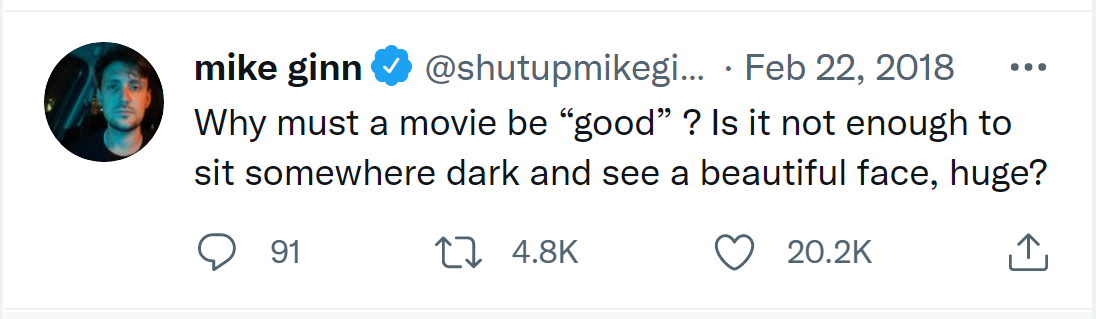
About every 1.6 weeks, someone gets on Twitter and asks some variation of “What’s the best tweet of all time?” There is always of course, the trotting out of the greats, like this one, this one, this classic, this jab, this burn, this zing, mockery of the New York Post, a personal favorite, someone who presumed the universality of a ludicrous idiosyncratic belief and chooses to dickishly ignore that they’re completely wrong, and of course, the truly greatest tweet of all time (and these two, which go out to my friends back home). But what’s “best” anyway? For me, all of these pale in comparison to this tweet, which I think about at least once a week: 

It came to mind again most recently yesterday, as I sat in a movie theater for the first time since Emma., watching Scarlett Johansson and Florence Pugh engage in a car/motorcycle/tank chase through the streets of Budapest and into the city’s subway, exchanging quippy dialogue all the while. In that moment, I flashed back to the similar car chase sequences in Berlin in Civil War, Seoul in Black Panther, San Francisco in Ant-Man and the Wasp, and [Cleveland as D.C.] in Winter Soldier, as well as probably others that I’m forgetting. And although this was another movie that largely stuck to the tried-and-true Marvel formula, I thought to myself, Why must a movie be “novel’? Is it not enough to sit somewhere dark and see a thrilling car chase through a metropolitan area, huge? After all, although this isn’t the first MCU film all about one of our lady heroes, it’s leaps and bounds better than Captain Marvel, which I gave a high star rating to upon release but was largely tepid about it in the review proper (I literally wrote “I’m hot and cold on this one”) and which I look back on now mostly with contempt, as its imperial Yvan eht Nioj underpinnings have only become clearer with the passing of time. 

I’ll admit here that, by and large, it’s pretty easy for a film to manipulate me emotionally (the people would like to enter into evidence my likewise high star rating for 2016’s Ghostbusters), and it’s also not just films that do it. The Alamo Drafthouse has, for the past few years, used the same simple animated introduction before new releases where several colored circles appear, then overlap, then space out to mimic planets orbiting a star, then come back together to embody the six circular cut-outs of the classic film reel canister. My description is overselling the complexity, I think, but I can’t find it online anywhere so forgive me. The sound design of it is fairly simple as well, but this time, after the theater darkened and the traditional Alamo font appeared on screen saying “We missed you,” the pre-show included a montage of clips of characters from the movies at the movies: Amélie, Taxi Driver, Cinema Paradiso, etc., and then the bonging tones of that intro came together, and I was overcome. It felt like coming home, and if I’m warmer to Black Widow than it truly deserves because of it, well, maybe the people will have to enter this review into evidence one day, too, but for now, I have to say, I really liked it. Even my best friend, who is generally apathetic to Marvel movies, thoroughly enjoyed it; immediately afterward, she said she would be willing to pay to see it again, and when we were considering watching another movie back home last night, she said she’d rather just watch television than another movie because she enjoyed Black Widow so thoroughly that she wanted to “marinate” in it a while before another cinematic experience watered it down. Take from that what you will. 

We open in Ohio in 1995, where a young Natasha (Ever Anderson, daughter of Milla Jovovich and Paul W. S. Anderson) rides her bike through suburban streets and into her backyard, where she plays with her younger sister, Yelena (Violet McGraw). When Yelena skins her knee, their mother Melina (Rachel Weisz) attends to her, and there appears to be some tension between Natasha and dear old mom. As night falls, Yelena notes the appearance of fireflies in their backyard, and Melina gives her daughters a little science lesson about bioluminescence. While they set the table, father Alexei (David Harbour) returns home, agitated. He shows Melina a 3.5’’ floppy and notes that “it” is “finally happening.” As Melina whispers a meaningful apology to Natasha at the dinner table, Alexei grabs a rifle and the entire family hops into their SUV and makes haste toward a small airstrip, with S.H.I.E.L.D. agents in pursuit shortly. After a tense shootout, the family manages to make their getaway in a prop plane and land in Cuba, where we learn that the “family” is comprised entirely of Russian agents, even the two children, and that the past three years in America have been part of a long term operation at a secret S.H.I.E.L.D. facility. Natasha attempts to prevent her separation from Yelena, citing that the younger girl is only six years old and too young for training, but Alexei notes that Natasha herself was even younger when she first began, and the two of them are forced apart on the orders of General Dreykov (Ray Winstone). 

After an opening montage (set to a downbeat cover of “Smells Like Teen Spirit”) gives us the general impression of what constitutes a Black Widow’s training in the “Red Room” (it’s not fun!) we move forward to 2016. The rest of the film is set parallel to the events of the aforementioned Captain America: Civil War, following Natasha (Johansson) in hiding after siding with Cap against Tony re: The Sokovia Accords. Elsewhere, Yelena (Pugh) and a team of fellow Black Widows tracks down and ultimately kills a rogue Widow, but not before her former ally exposes her to a red dust that acts as a counteragent to Yelena’s Black Widow programming, which we learn has grown beyond conditioning and brutal training to literal mind control. Natasha makes her way to a safe house in Norway with help from her friend Mason (O-T Fagbenle), who also delivers some things left behind at her last safe house in Budapest, which includes a package from Yelena that contains several vials of the red dust; the dust, in turn ends up drawing the attention of Taskmaster, Dreykov’s right hand killer, who has the ability to mimic the fighting styles of anyone from merely watching a video. Yelena and Natasha reunite and decide to destroy the Red Room once and for all. In order to do so, they must first rescue their “father” from the Siberian gulag to which he has been sent; the former “Red Guardian,” the only successful supersoldier equivalent of Captain America who was produced by the Soviet Union not relives his glory days in stories told to his fellow inmates and is mocked by his guards. He, in turn, leads them to their “mother,” who reveals that she was the scientist who worked on the beginnings of the mind control project. But can any members of this reunited not-really-a-family trust one another long enough to stop Dreykov? 

Look, this is a Disney’s Marvel Cinematic Universe consumable product. You’ve already decided if you’re going to see it or not, and if you’re going to see it, whether you’ll do so on a big screen, fork over an exorbitant amount of money to watch it on Disney+, or wait for a more affordable at-home option. It exists to sell toys, costumes, and trips to theme parks while continuing to build the Disney monopoly that we should all be more worried about since the overseers of antitrust laws are asleep at the wheel, and probably would be more worried about if we weren’t all (a) contemplating our insignificance and powerlessness to stave off the climate disaster that will boil, drown, bury, burn, smother, etc. us all alive, or (b) living in a state of denial of said looming extinction event. Its emotional beats are rote, its storytelling checkpoints are familiar, and the forward thrust of its characters is largely moot considering that, as of 2019, Natasha Romanoff is dead. For what it’s worth, at least Disney isn’t trying to insultingly push Black Widow as “empowering for girls/women” (one can read the text that way, but it’s not part of the metatext for once, and the film itself calls attention to the fact that Natasha’s dark past as an assassin renders her “hero” status among “little girls” problematic, to say the least). This film is also decidedly Not For Children, given its use of the visual language we associate with human trafficking to illustrate the horrors of the Red Room as well as the higher-than-normal profanity and a fairly graphic verbal description of the Red Room’s sterilization procedure. 

I’m sure that there will be some reviews that cite the film’s “heart,” although I would warn readers to take that with a grain of salt. The “reunited family that was really composed of spies but who could be a found family” element is present, and all of the cast (Pugh in particular) sell this angle in their performances, but how much it will resonate with you as a viewer will depend on a lot of factors that are external to the film proper. I wasn’t sold on it, but I still had a blast, and the setpieces here are some of the best that this franchise has brought to the table. Pugh is great in this first entry for her into the MCU, and Harbour brings an effortlessly comedic touch to the proceedings. Weisz has never given a bad performance ever, and her Russian accent here is a delight. It’s a shame that Johansson is finally given a vehicle in this series that is hers and hers alone and it must be an interquel due to the choices made in other films, but she’s been carrying films on her back since she was a literal child, so it’s no surprise that she delivers here in her postscript swan song. If you’re going to see it, see it, before we’re all dead.

-Mark “Boomer” Redmond

The New Mutants (2020)

Plenty was already written about the X-Men genre-bender The New Mutants in the years before its actual release.  Thanks to its very public production troubles, post-production tinkering, and release-date delays since its teaser trailer premiered in movie theaters way back in the Before Times of 2017, The New Mutants has been engaged with more as a News Item than as a Movie.  I’ve even personally contributed to that phenomenon myself, cheekily declaring it to be “The Defining Film of the 2010s” a full year before it ever screened for the public.  After living with the Idea of the movie and its bungled potential to mutate the superhero genre into an entirely new beast for multiple calendar years, general audiences (or at least the nerds who pay attention to this kind of cultural runoff) couldn’t help but enter The New Mutants with rigid preconceptions of what it was going to be – whether expecting a playful superhero-horror genre hybrid or an incomprehensible editing room disaster.  It’s hilarious to me, then, that its journey into wide distribution ended with the film being unceremoniously dumped into empty movie theaters in the middle of a global pandemic, then quietly surfacing on cable television just a few months later to practically zero fanfare.  In retrospect, it was the only fitting conclusion to that sad, drawn-out saga.

Approximately one million years ago, I was pretty dang excited for The New Mutants.  The now-ancient teaser trailer for the film/news-item promised an X-Men version of The Dream Warriors, indicating that the superhero genre had established a sturdy enough cultural footing that it could now experiment with subgenre detours—including, apparently, Nightmare on Elm Street riffs—without alienating general audiences.  The finished product (which is, reportedly, the exact version of the film director Josh Boone intended to release in the first place) is unfortunately much more timid than the horror genre detour I was expecting.  Instead of a Mutant Dream Warriors creep-out, The New Mutants is essentially just the YA version of Glass.  Its target audience skews way younger than what I initially hoped for, reeling in the broader possibilities of a superhero-horror blockbuster to settle for a PG-13 thriller aimed specifically at teens.  It even openly acknowledges that aim by including multiple scenes where the Buffy the Vampire Slayer TV show is playing on a background television, clearly indicating the exact kind of media it hopes to emulate.  Re-orienting its context from X-Men on Elm Street to over-the-plate PG-13 horror required a major expectation adjustment for me. Once I understood where it was coming from, though, I actually found the film passably decent . . .  give or take a few ridiculous accents & wigs.

Like The Dream Warriors, The New Mutants features a small group of traumatized teens living in shared confinement in a mental ward, each haunted by the literalized versions of their worst nightmares.  Except, in this case the teens are all X-Men type mutants in training.  Also, instead of their worst fears being brought to life by the wicked scamp Freddy Krueger, it’s the fault of a new recruit who doesn’t yet know how to control her unwieldy powers.  Because this is a superhero film, the surrealism of that teen-mutants-vs-their-own-psyches premise is eventually reduced to a smash-em-up CGI battle with a single, destructive villain (in this case, a kaiju-scale Demon Bear), but there are some truly great creature designs & jump scare gags in the build-up to that inevitable climax.  Its commitment to PG-13 scares means there’s no true body count, and the cast is rounded out by less-than-charismatic performances from TV-star teens who got their start in now-dusty properties like Game of Thrones & Stranger Things (including a career-worst performance from usual-MVP Anya Taylor-Joy). As far as tween-friendly horror goes, though, it ain’t half bad.  If nothing else, it scores easy bonus points for being centered around a cute, queer romance that’s more genuinely hormonal than what’s typical for the superhero genre, even in properties that are supposedly aimed at adults.

As a news item, The New Mutants was a cultural time capsule that typified a wide range of ways mainstream blockbusters were marketed, edited, distributed, and passed around between corporate buyouts in the 2010s.  As a movie, it’s nothing special – especially not in a market already flooded with similar #content like Split, Morgan, Legion, The Umbrella Academy, and Ms. Peregrine’s Home for Peculiar Children.  It could have been a game-changer within the superhero genre, had it taken the genre-blurring risks teased in its early advertisements.  Still, that doesn’t mean it can’t be enjoyed for what it actually is: a dumb-fun popcorn movie for teens.

-Brandon Ledet