Austin-based genre aficionado Liz Purchell’s depth of knowledge for obscure, disreputable schlock has long impressed me as an online follower of her work. Purchell’s Letterboxd lists, Austin-area repertory programming, and contributions to the Rupert Pupkin Speaks film blog always seem to uncover some grimy, unsung genre gem that no one has yet to highlight as a forgotten trashterpiece. Watching her fall down one hyper-specific rabbit hole within that larger fascination with low-budget genre relics has been especially rewarding, though, and I selfishly hope that she never climbs out of it.
Starting with an Instagram account (and most recently evolving into a weekly podcast), Purchell’s multi-media project Ask Any Buddy is an archival, celebratory effort to gather as much vintage ephemera she can find from the golden era of hardcore gay pornography. Like with the (mostly hetero) Rialto Report podcast & blog or HBO’s dramatized The Deuce, Ask Any Buddy sets out to highlight the underdog circumstances of independent filmmakers who produced vintage pornography in the days when it had delusions of Going Mainstream. There’s an academic, documentarian quality to this work, which seeks to preserve the real-life stories of an outsider film industry that was effectively outlawed in its time, making the allure of its circumstances irresistible to fans of low-budget, transgressive art. Purchell’s focus on the gay hardcore of the era offers an even more distinct POV within that vintage pornography academia, though. Through the Ask Any Buddy project, she’s effectively arguing against the fallacy that there was no solid queer filmmaking identity preceding the New Queer Cinema boom of the 1990s, as posited in works like The Celluloid Closet. In Purchell’s view, queer filmmaking already had its own established tones & tropes long before folks like Todd Haynes, Gregg Araki, and Bruce LaBruce arrived to the scene to greater critical acclaim; the earlier films just needed to include unsimulated blowjobs to secure financial backing and a guaranteed audience.
The centerpiece of this Ask Any Buddy project is its incarnation as a feature-length film. Currently making the “theatrical” rounds through online film festivals (after COVID-19 fucked up its initially planned distribution through AGFA), the movie is both a transgressive piece of D.I.Y. outsider art and a vital work of archival academia. A post-modern mash-up piece, Ask Any Buddy is composed of pre-existing clips from 126 gay porno films from the genre’s golden era in the 1970s & 80s. Rather than contextualizing these clips with any narration or talking-heads interviews, Purchell has simply edited them together in a linear, remarkably cohesive narrative that highlights the various tropes & collective fixations of vintage gay hardcore as a genre. The film loosely constructs a morning-to-night day in the life of an urban, post-Stonewall gay male archetype with an incredibly bustling sex life. With characters from over a hundred films taking turns amalgamating a single protagonist, we watch “a” gay man awake from a loopy wet dream, brush his teeth in the bathroom mirror, venture out into his city’s various cruising spots (bathhouses, the docks, drag clubs, porno theaters, etc.), celebrate with his local community at a house party, and then return to bed with his long-term partner to repeat the loop again. If vintage porno is supposed to have a documentary quality built into its unpermitted, renegade filmmaking style, here’s proof that you can repurpose that effect to loosely construct a typical day in the life of one of its subjects (one with an incredibly high libido and an incredibly short refractory period).
Approaching this film from a purely academic, documentarian lens is actually selling its merits short. Its deliberate inclusion of vintage Pride march footage, mapping out of glory hole etiquette, and illustration of what public cruising looked like in the 70s & 80s land it squarely in the realm of academic discourse, but that framing doesn’t fully capture how it works as an in-the-moment cinematic experience. By removing the typical signifiers of a documentary or essay film and instead assembling a found-footage tapestry narrative, Ask Any Buddy leans into the dreamlike, surrealist quality of cinema as an artform. In that way, it’s more akin to Kenneth Anger’s incendiary landmark short Fireworks than it is to anything like The Celluloid Closet, even though it is directly commenting on the history of queer identity & queer sex onscreen. Its disorienting match-cuts, its interchangeable characters & locations, and even the intentional surrealism of its source material all make the film more of a sensual, cerebral experience than a coldly academic one. By the time the “protagonist” reaches the celebratory house party at the film’s crescendo, the shared lived experience of the larger narrative comes into sharp detail, making the whole picture feel like a communal vision of political defiance & erotic imagination rather than anything as pedestrian as a mere documentary. Its overall effect is more hypnotic & psychedelic than it is intellectual.
The Ask Any Buddy film could easily have been tediously academic or pointlessly provocative in the wrong hands, but it instead comes across as a playful, genuinely loving catalog of tropes & narrative throughlines clearly assembled by a true fan of this supposedly low-brow, disreputable genre. As a stand-alone specimen of transgressive outsider cinema, it has plenty to offer its drooling spectators, including out-of-nowhere fistings and stunt “celebrity” cameos from the likes of “Gene Simmons” & “Marilyn Monroe”. Obviously, it also functions as commentary on pre-existing transgressive cinema from outsider artists of the past, whose contributions to the queer cinema canon Purchell argues have been undervalued. This film is a strikingly surreal, hallucinatory correction to that oversight, as much as it is an academically crucial one.
PBS programming was apparently a lot more adventurous in the 80s & 90s than I remember it being as a kid, even though I watched it religiously as a pretentious nerd without cable access. Or maybe it’s that local PBS affiliates in Louisiana weren’t broadcasting The Good Stuff (the gay stuff) that aired in less morally regressive areas of the country. Whatever the case, a few weeks ago I learned that PBS broadcast the radically queer video art flamethrower Tongues Untied the year of its initial release (admittedly to some national controversy in the press), and now I’m just finding out that the publicly funded network also broadcast a 30-minute Todd Haynes short about a child’s sexual awakening as a burgeoning kinkster. Made between Poison& Safe, Dottie Gets Spanked was a dispatch from the earliest, most abrasive period of Haynes’s career, when his voice was such an anomaly on the indie film scene that critics had to coin a new term for it: New Queer Cinema. And PBS was there to push that outsider-art queerness in front of a larger audience, risking morally righteous pushback from the Conservative pundits who are always on the hunt for excuses to defund the network. I think that’s beautiful, and it’s very different from the super-safe (although still incredibly helpful & informative) version of PBS I remember from my own childhood.
In Dottie Gets Spanked, a small suburban child in the 1960s becomes fetishistically obsessed with a spanking scene in an I Love Lucy type sitcom, much to the horror of his super straight parents. True to the messy multimedia style of Haynes’s early work, this simple story is told in a deliriously fractured, layered narrative that’s spread across three tiers of reality: the real world, the sitcom world, and the dream world. In the real world, the young boy is terrified of his emotionally distant father, a cold brute who mostly looms in doorways & watches football while his wife takes care of the actual parenting. The child escapes this tension by sitting inches away from the television and disappearing into the sitcom world, a black & white spoof of I Love Lucy era comedies (a fan-favorite of girls his age, which makes him out to be an outsider at school). In turn, this sitcom world informs the boy’s fantasies: surrealist De Chirico dreamscapes that become intensely erotic once a spanking episode of The Dottie Show introduces a burgeoning fetish into his nightly repertoire. It’s an uncomfortable but deeply relatable portrait of a young child discovering their first sexual impulses in a household where anything that’s not married heteros in the missionary position is considered an abomination & a personal moral failure. Because Haynes is behind the wheel, it’s implied that the young child is gay but unaware of that predilection, but the story is universal enough to hit home for anyone who’s ever discovered their queer identity or unexpected kink obsession while growing up in a conservative household.
Personally, I identified with this on a cellular level. It reminded me of recording sitcom episodes & other random television ephemera that overlapped with my own emerging kinks onto homemade VHS tapes in the 90s. It’s a shame those tapes were lost to flood waters in Hurricane Katrina; I imagine they might play with the same feverishly horny delirium that’s established in this film’s spanking dreams (or maybe the found footage video diary of a serial killer, if I’m being more honest with myself). A lot of those clips were likely pulled from PBS, appropriately enough, even though I don’t remember my local station’s programming being as boldly daring as the psychosexual overtones of Dottie Gets Spanked. But the whole point of this movie is that the content we fixate on while we’re mapping out our own erotic imaginations does not have to be direct or overt to be effective. Even when locked away from the broader spectrum of sexual play & identity in a morally buttoned-up household, we still find a way to indulge ourselves in what turns us on. That searching-for-scraps-of-kink scavenging may now be a relic of a pre-Internet world, considering how much access most children have to information outside their parents’ control, but it is perfectly captured in this playfully naughty Todd Haynes short from the 90s. Knowing that the movie’s production & distribution was at least partially publicly funded only makes its existence more perversely amusing.
I often talk about how there’s no movie more difficult to enjoy than a comedy that isn’t funny and about how comedy is the genre that translates the least well across cultural barriers. That’s why I’m surprised to find myself so fascinated with the 1970s curio Adele Hasn’t Had Her Supper Yet – a corny, unfunny broad comedy that relies heavily on Czechoslovakian cultural tropes to sell its humor. Usually, when a comedy isn’t funny there just isn’t much else to chew on; the genre is almost entirely reliant on eliciting laughter from its audience to justify its existence. Adele Hasn’t Had Her Supper Yet is an unusual beast, though, as it pours just as much effort into its visual artistry as it does into delivering zany Jokes. Even though it isn’t the hi-larious good time it so desperately wants to be seen as, the artful visual craft of its buffoonery makes the experience totally worthwhile. The movie plays more like a comedic tangent from the tail end of the Czech New Wave than it does the Czech equivalent of Paul Blart: Mall Cop, even if its humor is on the same broad frequency.
Adele admittedly does attempt to bridge the cultural divide for American audiences by spoofing our own nationalistic sensibilities. The movie stars “America’s greatest detective from America’s greatest city” (NYC), throwing back to a macho Dick Tracy-style dime store crime novel archetype straight out of American pulp fiction. This modern Yankie cad version of Sherlock Holmes is hired by a Czech noblewoman to pursue a missing-person case in Prague. The only thing is that the missing person is her dog. And all the local Prague cops are good for is escorting him to local pubs with the best sausages and beer. Cue the Benny Hill-level musical jaunts to constantly remind the audience “This is hilarious!” at every step, even though the jokes themselves feel like Mel Brooks on one too many sleeping pills. There’s almost something adorable about the “Americans are like this, Czechs are like that” structure that guides film’s sense of humor, but the actual gags delivered through that apparatus are only really worth an occasional eye-roll and a “woof.” It’s cross-cultural Dad Humor.
Where the movie gets interesting is in the visual splendor of its mad-scientist villain’s evil deeds. You see, the noblewoman’s dog wasn’t kidnapped at all; it was eaten by a mad scientist’s carnivorous plant, which he trained to eat flesh on command to the sound of classical music. We visit the wicked doctor in his lab where he plays violin to woo mutant eyeball plants, who in turn weep at the beauty of the music. It’s all very Little Shop of Horrors, right down to the giant carnivorous plant being named Adele, which is not too far off from Audrey. It’s just so goddamn beautifully rendered, though. A mixture of traditional puppetry, hand-drawn animation, and stop-motion trickery (contributed by visual wizard Jan Švankmajer) is conjured to animate the plant-monsters as they perform the scientist’s commands, so that the central conflict feels more like it belongs in an surreal dream more than a broad, pre-ZAZ comedy. As the American detective catches onto the mad scientist’s evil deeds, he has to escalate his own crime-fighting tactics, which involves an exponentially complex array of Seussian steampunk contraptions. Their final showdown together eventually does reach the sense of comedic mania the film attempts to achieve via its Jokes throughout, and the movie ends on its strongest, funniest imagery as their rivalry gets increasingly out of hand.
The only movie I can think to compare Adele Hasn’t Had Her Supper Yet to is the Russian sci-fi comedy curio Ivan Vasilievich Changes Profession. Both films suffer a little of the cultural & contemporary disconnect of being comedies out of their place & time (at least from a modern American perspective) but overcome those barriers through a surrealist sense of visual whimsy. It’s that kind of overcompensating visual artistry that makes the corny jokes it’s in service of feel more adorable than unendurable. I can’t say that the film had me genuinely laughing, but I can say that I was thoroughly amused from start to end. My only real complaint is that I would’ve preferred to spend more time with the plant-monsters than with the cunning detective, but I suppose that’s what we have Švankmajer’s directorial outings for.
After falling in love with two other major works in the Alec Guinness canon of post-War comedies for Ealing Studios, I was not at all prepared for the wholesome, crowd-pleasing sentiments of The Lavender Hill Mob. Whereas The Ladykillers and Kind Hearts & Coronets are viciously acerbic—if not outright sadistic—in their densely written wit, The Lavender Hill Mob is light-on-its feet, effervescent. It’s not my favorite film of the trio, but it’s certainly the most streamlined, and maybe the one with the biggest laughs in its final payoff. While I was shocked to find it so bubbly & sweet, I was not surprised to learn that it was the most popular of Guinness’s works for Ealing, even earning an Academy Award for Best Writing, Story and Screenplay.
Guinness stars as an absurdly bland, milquetoast man who’s assigned to supervise the transport of freshly-minted gold bars from the refinery to the bank. Perceived to have no ambition or imagination by anyone around him (and maybe not even himself), Guinness deduces that he’s perfectly suited to steal the gold from under the bank’s nose, undetected. More of an adorable doofus than a criminal mastermind, the mild-mannered nothing of a man must navigate a world of crime beyond his limited comprehension. We watch him bumble through assembling a crew of thieves and then smuggling the stolen gold as novelty Eiffel Tower-shaped souvenirs, increasingly charmed with his buffoonish naivete at every step. Of course, his scheme eventually blows up in his face in a spectacularly farcical fashion; that’s to be expected. What caught me off-guard was how much he genuinely falls in love with both thievery itself and his small crew of fellow criminals. While The Ladykillers & Kind Hearts are deeply misanthropic works about greed & exploitation, The Lavender Hill Mob is a wholesome goof-em-around where the only true villains are the asshole cops who spoil the criminals’ fun.
I assume this was a highly influential work that just happened to slip past my radar until now. It’s difficult to imagine wryly funny heist comedies like A Fish Called Wanda or Soderbergh’s Ocean’s series existing in their current form without Lavender Hill paving the way. It’s a very simple, straight-to-the-point comedy in a lot of ways, but it manages to pack in many distinguishing details in under 80 minutes of runtime: a spiral staircase chase scene that rivals the visual trickery of Hitchock’s finest illusions; an all-timer of a gag that tricks a cop into oinking like a pig for the audience’s amusement; a single-scene walk-on role for a pre-fame Audrey Hepburn, billed simply as “Chiquita”, etc. The vicious misanthropy of Kind Hearts & Ladykillers speaks more directly to my own sensibilities, but I totally get this one’s broader appeal and I very much believe it to be worthy of their company.
Welcome to Episode #114 of The Swampflix Podcast. For this episode, James, Britnee, and Brandon discuss their all-time favorite movie endings, with a particular focus on Being There (1979), Perfume (2006), and Dead Alive (1992). Enjoy!
You might be tempted to ask for a better directorial debut from actor-turned-auteur Ida Lupino than the 1949 sudden-illness weepie Never Fear, but it would be tough to ask for a more personal one. Lupino’s first credit as a director is a well-behaved but harrowing melodrama about polio, a disease that Lupino herself had suffered early in her career as a young actor. In fact, it was being bedridden with polio (and eventually losing some mobility in her leg and hand) that inspired Lupino to develop skills as a writer & a filmmaker in the first place, as it was a harsh realization that her career as an onscreen beauty was limited & impermanent. She explained in an interview, “I realized that my life and my courage and my hopes did not lie in my body. If that body was paralyzed, my brain could still work industriously . . . If I weren’t able to act, I would be able to write. Even if I weren’t able to use a pencil or typewriter, I could dictate.” Polio was maybe too sensitive of a subject at the time of Never Fear‘s release and, thus, failed to make a splash at the box office, but Lupino fearlessly tackled it head on from a place of personal frustration & anguish that affords it cultural significance anyway.
Story wise, there’s nothing especially daring about Never Fear that you won’t find in the decades of romantic melodramas about ill, bedridden women that followed: Love Story, The Big Sick, A Walk To Remember, The Fault in Our Stars, Ice Castles, etc. In this iteration, a young dancer (Sally Forrest, who also starred in Lupino’s uncredited debut as a director Not Wanted that same year) has her career cut short by a rapidly onset case of polio that leaves her paralyzed. She gradually earns her mobility back through painful months of physical & emotional therapy, but in the meantime struggles to hold onto her hopes to maintain the love, art, and independence she knew before the disease left her unable to dance. There are about twenty minutes of puppy-love bliss shared between the dancer and her partner/choreographer before polio cuts their ambitions short. The remaining hour is a pitch-black tearjerker that threatens to break that blissful romance apart, both through the introduction of potential love interests inside & outside the hospital and through the protagonist’s self-pity that makes her believe she’s no longer worthy of her former beau’s love & devotion now that she’s not a soon-to-be-famous dancer.
This movie would be a totally standard sudden-illness “Woman’s Picture” if weren’t for the way Ida Lupino pulls from her personal experience with polio to illustrate just how isolating & embittering the disease could be. It’s impossible to not draw this extratextual comparison as we watch a young artist who’s limited by the failings of her body just as her career is taking off. While the narrative beats are uniformly familiar to its genre, the details of the dancer’s time alone in her hospital bed can be impressively, uniquely horrific in flashes. In feverish internal monologues, the dancer curses her own body for failing her and endlessly frets about how much of a burden she is on her able-bodied fiancée despite his protests to the contrary. Everyone’s optimism that she will find a way to live a fulfilling life only makes her more bitter and she shrinks within herself, frustrated and increasingly alone. At the same time, this isolation is the first opportunity she’s had in her entire life to be alone with her thoughts (with the audience as spectator), which opens her up to a newfound sense of autonomy. At the beginning of the film, she’s somewhat resentful of her dance partner/choreographer/future-husband’s control over every aspect of her life (even though she loves him dearly), and in a fucked up, roundabout way the disease gives her the first chance to make decisions for herself by herself. The film illustrates a complex, nuanced psychological portrait of someone bedridden with polio, one that arrived in theaters while the country was still suffering the darkest days of the epidemic.
Presented as a true story “photographed in the places where it happened,” Never Fear was largely filmed on-location at the Kabat-Kaiser institute in Santa Monica, CA, employing many of the facility’s live-in patients as background characters. I almost wish Lupino had pushed this proto-cinema verité approach even further and played the lead role herself, amplifying the film’s personal resonance within her own biography. If nothing else, it could have used the extra oomph her screen presence brought to The Bigamist. Forrest does a decent enough job as Lupino’s avatar to make to sell the heartbreak of her frustrated internal monologues, though, and the sudden-illness weepie genre structure is emotionally effective even if it is overly familiar. Never Fear isn’t Lupino’s best work in the director’s chair, but it is one with surprising emotional depth in her expressions of personal, professional anguish, which makes it a worthy watch for anyone interested in her one-of-a-kind career as one of the most substantial female directors in the Old Hollywood system.
Every month one of us makes the rest of the crew watch a movie they’ve never seen before and we discuss it afterwards. This month Britneemade Boomer, Hanna, and Brandonwatch 3 Women (1977).
Britnee: “I’m trying to reach toward a picture that’s totally emotional, not narrative or intellectual, where an audience walks out and they can’t say anything about it except what they feel.” Robert Altman’s words about his 1977 masterpiece 3 Women accurately describes the experience I had when watching it for the first time about a year ago. When I first saw the film I didn’t really understand what I had watched, but I knew that I loved it. Over time, it’s become one of my all-time favorite movies. The idea for 3 Women came to Altman in a dream, and the movie really does feel like a dream, where nothing really makes sense yet everything feels perfectly normal. Typically, when you wake up from a dream it’s difficult to explain it to others, and 3 Women is equally difficult to explain to someone who hasn’t seen it.
As the title suggests, 3 Women is about three women: Pinky (Sissy Spacek), Millie (Shelley Duvall), and Willie (Janice Rule). Pinky is a carefree young girl and possibly a teenage runaway. She finds a job working at a geriatric health spa, which is where she meets her new coworker and her new obsession, Millie. Millie is a bit older than Pinkie. When she’s not working at the spa, she’s talking about all sorts of unappetizing recipes and how much she loves Scrabble. She actually never stops talking, but the problem is that no one listens to her. Everyone around her acts as if she doesn’t exist. Everyone except for Pinky, who is infatuated with Millie in a very Single White Female sort of way. Pinky eventually becomes Millie’s roommate in an apartment complex for singles. On their way to the apartment, Millie brings Pinky to her favorite bar, Dodge City, a dive attached to an abandoned Old West theme park in the middle of the desert. Both the bar and the apartment complex are owned by Edgar and his pregnant wife, Willie. Willie is older than Millie and Pinky, and she spends her time painting bizarre murals in silence.
Of the three women, my favorite is Millie. My God, Shelley Duvall is utter perfection in that role. She’s one of the most tragic characters in all of cinema, wasting most her time talking to people who don’t bother making eye contact with her or even acknowledge her existence. Whether it’s the group of male physicians she awkwardly lunches with, her coworkers, or the tenants in her apartment complex (especially bachelor Tom, with his never-ending “cough”), everyone treats Millie like a ghost. She really embodies that feeling of when you are trying to talk to someone in a dream, but they won’t respond or pay any attention to you.
Brandon, what did you think about Millie? Did her character’s journey throughout the film stick out to you more than Pinky and Willie?
Brandon: The main reason that Millie is such a standout in that central trio is that Shelley Duvall is such a heartbreaker of a performer. She is too fragile for this callous world, and watching people crush her spirit is always absolutely devastating. Whether in canonized classics like The Shining or in disposable novelties like Altman’s own Popeye adaptation, she is perfectly suited for the damsel in distress archetype. Unfortunately, this extends beyond her fictional performances and bleeds over into her real-life persona, something that’s haunted me ever since her offscreen struggles with mental illness were crassly exploited for ratings on a very special episode of Dr. Phil in 2016. Watching Millie endlessly chat at no one in particular, reaching out for human connection to a disinterested world only to be rejected, ignored, or taken advantage of over and over again easily made for the most compelling performance of the three women for me. By which I mean I spent most of the movie wanting to reach through the screen to whisk her away to a community that actually gives a shit about her. Even seeing her skirt get caught in the car door every time she went for a drive was just as heartbreaking as it was adorable.
The tragedy, of course, is that she does not acknowledge the one person who’s actively listening to her babble about boardgames and casserole recipes. Pinky’s childlike crush on Millie is just as delicately menacing as Spacek’s telekinetic fury was in her performance as Carrie White, but there is a kind of sweetness to her obsession as well. Pinky goes way overboard in her fixation on Millie, extending beyond a “I want to be your best friend” sentiment to more of a “I want to wear your skin like a housecoat” vibe. Still, Pinky’s loving attention towards her new roommate & unwilling mentor is essentially just an intense overdose of the kindness & interconnectedness that Millie longs for. It’s heartbreaking that they can’t get past their awkward social barriers to truly connect with one another on a meaningful level (ditto in their relationship with the reclusive artist Willie, who’s just as closed off to the world as Millie is openly vulnerable to it), so it’s effectively a relief when real-world logic breaks down to allow them to form a truly cohesive unit. The film strikes a nightmarish tone as it shifts their world around to allow these connections to happen, but the end result is outright sublime, serene: they become a family.
I don’t know why there are so many psychological thrillers where women who are fixated on each other start to meld & swap personalities over time, but I do know that I’m always a sucker for it (with recent examples including titles like Queen of Earth, Sibyl, Always Shine, and Butter on the Latch). Even so, 3 Women registers as one of the greats, maybe bested only by the queen of the genre: Persona. Boomer, do you have any thoughts on this genre in general or how 3 Women functions within it? What differentiates its tone & purpose from a more typical woman-on-the-verge-of-a-breakdown story?
Boomer: When the Swampflix Canon was updated a few months ago, I took a look at my contributions to that list and had one of those “You really don’t see your patterns until they’re laid out in front of you” moments and realized that there are apparently only three things that I like: (in Brandon’s words) “populist superhero spectacles, obscure Euro horrors,” and women-on-the-verge films. My love for the aforementioned Queen of Earth is well documented, but the film that I thought of most frequently throughout 3 Women (after my initial thoughts of “Oh, this is Single White Female” followed by “Oh this is actually Mulholland Drive“) was Puzzle of a Downfall Child, which similarly features dreamlike narrative and “gauzy” filmmaking juxtaposed against harsh realities of disaffection and occasional violence.
There’s a definite undercurrent of that quality that fascinates me in that genre present in 3 Women, but one major difference that I see is that 3 Women has (arguably more than) one woman who’s already on the other side of the verge: Willie. She’s clearly past the point where she cares about “society” in any meaningful way, living in a derelict mini golf park/shithole bar and spending her waking moments making angry and occasionally violent (literally, with bullet holes on the canvas) art on every available surface. Millie isn’t really flirting with the edge, yet, but you can tell that she knows it’s not too far away, as her constant attempts to garner not just the friendship but the mere attention of her peers and other members of the community is her defining character trait; at first, Pinky isn’t even aware that there’s a cliff that she could possibly go flying over, until her disappointment in and (tacit and explicit) rejection by Millie causes her to leapfrog straight over her crush/roommate into complete loss of identity.
What really differentiates 3 Women from others in this genre, however, is the way that it treats the characters’ pasts. Queen of Earth has flashbacks to the year prior and features much discussion of the past and the characters’ relationships that delineate their current conflict; Puzzle of a Downfall Child likewise has flashbacks to Lou’s childhood that ultimately explain why she is the way she is, albeit not without some contradiction; 2011’s The Roommate (which I’m citing because I saw it more recently than Single White Female, despite it being a worse movie in every way) has a backstory and a diagnosis for our identity-coveting villain. Like the desert itself, the “now” of the film seems ageless in an anxious, foreboding, and eternal way. We learn relatively nothing about Willie, even in comparison to her husband, whom we at least know is a prankster and a former stunt double from the outset. We know a little bit more about Pinky, but her backstory is still mysterious and possibly false, as we never really confirm if she’s even from Texas. In comparison, we know lots more about Millie because she’s always talking about herself, but the things we learn about her are pretty shallow (that irises are her favorite flower, that she had to sleep in the rollaway bed in the living room a lot when her previous roommate had “company,” and that she keeps a daily journal that’s factual and perfunctory rather than insightful or meditative) and don’t really inform an understanding of her long term psychology, other than the fact that she’s doing her level best to be “normal” without much success. There’s a strength of character and identity that’s conveyed solely through performance here without the standard packaging of “Character X does Y because of childhood event Z” that we normally see, and I like that a lot.
Hanna, what do you think of Pinky’s story, in or out of the context of the epilogue? I’m thinking in particular of her pre-hospitalization stories (such as they are) about herself, and the scene where Millie drives her home to the apartment for the first time, wherein Pinky compares their surroundings to Texas; later, when Pinky’s parents (maybe) visit to see her, her mother (maybe) says “It sure doesn’t look like Texas.” Does she really not recognize her parents only due to amnesia and taking on an amalgamation of Millie’s real and imagined identities, or is it because they’re not her parents, as is potentially indicated by Mrs. Rose’s claim that Mr. Rose came up with the name “Pinky,” although we know her real name is Mildred (or is it)? Is Pinky merely an honest girl who experienced severe brain damage or does she simply lie about her past like a lot of teenagers do and lose track of her deceptions?
Hanna: To be honest, I had a very hard time interpreting the journeys of these characters, or at least articulating any kind of interpretation. Just like in a dream, the relationships are foggy, disjointed, and archetypal; it seems like you can’t make sense of them unless you close your eyes. So, when I close my eyes, I feel like Mr. and Mrs. Rose are the parents of pre-coma Pinky, who dies in the pool; when Pinky is “reborn” as Mildred, her parents aren’t her parents anymore. I don’t think Pinky is lying about her past, and I don’t even really think that “Mildred” Pinky is brain damaged; I see “Pinky” Pinky and “Mildred” Pinky as two connected but distinct people, one of whom has started to absorb Millie’s identity. Pinky’s dive felt sacrificial, and the first step towards fulfilling the prophecy of enmeshed identity that Willie’s paintings seem to predict; through the sacrifice, she destroys any part of her that has history outside of the other two women. I also think it’s telling that, in the very end, Pinky identifies Millie as her mother, and that all three women have established relationships that preclude individual lives. This is a totally strange line of logic in real life, but if it was happening in a dream I don’t think I would question it.
I think one of the most compelling aspects of this film was each woman’s sublimation of self into a single folkloric identity. Boomer’s pointed out that nagging “eternal” feeling of the desert, and that perfectly describes my feelings about the three women. The film starts off with Pinky and Millie working in the rehabilitation center for the elderly, but slowly the two women are drawn out of Californian society and into this dreamworld saloon by the magnetism of Willie, the pregnant Wild Woman. In the end, we find all three of the women abandoning the identities that no longer serve them, creating a dreadful symbiotic family comprised of a Child, a Mother, and an Elder out on the ranch that’s incapable of fostering growth outside of itself. I imagine that they’ll be living out there until the end of time, certainly never in need of a spa for the old.
Lagniappe
Brandon: This feels like a huge departure from what I’ve come to expect from a Robert Alman picture. I’m much more used to seeing him in his big cast/overlapping dialogue mode (Short Cuts, Nashville, Pret-a-Porter, Gosford Park, etc), and 3 Women feels like a much more insular, cerebral experience than that. I wish he had tackled this kind of eerie, dreamlike, horror-adjacent material more often; he’s damn good at it. Looking through his filmography, the hallucinatory psych-horror Images is really the only title that seems close to this territory, and I’m excited to check it out.
Hanna: I definitely agree that Shelley Duvall was the standout (I cringed very deeply and personally during the lunchroom scenes), but I really wish this movie had more Willie. Her energy elevated 3 Women from a dreamy psycho-drama into the realm of the mystical. On the other hand, I think that mysticism was accentuated by the fact that she spent 90% of her scenes skulking around the edges of the frame painting beautiful, tortured fish-people.
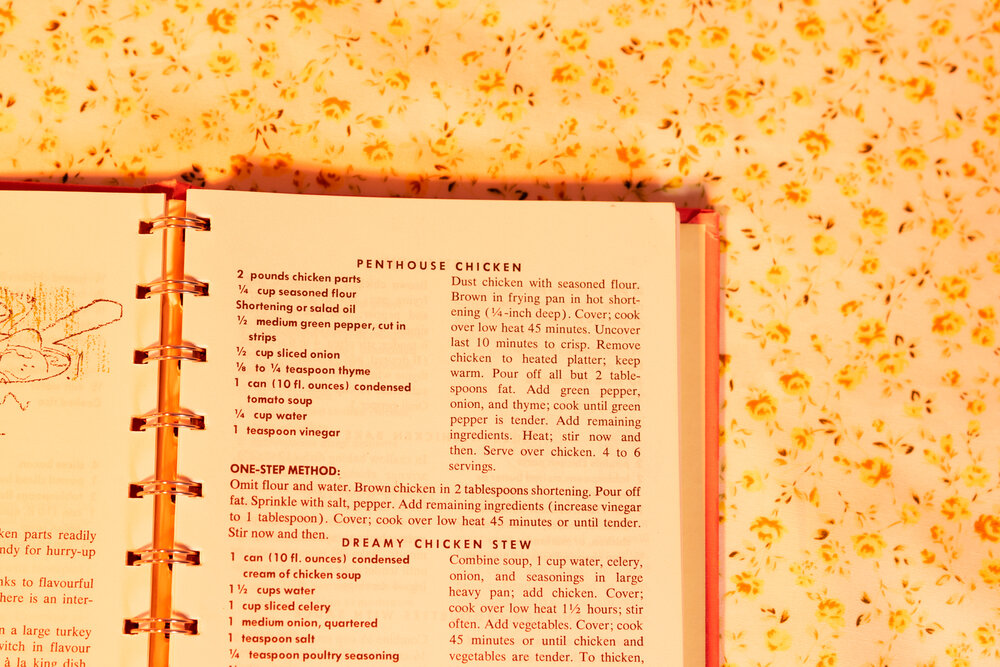
Britnee: Listening to Millie talk about now vintage recipes made with nothing but processed ingredients brought me so much joy. The one that stuck out to me the most was Penthouse Chicken. When she was trying to impress the table of silent doctors with the recipe that can be “made with a can of tomato soup,” I was sold. It turns out I’m not the only one who wanted to make Penthouse Chicken after watching 3 Women. The Famous for My Dinner Parties blog (titled after a direct quote from Millie) posted a picture of the recipe from the 1963 cookbook Cooking with Soup. What a great dinner and movie combination!
Boomer: Shelley Duvall’s overall career is referenced above, and I think it’s worth mentioning that when I think of her name, the first thing that comes to mind isn’t The Shining or Popeye, it’s Faerie Tale Theatre. Enjoy.
And also this, which is one of my earliest memories of watching a movie and fully warped my brain.
Upcoming Movies of the Month September: Hanna presents Women on the Verge of a Nervous Breakdown (1988) October: Brandon presents Monster Brawl (2011) November: Boomer presents Searching for the Wrong-Eyed Jesus (2003)
For this lagniappe episode of the podcast, Boomer and Brandon discuss the unlikely fan-favorite Star Trek sequel The Voyage Home (1986), aka “The One With the Whales.”
I’m not sure that Josh Trank bounced back from his career-imploding misfire Fant4stic (2015) with a better film, but he’s certainly returning to the scene with a more memorable & entertaining one. Trank’s misshapen Al Capone biopic stands alone in a genre defined only one other film to date: Venom(2018), by which I mean it’s a tragically bland nothing of a movie that Tom Hardy’s bizarro performance transforms into a riotous good time through sheer force of will. Trank wrote, directed, and edited Capone himself, so you think you’d be able to credit some of the film’s entertainment value to his guiding hand. Yet, his dialogue, direction, and editing choices are all so aggressively uninteresting that it’s a miracle any audience could sit through the entire picture without slipping into a coma. Tom Hardy alone is the source of that miracle, and it’s his batshit performance that transforms Capone into something truly remarkable, even if just remarkably laughable.
Capone covers only the final year of the notorious gangster’s life, which he spent under house arrest while left senile by neurosyphilis at the age of 48. Trank attempts to use this syphilitic madness as a device that allows the narrative to surreally drift through time & space as Capone’s mind wanders through his own memories, feeling immense guilt over the violence he commissioned at the height of his Chicago crime boss days. There’s no sense of purpose or immersive atmosphere to these drifts through Capone’s subconscious, though. When the movie’s over you’re left pondering if it had anything to say about violence, guilt, syphilis, Capone, or anything at all. The movie has no discernible reason to exist except in giving Tom Hardy the freedom to run wild in the titular role. Luckily for Trank, Hardy more than makes up for any & all filmmaking deficiencies by turning Capone into a one-man freak show. Against all odds, the film truly is a spectacle.
With none of the film’s stylistic or narrative elements being compelling enough to get in his way, Tom Hardy is given the greenlight to transform Capone into a series of Nic Cagian stunts. His demented vision of the titular gangster is horrifically grotesque. He mumbles incoherently in a garbled growl more appropriate for a talking trash can than a human being. He dresses in old biddy drag, fires pistols at alligators, belts out his showtunes from The Wizard of Oz, and fires a gold-plated Tommy gun at his friends & family while aimlessly wandering the grounds of his mansion in a soiled diaper. Admittedly, all these stunts were written into the screenplay, so it’s not as if Hardy ad-libbed the film’s saving graces. He’s just responsible for making them fun to watch in a bewildering sideshow act kind of way that we normally only allow Nic Cage to perform. It has got to be the most compelling, amusingly outrageous performance you’ll ever see where a main character pisses, shits, and pukes themselves for the entire runtime while staring directly at the audience with grotesquely bloodshot eyes.
I’m embarrassed by how much fun I had with Capone. By most reasonable metrics, it’s a terrible film, one that’s only dragged down by the eye-rolling decisions made by its commanding auteur. Why hire El-P to produce a score if his work is going to be so anonymous that the audience forgets that factoid immediately after seeing his name in the opening credits? Why cast eternally loveable performers like Linda Cardellini & Kyle MaClachlan just so they can sit around watching Tom Hardy do his thing? Why the fuck do you think the world needs a ~spooky~ rendition of Louis Armstrong’s “Blueberry Hill?” Who is any of this for? It ultimately doesn’t matter. All things considered, this is a much more memorable, entertaining, and overly ambitious take on the pathetic-mobster-geezer-regretting-his-evil-deeds story than the infinitely more competent The Irishman, so it really doesn’t matter how it got there. I would watch Tom Hardy shit his pants on an infinite loop if the results were always going to be this fun.
I am saddened to report that the prestigious motion picture Butt Boy is the absolute worst new release I’ve seen so far this year. That’s right; the festival darling that’s been earning such accolades as “a constipated would-be cult comedy” & “a strained, clenched exercise in fanny fiction” didn’t turn out to be as worthwhile of an experience as I expected, by which I mean I felt like Michael Bluth opening a sandwich bag labeled “DEAD DOVE Do Not Eat!” It’s a shame too, because Butt Boy’s over-the-top premise could have easily been deployed for something delightfully, memorably absurd, only for that potential to be deflated by its lethal overdose of hipster irony & edgelord humor. Butt Boy has a great logline & title, which is a small consolation for the 100 minutes of poisonous tedium that follows that initial delight.
A desperately bored office drone finds a new, highly addictive joy in life: sticking increasingly risky objects up his butt – starting with bars of soap & television remotes and gradually escalating to entire human beings. This supernatural, rectal crime spree is disrupted when he is assigned to be the AA sponsor of an alcoholic police detective who improbably uncovers his evil supernatural deeds. It’s an unashamedly idiotic premise that the film plays straight, as if it were a very special episode of CSI: Uranus, which at least saves it from fully treading into Sharknado-infested “bad”-on-purpose waters. Still, the movie doesn’t have anything especially fresh or nuanced to say about addiction, prostate pleasure, or midlife ennui. Beyond the novelty of it functioning as a Macho counterpoint to the recent body horror chiller Swallow, the entire film is basically one joke repeated over & over again: “Isn’t it hilarious when cis men shove things up their ass?” Spoiler: it’s not.
I should have been wise enough to bail within the first ten minutes of Butt Boy. At the very least, an early scene where the titular antihero discovers the pleasures of anal play when a doctor aggressively assaults him during a prostate exam should have been a tip-off that this film was not coming from a good place. Its penchant for latent homophobia & edgelord provocation only worsens from there, as it takes cheap shots at such delightful topics as cerebral palsy, suicide, and child abduction for easy shock humor. Way to punch up, assholes. I could probably also get worked up over the way the film (unknowingly?) equates prostate play with pedophilia, considering how the protagonist moans in pleasure whenever inserting objects into himself—including multiple young boys—but fully taking offense would be giving the film more effort than it’s worth. It’s thinly considered in both its writing and its execution, so I guess my engagement with it should remain just as shallow.
Butt Boy stinks. I suppose I’m somewhat glad I watched it just to I confirm that I still have standards, as most reviews on this site tend to range from positive to ecstatic. Otherwise, it was the movie equivalent of being locked in a hot car with Dad Farts and rolled-up windows: an excruciating experience only a bully would put someone through.