Swampchat: Can’t Stop the Music (1980)

EPSON MFP image

Sometimes it takes more than one of us to tackle a film. Those are the times when we need a Swampchat.

Brandon:
Britnee, I took your recommendation on watching the Steve Guttenberg/Village People vehicle Can’t Stop The Music for its value as a camp fest and I gotta admit: it was thoroughly insane. The weird-ass costumes people wear to the disco, the Rock & Roll High School dance number at the YMCA, the impromptu backyard disco concerts (which are not a thing), Steve Guttenberg rollerskating to maddeningly repetitious lyrics about “New York, New York, New York”: the movie’s got a lot of weird energy. I’m not saying everyone was on cocaine, but c’mon, everyone was on cocaine. The characters talk incredibly fast, rapidly moving on from task to task like little chatty raccoons. When one character offers Guttenberg’s goofy DJ a joint it seems so out of place because marijuana is most definitely not these people’s drug.

The cocaine use isn’t the only thing that’s swept under the rug either. I find it so strange that The Village People, a pop group so conspicuously catered to fit disco’s gay audience, would star in a movie that pretends to be so fiercely heterosexual. I realize that it’s unrealistic to expect a PG comedy from 1980 to display its homosexuality openly, but this was also the year of Friedkin’s Cruising, so I’d at least expect something a little more than just offhand details like a flaming-baton twirler who proclaims “I’m James and flame’s my game.” I wonder if even the straight audience was rolling its eyes at the central “Are they gonna get together?” heterosexual romance the film didn’t need or deserve. As the story jumps around from one insane, loosely tied together scene to another I got the feeling that I was watching less of a professionally-made movie and more of a coked-out drag show trying its damnedest to come across as the heterosexual dance party it definitely is not.

Britnee, does the movie’s refusal to acknowledge its subject’s inherent homosexuality hold the film back or does it make for a more interesting viewing experience as a time capsule of a 1980 bias?

Britnee:
Prior to my first viewing of Can’t Stop the Music, I really expected it to have a good bit of homosexuality. The Village People were brought together to target the gay disco scene by French disco producer, Jacques Morali (sounds a bit like Jack Morell, right?), so they’ve always been a big deal to the LGBT community. Until this day it’s hard to go into a gay club and not hear “Go West” or “Y.M.C.A.” blaring in the background. Needless to say, I was disappointed by the amount of heterosexual romance in the film. It sort of made certain scenes difficult to watch, knowing that this was the time for homosexuality to shine. I guess the crew behind the film didn’t want to take a chance by going in that direction, which is a complete and utter shame.

The absence of much needed homosexuality really did hold the film back from being almost revolutionary. I have yet to see Cruising, but I remember reading about how much the gay community really disliked the film. If only a film that really celebrated homosexuality would’ve came out around the same time as Cruising, but no, Can’t Stop the Music didn’t have the balls to do so. As we all know, films that are daring and ahead of their time are the most memorable, so I can’t help but think about what the film would be known as today if the producers and writers were braver. I’m not saying that it would have Gone with the Wind status, but it would probably have a much larger cult following like the Rocky Horror Picture Show. Well, maybe not that large, but it would be way much bigger than it is today.

Brandon, do you think that the film is ok as just a campy classic or with better writing, acting, directing, etc., that it would’ve had a chance at being a memorable movie musical?

Brandon:
Honestly, I don’t think the movie ever stood a chance. Its basic premise required two things: rushing into production while both The Village People (and disco in general) were still hot commodities & also offering a product that was appealing to the widest possible audience. There was obviously a lot of pressure to clean up their act for discerning, “wholesome” movie-going families, which is why you get Steve Guttenberg, Bruce Jenner, and a flirtatious party girl eating up the runtime while The Village People themselves take a back seat. The writers still obviously had a little bit of fun sneaking naughty dialogue into the script. Lines like “You rotten pussy,” “Nice box,” “You sure get up quick,” “What were you doing? Cruising down Times Square?” and “Anyone who can swallow two snowballs and a dingdong shouldn’t have trouble with pride” stand out as writer’s room mischief. Then there’s the nudity in the “YMCA” dance-number, which you pointed out in your review. Either the censors were willing to let a lot more slide in 1980 or they fell asleep during the opening “The Sound of the City” number. It’s a shame the writers weren’t set free from the sanitized worldview presented in the film, but the film would never have been made otherwise. Turning The Village People into a cash grab meant making them as commercially-viable as possible & stripping them of any countercultural tendencies.

Another reason why the film was doomed from the start: disco is not suited for the movie musical format. Disco is dance music. You sweat to it, forgetting where you are for long periods of time as the repetition thumps all around you. Musicals need the songs to further the plot line, to flesh out a character’s story arc as they dance out their emotions. The repetition of disco makes a movie feel like it’s treading water. It can be maddening in a musical context. Both Xanadu & Staying Alive suffered from a similar downfall at disco’s repetitious nature in the same era of Can’t Stop the Music’s release.

Britnee, I trust you as a greater authority on both disco & musicals. Are the two formats irreconcilable? Was a truly great disco musical an impossible dream?

Britnee:
Personally, I really do enjoy disco musicals. Disco music is upbeat, catchy, exciting, and fits in perfectly into the musical experience. Of course, disco musicals usually don’t do a great job of having deep, serious story lines, but I think that’s what makes them so much fun. Sometimes it’s nice to watch something just for the entertainment value and nothing more. They may not do very well in the movie format, but when it comes to the stage, they’re much more successful. For instance, the Xanadu film is considered to be a catastrophe, even though I absolutely adore it. I was in love with Xanadu before I developed an interest in reading movie reviews, so I was completely heartbroken when I realized that so many critics disliked it. In recent years, Xanadu has become an award-winning Broadway musical, and although the story was changed up a bit, disco was still present in the production.

I really think the same thing can be done with Can’t Stop the Music. The ingredients for an amazing musical are there, but the recipe is a little off. One of the biggest mistakes in the film was that just about all of the songs were presented in a music video/live performance format and seemed so out of place. They should’ve blended with the scenes and involved other members of the cast participating in the singing. If a couple of brilliant minds would get together and work on remaking Can’t Stop the Music, it has the possibility of being a great musical. The reboot might not do very well on the big screen, but it definitely has the potential to be a Broadway hit. That would be a dream come true!

Lagniappe

Britnee:
Describing Can’t Stop the Music is a difficult task because nothing in the film makes sense, but it’s heaps of fun to watch. I wish I could go back in time to the late 70’s and put a stop to all of the film’s unnecessary heterosexual love. I would also demand more focus on the members of The Village People since the musical was supposed to be about them. If only time travel was more achievable! Maybe all of my wishes will be granted with a reboot in the form of a Broadway production?

Brandon:
I definitely think you’re onto something with the Broadway (or even off-Broadway) idea for a reboot. Hell, live disco musicals worked pretty well for both Mamma Mia! & (more recently) Priscilla, Queen of the Desert. Why not Can’t Stop the Music? I absolutely adore the Xanadu film as well, but I’m not going to pretend it’s not an objectively bad movie and I’m sure a lot of the Broadway audience felt the same way. It’s one of those properties you love for their faults & I could totally see a live performance being the perfect way to celebrate that spirit. Similarly, Can’t Stop the Music could be a blast with a live atmosphere, maybe even with dancefloor breaks so you can groove with the glitter-coated performers and run to the bar for drinks. There’s even a built-in title waiting to go: Can’t Stop the Musical! Talk about a dream come true!

I’m glad the movie version exists as is, though, even if the songs could’ve been incorporated better. In some ways the movie might benefit from having so much subtext covered up with its half-assed heterosexual posturing. Sometimes the transgression of the gay movie under the surface aching to peak its head out makes for interesting energy the film wouldn’t have otherwise. For instance, there’s the scene where The Village People sing “It’s time for liberation!” (in a film where they’re far from liberated) and there are weird details in the set design at their impromptu disco concert (again, not a thing) that look eerily similar to the patio from Friedkin’s other controversial gay movie The Boys in the Band (which you really should see in addition to Cruising; time has been kind to both). I obviously still would’ve wanted to see Can’t Stop the Music if it were more open about its inherent sexuality, but it made for a more complicated, memorable experience in its self-denial. Maybe we’ll one day be able to write a more honest version with a Can’t Stop the Musical, but as a cultural document & a bizarre viewing experience Can’t Stop the Music is engaging enough in its current, compromised state.

-Britnee Lombas & Brandon Ledet

Killer Mermaid (2014)

EPSON MFP image

onestar

campstamp

The cover of Killer Mermaid (also known as Nymph or Mamula) is the main reason that I picked out this film. On the cover, there’s a girl in a bikini swimming in open water with a mermaid chasing after her. I knew it was going to be terrible, but I really was expecting it to be a bunch of fun like Piranha 3D orSharknado. Never judge a film by its cover. This movie was pure garbage and a complete waste of my time.

The beginning of the film was like a commercial for Sandals, except this was an all-inclusive shit show. Two American women, Lucy and Kelly, travel to Montenegro to visit one of their old college buddies, Alex. While they’re hanging out on Alex’s boat, they make the stupid decision of exploring Mamula, which is an island that was once used as a Nazi concentration camp. Once they’re on the island, they are hunted by a creepy, old fisherman who attempts to kill them in order to feed the killer mermaid that has yet to make an appearance. The killer mermaid is shown for less than 5 minutes at the very end of the film. That annoyed me so much because the only reason I wanted to watch the movie was to see a killer mermaid go on a killing spree or two. I didn’t want to spend an hour and a half watching a bunch of idiots trying to find their way off an island, but that’s exactly what ended up happening.

I’m getting bored just thinking about things to say about this boring movie. It was so hard for me to watch it until the end, but I had to find out if there was actually a killer mermaid. When she finally showed up for her 5 minutes of fame, she was a total dud. The scenery of Montenegro and Mamula was pretty incredible, but that was the only good thing about this entire film. Someone needs to take Killer Mermaid behind a barn and shoot it.

If you have absolutely nothing to do and want to waste 94 minutes, Killer Mermaid is currently streaming on Netflix.

-Britnee Lombas

The Boy Next Door (2015)

EPSON MFP image

three star

campstamp

“I really love your mother’s cookies.”

Jennifer Lopez’s new erotic thriller The Boy Next Door is the kind of movie you’d expect to find on Cinemax at two in the morning in the mid-90s. It is badly written, poorly acted, and campy to its core, but it’s also a lot of fun.

To quell expectations, the film starts with one of the lamest, most unnecessary montages ever. High school English teacher Claire is shown jogging through the park as melodramatic flashbacks of her crumbling marriage and the effect it had on her son Kevin are interspersed at random. Why the filmmakers chose to have a flashback in the first thirty seconds of the film when a few lines of dialogue could have done the same thing is beyond me, but it does establish the film’s “bad Lifetime Movie on steroids” vibe.

This sentiment continues when we are introduced to Claire’s seducer and new neighbor Noah, whose chiseled biceps appear on screen before his face. Handsome and charming, Noah quickly manipulates his way into the family’s inner circle by developing a bizarre, slightly homoerotic friendship with Claire’s asthmatic son Kevin. The two are supposed to be high school age but Noah looks closer to 30. Noah then moves on to seducing Claire by doing hunky things like fixing garage doors and working on cars in a sleeveless shirt. He even reveals his sensitive side (“Ah, poets. Homer, Shakespeare, Byron, Zeppelin, Dylan.”) and proceeds to win Claire over by buying her a first edition copy of The Iliad at a garage sale (huh).

One night, after a really bad date and a few too many glasses of wine, Claire gives in to temptation and lets Noah seduce her. That’s when the real fun begins. After Claire rejects Noah’s further advances, his transformation from hunk to psychopath happens almost instantaneously. What starts with double entendres like “I really love your mother’s cookies” & “It got real wet over here” quickly escalates to full-blown murder. Along the way we are treated to typical movie-psycho behavior: stalking, hacking email accounts, cutting people’s brakes, etc. This all leads to an absurd third act involving arson & eyeballs that approaches the high camp that could have made the film a true cult classic if there were only more of it.

Jennifer Lopez does the best she can with what she’s given but she alone can’t save the movie from coming across like a really crappy rehash of Fatal Attraction. There are lots of unintentionally funny moments, but the film doesn’t truly embrace its own badness until the last twenty minutes. The Boy Next Door isn’t going to be on any critic’s top ten list this year, but for fans of camp it is a trashy, highly entertaining mess.

-James Cohn

Séance on a Wet Afternoon (1964)

EPSON MFP image

fourstar

Picking a film to watch based solely on its title is sometimes the best way to have an exciting viewing experience. That’s exactly what I did when I decided to watch Séance on a Wet Afternoon. I knew nothing about the plot or cast, but the title seemed promising. What I expected to be an old supernatural horror film turned out to be a riveting psychological thriller about a deranged psychic, her anxious husband, and a kidnapping gone terribly wrong.

Kim Stanley puts on a flawless performance as Myra Savage, a psychic that is willing to do just about anything to publicize her talents. She is able to force her weak, docile husband, Billy Savage (Richard Attenborough) to kidnap the daughter of a high-profile couple so she can aid the police with finding the child’s whereabouts using her psychic powers. Myra is obviously mentally unstable and has one of the best mental breakdowns in cinema history at the very end of the film. One can’t help but feel sympathy for her husband because he’s so fragile and wants to please his wife so badly, but there’s definitely more than meets the eye with Billy. As the Savages get deeper into the kidnapping (or shall I say “borrowing”) of the child, they devise a plan to demand a ransom. While Billy may seem like a nervous mess, he does a great job of keeping calm while carrying out his plan to accept the ransom money, which leads to a very exciting cat-and-mouse chase through the streets of London.

This classic British film is full of top-notch acting and has one of the most unique storylines that I’ve ever seen in a movie. There are times when the film seems to be moving at a slow pace, but I can guarantee that there is never a dull moment. It’s really easy to dislike Myra, especially in the film’s opening scenes, but in her breakthrough moment at the end, there’s no doubt that those feelings will completely change. The development of her character from the beginning of the film to the end is really phenomenal. I really can’t get over how perfect Stanley’s acting is in this film. This is the only film that I’ve seen her in so far, but I plan on exploring some of her other work very soon.

Séance on a Wet Afternoon is currently streaming on Hulu Plus.

-Britnee Lombas

Saturday Night (2010)

EPSON MFP image

three star

One of my all-time favorite pop culture documents is Live From New York, the oral history of Saturday Night Live. It’s an impressively thorough work that traces the grueling writer’s room structure of the sketch comedy institution back to the coked-out shenanigans of the 1970s. The absurdly late hours & rapid-fire turnaround that give the show’s more gloriously inane moments their loopy, “Why would someone even write that?” absurdity seem like a very peculiar business practice, but make total sense when considered in the context of their 1970s origins. Over the three decades of SNL covered in the book, not much changes institutionally. The show is like a river that only gradually shifts its course as a constant supply of fresh faces flow through it.

In case you are interested in how SNL functions, but can’t be bothered with the ~700 page task of Live From New York, James Franco has your back. His 2010 documentary Saturday Night was seven years behind the definitive oral history, but is much more easily digestible and covers much of the same territory. The premise is simple: Franco films the one-week cycle of the production a single SNL episode. On the starting Monday, the writers & cast cram into Lorne Michaels’ office to pitch seeds of ideas for sketches that could possibly be developed that week. As the days roll on the crew develops around 50 sketches that get torn down & rebuilt through a series of table readings, producers’ meetings and live rehearsals. They frantically grasp at sketch comedy straws & avoid sleep like the plague with only the faint promise that something they develop makes the live broadcast. After a single day of rest it’s Monday again and they’re pitching sketch ideas for the next SNL host. It’s a punishing/fascinating creative process that may be a hangover of the 70s party scene when rampant drug use could get you through the ordeal, but it’s one that pays off with some of the more bizarre realized ideas on broadcast television for four decades running.

Saturday Night starts with its most amusing moments. It’s genuinely delightful to watch the wheels turn in writers’ & performers’ heads when they’re excited about getting to work on an infant sketch idea. The fun fades a bit as the work gets more difficult, the frustration involved with the detailed logistics of developing a sketch on full display for the camera. Franco’s choice to film a week John Malkovich hosted pays dividends, as his subject is an endlessly fascinating personality even when just standing around idling as the SNL machine swirls around him. Cast members like Bill Hader & Will Forte also carry the film a long way, especially early in the creative process when they’re frantically riffing or selecting fart noises from a sound board. There are a few moments when Franco’s personality becomes intrusive, like a frustratingly useless scene involving Hader’s dressing room mirror & the intentionally conspicuous absence of Amy Poehler, but for the most part he pulls the film off with a calm, low-key tone that benefits the laborious process he documents. Saturday Night is a great companion piece to the more definitive Live From New York book. There are less mind-blowing anecdotes & juicy gossip than in the whopping oral history, but the film brings the day-to-day logistics of the pop culture institution’s unfathomable workload into vivid focus.

Saturday Night is currently streaming on Hulu.

-Brandon Ledet

Carnival Revelry: The Intergalactic Krewe of Chewbacchus in 2015

EPSON MFP image

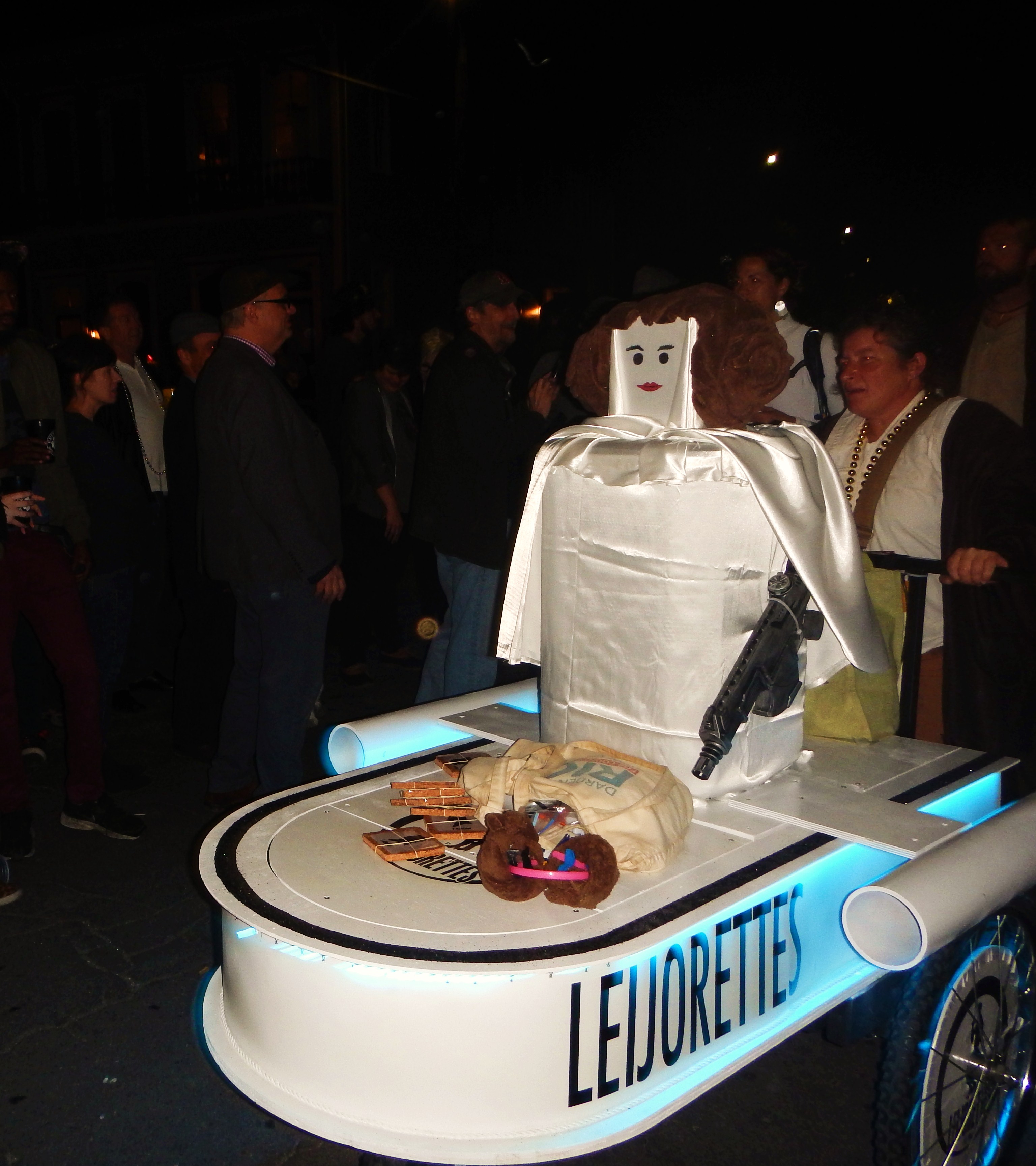
This past Saturday was the annual turning point for me when Mardi Gras stops being a vague concept I hear about on the radio & Facebook feeds and becomes an experience I’m living. Although the Phunny Phorty Phellows’ annual streetcar ride on Twelfth Night is the official start to Carnival season, it’s one I typically miss. Mardi Gras never feels real until I’m finally misbehaving in the thick of it & Krewe du Vieux is my usual starting point for the revelry, but I missed that parade this year as well. 2015’s Chewbacchus celebration was that magical moment when everything clicked and I thought “This is it. This is Mardi Gras.”

The Intergalactic Krewe of Chewbacchus is a relatively young parade that rolls hand-made, people-powered contraptions through the French Quarter & Marigny while the larger, gas-powered floats roll elsewhere across town. Although their nerdy umbrella has expanded to include all kinds of sci-fi goofiness, they’re the only parade I can think of that’s specifically designed to celebrate a movie franchise: Star Wars. Despite the inclusion of other sci-fi properties like Doctor Who, Star Trek, E.T. and (most recently) Guardians of the Galaxy, it’s still a mostly Star Wars-themed affair, one that lauds the “drunken Wookie” Chewbacca as its monarch. Real-life Chewbacca Peter Mayhew himself has even lorded over the parade the past couple of years, revelers treating him like nerdy royalty. The parade’s haphazard, DIY aesthetic perfectly matches the DIY practical effects of the original Star Wars trilogy. Star Wars’ endless parade of odd-looking weirdos and handmade sets & costumes serves as a fitting platform for New Orleans’ own endless parade of odd-looking weirdos & their personal creations, even if they’ve come to incorporate other fandoms as the years march on.

Wasting away a drunken afternoon in the Quarter and then capping off the night with Chewbacchus’ Imperial Stormtroopers & Jedi Knights was my personal introduction to the 2015 Carnival season. It was a great feeling to ring in my favorite time of the year while celebrating one of my other favorite activities: watching movies. Here are a few pics to help solidify the memory.

DSCN0999

DSCN1000

DSCN1001

DSCN1003

DSCN1004

DSCN1005

Have a great, safe Mardi Gras, y’all! And may the Force be etc, etc.

-Brandon Ledet

In a World . . . (2013)

inaworld

threehalfstar

In a World . . . is a traditional, by-the-books comedy about the niche movie trailer voiceover industry and overstuffed with niche comedians, but it’s one that attempts to make a universal point in its sucker punch ending. Writer/director/star Lake Bell creates a lived-in world that feels authentic in its portrayal of the insider humor of what movie-trailer narrators call “The Industry”, but also feels totally bogus in the way that all comedies do. The list of inspirational sources she manages to pull from while maintaining this balance is impressive: traces of 70s & 80s ensemble comedies; more modern, flat, bickering anti-humor; and professional competition Spencer-Tracy rom-coms like Adam’s Rib & Woman of the Year run throughout. There’s a confidence & ease to In a World . . . that makes Bell seem like either a natural or a great student of the Hollywood comedy as an art-form who’s been cooking this particular idea for a long while.

The plot centers on voiceover artists scrambling to fill the void left by the death of real-life movie trailer colossus Don LaFontaine, the infamous voice behind ads that begin with the phrase “In a world . . .” As portrayed here, “The Industry” is a cutthroat, tight-knit community overrun by white men who have dominated it since its inception. Lake Bell’s protagonist, Carol, attempts to shake up the old guard by infiltrating their ranks. Every success she achieves in “The Industry” on her own merits is regarded by her competition as her stealing their jobs and she quickly earns the moniker “The Thief”. Bullheaded men treat the idea of a woman in the business like an unwanted intrusion and the worst offender of all is Carol’s father, a legend in “The Industry”. He actively tries to limit her professional opportunities, championing a male voiceover artist as his protege instead of his own daughter and spouting unchallenged, sexist drivel that feels like a hangover of the boys-club era that’s slipping through his fingers. Early in the film he encourages Carol to abandon her dreams of becoming the next Don LaFontaine, telling her “The Industry does not crave a female sound. I’m not being sexist; it’s just true.” It’s true to him, at least. Because he’s sexist.

As mentioned above, In a World . . . gets very didactic & cruel in its last ten minutes, but the mood shift doesn’t feel unearned. There’s a consistent mean streak running throughout that telegraphs the bitter, cynical worldview of the climactic scene long before it arrives. It’s an ending that most likely won’t sit right with some viewers not only because it’s cruel, but because it muddles both the general vibe of the film as well as its central message. I believe the muddling was intentional, as it reflects the way a woman’s professional accomplishments & missteps can often feel muddled by the politics that surround them. Either way, it’s a conclusion that’s ultimately up for debate, since it refuses to be fully explained, instead opting to leave you on an oddly sour note.

There’s plenty of other great elements to praise, even if the ending doesn’t work for you. The film boasts the same reverence for sound employed in the likes of Berberian Sound Studio & Electrick Children, except more intensely focused on the sound of the human voice. There are great one-off gags involving “The Industry”, especially in fake movie titles like Welcome to the Jungle Gym. Perhaps the biggest strength of all is the stacked comedic cast mentioned earlier. Ken Marino plays a perfect 80s cad here and is backed up by names like Rob Corddry, Tig Notaro, Nick Offerman, Demitiri Martin and Geena F’n Davis. Lake Bell herself carries the central role as well as she carries the daunting tasks of a first-time writer/director. As a mission statement, Bell’s first feature suggests that she has a lot of great films in her just waiting to get made and, judging by In a World . . .’s bitter ending, they’re movies that aren’t going to play nice.

In a World . . . is currently streaming on Netflix.

-Brandon Ledet

Hercules (2014)

EPSON MFP image

twohalfstar

campstamp

Dwayne “The Rock” Johnson is the great WWE success story. When the juggernaut wrestling promotion tried its best to launch Hulk Hogan’s movie career with its first foray into film production, 1989’s No Holds Barred, the results were mixed. Hogan remains the most widely known household name in wrestling, but his movie career, which featured long-forgotten titles like Suburban Commando & Mr. Nanny, didn’t exactly pan out as planned. The Rock, on the other hand, basically launched WWE’s movie-making division all by his lonesome. His first three starring roles in The Scorpion King, The Rundown, and Walking Tall basically built WWE Studios from the ground up. The Rock’s world-class shit-talking skills & excessive mugging in his wrestling promos translated well to action stardom & he’s been the sole wrestler who’s been able to make a long-term career for himself on the big screen (though Bautista may be next in line).

The secret to Johnson’s success? He’s actually a damn good actor. He has a lot of weird, mostly untapped energy that can reach far beyond the limited roles he’s been landing. With early parts in action shlock like Doom & The Scorpion King, he’s proven himself to be one of the last Schwarzenegger-type muscle gods who manage to look convincing while kicking ass & dispensing pun-heavy quips indiscriminately. He’s perfectly suited for action movie roles, but he’s also being underserved in them. Riskier projects, like the more unhinged Southland Tales and Pain & Gain, have unleashed a different Dwayne Johnson altogether, one completely independent of the Schwarzeneggers & Van Dammes before him. He has a manic beast lurking under that confident exterior, just waiting to out-weird any other action star in the world, Stallone & Cage included.

Unfortunately, Hercules does not employ the offbeat wild-man Dwayne Johnson, but instead opts for the cookie-cutter action star The Rock. He’s in full Scorpion King mode here, hitting so many familiar Schwarzenegger beats that I assumed it was secretly a Conan the Barbarian remake that couldn’t secure the rights. Hercules’ opening narration plays like a trailer to a much better film, The Rock slaying a succession of giant, mystical beasts with ease. It slows down from there, limiting the action to a single episode of Hercules and his rag-tag crew of super-warriors leading an army into an epic battle, the exact kind of narrative you’d expect from vintage Conan the Barbarian story record. The movie has a sort of charm in its limited scope, especially in its lighthearted approach to mass violence and in The Rock’s natural magnetism. Most of Hercules’ best moments arise from The Rock’s inherent coolness. He just looks like a total badass as he wears a lion’s head as a crown, defeats wolves & charging horses with just his bare hands, and smashes a hooded executioner to pulp with a smaller, less talkative rock. Hercules makes for a much more convincing, enjoyable superhero adaptation/reboot than the similarly reductionist films I, Frankenstein & Dracula Untold, but in the end a lot of your enjoyment will hinge on how much you enjoy spending time with The Rock, as opposed to how much room Dwayne Johnson is given to be his enchanting self.

The transition from babyface wrestler to action hero makes total sense. Both roles require a convincing “good guy” to put the world’s depthless “bad guys” in their place. The Rock has had a few great action roles over the past decade or so, and with the exception of a couple missteps like The Tooth Fairy, he’s managed to avoid the pitfalls of Hulk Hogan’s career path. It’s just that after watching what a stranger, more nuanced Dwayne Johnson can do, it’s worrisome that he’s still making something this close to The Scorpion King at this point in time. Hercules can be a fun, one-time viewing for the audience, but let’s hope it’s not a damning career-trajectory indicator for Johnson. He can do so much more when given the chance.

-Brandon Ledet

Teenage Mutant Ninja Turtles (2014)

EPSON MFP image

fourstar

campstamp

One of the best aspects of the ancient art of recording television on VHS tapes was the commercials that you’d incidentally gather as a byproduct. A VHS recording of an old Sifl & Olly episode or Lifetime Original Movie may have been made irrelevant by the advent of YouTube, but the much trashier, more disposable art of a television ad is for the most part lost in the process. There’s a reason websites like Everything Is Terrible go back and dig up this garbage. An advertisement can serve as a time capsule of the era in which it was made. Even something as mundane as a car commercial feels strangely foreign 20 years later. A VHS recording of a pan & scan Jurassic Park isn’t particularly useful in 2015, but if you read between the dinosaurs there’s some useful glimpses into the world that was watching it: what the people were wearing, what hacky jokes they halfheartedly chuckled at, what bullshit later haunted their attics & dumps. Advertising is a low form of art, but it’s art that can later serve as a cultural relic.

Bad movies can work the same way. Mac & Me has just as much to say about where our culture was in 1988 as Cinema Paradiso, if not more. What kind of a sense of 1959 would you get if you only watched North by Northwest & The 400 Blows and completely avoided the likes of Attack of the Giant Leeches & Plan 9 from Outer Space? An incomplete one. We are not sophisticated people at heart. Our garbage has a lot more to say about who we are than our fine art ever will. When we create fine art we transcend our true natures and achieve greatness beyond our limitations. When we create garbage we’re being honest about the ridiculous fools we are at heart. A bad movie is a mirror to our worst, most banal impulses. A great bad movie makes us love those impulses. A great bad movie makes us love being a dumb, simple people.

I’ve said it before and I’ll say it again: Michael Bay’s production of Teenage Mutant Ninja Turtles was The Best Bad Movie of 2014. It deserves to have great longevity as a cultural relic, as it somehow captures the entire zeitgeist of our worst cinematic impulses in one ridiculous package. I’m talking lens flairs, found footage, product placement, inclusion of viral videos, over-reliance on CGI, shaky cam, action confused by quick cuts, large-scale destruction of a major city, a phony third act death crisis, and a dubstep beat for the rap song that plays over the credits. The film itself is an example our greatest, most frequent sin of recent years: the reboot. More specifically, it’s a gritty reboot, the most ludicrous gritty reboot of the post-Dark Knight era (although the peculiarly humorless I, Frankenstein certainly gave it a run for its money there). To top it all off, it boasts an above-it-all sense of irony that compels the movie to periodically point out how inherently silly its premise is. Characters poke fun at one another for “doing the Batman voice” and frequently mock the idea of talking humanoid turtles. Teenage Mutant Ninja Turtles is the last five years of bad taste in a nutshell. Or, if you will, on a half shell.

Despite its self-aware irony, there are still glorious moments when the film loses itself in its own ridiculousness. A few action set pieces, particularly a downhill slide and a rooftop battle, are the kind of far-fetched, detached-from-physics kind of fun that you’d expect in franchises like Fast & Furious and, less effectively, Transformers. The movie’s villains, a mech soldier Shredder & a corporate prick William Fichtner, are genuinely terrifying figures worthy of the film’s dark tone. There’s a “beating up the bad guys” vibe in the way the villains are dealt with that feels more like a sincere kids-playing-with-action-figures kind of storytelling than some of the film’s more ironic detachment. The found footage sequence briefly mentioned above, however, finds the film losing itself in its own ridiculousness more than any other. In this scene investigative reporter April O’Neil is digging through her childhood camcorder recordings only to discover that she herself raised the Ninja Turtles as pets in her father’s laboratory. April O’Neil is the source of the Turtles’ affinity for Pizza Hut® pizza; she is the one who named them after Renaissance painters; she is the one that saved their lives by casting them to the sewer. It’s a highly unlikely connection that the film makes & one I greatly appreciate for its lunacy.

There’s even a sense of purpose to the film’s hideous creature design. After April saves the infant Turtles by sending them underground they go through a strange transformation. Through a brief stop-animation effect & training montage, the cute-as-a-button Turtles morph into the ugly, alien-looking things that have been derided since the movie was first advertised. It was only until actually watching the film (as opposed to the ads) that I realized their ugliness had a purpose (even if it wasn’t intentional): puberty. The “Teenage” part of the characters’ namesake is stressed heavily in this incarnation. Their awkward, not-at-all-right appearance is only the tip of the pubescent iceberg. The teenage Turtles are hormonally violent, potentially dangerous young men who dream about running away from home as soon as they’re old enough and spend way too much money on their vehicle in the meantime. They struggle with creaky voices, fart openly, listen to loud music, get coked out on high doses of adrenalin, and have to answer to an angry rodent father figure when they miss their curfew. The most off-putting detail of all is the way they constantly hit on a nonplussed April O’Neil, calling “dibs” on her & whispering “She’s so hot I can feel my shell tightening” in moments of unearned, unseemly bravado, but also excitedly freaking out when she actually responds to them, bragging “I totally talked to a girl!” The Turtles are just as much teenagers as they are ninjas in the film and it’s just as awkward & disgusting as teenagers are in real life.

There are a few other bright spots to praise, like a legitimately cool animation effect that opens & closes the film (in a look that tips its hat to the characters’ comic book roots) as well as the decision to shroud the iffy CGI in darkness, which I think always benefits the format (as opposed to brighter looks like Avatar’s). The casting also shines here. Faces like Whoopi Goldberg, Taran Killam, and Will Arnett keep the mood light as physical reminders not to take the film too seriously. Arnett’s particularly funny as the flustered butt of throwaway gags, like when a Turtle calls him a “human nerd” or when he’s cooking alone to “Careless Whisper” in his apartment. Megan Fox is serviceable, not too distracting in her portrayal of April O’Neil, but not adding much either. I like to think of her here as the human Michael Bay calling card, as if the superfluous explosions weren’t enough on their own. As mentioned above, William Fichtner’s villain is as chilling as always; it’s a performance that honestly feels like it belongs in a much better film. The movie’s tone may be self-contradictory in places, but it ultimately is successful in being both a cheap thrills type of fun at face value as well as a comprehensive cultural relic when considered in the context of its place in time.

The worst part about Teenage Mutant Ninja Turtles is that I have so much fun watching it. I eat this garbage up. I first saw the film alone in a theater on a Friday night, drunk, and lightly surrounded exclusively by groupings of young dads & sons. I felt like a total goofball to be the only one chuckling as they watched in respectful (or bored) silence. C’mon, dads! It’s a fun movie! Tony Shalhoub totally plays a gigantic, scrotum-esque rat! C’mon kids! Shredder totally has badass knives for hands! My enthusiasm was unreciprocated long after I left the theater as well. No one was interested in even talking about the movie, much less watching it. I still can’t convince people to watch it, even for a goof. My love for 2014’s Teenage Mutant Ninja Turtles is a dirty secret only because no one cares to hear it. I believe the problem is that my timing is too soon. That 1993 Chrysler commercial incidentally archived on a VHS cassette during an X-Files episode wasn’t culturally significant until at least 2000. In a few more years the gritty Teenage Mutant Ninja Turtles reboot will cease being a fresh, undistinguished wound and earn its rightful status as a precious artifact, a prime specimen of our modern blunders, a more valuable cultural marker than all of the Boyhoods & Birdmans in the world. As a shoddy product so distinctly of its time, its value will only increase as the years soldier on.

-Brandon Ledet

Get Excited! What We Do in the Shadows is Looking to Fund an American Theatrical Release

EPSON MFP image

A few years ago I was ready to concede that the vampire & zombie genres had reached their saturation points. In the mad rush to capitalize off of the successes of viable commodities like Twilight & The Walking Dead, the market has just been flooded with untold piles of subpar schlock like Vampires Suck & Zombeavers. Every now & then, however, a movie proves me wrong. I found the zom-coms Life After Beth & Warm Bodies to be surprisingly sweet and compassionate. The unfairly ignored Vamps was a return to form for Clueless-guru Amy Heckerling’s particular brand of social satire. I have yet to see Jim Jarmusch’s Only Lovers Left Alive, but from the advertising it seems to bring the 80’s classic The Hunger’s vampiric ennui into the 21st Century, an aesthetic I hadn’t considered would return. The endless implications & metaphors swirling around the undead have proved the genres endlessly adaptable, even if the final product isn’t always solid.

That’s why I’m hopeful for the New Zealand horror comedy What We Do in the Shadows. It promises to take the same ennui employed by Only Lovers Left Alive into the satiric comedy territory of Vamps. Posed as a Christopher Guest-style mockumentary, the film follows modern day vampires as they navigate mundane activities like nightlife, dealing with roommates, and searching for a bite to eat. They clash with the likes of witches, zombies, werewolves, and plain-old humans in a loosely-plotted slice of (undead) life comedy. From the looks of the trailer, it could be quite funny as well as a fresh take on a genre I once thought hopelessly stale.

What We Do in the Shadows is currently looking to fund an American theatrical release through a Kickstarter campaign. The Kickstarter’s page is helmed by the filmmakers themselves, Jemaine Clement & Taika Waititi, two of the creative minds behind the cult-classic comedy series Flight of the Conchords (as well as the films Boy & Eagle vs Shark). Clement is also a major player in one my favorite dumb comedies, Gentlemen Broncos. He’s a very funny & talented performer that I wish didn’t have to beg for funding like this, but the worst part is that the campaign is barely more than halfway funded with just a week left to go.

Even if you are not in a position to donate to the film’s American distribution, at least visit the Kickstarter page for a humorous promo featuring Clement & Waititi themselves or maybe help spread it elsewhere on the internet. It would be great if more people could see this promising, self-funded comedy and it was rewarded for bringing undead concepts into unexpectedly fresh territory.

2/14/15 UPDATE: The project was a success!

-Brandon Ledet