Every month one of us makes the rest of the crew watch a movie they’ve never seen before & we discuss it afterwards. This month Britnee made Brandon , Alli, and Boomer watch Magic in the Mirror (1996).
Britnee: Moonbeam Entertainment, the sub-brand of Charles Band’s Full Moon Features, produced some of my favorite children’s fantasy and sci-fi films during the early 1990s. VHS copies of Prehysteria!, Dragonworld, and Pet Shop always lingered around my family’s television, but the one Moonbeam film that I just couldn’t get enough of was Magic in the Mirror. There’s just something about the film’s wackadoodle story and low-budget quality that is both memorable and charming. Magic in the Mirror may very well be the root cause of my garbage taste in movies because, until recently reading through the overwhelming amount of negative reviews, I had no idea that anyone could dislike it.
Magic in the Mirror is a modern-day fairy tale. Mary Margaret Dennis is a young girl with an active imagination, but her botanist father and physicist mother fail to give her the attention and encouragement that she desperately needs. She spends most of her time with her imaginary friends, Bella and Donna, and doesn’t have much human interaction. After discovering a bag of magical golden berries and inheriting an antique mirror from her late great-grandmother, she crosses to the other side of the mirror. What awaits her there is a surreal world ruled by human-like mallards that have a passion for tea made of people, which is steeped for a mere 60 seconds (I usually let my Earl Grey steep for 3 minutes).
Brandon, there’s an interesting mix of science and fantasy in Magic in the Mirror. Most of the scenes with Mary Margaret’s mother involve her working on an invention (a laser beam that defies space and time) while Mary Margaret is trekking through a mallard-filled fantasyland. Is there a message being made about science versus fantasy in Magic in the Mirror? Or is it just two cool concepts combined to make one hell of a movie?
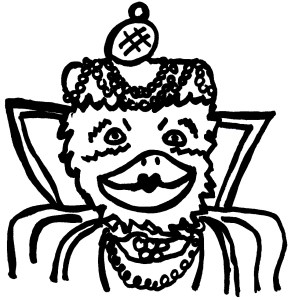
Brandon: If we’re going to single out Magic in the Mirror as “one hell of a movie,” I think we have to place the emphasis on the word “Hell.” Most of my appreciation of the film stems from the way it plays like a child’s half-remembered nightmare, so it’s funny to see it described here as “memorable and charming.” Before reading that introduction, I presumed it would be film’s nightmare quality that buried its imagery in the subconscious of 90s Kids™ who saw it young enough for it to torment them permanently, preventing it from being forgotten the way most Moonbeam Entertainment pictures have. Productions from Charles Band’s prime distribution label Full Moon (typified by franchises like Dollman, Ghoulies, Puppet Master, Evil Bong, and Demonic Toys) have always felt a little like kids’ movies that happened to feature R-rated monsters & gore. It’s only natural, then, that its (supposedly) child-friendly sub-brand would come across as an unintentional horror show. Magic in the Mirror was a production recycled from unused material for a canceled Full Moon fantasy film titled Mirrorworld (militant frugality is another one of Charles Band’s calling cards), so for all we know its magical kingdom of malicious mallards was originally designed to terrify adults, like the off-putting humanoid amphibians of Hell Comes to Frogtown. As an exercise in filmmaking craft, Magic in the Mirror possesses all of the cinematic artistry of a Wishbone episode. However, its villainous threat of humanoid ducks who boil children alive to make tea because they enjoy the way it tastes has a potency that far outweighs the limited means of its production values. In fact, the film’s aggressive cheapness somehow makes it feel even more sinister, as if we were an audience of children invited over to a D.I.Y. production of the Howard the Duck movie as a stage play in an adult stranger’s basement. By shifting the focus away from intentional monster-based scares to a children’s fantasy context, Full Moon had somehow delivered one of the most genuinely creepy films in its catalog. Until I can forget the sounds of these cursed duck beings greedily slurping their murder-tea, I’m going to be losing a lot of much-needed sleep. I can only imagine that effect would be even worse if I had caught this movie in its early VHS days (although, like Britnee, I had a strong childhood fondness for Prehysteria!, so who knows).
While I’ll concur that the film’s mixture of science fiction & fantasy as if they were two sides of the same coin was interesting, I’m not convinced the movie thought through the significance of their convergence to any great extent (unlike the recent animated gem Mary and the Witch’s Flower). The mother’s invention of an antimatter raygun almost doesn’t qualify as sci-fi at all, since its childlike logic is so far outside the bounds of reality. The divisions between those two genres seem to be present only to mirror the divisions between Mary Margaret and her mother. Mary Margaret is a fantasy-minded child with an overactive imagination. The too-serious adults in her life (especially her mother) refuse to pay her any attention because they only care about boring, rigid adult stuff like science, careers, and facts. In a way, it’s totally appropriate that the sci-fi aspect of the mother’s antimatter raygun (along with the botanist father’s cataloging of magic berries) only make sense in a fantasy context, since the film is told from Mary Margaret’s detached-from-reality perspective. Magic in the Mirror is by no means singular in its premise of a young girl learning the ways of the adult world through a nightmarish adventure in a fantasy land; a short list of similar (but more substantial) works might include MirrorMask, Alice Through the Looking Glass, Labyrinth, The Lion the Witch and the Wardrobe, His Dark Materials, and former Movie of the Month Paperhouse. The way it captures a young child’s isolation among adults who don’t have the time of day for their imaginative whimsy has its own merits, though, especially as Mary Margaret & her mother attempt to breach the invisible barrier of the mirror to reconnect with each other, each with their own tools (the magic berries & the raygun, respectively). This belittling feeling of being ignored by the too-serious, fact-minded adults around you is very relatable for kids and it’s one I can only remember being addressed this extensively in the much classier Val Lewton picture Curse of the Cat People.
Boomer, we seem to be painting two portraits of Magic in the Mirror here. One is a thoughtful expression of childhood frustration with being ignored by the adults who lord over you. The other is a subliminal nightmare that lingers only as a fear of cheaply costumed duck-people who boil children alive for the pleasure of the taste. Did either of these qualities overpower the other in your viewing of the film or did they work perfectly in tandem, like two realms on opposite sides of the same magic mirror?
Boomer: Unlike you, Brandon, I didn’t find the ducks–excuse me, Drakes–all that scary. Maybe if I were a child the first time I saw it, I would have had a different experience, but as it is, the flappy mouths and glug-glug-glug drinking sounds were too similar to the intentionally comical appearance of the eagle-headed colonel from Danger 5 to elicit anything other than laughter from me (which it did, every time). If anything, their sped-up waddling and the terrible flying effects render them adorably pathetic in spite of their menacing tea habits. Had I been a child during my first viewing, I would have found the Mirror Minders the far creepier creatures, as the thought of an oversized manchild in drab motley watching me from the other side of my mirror is a much more disturbing thought in its abstract than being boiled alive for a mere sixty seconds. I know that they’re supposed to be charming in a Mr. Tumnus way, but their high pitched voices and the “I used to be a birthday clown but now I live in the woods” color palette aren’t exactly virtues to me. I, too, am a longtime fan of Full Moon Entertainment, and frequently find myself extolling its virtues, like the fact that it was one of the first studios to have an interconnected film universe, with the eponymous main characters from their respective films coming to blows in the crossover Dollman vs. The Demonic Toys (which also featured a shrunken nurse from one of my personal favorites, Bad Channels, as Dollman’s love interest). That doesn’t mean I’m going to give a pass to just anything that Band put his hands on (I submit my review of Dungeonmaster as evidence), but I found this film more charming than alarming, despite the Mirror Minders. There is a bit of a creep factor, but it does, as you say, work in tandem with its more traditional fantasy fare.
The way that the film steals (or “pays homage to,” if you’re feeling generous) images from other dark children’s films of the 80s and early 90s really contributes to its overall charm. The influences of Lewis Carroll’s Alice duology are obvious (and explicitly pointed out in the film’s trailer), but Magic in the Mirror carves out a place in that same rhetorical space as 80s kid flicks with a dark undertones and anchors itself there. The visual of Mary Margaret approaching her great-grandmother’s herbiary could be from any number of films, but there’s a definite NeverEnding Story vibe as the framing calls to mind the moment that Bastian finds the book with the Auryn on the cover in Mr. Coriander’s book shop. Further, although Return to Oz hews closer L. Frank Baum’s Oz novels than the 1932 musical to which it is supposedly a sequel, it carries over the same “Oz is a hallucination/dream” conceit as the Judy Garland film. Once our heroine crosses back over into Oz, she meets the witch Mombi, who is played by the same actress as the cruel woman who runs the sanitarium in Kansas; her imagined mechanical man Tik-tok is influenced by the “face” in the machine that the woman intends to use to electrocute poor little Dorothy’s brain. This wasn’t a new idea even at the time (for instance, Captain Hook is traditionally played on stage by the same actor who portrays Mr. Darling, dating back to the earliest theatrical presentations of Peter Pan), but the similar dark tone to Return works to give Magic in the Mirror perhaps more gravitas than it rightly deserves. Dragora is played by the same actress as Mary Margaret’s principal, her vizier is the same actor as her mother’s douchey assistant, and all of the characters on the other side of the mirror have names that are similar to the scientific nomenclature in the herbiary. There’s no implication that the mirror world is a fantasy in the psychological sense (especially once Dr. Dennis crosses over and meets her royal doppelganger), but if the director were to claim he’d never seen Return to Oz, his pants would likely burst into flame.
Perhaps the most important commonalities in all of these works are the dual themes of grappling with and overcoming parental alienation coupled with a desire for the retention of the comforts of childhood, which bears some inspection. Dorothy Gale is an orphan being raised by her elderly aunt and uncle, who don’t understand her worldview or imagination. Bastian Balthazar Bux is the son of a widower father who keeps his child at arm’s length due to his grief over the loss of his wife. Jennifer Connelly’s character in Labyrinth feels overlooked by her family in lieu of the attention lavished upon new baby Tobey, and isn’t ready to forsake her LARPing to fall into the role of caregiver for her little brother. Alice’s parents are never mentioned, but readers can infer her relationship with her sister to be one of guardianship, and much academic ink has been spilled over this interpretation. In every instance the fantasy otherworld seems to be an escape but ultimately proves to be a crucible that causes each character to grow and have a better understanding of both themselves and their parents, and return home to find that, in their absence, the parental figures have learned to be more accepting of the child character as well. Dorothy realizes that there’s no place like home, and is moved by Uncle Henry and Aunt Em’s concern for her. Bastian learns that he can’t live entirely in his fantasies, and Mr. Bux sweeps his son into a long overdue hug after realizing that his blind grief over his wife nearly cost him his son as well. Sarah returns home with a newfound love for her brother and realizes that her fantasy world will always be there if she needs it, but shouldn’t consume her entirely; she has a pleasant interaction with her step-mother and realizes that being a big sister is an adventure all its own. The narrative of Mary Margaret and her parents follow this model so slavishly it’s almost paint-by-numbers, but that’s not necessarily a bad thing. The fact that these stories continue to be created and continue to be popular speaks to a near-universality of this metaphorical journey, and likely will as long as there are children whose budding maturity arouses confusing feelings of the dual but opposed desires for independence and attention, for individuality and community (so . . . forever).
My roommate has, of late, developed a fascination with soap operas. One of the reasons for this is that he loves anything that he feels like he, an amateur, could make himself. The Bold and the Beautiful so cheaply and poorly made that it captivates him, and I understand that, because that’s often how I feel about Full Moon (and Moonbeam) flicks. Other than the generally well-made puppets, there’s a pall of cheapness permeated with earnestness that lends these endeavors a charm that isn’t fully earned. As an example, I’d like to point to the scene where Mary Margaret finally meets the queen after escaping from the Drakes; you as the viewer should feel an air of majesty and magic around her, but that intended effect is completely undercut by the drabness of the dead grass all around her throne. Like, you couldn’t have sent someone out there the day before to spray paint the grass to make it uniformly, magically green? But no: this scene plays out in a field that is perfectly manicured but very, very brown. Alli, were there other parts of the film where it was obvious to you that the filmmaker’s reach exceeded their grasp? Did you find that endearing like I do, or no? What worked and what didn’t for you?
Alli: I’m going to be sadly honest here and say that this one just didn’t click for me as far as being amateurishly charming. I just thought it was bad. That being said, this discussion has given me a new angle to explore this.
Initially my reaction was that it felt like the children’s film version of Troll 2, but less fun because things that are obviously meant to appeal to children often just come across as obnoxious to me. The Mirror Minders, for instance, got on my nerves in a way that very few things can. (To get personal for a second, I think it’s something to do with the fact that Tansy reminded me of my ex.) I thought that the fact that the duck suits, while aesthetically great, were made in such a way that the actors literally couldn’t walk in them was so haphazard and ill-conceived. The whole plot felt taped together from bits and pieces that the writers found from previously scrapped ideas, resulting in an overall incoherence.
However, now I want to view it as if the purpose was to convey the feeling of a child’s point of view and how a child would approach filmmaking. I have a nephew who comes up with bizarre, horrifying ideas and plot lines that zig and zag in wild directions. If he were to write a movie, it would feel a little like this. Of course it’s a cheap aesthetic. Kids have a way of taking a book of unprotected pressed leaves and making it into a grimoire. In that way, I feel like the filmmakers here really hit the mark. It felt like they put a lot of time and energy into the ideas that really caught them and let everything else slide. For instance, the Mirror Minding chamber is a well-designed set that perfectly contrasts between the two worlds. The costumes for the queen and the Drakes are quite nice for a shoestring budget, even if waddling and running in those duck costumes seems like it was a dangerous endeavor. I feel like all of this put together would really appeal to children who hyperfocus on the ideas that they’re really in love with. And in that way, the movie works. Just not for me.
One of the things that seemed extremely undeveloped for me was Mary Margaret’s parents’ marital problems, which result in both of them trying to control their daughter’s interests and behavior whenever they happen to be paying attention to her. We see that her dad is a little bit of a depressed layabout and that her mom is a career focused scientist with her eyes on the prize, but everything else is given to us in hints. For instance, Lazlo seems to be constantly flirting with her, and the dinner scene seemed like a wildly inappropriate staging for a swinger’s party that a child was just dragged into.
Britnee, what do you think of that dinner party scene? Am I reading too deeply into this?
Britnee: The dinner party scene always seemed a little odd to me. And for a weird ass movie like Magic in the Mirror, that’s saying a lot. Mary Margaret is so out of place at that dinner. I know that’s what was intended, as parts of the film that take place in the “real world” spend a lot of time showing us how Mary Margaret doesn’t belong, but that scene just doesn’t feel right. No one recognizes that she’s a child, and she’s treated as a fellow grown up during the dinner. The dinner guests (Lazlo and his wife) do not like Mary Margaret one bit, and it’s more of a dislike of her being at the dinner rather than a dislike of her personally. The possibility of the two wanting to get it on after dinner with Mary Margaret’s parents would be a fantastic reasoning behind their strange behavior.
I wouldn’t put it past a Moonbeam feature to have some sexual innuendo sprinkled throughout the film, even though this is 100% for children. Moonbeam movies are pretty trashy for being family features, which is probably why I’m drawn to them so much. I have this image of the film crew throwing back a few beers while saying something along the lines of, “Dude, wouldn’t it be funny if, like, Mary Margret’s parents wanted to get it on with Lazlo and his wife? That would be totally sick! Let’s make it happen!” So Alli, I definitely do not think that you’re reading too deeply into the weird dinner party scene and the marital problems of the parents. If anything, you’ve pointed out the obvious.
While on the topic of the parents, I found their characters to have some gender-swapped traits, as far as most parents in 90s movies go. The dad is a very soft-spoken, artsy fellow that is a little more understanding of Mary Margaret’s creativity, but the mother is a career-minded scientist that doesn’t seem to understand her daughter at all. Most children’s films of this era have a mother who is supportive of their child’s wild imagination, while the father has a very no-nonsense type of personality. I’m not sure if a statement was trying to be made here, but if there was, it’s not a very positive one. The myth of career women not being able to be maternal seems to be purposefully implied with the mother’s character.
Brandon, what are your thoughts of gender roles of Mary Margaret’s mother and father? Do you think that Mary Margaret’s mother is villainized for being a career-minded mother?
Brandon: It’s certainly valid to read that icy mother-daughter dynamic as an indictment of women who chase career opportunities at the supposed expense of their domestic responsibilities. There’s plenty of other examples of that shrewish, disciplinarian mother trope in 80s & 90s family-friendly cinema that makes Magic in the Mirror appear to be a thoughtless participation in a sexist cultural ideology (Sally Fields in Mrs. Doubtfire immediately comes to mind, if nothing else). I’m just not convinced that the mother is villainized, exactly. She’s more in desperate need of being reminded of the value of childhood play & open-ended imagination. As potentially (and wrongfully) critical it may be of the way the mother balances home life with professional ambitions, the dynamic she has with her less . . . intense husband does recall a common, unfair expectation of women to be the daily disciplinarians of children while fathers get to enjoy the benefits of filling a kind of goofball best friend role. It’s a dynamic that’s been more purposefully explored elsewhere (Lady Bird being an excellent recent example), but I do think it has a real life significance.
What I’m struggling to interpret in retrospect, though, is how the mother’s real life relationship with Mary Margaret correlates with her mirrorworld avatar. In more classic films like The Wizard of Oz & MirrorMask, real life characters’ fantasy realm counterparts are typically amplifications of whatever anxieties they inspire in the young protagonist. In Magic in the Mirror, actor Saxon Trainor is the most significant player to pull double duty as a character in both realms: she plays the uptight scientist mother in the “real” world and the floral, despotic queen of the mirrorworld whose rule of the land is being challenged by the Drakes. Boomer, can you help me make sense of what these two characters have to say about each other in tandem? The usurping drake queen is portrayed by the same actor (Eileen T’Kaye) who appears as Mary Margaret’s schoolteacher, Mrs. Mallard, so the avatars might be saying something about the role of authority figures in Mary Margaret’s life, but it’s difficult to pinpoint exactly what. The easy answer is that the dual casting was solely a Charles Band-brand, money-saving manuever, but I don’t fully buy that.
Boomer: I’ll try! In the classic ’32 Oz, Margaret Hamilton is both the horrible Elmira Gulch, a shitty neighbor who taunts Toto into attacking her in order to have an excuse to have the dog put down, and then in the fantasy world (again, I feel the need to stress the idea that Oz is a child’s fantasy as being a film-only conceit) she is the Wicked Witch of the West who is Gulch’s reflection as a figure of evil and terror, right down to threatening Dorothy’s dog. In Return, the asylum attendants who move patient beds from place to place on squeaky wheels are reimagined in Oz as the creepy Wheelers, again played by the same actors. It’s a recurring trope of fantasy, as the majority of these films present the idea that a child’s fantasy world is a rhetorical space for that child to inspect, explore, and perhaps expunge their conflicting emotions about the world as seen through their eyes. As a society, we’ve progressed far beyond the relatively shallow understanding of human psychology that characterizes the work of Sigmund Freud, but there are still elements of his theories that hold true; he was of the opinion that, until they reach a certain level of maturity, children have a very black and white view of morality, and they cannot rationalize “good” and “evil” as being constituted within the same person. This was further explored by Bruno Bettelheim (admittedly also a problematic source) in his book The Uses of Enchantment: “all young children sometimes need to split the image of their parent into its benevolent and threatening aspects.” Essentially, most of these films are modern interpretations, adaptations, or reinventions of the fairy tale, and as such they textually examine the dichotomy of the “true” parent and the “pretender” parent. We see this most often in the way that fairy tales often feature an evil stepmother, which is a sanitization of older stories in which the biological mother was the cruel one. The switch to the use of the stepmother was an invention on the part of the Grimm Brothers (check out the chapter on the absent mother in Marina Warner’s From the Beast to the Blonde for more info about this phenomena). To further quote Bettelheim: “the typical splitting of the mother into a good (usually dead) mother and evil stepmother […] is not only a means of preserving an internal all-good mother when the real mother is not all-good, but it also permits the anger at this bad ‘stepmother’ without endangering the goodwill of the true mother” and it also preventing the associated guilt “about one’s angry thoughts and wishes about her.”
Mary Margaret’s relationship with her mother is a textbook example of this dichotomy: her real mother, though loving, seems to have no idea how to interact with a child or even how children conceptualize the world; she even admits as much in her laboratory. As a result, Mary Margaret has a mother who cannot connect with her in the way that her father does, who has no room for flights of fancy or imagination. As Britnee noted above, Mary Margaret is essentially treated as a small adult and not a child. In contrast to her relationship with her father, who seems to work from home, have a job that even a child could understand, and have endless free time, her mother has a lab, has a job that is incomprehensible to a child (and me, really, because this anti-matter laser is fucking nonsense), has rules and boundaries that are enforced but neither explained nor understood, and is distant emotionally and often absent. With this as a source of unidentifiable (to a child) anxiety, it makes complete sense that Mary Margaret casts Sylvia as Queen Hysop in her fantasy world; the queen is an absolute authority who is likewise cold and distant, rules her kingdom with a set of seemingly arbitrary rules that are not explained, and exacts punishment without explanation. As a method of discipline, being “planted” is simply a fantasy version of being told to stand in a corner; as a worldview, a queen’s “I don’t have to listen to anything; I’m the queen” is not dissimilar from a mother’s “Because I said so.” It makes perfect sense that Mary Margaret would cast her mother in this role in her fantasy world.
Except! This isn’t Mary Margaret’s fantasy. The world on the other side of the mirror is completely real, and although Sylvia/Hysop are not the only doppelgangers/analogues on both sides, most of the characters aren’t. There’s no equivalent to Mr. Dennis on the other side, nor do Tansy or Bloom have mirror images on “our” side. Magic in the Mirror is trying to have it both ways, treating the fantasy world as a real place (like in the Oz books) while incorporating the conceits and rhetorical strategies of those works which treat fantasy worlds as literally fantasy and entirely in the mind of the protagonist (like in the Oz films). As a result, there’s a separation in the metaphorical batter that I think is causing your confusion. Alli, you mentioned that this film doesn’t work for you; I doubt that its internal inconsistency as to whether this is a fantasy film or a fantasy film is likely not the reason, but would you have preferred one or the other? Do you feel like you could have gotten more out of it if the filmmakers had chosen one tack and stuck with it?
Alli: The lack of internal consistency is definitely not what didn’t work here. I guess I just don’t have the same enthusiasm for cheaply made kids’ movies that I have for ones geared towards adults. I don’t think I can handle the unironic, saccharine acting or the film school aesthetic. There was a time and place for that in my life, and it’s sadly over.
However, if I have to choose, I think I would have preferred this movie to stick to the fantasy. I have a big soft spot for everything fantasy, and there’s really not enough fantasy films out there, which is probably why I’m such a big Del Toro fan. It’s a shame the vast majority of fantasy film is low budget and aimed at children, but I think children need fantasy and escape in their lives, however low budget it is. The idea of getting away to a mysterious land and being a hero is empowering, even in something as ridiculous as this. Whereas, a fantasy film would still be empowering, but those always have a bigger dose of the horror of self exploration. Alice learns that a dream world with a lack of focus isn’t all fun and games. Coraline learns to forgive her parents for being busy after finding out that an overbearing mom, albeit exaggerated, is terrifying. Mary Margaret never learns anything about her own behavior. She just escapes. And I like her all the better for not having changed and being the same creative, stubborn child at the end. That’s the beauty of true fantasy for children; kids find out that they were and are strong.
It would have been neat for the movie to retain both the internal fantasy elements and the fantasy/scifi elements like A Wrinkle in Time does. I know that’s a bit more elegant for fare of this kind, but I think it could have been done with a little less focus on the lives of the parents. The whole parental plot in general just felt like a placeholder for something else. Probably, more adventures and obstacles in this mirrorworld that they didn’t have the budget for or the inclination to write.

Lagniappe
Alli: I like that there’s no clear-cut good side in this story. Obviously, massive ducks bent on making tea out of other life forms is definitely bad, but who are the good people here? The queen literally plants her subjects after no trial or due process. I don’t see how that’s preferable to Queen Dragora. I guess the good side is the Mirror Minders? I don’t know, but I appreciate the subtlety.
Boomer: The fact that the main character’s name was Mary Margaret is terribly distracting. It took me a minute to realize why it was so familiar, until I remembered that this was the name of Ginnifer Goodwin’s character in the “real world” on Once Upon a Time, another piece of contemporary enjoyable-in-an-unintended-way-but-also-terrible fairy tale media that I happened to stick with for longer than I should have for reasons of my own (#swanqueen). Also, as far as a final question, what was up with the use of that county courthouse as the “castle” of Dragora and her comically sped-up waddling henchmen?
Brandon: While I might be the only member of the crew to be genuinely terrified by the look of them, I do believe the Drakes are the main reason to seek out Magic in the Mirror. Not only do they offer bizarre insights like an answer to the eternal question “What would Howard the Duck look like in lipstick?,” they they also include the laziest, most nonsensical “wordplay” you’re ever likely to hear in a finished screenplay. It’s unclear what failed puns were intended when Drakes refer to their mallardian queen as “your Quackiness” or “your Quacktitude,” but they’re laughably half-assed in the attempt. I should warn you, though: do not be fooled into watching the sequel Magic in the Mirror: Fowl Play. Despite what may be promised in its title & cover art, there isn’t necessarily any more Drakes content in that picture than there was in the first one. Also, the whole thing appears to have been filmed in a crewmember’s living room while the sets of the first film were being hurriedly broken down, which might as well be the case since both films managed to secure a 1996 release. Full Moon truly is a wonder. If, as Boomer suggests, the charm of Magic in the Mirror is partly that you, an amateur, could have made it yourself, the charm of Fowl Play is that it looks like it could’ve been made by your kids. And not even the more talented ones.
Britnee: When the mallards make their infamous people tea, the people are steeped for 60 seconds. I don’t think that a human would necessarily die from being boiled alive for a mere minute (I refuse to Google this in fear of the results), but they would be severely injured once they are pulled out of the giant duck teapot. It would be interesting to know what happens to the people after the steeping. Are they given medical attention and returned to the other side of the mirror? Are they thrown in some sort of mass grave where they will eventually succumb to their injuries? I haven’t watched Fowl Play, but I’m almost positive this isn’t explored in the film. It would just be nice to know the full story, but maybe some things are better left unanswered.
Upcoming Movies of the Month
May: Boomer presents Batman: Under the Red Hood (2010)
June: Alli presents Gates of Heaven (1978)
July: Brandon presents Born in Flames (1983)
-The Swampflix Crew