Death Race 2050 (2017)

threehalfstar

campstamp

When people claim that “bad on purpose,” winking-at-the-camera camp films of recent years aren’t ever as exciting as those of distant schlock cinema past, I don’t think they’re necessarily saying that, as a rule, intentional, “low” camp is by nature less engaging than bad-on-accident, “high” camp. I hope not, anyway. I just think there’s typically a laziness to straight-to-VOD/SyFy Channel schlock that stops at a premise or a title, say Shark Exorcist or Cowboys vs. Dinosaurs, without any thorough or passionate pursuit of where its initial ideas can lead. To put it simply, modern CG schlock is rarely as deeply weird as it’s advertised to be in its Ain’t This Weird?! titles. That doesn’t mean all “bad”-on-purpose cinema is worthless, though. Just look to last year’s camp cinema triumphs like The Love Witch, The Greasy Strangler, and Pee-wee’s Big Holiday to prove that’s not true. Modern camp just needs to keep in mind that its most memorable ancestors, from the likes of Roger Corman or John Waters or Ed Wood, were made with great filmmaking passion that covered up whatever shortcomings their microbudgets couldn’t. Even when their tone wasn’t genuine, their inherent weirdness was.

Death Race 2050 is a genuinely weird film. It isn’t much more than a R-rated version of straight-to-SyFy Channel schlock, but it makes its cheap camp aesthetic count when it can and it survives comfortably on its off-putting tone of deeply strange “bad”-on-purpose black comedy. Much more closely in line with the Paul Bartel-directed/Roger Corman-produced original film Death Race 2000 than its gritty, self-serious Paul W.S. Anderson remake, Death Race 2050 is a cheap cash-in on the combined popularity of Hunger Games & Fury Road and makes no apologies for that light-hearted transgression. Corman productions have a long history of cannibalizing the films they’ve influenced, like when Joe Dante’s Piranha film openly riffed on Jaws (which was essentially a Corman film on a Hollywood budget). The original Death Race 2000, along with countless other Corman productions, surely had an influence on both the Mad Max & Hunger Games franchises and it’s hilarious to see the tireless film producer still willing to borrow from his own spiritual descendants for a quick buck all these years later. It’s also funny to hear him describe Death Race 2050 as “a car racing picture with some black humor,” which is about the most mild-mannered way you could possibly put it. The movie is, more honestly put, a live-action cartoon bloodbath featuring broad comedic personalities that would make a pro wrestling promoter blush . . . with a little car racing thrown in for fun. It never tries to survive solely on the strength of its premise, but instead injects each possible moment with weird character details and ludicrous production design. That’s the open secret of its many minor successes.

The plot here is standard Death Race lore. A near-future dystopia known as The United Corporations of America enacts population control through a televised racing competition in which contestants earn points for each pedestrian they run over. Children & the elderly earn them extra. Each contestant has a pro wrestling-sized persona: an obnoxious pop music idol, a genetic freak with inner conflicts regarding his sexuality, a Texas Christian archetype who’s turned her faith into terrorist fanaticism. None are nearly as popular as Frankenstein, however. A cyborg crowd-favorite who has long remained masked, Frankenstein is the paradoxical heartless killer with a heart of gold. Because this film is at least partly a Fury Road knockoff, New Zealander Manu Bennett plays Frankenstein as a cheap Tom Hardy stand-in instead of a reflection of David Carradine’s work in the original film. He drives across the country racking up points, trying not to fall in love with his comely co-pilot/annoying audience surrogate, fighting off a misguided revolution, and ultimately taking aim at his most crucial foil: a CEO-type dictator who falls somewhere between Emperor Snow & Donald Trump (the film’s only casting “get,” Malcolm McDowell). Rapid montages of a pollution-crippled future mix with television gameshow gimmickry, dismembered body parts gore (both traditional & CG), a long list of pointless tangents (including an otherwise-useless scene that deliberarely points to its own minimum-effort satisfaction of The Bechdel Test), and a romance plot no one asked for to make this ultra-violent race across the country a consistently fun, if wholly predictable journey. Death Race 2050 never transcends the bounds of what it is: a straight-to-VOD trifle. It stands as an enthusiastically entertaining example of the format, though, one that pulls some weird punchlines like “When your DNA sleeps it dreams of me,” and “Looks like rain today . . . and enslavement by machines tomorrow” whenever it gets the chance.

The only glaring faults I can cite in Death Race 2050 are a total lack of chemistry between its dull protagonists (Frankenstein & his co-pilot) and a dinky production value that suffers under what must have been a microscopic budget. That’s not so bad for a shameless, winking-at-the-camera remake meant to capitalize on two unrelated franchises that have earned popularity in its original version’s wake. Although Death Race 2050 tries to update some of Death Race 2000‘s minor details for a modern context (VR goggles that look an awful lot like swimming goggles, a Donald Trump-like villain, a self-driving AI vehicle contestant, references to things like St. Dwayne The Rock Johnson & Bieber Elementary), its spirit is very much rooted in the genuine weirdness of the Paul Bartel original. It’s a difficult tone to strike, I presume, given how often these cheap CG camp exercises come off as lifeless, passion-free slogs. Through some simple production details (especially in its dystopian Rainbow Store costuming), a dedication to R-rated sex & gore, and a surprisingly authentic punk soundtrack, Death Race 2050 shines like a rare CG gem in a murky sea of unmemorable schlock. It’s loud, dumb, “bad-on-accident” fun, but in a deliberately strange fashion that never feels lazy or half-cooked the way its peers often do.

-Brandon Ledet

Rollerball (1975)

EPSON MFP image

three star

Despite what you may assume from the flood of recent titles like Nerve, The Hunger Games, and The Maze Runner, the future-murder sports dystopia flick is not a new invention. The stars of those YA action flicks might skew younger & more feminine than they used to, but there’s a long tradition of dystopian sci-fi sports movies that dates at least as far back as cult classic like Death Race 2000, The Running Man, Tron, and Logan’s Run. Unfortunately, the James Caan sports dystopia Rollerball isn’t exactly a forgotten gem of the genre. It’s an admirable contribution to the field, though, and it had the good fortune of arriving early enough in the deadly future-sports genre to escape accusations of being derivative. If released in 2016 with a Chloë Grace Moretz or an Elle Fanning in its lead role, Rollerball would be a bankable, but forgotten addition to an already-crowded field, but in 1975 it could still pass as an oddity & a novelty, one that’s – for better or for worse – a lot more gruff & macho than its genre has become in the decades since.

The most exciting aspect of Rollerball is, of course, its titular game. Like a deadly version of roller derby filtered through aspects of football, hockey, jai alai, and motocross, rollerball is a swirling tornado of roller skates, motorbikes, and beefy men aiming to break the neck of any competitor willing to block their path to the same goal that commands most professional sports: putting the ball in the hole. Director Norman Jewison (who is also responsible for Moonstruck, oddly enough), throws all of his weight into the staging & the cinematography of the scenes set in the rollerball arena. The film opens with ominous organs that playfully hover between stadium music & a horror score. Intensely lit players on roller skates & motorcycles whip around the arena, flashing spiked gloves & ridiculous facial hair. Rollerball was made in a time when roller derby felt like a brutal & futuristic sport. It’s since become somewhat of a retro relic, but it’s got its own legion of dedicated fans & players and the movie captures the excitement of those crowds, just with an extra layer of bloodlust piled on top. As such, it’s perfectly calibrated for cult film longevity, even if it’s outshone by far superior works like Death Race 2000 & Logan’s Run.

That’s why it’s somewhat of a shame that the rest of the film surrounding the fictional sport is so oddly subdued. James Caan is perfectly cast as a gruff, but aging sports star, recalling several mid-70s quarterbacks from the NFL. He’s seen as being too on top of his game, however, as the wealthy executives who won the international rollerball league urge him to retrieve & squash his massive fanbase. The world of Rollerball is vaguely defined, but features a monolithic organization of Corporations that have replaced world governments with insular profit sharing & traded in business-disrupting wards with, you guessed it, rollerball. The Energy Corporation, who owns the Houston team Caan’s protagonist leads to frequent victory, reminds their star player constantly and with grave seriousness that, “No player is greater than the game itself.” As a sport, rollerball was specifically designed to encourage being a team player & to downplay the significance of the lone hero, a sentiment & philosophy meant to keep The Corporation’s subjects complacent, Caan’s heroic sports star threatens to disrupt that complacency when he refuses to step out of the spotlight and the executives who run the show conspire to rig the game in in order to force him out with the in-the-arena violence. By the time this comes to a head, bodies are on fire & piled on the court, but Caan keeps skating on & putting the ball in the hole. I like the central idea of a bloodsport keeping the common people’s heroics in check by encouraging groupthink, but the film does a much more compelling job establishing that story in the rollerball arena than it does in the lavish boardrooms & penthouses that languidly eat up the other half of its bloated runtime.

There may never be a better time for a Rollerball remake. Not only are remakes in general a hot commodity, but if you recast Caan’s lead role with a female teen you’ll have instant YA profits waiting to pour in (although I suppose it might’ve been a better bet to get it greenlit around the time of the first Hunger Games film, seeing how Nerve unfortunately passed by with little fanfare this summer). Rollerball was already disastrously duplicated in the hellish cultural low point of the nu metal 00s, but the time was less ripe then. Throw some neon & electronica on those undeniably exciting & PG-13 violent roller derby sequences and you’d have a really fun summer blockbuster on your hands. The 1970s version we already have is a decent enough picture on their own, though, especially in its exhilarating scenes of futuristic murder sports. You might have to be an already-established fan of that kind of sci-fi dystopia to be won over by its ludicrous thrills; it’s not an exception within its genre, but more of a typified. It is a weird little action movie, though, one I probably should have watched a lot sooner than I did, given my affection for its highly specific subgenre.

-Brandon Ledet

An Evening with Richard Kelly: A Southland Tales (2007) Q&A

EPSON MFP image

“No film is every really finished, just abandoned by the filmmaker.”

This is the philosophy, or rather one of the facets of the real-life and filmmaking philosophies, of Richard Kelly. In something of a MotM miracle, I received an email last week advising that Austin’s Alamo Drafthouse would be hosting a screening of Kelly’s 2007 opus Southland Tales, with an introduction by the director and a Q&A following the film. As discussed in our email roundtable, I was a fan of Donnie Darko when it was first brought to my attention in 2003, when a DVD of the film was passed around like wildfire at the Louisiana School for Math, Science, and the Arts. Although time and distance (and a strong wave of hype backlash as the film caught on outside of the cult scene) have dulled my teenage enthusiasm for the film, my interest in Kelly’s work was piqued again by our viewing of The Box, a film I didn’t love but haven’t been able to stop thinking about. I never got the chance to see Southland Tales before this past Sunday, but I’m glad that my first viewing experience was on the big screen and not limited to the comparatively tiny television in my living room.

What’s the film about? I’ll try to be as succinct as I can: Southland Tales takes place in an alternate 2008, where post-9/11 paranoia and the overreach of infringement upon civil liberties that followed that incident has been further exacerbated by a nuclear attack on American soil (Texas, to be precise). The draft has been reinstated, interstate travel is extremely restricted, and citizens are heavily monitored via the use of information network USIdent and the deployment of heavily militarized Urban Pacification Units, which seem to have taken the place of standard police forces. The Republican Party, most notably represented by Texas Senator and potential VP Bobby Frost (Holmes Osborne) and his wife, NSA Deputy Director cum USIdent overlord Nana Mae (Miranda Richardson), is seeking to swing California to the red in order to ensure the continued power of USIdent and the party. Popular action star Boxer Santaros (Dwayne Johnson), the husband of the Frosts’ daughter Madeleine (Mandy Moore), has recently awoken in the desert with amnesia; he makes his way into the arms of Krysta Now (Sarah Michelle Gellar), a psychic porn star seeking to expand her media and merchandise empires through diversification. Krysta has recently completed a screenplay entitled The Power, which foretells the end of the world.

Elsewhere, the underground liberal forces of the Neo-Marxists oppose the Republican Party (this entire group is composed almost entirely of former SNL cast members, including but not limited to Nora Dunn, Amy Poehler, and Cheri Oteri). Their current plan involves staging a racially-motivated police shooting committed by haunted veteran Roland Taverner posing as his twin brother Ronald (Seann William Scott), an UPU officer; the intention is to have this captured on film by Boxer during a ride-along for research purposes, then use the footage to discredit Bush’s apparent successors. Their machinations are held in check by a series of double-crosses that undermine their ability to take any real political action. Elsewhere elsewhere, the wizard Baron von Westphalen (Wallace Shawn) has invented both a device that uses the power of the ocean to generate wireless electricity as well as several injectable liquids of various colors that are used as drugs for both recreational and psychic purposes. He and his band of assorted cronies (Bai Ling, Curtis Armstrong, Zelda Rubinsten, and Beth Grant) move throughout the various factions at play, gaining political power and prestige while well aware that the alternative energy source that they have created could bring about the end of humanity. And all of this is narrated by Pilot Abilene (Justin Timberlake), a former movie star whose face was disfigured by friendly fire in Iraq after he was drafted. And, hey, if you were starting to think any of this was too straightforward, don’t worry; there are also stable time loops, predestination paradoxes, mistaken identities, and all the other Kelly elements you’ve come to know and, perhaps, love. Plus a lip-synch music video.

Part multimedia experiment, part time travel film, part jeremiad prophecy of the dangers of unchecked rightwing expansion into surveillance and homeland policing, part philosophy lecture, but mostly a political satire, Southland Tales has been called many things: unwatchable, convoluted, pretentious, and incomprehensible. For my money, however, the film (and its expanded materials, which I hesitate to call “supplementary” given that they were always intended to be part of the experience) is simply too ambitious to ever have any kind of mainstream penetration, even on the level that Darko did. There’s also been a lot of name-calling and assumptions with regards to Kelly’s ego and affectations of intellectualism, even from those of us here at Swampflix; in person, however, Kelly comes across as approachable, well-spoken, thoughtful, and shy (and he’s a total babe as well– look up a picture or two if you haven’t already done yourself this great service; those triceps are poppin’). Kelly directed this film when he was twenty-nine; that’s my age, and all I have to show for a life is a stack of unopened mail and a heap of student loan debt that I’ll finish paying off seven years after I’m dead– if I’m lucky.

In case you weren’t aware, Southland was originally envisioned as the final three chapters in a six-chapter arc, with the first three components released as graphic novels (Kelly said that when these materials, which were not quite complete at the time of the Cannes premiere, were given to the press, they sneered). There is a certain feeling of incompleteness that can be felt in the film as a result, but this is not the same thing as saying that the film is, as Kelly said in his introduction, “unfinished.” There’s certainly an element of that in play in the theatrical version that was screened, but I didn’t find it as distracting as others have. He discussed the nature of the release of the film, the way that certain visual effects were never quite completed due to the fact that the money for said polishing was to have come from one studio that held the international distribution rights, but there were issues with the domestic distributor. It’s all information that you can find elsewhere, I’m sure, so I won’t get into it here. There were some new tidbits that were shared in the Q&A that I’ll share here, though.

Why is Janeane Garofalo in the final scene? In the earlier, longer version of the film that was screened at Cannes, there is an additional subplot in which Garofalo plays a general who is engaged in a Dungeons & Dragons game with veteran Simon Theory (Kevin Smith) and a couple of other characters, with that game serving as an additional metaphorical layer to the events of the film, just line the screenplay for The Power. (I did see a credit for a D&D consultant in the final credits, which confused me until this was explained.)

Was this movie inspired by Brazil? Yes, Kelly loves Brazil.

Where did the character names come from? Kelly discussed that there’s a music to character names, and described how some come from more obvious sources (like the Robert Frost-quoting Senator Bobby Frost), and some a bit more obscure from sources both historical (like the von Westphalen family, whose true allegiances are obvious from the outset for those who know Jenny von Westphalen was the wife of Karl Marx), and literary (the Taverners share their surname with Jason Taverner, protagonist of Philip K. Dick’s Flow My Tears, the Policeman Said, which shares a rightwing autocratic dictatorship with Southland). So, like many of the references to extratextual real-world works that we mentioned in The Box discussion, they’re present less because Kelly wants to prove how smart he is and more because he thinks we’re all on his level, which is a compliment more than anything else.

Why so many Saturday Night Live actors? Besides the aforementioned Poehler, Oteri, Dunn, and Garofalo, other SNL alums include Jon Lovitz and John Larroquette. I really liked Kelly’s answer to this question; when we talk about political satire, at least in America, SNL is the troupe that is on the cutting edge of that discussion.

Is the recurring theme of free will versus predestination representative of a personal philosophy or just something that Kelly finds intriguing to play with on film? This was my question, and was admittedly a little longer in the actual asking (which involved referencing the Job-like structure of The Box and eschatological nature of Southland, leading Richard Kelly to compliment me personally, so take that, world!), but Kelly stated that this was something that he thinks about a lot, that humans beings are often bandied about by forces outside of their control, and how much agency any of us have at all (one audience member asked about Krysta Now’s agency in regards to the film, but I missed the answer to that one trying to calm myself enough to ask my question). Kelly had previously mentioned that Southland was intended to be a cathartic film experience; given that the themes of the film boil down to the idea that salvation comes from forgiving the self, which is an entirely internal emotional journey, I think that this could be reflective of that idea. Forgiving one’s self, like Taverner does in the film’s final moments, removes the external elements of predestination and is purely an act of personal decision, and through that comes real existential relief.

Whatever happened to the Norma Lewis prosthetic foot prop? This one I had to ask for Britnee, per her final thoughts on The Box. As it turns out, Kelly’s father, who really did work on the Mars Viking Lander project, did something similar for Kelly’s mother, whose own foot was disfigured, not unlike Norma’s. As for the prop, Kelly said he would have to make some calls to be absolutely certain, but he’s pretty sure it’s in a props warehouse in Boston.

For more on September’s Movie of the Month, Richard Kelly’s sci-fi mystery thriller The Box, check out our Swampchat discussion of the film and last week’s look at how the film works as a literary adaptation.

-Mark “Boomer” Redmond

Equals (2016)

fourstar

Is it all transgressive or radical anymore to point out that Kristen Stewart is a divinely talented actor? Have her Twilight days been sufficiently been wiped out by the ever-expanding wealth of killer onscreen work she’s put in outside that franchise? I hope so, because it’s becoming tiresome starting reviews like this (my third defensive preamble for her talents after American Ultra & The Clouds of Sils Maria). Kristen Stewart’s main problem, if she has one at all, is that the film industry often seems confused about exactly how to utilize her detached onscreen cool, a visible lack of urgency that lands her presence somewhere between James Dean & Lauren Bacall in its smooth, smoky, effortless charm. Although it nearly approaches the YA romance territory that has threatened to pigeonhole her career, the dystopian sci-fi drama Equals does know what to do with Stewart’s detached cool. Besides indulging in an always-welcome, heartachingly sincere story of sci-fi romance, Equals presents a future where emotion has been outlawed, a perfect platform for Stewart’s own emotive talents, which are typically communicated through subtle body language & small shifts in tone. It’s not my favorite Stewart performance by any stretch, but it might serve as a convincing argument on her behalf for those still on the fence in regards to her immense, underappreciated talent.

As much as I’m rambling on about the many merits of Kristen Stewart here, the true protagonist of Equals is a man named Silas, played by Nicholas Hoult. Silas navigates a cold, clinical world in which war has been eradicated by outlawing human emotion. As a member of the emotionless Collective, Silas lives & works in a society of Spocks. Everything is bland, uniform, and designed for logical, streamlined function, the entire world an Apple Store. Silas’s peaceful life as an illustrator of “speculative non-ficiton” is threatened when an outbreak of the disease S.O.S. (or “switched on syndrome”) starts to trigger “behavioral defects” (emotions) in members of The Collective, including our protagonist. Silas dutifully takes his prescribed pills, but continues to feel anyway (likely a comment on the effectiveness of anti-depressants), and eventually finds himself dangerously infatuated with a coworker, played by Stewart. His love interest is dealing with her own rapidly-progressing S.O.S., however undiagnosed & unmedicated, and initially treats his advances like the unwanted attentions of any other workplace creep. Their attraction is inevitable, though, and sets up an achingly sincere, doomed-to-fail romance full of secretive, tender sexual encounters that put both Hoult’s & Stewart’s characters at risk for correctional “defective emotional therapy” at the hands of The Collective’s governing elite, a “treatment” that often ends in encouraged suicide.

Equals is mostly a slow, sensual drift through a cold, calculated future defined by its clean lines & blue lighting. Its romanceless dystopia most closely resembles the surrealist fantasy of this year’s The Lobster, but it approaches the subject from a more sincere, open-hearted place that recalls the sci-fi romance of titles like Her & Upside Down. There’s a metaphor to be found in the way this future society values “productive” lives over genuine mental health, but its true bread & butter is in the nervous, trembling touches Hoult & Stewart share as two young lovers unaccustomed to intimate human contact. The film finds its own visual language in the way it zooms in on actors’ bodies & faces in search of the tiniest of emotive responses, shrinking even the subtle bodily flirtation of Carol to a more microscopic stature (until, you know, it becomes full-on boning). There’s a little dose of subtle comic relief mixed in with this chest-heaving sensuality in the emotionless delivery of lines like, “You’re going to live, pal,” and [upon witnessing a coworker’s suicide] “That’s unfortunate,” but the film works best for those easily won over by sincere romance juxtaposed with a clinical sci-fi setting, an aesthetic I’ll admit I’m a huge sucker for.

Nicholas Hoult does a great job of selling the heartbreaking sincerity of this futuristic love connection (and, speaking of underappreciated actors, The Diary of a Teenage Girl‘s Bel Powley shows up to support the main cast), but Equals is Stewart’s show, not only because it fits the detached cool of her already established persona so well. As much as I appreciate the cold, clinical future presented here, it mostly makes me wish for a not-too-distant future where Stewart’s recognized for the full scope of her talent, not for being the girl from Twilight. Equals is a welcome step in that direction as well as a great, self-contained love story heightened by an oppressive air of emotional restraint.

-Brandon Ledet

High-Rise (2016)

EPSON MFP image

fourhalfstar

One of my favorite movie genres is something I’ve dubbed the “Party Out of Bounds,” a kind of storytelling structure where guests at an initially civil social event are compelled beyond reason to stay once polite society de-evolves & things get primally nasty. The exit is open, but they decline & instead choose to duke it out with their fellow “party” guests. As much as I enjoy the realistic examples of this (admittedly made-up) genre like Who’s Afraid of Virginia Woolf?, The Boys in the Band, and this year’s A Bigger Splash, I really get excited when the “Party Out of Bounds” story gets supernaturally twisted, like in the genre’s crown jewel The Exterminating Angel or in the recent dystopian period piece High-Rise. High-Rise is a particularly interesting case because its party starts from a seemingly dangerous, chaotic place and gets even more wild & savage from there, expanding the scope of its hedonism & cruelty to a months’ long, seemingly supernatural descent into the darkness of the human soul. It’s a sight to behold, a sinisterly amusing & deeply unsettling sight that stands as one of the best “Party Out of Bounds” stories I can remember ever seeing onscreen (and in subsequent nightmares).

Adapted from a novel by J.G. Ballard, the madman who penned the source material for Crash (1996’s incredible Cronenberg provocation, not 2004’s shameless Oscar bait), High-Rise is a reflection of 1970s anxieties about “luxury lifestyle” commodity & spiritually-erosive consumer culture as funneled through an aggressive, vague menace of existential dread. The film posits the modern consumer as a “bio robot,” a soulless machine who cannot function without their various gadgets & devices of “convenience.” Tom Hiddleston’s relatively well-adjusted protagonist begins his journey into a bleak, 1970s version of the future when he moves into a high-rise condo complex, a towering work of architectural Brutalism. It’s easy to believe you understand where the film is headed in his early interactions with the high-rise & its inhabitants. The building is a self-contained class system that matches the rigid haves-vs-havenots societal structure of works like Snowpiercer; the wealthy live on upper floors while the middle & lower class fight for their crumbs on the bottom. As the Talking Heads would put it, the building “has every convenience,” from a grocery store to a gym to a rooftop terrace complete with gardens & horseback riding (that only the upper floor wealthy can access, of course). The rich divert & hoard the best of the building’s resources, setting up an anti-capitalist uprise that we’ve seen play out in many (if not most) dystopian sci-fi works in the past. High-Rise begins its journey into human depravity from this familiar place, but completely unravels & sets fire to the genre expectations that accompany its starting point. I don’t think I’ve ever seen anything exactly like it before, which is what makes it such an exciting, terrifying work.

In addition to their addiction to modern convenience, the inhabitants of the titular high-rise are also addicted to partying. As a seemingly well-to-do surgeon (whose professions appears curiously specific to peeling faces off cadavers), Hiddleston’s protagonist is just wealthy enough to get a glimpse of the Victorian-style excess of the parties on the upper floors (as orchestrated by the building’s owner/architect, portrayed by Jeremy Irons), to mingle with the swinging 70s drug orgies of the middle floors, and to kindly visit with the little kids’ birthday parties of the lower working class floors (dutifully lorded over by Elizabeth Moss’s eternally pregnant, much put-upon matriarch). Hiddleston’s role as an entry point to each layer of the literally stratified society within the high-rise is a great starting point for establishing the scenario’s social structure, but ultimately becomes meaningless as the walls dividing these groups begins to break down. After the high-rise experiences an unexplained power outage the entire building devolves into total chaos. In a literal sense the structure begins to crumble: the water stops flowing, the gym is dismantled, the food in the grocery rots & molds, etc. There’s something much stranger going on in this shift, however, something that feels akin to a Persona-style psychological break. High-Rise is, at heart, a mass hysteria horror, a surreal exploration of a weird, unexplained menace lurking in our modern political & economic anxieties. Instead of simply leaving the titular building when things go horrifically sour, its inhabitants instead party harder and their drunken revelry devolves into a grotesque, months-long rager of deadly hedonism & de Sade levels of sexual depravity. The people of the high-rise are portrayed as just another amenity, one that can malfunction & fall apart just as easily & thoroughly as a blown circuit or a busted water pipe. It only takes weeks for the societal barriers that keep them in line to fully degenerate so that the entire high-rise society is partying violently in unison in their own filth & subhuman cruelty. If this is a version of America’s future in consumerism & modern convenience, it’s a harshly damning one, a confounding nightmare I won’t soon forget.

As much as the nastier details of High-Rise‘s eventual descent into cannibalism, rape, and animal cruelty (the majority of which, it’s worth noting, thankfully occurs offscreen) is obviously far outside my own experience with what happens when a party goes out of bounds, I do recognize a little truth in the initial power outage as a source for the mayhem. Anyone in New Orleans (or elsewhere in the coastal South) who’s gotten through the weeks-long power outages that follow hurricanes by drinking gallons of liquor in the darkness & heat should be able to recognize some of their own despair & depravity in the scenario, even if just a little. No matter how much you love the people you ride out a hurricane outage with, the confined space, oppressive boredom, and uncomfortable living conditions of the situation can increase tensions exponentially on a daily basis. The alcohol doesn’t help either (except maybe with the boredom). As I multiply that scenario in my head by the hundreds of people occupying this fictional high-rise & the economic tensions already driving them mad before the outage, this movie’s complete descent into subhuman depravity sort of makes perfect sense. Sort of.

There’s plenty of high art craft that goes into High-Rise‘s trashy version of Cronenberg mania, a marriage of aesthetics represented nicely in its off-putting soundtrack of nervous proto-punk jams & various spooky covers of ABBA‘s “S.O.S.” The film puts a lot of care in constructing its traditional sci-fi dystopia beginnings, distinguished only in details like its The Diary of a Teenage Girl/Space Station 76 faithfulness to its grim 70s era origins and its willingness to ogle at a male actor’s naked body for a change (Hiddleston’s, of course). When the setup gives way to the blindingly chaotic & inhumanly cruel punchline, though, the film finds its own distinctive space of cinematic innovation. High-Rise pushes its initially-familiar story into new, surreally wicked territory that makes for a more memorable experience than what the first act would lead you to expect and then lingers there for an uncomfortably long time. I’ve seen plenty movie parties go out of bounds before, but this is the one that most convincingly sets fire to the path back to civilization in the process. Its an entirely unique obliteration of the thin line that separates the modern consumer from the wild, bloodthirsty beast, a nightmare of a good time that will surely become a strong contender for cult classic status once more people have a chance to fall under its terrifying hypnotic spell.

-Brandon Ledet

The Hunger Games: Mockingjay – Parts I & II (2014, 2015)

EPSON MFP image

fourstar

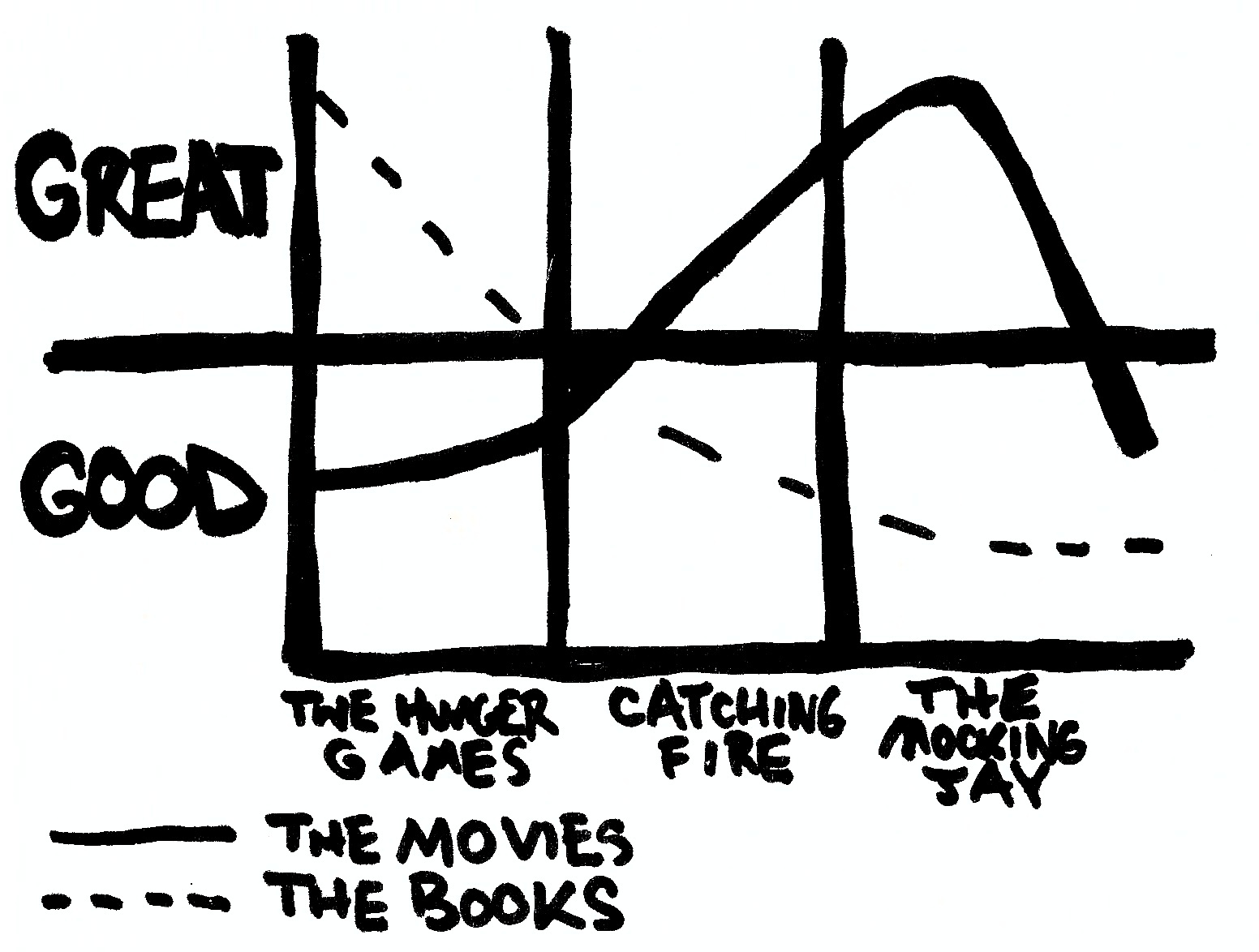
I’ve enjoyed following the Hunger Games saga, both as a series of YA novels & and as a series of dystopian sci-fi film. It’s a pretty grim franchise for something a lot of people consider “kids’ stuff”, one that takes its forcing-to-children-to-fight-to-the-death-for-entertainment premise very seriously. Its haves-vs-have-nots dystopian world-building is nothing particularly new and can especially be seen telegraphed in properties like Battle Royale & The Running Man, but I think it’s a pretty great sci-fi intro for teens, especially refreshing for its strong female protagonist Katniss Everdeen (played by Jennifer Lawrence in the films, duh) & in the way its potentially-corrosive love triangle conflict is handled. One strange aspect for me has been how the film versions of the Hunger Games trilogy have resisted the law of diminishing returns. I felt that Suzanne Collins’ novels started at their strongest point, doing a great job of establishing an in-the-moment intensity in its abysmal future-world by dragging the audience along closely with Katniss’ experience navigating the Hunger Games. The quality dropped off a bit for me in the sequels, though, as the pacing seemed to get away from Collins and large swaths of summarizing overtook the focused intimacy of early scenes. The first movie was pretty great as well, doing a good job of capturing Katniss’ in-the-moment POV, but the film series subsequently seemed to improve from there, knowing exactly what to show & what to ignore in Collins’ sprawling narrative for maximum effect.

EPSON MFP image

Mockingjay – Part I might just be the pinnacle of the Hunger Games movies for me. General consensus has the franchise peaking with the second film, Catching Fire, but I’d say it’s at the very least a close call. the film’s themes of PTSD, regret, powerlessness, and the pressures of being the face of a revolution all hit me pretty hard. I’ve heard friends & family describe the film as boring, saying nothing happened, which is pretty surprising for a film with such a high bodycount & grandscale warfare, but I had a genuinely emotional reaction to its horrors, getting teary-eyed at the film’s hospital bombings, mass graves, and three-fingered solutes. Its murderers’ row of talented actors certainly didn’t hurt: Philip Seymour Hoffman, Julianne Moore, Jeffrey Wright, Natalie Dormer, and Donald Sutehrland are all at the top of their game here, which is really saying something. I also appreciated scenes of Jennifer Lawrence, who is an incredibly gifted actor, pretending to be an incredibly inept actor as Katniss fails miserably to produce convincing propaganda clips to rally support for a revolution. Mockingjay – Part I‘s riots, uprisings, strikes, and rescue missions were all a lot more satisfying to me than expected & Lawrence deserves a lot of credit for anchoring the film’s emotional resonance.

Mockingjay – Part II unfortunately didn’t hold up quite as well for me. I think the issue is that Collins’ summarizing had gotten out of control by the final book, so that the film version struggles to make individual scenes count for much as it chases an exponential momentum of a plot trying to wrap up a widespread political revolution, a small family’s struggle to remain a unit, and a strained, increasingly bitter love triangle in just two hours time. There were a few small moments to enjoy in the chaos — my favorite was when Katniss is called out for the “tacky romance drama” & cliché  “the one” specialness of her mythology at a wedding — but for the most part the films struggles to let its Big Moments properly breathe. Mocking Jay – Part II‘s killer C.H.U.D.s & third act Major Character Death both failed to land with full impact thanks to the runaway momentum of Collins’ plot & pacing. And because director Francis Lawrence did such a great job with Catching Fire & Mockingjay – Part I, I’m willing to give him the benefit of the doubt & suppose that the rushed nature of Mockingjay – Part II was far from his fault. Considering all of the ground that the novel covers (I’m struggling not to go long here just touching on it), Francis Lawrence  could’ve stretched Mockingjay into its own separate trilogy & given each underserved scene its own proper moment to shine.

I can’t imagine impatient fans, who groused about splitting the finale into two parts in the first place, would’ve been receptive to a Mockingjay – Part III,  though. If you consider that Francis Lawrence had no choice but to split the finale into two parts, I think he did a great job of adapting a difficult work of fiction for the screen. Mockingjay – Part I carries the emotional weight the film series as earned over the last few years & Mockingjay – Part II does the necessary work of bringing the whole thing to a close. The two halves function well together as a single, four-hour feature. One picks up exactly where the other leaves off & together they do a satisfactory job of carrying a work that’s spread pretty thin to a convincing conclusion. Although I’d contend that Part I is the far superior picture, they average out to something pretty great in the end, which fairly unusual for the third film in a sci-fi trilogy.

Bonus points: I’d like to take this opportunity to give kudos to the Hunger Games series for being the only action franchise I can think of where fashion as an artform plays a deeply integral part to the films’ central themes. I particularly liked a moment in Mockingjay where Katniss is told she’ll be “the best dressed rebel in history” & it’s a sentiment that actually means something significant. It’s a cool, distinguishing detail, if nothing else.

– Brandon Ledet

Australia Had Its Own Class of 1999 (1989) in Future Schlock (1984)

EPSON MFP image

Five years before our November Movie of the Month, Class of 1999, was released in America, Future Schlock, a similarly-minded low-budget dystopian fantasy film, was released in Australia. Class of 1999 is far superior to Future Schlock in terms of quality & cultural shelf-life, but its all too easy to see echoes of the near-future class politics of 1999 in its Australian new wave punk predecessor. Both films only managed to recoup half of their respective budgets in their lackluster theater runs, but there’s no denying that Class of 1999‘s $5 million price tag afforded it a generous head start that Future Schlock‘s comparatively minuscule $½ million couldn’t compete with. That may account for a lot of Class of 1999‘s staying power in terms of cult classic potential, but there’s plenty of fascinating, shabby ideas at play in Future Schlock that make for an interesting watch, however flawed, especially when you’re coming fresh from Class of 1999‘s similarly-oriented dystopian charms.

Class of 1999 predicts a ten-years-down-the-line cyberfuture in which unruly Reagan-era youth have become such a menace that entire sectors of Seattle have been ceded to them in order to protect the law-abiding adults that live in surrounding suburban areas. Future Schlock looks slightly further into the future, say 15 years, warning of The Middle Class Revolt of 1990 that leaves Melbourne legally segregated by oppressively rigid class lines. Similarly inspired by the fallout of Reaganomics, Future Schlock forecasts a period of class stasis after the revolt in which upward mobility has been eliminated & suburban mediocrity is mandatory by law. Much like the walled-in, teen-run free fire zones of Class of 1999, Melbourne’s working class community is imprisoned in an inner-city ghetto where police beatings are not only routine, but officially encouraged and the ruling middle class suburbanites visit to gawk, as if entertained by animals in a zoo. As bleak as all that sounds, there’s actually a great deal of irreverent comedy that overpowers any of the film’s doomsaying politics, the same as it does in the much superior Class of 1999.

Part of what feels so off about Future Schlock‘s quality as a finished product is that its central narrative is decidedly loose. Class of 1999 tells a clear story about rival teen gangs, The Razorheads & The Blackhearts, banding together to destroy their murderous teacherbots (or “tactical education units”) in order to prevent their impending mutual demise. Future Schlock is more of a chaotic collection of comedic sketches meant to flesh out the film’s central, high-concept premise, held together as a single story only by a documentary-style narration track. In the worst of the film’s segments a pair of violent police officers track down infamous, ghetto-imprisoned bandits with the aliases Cisco Kid & Sancho Panza. The cops are belittled for being fruitcakes & pansies in an unwelcome reminder of just how ultra-macho & backwards the 1980s could be, apparently even in the era’s punk rock cinema. Slightly better are segments that follow Cisco Kid & Sancho Panza’s true selves, Sarah & Bear, a pair of new wave punk performance artists who perform songs with lyrics like “Everybody, fuck ’em. Fuck ’em, everyone,” nightly in a ghetto cabaret. As their bandit alter-egos, Sarah & Bear go undercover to freak out the milquetoast suburban normals, but they’re honestly much more interesting when they’re performing synth pop songs of protest to drunken, ghetto revelers as the crowd cheers loudly, performs public cunnilingus, and just generally establishes that their sloppy punk ways are more far more enticing than the dull tidiness of middle class suburbia.

The problem is that we don’t see nearly enough of that middle class mediocrity to draw a proper distinction between that world & the punk ghetto alternative. Much like with Class of 1999, a lot of Future Schlock‘s best moments happen in the classroom, where the film establishes how its laws of mandatory conformity, detailed in “The Standard Set of Middle Class Guidelines” are passed down to the brainwashed youth. Of course, the youth in Future Schlock are much more docile & subdued than the machine gun-wielding teens in Class of 1999, but the way their education system is set up to break their spirits & dull their personalities is very similar in tactic. Honestly, I just wish there was more of that perspective of what a mandatory milquetoast society would be like. There wasn’t much insight into how the suburban areas outside of Class of 1999‘s teen-run free fire zones would operate on a daily basis, but I assumed they hadn’t changed too much since the youngster takeover, so that wasn’t too big of a deal. In Future Schlock, on the other hand, a lot of time wasted on the peculiarities of Sarah & Bear’s sexual habits & homophobic humor aimed at the ghetto’s abusive cops could’ve been pointed at exploring what suburban Melbourne would look like in this particular, dystopian future after The Middle Class Revolt of 1990.

Ultimately, it doesn’t make too much sense at this point to complain about how much better Future Schlock could’ve been with a bigger budget & some thematic tweaking. The film is more or less inconsequential in its current, forgotten state, of interest only for fleeting moments of absurd brilliance & for its context in terms of how it relates to Class of 1999, which I will vehemently contend deserves more traction as a cult classic than it gets. In the spirit of celebrating Future Schlock‘s highlights instead of mulling over its obvious flaws, I’m going to conclude this piece with a transcription one of the film’s best moments: a revised Australian national anthem, updated for the nightmarish suburban middle class state detailed in the film’s opening classroom scene. Along with Sarah & Bear’s aforementioned “Fuck ’em” anthem, it’s a moment that shines as a standalone piece of high art, one that almost justifies the rest of the film’s wasted potential:

“Australia’s sons, let us rejoice, for we are middle class. We’ve golden soil and sun tan oil. Our home is girt by grass. Our land is drowned in swimming pools. The barbie’s over there. The Carlton Light and cask of white are in the frigidaire. A pie and sauce, a winning horse. T.V. and easy chair. Australia’s homes are brick veneer. We own a Betamax. We’ve Commodores and sliding doors. We cheat a bit on tax. A microwave and Magimix. A dishwasher as well. We’re good at golf. Three cheers for Rolf! We’re in the R.S.L. At Christmas time we choose our gifts from Myers and K-Tel. Of course, we all like Chinese food and own a caravan. Electrolux and flying ducks. A non-stick frying pan. K-Mart’s our fashion saving place. The shopping mall’s our shrine. Our homes are clean. We drink Ben Ean while watching channel 9. I’m sure the neighbours would approve. Their taste’s the same as mine.”

Beautiful stuff. Brings a tear to my suburban eye.

For more on November’s Movie of the Month, 1989’s Class of 1999, check out our Swampchat discussion of the film & our look at the diminished returns depths of its shoddy sequel.

-Brandon Ledet

Movie of the Month: Class of 1999 (1989)

EPSON MFP image

Every month one of us makes the rest of the crew watch a movie they’ve never seen before & we discuss it afterwards. This month Boomer made Britnee, Brandon and Erin watch Class of 1999 (1989).

Boomer: Class of 1999 is a strange little movie. For readers who haven’t had the pleasure, the film is set in the titular year, less than a full decade after its release date. In this “distant” future, inter-gang violence has become so overwhelming that the areas around high schools have become dystopian free fire zones, but these violent, Mad Maxian teenagers still submit to going to campus every day for some reason. The movie’s protagonist, Cody Culp (Bradley Gregg), is a former gangmember paroled and returned to school. Unbeknownst to the student body, the principal (Malcolm McDowell) has agreed to allow an obviously mad roboticist (Stacy Keach) to install three former military androids (Patrick Kilpatrick, John P. Ryan, and goddess on this earth Pam Grier), “reprogrammed” as educators, as new instructors. Culp tries to stay out of trouble, but his narrative arc is complicated by his romance with the principal’s daughter (Tracy Lind). The androids decide that the best way to create a stable educational environment is to rid the school of violence by creating a war between the two rival gangs, even drawing in Culp due to the false flag death of his brother (Joshua John Miller, who was also the annoying kid brother in Teen Witch). As you would expect, this culminates in the two gangs putting aside their differences to defeat the Terminator. I mean the teachers.

I love this movie. It’s a perfect encapsulation of worst case, slippery slope thinking with regards to teen violence, a misplaced jeremiad warning of dark days to come–won’t someone please, please think of the children? Bradley Gregg, star of many of my adolescent fantasies (and one of the dream warriors from Nightmare on Elm Street 3), parades around in an outfit that manages to be both utterly ridiculous and strangely sexy, featuring skin-tight leather pants emblazoned with the word “war” over and over again and a form-fitting tee under an oversized babydoll jacket. He has nothing on Keach, of course, who struts around in this film with a platinum ponytail and matching (painful looking) contact lenses, while still somehow managing to play this ludicrous role as straight as possible. Throw in the other stars in the cast, like Grier and McDowell, and it’s a surprise that this Terminator ripoff made barely half of its relatively low budget back in ticket sales.

The Keach/Culp dichotomy of seriousness and campiness is one of my favorite things about Class. On the one hand, the film features ridiculous gang warfare with oversized vehicles in one scene, followed by dark domestic trouble in the form of Angel and Cody’s mother’s truly frightening drug addiction in the next (before she completely disappears from the film). Somehow, this intermix works for me, although I can admit it probably shouldn’t. What do you think, Britnee? Is this tonal inconsistency a drawback, or a feature?

Britnee: I think the mix of the film’s outlandish features and serious moments made Class the unique and unforgettable film that it is. If anything, the serious moments of the film, such as the mother and son drug brawl, amplified the film’s campiness, and that’s always a good thing. When serious, dramatic situations are placed in such a ridiculous setting (post-apocalyptic 1999), they bring out this sick and twisted type of humor that makes us all think, “I really shouldn’t be laughing at this.” Being able to successfully pull off this type of humor and create such an uncomfortable mix of emotions is the greatest achievement that a film can accomplish. Unfortunately, Class did not have as many of those wonderful Lifetime movie-like moments as I hoped for, but I think that may be the only complaint I have about the film. It was that good.

Something that I just can’t stop thinking about from Class is the gang warfare between the Blackhearts and the Razorheads. The film’s street gangs are made out to seem like these awful groups of mixed-up teens who will never escape their miserable, violent lifestyle, but under their rough and tough exterior, they’re just a bunch of kids searching for a little bit of love and understanding. This really comes through when the Blackhearts and Razorheads stop killing each other and team up to fight the evil robotic teachers. The bad guys (Razorheads) join the not-as-bad guys (Blackhearts) and ultimately become the good guys. At this point, the gang lifestyle actually seems more acceptable and becomes a little appealing. I mean, if I was stuck in some crazy life-or-death situation where I was forced to join a gang, I would definitely let the Blackhearts jump me in. 80’s new wave couture, Nine Inch Nails dance parties with machine guns, and a gnarly black heart tattoo are enough to win me over.

Erin, what are your thoughts on the two opposing gangs joining forces to fight the evil robotic teachers? Was this one of the few heartwarming parts of the film? Or is it just another cheesy moment to add to the list?

Erin: I thoroughly enjoyed the Class of 1999 experience . . . but I’m not sure that I found the gangs joining forces to be terribly heartwarming.  I think that if they hadn’t been in an automatic-weapon fueled fire-fight, I might be with you.  Had they been engaged in an old fashioned fist-fight-style rumble, I think that I would be more sympathetic to their situation.  As it was, it seemed like the gang side of The Warriors and the terrorist robot side of The Terminator got together and forgot to bring a side helping of the humanity from The Outsiders (I’ll take 1980s movie title conventions for $500, Alex).

I think that Class of 1999 is trying to communicate a series of relationships to the viewers: the difference between the viewers and the post-apocalyptic kids,  the difference between the rival gangs, and the difference between all of the kids and the inhuman robots.  I think that the movie does a great job showing us the first relationship, but stumbles with the second two.  The gangland teens are pretty reprehensible, truly living up to the premise of the movie that youth gangs have turned American urban centers into warzones.  The movie makes a very clear break from reality with its set up and presentation of the its own world.

Cody is really the best glimmer of humanity out of the entire movie, in my opinion.  He’s the only example of a multi-dimensional character, with his dark side trying to survive in a gangland and his sweet side of falling in love with a certified Nice Girl.  We don’t get that multi-dimensionality from other members of the Blackhearts, much less from the punks in the Razorheads.  It’s really hard to root for any of them.  Perhaps Cody is supposed to stand out as the Last Sane Man?

In any case, it’s hard for me to see myself in the gang members as they make a stand against the Teachernators.  Yes, they’re scrappy kids coming together to take on psychotic military robots, but minutes earlier they were trying to kill each other with machine guns! On the other hand, the Roboteachers are out-of-their-minds inhuman, which is made evident early in the movie by their behaviors and later in the movie by their physical transformations into walking weapons.

What do you think, Brandon, does Class of 1999 struggle to humanize the human characters?  Is there a clear enough difference between the terrible actions taken by the gangs and the Teachbots?  Does the audience get an avatar to insert themselves into the movie, or are we just supposed to watch the carnage?

Brandon: Simply by the nature of what it’s trying to portray, I totally have to agree that all basic humanity has been stripped from this movie’s ultraviolent teens. Cartoonishly over-exaggerating adult fears about out of control young adult behavior, Class of 1999 poses a grim, larger than life portrait of teen rebellion that is far beyond anything you’d expect to see in any conceivable human being, young or not, even in a worst case scenario, ten years down the road cyberfuture. Yeah, teens can be perilously obsessive over getting their hands on drugs, beers, sex, and cool cars at times, but usually not in the way Class of 1999‘s teens mix those simple pleasures with guns, bombs, landmines, and missile launchers. The first half or so of the film plays like a particularly paranoid parent’s warped nightmare about what their teen is up to while they’re out with their bonehead friends. A great example of this is the warehouse concert scene. I’ve been to quite a few concerts in my time & while many may have involved industrial music dance parties, I can’t remember ever witnessing a gang beating in the moshpit, machine gun fire set off to the rhythm of the songs being played, or the venue being lit by carefully placed barrel fires. I’m sure that as my parents first let me out of the house to experience live music for the first time, however, their worst fears of what was going on weren’t too far off from that image.

The trick here is that Class of 1999 is smart to spoof both sides of the teen rebellion coin. Because teens are perceived as such violent, out of control animals, authority figures take an automatically adversarial position against them. Late in the film when Principal Malcom McDowell complains about his army of roboteachers, saying, “They’re waging war with my students!”, he’s met with the response, “Isn’t that what all teachers do?” If the film indeed has any specific sort of point it’s trying to make & we’re not supposed to just, as Erin suggests, sit back & “watch the carnage”, I think it’s to be found somewhere in that exchange. Even if real life teens are as bad as portrayed in this film (they’re not), they’re still far more sympathetic than the (robotic) adults that brutally murder them by snapping their necks or forcefeeding them glass vials of superdrugs. There’s an oppressive, prison-like atmosphere in the film’s educational system (complete with “RESPECT”, “OBEY”, “LEARN” commands that could’ve been directly lifted from John Carpenter’s They Live) that feels like a direct indictment of privatized, militarized schooling that treats kids like violent threats instead of young, eager minds. The cyberfuturism of Class of 1999‘s killer robot “tactical education units” may not be readily recognizable in today’s flesh-bound educational units (public school teachers), but they do feel like a blown-up, exaggerated version of the way we systematically tend to treat children as a threat & a nuisance.

Boomer, how much do you think Class of 1999 is a movie of its time? Do you think that there’s a bit of historical, late 80s gang violence context here that would drastically change if there were to be a Class of 2025 released in 2015? Or would the same basic adult fears of teen rebellion & a privatized, militaristic educational system be eligible for lampooning today (with CGI bloodsplatter unfortunately subbed for the practical effects gore, of course)?

Boomer: One of the great truths about western culture is that each generation that reaches the level of becoming “the establishment” seeks out and pontificates about the fatal flaws in the generation that follows. This is nothing new; adults of today are “concerned” about the isolating effects of handheld devices, just as my parents were “concerned” about the isolating effects of the Discman, or their forebears were concerned about the invention of this thing or that thing, going back to concerns that the invention of the phonograph would lead to fewer people being interested in learning to play instruments. There are a lot of sociological and anthropological reasons for this, but most of it boils down to the universal constant that we will only get older, coupled with the fear of obsolescence and fear-mongering about “the youth,” and treating them, as Brandon notes, as a threat or nuisance.

The other major factor in the genesis of 1999 is that the late eighties and early nineties saw a very visible rise in gang violence, something that couldn’t simply be dismissed, so the news media had to address it. However, the “establishment” couldn’t acknowledge that disenfranchised people turn to crime because of systemic problems related to class and privilege, especially not when people were basically walking down the street accidentally poking others with their raging pro-wealth Reaganomics hard-ons. As a result, the majority of Americans, ignorant of the real causes of gang violence and its apparent meteoric rise, had nothing to cling to but their filtered and incorrect understanding of social problems, reinforced by the cyclical nature of youth-blaming.

What’s so interesting to me is how 1999 manages to be both an indictment of that mindset and the apotheosis of it at the same time, and, although I may be giving it too much credit here, I think that this is intentional. The darkness that permeates Culp’s world represents all the things that the parents of 1989 feared about the future, a horribly violent place where those nasty (scary) teenagers with their loud music and their dirty fingernails rule over a scorched suburbia because no one took a stand against teenage skullduggery when there was a chance! But it also holds up a mirror to that absurd frame of mind, pointing out the flaws in that kind of fearful, conservative nightmare by showing how unrealistic and silly such a future would be. Also, there are killer robots, because who doesn’t love that? And, if your kids are running around doing drugs, they probably learned it from watching you, mom or dad!

So, the answer is “yes,” 1999 is a very much a product of its time and of the politico-cultural environment from which it sprung, and there would have to be significant updates to remake this movie, although I could see how it could be done in a couple of different ways, depending upon which of Joann and Cletus’s fears you wish to highlight and mock. Political correctness is often a good place for conservative muckrakers to stir up some passion: “In the future world of 2025, schools no longer teach facts, they teach feelings. They no longer teach science, they teach sensitivity. And they only teach the ‘corrected’ version of history.” And, like, instead of robot teachers, there’s an AI that seeks to “purge” students of their hopefulness or individuality or whatever by teaching them about all of American history, atrocity alongside progress, and by teaching them self-control and tolerance. Cody Culp would be a secret bigot who teaches his androgynous and sexless peers, long having been made soft of mind by those damn SJWs, to fight back against the machine of liberal indoctrination by being politically incorrect and proud, or whatever. To be honest, though, I don’t know that this would be recognized as a satirical interpretation of a conservative’s nightmare of the future; it would be more likely to be seen as a prescient vision of a world to come, ruled by the “libtard.” Or maybe I’m just on a tangent; who knows.

The real truth is this: the way education is enforced in the west is not the best method for schooling, and we all pretty much know that. The priorities are all skewed, and the eight-hour, rigidly-structured schoolday that has been the model for a long time isn’t based on the best pedagogical or psychoeducational practices but on the model of a workday; it forcibly instills in children a willingness to accept the drudgeries of pyramid capitalism, essentially, rather than encouraging critical thought, technical acumen, interest in knowledge for its own sake, or any kind of prioritization of variety in educational forms. You can see that small changes are taking place today, but for the worse; as an educator, I toured a new charter school just a year or two ago that was filled with classrooms that didn’t look like classrooms. They looked like call centers. So even if Class of 2025 were to be made in the way that I poorly pitched above, a Republican nightmare of social justice gone mad, it would still be nothing like the schools of the future, just as my school in 1999 was not a war zone of apocalyptic proportions.

Britnee: What do you think about a Class of 2025? Does your conception of what Class of 1999‘s thesis was differ from mine, and if so, how do you think your interpretation would be updated for a contemporary audience?

Britnee: When watching Class of 1999, I did realize that there was a connection to the large amount of youth gang violence occurring around the time the film was released, but I really didn’t think much of it. I saw the film as being loads of stupid fun without much depth, but your perspective really got me thinking about the whole “youth-blaming” and “conservative nightmare” aspects that the film definitely illustrates. Loud music, fast cars, leather jackets, heavy eyeliner, and funky haircuts were a conservative parent’s nightmare in the late 80s/early 90s, and the teens in 1999 are an explosion of this stereotypical degenerate youth. The whole film actually reminds me of a lost Billy Idol music video. It’s just so “Rebel Yell.” These types of teens were going to cause the world to become a post-apocalyptic cesspool of crime, violence, and pure filth. Unfortunately, the world did not become that exciting by 1999. There were many changes that occurred within those short 10 years, but at the same time, much remained the same.

Now, to think of what my interpretation of 1999 would be for a contemporary audience. 1999 did play on the fear of what the future would be like for the youth of that time, and now it seems as though one of the biggest fears for today’s youth is the lack of importance placed on quality education. A modern 1999, or as Boomer stated, 2025, would deal with the absence of general education and the emphasis on some sort of super strict social class-based structure. Children will be sorted into military, white-collar, or blue-collar positions at birth, like in the movie Antz when newborn ants are assigned to be workers and soldiers. Who knew that such a horrible movie would be so insightful? Each group would have their separate type of school, but they would be more like training academies. Only the elite would receive a quality education, and they would use it to coerce obedience and conformity on the youth. Those that do not have elite status would live in squalor and have all sorts of chemicals in the air and water that dope them up, making them ultra submissive to authority. I feel as though the teen rebellion wouldn’t be as violent as one would expect. They would rely more on outsmarting the authority and only shooting them up from time to time instead of a constant machine gun blowout like in 1999. At this point, weapons would probably have lasers instead of bullets, so the battle scenes would be a little more on the calm side.

Erin, speaking of weapons, did you think that it was strange that the weapons in 1999 weren’t very futuristic? Come to think of it, not much was futuriscitc about this film that was set in the future. Is the budget to blame for this or is it something bigger?

Erin :  Britnee, someone remarked during our viewing of Class of 1999 “Oh no!  They didn’t invent cell phones in the future!” as two characters were forced into a situation with no way of contacting each other.

In some ways, yes, I think that budget has something to do with why the weapons and other parts of the film weren’t very futuristic.  Clearly, the bulk of the effects budget went to the Teachbots and their final set-chewing rampage.  Honestly, I think the bulk of the general budget may have gone to that last scene.

In other ways, I think that a few things inhibited Class of 1999‘s presentation of the future.  First of all, it could make logical sense that the teen gangs in the movie only have access to older, out of date technology and weapons. Teens in 1999 might have had pagers, but in my community were only on the cusp of common cellphone ownership.   Admittedly, this theory falls apart a little in the way that the administrators are not seen using futuristic technology either.

Secondly,  one of the difficulties of setting a movie in the near future is hitting the right pitch for technological advancement.  I think that the rapid development of computer and internet culture, where even impoverished  families have internet access and at least one computer, and the ubiquity of personal electronics such PDAs and cellphones might have been impossible to see from late 1980s.  From where we stand, it seems obvious and inevitable that the future would look like it does (or did, in 1999).  For the writers and audiences at the time, that might have seemed as outlandish as Star Trek’s communicators and tricorders.

And thirdly (and most likely, I think), placing Class of 1999 in the near future is a nice way to hand wave away the complete ridiculousness of the world that the movie inhabits.  The future setting means that the filmmakers have to take much less responsibility for portraying any kind of real life anything, from the physical sets to the interactions of the characters.  Honestly, I think that’s a sloppy use of what can be an effective story-telling tool.  Science Fiction as a genre is also used as a means of giving us the distance needed from reality to discuss difficult issues.  By setting Class of 1999 in the future, the filmmakers were able to explore both the dual fear of out-of-control youth and out-of-control education institutions with removal from the actual educational landscape of 1989-90. (I’ll insert here that I think Class of 1999 is more a fantasy rather than a proper Science Fiction movie.)

The unreality of the movie not withstanding, there are some moments that resonated with me as “real”.  When Cody’s mother and brother fight over drugs, I was reminded that the late 80s had seen crack cocaine strike urban areas like an epidemic.  Many cities were still suffering from botched urban renewal plans and the hemorrhagic flow of residents to suburbs.

What do you think, Brandon, where do you see realism in this movie?  Is searching for reality even relevant?

Brandon: I feel like we’ve already run through a great deal of the film’s startling realism here: the cultural context of 80s gang violence (as portrayed in the media); the broken, unnecessarily adversarial education system; the shocking jolts of harrowing drug addiction & attempted sexual assault that break up the fun, etc. Something that does stand out to me, though, is the budding romantic relationship between our beloved teen protagonists Cody & Traci. Okay, it’s a little ridiculous that that the movie made time for a romantic subplot in the midst of battle droid educational units liberally murdering teenagers in the guise of discipline, but it’s also a somewhat believable ridiculousness. If you combine already heightened teenage libidos with the kind of tumultuous situations that naturally tend to bring people together (say, your gym teacher removing his arm to reveal a subdermal rocket launcher, for instance) it’s only logical that a romantic bond or two will arise. Thankfully, the one delivered here is accompanied with such great exchanges as Cody coolly responding to the question “You gonna call me or what?” with “Yeah. Both.” and hilariously teasing Traci to “Open up those suburban eyes” to the danger they’re facing. I’ll make no guesses as to how realistic that exact dialogue is, but the situation is at the very least more believable than an army of robotic teachers that get away with viciously spanking (not to mention disembowling & setting aflame) their students with out so much as a peep from the PTA.

Lagniappe

Erin: The least believable part of this whole movie is that these kids are still showing up for school.  With the exception of Cody’s probation requirement, there is absolutely no reason for anyone to show up. Why?  Why are they there?

Britnee: Of all the strange yet amazing moments in Class of 1999, the one that I just can’t forget is when Mr. Hardin (John P. Ryan) exposes his claw machine hand for the first time. As he sinks his creepy claw into the skull of an unfortunate teen, he says one of the greatest lines in the film: “I love to mold young minds.” Those obnoxious arcade toy machines will never be the same!

Brandon: One of the oddest details in a movie where they’re in no short supply are the ordinary objects of a banana & glass of milk. Character actor Stacy Keach does an excellent job of chewing scenery as the evil “Megatech robotics specialist” Dr. Robert Forrest, who provides the technology for the evil teacherbots. He gets obvious perverse pleasure from watching his creations discipline their students (which is especially alarming during one particular robospanking), deriving even greater joy when their “discipline” escalates to murder, and he just generally looks like an evil lab rat that killed so many other lab rats that he was honorarily dubbed a scientist because people were afraid to put him down. What I love most about Dr. Forrest, who is an all around great villain, is that on top of these unwholesome characteristics, he seems to enjoy incongruously wholesome snacks. Watching someone so evil & so fake-looking casually chew on a banana & gulp a glass of milk is a hilarious, unsettling sight gag that beautifully complicates his character in a way that’s almost too good to have been scripted. I like to imagine that Keach came up with his own onscreen snack regimen himself, insisting on enjoying his milk & his banana (surely obtained from craft services) on camera in order to give his character a whole other layer of perversity. No matter whose idea it was, though, it totally worked & after the movie I ended up thinking just as much about those snacks as I did about the film’s roboviolence, which is really saying something.

Boomer: The DVD for this movie is as light on special features as you would expect for a niche-but-not-quite-cult classic film such as this, but it amuses me that the DVD cover foregoes the Terminator-esque cover of the VHS in favor of an image that looks like Shaq in Steel. Almost every trailer on the disc, however, is for some film that echoes Terminator in some way, however, which is good enough. Also, nothing tells you more about the film-makers’ misconception of the teaching profession than Traci’s comment that women never buy just a sexy bra or pair of panties, that they treat themselves. Because teachers make soooo much money with which to treat themselves, am I right? That’s why I’m still a teacher–no, wait, I quit because even working a second job didn’t net enough to get by on. Sorry, Traci, not all of our academically employed fathers are getting grant money from crazed scientists.

Upcoming Movies of the Month
December: Brandon presents The Independent (2000)
January: The Best of 2015

-The Swampflix Crew

Turbo Kid (2015)

EPSON MFP image

fourhalfstar
campstamp

Functioning as an unassuming but surprisingly elegant eighties nostalgia vehicle, Turbo Kid is a New Zealand-Canadian co-production starring Munro Chambers (formerly Eli of Degrassi TNG) as “The Kid,” an otherwise-nameless survivor of a nondescript apocalypse fighting to stay alive in the distant, irradiated future year of 1997. His hero is comic book character Turbo Blaster, master of the Turbo Punch, and he obtains water (which is becoming less drinkable by the day) by trapping and trading mutant rats. His life changes when he meets and reluctantly befriends Apple (Laurence Leboeuf), a strange girl who comes from the other side of the wasteland, and discovers an underground bunker containing the Turbo Blaster’s real armor and weaponry. The master of this domain is the implacable Zeus (Michael Ironside, because of course), a warlord who is attended by his masked lieutenant Skeletron (Edwin Wright), a voiceless monster with a metal skull mask and razor-studded football pads. When Apple, the newly christened Turbo Kid, and renegade cowboy Frederic (Aaron Jeffery) are captured by Zeus to compete in his murderous bloodsports, the trio learns that the water they’ve been drinking is made of the same stuff as Soylent Green; they escape and begin to take the fight to Zeus.

This is an eccentric movie, and it’s definitely not for everyone. Simon Abrams of RogerEbert.com refers to the film’s aesthetic as an “infantilizing vintage fetish,” which isn’t inaccurate but fails to account for how much joy a properly attuned viewer can derive from the film’s strange blend of innocence and gore, born from nostalgia for a time when films like this were more commonplace. The late eighties and early nineties were a strange time, when R-rated films like Robocop, Police Academy, and Rambo were made for adults but marketed to children in the form of action figures and cartoon adaptations, and the peculiarity of that idiosyncratic time acts as a kind of unstated thesis or leitmotif at the core of this film. So much of the movie plays like something that a group of kids would make in their backyard, with the prominence of playground equipment in the areas where Kid spends his time, his eighties kid dream bedroom in the underground station where he has made a home, and the fact that the only apparent mode of transportation is by bicycle (presumably due to a lack of fuel); with this in mind, it would be easy to assume that the movie would feel like it was made for children as well, until the ludicrous blood squibs start popping off.

The film’s darker comedy elements come from the fact that this flick is very, very violent. And bloody. Underneath the primary colors of the Turbo suit and the Punky Brewster by-way-of Caravan of Courage: An Ewok Adventure sartorial choices, there’s gore to satiate even the most bloodthirsty viewer. At one point, a person’s body is blown in half, and his torso and head land atop another person’s shoulders, effectively blinding him and turning the 1.5 men into a human totem pole; it’s so over-the-top that it crosses a line… until the bottom half of said mauled fighter also lands on yet another person’s shoulders, and skips right back across the line to be bloody hilarious once more. Skeletron’s weapon of choice is a gauntlet that shoots saw blades (like the makeshift weapons from Blood Massacre), which provides plenty of opportunities for fountains of blood, and even Turbo Kid’s overpowered gauntlet causes people’s bodies to burst like giant hemoglobin balloons. And I forgot to mention–these are practical effects, at least for the most part. That’s dedication that you don’t see often anymore, and it’s best to appreciate it when the opportunity arises. It’s silly and farcical and oh-so-wonderful, and I can’t recommend it enough.

From the throwback rock & roll music that Kid listens to on his walkman (when he can scavenge some batteries) to the sound effect cues and overall usage of color and depth of frame, this is a movie that made me so happy that I immediately watched it a second time on the day following my first viewing. As noted above, it’s not a movie that everyone can love; you have to be of a certain mindset and have a certain fondness for films of yore. It’s a solid film predicated upon a familiarity with films of the Cold War, featuring homages to Terminator, Star Wars, Mad Max, and everything else your Muppet Babies-loving heart has dreamed of combining into one narrative. The only potential problem that I can foresee for this film is that it could become a surprise indie hit that crosses over into mainstream saturation; check it out now before the Napoleon Dynamite-like hype and inevitable backlash destroys your capacity to love it for what it is.

-Mark “Boomer” Redmond

Advantageous (2015)

EPSON MFP image

threehalfstar

Some dystopian futures are wildly chaotic & packed to the gills with dirt & grime, like this year’s Fury Road, for instance. Others, like the indie sleeper Advantageous, imagine a cleaner, more tightly controlled future, where any semblance of chaos & grime are swept to the edges. There’s a lot of unrest in the world Advantageous presents as a possible tomorrow (rampant homelessness, reports of large-scale child prostitution, frequent terrorist attacks), but that aspect is relegated to the margins, mostly hidden from sight, making the calm, too-clean façade of the big city all the more nerve-racking in its artificiality. The movie’s cheaply-filmed digital photography is actually somewhat . . . advantageous in that aspect, fitting in perfectly with its sterilized, surveillance-laden atmosphere. Advantageous is a shining example of cheap sci-fi done right. It has a lot of big ideas, but limits its scope to intimate implications, focusing on the emotional turmoil of a single family instead of relying heavily on lowgrade CGI spectacle (which is only used sparingly here, when necessary in detailing a terrorist attack or an unusually voluptuous skyscraper).

The story Advantageous tells is all too appropriate for our current Recession-troubled economic climate. As the protagonist struggles with the degrading loss of a job, an overcrowded job market, a lack of professional opportunity (for aging women in particular), and the struggle to fund a worthy education for her bright, young daughter who will inevitably suffer similar circumstances, she encounters a financial back-against-the-wall position that a lot of people can undoubtedly empathize with these days. She just happens to be suffering these indignities in the future with strange & uncomfortable ways out that leave the viewer dying to know What’s Going to Happen? In order to save her family from financial ruin she’s pressured into a futuristic cosmetic operation that challenges her sense of self, the nature of her loyalty to her daughter, and the very nature of the human soul as a physically tangible & transferable property.

Advantageous is, admittedly, much more satisfying in its world-building than in the would-be rug-pull of its conclusion. Even the most casual observers of dystopian sci-fi will expect the film’s threatened cosmetic operation to be both inevitable & inevitably doomed to failure, but that’s not what makes the movie special. It’s the detail & circumstances of the world surrounding the operation that distinguish it. Precocious children, classical music, impossible skyscrapers, casually-observed terrorism, the homeless, The Elite, a catty little minx of a surveillance state operator named Drake: these are the details likely to stick with you, not the unavoidable fallout of the climactic act. Much more restrained than the similarly-minded, but infinitely goofier The Congress (which I loved much more deeply, because I have a general inclination towards lack of restraint), Advantageous is a well-executed, small-scale sci-fi slow burner that may not have a lot tricks up its sleeve narratively speaking, but does have a lot of insight into how cold the world can be for a single mother struggling to get by in the face of professional, financial, and political turmoil. Even if it doesn’t surprise you in its third act, you can at least bet that its reflection & exaggeration of our current cultural climate will touch you with an uncomfortable pang of recognition, which is always a great sign in the context of the dystopian genre.

-Brandon Ledet