Giallo (2009)

EPSON MFP image

three star

I don’t know if it’s fair to detract from this movie’s score based on what I learned about it after viewing it. I’m not talking about Adrien Brody’s high-profile lawsuit against the production company to block distribution of Giallo in the U.S. until he received the remainder of his paycheck; that sort of thing shouldn’t (and doesn’t) really affect an interpretation of the film’s quality. What I am talking about is the fact that I honestly thought Dario Argento had gone out and hired someone with an unusual, potentially deformed facial structure to portray the killer, much like he had hired an elderly prostitute to portray the briefly corporeal Helena Markos in the final moments of Suspiria, and it turns out I was very, very wrong. The prosthetics applied to the killer are hideous if you accept that this is the face of a real person, but, once their falsity is pointed out, they are embarrassingly obvious—in the sense that I’m embarrassed by the fact that I made it through the whole film without realizing that it was actually Brody under all that bulbous latex. So, completely outside the world of the film itself, I have to admit that this has the overall effect of making the film goofier in retrospect.

Following the kidnapping of a beautiful tourist, Linda (Emmanuelle Seigner) arrives in Turin to visit her sister, fashion model Celine (Elsa Pataky). When Celine doesn’t come home when expected, Linda goes to the police, who direct her to Inspector Enzo Avolfi (Adrien Brody), an antisocial detective who is on the trail of a serial kidnapper and murderer (also Brody) who uses his unlicensed taxi as a cover in his abductions. Linda forces her way into his investigation, and they learn from a not-quite-dead victim that her assailant is literally yellow, a fact which they use to determine that the killer, now nicknamed “Giallo,” has jaundice as a result of kidney problems and track him to a clinic. Meanwhile, Enzo reveals that his dedication to the job arose from the fact that he saw his mother murdered by a serial killer when he was a child, a butcher whom he later encountered and killed in revenge as a teenager. Giallo realizes that Linda and Enzo are closing in and takes Linda hostage, promising to tell her where Celine is hidden once he gets away.

When I hit the midpoint of this Dario Argento project, I decided to start keeping track of which of his recurring motifs were used most often and then, when we got to the end, I planned to use this info to determine which Argento was the most Argento of all the Argentos. Strangely, within the first few minutes of this film, it seemed like Giallo was aiming to be the most motif-heavy, as there was a brief scene where a character attended an opera, then a scene of running in the rain, the killer’s eyes being reflected in a mirror, and other elements that had already appeared in four or more films. And then it occurred to me: if The Black Cat was Argento doing Poe and Do You Like Hitchcock? was Argento doing Hitchcock, then Giallo is Argento doing Argento, and it works in some ways but fails in too many others.

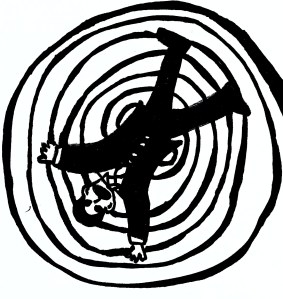
The all-too-brief sequences of Enzo’s youth, which are shot to be stylistically similar to Argento’s movies of the late seventies and early eighties, are the most interesting part of the film. These shots are beautiful, and they really make me want to see the aging director craft a giallo period piece set during the era of his greatest successes, perhaps as the last project of his career before retirement. There’s also a return to form with regards to his cinematic eye here; the use of color throughout is particularly well done, especially as this element has been absent from his work for over a decade at this point (a chase sequence that makes its way down a giant yellow spiral staircase is notably both fun and visually appealing). I also appreciated that Enzo and Linda learned the name of the killer fairly early in the film’s run time and tracked down his location, prompting Giallo to be more proactive in a way that none of Argento’s previous antagonists had been. There’s even a fake-out downer ending with an ambiguous epilogue, which is another departure from some of Argento’s more tired ending tropes. Brody seems to be phoning in his performance as Enzo, perhaps to counterbalance his performance as the more striking Giallo, but Seigner is likable and sympathetic as a woman who refuses to give up on her sister, and she makes the character’s decision to acquiesce to the killer’s hostage taking believable.

On the other hand, the original ideas here serve to highlight just how much of this movie isn’t fresh or clever. While Seigner plays her role with understated franticness, Brody poorly acts each of his roles in a different way. The inspector is an interpretation of a hard-boiled NYC cop (it is explained that Enzo spent some time in the states growing up after the death of his mother) with a chip on his shoulder that prevents him from forming emotional relationships; Giallo is a grotesque Quasimodo who shrieks back at his victims and gets off on stealing women’s beauty by mutilating them. Both characters are too broad to leave much of an impression, and the revelation of Enzo’s backstory is more interesting in its execution than in the material revealed. Alternatively, the backstory of Giallo–that his junkie mother abandoned her jaundiced, hepatitis-infected baby to be raised by the church, where he was isolated by his yellow skin–is too maudlin to be taken completely seriously. That the film takes an unusual turn in its final third is interesting, but not interesting enough to save it.

-Mark “Boomer” Redmond

Movie of the Month: The Independent (2000)

EPSON MFP image

Every month one of us makes the rest of the crew watch a movie they’ve never seen before & we discuss it afterwards. This month Brandon made Boomer, Britnee, and Erin watch The Independent (2000).

Brandon: I first was alerted to the low-stakes indie comedy The Independent this past summer when Britnee posted an article about how our former Movie of the Month Highway to Hell happened to feature every member of the Stiller family: Jerry, Ben, Anne (Mearea), and Amy. An observant Swampflix reader, Tom Morton, was kind enough to point us in the direction of yet another film that featured every member of the Stiller clan, The Independent. I fell in love. I gushed heavily in my review of the film & added it to the growing list of our so-called Swampflix Cannon after just one viewing, despite it being a fairly simple, straightforward comedy. Something about the subject matter just clicked perfectly with my own pet cinema obsessions, especially in the B-movie spectrum. In the film Jerry Stiller plays Morty Fineman, a Roger Corman archetype who’s made a career out of schilling an infinite stream of schlock for decades on end. Unlike Corman, who is generally calm on the surface but expressive in his filmmaking, Fineman is on the same violently explosive vibe Stiller brought to his role as Frank Constanza on Seinfeld. He also (for the most part) lacks Corman’s thirst for making art films, like The Masque of the Red Death, and sticks mostly to genre fare that’s main selling point is “tits, ass, and bombs”.

The great thing about this set-up is that Morty is not only a stand-in for Corman (who appears as himself within the film), but also fills the role of countless other legendary B-movie directors & producers: Ed Wood, Russ Meyer, David Friedman, etc. In other words, he is schlock personified. Morty Fineman is the entire B-movie industry wrapped up into one convenient, hilarious package. A lot of the soul of The Independent is in the brief clips & promotional material for Morty’s work. There’s a Meyer-esque sexploitation pic about an eco-friendly biker girl gang, a wonderful mushroom cloud pun mockup for a film called LSD-Day, a Fred Williamson-falls-in-love-with-a-sexy-robot blaxploitation called Foxy Chocolate Robot, and so on. These schlock spoofs are consistently funny & evenly spaced from beginning to end, supported only by the flimsiest of narrative glue about Fineman’s struggle in his old age to climb out of financial ruin either by filming a morally-reprehensible musical about a real-life serial killer or accepting a film festival gig in a shithole town he dubs “Blowjob, Nevada.”

At the time of its release, reviews of The Independent were mixed at best, but I honestly believe it was ahead of its time. If pitched in the current cultural climate, it would make for a knock-out HBO comedy series. Its mockumentary format, improv-based looseness, tendency towards one-off gags & celebrity cameos, and loveable reprobate of a protagonist would all play perfectly into the modern HBO comedy. It’s a wonderful little love-letter to the schlock movie industry that recognizes its faults (like the literally fatal risks of some of the less-than-safe sets) as much as its glorious heights. I’m not going to pretend to know the entirety of Jerry Stiller’s career, but I will say this is the best feature-length vehicle I’ve ever seen for his brand of comedy.

Boomer, do you think part of the reason audiences did not connect with The Independent when it was released 15 years ago was that there was too much focus on the one-off B-movie spoofs & not enough of a fully-fleshed narrative to support a full-length feature? Do you think that breaking up the spoofs into a weekly sketch comedy format would’ve benefited the story it was trying to tell or was the film satisfying enough as a self-contained, low-stakes tale of a struggling, past-his-prime director trying to keep his family & his business intact?

Boomer: When watching this movie, the thing that struck me most about it was, as you noted above, how ahead of its time it felt. Debuting a year before the original UK version of The Office, it was not the first mockumentary, but it was made during a time when the tropes and rhetorical shorthand methodologies of the genre were largely unknown by the general population. I’d wager that if The Independent were to have been made after the airings of Arrested Development and, to a much greater degree, the US version of The Office, then the film would have seen wider appeal. We live in a world full of sitcoms that use talking head confessionals as a quick and dirty way of telling jokes in a more succinct way, for better or worse, even when the show itself doesn’t lend itself to that (for instance, it works for The Office, and that show eventually incorporated the film crew as part of the action in its final season, but why exactly do the Dunphys and Pritchetts of Modern Family mug for–and talk directly to–the camera?). I think it’s safe to say that, should there be an interested producer looking for a project, a series adaptation of The Independent would not be out of place in today’s television landscape.

I’m hesitant to commit to watching this hypothetical series, however. So much of what makes The Independent work is that the film’s tone never becomes too sentimental or unfocused on Stiller’s objectively reprehensible but subjectively human protagonist, and I feel like a series, even a serialized, single season adaptation, would find itself going to the well of emotional pathos much more than the source material did. The quick shots we see of his films contribute to the sense of his character, and his films convey a great deal in their (relative) understatement, regardless of how outlandish the films themselves may be. I get the feeling that an adaptation would rapidly experience diminished returns as we saw more and more of his body of work, pushing beyond their initial humor into exponentially more outlandish film outings that would undermine the film’s taut use of this device. Der Ubergoober, Truckstop Nurses, and The Despot Removers are all film titles that are pure perfection in the abstract but wouldn’t work, or would disappoint, if we were presented with them on film (although I have to admit that I would love to see Hot Justice in Thirty Minutes or Less, and Rock ‘n’ Roll Golem sounds like a blast).

That the film is simply that, a film, works best for me personally. That we see Janeane Garofalo’s Paloma exact revenge on facsimiles of the cheerleaders who spurned her in less than thirty seconds of Cheerleader Camp Massacre, for instance, shows that the strength of The Independent lies in knowing what to expand and what to explore only briefly. Given contemporary television’s tendency to decompress storylines at the expense of consistency and viewer patience, as well as the general saturation of the mockumentary-as-comedy style, I feel like a series adaptation would be a letdown. As a concept, it was ahead of its time, and now that its time has come, it has no real place among its contemporary peers.

That having been said, there are quite a few of these films that I would love to see in full, especially with a little MST3k-esque riffing. What about you, Britnee? Are there any of Fineman’s movies that you would desperately like to see as real films? Any that you think are best left imagined rather than realized? And why?

Blombas: Without a doubt, I would love to see Whale of a Cop (1981) as a full-length film. From what the trailer implied, a cop, played by Ben Stiller, is the human form of a whale, and he has a close friendship with a 8-10 year old kid. Stiller makes all sorts of whale noises, and he even spits out water! In the trailer, the kid is having one of those shoo-the-dog goodbye moments. Stiller looks all dopey-eyed and confused while this kid is crying up a storm and yelling something along the lines of “go be with your own kind!” I was crying from laughing so hard during this scene. How did the spirit of a whale end up in the body of a cop? Why is this super young kid with a bowl cut his best friend? These are all questions that I am dying to have answered. Hopefully, they were both once whales, but the boy fully turned into a human while Stiller is only half human. The police department recruited him because his special whale senses were helpful with their criminal investigations.

Another film that sounds like a blast would be A Very Malcolm Xmas. It’s never discussed during the actual film, but the title is shown during the credits (along with the rest of Fineman’s filmography). As an admirer of Malcolm X, I would love to know how Fineman would blend his legacy with Christmas traditions. As a lover of bad films and just being a curious person in general, I can’t really think of any fake Fineman movies that I would not want to see as actual films.

Other than the many “fake” film trailers featured in the movie, something in the film that really stood out to me was the duo that is Jerry Stiller and Janeane Garofalo. The chemistry between the two was so unexpected but, by God, it was extraordinary. They both have such different styles of comedy, and I think that’s why they got so many laughs out of me.

Erin, did you feel the same about Garofalo and Stiller? Would you like to see the two act in similar roles again? Or was this more of a one time thing?

Erin: I have to say, seeing Janeane Garofalo as a fake-tanned daddy’s girl was a lot of fun, since I’m most familiar with her acidic side, a la Heather of Romy and Michelle’s High School Reunion.  And Jerry Stiller is perfect as Morty Fineman.  After watching The Independent, it’s hard to imagine him as any other role (although, I suspect that Stiller’s acting talents often lie in adding quite a bit of himself to his roles).  I liked seeing Garofalo and Stiller playing off each other, and the were really, truly believable as adults navigating a parent-child relationship.  Oddly enough, though, I would have to say that while I would like to see more of Jerry Stiller in similar roles, I’m not sure that I’m sold on Garofalo in similar roles.  I think that it might be because Garofalo was acting against type that her performance in this movie comes off so well, and I think that this kind of magic might lose its luster if repeated too often.

To change the subject a bit, I think that one of the things that made this movie so watchable was the pacing, the way that little glimpses of the Fineman world were revealed in a way that eased us into the madness of it all.  I wouldn’t have accepted the immediate introduction of Fineman’s car-dwelling ex wife, even after the strangeness of the opening scene.  However, by the time we meet her, we’re fully prepared for the next wacky turn of events. The Independent takes us by the hand and leads us happily down the lane, and by the time we think to ask where we’re going we’ve left the real world behind.  It’s the skillful story telling that makes me think of The Independent as a filmmaker’s film, something made not necessarily to entertain the masses but turn the lens of film back on itself.

The Independent is like watching a home movie.  I think, perhaps, that this home movie is meant for filmmakers, to see themselves and their passions through the fiction of a movie.  It’s interesting to see how the filmmakers portray themselves here – confident, persistent, optimistic, and terrible to live with.

What do you think, Brandon?  Is The Independent a self portrait, meant for filmmakers?  Is is self-indulgent, or a surreal confessional asking for atonement?

Brandon: So far I’ve honestly only thought of this movie as a film for schlock junkies. Fans of the trash auteurs of yesteryear will find plenty to chew on in The Independent, especially in those short-form spoofs & Roger Corman interviews. I don’t think that descriptions excludes filmmakers from the intended audience, though. A lot of filmmakers, even the ones who make endless piles of garbage, are really at heart just big movie fans who can’t help but make the the things they love. For example, Morty Fineman didn’t make hundreds of movies on accident. He made it because them because he doesn’t know what else to do with himself. It’s in his blood. Also, because he liked “the tits, bombs, and ass,” as he confessed in the fabulous scene in his ex-wife’s house/car Erin just mentioned.

Something I always wonder about directors like Roger Corman & Morty Fineman is whether or not they ever have time to actually watch movies for fun. In the documentary Corman’s World (which is required viewing, by the way) Corman recalls an anecdote where he was running almost a dozen simultaneous film production. When his wife asked him if he could actually name them all from memory, he could only recite the titles of all but two & then said something to the effect of, “Well, whatever the rest are, I’m going to cancel them in the morning.” Folks like Fineman & Corman are constantly swamped with shooting schedules & issues of financial backing, but their work is obviously influenced by the cinematic world surrounding them, so they somehow have to be watching movies in their leisure time. For instance, Fineman’s lost herpes PSA film The Simplex Complex was a spoof of Bergman’s The Seventh Seal. Corman’s production of Joe Dante’s Pihranna was a thinly veiled response to Spiendberg’s Jaws (which, in turn, was heavily influenced by Corman’s own creature feature work). I have no idea how an over-productive schlock director could find the time to keep up with their contemporaries that way, given the near impossible weight of their workloads.

To bring it home to Erin’s question, if this film were made with any particular filmmaker in mind it’d be Roger Corman, but would he even have had time to watch it? Even his contributions as an extended cameo seemed to be brief & succinct, probably shot on a break between a dozen other projects. It’s interesting to think of a what a Fineman-esque schlockmeister would get out of The Independent, considering the film’s admiration of their work & acknowledgement of their sleaziness, but I’m not sure they’d ever have the time to engage with it in that way. Did Corman ever sit down to watch this movie even though he appears in it? I’m curious, but doubtful.

It seems that The Independent‘s best chance for a cult audience is in comedy nerds who enjoy a Christopher Guest-style mockumentaries & weirdo sketch comedy and in schlock junkies who genuinely love bad movies as an art form, even beyond the MST3k brand of sarcastic derision. My question is whether or not you’d have to exist in the overlap of that Venn diagram to enjoy the film for all it’s worth. It’s obviously difficult for me to discuss The Independent without droning on about folks like Roger Corman & Russ Meyer, so I’m wondering if someone without that sense of B-movie context would get the same kind of appreciation of the movie’s insular little world of shoddy filmmaking.

What do you think, Mark? Is familiarity with the world of folks like Roger Corman necessary for loving this film beyond a tossed off “That was pretty funny, I guess.”? Is being a fan of irreverent comedy enough to fully appreciate The Independent or do you also have to be a little bit of a B-movie nerd to get on its wavelength?

Boomer: It’s interesting to me that you mention Christopher Guest, especially since his movies were the first point of contact I thought of when viewing The Independent, not Roger Corman, despite Corman’s cameo in the film’s opening moments. There’s a fine line tread here between the kind of zealous schlock that characterizes Corman’s work and the nuanced character work that typifies Guest’s. To be honest, I think that an appreciation for the kind of work that Guest does may be more integral to the overall enjoyment of The Independent as a movie than an appreciation for Corman and his ilk. Guest’s films generally feature a mixture of understatedly human emotions acted out by larger-than-life characters in situations that are incredibly idiosyncratic, be it a high-stakes dog show or a folk music reunion concert. The characters that populate the faux-documentary, especially but not limited to Morty, his assistant, and Paloma, are very much Guest-type people.

Of course, the prevalence of Corman-esque style in Morty’s works themselves can’t be ignored, either. Morty is Corman as a Guest character, and it works very, very well. It’s not hard to imagine Corman creating a film like Bald Justice, and a line like “You’re gonna like Leavenworth; they’ve got a great barber,” could have flowed from his pen just as easily as it did from Stephen Kessler and Mike Wilkins’s. Overall, though, I think it would be easier to enjoy the movie if you knew Guest but not Corman, rather than Corman but not Guest, simply given the fact that the homages to Corman, while pitch perfect and hilarious, don’t carry the weight of the narrative in and of themselves.

I would love to see more films of this type. Maybe a satirical slasher film that centered around a Hitchcock type, or a desert island survival story wherein all the characters are the stars of a seventies sci-fi show reunited for a convention cruise that goes awry. Or, of course, more mockumentaries about eccentric artists who are secretly self-deluded hacks. What about you, Britnee? How would you adapt this format into a personal instant classic?

Britnee: I’ve always wished and hoped for someone to make a John Waters biopic that would depict his work with the Dreamlanders crew. Could you imagine such a treat? So when thinking about what sort of film I would like to see in the style of The Independent, I would love to see a film that follows the journey of a Waters-like director and his band of misfits. The crew would travel the country creating snuff films in small, all-American towns. They would have a cult following of all ages willing to “die for art.” If anyone with the connections and resources ever reads this, please, oh please, make this happen.

Come to think of it, there really aren’t enough films that focus on the careers of movie directors, and they have one of the most interesting jobs on the planet! When director roles are featured in films, they are usually portrayed in a negative way. Most of the time, they’re sleazy douchebags that promise cast members leading roles in exchange for sex. It was nice to see a director portrayed in a positive light in The Independent. Morty has so much passion for filmmaking, and he truly loved all 400+ of his terrible b-movies. What an inspiration!

Going back to the discussing the film’s unique style, I don’t think it would be as enjoyable if it were anything other than a mockumentary. Erin, if The Independent was not filmed as a mocumentary, but was still a comedy, do you think it would still be as likeable? Why or why not?

Erin: Interesting question, Britnee!  I agree with you.  The mocumentary style of The Independent is an important part of its charm.  It allows for Morty’s character to be portrayed as humanly as possible.

That’s where I connected most with The Independent, with its portrayal of humanity.  The hyperbole used in the storytelling lets the actors tell a deeply human story about the the struggle to balance the compulsion to create and live according to one’s own heart against the very real impact that every human has on those around him or her.
As fluffy and ridiculous as The Independent is, there are moments of genuine pathos and discomfort.  Those moments, in a way, make the movie. They use of comic relief and exaggeration to tell real truths about the human condition is one of our best introspective tools as a species.

Lagniappe

Erin:I really, really want to see Whale of Cop brought to fruition.  There’s no shame in that game.

Britnee: I’m so glad to know that there’s another film other than Highway to Hell that involves all members of the Stiller clan. I have to say, I really wish there was more Rita (Anne Meara)!  Rita (Morty’s ex-wife that lives in a luxury car) was probably my favorite character in the film, but she was definitely not given enough screen time.

Boomer: Rita was definitely a character that I would have loved to see more of, especially with regards to her relationship with her eternally devoted doorman/chauffeur/lover. I also really loved the moment of footage we saw of Rat Fuck; it was such a great, minimal joke. In my notes from watching the film, I noted that Christ for the Defense reminded me, at least visually, of Jesus Christ Vampire Hunter, which never came up organically in this discussion but which I think bears mentioning, if anyone feels like watching a movie that Morty may as well have directed.

Brandon: When started doing Movie of the Month Swampchats this past February I joked that the cold weather was making us a depressed bunch. The first few movies we discussed (The Masque of the Red Death, The Seventh Seal, Blood & Black Lace, etc) were a morbid procession of death & pestilence. I’m glad to say we pulled out of the funk in the past few months & started having some fun with a few comedies & even a kids’ movie, but it’s also remarkable how the year came full circle, beginning & ending with Roger Corman, who directed Masque & had a large influence on The Independent. There are few filmmakers out there who I love more or who could better represent this site’s love of where trash meets art. Let’s hope next year’s just as tidy & well-rounded. It’s been fun.

-The Swampflix Crew

Pelts (2006)

EPSON MFP image

three star

campstamp

When I wrote my review of Jenifer, I noted that it was unique among Dario Argento’s body of work in a few ways, for better or worse. Jenifer herself was imagined by Argento as an alien life form, even if that wasn’t explicit in the text itself, making her the only extraterrestrial in his canon (unless I’m in for the shock of a lifetime when I get to Dracula 3D); further, the effects work on Jenifer was grotesque and monstrous, with the only similar prosthetic work in his films that I can recall being the monstrous child in Phenomena. Argento’s second Masters of Horror episode, Pelts, is also quite unlike his previous work, although not in the way that is frequently referenced. Nearly every review of Pelts mentions the short film’s “political message,” especially given the generally apolitical nature of all of Argento’s work, but I don’t really think that there is one, at least not in the way the uninitiated interpret the word. As a composition scholar, I am obliged to perceive and interpret all forms of composition and creation as inherently political, as all creation is an act of expressing individuality and thus is a political act in and of itself; by choosing what to include and what to exclude in the created thing, be it a poem, speech, or painting, the author/composer makes a de facto “political” statement. And, yes, the fact that Argento focused this film on the fur trade does lend itself to the assumption that the director is making a capital-P “Political” statement, but I don’t think that was Argento’s goal, nor do I think that decrying fur played a larger role in the inception of this plot than wanting to show a man skinning himself of his own flesh and then working backwards to create parallelism did. But I’m getting ahead of myself.

Jake Feldman (the one and only Meat Loaf Aday) is a fur trader who lusts after Shanna (Ellen Ewusie), a stripper who is disgusted by Feldman’s possessiveness and the fact that, as a furrier, he constantly reeks of dead flesh. She has made it clear that she will dance for—but never sleep with—him, no matter how pathetic he is. One of his suppliers, Jeb Jameson (John Saxon, who previously worked with Argento in Tenebrae), is an old drunk who takes his son Larry (Michal Suchánek) into the woods to check the raccoon traps he set earlier. Larry expresses some concern when he realizes that his father is taking him beyond a warning fence, onto the land of Mother Mater (Brenda McDonald), but the elder Jameson scolds his son for his superstition. The two come upon stone ruins, which Larry notices are carved with the faces of raccoons, while his father instructs him to crush the windpipes of the animals they have trapped, apparently in abundance, and to take a baseball bat and crush the skulls of any raccoon that does not die instantly. Jeb calls Feldman to tell him that he has secured a large number of pelts, the most beautiful he has ever seen. Later, after the two have skinned the animals and their pelts are drying, Jeb heads to bed while Larry ecstatically examines the animal hides with a spiritual reverence. Moved by their beauty, he goes upstairs to his father’s room and crushes his skull with the baseball bat before gleefully setting up a trap and then killing himself with it.

Feldman and his lackey find the two in this position and, thinking quickly, take off with the raccoon skins. Various workers in Feldman’s shop begin to self-harm in ways that are reminiscent of their interactions with the furs in the coat-making process, until the coat is finally completed. In the meantime, Feldman visits Mother Mater, who warns him that the nearby fenced-off woods are protected by the “pine lights,” which he laughs off when he realizes she means raccoons. Feldman presents the coat to Shanna, who sleeps with him in exchange for it. He excuses himself to the restroom, where he proceeds to skin himself, cutting off his own flesh in roughly the shape of a tank top and then attempts to gift this flesh to Shanna, who flees from him. Feldman pursues her to the elevator, where her hand is trapped and then torn off (symbolic of the animal that gnawed its own foot off to escape the trap), and then they both die. The end.

I remember watching Tenebrae and being shocked by how unusually violent it was in comparison to the (comparatively) understated violence of the films that preceded it; Pelts gives that film a run for its money. Argento brought back Howard Berger, who had done the make-up and visual effects on Jenifer, and he was again interviewed on this DVD. Berger, who has worked with director Quentin Tarantino numerous times, recalled in his interview for this project that Tarantino’s directions on the set of Kill Bill largely consisted of “make it bloodier than Tenebrae.” He felt he had come full circle by contributing to this project, citing that it was the goriest thing he had ever worked on, and I can’t argue with that. There’s not a lot to engage an audience here on a philosophical level (and certainly nothing on a political level), but there’s more than enough to satisfy even the sickest fans of gore. I consider myself to have a fairly strong constitution, steeled by many a midnight horror flick, but some scenes were almost too much for even my stomach. The scene in which Feldman flays himself is horrifying in all the best ways, and the scene in which the younger Jameson serenely plunges his face into a bear trap carefully combined tension and the grotesque in perfect measure. That’s a real feather in the cap of the people who worked on the short’s practical effects, but it also highlights the poor quality of much of the CGI work. The worst offender in this arena has to be the scene in which one of Feldman’s employees sews her eyes, mouth, and nose shut; there’s no real reason why this couldn’t have been done practically using a dummy head, especially given Berger’s talents, and it looks terrible and rushed in the final product.

Although Meat Loaf is most well known as a musician and his most memorable role since The Rocky Horror Picture Show was a supporting one in Spice World as the Girls’ driver, he has a willingness to completely immerse himself in a part the way that many actors who are more “legitimate” or noteworthy do not. Feldman is an utterly vile person, and any humanization that he has is as a result of Meat Loaf’s surprisingly nuanced and careful performance. Saxon is the only other actor of note in the production, and he does the opposite, playing up the campiness of the Jameson character; it’s a bit of a relief to see him killed off so early, as that frees Saxon from sullying himself too much. The rest of the cast is largely comprised of nobodies; each of them has an IMDb page full of “Man #3,” “Bouncer,” “Tough Guy,” and “Stripper #4” credits, and there’s not much to say about any of them. Ellen Ewusie really gets the worst of this, however, as her interview (like Moran Atias’s in the supplemental materials for Mother of Tears) illuminates her as a woman saddled with attempting to discuss building the background and motivations of a character who exists solely for titillation, and I wish I could see her in a role that requires more than that.

Overall, this was an experience that I neither loved nor hated. The message is less “fur is murder” and more “selfishness is self-destructive,” which is all well and good but not very groundbreaking. The acting is a mixed bag, and there’s so much gore packed into this short run time that it is worth a watch if you’re into that sort of thing. It’s by far the better of Argento’s two Masters episodes, and while it’s not very good, it is an unusual part of the director’s canon that gives some insight into his mind that is lacking in his other works.

-Mark “Boomer” Redmond

High Anxiety (1977)

EPSON MFP image

fourhalfstar

My first experience with Alfred Hitchcock wasn’t actually with the work of the man himself. When I was a child, my grandparents lived in Waukegan, a suburb of Chicago, and I would often spend a month or two with them every summer. There was a station they received that would show the same movie every day for a week, perhaps longer, and it was on this station that I first watched Back to the Future II (at least a dozen times) and often-overlooked Joe Dante flick Explorers, both of which I loved. The best movie shown on this repeating station, however, was Mel Brooks comedy High Anxiety. Although not as well known or beloved as pictures like Blazing Saddles, The Producers, or Spaceballs, High Anxiety remains, to this day, my favorite of the entire Brooks oeuvre. It’s a pastiche homage to the films of the Master of Suspense, and, as with Head Over Heels, I couldn’t stop thinking about it during and after watching Dario Argento’s Do You Like Hitchcock? I didn’t understand the references when I was a child, but every time my grandmother would laugh out loud, she would explain which of Hitchcock’s films was being parodied, and why the joke worked. I recently rewatched the film and was worried it would pale in comparison to my memory of it, but I’m delighted to say it’s only gotten better with time.

Dr. Richard Thorndyke (Brooks), a Harvard professor, has just flown to California to take over as the director of the Institute for the Very, Very Nervous. After making his way through a notably dramatic airport, he is greeted by his driver, Brophy (Ron Carey), a motormouth shutterbug who exposits about the institute and its staff, whom Thorndyke meets upon arrival. Many of them are played by part of Brooks’s recurring stable of actors: Cloris Leachman plays Nurse Diesel, a parody of Rebecca‘s Mrs. Danvers; Harvey Corman is Dr. Montague, who is engaged in a scheme and a BDSM relationship, both with Diesel; and Dick Van Patten portrays Dr. Wentworth, who tries to warn Thorndyke that something is amiss. Thorndyke is eventually led to investigate the institute’s violent ward, where he is introduced to the very wealthy patient Arthur Brisbane, now suffering under the belief that he is a dog, the result of a nervous breakdown. On a business trip to San Francisco, Thorndyke meets Brisbane’s daughter, Victoria (longterm Brooks collaborator and one of the greatest comediennes of all time, Madeline Kahn), with whom he discovers that Diesel and Montague are attempting to steal the Brisbane fortune and that the man Thorndyke met was a random patient. The dastardly duo hire a hitman to frame Thorndyke for murder, causing the good doctor and Victoria to flee the city while Brophy works to prove Thorndyke’s innocence. And, as with most Hitchcock homages, there’s a climactic altercation at a great height waiting at the end.

The above plot summary outlines the larger elements of the Hitchcockian thriller narrative but belies just how funny this movie is. Film comedy, by its nature, does not demand that its plot be tightly structured in order to be successful; many comedies have only the barest of plots, which exist only to be a skeleton upon which jokes and gags are hung. I’m always more impressed when a comedy takes the time to construct an intricate plot that would stand alone as a decent mystery without comic elements, which is probably why I love Clue (also starring Madeline Kahn) and Hot Fuzz (which is basically the apotheosis of mystery comedy) so much. While High Anxiety‘s plot isn’t as airtight as it could be, it does stand out as part of what makes the movie work.

The homages run fast and heavy, and they work much better here than they did in Argento’s film. The overall plot about a scheme within a mental institution that is brought to light by the newly arrived overseer is taken from Spellbound, my second favorite Hitchcock (side note: Salvador Dali was an art director on Spellbound, which makes it an absolute must-see for any fan of art and cinema). The finale, like Do You Like Hitchcock?’s, borrows most heavily from Vertigo. But there’s also the scene in which Thorndyke tries to escape from a huge flock of birds, or Birds, and the scene in the hotel which presents Thorndyke’s framing for murder is evocative of the similar scene in North by Northwest. Meanwhile, the gags range from broad (wealthy heiress Victoria Brisbane drives a car that is covered in Louis Vuitton leather—not upholstered, covering the outside) to the specific (future Good Morning, Vietnam director Barry Levinson plays an uptight bellboy who attacks Thorndyke with a newspaper in the shower, causing gray newsprint to funnel into the drain, just like Marion Crane’s B&W blood in Psycho) and some fall all over the spectrum.

Hollywood legend says that the Master of Suspense himself sent Brooks six bottles of 1961 Château Haut-Brion to express his appreciation for the thorough and engaging send-up of the British director’s body of work. That alone speaks volumes about just how much love and effort went into crafting High Anxiety‘s homages. It’s reflective of the amount of adoring attention that went into, say, Argento’s adaptation of Poe’s “The Black Cat,” but not his more metatextual and by-the-numbers Hitchcock piece. High Anxiety is a movie that anyone who loves comedy, or classics, or Hitchcock should watch and watch again.

-Mark “Boomer” Redmond

Cop Car (2015)

EPSON MFP image

fourhalfstar

Cop Car is the second feature helmed by 34-year-old director Jon Watts, and it is hands down one of the best new thrillers that I have seen in quite some time. Somehow, it’s a Coen Brothers crime thriller that features no involvement from either Joel or Ethan, an unblinking gaze into Everytown, America, full of heartless thugs and killer cops, long empty highways, oppressive silence, and inevitable death. There are only five characters of significance, all but one in search of an exit, and the sweet, sweet voice of Kyra Sedgwick as the unseen dispatcher. It’s moody, cinematic, and not to be missed.

Two elementary-age boys, Travis (James Freedson-Jackson) and Harrison (Hays Wellford), have run away from home; after travelling what they guess must be fifty miles, they stumble across a cop car in a thicket. After a series of escalating dares, the two end up finding the keys to the car and taking it for a joyride, where they nearly run Bev (Camryn Manheim) off the road. Unbeknownst to them, the car belongs to Sheriff Kretzer (Kevin Bacon), who left the vehicle behind in order to drag a corpse to what I can only describe as his “murder hole,” a covered hole the size of an old well, where he drops the corpse and sprinkles it with quicklime. He returns to discover the car is gone, along with the other body (Shea Whigham) in the trunk.

I can’t really say more than that without giving away too much; I only recapped what could be gleaned from the trailer in the paragraph above, and even that feels like it verges on being too spoilery. The film’s appreciation for the seemingly endless vastness of rural living, the way it extends for as far as the eye can see while you’re standing in the middle of it, is captivating in its paradoxically warm yet clinical approach. There’s an inherent serenity to the calm and quiet of dry country, and the way that this peacefulness is disrupted and destroyed throughout the film is effective every time. The tension in the film begins almost immediately, and the way that it builds as the boys innocently and stupidly play with deadly police equipment (including a defibrillator which one child is preparing to shock himself with before he is distracted) plays out like a Fibonacci sequence of increasing anxiety as things get worse and worse, in the best possible way.

Bacon plays the sheriff’s spiraling mania and intermittent calm with perfection, and Whigham’s character is also delightfully terrifying. The film has a great deal of trust in its audience’s intelligence, which is a rarity in contemporary film, and the movie refuses to spell anything out for you or hold your hand through the narrative. The most Coen-y thing about it, however, is the way that you, as a member of the audience, are expected to fill in the blanks and the backstory. We never are told for certain who Whigham’s character is (he’s never even named), why exactly the Sheriff had him in the truck, or who the other person was, although it can be assumed that it has something to do with drugs. Why are these boys running away from home in the first place? That’s for you to decide, making the film more immersive than it would be if we knew more about the characters’ home lives than the tidbits we get. If you actually want to be on the edge of your seat this year, check out Cop Car.

-Mark “Boomer” Redmond

The Cheap, Diminished-Returns Depths of Class of 1999 II: The Substitute (1994)

EPSON MFP image

November’s Movie of the Month, Class of 1999, is by no means a great movie. It’s a strange, didactic, dated, entertaining, culturally intriguing piece of mindless cyborg action with misguided social commentary, but while it’s a movie that holds a special place in my heart, there’s nothing groundbreaking or objectively iconic about it. For all its strengths and weaknesses, it’s a movie that truly commits to its fictional world and its boundaries and stays within those strictures: the grime is grimy, the robots are robotic, and the violence-prone teenagers are teenaged and prone to violence. The idea that armed, militant teenagers whose schools are at the heart of free fire zones would continue to attend class is absurd, but the movie never winks at this idea. Sure, the dieselpunk armored vehicle chase that opens that film is ridiculous, but the movie plays it with sufficient sincerity to make it, if not believable, at least explicable. The sequel? Not so much.

Class of 1999 II: The Substitute isn’t just a movie with a title that combines Arabic and Roman numerals in an attempt to drive classicists insane, it’s also one of those sequels that features no returning cast members and seems to have missed the point of the first film. I hardly know where to start here—there’s almost nothing right about this movie and so very much that’s wrong. According to the poorly composed Wikipedia plot summary of the film, Substitute is, like the original Class, set in “a violent future metropolis where gangs rule the hallways.” This is a lie; the setting of Substitute is somewhere in the featureless American midwest, judging by the area surrounding the school, in a building that the crew wasn’t allowed to alter in any way. Early in the movie, a character stands atop the school’s roof, and the entire background is just rural dusty nothingness, where cars move slowly and lazily down a traffic-free highway. With regards to set design, the graffiti that covers the walls of the school is clearly painted on translucent plastic sheeting that moves in the wind, demonstrating zero effort to maintain the illusion that this isn’t just some random school that was open for filming on weekends. A teenage wasteland it most definitely isn’t.

The plot follows John Bolen (Sasha Mitchell), a substitute-of-fortune who happens to be a decommissioned and repurposed military android, just like the three killer bots from the first film, apparently the last of his kind still wandering the earth. He is being pursued—if lackadaisically and perfunctorily following the trail of a killer robot can be called a pursuit—by a man whose sole purpose is to provide voice-over exposition in the form of digressive verbal journal entries, named G.D. Ash (Rick Hill). Bolen’s left a trail of bodies behind at every school that has had the misfortune of playing host to one of the iterations of his cycle of violence, and he’s just arrived at a new school. Jenna McKenzie (Caitlin Dulany) is a teacher there, although she’s suffering harassment at the hands of gang members who support Sanders (Gregory West), a gangbanger against whom Jenna is planning to testify; she’s the only one who saw him intentionally aiming at a fellow student who was supposedly killed by an accidental gun discharge. Her boyfriend, Coach Grazer (future Alpha Dog director Nick Cassavetes), is also the curator of the local military history museum, and he pleads with Sheriff Yost (Jack Knight) to increase his protection of Jenna, but Yost doesn’t have the manpower (in fact, there is not one other police officer in the entire film, seeming to imply that Yost is the beginning and end of this town’s police force). Bolen shows up and immediately starts killing students. He also develops an attraction to Jenna, whom he protects from attacks by Sanders’s goons.

You’ll notice that there’s scarcely a mention of students in the above paragraph, or of classes, or of school. Unlike the previous film, wherein the teenage students were the protagonists, here they are indistinguishable cannon fodder, with Jenna and Grazer as the unmemorable leads. With Class, even if the characters were thinly defined, there was a supporting group of recognizable people with different clothes and hairstyles rounding out the main cast of teen characters like Angel, Cody, and Hector. Here, every single teenager wears a prison orange jumpsuit, even though they’re not incarcerated or even particularly violent; the only two teenagers of consequence are Sanders and his lieutenant Ice (Diego Serrano), and neither of them are ever seen attending school. We never even find out what subject Jenna teaches! Grazer doesn’t mention that he’s a coach until well into the film and long after the audience has made the assumption that he’s just some survivalist who Jenna happens to be dating, like Burt Gummel from the Tremors series. Class was about kids whose teachers happened to be military killdroids. Substitute is, instead, about a killer robot who happens to be a teacher, and only the former is relevant. There’s no reason that this narrative needed to be set at a school at all; the plot could be transposed to a law firm, a diner, or a grocery store with no significant effect on the storyline, which is a problem when your title has the word “class” in it.

I hate to keep coming back to the problem with the film’s setting and the difference from Class, but it’s quite distracting, especially since the movie itself refuses to let you forget that it’s a sequel, what with all the reused footage that illustrates Ash’s expository narration. The editing in Substitute is already schizophrenic, but Ash’s presence in the story is particularly poorly integrated, as his stream of information feels like it was initially written as one long monologue that was then chopped up and distributed throughout, played over unconnected footage from the first film. Case in point: one sequence of the film features Ash describing Bolen’s M.O., “His method is to cap off a series of onesie/twosie murders with a mass kill.” This information is relayed over footage from Class of the P.E. teacher’s Terminator walk, the teachers’ Taurus flying over the edge of a dock, and a random fire. This is followed by a scene of Jenna and Grazer talking about their relationship, which is itself followed by more expository monologuing that begins with “This is consistent with his infiltration programming….” The monologue is one uninterrupted thought that is artificially broken up into incomplete chunks. That’s madness.

That’s not even getting into the nitpicky inconsistencies with Class‘s worldbuilding, such as it is. The entire plot against Jenna hinges upon the fact that Sanders claims his gun went off in class accidentally, ignoring that the first film made it abundantly and explicitly clear that weapons were confiscated at the entrance and students had to go through metal detectors, not to mention that this would have gotten a kid in 1994 charges of criminal negligence and possession of a firearm at the very least. There’s also the fact that the excesses of 1989 made their way into Class‘s vision of the future, while the relative drabness of real-world 1994 meant that Substitute‘s aesthetic was more realistic but much less visually intriguing. Class‘s northwestern shooting locations rendered that film’s post-apocalyptic world in an effective perpetual overcast, whereas the glaring sun in this movie makes for a complete tonal reversal, further distancing Substitute from its predecessor. And I haven’t even mentioned that the big, violent setpiece that serves as this movie’s anticlimactic climax is a paintball game, whereas Class ended with full-on warfare between killer droids and a unified teenage front comprised of rival gangs. Comparatively, imagine that Rocky II had boiled down to Stallone battling the antagonist at Rock ‘Em Sock ‘Em Robots, or that the conclusion of Terminator II featuring Sarah Connor and the T-1000 settling their differences with laser tag.

This movie is cheap in every conceivable sense of the word. Its sets are cheap, its actors are cheap, its plot is cheap, and it’s not really all that entertaining. The bizarre editing sometimes makes the movie seem to have more energy than it actually does, which is a mark in favor of the editor. The few jokes that we get about the future are likewise cheap, like references to the impeachment of Bill Clinton (“hahaha”) and the reference to American domination of Japan in the realm of computer advancement, a jingoistic attitude that carries over into the film’s inexplicable and sudden occasional fervor for and idealization of the war machine and military history. Substitute also has the ultimate cheap ending: Bolden isn’t even a military droid after all! He’s actually the son of Robert Forrest, the creator of the robots, memorably portrayed by Stacy Keach in Class. His robotic behavior is the result of PTSD, and all those times he was shot and kept going was because he was wearing Kevlex, silvery spandex that can stop bullets! To be fair, I did find myself wondering early in the film why he would be out taking a jog if he didn’t need exercise, and why he would be programmed to sweat while experiencing lustful thoughts, but the explanation that he’s actually human doesn’t make sense either, given all the buildings and precipices he leaps from with impunity.

It’s really no surprise that the director of the film has never made another feature, although he helmed several episodes of the terrible 90s series Team Knight Rider and has credit as a second unit director on 72 projects, although his major area of expertise is in stuntwork. Writer Mark Sevi appears to have rooted his entire career in drafting scripts for bad DTV sequels to forgotten and forgettable fare like Excessive Force and Relentless; it was not until his ninth script that he wrote something that didn’t have Roman numerals in the title, and two of his last five writing credits appear to be creature features of the Asylum Studios mold. Star Sasha Mitchell was arrested a year after release for alleged domestic assault, and a year after that he was briefly a fugitive after skipping out on his probation, a debacle that cost him his lucrative main cast role as lovable dimwit Cody on TGIF staple Step by Step; his career never really recovered. No one emerged from this movie unscathed, save for Cassavetes, who will still be remembered by history as the man who directed The Notebook, so the curse touched him as well.

If this were just a standard review, this would be the point where I would say “avoid this movie” and award a star value, but this movie is more than just a 1.5 star piece of DTV detritus, it’s a time capsule that reminds us of a period when sequels were all but guaranteed to be cheaper, less imaginative retreads of a more successful movie, and not even one that was particularly popular or noteworthy. It represents the beginning of the era we live in now, where everything from My Big Fat Greek Wedding to Sinister to Cars can and will get a sequel that sees a theatrical release. It was a sequel that required no knowledge of the first film, and one which actually makes no sense in the original’s context. It has a place in history, but isn’t worth celebrating.

For more on November’s Movie of the Month, 1989’s Class of 1999, check out our Swampchat discussion of the film.

-Mark “Boomer” Redmond

Jenifer (2005)

EPSON MFP image

twostar

Steven Weber is not a movie star. I’m sorry, but it’s true. Every time I see him, all I can ever think about is his character from Wings, a sitcom that ran for the better part of a decade and then was syndicated for the entirety of my formative years. I can only see Brian Hackett. Even when Weber is supposed to be Jack Torrance in Stephen King’s poorly overproduced miniseries remake of The Shining, or whatever his character’s name was in that Larry David movie that Larry David hates, he’ll always be slacker Brian Hackett to me. The inverse is also true; Argento is not a director who should be bound by the limits of the small screen, as was seen in Do You Like Hitchcock? and here. Apparently Weber has a talent for screenplay writing, which he exercised here in this first season Masters of Horror episode, adapting a horror story from a 1974 issue of Creepy: “Jenifer.” This is also Dario Argento’s return to America after Trauma, which he chose to shoot in what he described as “featureless Minnesota” for presumably thematic reasons that I still don’t understand. All discussion about his crumbling auteurship aside, it can never be said that Argento does not put all of his energy into his work. The Masters of Horror DVDs are some of the best you can ask for, featuring hours of special features for each episode, including interviews with actors who worked with the director of that episode earlier in his career as well as featurettes and other behind-the-scenes footage; here, it’s really evident that Argento, despite being in his sixties at the time, is working just as hard on this one hour film as he did on the exalted films from earlier in his career. It’s just too bad that the end product isn’t really all that worthwhile.

Frank Spivey (Weber) is a police officer who shoots and kills a derelict when the man refuses to drop the giant blade he is holding to the neck of a woman whose face is unseen. With his dying breaths, the man warns Spivey that he can’t comprehend what he has done, before Spivey sees the face of the woman he rescued and recoils in horror. Jenifer (Carrie Anne Fleming), as we will learn she is named, has an attractive body but a terrifyingly hideous face, featuring enlarged and asymmetrical black eyes and a malformed mouth full of jagged teeth; she also drools profusely and her tongue appears to be covered in food bits at all times. Spivey becomes obsessed with her despite her appearance, inviting her to stay in his home while they look for her family. Things start to go awry almost immediately, as Jenifer gorily eats the family cat, prompting Mrs. Spivey and the couple’s son to leave the home, but Jenifer and Spivey begin to have sex and Spivey seems addicted. When he cannot curb Jenifer’s cannibalistic outbursts (which culminate in the killing and eating of the little girl who lives next door), Spivey moves Jenifer to a cabin in the woods and takes a job as a shelf stocker at a grocery store operated by a single mother (Cynthia Garris). Jenifer can’t help but kill yet again, eviscerating and feeding upon the entrails of the shop owner’s teenage son (Jeffrey Ballard). Realizing that he can never stop her, Spivey takes Jenifer into the woods to kill her, but is shot by a hunter before he can complete the deed; Jenifer goes with the hunter, to begin the cycle anew.

Jenifer succeeds in one way that Argento’s previous films didn’t: Jenifer herself is positively grotesque and disgusting. As in the original comic story, there’s never an explanation given as to where she came from or why she does what she does, although Argento imagined that she was an alien life form of some kind and instructed the makeup department accordingly, making this the first and only appearance of an alien life form in his body of work to date. I mention this not only because it is noteworthy, but because much of the short itself is not. Everything interesting about Jenifer is revealed and discussed in the supplementary materials, not in the text proper, which is a problem. The plot is paper thin, and the fact that this is apparently a recursive narrative is the only thing that makes it notable at all. Of the two television projects that Argento worked on in 2005, this one manages to be stronger than Do You Like Hitchcock? in its sense of style and its lush Oregon landscape, but this is still a paper-thin plot about a man whose sex drive is stronger than his will to live or his oath to protect people, which makes him difficult to care about. Although it is apparent that Jenifer is warping his mind somehow from the moment the two meet, we spend no time with Spivey before this event, so we have no way of knowing if he was ever a decent cop and good father who is turned by his weakness to his lusts, or if he was always as pathetic as he is presented to be at the conclusion.

Masters of Horror was always better in concept than in action. In practice, it seems that most of directors invited to be part of the series were past the point where they or their points of view could be said to have any cultural relevancy. The BTS materials demonstrate that Argento was somewhat hamstrung by the sensibilities of the network, even though you’d expect Showtime to have a loose hand. A monstrous woman with a hideously deformed face but great breasts eviscerating and feasting upon a cat and a seven year old girl? Fine. But show her chowing down on a victim’s penis? Too far! According to Howard Berger, who designed and applied the prosthetics and makeup for Jenifer, Argento also asked him to design a horribly alien murder vagina, which he then crafted out of chicken parts and prosthetic teeth; Showtime nixed this idea as well. And frankly, I don’t know how to feel about that. At the time of filming, Argento was still physically directing his actors, acting out how he wanted them to move and react to things like a person truly passionate about their craft; he was also trying to push the boundaries of horror and good taste, taking no prisoners and holding back nothing in the pursuit of an artistic endeavor. But not being able to realize his perversely horrifying or horrifyingly perverse ideas isn’t really the problem with the final product. Passion isn’t imagination, or talent, or relevance. It’s vital but insufficient, and the problems with Jenifer are that it’s just too blasé, too 1990s The Outer Limits, too television. Jenifer herself will give you nightmares, but that’s the discomfort of the uncanny valley, not tension. The story is repetitive despite its short run time (“Will Jenifer kill again? Yes.”), and it has no staying power.

-Mark “Boomer” Redmond

Head Over Heels (2001)

EPSON MFP image

fourstar

campstamp

Watching Do You Like Hitchcock? reminded me of one of my favorite guilty pleasures. In much the same way as Britnee discovered The Boyfriend School on cable late one night, so did I stumble upon the nearly-forgotten romcom crime thriller Head Over Heels. Two parts standard turn of the century romcom, one part Rear Window, with just a dash of genderbent Zoolander, this second feature from director Mark Waters (following the darkly comical Parker Posey vehicle House of Yes) was despised by critics and the general public alike. Roger Ebert gave the film a scant 1.5 stars, and the film has an abysmal Rotten Tomatoes score of 10%. To put that in perspective, Dario Argento’s Phantom of the Opera, a movie so bad I would recommend screening it as punishment for unrepentant murderers were that not potentially a war crime, has a 13% approval rating. People hate hate hate this movie. And I love it.

Amanda Pierce (Monica Potter) has a talent for choosing terrible men. Born in Iowa, Amanda now works as a restoration artist in the Renaissance wing of the Metropolitan Museum of Art, where her lesbian best friend Lisa (China Chow) warns her that if she devotes too much of her life to her work, she’ll end up like the three elderly spinsters who work in the same department. When she tries to surprise her boyfriend (a cameo by Timothy Olyphant), she catches him in bed with another woman and leaves him. She finds an unrealistically cheap room in an gorgeous apartment, and although she is initially skeptical of her roommates, a quartet of international fashion models, she bonds with and helps ground them as they help her become more outgoing and engaged with the world. They are: Holly (Tomiko Fraser), the one who skipped a free ride to Stanford to model; Jade (Shalom Harlow), the most approachable one; Candi “with an ‘i'” (Sarah O’Hare), an Australian woman who grew up on a farm under the eye of her creepy uncle and receives various facial surgeries throughout the film; and Roxana Milla Slasnakova (Ivana Miličević), a Russian woman with deadpan delivery.

Amanda has a meet cute with their neighbor, Jim Winston (Freddie Prinze, Jr.), that involves a Great Dane named Hamlet whose rambunctiousness is a recurring joke. Although she is immediately weak-in-the-knees attracted to the young fashion entrepreneur, she and her four roommates spend some time watching him through his windows from their living room, Rear Window style, because she assumes he must have a hidden flaw if she is attracted to him. After several potential negatives turn out to be misunderstandings, the models convince Amanda to crash a party that they see Jim preparing for. The two eventually hit it off, and Amanda returns home to share her experience with Candi (unable to attend after her most recent surgery), only to watch in horror as Jim apparently murders one of his guests after the party is over.

Here’s where the movie really kicks into high gear, as Amanda and her entourage of supermodels must take up their own investigation after the police fail to take them seriously. This includes more Hitchcockian hijinx, including Holly’s frantic attempts to alert the other women that Jim is in the hallway while she watches them search his place for clues, culminating in a scene where Jade, Candi, and Roxana must hide in the shower while Jim takes a really gassy bathroom break. It’s not the highest form of humor, but it’s toilet humor that works somehow. Of course, once Amanda is finally convinced that she can trust Jim, it turns out that he really isn’t who he says he is.

It’s no surprise that Waters would go on to direct Mean Girls just a few years after this, as that film has a similar tone, although the differences in sensibilities between the two make it obvious that one film was written by Tina Fey while the other was initially conceived by the chuckleheads behind There’s Something About Mary. Still, this is a movie about unlikely friendships between women who empower each other as much as it is about a woman who finally finds Mr. Perfect, and there’s a lot to be said for that. The supermodel characters could easily be stereotypical airheads who are always the butt of jokes, and although that description isn’t entirely inaccurate, the film never treats them disrespectfully or cruelly, and their specific knowledge ends up being critical in the solution to the crime at the end of the film. Although they are beautiful, vain, and err on the side of ditziness, they are nonetheless good people who care about Amanda and genuinely want the best for her, and it’s refreshing to see a group of attractive women in a movie written and directed by men who don’t conform to being characterized as catty or combative.

This is also a very witty movie, which I suspect is part of the reason it was so poorly received upon release. The filmmakers have said that they conceived the movie as a deliberate throwback to stylized comedies of yore, with urbane and carefully composed dialogue delivered amidst slapstick visuals and ridiculous setpieces. With regards to the dialogue, Miličević is obviously the MVP here, as her background in stand-up comedy makes her perfect as the punchline spouting Russian sexpot. Potter is a surprise comedian, as she generally plays the straight man against whom the jokester acts out (Patch Adams probably being the best and worst demonstration of this); here, she gets in on the action with her rapid-fire witticisms and her willingness to go all the way with her slapstick. Amanda tumbles down stairs, gets tackled by a giant dog multiple times, and takes a dive from a catwalk, and it’s absolutely hilarious.

The verbal jokes are also great, and I found myself laughing out loud all alone while rewatching this movie, which rarely happens. The models grow very tense when Amanda mentions that her boyfriend was cheating on her with a lingerie model, and their palpable relief upon learning none of them was responsible is great (Jade: “I’m so glad we don’t have to deal with that… again.”). Every character gets to be funny, even the villain’s henchman at the end who is present when the gang realizes that the mafia isn’t laundering money but smuggling diamonds (Jim: “If this had been a rhinestone I could have bitten straight through it instead of chipping my tooth!”), who realizes this is the reason why the mafioso never let him take one of the diamond-encrusted dresses “To give to [his] girlfriend! Or [his] wife!” This is also a surprisingly queer movie, especially for a film from 2001. Beyond Amanda’s teen sweetheart (whom she catches kissing another guy at homecoming) and her friendship with Lisa, there’s also Jim’s building super, who lets the women into his apartment in exchange for Roxana’s leopard print dress, which we see him wear with great delight.

Head Over Heels is not a great movie, but it’s also not nearly as terrible as critical contemporary reception would lead you to believe. It’s a delightful bit of romcom fluff with enough self-awareness and love for Hitchcock to carry you past the wayposts that all romcoms seem to have. In only 86 minutes, Freddie Prinze, Jr. will sweep me off my feet–I mean, sweep Monica Potter off her feet, and you’ll get a fair number of chuckles from it. If you catch it on cable late one night, give it a chance; just try not to wake your housemates with your giggles.

-Mark “Boomer” Redmond

Do You Like Hitchcock? (2005)

EPSON MFP image

twostar

Way back when I first started working my way through the films directed by Dario Argento, I opened my review of The Bird With the Crystal Plumage with a reference to  the early U.S. promotional materials for that film, which banked on the connection between the young Italian director and Alfred Hitchcock. The quotation from Hitchcock cited therein, that he found Argento’s work to be troubling, fascinates me, especially as Argento himself was known at the height of his career as the Italian Hitchcock. As I reach the end of Argento’s C.V., I have to note that this comparison is reductive and does a disservice to both men. Even at their worst, Hitchcock’s stories always made sense, and his reprehensible antihero protagonists were viewed from a distance that was sufficient to allow the audience to have ambivalent feelings about them. For instance, famously, the intent of the scene in which Norman Bates pushes a
car into a bog was designed to elicit an anxious reaction when the vehicle failed to sink, because part of you wants him to succeed. After three and a half decades directing films, Argento was finally able to go full Hitchcock in this tepid made-for-tv picture.

The film opens with an utterly inconsequential sequence in which young Giulio (Elio Germano) is riding his bike in the woods before stumbling upon two women, who make their way to an abandoned shack. He spies on the two through the window as they excitedly slaughter a rooster and dance about in its blood. They discover him peeping and chase him away, screaming after him that they will catch him eventually (they don’t). We then see Giulio in the present day; he’s now a film student working on a thesis about German expressionism, whenever he can tear himself away from peeping on his neighbor, Sasha (Elisabetta Rocchetti), in various states of undress. He also bears witness to Sasha’s frequent altercations with her mother. One day, while visiting his local video rental outlet, he notices Sasha and a blonde woman, Federica (Chiara Conti), both attempting to rent Strangers on a Train. Sasha ultimately rents the movie, but promises to bring it back the very next day so that Federica can have her turn. Giulio befriends the slacker shop owner, Andrea (Ivan Morales). A few nights later, an intruder enters Sasha’s home and kills her mother. Because Giulio had previously seen Federica and Sasha laughing together in the park, he becomes obsessed with the idea that they’ve entered into a murder pact, Strangers on a Train style.

Giulio’s girlfriend Arianna (Cristina Brondo) thinks he’s being absurd, and her mood doesn’t improve when she realizes his evidence gathering technique involves spying on nude women. Giulio begins snooping around Sasha’s apartment while cleaners are there and goes so far as to steal a piece of her mail, which shows how much she stands to inherit from her mother’s death; Sasha realizes Giulio is spying on her. Later, while he is in the shower, an intruder breaks in but is scared off, prompting Giulio to have his locks changed. The next day, he meets up with Andrea, who asks him to mind the shop for a moment; Giulio uses this opportunity to get Federica’s address from the customer database, and to flirt with Sasha when she stops in. Giulio then follows Federica from her home to work one day, where he sees her supervisor behaving inappropriately. He follows the two back to the boss’s apartment, where it is revealed that she stole money from the company and that he is blackmailing her for sexual favors. Before he can force himself upon her, however, he notices Giulio doing what he does best, peeping, and pursues the kid into the street, where he sustains an injury to his foot before absconding on his comical scooter. He’s in full-on Rear Window mode now, with his binoculars and his foot cast, and when evidence starts to mount that he might not be as crazy as was initially suspected, including an attempt on his own life, Arianna joins him in his investigation.

Do You Like Hitchcock? is an unimaginative movie, full of twists that ultimately render the mystery moot and featuring a thoroughly unlikable protagonist. Giulio is a creeping peeping tom, and there’s no way around it; his Harriet the Spy hijinx are not adorable when applied to an adult who only becomes aware of a murder because it interrupts his voyeurism. This is, apparently, the message of the film, given that the final frames are dedicated to reminding the viewer of all the times he spied on people without their knowledge. There’s no denunciation of his activities on the part of the film, and the only person who calls him out on the inappropriateness of this behavior is Arianna, who is presented as an unlikable shrew who lashes out and fails to believe Giulio when he needs her to.

As an Argento product, this is most clearly similar to The Black Cat, except that here the object of emulation is Hitchcock, not Edgar Allan Poe. There are a few reasons why that film worked and this one doesn’t; first and foremost is in the different lengths of the two films. It’s not as if giving Argento a shorter running time will guarantee a great picture (as we’ll see next time), but a lot of Black Cat‘s tautness can be attributed to its abbreviated running time, which ensured the director’s digressions were largely kept to a minimum. Secondly, the characters in the 1990 film were pastiches of ideas and character traits from several different Poe characters, so they felt both familiar and novel, grounded and immortal at the same time; here, it’s impossible not to compare Giulio to both James Stewart’s L. B. Jeffries and Harvey Keitel’s Usher, and where the latter two are consequential, the former is blandly nonpresent, existing only as a cipher through which the plot can happen. And that’s not even getting into the vast difference in acting ability.

There’s also the fact that, in Black Cat, characters couldn’t just walk around saying, “Oh, this killer’s M.O. reminds me of ‘Berenice’,” or “oh, this crime scene is just like ‘The Pit and the Pendulum’.” Hitchcock could have gone all the way with this metatextual reframing of the narrative, making this movie like Scream with Hitchcock films in place of slasher flicks. Instead it falls flat, as Giulio says things like “I thought they were doing Strangers on a Train, but they’re doing Dial M for Murder!” Subtlety has never been Argento’s forte, but this movie has virtually no subtext whatsoever, save for one recurring visual that is probably unintentional. There’s a rather large poster for Il cartaio on the video store door, right next to a poster for Hitchcock’s latter day thriller Marnie, which is largely forgotten or reviled these days, with good reason (if you ever wondered what it would look like if James Bond raped Tippi Hedren, Marnie is the movie for you, you sick bastard). Cartaio and Marnie are very dissimilar films, but they both represent a period in each of their respective directors’ careers where the bloom was off the rose, so to speak; their best works already having been completed and canonized as classics, but neither director was ready to go quietly into obscurity.

The connection to Marnie is further underscored by Federica’s similarity to the title character of that film, as both are blackmailed and assaulted by their employers for having stolen funds. Aside from the obvious references to Strangers and Dial M, there are also a few other appearances of elements from Rear Window, some of which are updated for modernism in a way that I actually enjoyed. If you ever wondered how the finale of Rear Window would have been different if Stewart could have just called Grace Kelly on her cell phone, this is the movie that will answer that question for you, for better or worse. The rooftop pursuit has elements of Vertigo in it while also harkening back to a similar chase sequence in Cat o’ Nine Tails, which is a nice touch. Maybe it’s the inherently small nature of television that held this film back, but all in all, it’s one that’s not really worth bothering with. If you want to see Argento try his hand at Hitchcock and succeed, go back and rewatch the opening of Sleepless again; the train-bound chase sequence that centers around the retrieval of mysterious files and papers is very much a spiritual descendant of similar scenes in North by Northwest and The 39 Steps, and packs more of a punch (and more respect for Hitch and his legacy) into 13 minutes than this film does in its entire runtime.

-Mark “Boomer” Redmond

Il cartaio (aka The Card Player, 2004)

EPSON MFP image

twohalfstar

Roughly ten to fifteen years ago, poker was everywhere. The boom of internet-based video poker played a huge role in the game’s rising profile, and as more people got to experience the game and hone their skills in a low-risk environment, suddenly everyone was an expert. The World Series of Poker became must-see television, or else you would be left out of the watercooler conversation the next day; at night, USA Network would force teenagers across the country to wait an interminable thirty minutes to see Strip Poker contestants in their underwear. If you could poker-ify a product, you could sell it, as obsession with the card game brought poker to a point of cultural saturation that normally only your Seinfelds and your Cosbys get to enjoy. It’s not hard to imagine why; poker is like the lovechild of lottery and sport, allowing players (and viewers, by proxy) to experience the pure adrenaline thrill of wagering on something that combines strategy with luck. Like all fads, it eventually faded away, but not before several filmmakers tried to herd gullible people into theatres by making poker a focal point; search Google for “movies about poker,” and you’ll see that most of the results come from 2003-2008. For better or worse, Dario Argento was one of those directors.

The script that would eventually become Il cartaio (The Card Player, 2004) began as an idea about a sadist challenging the police to a game of poker. He also envisioned the film as a sequel to The Stendhal Syndrome, revisiting Inspector Anna Manni (presumably rehabilitated following her psychotic break in that film). When his daughter was not available to reprise her role, Argento reworked the script; since I went into this film with that knowledge, it’s impossible for me to say how much of the narrative is a holdover from its previous incarnation and how much of it merely seems that way because I was subconsciously looking for connections, but those apparent connections, be they real or imagined, fail to make this a standout film. Despite some new ideas, The Card Player feels as if it was dated from the moment of its release, and often plays more like a television procedural than a movie from one of the great living directors.

Inspector Anna Mari (Stefania Rocca) is an investigator who believes in healthy living and keeping her personal and professional lives separate, much to the chagrin of Carlo Sturni (Claudio Santamaria), a fellow officer. Mari begins to receive messages from a serial killer known as the Card Player, who challenges the department to a game of online video poker with the prize being the life of a young woman who is hooked up to a live feed, to be killed or freed, depending on whether or not the police can beat him in three hands. The police commissioner (Adalberto Maria Merli) initially refuses to play along, and the first victim is a British tourist whose murder brings in Irish-born London-detective-in-exile John Brennan (Liam Cunningham, aka Ser Davos the Onion Knight of Game of Thrones). The killer’s second victim dies when Sturni fails to beat the killer’s hand, and Brennan and Mari’s investigation brings them to young student Remo (Silvio Muccino), a poker prodigy whom Mari enlists to help them win against the murderer, or at least keep him online long enough to track. The third victim almost escapes uring the game, but is recaptured and killed. Meanwhile, Mari staves off a home invasion by the killer, which leads to her becoming romantically entangled with Brennan. then the fourth victim turns out to be the commissioner’s daughter (Fiore Argento), can she be saved in time?

The biggest problem with Cartaio is that it’s toothless and small. A contemporary New York Times review dismissively compared the film to CSI, but its focus on a culturally ubiquitous fad reminded me more of one of those tone deaf and out-of-touch episodes of Law & Order, where they try to tackle something like Bronies or Gamergate and completely fail to grasp it as a concept. Aside from Mari, who comes across as vulnerable but competent and self-assured, the characters are flat, and any personality they have is painted in the broadest of strokes. Cunningham tries his best to breathe life into the paper-thin alcoholic disgraced cop cliché with which he’s saddled, but there was only so much he could do with what was on the page. The other cops are virtually indistinguishable from one another, and it’s a testament to how irrelevant the characters are that the actor behind the killer isn’t even credited on the movie’s Wikipedia page. It’s a big step back from the best thing about Sleepless, which is a shame.

The film is not without its merits, however. As mentioned above, Rocca’s Mari leaves a distinct impression, and the sequence that revolves around her fending off the killer in her home is a tense one that calls to mind a similar sequence in Terence Young’s Wait Until Dark, in which blind Audrey Hepburn extinguishes all the lights in her home and puts herself and an invader on equal footing on her terms. Muccino’s Remo is also a likable screen presence, which makes his sudden death (as well as Brennan’s) all the more shocking. That’s not to say that I would have made the same storytelling choices, but it is an effectively sudden change after the first 70% of the film’s murders were displayed in a more distanced fashion, from the other side of a small chat window (again contributing to the film’s sanitized, crime-procedural aesthetic).

Overall, the lukewarm critical response to Cartaio is commensurate to its reheated plot. There’s nothing novel about the motivations of any of the characters, and making video poker the central focus of originality in the film was a mistake. The musical composition is simply terrible in places, and even the characters agree, as Mari eventually shoots and destroys a car stereo that has been playing the electronica score diegetically (you can get a taste of it in the film’s horrible, dialogue-free trailer; now imagine that playing in roughly half of a two hour movie). The romance between Mari and Brennan feels forced, and the plot reveal of “yeah, he’s dead, but she’s pregnant now, so hooray!” is trite and reductive. Sure, the ending, in which the killer chains both himself and Mari to train tracks and forces her to play very slow video poker to save her life, makes sense thematically. That still wouldn’t make for an exciting climax to an episode of the kinds of shows that Cartaio cribs from, let alone a feature. It’s not the worst Argento, but it doesn’t hover very far above the bottom either.

-Mark “Boomer” Redmond