I’ve been thinking a lot about Harrison Ford lately, mostly by happenstance. He’s in TV commercials promoting a new Captain America film as a tomato-red variation of The Hulk transformed by the magic of CGI. He’s lurking in the background of Awards Season ceremonies, disrupting live broadcasts with his signature geriatric-stoner aloofness. When I last went to the theater, he unexpectedly appeared against-type as a young, stone-faced villain in Francis Ford Coppola’s The Conversation. Harrison Ford is everywhere, as long as you happen to be making the exact programming choices I am. So, when I was flipping through my stack of unwatched DVD purchases, I had to follow the pattern and watch the first movie that featured Ford’s handsome face on the cover: Mike Nichols’s late-80s romcom Working Girl, where Harrison Ford plays the lead romantic interest for star Melanie Griffith. Despite Ford’s lengthy screentime and central importance to the plot, it turned out to not be an especially great watch if you’re looking for pure Harrison Ford content. He’s mostly used as a sex-symbol prop, an object to be ogled. Like in my recent everyday life, he’s just kind of . . . there.
Besides the film being a star-vehicle for Melanie Griffith, the reason Harrison Ford doesn’t make much of a strong impression in Working Girl is that the cast is overflowing with a surplus of supporting players, of which he just happens to play the primary hunk. Alec Baldwin plays Hunk #2, a perfectly cast meathead himbo. Sigourney Weaver gives a hilariously broad performance as Griffith’s boss & romantic rival. Joan Cusack plays her even more eccentric bestie. Oliver Platt appears as her workplace enemy, a Wall Street slimeball. Kevin Spacey plays an even slimier Wall Street slimeball. David Duchovny shows up as a background player at her surprise birthday party. Working Girl has the kind of stacked cast of character actors that has you shouting “Holy shit, look who it is!” all the way until the final minute. The last one that got me was Suzanne “Big Ethel” Shepherd from A Dirty Shame delivering exactly one line as an unnamed receptionist in the final few minutes, one of two single-scene appearances from John Waters players, including an earlier appearance from Ricki Lake. Casting director Juliet Taylor was a real over-achiever, as evidenced by roping in someone as classically charismatic as Harrison Ford to just stand around and look handsome.
Working Girl is essentially a fish-out-of-water comedy about a Staten Island party girl (Griffith) who struggles to be taken seriously in the Big Business world of Manhattan across the bay. She rides the ferry to work every morning in her stockings & tennis shoes, switches to the sensible heels stored under her desk, and struggles to keep her hairspray-sculpted lioness mane vertical while battling sexist stereotypes in the lion’s den of stock trading. Her big break arrives in the form of a broken leg, when her much more refined Manhattanite boss (Weaver) injures herself skiing and is briefly taken out of the picture. Our titular working girl makes a power move by taking over her boss’s life & wardrobe, Single White Female-style, and attempting to broker a major corporate-buyout deal with a hotshot fuckboy broker (Ford) before she’s discovered to be a fraud. After the movie comes dangerously close to kicking things off with a date-rape meet cute, they genuinely fall in love and a series of silly deceits & misunderstandings ensue. The entire two-hour runtime is dedicated to the contract negotiations of their singular business deal together, but that doesn’t really matter. What matters is Griffith’s self-described persona of having “a head for business and a body for sin,” a line so perfectly written it belonged on the poster instead of in the dialogue.
Griffith’s sinful body is frequently put on display here, as lacy, overly complicated lingerie appears to be just as much of her Big Business uniform as her pencil skirt; she even vacuums in it. Harrison Ford is tasked to strip too, for a sense of balance, at one point taking a whore’s bath during a phone call in his glass-walled office while his female coworkers gawk & applaud. As a Reaganite cultural clash between the small-town vulgarity of Staten Island and the big-city sophistication of Manhattan, Working Girl is a little conceptually vague. As a collection of always-welcome faces, however, it’s exceedingly charming from start to end (Spacey excluded). You can tell it’s charming just by clocking that there are two overlapping cast members from Moonstruck featured here (Cher’s mom & Cher’s hairdresser), which is the undisputable masterpiece of this 80s NYC romcom subgenre. Harrison Ford is just one handsome face among many. He hadn’t yet learned how to be a dazed, scene-stealing agent of chaos, but thankfully there were plenty of other over-the-top performers around to pick up the slack (with Weaver & Cusack doing most of the heavy lifting in that respect).
Our current Movie of the Month, 1989’s BabyCakes, is a made-for-TV romcom starring Ricki Lake as the world’s most adorable stalker. It follows the exact narrative beats of the original 1985 German film it adapts, Sugarbaby, but it handles them with a much lighter, gentler touch. In Sugarbaby, our lonely mortician protagonist has no friends or hobbies outside her obsessive scheming to sleep with the married man who catches her lustful eye. It’s a much darker film than BabyCakes tonally, but it’s also much more colorful, as it’s lit with enough candy-color gels to halfway convince you that it was directed by Dario Argento under a German pseudonym. BabyCakes sands off all the stranger, off-putting details of the original to instead deliver a familiar, cutesy romcom about a woman struggling with self-image issues as the world constantly taunts her for being overweight; Ricki Lake’s bubbly personality lifts the general mood of that story, as does the decision to make her object of desire an engaged man instead of a married one. Even her stalking is played as an adorable quirk in 80s-romcom montage, as she tries on different disguises while tracking down her supposed soulmate.
One essential romcom element of BabyCakes is the quirky circumstances of its star-couple’s professions. Ricki Lake not only plays a mortician in this case; she’s the morgue’s designated beautician, livening up dead bodies with cheery glam makeup. The hunk she stalks in the NYC subway system is not traveling to a boring desk job in some office cubicle somewhere; he’s the subway train conductor who drives her to work everyday, a much less common occupation. Naturally, then, the NYC subway setting where she first lays eyes on him becomes a defining component of the film, affording it some novelty as a Public Transit Romcom instead of just a generic one. It’s in the subways where she forces a meet-cute, where she flirts by buying him Sugar Babies at a vending machine, where she dresses like a mustachioed janitor to sneak a peek at his work schedule, etc. That setting had me thinking a lot about public-transit romances as a result, so here are a few more titles in that subgenre to check out in addition to our Movie of the Month.
While You Were Sleeping (1995)
The most adorable public-transit romcom I could find also involves some unethical scheming and lusting from afar by its female star, in this case Sandra Bullock instead of Ricki Lake. Like in The Net, Bullock stars as an unloved schlub with no social life outside her relationship with her cat. Her only romantic prospect is making cartoon-wolf eyes at a handsome businessman stranger (Peter Gallagher), whom she watches board the train for his morning commute with ritualistic devotion. You see, her quirky romcom occupation is working the token booth for the Chicago L-Train system, which the movie specifies early in an opening credits sequence that features hotdog stands, Wrigley Field, and a Michael Jordan statue to establish locality. It also ends on an image of Bullock riding the L-Train herself as a passenger instead of a booth worker, modeling a classic white wedding dress and a “JUST MARRIED” sign as if she had hired a limousine in the suburbs.
While You Were Sleeping doesn’t spend too much time on that train platform, though. In an early scene, her mysterious would-be beau is mugged and falls unconscious onto the tracks, when she suddenly springs to action for the first time in her go-nowhere life and pulls his limp body to safety. Much of the rest of the film is spent in hospital rooms and the newly comatose man’s family home as she hides her non-relationship with him by pretending to be his fiancée. It’s a convoluted sitcom set-up that would lead to one doozy of a “Grandma, how did you meet Grandpa?” conversation by the time she makes a genuine romantic connection, but in terms of romcom logic it’s all relatively reasonable & adorable. Notably, she is eventually proposed to through the plexiglass barrier of the train-platform tollbooth, with an engagement ring passed along as if it were token fare. Cute!
On the Line (2002)
If you wish While You Were Sleeping had more emphasis on the novelty of its Chicago L-Train setting and are willing to give up little things like the movie being good or watchable, On the Line is the perfect public-transit romcom alternative. In fact, that is the only case in which it is recommendable. *NSYNC backup singers Lance Bass & Joey Fatone play boneheaded bros in the worst college-campus cover band you’ve ever heard. While Fatone refuses to grow up after college (continuing to live out his rockstar fantasy by playing dive bars and wearing t-shirts that helpfully say “ROCK” on them), Bass gets a boring desk job at an ad agency, which means a lot of morning commutes on the L. It’s on one of those trips to work when he strikes up a genuine connection with a fellow rider, chickens out when it’s time to ask for her number, and then spends the rest of the movie trying to complete the missed connection. When they inevitably find each other a second time, it’s on the same train platform, where they once again flirtatiously bond by reciting Al Green song titles and the lineage of American presidents. I am not kidding.
Do not ask me what happens between those two fateful meetings on the L, because I am not sure there is an answer. In lieu of minor details like plot, themes, or jokes, On the Line is a collection of occurrences that pass time between train stops. Besides a heroic third-act nut shot in which one of Bass’s idiot friends catches a baseball with his crotch at the aforementioned Wrigley Field, most of the “humor” of the film consists of characters reacting to non-events with softly sarcastic retorts like “Okayyyy,” “Well excuuuuuse me,” and “Ooooohhh that’s gotta hurt.” Otherwise, it’s all just background noise meant to promote a tie-in CD soundtrack that features acts like Britney Spears, Mandy Moore, Vitamin C and, of course, *NSYNC (the rest of whom show up for a “hilarious” post-credits gag where they play flamboyantly gay hairdressers, to the movie’s shame). Other on-screen corporate sponsorships include Reebok, Total Request Live, McDonalds, Chyna, and Al Green, the poor bastard. And because Bass works at an ad agency, the movie even dares to include a conversation with his boss (Dave Foley, embarrassing himself alongside coworker Jerry Stiller) that cynically attempts to define the term “tween females” as a marketing demographic. The main product being marketed to those tween females was, of course, Lance Bass himself, who comes across here as a not especially talented singer who’s terrified of women. Hopefully they vicariously learned to love public transit in the process too, which I suppose is also advertised among all those corporate brands. If nothing else, the romance is directly tied to the wonders of the L-Train by the time a character declares “Love might not make the world go round, but it’s what makes the ride worthwhile” to a car full of semi-annoyed passengers.
Paterson (2016)
If you’re looking for a movie that’s both good and heavily public transit-themed, I’d recommend stepping slightly outside the romcom genre to take a ride with Paterson, Jim Jarmusch’s zen slice-of-life drama starring Adam Driver. Paterson may not technically be a romcom, but it is both romantic & comedic. Driver leans into his surname by driving a city bus around his hometown of Paterson, New Jersey, earning just enough of a decent living to pay for his eccentric wife’s art supplies. His character’s first name also happens to be Paterson, which is one of many amusing coincidences that become quietly surreal as they recur: seeing twins around town, hearing repeated lines of dialogue, and striking up conversations with strangers who happen to be practicing poets. You see, Paterson is not only a bus driver, no more than Sandra Bullock’s lovelorn protagonist was only a tollbooth worker or Lance Bass was only a mediocre singer. He’s also an amateur poet who spends his alone time between bus rides writing work he never intends to publish, poems that are only read by his adoring wife. It’s all very aimless & low-stakes, but it’s also very lovely.
I generally find Jarmusch’s “I may be a millionaire but I’m still an aimless slacker at heart” schtick to be super irritating. However, as a former poetry major who rides the bus to work every day and whose biggest ambition in life is to write on the clock, I can’t be too too annoyed in this case. If nothing else, Paterson gets the act of writing poetry correct in a way that few movies do. It’s all about revising the same few lines over & over again until they’re exactly correct; it’s also all about the language of imagery. Paterson gets the humble appeal of riding the city bus right too, even if it is a little idealistic about how pleasant & clean the bus itself and the conversations eavesdropped on it tend to be (speaking as a person of NORTA experience). While You Were Sleeping & Baby Cakes have the most adorable use of their public-transit settings on this list; On the Line has the most absurd. For its part, Paterson just has the most. There are a lot of quiet, contemplative bus rides as the movie peacefully rolls along, which is the exact kind of energy I try to bring to my morning commute every day.
Every month one of us makes the rest of the crew watch a movie they’ve never seen before, and we discuss it afterwards. This month Britnee made Brandon & Boomer watch Baby Cakes (1989).
Britnee: Have you ever believed that you imagined a movie? For years, I had faded images in my mind of a young Ricki Lake eating a bag of Sugar Babies. I had separate memories of a grocery store wedding that felt like something I visualized from a retelling of a family event. I even wrote those images down in various notebooks in my preteen bedroom, just so I wouldn’t forget. When I finally got frequent access to the internet, I plugged in these descriptions on Ask Jeeves, and viola, the answer to these burning mysteries was the 1989 made-for-TV movie Baby Cakes. More recently, I found out it’s a remake of a 1985 German film called Sugarbaby, which I have yet to see but am very interested in watching. Perhaps it’s the reason behind Ricki Lake’s candy of choice?
Grace (Lake) is an overweight mortician living in Queens. When she’s not working, she’s spending time with her incredibly pessimistic friend, Keri, or indulging in snacks while watching horror movies alone in her apartment. She’s very relatable. Her mother has passed, and her father marries a woman who is cold towards Grace, and the couple make frequent disparaging comments about her weight. While Grace and Keri are hanging out at an ice-skating rink, Grace spots “the most beautiful man she’s ever seen” skating his butt off on the ice. He ends up being a subway train conductor, and Grace, who takes the subway every day, starts to stalk him. It’s more like the type of stalking teens do to their crushes than Baby Reindeer stalking, so it’s more cute than creepy.
It turns out that Grace’s crush, Rob (Craig Sheffer), is in an unhappy relationship, and she shoots her shot. He politely brushes her off at first, but he has a couple of drinks and shows up to her apartment for a romantic dinner gone bad. Their relationship starts off with a pity date where she brings him to her parents’ home to show him off (along with her own sassy makeover), ultimately to prove to them that she can have a boyfriend who loves her for who she is. But after she and Rob start to spend time together, their relationship blossoms into genuine romance.
Baby Cakes is a feel-good romcom with a John Waters touch. What I admire about this film is that that it avoids the overweight main actress cliche by not having a segment where Grace tries to lose weight to win over a man. If anything, she leans into her love for food to seduce him. Brandon, other than Grace’s non-changing relationship with food, what are some other unique touches to the film that caught your attention?
Brandon: Like all romcoms, Baby Cakes is entirely defined by its unique touches. We know exactly what’s going to happen to our couple-to-be as soon as Grace forces a meet-cute through some light, adorable stalking, so the joys of the film are entirely to be found in the quirks of its details. That manufactured meet-cute being staged at a Sugar Babies vending machine was a memorable enough quirk to linger in Britnee’s mind for decades, as was the grocery-store wedding, which is so oddly adorable that it’s incredible the idea hasn’t been stolen by a film with a bigger budget. As with all romcoms, our leads both have quirky professions (corpse beautician & subway train conductor) and quirky hobbies (stalking & figure skating) unlikely to be shared by the audience. Then there’s the quirky prop of the awkward family portrait Grace had commissioned of her younger, thinner self and her younger, happier father, which the movie mines for genuine pathos while never losing sight of the fact that it looks ridiculous. Baby Cakes is all quirks all the time, as required by its choice of genre.
Personally, my favorite quirks were the dour personality ticks of Grace’s sidekick, Keri, who absolutely kills her job as the movie’s wet blanket. Mostly, I was just excited to see actor Nada Despotovich in an extended, feature-length role, since her biggest impact on the cinematic artform was a single scene as Chrissy in Moonstruck. It was like getting to hang out with my favorite cryptid for 90 minutes after years of only catching blurry glimpses of her in roles like “Receptionist” (The Boyfriend School), “Bartender” (Castle Rock), and “Mom” (Challengers). Despotovich’s pouting over Nic Cage’s romantic indifference (and her pouty refusal to “get the big knife”) in Moonstruck is Hall of Fame-level romcom quirk, so it’s delightful to watch her pout at length in Baby Cakes as a hypochondriac doomsayer who hates everyone & everything except her equally tragic bestie. There’s some genuine friendship drama shared between the women, too, as Keri predictably becomes frustrated when Grace finds confidence & happiness, since it ruins their miserabilist dynamic.
The audience knows to cheer on Grace’s newfound confidence, though, even if Keri has a point that she’s setting herself up for heartbreak by falling for a man who’s already engaged. The victory of Baby Cakes is more than Grace achieving self-actualization without losing weight; it’s that she consciously stops trying to lose weight and instead learns to love her body as it is. That confidence radiates off of her, making her more attractive to people who usually look right past her. One of the best sequences is a montage of Grace’s neighbors complimenting her “punk” makeover as she runs her daily errands, modeling Desperately Seeking Susan-era Madonna outfits and flipping around a ponytail. The inward search for that confidence being sparked by outside validation from a man who’s initially embarrassed to be seen with her in public is a complicated, queasy issue, but that’s exactly what drags this story out of romcom quirks and into the realm of real-life human behavior. I understand why the early, cutesy stalking sequence invites Baby Reindeer jokes from the overly cynical Letterboxd commentariat, but the modern work this most reminded me of was the Aidy Bryant sitcom Shrill, which still felt progressive for touching on these same body positivity issues decades later (if not only because there are so few other representations in mainstream media that take the inner lives of women seriously if they’re not exceptionally thin).
To me, Grace’s short-lived stint as Rob’s stalker didn’t feel entirely out of line with typical romcom behavior. Her outlandish personal-boundary violations while luring him to her apartment are just as integral to romcoms’ entertainment value as the outlandish personality quirks of the film’s various side characters, to the point where they’d be parodied by Julia Roberts’s “pond scum” protagonist in My Best Friend’s Wedding less than a decade later. The question of a romcom’s success mostly relies on whether an audience can look past the unethical behavior & eccentric personalities and still feel genuine emotion when the couple-to-be finally, inevitably gets together. By that metric, Boomer, was the drama of Baby Cakes successful for you? Did you feel anything for Grace & Rob beyond amusement?
Boomer: I found this dynamic pretty effective, honestly. I don’t know how widespread knowledge about this issue is in the mainstream, but the gay community is a pretty image-focused, fatphobic, and body-fascistic group – especially the most visible community members, who are usually white, cis men. There are historical reasons for this. In the 70s, the biggest sex symbols of the era were slender rock stars with lean bodies and who were playful with gender norms: your Jaggers, your Mercurys, your Bowies, etc. When the AIDS Crisis hit its peak, those things that had defined sexiness in the previous decade were stigmatized by society at large, as the public associated that leanness with illness and queerness with disease. This gave rise, in part, to the action star of the 80s: a he-man with huge biceps. There was large-scale adoption of your Stallones and your Schwarzeneggers as the new blueprint of sexiness affected both straight and queer communities, as gay men all over attempted to emphasize their health through bodybuilding (and steroid use, which—as a needle drug—made the situation worse). Things have swung back the other way in the years since (famously, 2018 was crowned by one writer as the dawning of the age of the twink), and back again at an even faster rate. Widespread use of social media platforms that keep its audience engaged by feeling bad about themselves, the rise of self-marketing on said social media as one of the few (extremely unlikely) bids for class mobility, the propaganda about health and virility that always accompany fascist trends, and pandemic-era social isolation combining into a horrible Voltron of body dysmorphia unlike anything history has ever seen.
I spent a long time at war with my body because of the culture I came of age in, and there’s an existential loneliness that I recognize in Grace from certain points in my life (not that I’m any less single now, but I’m managing). Life can be miserable when there’s something about your physical appearance that you can’t change, that you exhaust yourself trying to change (Grace mentions a half dozen diets that produced no results), and when people not only can’t see past that, but also see your inability to change it as a moral failure of willpower. For Grace, this is further compounded by her father’s negligent absenteeism in her life, and he and her stepmother both pile on her about how her life would improve if she just lost some weight. I felt for Grace, and so her desire to go outside the bounds of acceptable social behavior was understandable, albeit only condonable in a fictional, heightened romcom world. Grand romantic plans of this nature rarely work out in the real world, but it’s fun to watch it play out in a fairy tale fantasy where the girl with the wicked(ish) stepmother finds love with the prince when she wins his heart while breaking him free of a loveless engagement. And then they kiss in a subway!
About twenty years later, this same kind of thing would be tackled again, but less deftly. TV movies of the 90s and the turn of the century were more focused on “in” eating disorders like anorexia and bulimia, and were either fictionalized “ripped from the headlines” scripts or biopics like Dying to be Thin (1996). Starting around 2005, however, there were a lot more films focused on what it was like to be stigmatized as a fat person. To Be Fat Like Me, a 2007 Lifetime original starring Kaley Cuoco who puts on a fat suit to prove to her heavier family members that their experiences of bullying are overstated, only to realize that, nope, people do treat her differently (none of this is made up). A year later, the crown jewel (to some, and crown turd to others), Queen Sized, about an overweight teen girl who becomes her suburban high school’s homecoming queen, also premiered on Lifetime; this one is worth mentioning since the main character was played by Nikki Blonsky, who portrayed Tracy Turnblad (a role originated by Ricki Lake) just a year prior in the 2007 Hairspray. Although films like these are aiming at the same “accept yourself” theme as Baby Cakes, they don’t feel as authentic. They feel manufactured to fulfill a quota or try to cheat some kind of grant out of a “stop bullying” campaign rather than an honest story about a girl whose looks don’t match the current zeitgeist but who is empowered to take the reins of her life by a few passionate weeks with a troubled (but not too troubled) stud. She stands up for herself to her family, she leaves behind her abusive boss and takes the first steps into finding work in the land of the living, and she gets the guy in the end. The big speeches in the Aughts TV movies about this kind of thing are too serious and self-important, while the offbeat surreality of Baby Cakes means that Grace’s monologues can be sweet without being saccharine, sincere but injected with bits of humor that make her feel more like a fully realized person and less like a sock puppet for a workshopped-to-death speech in a basic cable melodrama.
Since we’ve mentioned most of the supporting characters who contributed to the overall atmosphere of the film, I think it would be a missed opportunity not to bring up Grace’s boss at the funeral parlor, who was both hilariously awful and awfully hilarious. He’s clearly a terrible employer, as he attempts to tell Grace she can’t take four weeks off (for her long-term plan to stalk Rob day and night, but he doesn’t know this) because she was late for a cumulative thirteen minutes that month. This tips into funny when he goes on that he needs her – not only because of Keri’s terrible workmanship (we later learn that she tried to fluff up a corpse’s chest with tissue paper, so he’s not incorrect on this point), but also because it’s the holidays, which means it’s their busy season. Later on, he can’t help but play salesman in the middle of a funeral, giving a eulogy in which he mentions the deceased’s desire to one day own a white Cadillac, and that he was “driving one today!”, smacking the casket by his side and declaring it the best that money can buy like he was peddling a 1988 Taurus. Truly wonderful stuff.
Lagniappe
Britnee: Currently, Ricki Lake is getting a lot of media attention for her recent weight loss. If you Google her, you’ll be bombarded with articles about her losing 35 pounds. I’m glad that she’s thriving, but I hate that this latest Ricki Lake revival is focused, yet again, on her body. How long until the general public rediscovers Baby Cakes? Will they reboot a second time to modernize it? My anxiety about this sacred film being tainted with a terrible remake is very real. I just know they’re going to put the new Grace on Ozempic and, God forbid, bring in Ricki Lake for a cameo where she slaps the Sugar Babies out of Grace’s hands.
Brandon: I, of course, had to watch the original 1985 German film Sugarbaby for completion’s sake, and it turns out this made-for-American-TV remake is a shockingly faithful adaptation. A lot of the exact scenes and plot details of Baby Cakes are copied directly from its source text, and everything it adds to flesh out the story is pure romcom quirk: the figure-skating hobby, the goofy painting, the supermarket wedding, the hypochondriac bestie, etc. Sugarbaby is a much sparser, sadder movie as a result, but it’s also incredibly stylish. Every scene is overloaded with enough color-gel crosslighting to make you wonder if it was directed by Dario Argento under a pseudonym, and it’s much more comfortable hanging out in silence with its downer protagonist instead of constantly voicing her internal anxieties in dialogue. It also doesn’t go out of its way to leave the audience feeling clean & upbeat. In Sugarbaby, the subway conductor is married, not engaged, and his affair with the mortician doesn’t necessarily leave either lover in better shape, making for a much more emotionally & morally complicated narrative. It’s almost objectively true that Sugarbaby is smarter, cooler, and prettier than Baby Cakes by every cinematic metric, and yet because it doesn’t have the bubbly star power of a Hairspray-era Ricki Lake (or that incredible elevator-music theme song) it ends up feeling like the inferior film anyway.
Boomer: Sometimes, looking back over the width and breadth of topics that we’ve covered, in print and audio, in brief and perhaps too extensively, I’m fascinated to see how much we’ve grown at Swampflix over a decade, but I also love how each of us has a handful of movies that “feel” like they were made for just one amongst us. I was five minutes into this one and I thought, “This is such a Britnee movie,” and I mean that in the most affectionate way possible. Weirdly, another example I thought of as a definitive Britnee movie was Mrs. Winterbourne, so I was surprised when I went back to that one to realize that it was actually nominated by a different contributor. This one shares that only-in-the-80s romcom energy where our lead finds love through fraud, stalking, and seduction with The Boyfriend School, though, which was a Britnee selection. Salud, colleague; you are a woman of distinct and delightful taste.
One of the most fascinating aspects of early John Waters pictures like Multiple Maniacs & Pink Flamingos is how at home they feel with punk culture despite being released well before punk even had a name. Waters’s early 70s freak shows arrived at a time when feel-good Free Love vibes dominated the counterculture, feeling completely out of step in their amoral nastiness & gleeful shock value chaos. The leopard print & leather costuming, bright hair dye, old cars, and return to straightforward rock n’ roll (as opposed to the era’s psychedelic folk & bloated arena rock) of Waters’s early films telegraphed & possibly influenced a lot of what the punk subculture would come to accept as identifiers & badges of dishonor in the years to follow. It’d be easy to think of Multiple Maniacs & Pink Flamingos as being ahead of their time in that way, but a lot of those signifiers of tackiness & bad taste were actually deliberately old-fashioned & out of style holdovers from the 50s & 60s. Waters’s freak show atrocities were poor, degenerate weirdos, conspicuously out of step with the times & repurposing fashion from their parents’ closets and secondhand stores around Baltimore. Waters’s early films suggest that punk culture had existed long before it had a name; watching teen rebels in 1950s garb devour cops alive in Pink Flamingos and defile Catholic churches with blasphemous ass play in Multiple Maniacs bridges the gap between early rock n’ roll rebels & the punk era’s return to that nasty simplicity by skipping over hippie niceness entirely. When the director made his move into mainstream filmmaking with the period pieces Hairspray & Cry-Baby in the 1980s, he made that connection even more explicit, detailing the undercurrent of punk culture rebelliousness that’s always existed among teen outsiders & societal rejects.
Waters often cites Hairspray as the most subversive film of his career. The idea that the unapologetically queer director of some of the greatest shock value films of all time somehow made a massively popular PG-rated comedy about the evils of racism definitely feels like a provocateur getting away with something. Set in early 1960s Baltimore, Hairspray recreates the American Bandstand era pop music mania of Waters’s youth both as a nexus of nostalgia for the time’s tacky fashions & as a platform to discuss the hypocrisy of cultural appropriation. The white teens of the film’s bygone suburbia structure their entire lives around dancing on television to black music, but refuse to integrate socially with actual black people. A baby-faced Ricki Lake stars as Waters’s chief rabble-rouser, who protests Baltimore’s local Bandstand knockoff (The Corny Collins Show) for failing to racially integrate beyond featuring black musicians as performers. This defiance (on top of her default outsider status for being heavier than other teen girls on the show) leads our hero down a back alley world of beatniks, hair hoppers, and black Baltimore teens she didn’t have prior access to at home with her worrisome parents (Divine & Jerry Stiller, history’s greatest power couple). Hairspray somewhat succumbs to the common Hollywood problem of glorifying white people for solving racism, but it also makes it clear that America’s worst monsters are smiling, white, suburban faces. As Edith Massey warns in Female Trouble, “The world of heterosexuals is a sick & boring life.” With the exception of the beatniks, whose portrayal’s even more cartoonish than the Roger Corman take in Bucket of Blood, teen counterculture is presented here as the sane alternative to the hideous norm. Hair hopper fashion is far from the signifiers of punk telegraphed in earlier Waters films, but it is equally garish and designed to outrage parents. The music may also be a much simpler, more soulful version of rock n’ roll, but it’s operating with the same rebellious spirit that punk aspired to echo as a disruption to hippie feel-goodery. Hairspray offers Waters’s tamest (and possibly most subversive) version of protopunk teen rebellion, but its historical sense of outrageous teen fashion & disgust with racial fascism are at least in line with punk ideology.
The punk undercurrent is much more immediately apparent in Hairspray‘s follow-up, Cry-Baby. Flipping the calendar back even further to the teen rebels of the 1950s, Cry-Baby is a movie musical pastiche of teen gang melodramas likeThe Wild One & Rebel Without a Cause (with a little Jailhouse Rick thrown in for good measure). Johnny Depp stars as the titular Cry-Baby, a teenage delinquent who constantly breaks laws to honor the lives of his dead criminal parents, but then cries for the evil things he has to do in their name. The leather jackets & straightforward rock n’ roll of Cry-Baby‘s world are a clear source of inspiration for punk’s barebones, no frills ethos. Although racism is certainly at play in suburban Baltimore’s hatred of its teen counterculture element, the movie distills its “squares” vs. “drapes” dichotomy by making teenage outsiders’ very existence the scourge that’s being targeted. When a young teenybopper dares to cross the social line dividing squares & drapes (becoming a “scrape” hybrid, according to Ricki Lake’s crony), she completes the transformation with a Bad Girl Beauty Makeover, which is very similar to the way young outsiders are inducted into punk culture with shaved heads, piercings, new names, etc. I’m not a huge fan of the songs performed during Cry-Baby‘s traditional movie musical numbers, but seeing the same mainstream production design from Hairspray being applied to a love letter to teenage delinquency in those moments of Hollywood Tradition feels like yet another subversive act on Waters’s part. Waters looks back to the Elvis musicals of his youth to draw a direct connection from the leather jacket rock n’ roll of that era to the protopunk outsider freaks he previously featured in his early Dreamlanders productions. He may have been ahead of the curve on punk culture, but he’s more than willing to provide historical context on why he wasn’t the first to get there.
Just in case you weren’t already clued in by the teenage delinquency and hair hopping social outrage of his two period pieces as punk culture history lessons, Waters also cast two punk icons in central roles in the films. In Hairspray, Debbie Harry features as the racist, uptight mother of one of the most popular dancers on The Corny Collins Show. Cry-Baby casts Iggy Pop as a wild-eyed societal outcast who never outgrew his rebellious teen spirit (not that he really stood much of a chance in avoiding that). Waters’s early 70s version of protopunk grime feels far less out of nowhere after the historical context laid down in these two period pieces, which is an invaluable history lesson on punk’s eternal spirit in teen awkwardness & angst, political or otherwise. More importantly, though, these two films allow Waters an opportunity to contrast the warmth & righteousness of those outsider communities with the grotesque horrors of straight, square suburbia. Polyesterwas an epiphanic moment in the filmmaker’s career where the aping of Douglas Sirk melodramas showed him the value of contrasting his societal freakshow outsiders with straight-laced, “normal” settings. Hairspray & Cry-Baby focused more intently on exposing these settings as hateful, destructive forces. By bringing his cavalcade of horrors to suburbia, Waters found a chance to emphasize how mainstream culture was so much worse, from the broken legal system to white women spouting hateful racism in the faces of black youth to the grotesque wet smacks of heterosexual teens making out (which is far more disgusting than watching Divine eat dog shit, to be honest). John Waters’s punk culture history lessons are not only a great reminder of the consistent presence of teenage delinquents & societal outcasts in modern American life, but also a necessary indictment of the hatefully homogenized culture those small scale rebels buck against with their mere existence. The great punchline to that joke, of course, is that the mainstream culture he skewered in those two titles ate up that shit & financially sealed his fate in filmmaking infamy. He not only profiled the evolution of punk spirit through the ages, but also sold that historical glorification to the very people who made punk politically & culturally necessary.
I was first introduced to the zany Mrs. Winterbourne by a good friend of mine. We giggled over the ridiculous plot, the fun overacting of Ricki Lake, the suaveness of Brendan Fraser – all of the things that make Mrs. Winterbourne its fabulous self. It’s an entertaining, lighthearted, and strange movie. It’s fun to see Ricki Lake and Brendan Fraser in full 90s getup attempting to set up a plot about unwed mothers, literal train wrecks, domestic abuse, and murder into a screwball comedy.
Years later, I would search Netflix for “noir” and scroll through a list of noir films. No Man of Her Own caught my eye, a 1950 film starring the ever-moody and beautifully tense Barbara Stanwyck. It was somewhere around the train accident that I started to experience a strange sense of déjà vu. Sure enough, the desperate pregnant woman wakes up panicked and decidedly un-pregnant at a hospital, only to find herself misidentified as a dead man’s wife.
What, I thought to myself, is going on here? Could Mrs. Winterbourne be a remake?!
No, it turns out, it’s not.
Mrs. Winterbourne and No Man of Her Own are both based on the same book, I Married a Dead Man, written by Cornell Woolrich and published in 1948. This book is firmly described as a drama, appropriate for a story dealing with mistaken identity, blackmail, and murder. No Man of Her Own definitely sticks more closely to the original spirit of Woolrich’s novel. [Full disclosure: I haven’t read the novel]
The broad details of the movie are, of course, the same. An unmarried pregnant woman is rejected by the baby’s father. She takes a one-way train away from a nasty ex-boyfriend and meets a charming, rich couple. The female half of the couple is also pregnant, leading to bonding between our protagonist and the other lady. The charming couple is killed in a terrible train accident, but our protagonist survives and is mis-identified as the other woman . She gives birth in the hospital while in a coma, and wakes to find that it has been arranged for her and the baby to be taken in by the family of the dead couple. She and the baby are welcomed into the family’s home as their daughter-in-law, where she meets the brother of the dead man. As she commits to living a stolen life and she and her “brother-in-law” fall in love, the baby’s real father finds her and starts to blackmail her, leading to a third-act murder mystery.
Despite the broad plot points (and a few smaller similarities, like the maid’s double-bun hairstyle), No Man of Her Own does several important things very differently. First of all, No Man is firmly a drama. The atmosphere is one of tension and anxiety, brought beautifully to screen by Stanwyck. The chemistry between Stanwyck and John Lund is much more natural and less showy than the relationship between Fraser and Lake, which is one of my main complaints about Mrs. Winterbourne. The focus on the film is much less about blooming relationships and personal growth. I’m sorry to report that there is no tango scene. No Man of Her Own is a much darker movie, which is appropriate for the content of the plot. The pacing is tight and fast, and feels shorter than the hour and 38 minute run time. There aren’t any scenes that leave you wondering what the hell the director was thinking (I’m looking at you, “On the Sunny Side of the Street”).
The differences that I found the most interesting are some of the more subtle ones. Helen isn’t happy about the baby, but never has the option to consider keeping the pregnancy or not. It is a given that she will have the baby as an unwed mother. She also makes the conscious decision to masquerade as Mrs. Harkness much earlier on, before she leaves the hospital, instead of being browbeaten into by others. Bill isn’t played as a stiff necked prat, but as a charming sweetheart who calls easily befriends Stanwyck’s Helen. No Man of Her Own focuses less on the blooming relationship between the protagonist and her ersatz brother-in-law, and is much less interested in the personal growth of the characters. There is less interest in the class difference between Helen and her adoptive family as well, and though she is invested in the luxury of her new life, she is portrayed as polished and classy, running up and down the stairs for the baby’s bottle in heels and speaking in the same beautiful Mid-Atlantic accent as everyone else. Helen’s potential giveaways are about her knowledge of Hugh, her dead “husband”, not her inability to eat dinner without blurting out crude words in a Joisey accent.
There are a few things that Mrs. Winterbourne does better. Shirley MacLaine’s portrayal of Grace Winterbourne is really lovely, and shifts the heart of the movie to her character in a way that makes sense in the plot as the protagonists in both movies are motivated to protect Bill’s mother from life-threatening stress. I think that Mrs. Winterbourne does a better job of showing the confusion and heartache of a family that has just lost a loved member. Grace Winterbourne’s reaction of attempting to drown Connie and the baby in gifts and kindness is portrayed much more strongly and Bill Winterbourne’s suspicion and coldness make sense as reactions to a death in the family. Mrs. Winterbourne’s Steve, portrayed by Loren Dean, is so perfectly scummy and dramatically sociopathic that he makes Lyle Bettger’s slick and cold Steve look bland. The charm of Miguel Sandoval as the sassy and wise Paco is missing from No Man of Her Own, and Helen is left to her own devices to figure out a course of action.
No Man of Her Own and Mrs. Winterbourne are on opposite ends of the genre spectrum – noir drama and screwball comedy. Even so, I think that a comparison can be made between the two movies. No Man of Her Own is very watchable, and an interesting entry in the noir genre because of its female protagonist. Stanwyck’s Helen is much more self-determined than Lake’s Connie, taking action for herself and bringing more agency to the screen. No Man comes across as more comprehensible and cohesive, while Mrs. Winterbourne sometimes leaves the audience incredulous. Honestly, it’s a better movie than Mrs. Winterbourne, though I concede that it’s less entertaining. No Man might be a more difficult sell for modern audiences as well, and I have to admit that I’m a noir enthusiast to begin with. Mrs. Winterbourne would probably be my pick for a movie night (and . . . it was, for the Swampflix crew) because of its humor. It’s interesting to see two such completely different takes on the same plot, and I hope that you get the chance to compare the two for yourself sometime.
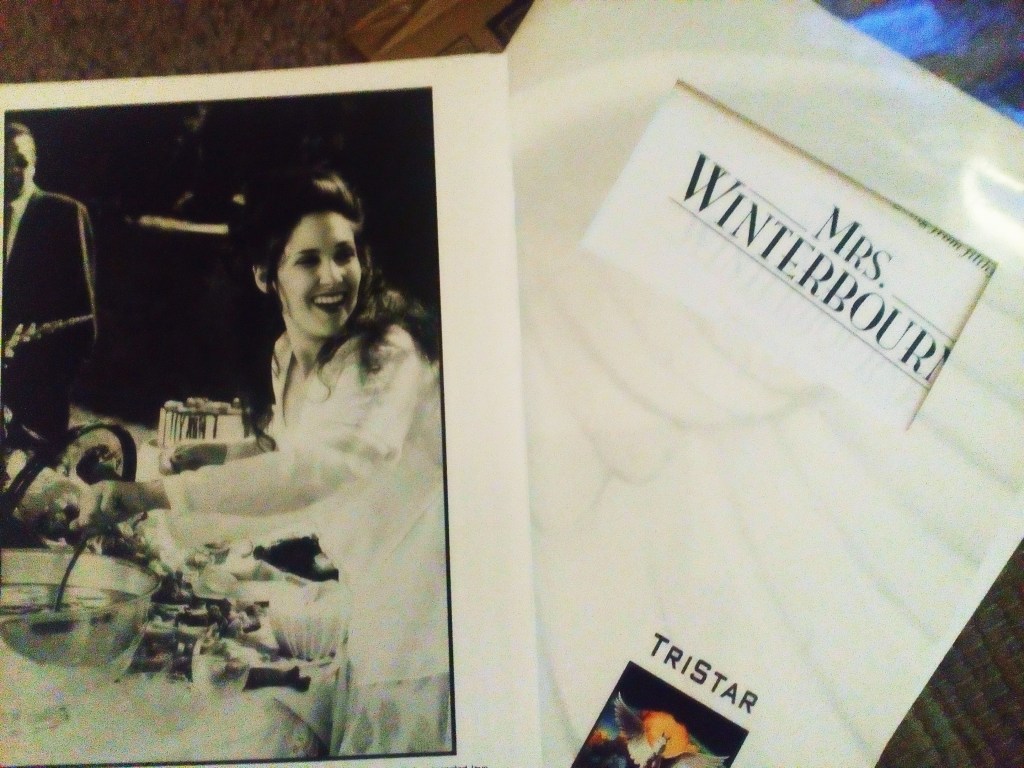
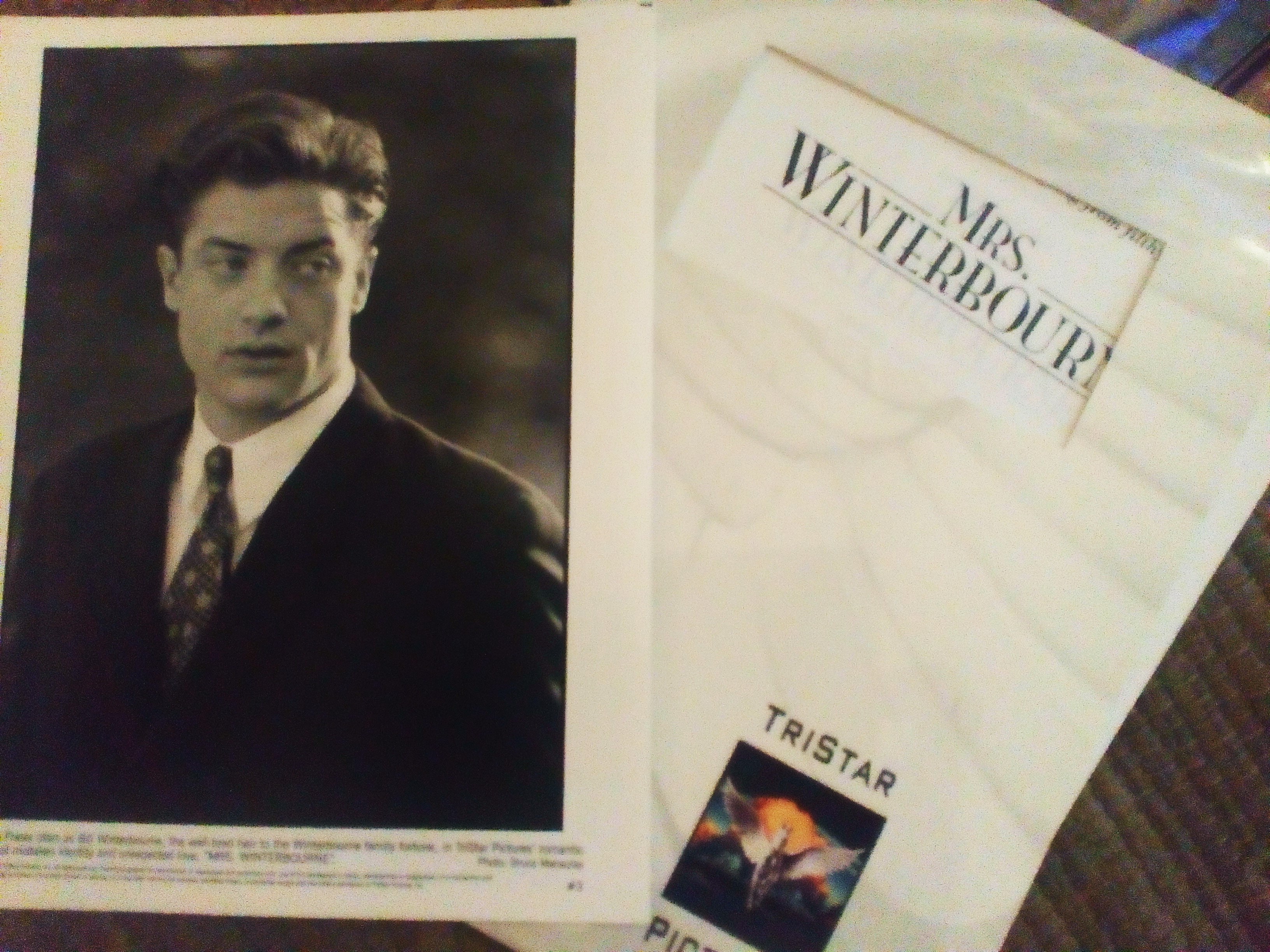
The I Luv Video outlet near me on Austin’s Guadalupe Street is closing down and consolidating with their other location. There’s been a sign out front for weeks now advertising that a lot of their old fare is for sale. I went hoping to find some Dario Argento DVDs like Phenomenaor Tenebrae, and although the good stuff was all gone (there are two copies of Eldritch abomination Phantom of the Opera and one of Jenifer, for those of you who hate yourselves and have a few dollars rattling around that you would prefer not to have), I did stumble across a small trove of press kits for nineties flicks. And what should I find among them but a folder labeled Mrs. Winterbourne?
What’s a press kit? Well, whippersnappers, back in the day before the internet made the acquisition and dissemination of information easy and manageable, production companies would distribute press kits to media outlets. These packets contained information about the production, statements from cast and crew, and glossy photos from the film itself, all ready for inclusion and quotation in previews and reviews. There’s little information in them that can’t be found online these days, but there were a few things in the press kit for Winterbourne that were interesting and that we didn’t know before watching the movie. Look, this isn’t Buzzfeed, I’m not going to tell you that any of these facts with “change the way you look at [x] forever,” or pretend that any of them are “mind blowing.” But they are neat, so without further ado, here are 9 Mildly Interesting Facts I Learned from the Mrs. Winterbourne Press Kit:
1. Brendan Fraser was the last person to join the cast. Ricki Lake was actually first cast, with Shirley MacLaine cast shortly after. According to page 7, Fraser “came into the cast […] only days before rehearsals were scheduled to begin.”
2. Fraser’s casting was at the behest of Lake. From page 8: “Fraser is a friend of Lake’s and was suggested by her.”
3. Fraser was also making a name for himself on stage in the nineties. Fraser’s bio on page 11 delineates a theatre career that includes a B.F.A. in acting from the Actor’s Conservatory as well as performances at Seattle’s Intiman Theater, The Laughing Horse Summer Theater, and “rave reviews for his work as a tortured writer in John Patrick Shanley’s play Four Dogs and a Bone.”
4. Loren Dean (Steve DeCunzo) also worked with Shanley. In addition to winning a Theatre World Award in 1989 (for something called Amulets Against the Dragon Forces, which isn’t underlined or italicized, so it’s unclear what kind of work that is), he also originated roles in the aforementioned Four Dogs and a Bone and Shanley’s other play Beggars in the House of Plenty.
5. Susan Haskell (the real Patricia Winterbourne) is a scientist. From page 13: “A native of Toronto, Canada, Haskell graduated cum laude from Tufts University with a Bachelor of Science degree in Bio-Psychology.”
6. Director Richard Benjamin won the 1975 Golden Globe Award for Best Supporting Actor for his role in The Sunshine Boys.
7. Producer Dale Pollock began his career as a journalist. This phase of his career lasted 12 years, during which he was a film critic and box office analyst for Daily Variety and a writer for the LA Times. He also wrote George Lucas’s biography, Skywalking, which had the good fortune to be released before the Star Wars prequels.
8. Writer Phoef Sutton won a comedy award. Although his main claim to fame was as a writer/producer for Cheers (which earned him a Golden Globe, a Writer’s Guild Award, and two Emmy Awards), he won the Norman Lear Award for Comedy in 1980, and he received a National Endowment for the Arts Playwright’s Fellowship in 1983.
9. Writer Lisa-Maria Radano worked on The Tracey Ullman Show. Radano also founded a small Manhattan theater company called Shadowfax and received a New York Council for the Arts grant for her play The Secret Sits in the Middle in 1988.








 Swampflix