Circle (2015)

EPSON MFP image

threehalfstar

If there’s an Achilles heel for hard sci-fi it’s that the ideas are often bigger than the narrative. Cheaper-end sci-fi writers often sink a lot of their attention into what’s happening to their characters without ever addressing why anyone should care that it’s happening. Last year’s sound stage sci-fi feature Circle is the height of big-ideas-over-character-development genre work. Essentially a Twilight Zone premise stretched to feature length, Circle is a glorified table read featuring fifty archetypal characters standing in a . . . circle & talking each other through a philosophical/supernatural crisis. Each character functions to serve the story, not the other way around, so if you’re going to enjoy the film it has to be on an intellectual level, not an emotional one. Good thing for Circle that its ideas are interesting enough to carry its breezy 87 minute runtime on their back without any real support from its faceless chess piece personalities.

Fifty strangers wake to find themselves standing on a circular board game-esque platform with no real explanation of how or why they arrived there. It quickly becomes apparent that they’ve been assembled to play a sadistic kind of game, a philosophical social experiment. At one or two minute intervals the circle removes a piece from the board, i.e. zaps someone to death. The characters soon discover that they are anonymously voting as a group on who will die next. A lot of finger-pointing, lying, begging, manipulation, and hateful prejudice (racism, classism, homophobia, the whole gamut) turns this already dire situation even uglier as their ranks become increasingly thin. Philosophical questions about whose life should be valued over others’ (whether it be for age, sexuality, criminal past, what they “contribute to society”, etc.) are asked until they reach their logical end- or until the more desperately conniving players decide to gang up & save their own skin.

I won’t ruin the details of who survives Circle‘s deadly sci-fi board game, since the process of elimination is where most of the film’s entertainment value lies. I will say, though, that the film ultimately reaches a satisfying conclusion worthy of the shocking reveals of its Twilight Zone roots. It’s generally obvious who will die next in the moment when it’s happening. For instance, if someone says something overtly racist or homophobic it’s typically a given that they’ll be the next player zapped to death (which is entertaining in its own way). However, as the film gets uglier in its interpersonal conflict the kills get increasingly unpredictable and the looming question of who or what is behind the mysterious circle’s origin becomes increasingly fascinating.

Beyond what the film does or doesn’t accomplish narratively, Circle does a good job of distinguishing its own sense of style despite its obviously limited budget. Filmed in a black sound stage void, the movie somewhat resembles the music video for Battles’s 2007 indie hit “Atlas“. Its soundtrack of atmospheric drone & 360° camera spinning can be downright eerie in their own right and the emptiness of its set ultimately serves the abstract philosophy of its narrative by highlighting the dialogue as a focal point. Again, this is a film that survives on the strength of its ideas, which are plotted out in an interesting enough structure to keep your mind active & engaged throughout. Calling to mind both the similarly-minded supernatural horror Devil & real-life social experiments like The Stanford Prison Study, Circle is a perfectly entertaining exercise in ideas-over-characterization sci-fi writing.

-Brandon Ledet

The History of Future Folk (2013)

EPSON MFP image

fourhalfstar

Once upon a time on a planet named Hondo a well-respected war general was asked to save his home planet from certain destruction via comet by finding a new, inhabitable world & destroying its current resident population with a flesh eating virus to make room for the Hondonian people. The general crash landed on Earth, but decided not to mass-murder the 7 billion people who inhabit it because it’s on this new world that he heard music for the first time. Now desperate to save Earth from the Hondonians, he attempted to alert his home world of the wonders of music via satellite transmissions, all while living a double life as a family man & a dive bar folk musician. The question is would he be able to get his message across before Hondonian assassins ended his traitorous life. This is, more or less, the history of Future Folk.

Future Folk is a duo of novelty musicians from Brooklyn, New York (Nils d’Aulaire & Jay Klaitz) who’ve been writing & performing songs around the above premise for more than a decade. If they hadn’t been toiling away at their shtick since the early 2000s it’d be pretty easy to accuse them of being derivative of similar, but more successful acts like Flight of the Conchords or Tenacious D, but the truth is they’re more contemporaries than copycats. And just like the two acts just mentioned, their transition from concert hall sketch comedy to television/film is an impressively smooth one. Their visual & narrative backstory feels well explored & intricately detailed, but more importantly their screen presence & dedication to the act feels entirely sincere. As a film The History of Future Folk is somewhere between a quirky indie comedy & a low-stakes sci-fi fantasy epic. As a contribution to the comedy landscape at large, the film is a priceless document of a finely-tuned two-person act that doesn’t have any other way to reach an audience outside the Brooklynites who’ve seen them perform it live.

The most amusing aspect of the Future Folk’s Hondonian backstory is the way it’s played with straight-faced deadpan. It’s first introduced as a bedtime story for a little girl who treats it like an awe-inspiring myth of the ages. The same exact story is later treated like comedy gold by the far less sincere hipster bar patrons who accept the threat of intergalactic war & flesh-eating viruses as an ironic joke. In both instances the misplaced Hondonian general speaks in total, unembellished honesty. What people do with the truth is largely dependent on the audience in question. This stripped down earnestness pairs nicely with the film’s complete absence of a budget. Many shots feel candid, as if they were stolen without a permit, but its cheapness never feels like a detriment. It only adds to the Future Folk’s brand of earnest charm.

I guess it takes a certain tolerance of twee preciousness to get on The History of Future Folk‘s wavelength, but like I said, its much more in line with the subdued humor of acts like Flight of the Conchords than it is with heart-on-the-sleeve indies like Me and Earl and the Dying Girl. The History of Future Folk works best as intricate, feature length sketch comedy. Its limited budget & dedicated-to-the-joke leads leave little room for vanity or pretension. There’s an endearing sense of heart & earnestness that adds to the film’s charm, but it’s most mostly remarkable for its ability to earn belly laughs through such unlikely sources as department store Muzak & red plastic buckets. The History of Future Folk is an easily-lovable, genuinely hilarious work of modern sketch comedy. It’s about as much of a crowd-pleaser as a quirky, low-budget indie comedy could possibly be, twee vibes be damned.

-Brandon Ledet

Attack the Block (2011)

EPSON MFP image

fourhalfstar

Are we all pretty much done talking about Star Wars Episode VII: The Force Awakens at this point? If so, please forgive me for the following preamble. One of the most exciting aspects of the film for me was the introduction of relative newcomers Daisy Ridley as the oddly-controversial Rey & John Boyega as the absurdly affable Finn. They both do an excellent job of holding down the protagonist end of the film in a remarkably deft tag team effort for two actors who aren’t too used to headlining multi-million dollar tentpole epics. More astute sci-fi fans might not have been as surprised as myself by Boyega’s part in that effort, though, given that he already had put in a rewarding lead performance in a deliriously fun action film a few years prior to The Force Awakens. Attack the Block finds John Boyega in a much quieter, more stoic leading role than he’s asked to play with Finn (who is often employed as comic relief), but even as a babyfaced teenager he was prepared to prove himself to be leading man material.

As stoic & as straight-faced as Boyega plays its protagonist, Moses, Attack the Block is anything but a grim horror picture. An urban sci-fi horror comedy about an alien invasion that targets the unlikely ground zero of a housing project in London, Attack the Block is a wildly fun creature feature with an exceptional knack for practical effects monster design & sleek music video aesthetic. Its ragtag group of barely-out-of-diapers youngsters that fend off the otherworldly invaders are an amusing gang of pothead ruffians (the kind that would inspire Liz Lemon to involuntarily shout “youths!”), mostly harmless in their overly-macho, self-aggrandizing indulgence in vulgarity & hip-hop swagger. Their accents border on being incomprehensible for an American outsider such as myself, but that foreign aspect can also be insanely charming, recalling the early 2000s raps of Dizzee Rascal & The Streets. Even more incomprehensible are the alien beasts that attack these kids. Kinda bearish, kinda canine in nature, these creatures are too dark to get a good look at, unless they’re baring their glow-in-the-dark fangs. The audience isn’t alone in not knowing what to make of the aliens. They’re described most accurately described in the film as “big alien gorilla wolf motherfuckers” & “Maybe there was a party at the zoo and a monkey fucked a fish?”. The difficult-to-pin-down creature design of the aliens pairs nicely with the highly specific cultural context of their victims & the film’s overall silly horror comedy tone to make for a remarkably memorable & unique picture.

Attack the Block turns a small cast & a limited budget into something truly special, a trick that can only be pulled off by fans of the genre it works in. Indeed, the film even goes as far as to shout out properties like Gremlins, Ghostbusters, and Pokemon by name, not to mention the close involvement of Nick Frost & the producers of the cult favorite Shaun of the Dead. The budget might be somewhat limited, but the film pulls a remarkably unique visual language from such simple visual sources as fireworks, smoke, swords, and motor scooters. What’s more important, though, is that it nails the monster attacks aspect of its appeal, which are plentiful  without being overly gore-heavy (despite a stray decapitation or throat-tearing here or there). And the film gets major bonus points for achieving most of this mayhem with practical effects, a minimal amount of CGI seamlessly mixed in for bare bones support.

There are plenty of reasons for sci-fi & horror fans to give Attack the Block a solid chance. It’s a perfectly crafted little midnight monster movie, one with a charming cast of young’ns, a wicked sense of humor, and some top shelf creature feature mayhem. The film doesn’t need John Boyega’s teenage presence to be worthy of a retroactive recommendation & reappraisal, but that doesn’t hurt either. In just two films, Boyega has carved out a nice little name for himself in genre-cinema. If you enjoyed his turn as Finn in The Force Awakens, you should definitely check out his earlier work in Attack the Block. The truth is, though, that you should check out Attack the Block even if you hated The Force Awakens. It’s an undeniable crowdpleaser, a commendable entry in the horror comedy genre that will endure long after the novelty of seeing a babyfaced Boyega in action wears off.

-Brandon Ledet

Cloverfield (2008)

EPSON MFP image

twohalfstar

News broke late last week that sometime after J.J. Abrams had wrapped filming on Star Wars Episode VII: The Force Awakens, his production company Bad Robot had “secretly” filmed a “blood-relative” followup to his 2008 production Cloverfield. I personally had a mixed reaction to the revelation that a second Cloverfield film is headed our way. I absolutely hated the original Cloverfield film when it was released in 2008. Loathed it. A sequel (or a “blood relative” semi-sequel) would not likely be something I’d be interested in, then, except that the trailer for 10 Cloverfield Lane is so thoroughly badass that it made me reconsider my stance on the original entirely. So, for the third time in eight years I decided to give Cloverfield a chance to grow on me. I’m bummed to report that although my hatred for the film has calmed down a great deal, it’s still not my thing.

Found footage horror films are a dime a dozen (almost literally; their attractively low production costs are a large part of why they’re so plentiful). Cloverfield is a step above the rest in terms of what it accomplishes with the limited scope of the found footage horror as a genre. On the monster end of the equation, the movie nails everything it aims for. Its lumbering, Godzilla-sized creature is a sight to behold (whenever you can get a good glimpse of it) and the broad strokes of its threat on New York City is complimented nicely by an evil army of tiny insectoid (baby?) versions of the larger creature. The movie is smart not to over-detail exactly why or how the monster arrived. Is it from the ocean floor? Is it from another planet? These questions are asked, but never answered. Instead, Cloverfield focuses on detailing the mayhem: rockets launched, buildings demolished, oil tankers tipped & set aflame. It’s honestly not at all hard to see why so many people have latched onto Cloverfield as a breath of fresh air in the creature feature genre.

What sinks the film for me is the human end of the equation. The characters are understandably panicked by the sight of a grand scale monster tearing the city down around them, but their shrill, frantic reactions are relentless & honestly, annoying. As an audience member it’s far more entertaining to focus on what the gigantic (alien?) beast is up to instead of hearing someone shriek “Rob’s got Beth on the phone! Rob’s got Beth on the phone! Rob’s got Beth on the phone!”, especially since Rob & Beth are so vaguely defined that they’re barely more than total strangers. It’s an exciting feeling to be chased down to a creature you barely comprehend, but when you’re only interacting with the damned thing through brief flashes & the creatures you do spend time with are just as barely-comprehendible New York City nobodies, the whole ordeal can be very frustrating. Despite the presence of future-greats Lizzie Caplan & T.J. Miller, the human toll in Cloverfield feels greatly deserved, a debt well paid. I wanted (most of) these characters to die at the monster’s hands(? tentacles?). I doubt that was the desired effect.

Still, I find myself excited for 10 Cloverfield Lane. Maybe it’s the narrative remove from the found footage format that’s working for me in that ad? Cloverfield aims for a kind of authenticity that I’m not sure it achieves. It bends over backwards to make sure there’s a reason why the cameraman (Miller) would be filming in the first place (a going away party for Rob! Rob! Roooooooob!). It goes way overboard on that end, though, with the cameradude explicitly saying “This is going to be important. People are going to want to see this.” There are also some eyeroll-worthy instances of coincidence (like the Statue of Liberty’s head rolling to a stop at these exact characters’ feet) & terrible self-survival choices (even for the horror genre) that compromise the film’s attempts to feel like a document of a “real” supernatural event. Really, though, what doesn’t work for me in Cloverfield is its human casualty stockpile. It’s especially sad that they’re so blandly represented & so unable to generate sympathy even though the monster mayhem doesn’t start until 20 minutes into the runtime & the characters in question never leave our sight. They’re always around, waiting to baffle & annoy. 10 Cloverfield Lane promises almost the exact opposite experience: three characters trapped in a small space through a cinematic lens instead of a faux documentary one. I expect that set-up (and what promises to be one intense John Goodman performance) will be a much more satisfying experience. I believe this despite optimistically giving the first Cloverfield a shot three separate times, with my opinion only being raised from white hot anger to mild displeasure. That’s still progress, I guess.

-Brandon Ledet


Instinct Vs. Ability in Rey’s Use of the Force in Star Wars: The Force Awakens (2015)

EPSON MFP image

When I first reviewed Star Wars Episode VII: The Force Awakens, it had just opened for wide release. This was a magical time, just less than a month ago, when I couldn’t imagine what anyone could possibly have to complain about in J.J. Abrams’ fan-pleasing entry to one of pop culture’s most beloved franchises. After viewing the film three times in the theater (possibly the first time I’ve done that for a movie since 2004’s The Life Aquatic with Steve Zissou), my enthusiasm hasn’t wavered a bit. I’m proud that it ended up ranking on our Top Films of 2015 list & personally would place it behind only Empire Strikes Back as one of the best in the franchise. Boy, was I wrong about the complaints, though. From what I can tell, the world (or at least the world online) has forgotten how to have fun at the movies & has devolved mostly into whiny nitpicking & self-assigned superiority. Despite the critical response to The Force Awakens remaining largely positive, the volume & variety of complaints surrounding the film have become absolutely overwhelming. There are many common quibbles I disagree with (it too closely resembles A New Hope, its central villain is too “emo” to be threatening, etc.), but for the sake of brevity I’d like to address just one complaint against the film that I find dubious: the idea that its protagonist, Rey, gets “too good, too fast” in her use of the Force.

The last thing the world needs right now is another lengthy think piece about The Force Awakens so I’ll try to keep it brief here. It’d be possible to address the complaints against Rey’s Force abilities from the POV that a slowburner about a young space wizard spending hours of screen time learning to play laser swords might not be the most exciting plot for an action-packed space opera. It’s also possible that there’s a hint of sexism afoot in these complaints about Rey, since no one seemed super-miffed about how quickly Luke could block laser blasts blindfolded in A New Hope. I’d like to offer a much simpler explanation for Rey’s sudden talent with the ancient art of the Force besides streamlining the plot, however: her talent was a lot more gradual than most people realize. The scene most people seem to gripe with concerning Rey’s abilities is an interrogation room battle with Kylo Ren when she seemingly discovers her Force abilities, then immediately dominates her professionally-trained opponent in a mental tug of war. It’s my contention that Rey had already been “using the Force” long before she entered that interrogation room; she just didn’t have a name for something she had been doing by instinct.

For concrete evidence for Rey using the Force before the interrogation scene, just look to all of her instances of “luck” & “coincidence”. Rey is introduced as having a unique talent for scavenging for minuscule parts in gigantic ships, but is it a purely human talent that drives these needle-in-the-haystack searches? Perhaps not. Even more convincing is the scene where Rey first flies the Millennium Falcon. She is familiar with the individual parts of ships from her daily scavenging & can talk shop with the best of  them (most notably Han Solo), but knowing & doing are two separate endeavors. When Rey takes the controls of the Millennium Falcon (a ship she derides as some nameless junker) she flies it recklessly in a panic, repeating “I can do this, I can do this” to herself & barely getting by on rudimentary skills & “luck”. When she devises a plan on how to utilize Finn’s gun (which is locked in a downward position) by executing a flawless maneuver that positions the ship upside down, a switch seemingly flips in her head. She looks confident, determined, and the wild nature of piloting smooths out. Finn asks her, “How did you do that?” and she responds, “I don’t know. I’ve flown before, but . . .” in an exasperated tone. This is a line of questioning is repeated later in the film when she escapes Kylo Ren’s interrogation by using the Force (supposedly for the first time) and when asked to explain how, she responds, “I can’t explain it & you wouldn’t believe me.”

I believe there is a pattern there. Rey is instinctually using the Force in the Millennium Falcon scene without knowing what she’s doing exactly. It’s a pattern repeated when she first uses a laser blaster. She misses her first shot, looking frazzled, then throws on her determined Force Face (a great body language detail from actor Daisy Ridley) & never misses again, offing a storm trooper every time she pulls the trigger. It’s also echoed in the scene where she accidentally releases the alien beasts Han Solo is smuggling. She mistakenly opens the wrong blast doors on her first try, but when she has to save Finn from the wicked things’ tentacles she calmly executes the correct blast door at the exact correct time, joking “That was lucky.” I disagree with Rey (even though she was speaking in jest). It wasn’t lucky; it was the Force. I could kind of pinpoint a few more of Rey’s instant “talents” & lucky “coincidences” that could possibly be attributed to the Force (happening to run into Finn in the first place, innate understanding of obscure languages, the ability to fight off multiple men at once, moving a gigantic metal grate with her bare hands, etc.), but you’d have to squint at those examples the right way to make them work. I’m at the very least confident that the Falcon flight, the laser blaster, and the blast doors are concrete examples of Rey using the Force by instinct.

I don’t think that Rey’s Force abilities being introduced gradually instead of suddenly makes or breaks The Force Awakens as a good or a bad movie. There’s so much going on in the film that makes it a worthwhile slice of sci-fi fantasy entertainment otherwise. If nothing else, watching animatronic cutie patootie BB-8 roll & bleep its way through danger is alone worth the price of admission. I do, however, firmly believe that Rey’s gradual use of the Force through instinct was an intentional choice made by director J.J. Abrams & screenwriter Lawrence Kasdan. Long before Rey Jedi mind tricks her way out of the interrogation room & even before she receives visions by touching the Skywalker family lightsaber, her unknowing use of the Force is referenced by none other than Supreme Leader Snoke himself. Snoke asks Kylo Ren, “There has been an Awakening. Can you feel it?” (For the record, Ren can.) If a fictional, spooky projection of an evil wizard can sense that Rey is using the Force sight unseen, why can’t the film’s detractors, who have the benefit of watching her every step? Sometimes it’s fun to complain, I guess, whether or not the film or the character deserves the scrutiny.

-Brandon Ledet

Star Wars Episode VII: The Force Awakens (2015)

EPSON MFP image

fourhalfstar

I can’t tell if J.J. Abrams’ current career status would be a nerd’s wildest dream or their worst nightmare. Both? Simultaneously tasked with commanding sci-fi nerdom’s two most beloved properties, Star Wars & Star Trek, I’m sure he’s giddy with the power of adapting two franchises he surely grew up loving. Nerds are a tough bunch to please, though, so there’s an absurd amount of external pressure to not muck up their sacred texts, a pressure even Star Wars creator George Lucas wasn’t protected from (after he admittedly mucked them up spectacularly). One of the most delightful things I have to report about Abrams’ first Star Wars feature (of presumably many to come), The Force Awakens, is simply that it is by no means a misstep or a failure. I’m in a nice sweet spot of expectation where I grew up loving the original Star Wars trilogy, but not to a rabid, detail-obsessed degree that would leave me nitpicking whatever Abrams delivered. Coming from that perspective, I can’t exactly speak on behalf of Star Wars fanatics, but as a movie lover it’s hard to imagine that they’d be anything but pleased by The Force Awakens as a finished product. A great balance of enthusiastic fan service & promising new ideas/story threads, the latest entry in the Star Wars universe is far from the muted, just-good-enough, tragedy-averted compromise of 2015’s The Peanuts Movie (or Abrams’ own Star Trek work, for that matter). It’s an actually-great, entirely successful new birth for the franchise, sometimes feeling like it could be in contention as being nearly just as good as Episodes IV or V. The overall feeling I got while watching The Force Awakens is “What more could you ask for?” Abrams has successfully walked the Star Wars tightrope & delivered something sure to please both newcomers & skeptics and, more importantly, something that’s deliriously fun to watch when divorced from the burden of expectation.

Of course, because the film is so fresh & so highly anticipated, there’s an intense fear over the possibility of spoilers among some viewers, so I’ll try to tread lightly in this review. Even a simple roll call feels like a small betrayal, but it’s a somewhat necessary one. On the fan service end of Abrams’ well-calculated formula, the film could’ve just as easily been titled Star Wars Episode VII: The Gang’s All Here. Luke Skywalker’s importance to the universe has escalated to mythical proportions as he’s reported to be “the last Jedi.” His sister Leia has graduated from princess to general, establishing herself as the figurehead of The Resistance. Speaking of which, The Resistance is an obvious stand-in/update for The Rebel Alliance of the original trilogy, just as its The First Order big bad is a stand-in/update for the older films’ Galactic Empire. The only figure that seems to not have changed a lick is swashbuckling smuggler Han Solo, who remains as steadfast in his personality as a droid would, just as unable to evolve in his demeanour as the same-as-ever C-3PO. The characters are far from the only elements re-purposed from the franchise’s origins, though. A quest to locate Luke & the wisdom of Jedi knowledge is very much reminiscent of Luke’s quest to train with Yoda. There’s also some major theme callbacks like struggling with identity in the context of parentage and, of course, the eternal struggle of Good vs. Evil (in the succinctly-framed balance of The Force) mixed among much smaller tips of the hat to details like space chess & the infamous Cantina scene. I also had a lot of fun with the way it indulged in recreations of the older films’ exact screen wipes & Force-manipulation battles (which are essentially 100% sound cues & intense trembling). The greatest trick The Force Awakens pulls off, though, is when it finds a metaphor for its own existence in the callbacks. For instance, an almost exact replica of The Death Star is represented here, except that it’s 20 times larger, much like Abrams’ budget vs. what Lucas was originally working with. And then, of course, there’s the BB-8 “ball droid”, which is essentially a cuter, more technically impressive, surprisingly versatile version of R2-D2. It’s a modern update to a classic model, much like the film itself.

Speaking of BB-8, that little bugger has got to be the most exciting new addition to the Star Wars canon right? It’s at least the film’s breakout star, a kind of acknowledgement to the merchandising end of the franchise (in that it’s super cute & palatable for children), but also a ruthless, shrewd, determined, even dangerous character in its own right (possibly in a conscious effort to distance its cuteness from the heavily debated, somewhat purposeless existence of Ewoks). For the full year of advertising we all survived in order to get to this point, all I could think about in relation to this film was BB-8. Comedian Paul F. Tompkins’ four second delivery of “I’m Ball Droid. I gotta roll on out of here,” got me more hyped on watching The Force Awakens more than any particular ad did (and, of course, that clip continuously played through my head once I actually got to watch it). There are a lot of of other great, new characters introduced to the Star Wars universe in The Force Awakens, including a new possible future for the Jedi tradition, a rage-filled Sith-in-training prone to on-brand temper tantrums, and a Storm Trooper With a Heart of Gold, but in a lot of ways they feel like echoes of characters we’ve seen in the past films (well, except maybe for that Storm Trooper dude). There’s just something really special about the BB-8, whether or not it’s taking up the baton from a still-beloved R2-D2. It’s a pretty remarkable achievement in character design as well as exploitation of body language & subtle vocal manipulation. For new viewers entering the Star Wars universe for the first time with The Force Awakens (and they do exist) a lot of old, well-established familial ties & big concepts like The Force are going to be somewhat off-putting, since the film is not going to be able to hold their hands through the catch-up process, but BB-8 is such a great encapsulation of what makes the franchise work for so many people that it might not be a problem. It’s the perfect little tour guide for a space-set soap opera that’s only going to get more tangled & complex as these films continue to be produced (which will probably be for eternity, considering how much money this one will make at the box office). It’s instantly loveable & accessible.

I’m not going to pretend that The Force Awakens is perfect. I was a little off-put by some of the CGI reliance, particularly when it came to intimate interactions with alien faces. A lot of the CGI is nicely restrained & deftly employed, but it gets tiresome to look at (and is guaranteed to age poorly) whenever it’s used on a green-screened character with more than a line or two of dialogue. I also felt that the action sequences could sometimes go a bit long in a way that softened their impact, but that’s a small quibble, especially considering just how visceral & vicious things get in the climactic lightsaber battle. For the most part, though, it’s a remarkably difficult film to complain about. Even with lines like the racially-tinged throwaway gag “Droid, please”, which should fall flat in a very uncomfortable way, the film somehow makes it work. It’s easy to tell that Abrams & his collaborators were huge fans of the franchise doing their best to deliver a film that most people could love. He finds an immensely satisfying balance here of recreating past successes from the original trilogy, but with entirely new purpose. Much like the universe it inhabits, The Force Awakens feels old, beat up, lived in, the exact kind of world-building last year’s The Guardians of the Galaxy strained to establish in just one film, but this time with an extensive back catalog of content for support. The film’s ragtag group of heroes more or less winging it in their quest to overthrow The First Order may be very reminiscent of a similar motley crew who tried to overthrow The Galactic Empire (for instance, a female lead most certainly not in need of constantly being saved shouts “Stop taking my hand!”, which could have very easily been an old-school Leia moment), but they’re more of a refreshing evolution than a shameless retread. Sure, The Force Awakens can rely on work already put in by past films for lines like “Without the Jedi there can be no balance in the Force” to actually mean something, but it also finds its own touching moments, like in the question of when is running from a threat a form courage & when is it a submission to fear or in finding the simple goodness of people in exchanges like “Why are you helping me?” “Because it’s the right thing to do.” Most importantly, it feels like all of the ground work of pleasing fans through callbacks & establishing its own competence as a unique property are now out of the way, which is in a lot of ways a burden lifted. When the film ends, you’re genuinely excited to see where the story goes next because the future of the franchise is promised to be less self-reflective, more open-ended, uncharted territory. I’m already getting amped about Episode VIII‘s release in Spring 2017 as I type this, which I guess is a sign that Abrams did something exactly right in The Force Awakens.

Bonus points: There are a lot of great new-to-the-scene actors in this film – Adam Driver, John Boyega, Lupita Nyong’o, etc. What really made me giddy, though, is that both Domhnall Gleeson & Oscar Isaac made the cast, which makes for just about the most unexpected Ex Machina reuninon I could possibly imagine. Those two films are so far from one another on the opposite ends of the sci-fi spectrum that it’s difficult to justify that they’re billed as being in the same genre at all.

-Brandon Ledet

The Hunger Games: Mockingjay – Parts I & II (2014, 2015)

EPSON MFP image

fourstar

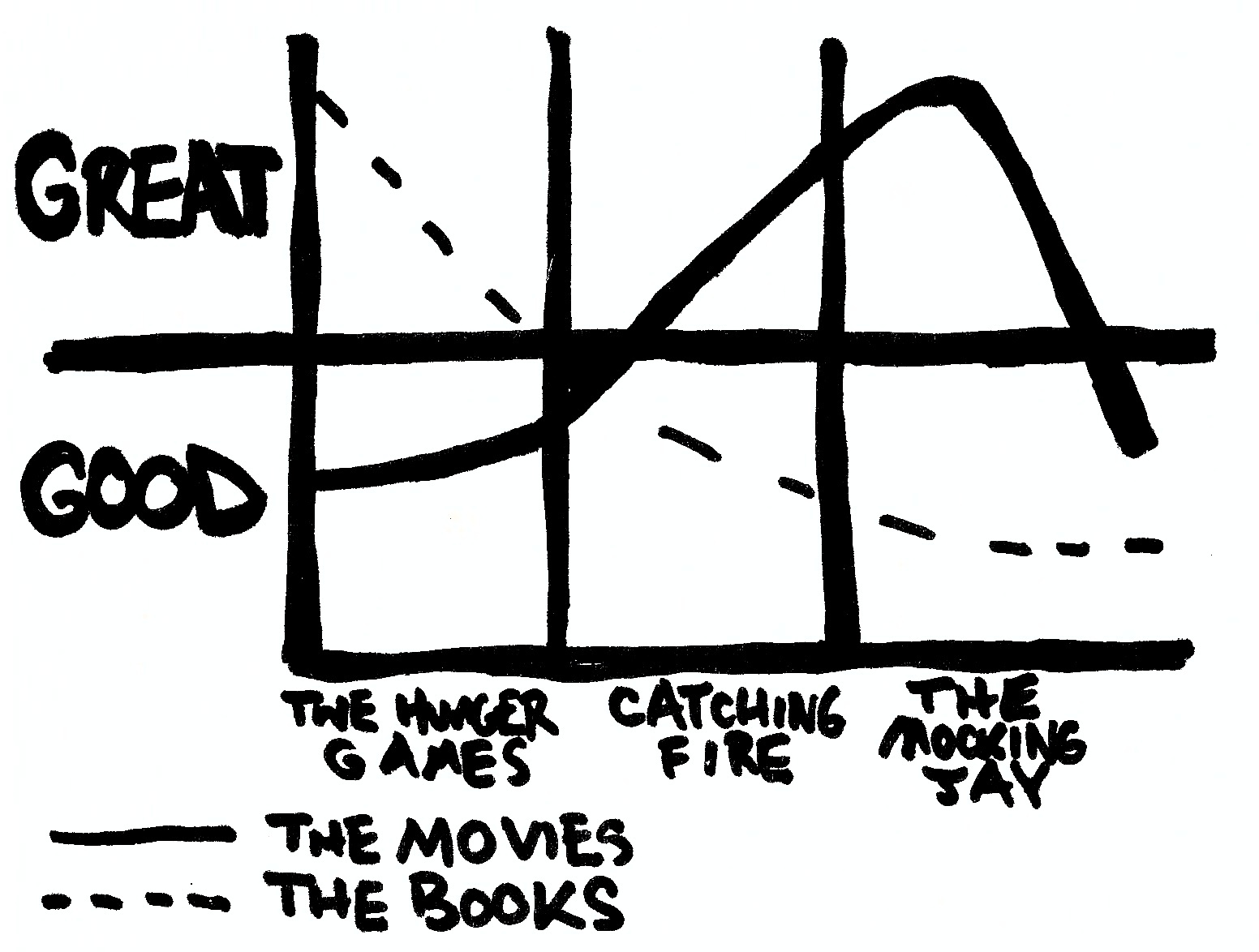
I’ve enjoyed following the Hunger Games saga, both as a series of YA novels & and as a series of dystopian sci-fi film. It’s a pretty grim franchise for something a lot of people consider “kids’ stuff”, one that takes its forcing-to-children-to-fight-to-the-death-for-entertainment premise very seriously. Its haves-vs-have-nots dystopian world-building is nothing particularly new and can especially be seen telegraphed in properties like Battle Royale & The Running Man, but I think it’s a pretty great sci-fi intro for teens, especially refreshing for its strong female protagonist Katniss Everdeen (played by Jennifer Lawrence in the films, duh) & in the way its potentially-corrosive love triangle conflict is handled. One strange aspect for me has been how the film versions of the Hunger Games trilogy have resisted the law of diminishing returns. I felt that Suzanne Collins’ novels started at their strongest point, doing a great job of establishing an in-the-moment intensity in its abysmal future-world by dragging the audience along closely with Katniss’ experience navigating the Hunger Games. The quality dropped off a bit for me in the sequels, though, as the pacing seemed to get away from Collins and large swaths of summarizing overtook the focused intimacy of early scenes. The first movie was pretty great as well, doing a good job of capturing Katniss’ in-the-moment POV, but the film series subsequently seemed to improve from there, knowing exactly what to show & what to ignore in Collins’ sprawling narrative for maximum effect.

EPSON MFP image

Mockingjay – Part I might just be the pinnacle of the Hunger Games movies for me. General consensus has the franchise peaking with the second film, Catching Fire, but I’d say it’s at the very least a close call. the film’s themes of PTSD, regret, powerlessness, and the pressures of being the face of a revolution all hit me pretty hard. I’ve heard friends & family describe the film as boring, saying nothing happened, which is pretty surprising for a film with such a high bodycount & grandscale warfare, but I had a genuinely emotional reaction to its horrors, getting teary-eyed at the film’s hospital bombings, mass graves, and three-fingered solutes. Its murderers’ row of talented actors certainly didn’t hurt: Philip Seymour Hoffman, Julianne Moore, Jeffrey Wright, Natalie Dormer, and Donald Sutehrland are all at the top of their game here, which is really saying something. I also appreciated scenes of Jennifer Lawrence, who is an incredibly gifted actor, pretending to be an incredibly inept actor as Katniss fails miserably to produce convincing propaganda clips to rally support for a revolution. Mockingjay – Part I‘s riots, uprisings, strikes, and rescue missions were all a lot more satisfying to me than expected & Lawrence deserves a lot of credit for anchoring the film’s emotional resonance.

Mockingjay – Part II unfortunately didn’t hold up quite as well for me. I think the issue is that Collins’ summarizing had gotten out of control by the final book, so that the film version struggles to make individual scenes count for much as it chases an exponential momentum of a plot trying to wrap up a widespread political revolution, a small family’s struggle to remain a unit, and a strained, increasingly bitter love triangle in just two hours time. There were a few small moments to enjoy in the chaos — my favorite was when Katniss is called out for the “tacky romance drama” & cliché  “the one” specialness of her mythology at a wedding — but for the most part the films struggles to let its Big Moments properly breathe. Mocking Jay – Part II‘s killer C.H.U.D.s & third act Major Character Death both failed to land with full impact thanks to the runaway momentum of Collins’ plot & pacing. And because director Francis Lawrence did such a great job with Catching Fire & Mockingjay – Part I, I’m willing to give him the benefit of the doubt & suppose that the rushed nature of Mockingjay – Part II was far from his fault. Considering all of the ground that the novel covers (I’m struggling not to go long here just touching on it), Francis Lawrence  could’ve stretched Mockingjay into its own separate trilogy & given each underserved scene its own proper moment to shine.

I can’t imagine impatient fans, who groused about splitting the finale into two parts in the first place, would’ve been receptive to a Mockingjay – Part III,  though. If you consider that Francis Lawrence had no choice but to split the finale into two parts, I think he did a great job of adapting a difficult work of fiction for the screen. Mockingjay – Part I carries the emotional weight the film series as earned over the last few years & Mockingjay – Part II does the necessary work of bringing the whole thing to a close. The two halves function well together as a single, four-hour feature. One picks up exactly where the other leaves off & together they do a satisfactory job of carrying a work that’s spread pretty thin to a convincing conclusion. Although I’d contend that Part I is the far superior picture, they average out to something pretty great in the end, which fairly unusual for the third film in a sci-fi trilogy.

Bonus points: I’d like to take this opportunity to give kudos to the Hunger Games series for being the only action franchise I can think of where fashion as an artform plays a deeply integral part to the films’ central themes. I particularly liked a moment in Mockingjay where Katniss is told she’ll be “the best dressed rebel in history” & it’s a sentiment that actually means something significant. It’s a cool, distinguishing detail, if nothing else.

– Brandon Ledet

The Cheap, Diminished-Returns Depths of Class of 1999 II: The Substitute (1994)

EPSON MFP image

November’s Movie of the Month, Class of 1999, is by no means a great movie. It’s a strange, didactic, dated, entertaining, culturally intriguing piece of mindless cyborg action with misguided social commentary, but while it’s a movie that holds a special place in my heart, there’s nothing groundbreaking or objectively iconic about it. For all its strengths and weaknesses, it’s a movie that truly commits to its fictional world and its boundaries and stays within those strictures: the grime is grimy, the robots are robotic, and the violence-prone teenagers are teenaged and prone to violence. The idea that armed, militant teenagers whose schools are at the heart of free fire zones would continue to attend class is absurd, but the movie never winks at this idea. Sure, the dieselpunk armored vehicle chase that opens that film is ridiculous, but the movie plays it with sufficient sincerity to make it, if not believable, at least explicable. The sequel? Not so much.

Class of 1999 II: The Substitute isn’t just a movie with a title that combines Arabic and Roman numerals in an attempt to drive classicists insane, it’s also one of those sequels that features no returning cast members and seems to have missed the point of the first film. I hardly know where to start here—there’s almost nothing right about this movie and so very much that’s wrong. According to the poorly composed Wikipedia plot summary of the film, Substitute is, like the original Class, set in “a violent future metropolis where gangs rule the hallways.” This is a lie; the setting of Substitute is somewhere in the featureless American midwest, judging by the area surrounding the school, in a building that the crew wasn’t allowed to alter in any way. Early in the movie, a character stands atop the school’s roof, and the entire background is just rural dusty nothingness, where cars move slowly and lazily down a traffic-free highway. With regards to set design, the graffiti that covers the walls of the school is clearly painted on translucent plastic sheeting that moves in the wind, demonstrating zero effort to maintain the illusion that this isn’t just some random school that was open for filming on weekends. A teenage wasteland it most definitely isn’t.

The plot follows John Bolen (Sasha Mitchell), a substitute-of-fortune who happens to be a decommissioned and repurposed military android, just like the three killer bots from the first film, apparently the last of his kind still wandering the earth. He is being pursued—if lackadaisically and perfunctorily following the trail of a killer robot can be called a pursuit—by a man whose sole purpose is to provide voice-over exposition in the form of digressive verbal journal entries, named G.D. Ash (Rick Hill). Bolen’s left a trail of bodies behind at every school that has had the misfortune of playing host to one of the iterations of his cycle of violence, and he’s just arrived at a new school. Jenna McKenzie (Caitlin Dulany) is a teacher there, although she’s suffering harassment at the hands of gang members who support Sanders (Gregory West), a gangbanger against whom Jenna is planning to testify; she’s the only one who saw him intentionally aiming at a fellow student who was supposedly killed by an accidental gun discharge. Her boyfriend, Coach Grazer (future Alpha Dog director Nick Cassavetes), is also the curator of the local military history museum, and he pleads with Sheriff Yost (Jack Knight) to increase his protection of Jenna, but Yost doesn’t have the manpower (in fact, there is not one other police officer in the entire film, seeming to imply that Yost is the beginning and end of this town’s police force). Bolen shows up and immediately starts killing students. He also develops an attraction to Jenna, whom he protects from attacks by Sanders’s goons.

You’ll notice that there’s scarcely a mention of students in the above paragraph, or of classes, or of school. Unlike the previous film, wherein the teenage students were the protagonists, here they are indistinguishable cannon fodder, with Jenna and Grazer as the unmemorable leads. With Class, even if the characters were thinly defined, there was a supporting group of recognizable people with different clothes and hairstyles rounding out the main cast of teen characters like Angel, Cody, and Hector. Here, every single teenager wears a prison orange jumpsuit, even though they’re not incarcerated or even particularly violent; the only two teenagers of consequence are Sanders and his lieutenant Ice (Diego Serrano), and neither of them are ever seen attending school. We never even find out what subject Jenna teaches! Grazer doesn’t mention that he’s a coach until well into the film and long after the audience has made the assumption that he’s just some survivalist who Jenna happens to be dating, like Burt Gummel from the Tremors series. Class was about kids whose teachers happened to be military killdroids. Substitute is, instead, about a killer robot who happens to be a teacher, and only the former is relevant. There’s no reason that this narrative needed to be set at a school at all; the plot could be transposed to a law firm, a diner, or a grocery store with no significant effect on the storyline, which is a problem when your title has the word “class” in it.

I hate to keep coming back to the problem with the film’s setting and the difference from Class, but it’s quite distracting, especially since the movie itself refuses to let you forget that it’s a sequel, what with all the reused footage that illustrates Ash’s expository narration. The editing in Substitute is already schizophrenic, but Ash’s presence in the story is particularly poorly integrated, as his stream of information feels like it was initially written as one long monologue that was then chopped up and distributed throughout, played over unconnected footage from the first film. Case in point: one sequence of the film features Ash describing Bolen’s M.O., “His method is to cap off a series of onesie/twosie murders with a mass kill.” This information is relayed over footage from Class of the P.E. teacher’s Terminator walk, the teachers’ Taurus flying over the edge of a dock, and a random fire. This is followed by a scene of Jenna and Grazer talking about their relationship, which is itself followed by more expository monologuing that begins with “This is consistent with his infiltration programming….” The monologue is one uninterrupted thought that is artificially broken up into incomplete chunks. That’s madness.

That’s not even getting into the nitpicky inconsistencies with Class‘s worldbuilding, such as it is. The entire plot against Jenna hinges upon the fact that Sanders claims his gun went off in class accidentally, ignoring that the first film made it abundantly and explicitly clear that weapons were confiscated at the entrance and students had to go through metal detectors, not to mention that this would have gotten a kid in 1994 charges of criminal negligence and possession of a firearm at the very least. There’s also the fact that the excesses of 1989 made their way into Class‘s vision of the future, while the relative drabness of real-world 1994 meant that Substitute‘s aesthetic was more realistic but much less visually intriguing. Class‘s northwestern shooting locations rendered that film’s post-apocalyptic world in an effective perpetual overcast, whereas the glaring sun in this movie makes for a complete tonal reversal, further distancing Substitute from its predecessor. And I haven’t even mentioned that the big, violent setpiece that serves as this movie’s anticlimactic climax is a paintball game, whereas Class ended with full-on warfare between killer droids and a unified teenage front comprised of rival gangs. Comparatively, imagine that Rocky II had boiled down to Stallone battling the antagonist at Rock ‘Em Sock ‘Em Robots, or that the conclusion of Terminator II featuring Sarah Connor and the T-1000 settling their differences with laser tag.

This movie is cheap in every conceivable sense of the word. Its sets are cheap, its actors are cheap, its plot is cheap, and it’s not really all that entertaining. The bizarre editing sometimes makes the movie seem to have more energy than it actually does, which is a mark in favor of the editor. The few jokes that we get about the future are likewise cheap, like references to the impeachment of Bill Clinton (“hahaha”) and the reference to American domination of Japan in the realm of computer advancement, a jingoistic attitude that carries over into the film’s inexplicable and sudden occasional fervor for and idealization of the war machine and military history. Substitute also has the ultimate cheap ending: Bolden isn’t even a military droid after all! He’s actually the son of Robert Forrest, the creator of the robots, memorably portrayed by Stacy Keach in Class. His robotic behavior is the result of PTSD, and all those times he was shot and kept going was because he was wearing Kevlex, silvery spandex that can stop bullets! To be fair, I did find myself wondering early in the film why he would be out taking a jog if he didn’t need exercise, and why he would be programmed to sweat while experiencing lustful thoughts, but the explanation that he’s actually human doesn’t make sense either, given all the buildings and precipices he leaps from with impunity.

It’s really no surprise that the director of the film has never made another feature, although he helmed several episodes of the terrible 90s series Team Knight Rider and has credit as a second unit director on 72 projects, although his major area of expertise is in stuntwork. Writer Mark Sevi appears to have rooted his entire career in drafting scripts for bad DTV sequels to forgotten and forgettable fare like Excessive Force and Relentless; it was not until his ninth script that he wrote something that didn’t have Roman numerals in the title, and two of his last five writing credits appear to be creature features of the Asylum Studios mold. Star Sasha Mitchell was arrested a year after release for alleged domestic assault, and a year after that he was briefly a fugitive after skipping out on his probation, a debacle that cost him his lucrative main cast role as lovable dimwit Cody on TGIF staple Step by Step; his career never really recovered. No one emerged from this movie unscathed, save for Cassavetes, who will still be remembered by history as the man who directed The Notebook, so the curse touched him as well.

If this were just a standard review, this would be the point where I would say “avoid this movie” and award a star value, but this movie is more than just a 1.5 star piece of DTV detritus, it’s a time capsule that reminds us of a period when sequels were all but guaranteed to be cheaper, less imaginative retreads of a more successful movie, and not even one that was particularly popular or noteworthy. It represents the beginning of the era we live in now, where everything from My Big Fat Greek Wedding to Sinister to Cars can and will get a sequel that sees a theatrical release. It was a sequel that required no knowledge of the first film, and one which actually makes no sense in the original’s context. It has a place in history, but isn’t worth celebrating.

For more on November’s Movie of the Month, 1989’s Class of 1999, check out our Swampchat discussion of the film.

-Mark “Boomer” Redmond

Movie of the Month: Class of 1999 (1989)

EPSON MFP image

Every month one of us makes the rest of the crew watch a movie they’ve never seen before & we discuss it afterwards. This month Boomer made Britnee, Brandon and Erin watch Class of 1999 (1989).

Boomer: Class of 1999 is a strange little movie. For readers who haven’t had the pleasure, the film is set in the titular year, less than a full decade after its release date. In this “distant” future, inter-gang violence has become so overwhelming that the areas around high schools have become dystopian free fire zones, but these violent, Mad Maxian teenagers still submit to going to campus every day for some reason. The movie’s protagonist, Cody Culp (Bradley Gregg), is a former gangmember paroled and returned to school. Unbeknownst to the student body, the principal (Malcolm McDowell) has agreed to allow an obviously mad roboticist (Stacy Keach) to install three former military androids (Patrick Kilpatrick, John P. Ryan, and goddess on this earth Pam Grier), “reprogrammed” as educators, as new instructors. Culp tries to stay out of trouble, but his narrative arc is complicated by his romance with the principal’s daughter (Tracy Lind). The androids decide that the best way to create a stable educational environment is to rid the school of violence by creating a war between the two rival gangs, even drawing in Culp due to the false flag death of his brother (Joshua John Miller, who was also the annoying kid brother in Teen Witch). As you would expect, this culminates in the two gangs putting aside their differences to defeat the Terminator. I mean the teachers.

I love this movie. It’s a perfect encapsulation of worst case, slippery slope thinking with regards to teen violence, a misplaced jeremiad warning of dark days to come–won’t someone please, please think of the children? Bradley Gregg, star of many of my adolescent fantasies (and one of the dream warriors from Nightmare on Elm Street 3), parades around in an outfit that manages to be both utterly ridiculous and strangely sexy, featuring skin-tight leather pants emblazoned with the word “war” over and over again and a form-fitting tee under an oversized babydoll jacket. He has nothing on Keach, of course, who struts around in this film with a platinum ponytail and matching (painful looking) contact lenses, while still somehow managing to play this ludicrous role as straight as possible. Throw in the other stars in the cast, like Grier and McDowell, and it’s a surprise that this Terminator ripoff made barely half of its relatively low budget back in ticket sales.

The Keach/Culp dichotomy of seriousness and campiness is one of my favorite things about Class. On the one hand, the film features ridiculous gang warfare with oversized vehicles in one scene, followed by dark domestic trouble in the form of Angel and Cody’s mother’s truly frightening drug addiction in the next (before she completely disappears from the film). Somehow, this intermix works for me, although I can admit it probably shouldn’t. What do you think, Britnee? Is this tonal inconsistency a drawback, or a feature?

Britnee: I think the mix of the film’s outlandish features and serious moments made Class the unique and unforgettable film that it is. If anything, the serious moments of the film, such as the mother and son drug brawl, amplified the film’s campiness, and that’s always a good thing. When serious, dramatic situations are placed in such a ridiculous setting (post-apocalyptic 1999), they bring out this sick and twisted type of humor that makes us all think, “I really shouldn’t be laughing at this.” Being able to successfully pull off this type of humor and create such an uncomfortable mix of emotions is the greatest achievement that a film can accomplish. Unfortunately, Class did not have as many of those wonderful Lifetime movie-like moments as I hoped for, but I think that may be the only complaint I have about the film. It was that good.

Something that I just can’t stop thinking about from Class is the gang warfare between the Blackhearts and the Razorheads. The film’s street gangs are made out to seem like these awful groups of mixed-up teens who will never escape their miserable, violent lifestyle, but under their rough and tough exterior, they’re just a bunch of kids searching for a little bit of love and understanding. This really comes through when the Blackhearts and Razorheads stop killing each other and team up to fight the evil robotic teachers. The bad guys (Razorheads) join the not-as-bad guys (Blackhearts) and ultimately become the good guys. At this point, the gang lifestyle actually seems more acceptable and becomes a little appealing. I mean, if I was stuck in some crazy life-or-death situation where I was forced to join a gang, I would definitely let the Blackhearts jump me in. 80’s new wave couture, Nine Inch Nails dance parties with machine guns, and a gnarly black heart tattoo are enough to win me over.

Erin, what are your thoughts on the two opposing gangs joining forces to fight the evil robotic teachers? Was this one of the few heartwarming parts of the film? Or is it just another cheesy moment to add to the list?

Erin: I thoroughly enjoyed the Class of 1999 experience . . . but I’m not sure that I found the gangs joining forces to be terribly heartwarming.  I think that if they hadn’t been in an automatic-weapon fueled fire-fight, I might be with you.  Had they been engaged in an old fashioned fist-fight-style rumble, I think that I would be more sympathetic to their situation.  As it was, it seemed like the gang side of The Warriors and the terrorist robot side of The Terminator got together and forgot to bring a side helping of the humanity from The Outsiders (I’ll take 1980s movie title conventions for $500, Alex).

I think that Class of 1999 is trying to communicate a series of relationships to the viewers: the difference between the viewers and the post-apocalyptic kids,  the difference between the rival gangs, and the difference between all of the kids and the inhuman robots.  I think that the movie does a great job showing us the first relationship, but stumbles with the second two.  The gangland teens are pretty reprehensible, truly living up to the premise of the movie that youth gangs have turned American urban centers into warzones.  The movie makes a very clear break from reality with its set up and presentation of the its own world.

Cody is really the best glimmer of humanity out of the entire movie, in my opinion.  He’s the only example of a multi-dimensional character, with his dark side trying to survive in a gangland and his sweet side of falling in love with a certified Nice Girl.  We don’t get that multi-dimensionality from other members of the Blackhearts, much less from the punks in the Razorheads.  It’s really hard to root for any of them.  Perhaps Cody is supposed to stand out as the Last Sane Man?

In any case, it’s hard for me to see myself in the gang members as they make a stand against the Teachernators.  Yes, they’re scrappy kids coming together to take on psychotic military robots, but minutes earlier they were trying to kill each other with machine guns! On the other hand, the Roboteachers are out-of-their-minds inhuman, which is made evident early in the movie by their behaviors and later in the movie by their physical transformations into walking weapons.

What do you think, Brandon, does Class of 1999 struggle to humanize the human characters?  Is there a clear enough difference between the terrible actions taken by the gangs and the Teachbots?  Does the audience get an avatar to insert themselves into the movie, or are we just supposed to watch the carnage?

Brandon: Simply by the nature of what it’s trying to portray, I totally have to agree that all basic humanity has been stripped from this movie’s ultraviolent teens. Cartoonishly over-exaggerating adult fears about out of control young adult behavior, Class of 1999 poses a grim, larger than life portrait of teen rebellion that is far beyond anything you’d expect to see in any conceivable human being, young or not, even in a worst case scenario, ten years down the road cyberfuture. Yeah, teens can be perilously obsessive over getting their hands on drugs, beers, sex, and cool cars at times, but usually not in the way Class of 1999‘s teens mix those simple pleasures with guns, bombs, landmines, and missile launchers. The first half or so of the film plays like a particularly paranoid parent’s warped nightmare about what their teen is up to while they’re out with their bonehead friends. A great example of this is the warehouse concert scene. I’ve been to quite a few concerts in my time & while many may have involved industrial music dance parties, I can’t remember ever witnessing a gang beating in the moshpit, machine gun fire set off to the rhythm of the songs being played, or the venue being lit by carefully placed barrel fires. I’m sure that as my parents first let me out of the house to experience live music for the first time, however, their worst fears of what was going on weren’t too far off from that image.

The trick here is that Class of 1999 is smart to spoof both sides of the teen rebellion coin. Because teens are perceived as such violent, out of control animals, authority figures take an automatically adversarial position against them. Late in the film when Principal Malcom McDowell complains about his army of roboteachers, saying, “They’re waging war with my students!”, he’s met with the response, “Isn’t that what all teachers do?” If the film indeed has any specific sort of point it’s trying to make & we’re not supposed to just, as Erin suggests, sit back & “watch the carnage”, I think it’s to be found somewhere in that exchange. Even if real life teens are as bad as portrayed in this film (they’re not), they’re still far more sympathetic than the (robotic) adults that brutally murder them by snapping their necks or forcefeeding them glass vials of superdrugs. There’s an oppressive, prison-like atmosphere in the film’s educational system (complete with “RESPECT”, “OBEY”, “LEARN” commands that could’ve been directly lifted from John Carpenter’s They Live) that feels like a direct indictment of privatized, militarized schooling that treats kids like violent threats instead of young, eager minds. The cyberfuturism of Class of 1999‘s killer robot “tactical education units” may not be readily recognizable in today’s flesh-bound educational units (public school teachers), but they do feel like a blown-up, exaggerated version of the way we systematically tend to treat children as a threat & a nuisance.

Boomer, how much do you think Class of 1999 is a movie of its time? Do you think that there’s a bit of historical, late 80s gang violence context here that would drastically change if there were to be a Class of 2025 released in 2015? Or would the same basic adult fears of teen rebellion & a privatized, militaristic educational system be eligible for lampooning today (with CGI bloodsplatter unfortunately subbed for the practical effects gore, of course)?

Boomer: One of the great truths about western culture is that each generation that reaches the level of becoming “the establishment” seeks out and pontificates about the fatal flaws in the generation that follows. This is nothing new; adults of today are “concerned” about the isolating effects of handheld devices, just as my parents were “concerned” about the isolating effects of the Discman, or their forebears were concerned about the invention of this thing or that thing, going back to concerns that the invention of the phonograph would lead to fewer people being interested in learning to play instruments. There are a lot of sociological and anthropological reasons for this, but most of it boils down to the universal constant that we will only get older, coupled with the fear of obsolescence and fear-mongering about “the youth,” and treating them, as Brandon notes, as a threat or nuisance.

The other major factor in the genesis of 1999 is that the late eighties and early nineties saw a very visible rise in gang violence, something that couldn’t simply be dismissed, so the news media had to address it. However, the “establishment” couldn’t acknowledge that disenfranchised people turn to crime because of systemic problems related to class and privilege, especially not when people were basically walking down the street accidentally poking others with their raging pro-wealth Reaganomics hard-ons. As a result, the majority of Americans, ignorant of the real causes of gang violence and its apparent meteoric rise, had nothing to cling to but their filtered and incorrect understanding of social problems, reinforced by the cyclical nature of youth-blaming.

What’s so interesting to me is how 1999 manages to be both an indictment of that mindset and the apotheosis of it at the same time, and, although I may be giving it too much credit here, I think that this is intentional. The darkness that permeates Culp’s world represents all the things that the parents of 1989 feared about the future, a horribly violent place where those nasty (scary) teenagers with their loud music and their dirty fingernails rule over a scorched suburbia because no one took a stand against teenage skullduggery when there was a chance! But it also holds up a mirror to that absurd frame of mind, pointing out the flaws in that kind of fearful, conservative nightmare by showing how unrealistic and silly such a future would be. Also, there are killer robots, because who doesn’t love that? And, if your kids are running around doing drugs, they probably learned it from watching you, mom or dad!

So, the answer is “yes,” 1999 is a very much a product of its time and of the politico-cultural environment from which it sprung, and there would have to be significant updates to remake this movie, although I could see how it could be done in a couple of different ways, depending upon which of Joann and Cletus’s fears you wish to highlight and mock. Political correctness is often a good place for conservative muckrakers to stir up some passion: “In the future world of 2025, schools no longer teach facts, they teach feelings. They no longer teach science, they teach sensitivity. And they only teach the ‘corrected’ version of history.” And, like, instead of robot teachers, there’s an AI that seeks to “purge” students of their hopefulness or individuality or whatever by teaching them about all of American history, atrocity alongside progress, and by teaching them self-control and tolerance. Cody Culp would be a secret bigot who teaches his androgynous and sexless peers, long having been made soft of mind by those damn SJWs, to fight back against the machine of liberal indoctrination by being politically incorrect and proud, or whatever. To be honest, though, I don’t know that this would be recognized as a satirical interpretation of a conservative’s nightmare of the future; it would be more likely to be seen as a prescient vision of a world to come, ruled by the “libtard.” Or maybe I’m just on a tangent; who knows.

The real truth is this: the way education is enforced in the west is not the best method for schooling, and we all pretty much know that. The priorities are all skewed, and the eight-hour, rigidly-structured schoolday that has been the model for a long time isn’t based on the best pedagogical or psychoeducational practices but on the model of a workday; it forcibly instills in children a willingness to accept the drudgeries of pyramid capitalism, essentially, rather than encouraging critical thought, technical acumen, interest in knowledge for its own sake, or any kind of prioritization of variety in educational forms. You can see that small changes are taking place today, but for the worse; as an educator, I toured a new charter school just a year or two ago that was filled with classrooms that didn’t look like classrooms. They looked like call centers. So even if Class of 2025 were to be made in the way that I poorly pitched above, a Republican nightmare of social justice gone mad, it would still be nothing like the schools of the future, just as my school in 1999 was not a war zone of apocalyptic proportions.

Britnee: What do you think about a Class of 2025? Does your conception of what Class of 1999‘s thesis was differ from mine, and if so, how do you think your interpretation would be updated for a contemporary audience?

Britnee: When watching Class of 1999, I did realize that there was a connection to the large amount of youth gang violence occurring around the time the film was released, but I really didn’t think much of it. I saw the film as being loads of stupid fun without much depth, but your perspective really got me thinking about the whole “youth-blaming” and “conservative nightmare” aspects that the film definitely illustrates. Loud music, fast cars, leather jackets, heavy eyeliner, and funky haircuts were a conservative parent’s nightmare in the late 80s/early 90s, and the teens in 1999 are an explosion of this stereotypical degenerate youth. The whole film actually reminds me of a lost Billy Idol music video. It’s just so “Rebel Yell.” These types of teens were going to cause the world to become a post-apocalyptic cesspool of crime, violence, and pure filth. Unfortunately, the world did not become that exciting by 1999. There were many changes that occurred within those short 10 years, but at the same time, much remained the same.

Now, to think of what my interpretation of 1999 would be for a contemporary audience. 1999 did play on the fear of what the future would be like for the youth of that time, and now it seems as though one of the biggest fears for today’s youth is the lack of importance placed on quality education. A modern 1999, or as Boomer stated, 2025, would deal with the absence of general education and the emphasis on some sort of super strict social class-based structure. Children will be sorted into military, white-collar, or blue-collar positions at birth, like in the movie Antz when newborn ants are assigned to be workers and soldiers. Who knew that such a horrible movie would be so insightful? Each group would have their separate type of school, but they would be more like training academies. Only the elite would receive a quality education, and they would use it to coerce obedience and conformity on the youth. Those that do not have elite status would live in squalor and have all sorts of chemicals in the air and water that dope them up, making them ultra submissive to authority. I feel as though the teen rebellion wouldn’t be as violent as one would expect. They would rely more on outsmarting the authority and only shooting them up from time to time instead of a constant machine gun blowout like in 1999. At this point, weapons would probably have lasers instead of bullets, so the battle scenes would be a little more on the calm side.

Erin, speaking of weapons, did you think that it was strange that the weapons in 1999 weren’t very futuristic? Come to think of it, not much was futuriscitc about this film that was set in the future. Is the budget to blame for this or is it something bigger?

Erin :  Britnee, someone remarked during our viewing of Class of 1999 “Oh no!  They didn’t invent cell phones in the future!” as two characters were forced into a situation with no way of contacting each other.

In some ways, yes, I think that budget has something to do with why the weapons and other parts of the film weren’t very futuristic.  Clearly, the bulk of the effects budget went to the Teachbots and their final set-chewing rampage.  Honestly, I think the bulk of the general budget may have gone to that last scene.

In other ways, I think that a few things inhibited Class of 1999‘s presentation of the future.  First of all, it could make logical sense that the teen gangs in the movie only have access to older, out of date technology and weapons. Teens in 1999 might have had pagers, but in my community were only on the cusp of common cellphone ownership.   Admittedly, this theory falls apart a little in the way that the administrators are not seen using futuristic technology either.

Secondly,  one of the difficulties of setting a movie in the near future is hitting the right pitch for technological advancement.  I think that the rapid development of computer and internet culture, where even impoverished  families have internet access and at least one computer, and the ubiquity of personal electronics such PDAs and cellphones might have been impossible to see from late 1980s.  From where we stand, it seems obvious and inevitable that the future would look like it does (or did, in 1999).  For the writers and audiences at the time, that might have seemed as outlandish as Star Trek’s communicators and tricorders.

And thirdly (and most likely, I think), placing Class of 1999 in the near future is a nice way to hand wave away the complete ridiculousness of the world that the movie inhabits.  The future setting means that the filmmakers have to take much less responsibility for portraying any kind of real life anything, from the physical sets to the interactions of the characters.  Honestly, I think that’s a sloppy use of what can be an effective story-telling tool.  Science Fiction as a genre is also used as a means of giving us the distance needed from reality to discuss difficult issues.  By setting Class of 1999 in the future, the filmmakers were able to explore both the dual fear of out-of-control youth and out-of-control education institutions with removal from the actual educational landscape of 1989-90. (I’ll insert here that I think Class of 1999 is more a fantasy rather than a proper Science Fiction movie.)

The unreality of the movie not withstanding, there are some moments that resonated with me as “real”.  When Cody’s mother and brother fight over drugs, I was reminded that the late 80s had seen crack cocaine strike urban areas like an epidemic.  Many cities were still suffering from botched urban renewal plans and the hemorrhagic flow of residents to suburbs.

What do you think, Brandon, where do you see realism in this movie?  Is searching for reality even relevant?

Brandon: I feel like we’ve already run through a great deal of the film’s startling realism here: the cultural context of 80s gang violence (as portrayed in the media); the broken, unnecessarily adversarial education system; the shocking jolts of harrowing drug addiction & attempted sexual assault that break up the fun, etc. Something that does stand out to me, though, is the budding romantic relationship between our beloved teen protagonists Cody & Traci. Okay, it’s a little ridiculous that that the movie made time for a romantic subplot in the midst of battle droid educational units liberally murdering teenagers in the guise of discipline, but it’s also a somewhat believable ridiculousness. If you combine already heightened teenage libidos with the kind of tumultuous situations that naturally tend to bring people together (say, your gym teacher removing his arm to reveal a subdermal rocket launcher, for instance) it’s only logical that a romantic bond or two will arise. Thankfully, the one delivered here is accompanied with such great exchanges as Cody coolly responding to the question “You gonna call me or what?” with “Yeah. Both.” and hilariously teasing Traci to “Open up those suburban eyes” to the danger they’re facing. I’ll make no guesses as to how realistic that exact dialogue is, but the situation is at the very least more believable than an army of robotic teachers that get away with viciously spanking (not to mention disembowling & setting aflame) their students with out so much as a peep from the PTA.

Lagniappe

Erin: The least believable part of this whole movie is that these kids are still showing up for school.  With the exception of Cody’s probation requirement, there is absolutely no reason for anyone to show up. Why?  Why are they there?

Britnee: Of all the strange yet amazing moments in Class of 1999, the one that I just can’t forget is when Mr. Hardin (John P. Ryan) exposes his claw machine hand for the first time. As he sinks his creepy claw into the skull of an unfortunate teen, he says one of the greatest lines in the film: “I love to mold young minds.” Those obnoxious arcade toy machines will never be the same!

Brandon: One of the oddest details in a movie where they’re in no short supply are the ordinary objects of a banana & glass of milk. Character actor Stacy Keach does an excellent job of chewing scenery as the evil “Megatech robotics specialist” Dr. Robert Forrest, who provides the technology for the evil teacherbots. He gets obvious perverse pleasure from watching his creations discipline their students (which is especially alarming during one particular robospanking), deriving even greater joy when their “discipline” escalates to murder, and he just generally looks like an evil lab rat that killed so many other lab rats that he was honorarily dubbed a scientist because people were afraid to put him down. What I love most about Dr. Forrest, who is an all around great villain, is that on top of these unwholesome characteristics, he seems to enjoy incongruously wholesome snacks. Watching someone so evil & so fake-looking casually chew on a banana & gulp a glass of milk is a hilarious, unsettling sight gag that beautifully complicates his character in a way that’s almost too good to have been scripted. I like to imagine that Keach came up with his own onscreen snack regimen himself, insisting on enjoying his milk & his banana (surely obtained from craft services) on camera in order to give his character a whole other layer of perversity. No matter whose idea it was, though, it totally worked & after the movie I ended up thinking just as much about those snacks as I did about the film’s roboviolence, which is really saying something.

Boomer: The DVD for this movie is as light on special features as you would expect for a niche-but-not-quite-cult classic film such as this, but it amuses me that the DVD cover foregoes the Terminator-esque cover of the VHS in favor of an image that looks like Shaq in Steel. Almost every trailer on the disc, however, is for some film that echoes Terminator in some way, however, which is good enough. Also, nothing tells you more about the film-makers’ misconception of the teaching profession than Traci’s comment that women never buy just a sexy bra or pair of panties, that they treat themselves. Because teachers make soooo much money with which to treat themselves, am I right? That’s why I’m still a teacher–no, wait, I quit because even working a second job didn’t net enough to get by on. Sorry, Traci, not all of our academically employed fathers are getting grant money from crazed scientists.

Upcoming Movies of the Month
December: Brandon presents The Independent (2000)
January: The Best of 2015

-The Swampflix Crew

The Thing from Another World (1951)

EPSON MFP image

three star

In a lot of ways John Carpenter’s 1982 technical marvel of a creature feature The Thing is a one of a kind movie. If nothing else, the titular creature in the film presents itself in many uniquely complex-grotesque forms, each worthy of being preserved & displayed in a museum. As unique of a picture as it is, Carpenter’s The Thing is just one of several adaptations of the same novella, Who Goes There? by John W. Campbell Jr. Three decades before Carpenter got his hands on the story, prolific Hollywood producer Howard Hawks had already loosely adapted the work in a film titled The Thing From Another World. Carpenter was undoubtedly a fan of this older incarnation, as he borrowed its title & the look of its title card, but the two films are fundamentally different in their approaches to telling Campbell’s space invasion story. While Carpenter’s The Thing dazzles viewers with complex, constantly evolving forms of its alien beast, Hawks’ The Thing From Another World keeps its monster mostly under wraps until the last third of the film, instead building its narrative more around the paranoid infighting that plagues the crew dealing with the otherworldly presence.

Set on the exact opposite side of the globe as Carpenter’s The Thing, the film begins in Anchorage, Alaska, where a crew of poker-playing, dame-talking military men are sent on an expedition to the North Pole to investigate a potential UFO sighting, a newspaper man in tow. Once there, they discover a massive flying saucer buried in the ice & attempt to melt it free, accidentally destroying the ship in the process. What they manage to preserve instead is a frozen alien being, one roughly shamed like a human male, except over 8ft tall. In Carpenter’s The Thing, the crew’s paranoid in-fighting revolves around the creature’s ability to imitate other life forms, thus making every team member a suspect for being “the thing”. In The Thing From Another World, the conflict is more concerned with balancing the need for scientific research with the more immediate concerns for self-preservation. As the gigantic humanoid alien monster proves itself to be a threat to the crew, they must decide whether to destroy it for their own safety or to attempt to peacefully contain it for further research, as instructed by the military higher ups.

Although the titular thing in Hawks’ production isn’t quite as visibly alien as Carpenter’s eerily unrecognizable shapeshifter, its humanoid form is merely a deception. The beast is eventually revealed to be a highly evolved form of plant life, one that feeds off of blood rather than water, like Aubrey II in Little Shop of Horrors. There’s a great sense of unnerving ambiguity in the gradual way the film’s isolated crew of scientists & military men piece together exactly what makes the thing ticket. There are also a couple of moments of special effects spectacle in the film, like in a sequence involving a severed arm and an extreme scene of violence in which the thing is set aflame & escapes into the snow. For the most part, though, where Carpenter established the terrifyingly alien nature of his creature’s biology through visual technique, the 1951 adaptation of the same story builds the same effect through a slow burn of dialogue, saving its creature feature surface pleasures for the final half hour. It’s not quite as exciting or satisfying as Carpenter’s picture, but fans of The Thing are likely to get a kick out of The Thing From Another World, both for the surprisingly adept dialogue and for the  fun of comparing & contrasting.

-Brandon Ledet