Every month one of us makes the rest of the crew watch a movie they’ve never seen before & we discuss it afterwards. This month Boomer made Brandon , Alli, and Britnee watch Batman: Under the Red Hood (2010).
Boomer: Cards on the table: Under the Red Hood is my favorite Batman movie. Obviously I prefer it over Zack Snyder’s take on the character, but I also find it superior to both Tim Burton and Christopher Nolan’s respective series, although there are elements of both that work well and that I quite enjoy. This may not be my favorite version of Batman (that honor always has been and presumably forever shall be the Bats of Batman: The Animated Series), but it’s the best self-contained feature that both feels like a true standalone while also addressing the character’s long history. There’s no origin story, no belabored backstory showing how and why Bruce Wayne came to be the Batman, no attempts to make the character feel like he fits in a modern context or make the gadgets and gizmos seem “realistic,” and no damned pearls in an alley (note, even Batman v Superman did this, two years after the linked video pointed out that it was a cliche). I said it two years ago and I’ll say it again: Batman has the second most famous origin story in the world, surpassed only by the birth of Christ; we don’t need to see it on screen ever again. Instead, this film jumps in at a point in time pretty far into the detective’s career.
Under the Red Hood opens in Sarajevo, where The Joker (John DiMaggio playing against type) has savagely beaten Jason Todd (Jensen Ackles), the second of Batman’s sidekicks/apprentices to bear the codename “Robin,” nearly to death with a crowbar. Batman (Bruce Greenwood) races to the scene, but arrives too late, as a bomb destroys the warehouse in which Jason was left behind. Years later, The Joker is safely locked away and the majority of Gotham City’s criminal element reports to the Black Mask (Wade Wilson), but the leaders of various crime families are confronted by a new player: The Red Hood. The Hood has knocked off several of the families’ top players to demonstrate his prowess, and his hijacking of a major weapon brings him to the attention of Batman and Dick Grayson/Nightwing (Neil Patrick Harris), the first Robin. Batman realizes early on that The Red Hood knows his true identity and is haunted by his past mistakes and failures, the worst of which was his inability to save Jason. The crime war between Red Hood and Black Mask escalates to the point that the Mask is so desperate he breaks The Joker out to take down his rival, leading to a confrontation that forces Batman to confront his mistakes, morality, and the nature of his war on crime.
This is a grim story, with a bleak ending that gives me chills every time. I’ll not bother with the spoiler alert as this movie is over ten years old and the comic on which it was based was published five years before that, and the film itself does little to disguise the reveal that The Red Hood is, in fact, Jason. This is a departure from the comic, which preserved this mystery for as long as possible, which makes for a richer story as it allows for a deeper rumination on the ways that devotion to an absolute moral code can have unforeseen consequences, and how a bad seed can take root in the soul despite the best attempts to provide a moral compass. As Bruce says in one of his introspective moments, the responsibility for the life and death of Jason Todd falls on his shoulders: “My partner. My soldier. My fault.” How Jason came to be The Red Hood and his motivations are instead the crux of the film’s mystery, and it’s all the more poignant for it. I find myself thinking about the emotional gut punch of the final scene fairly frequently: after the apparent death of Jason (again), violently and pointlessly, we return to the cave and a memory of Jason’s first day as Robin, as he excitedly dashes around with the kind of effortless exuberance that only a child can have, before declaring that it’s the “best day of [his] life.” And we fade out on that image of the hopeful, blindingly optimistic beginning of a journey that we as the audience have just seen come to a brutal, bitterly violent end; it’s a closed, nihilistic loop that gets me every single time.
Comparisons to Winter Soldier were common thirteen years ago when Judd Winick was writing the comic on which the film was based, titled simply Under the Hood. It was a common joke for decades that “no one in comics [stayed] dead except for Bucky (killed in action in 1945, as revealed in Avengers #4 in 1964), Jason Todd (killed in 1988’s Death in the Family storyline by Jim Starlin), and Uncle Ben (killed in the first appearance of Spider-Man, Amazing Fantasy #15 in August 1962).” Winick started building his mystery in late 2004; in early 2005, Ed Brubaker was helming the fifth volume of Captain America, and he, like Winick, introduced a new enemy who proved to be a long-dead supporting character brought back to life. Both have since been adapted, although 2014’s Captain America: Winter Soldier obviously has the higher profile, being a part of the MCU. In that film, however, directors Anthony and Joe Russo preserved the revelation that The Winter Soldier was Bucky until the end of the second act, although given the fact that Sebastian Stan has a memorable face and comic book fans already knew the identity of The Winter Soldier, your mileage may vary based as to how successful that reveal is. Brandon, given that you’ve seen both films and aren’t really a devotee of superhero comics, which approach do you think works better? My money is on Under the Red Hood, but I can’t quite imagine what it would be like to be a first time viewer of either film without the knowledge that comes from the source material. Is it better to not attempt to preserve the mystery? Do you think that one approach or the other is geared towards a different kind of fan?
Brandon: One of my very favorite aspects of Under the Red Hood was, indeed, that the reveal of Jason’s vigilante resurrection as The Red Hood was not saved for a last-minute shock. In my mind, there wasn’t anyone the Red Hood could have been but Jason that would have been satisfying, considering that the movie opens with a lengthy depiction of his murder at the hands of The Joker. Ebert even coined a name for that scenario in his Glossary of Movie Terms. He describes it as “The Law of Economy of Characters”, writing, “Movie budgets make it impossible for any film to contain unnecessary characters. Therefore, all characters in a movie are necessary to the story— even those who do not seem to be. Sophisticated viewers can use this Law to deduce the identity of a person being kept secret by the movie’s plot. This ‘mystery’ person is always the only character in the move who seems to be otherwise extraneous.” As a direct-to-video, animated feature, Under the Red Hood may have had more freedom to play around with extraneous characters than a megacorporate, every-minute-wasted-is-money-lost production like The Winter Soldier, but it would still be odd to waste so much screentime on Jason’s demise at the top of the film if it weren’t going to become significant to The Red Hood’s identity later.
I’d be lying if I said I could exactly remember how that relates to my reaction to the very similar Bucky reveal in The Winter Soldier, since we reviewed that film over two years and nine MCU entries ago. In our Agents of S.W.A.M.P.F.L.I.X. piece, I only mentioned Bucky once, saying that I had spoiled the mystery of his identity for myself by watching the MCU films late & out of order before we had started the project. I can say, though, that on principle I believe revealing the twist early was the smarter move, to Under the Red Hood’s credit. Ebert’s being a little snobbish when he says “sophisticated” viewers will be the ones to see through this kind of mystery before the reveal; I’d be more likely to use the word “seasoned.” I can’t speak for how shocking the Bucky or Red Hood reveals were in the comics, since those characters had ostensibly been dead for decades in the canon. However, anyone who’s seen more than a few movies, which require a much stricter storytelling economy, should see through the “mystery” almost right away. In a cinematic context, I’d say the Winter Soldier approach of withholding the character’s true identity until as late as possible will likely work best for younger fans who haven’t already puzzled their way through similar mystery plots in other works. By contrast, Under the Red Hood benefits seasoned vets who’ve been there too many times before and are eager to move onto the next story beat.
Part of what’s so wonderful about the early reveal of The Red Hood’s past life as Robin the Boy Wonder 2.0 is that it raises questions instead of answering one. Jason’s death at the start of the film is brutal, with a distinct finality to it. The Joker mercilessly beats the poor boy with a crowbar, splattering PG-13 blood & gore around the room. Jason is then subjected to a close-range bomb explosion, with Batman personally carrying his charred body from the rubble. The movie does a decent job of justifying his choice to reemerge as the Red Hood persona, which is explained to be a communal, anonymous part played by many villains in the past, including The Joker himself. It also uses The Red Hood’s predilection for gun violence (he’s essentially a less “Ain’t I a stinker?” version of Deadpool in tactics & design) to establish the classic vigilante conundrum that plagues most superheroes: How far is too far to keep citizens safe? What really separates these masked fighters from their violent opposition.? The questions that remain, then, are not why Robin 2.0 reemerged as The Red Hood, but how. He was established to be very, very dead— a mystery that confounded Batman himself, one of fiction’s great detectives, to the point that he excavates the unfortunate child’s grave for clues. Answering that question is much more complicated & dramatically fruitful than merely waiting for his hood to be pulled off in a climactic confrontation to reveal a character that other movies have trained us to expect.
In general, I agree with Boomer that more live-action adaptations of the Batman comics could learn from Under the Red Hood’s avoidance of an origin-story narrative in favor of a just-another-episode approach. Still, dropping into this particular scenario in medias res was especially jarring to me. There are not only a near-century of Batman comics I’m unfamiliar with, but now also decades of animated DC movies this entry could have been a part of in series that I would have been completely blind to. The Joker beating Robin to death at the top of the film felt like a “Previously on. . .” catch-up reel. Learning later that the dead Robin was actually the second Boy Wonder in a continued lineage was also news to me, since it has yet to come up in the live-action adaptations despite being what I assume is common knowledge to well-read comic book folks. In one way, constantly resetting the rotary dial back to Batman’s origin story is preventing the character’s live-action movies form moving onto fresh, lesser known storylines like Under the Red Hood’s. At the same time, though, the endless soap opera quality of comic book storytelling risks leaving the uninitiated behind by requiring too much knowledge of decades of backstory to get all viewers on the same page. Britnee, how do you feel about the balance Under the Red Hood strikes in giving comic book fans an opportunity to see something other than Batman’s origin story for a change and catching outsiders up on the info they need to understand its basic plot? Were you more baffled or delighted by being dropped midway into a Batman storyline you were wholly unfamiliar with?
Britnee: I don’t really watch many superhero movies or read many superhero comics (I stay within the Elf Quest realm for the most part), so I’m generally unfamiliar with the storylines of Batman, Superman, Captain America, etc. Straight-to-video animated superhero films like Under the Red Hood have always intimidated me a little, as it seems like they are made strictly for the super-fans. There are no big name actors or any substantial marketing behind them like with the live-action superhero films, so there’s really nothing to drive the non-superhero fans to grab a copy.
Under the Red Hood has disproved my assumptions of animated straight-to-video superhero films. It was fantastic! Initially, I felt like I was a little late to the party as the beginning of the film was so fast paced, but it turns out that I wasn’t. I got caught up in trying to figure everything out within the first 5 minutes because I assumed that this was specifically made for those with intense Batman knowledge, but it turns out that the beginning of the film would eventually be thoroughly explained later on. All I needed was a little patience. The film didn’t feel like a dumbed-down version of a Batman story either, as it wasn’t really focused on Batman all that much. This movie was about the origin of Red Hood, so it does offer something exciting to even the biggest Batman fans. It mustn’t have been easy to “get the balance right” *wink to Depeche Mode fans*, so I truly appreciate the thought and work that went into this story.
I love that Red Hood is an antivillain, so his story is much more complex than one of a hero or villain. It’s never obvious which side he’s on or if his next move will be good or bad. The mystery of it all is just so thrilling. Alli, I’m not sure if you’re a Batman fan or not, but do you consider Red Hood to be an antivillain, antihero, villain, or hero? And why?
Alli: I know just enough about Batman to know that I’m not a fan of his persona. I’ll get to that later.
I think of The Red Hood as a hero. I was rooting for him from the very beginning when he commanded that The Black Mask not sell drugs to children. He knew how to better the city of Gotham. He knew how to turn the true criminals against each other and how to control them in general. His plan to save the city was sophisticated, strategic, and effective. In a single crime spree, he totally changed the power structure of Gotham’s criminal element, got major drug lords off the street, and nearly killed The Joker. That’s more than Batman has ever done is his long, long life of “fighting crime.” Jason was a street kid with street-smarts saving his own streets, and he was doing a damn good job of it. The only thing that got in the way was his sentimental, burgeoning on codependent need for his father figure Bruce Wayne to accept his philosophy. Had The Red Hood kept going, crime would be down and there’d be an actual sense of community in this city plagued by extreme class disparity and fear.
On that note, let’s get right down to my dislike of Bruce Wayne. This is a rich, rich guy, rich enough to afford endless gadgets, cars, helicopters, and a literal man cave. Instead of using his money (inherited and presumably acquired through exploitation of underpaid workers) to help end poverty on a mass scale, he just finds an orphaned little boy here and there that just happens to remind him of his younger self, puts the kid in a costume, and trains him to fight crime too. Batman is the neoliberal of superheroes. Honestly, I wouldn’t be surprised to learn that some of these crooks who have chosen a life of crime are working class folks underpaid by one of Wayne Enterprise’s many ventures. He’s a rich guy who takes to streets he’s not even that familiar with to throw people into a prison system that seems even less effective and ethical than the real life American one. He approaches crime fighting like a man drunk with power playing god, which is probably exactly how the heads of his family before him conducted business. He may refuse to kill people or wield a gun, but that doesn’t mean he’s not also just constantly feeding into the cycle of crime. It’s no shocker to me that this capitalistic, neoliberal masked crusader is squared up against a foe of his own making under the moniker “The Red Hood,” a name that brings to mind “The Red Scare.”
Boomer, I’m going to admit upfront that I only have peripheral knowledge of Batman coming from a childhood of weekend cartoons and an adulthood being friends with comic book nerds. Is my characterization of Batman unfair? Do you think The Red Hood’s plan would have worked?
Boomer: I love this question! Your description pretty perfectly encapsulates my mixed feelings both about Batman as a character and as a cultural icon. It’s interesting to me, however, that you mention weekend cartoons; in my opinion at least, Batman: The Animated Series is the default Batman that I think of and is the best version of the character, even more than in the original comic texts. This is a Batman who was born of a perfect confluence of events: the popularity of a darker, more metatextually introspective Batman of the 1980s embodied by (for better or worse) Frank Miller’s 1986 opus The Dark Knight Returns and Tim Burton’s 1989 Batman theatrical release; the rise of merchandise-driven children’s television programming in the 1980s (think Transformers, G.I. Joe, and Rainbow Brite) after Reagan and his raging hard-on for so-called free-market capitalism abolished the regulations from the 1960s that were intended to decrease commercial interest and increase educational content in children’s programming; and the backlash against this deregulation. In 1990, Congress approved legislation to give TV industry officials an antitrust exemption to permit joint meetings to delineate guidelines on TV violence, confirmed in 1992 (the year that Batman TAS premiered). Violence must be “relevant to the development of character, or the advancement of theme or plot”, while it must not be glamorized, excessive, easily imitated by children, or used merely for shock value. As a result, we ended up with a perfect Batman adaptation, one in which the villains were psychologically complex and they were rarely defeated through violence. Instead, more often than not, Bats dealt with his nemeses through the revolutionary idea of talking to them, understanding their reasons for doing what they do (think of the Mad Hatter or Baby Doll) and talking them down from their activities before ensuring that they got the help they needed, not just breaking mentally ill people’s bones and then sticking them into the prison system.
Contrast this to my least favorite Batman adaptation: The Dark Knight Rises. I despise this movie, although not for the reasons that most people do. I think Batman Begins is good, and The Dark Knight is pretty great, but Rises feels like a personal affront. It came out at the height of the Occupy movement, and the first trailer made it seem like the film was poised to directly address the problem of Bruce’s millions, with Anne Hathaway’s Selina Kyle giving a pretty great little speech: “You think this [abundance] can last… there’s a storm coming, and you and your friends better batten down the hatches because when it hits, you’re all going to wonder how you thought you could live so large and leave so little for the rest of us.” I was pumped for this kind of deconstruction, because this was following a few years after my own realization that, as a character, Batman was kind of the worst. You are absolutely correct that there is something not-quite-right about idolizing a man who is the “World’s Greatest Detective” but also has a child’s understanding of crime and criminality. The question of why so much low-level crime exists (that is to say, economic inequality and the often insurmountable barriers to any kind of upward mobility) is rarely addressed in any kind of media, but Batman became a particularly problematic fave as I got older and became more socially aware. His adventures are, after all, those of a wealthy-beyond-measure man who takes to the streets and beats up poor people instead of, as Alli notes, investing in infrastructure or addressing the ways that intense stratification of wealth and the accumulation of great wealth in the hands of the elite are the primary factors in creating the inequality that breeds crime in the first place. And I really thought that Rises was going to tackle that conversation head on! How fucking naive of me.
Instead, Rises is a movie that not only treats the people associated with Occupy as simpletons who would willingly (and in fact gleefully) submit to the will of a terrorist because he gave them what they want, or rather what screenwriter David S. Goyer thought they wanted. Selina’s little friend is perfectly happy nearly starving in what is essentially post-apocalyptic Gotham in that film, content with having nothing, because no one has anything. No doubt Goyer is completely blind to the irony of the fact that, like Batman and his immature understanding of criminality, he outed himself as someone who not only had no clue what Occupy’s purpose and desire was and is while making himself come off as a smug jerk (his net worth is $12M, by the way). He’s not just an asshole, he’s a stupid asshole whose ego is so bloated he has no desire to entertain the possibility that those who disagree with him politically may have valid points; he’d rather just paint them as terrorist collaborators. This not only makes Rises a bad movie, but also morally reprehensible and socially dangerous.
So we have our great Batmen and our terrible Batmen, with decades of storytelling lying in between, with various men (and too few women) articulating a variety of worldviews using the dark knight as their mouthpiece. Sometimes there is a self-awareness of the problematic nature of the character and we end up with something like Batman TAS or even The Brave and the Bold (which is a delight), and sometimes you have an actual monster at the helm and end up with a blindingly ironic situation. Most of the stories fall somewhere in between, and some writers have actually addressed this directly (on more than one occasion, Bats deprived an enemy of his henchmen by referring all of them to Wayne Industries and promising them jobs), but Alli’s point of view is completely valid. I think that part of the appeal of Under the Red Hood for me, and I’m only just realizing this as I write it, is that Jason Todd represents my own personal journey as a Batfan. As I grew up I bucked more and more against his worldview, until part of me wanted nothing more to do with him, but he was still one of my first heroes and thus too important for me to let go of completely. And when I look back at the youngest version of myself, watching Batman TAS every day after school starting from kindergarten and going forward, I see that optimistic little Robin, ready for his first mission, with so, so far to fall ahead of him.
For what it’s worth, I don’t think that Red Hood’s plan would have done much to make Gotham a better place; by wiping out entire crime families and eliminating drug cartels, all that would be left would be a bunch of desperate people and a massive power vacuum. The first few days, when addicts wouldn’t be able to get their fix, would be madness as violence erupted across the city. On The Wire, there’s mention that one corner could pull in $5000 a day, and those slingers are selling heroin at $10 a pop, so that’s 100 people a neighborhood; conservatively, if there’s 500 junkies in just a few of Gotham’s neighborhoods all going through withdrawal at the same time, that’s going to be a disaster. Someone is going to swoop in and take advantage of that to build their own criminal empire. It might seem like a good plan in the short term, but the only real long-term solution is what you previously mentioned: infrastructure improvement. I cou moral quandry he presents feels so at hould be wrong, though.
Brandon, how do you feel that this film’s thesis holds up, especially in comparison to other Batman films, which are much less self-aware and critical of the hero? I’m pretty critical of The Dark Knight Rises, but are there other Batflicks that you’ve seen that you would argue have worse moral or ethical problems?
Brandon: I honestly didn’t dwell for too long on the political ethics at the heart of Under the Red Hood, because they didn’t stick out to me as especially unique within the superhero genre. Now that there are roughly a dozen major superhero releases annually, the stories are more varied, but for a while it felt as if the majority of them were hinged on the moral conflict of what, exactly, separates the masked vigilantes from the masked criminals. The Red Hood is an interesting foil because his Bad Guy status is a grey area, but the “What if Batman, but too much?” moral quandary he presents feels so at home in a superhero storytelling context it would be safe to call it a cliche. As for Batman’s own ethics, it was initially jarring to hear Alli describe him as a neoliberal fantasy figure, since I’m so used to his politics being criticized for their undertones of right-wing fascism. That subtext is likely a stain left on the Batman brand by the Christopher Nolan trilogy (which, as Boomer points out, really went out on a wet fart with The Dark Knight Rises). As perversely fun as Heath Leger’s performance as The Joker can be and as welcome as it was to see Anne Hathaway challenge her usual typecasting as Catwoman, that trilogy has left a sour taste in its wake, especially in the way its been adopted as gospel by the more Conservative, Reddit-flavored corners of the internet. I don’t think the political stance Batman takes in Under the Red Hood is nearly that well-defined and the movie’s moral dilemma is more about the opposing virtues between extremism & moderation than it is about arguing any specific ideology.
I personally don’t need a specific, clearly defined political ideology to enjoy my Batman media, though. My favorite interpretations of the character are when he’s defined mostly as the ringmaster werido at the center of a fetishistic freakshow. Tim Burton & Michael Keaton’s collaborations are the pinnacle of that horned-up werido-pervert version of Batman (which is why Batman Returns has long been my favorite episode in Caped Crusader cinema), but it’s something you can see echoed in plenty kinky Batman interpretations (and real life kink play) elsewhere. I suspect it’s partly why I enjoy the over-the-top Joel Schumacher monstrosity Batman & Robin so much, since it shifts that kinkiness closer to a queer spectrum (while also subversively doubling down on the Saturday morning cartoon kids’ fluff aspects of the material). I didn’t think much about the political quandary at the center of Under the Red Hood, since my own experience with Batman is more as a kinky psychosexual id. As such, I found myself instead fixating on the two former Robins’ relationships with Batman and how they resembled spurned romantic exes. It’s probably best to ignore the usual insinuations about Batman & Robin’s power dynamics as master & ward (though I will say that scenes of a teen Robin running around in little green panties did make me very uncomfortable), but the way the two Robins shed their former identities to don wholly new personas, Nightwing & The Red Hood respectively, felt like watching someone experiment with a drastic haircut or a cross-country move to shake themselves out of the emotional fallout of a nasty breakup. They both still desperately need Batman’s attention & approval, too, despite trying to appear aloof in his presence. There’s always an undercurrent of romantic & sexual power dynamics lurking under Batman’s interactions with other masked weridos, whether friend or foe, and I found his relationships with his ex-Robins here to be a more complex expression of that than most. The movie intends for their relationships to play as entirely paternal, but my growing up with Batman as a horned-up kinkster makes it impossible not to see it through that lens.
Britnee, feel free to ignore my fixation on Batman’s function as a romantic kink icon, but I am curious what you thought of the character’s relationships with his ex-Robins here. Is there anything especially unique about the Batman & Robin dynamic in Under the Red Hood, besides there being more Robins than usual? What do you make of Nightwing & Red Hood’s compulsion to continue to be around a crime-fighting loner weirdo who doesn’t seem to share that enthusiasm?
Britnee: I love that we were introduced to two Robins in this movie. Bringing in Nightwing added so much more to this short, action-packed animated flick. Even though Nightwing has a bigger personality than Batman, their crime fighting guidelines are quite similar. Catch the bad guy without killing him, and let the incompetent justice system take over at that point. Red Hood is the rebel in this unusual family. Sick and tired of the endless cycle of catching a bad guy only to have him escape his confinements, Red Hood kicks it up a notch when it comes to crime fighting. Nightwing and Red Hood have a relationship similar to siblings that are close in age. One always seems to be the goody two-shoes while the other is angsty and misunderstood.
Batman is meant to be seen as their paternal figure, but he comes off more as a “daddy” than an actual father. What I found interesting about Under the Red Hood‘s unconventional family dynamic was Nightwing’s and Red Hood’s need for Batman’s approval. Both were just waiting for a pat on the back or an “I’m proud of you” to come from Batman, but of course, that never happened. I’m not sure if this is a result of great mentorship or abuse. Speaking of abuse, I have to admit that I too was very disturbed by pre-teen/teen Robin running around in green panties in front of Batman, who does have a bit of a leather daddy vibe. Thankfully, Robin eventually earns a pair of tights to cover up his bare legs, but I’m not sure exactly what he had to do to earn them. This may all be innocent, but if we flip Robin’s gender for a minute, a young girl running around in the bat cave with green panties would 100% make Batman look like a pedophile. I know that this is just a cartoon, but I really disliked those young Robin scenes. This also makes me wonder why he gets a new Robin when one leaves the nest (or the cave). What’s preventing him from keeping a Robin around to assist him with fighting crime? It could be that Batman wants to work alone once his Robins are ready to fight crime on their own, which is ridiculous because two crime fighters working together is always better than one, or it could be that Batman wants to have a younger partner at his side.
Alli, why is it that Batman just can’t hold on to his Robins? Would you prefer a duo with Batman and one Robin until the end of time? Or do you enjoy the process of Robins becoming their own superheros and new Robins filling in their place?
Alli: Gosh, here we get into more of my dislike of Batman, but this time it’s his personality. (And I know the personal is political, but I’ll try to stay on-topic.)
Batman has got to be hard to live with. He broods all day in his batcave. He holds onto a decades-old trauma to the point of exacting revenge on criminals who weren’t responsible for it. He’s incapable of forming any personal bonds out of emotion or affection. And as you said, nothing is ever good enough to warrant praise from him. Of course, as a young sidekick gets older they’re going to figure out how messed up all of this is and, while it’s permanently changed their life, leave to be on their own.
I think this is a lot like the standard idea of parenthood in general. Batman may be a freak in a leather suit with a broody man cave, but by God, he’ll be portrayed as going through at least one of the normal processes of parenthood by having the kids move out. It seems to be a lesson to the audience, of children, that one day they too will have to move out, even if their parents have a massive mansion with more than enough room to accommodate their need for privacy.
Seeking out new Robbins seems like an another aspect of Batman dealing with his trauma. It’s what psychologists call “trauma compulsion,” which is when you repeat the traumatic circumstances over and over again. He relives secondhand the act of losing his parents through these kids over and over again, which explains his actions pushing them away once they become adults as well. He’s stuck in this stage, permanently stunted. Instead of growing and fixing himself, he just gets new boy toy after new boy toy, replaying his fears over and over again. That’s pretty messed up.
So yeah, I like the idea of all the various Robins going out on their own. I think they need to find a new path and learn to appreciate themselves & their own strengths unlike their surrogate father figure. Until Batman grows up, I don’t think he can properly work with anyone who is an independent adult. Two heroes are better than one, but no Batman is also better than one.

Lagniappe
Alli: I was super impressed with the quality of animation and how well this film was made! Usually your expectations of a cartoon Batman movie don’t include well-animated smoke plumes and amazing sound design. I was really blown away by that. This was a technically amazing piece of animation, and it bears being said since we didn’t get to it.
Britnee: Under the Red Hood has sparked my interest in animated superhero films and television series. In an episode of Superman: The Animated Series, Batman and The Joker are present for whatever reason, and there’s a scene where the Joker is hitchhiking and shows a little leg. That image is the first thing that comes to my mind when I think of Batman, and it’s one of my favorite things in the world. If that was just one scene from one episode, imagine all the other funky stuff that is just waiting for my discovery.
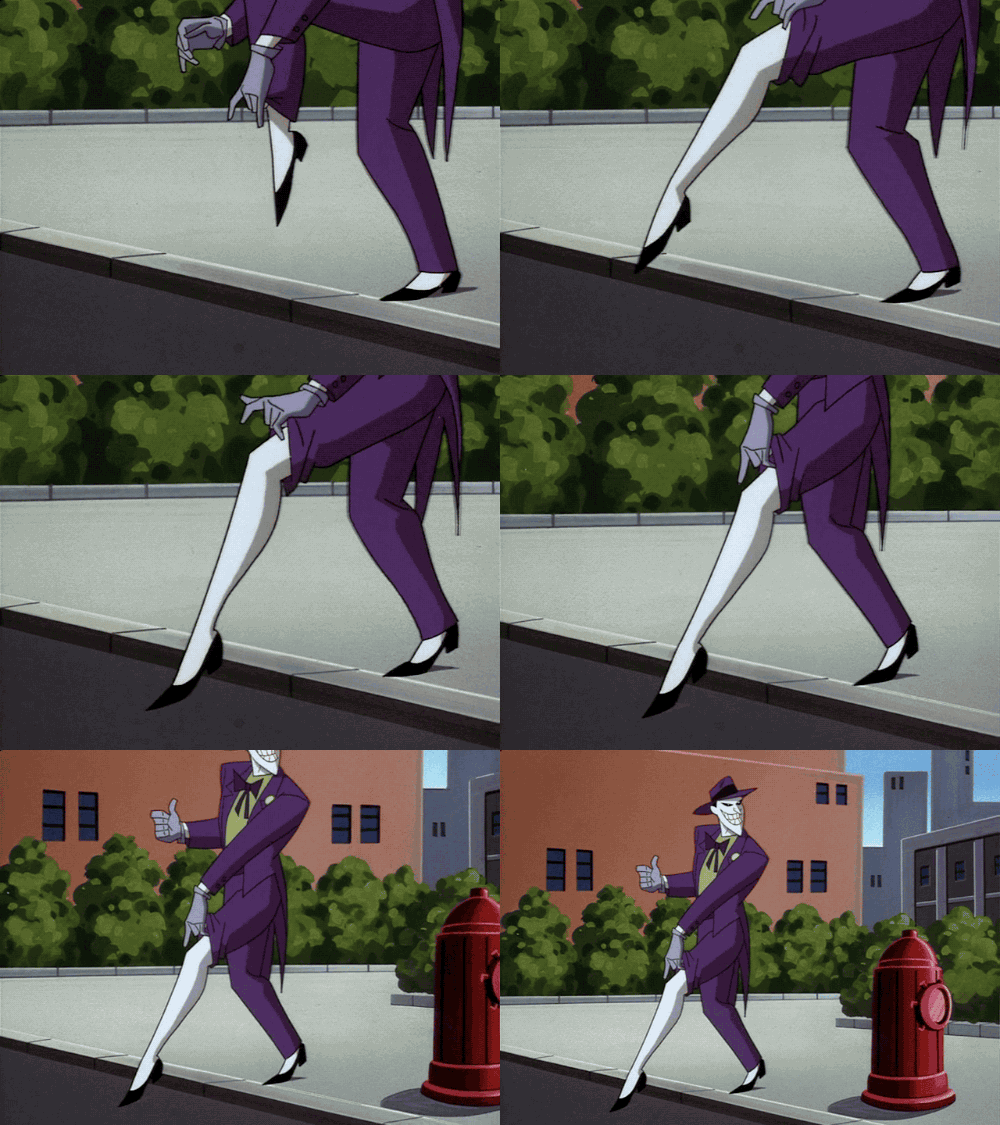
Boomer: I’m always curious how other people interpret the Batman/Robin relationship, especially with regards to the appropriateness (or not) of the Robin costume in general. In general, the Robins are young, generally getting started at the cusp of adolescence. For me, though, my first and still-primary image of Robin is of the character as played by Burt Ward in the classic, campy 1960s Adam West era. That costume was the classic, hot pants version, although Ward was given a pair of nude hose to wear, and it was an awakening for young Boomer. (It’s worth noting that Yvonne Craig’s Batgirl outfit was far slinkier and more intentionally titillating despite covering the entirety of her body.) The next Robin to come along was in Batman Forever, when I was eight years old, and that one also leaned hard into the “sexy Robin” template, and that was only more of an eye-opener. Robin was rarely present in the animated series when I watched it as a kid, and even his first appearance, in the episode “Fear of Victory” (aired 09/29/92), firmly established him as being a college student. Given that Ward was 21 in 1966 when he donned that cape and those ridiculous elf boots and that Chris O’Donnell was 25 in Forever, I never conceived of Robin as being all that young until I got older and started reading comics, at which point Dick Grayson was already active as Nightwing, Jason Todd was dead, and even Tim Drake was presented as being in his late teens; it wasn’t until Damian Wayne was retconned in that there was ever a child Robin in anything that I read. As such, I never read his costume (or relationship with Batman) as being exploitative until later in life, when thinkpieces about the inappropriateness of Robin went through a period of fad intensity. As someone trapped within the horizon of his experiences with the text, I have to admit that I can see how others would read the mentor/ward hero/sidekick relationship as inappropriate or exploitative, I prefer to reject that interpretation, although I admit that part of that is just to keep my Robin crush, developed in childhood toward older actors, intact— without it getting creepy or weird. On the other hand, if finding the subversiveness in everything is your cup of tea, the Venture Brothers episode “Handsome Ransom” inspects that issue with the creators’ trademark acerbic iconcolasm, with Batman TAS voice actor Kevin Conroy (my Batman) in the role of Captain Sunshine, a Superman expy with… questionable predilections.
Brandon: Alli’s criticism of Batman as “a rich guy who takes to streets he’s not even that familiar with to throw people into a prison system that seems even less effective and ethical than the real life American one.” immediately reminded me of a recent SNL sketch about Bruce Wayne being confronted by the community he supposedly protects. The sketch, titled “Wayne Thanksgiving,” is a quick, hilarious watch that feeds directly into the questions of Batman’s political ethics discussed in the conversation above. I highly recommend giving it a look:
Upcoming Movies of the Month
June: Alli presents Gates of Heaven (1978)
July: Brandon presents Born in Flames (1983)
August: Britnee presents Blood and Donuts (1995)
-The Swampflix Crew