Pam Grier’s Undervalued Career in Witchcraft & Voodoo

I often complain about how much of a shame it is that there are two Pam Grier In Space movies and they both suck. One of the all-time great personalities in genre filmmaking, Grier deserves so much better than the likes of the late career Eddie Murphy comedy The Adventures of Pluto Nash and the nu metal era John Carpenter misfire Ghosts of Mars. If we’re only going to launch Grier’s visage into space twice in her career, she deserves a fate far more badass. It turns out, though, that her out-of-orbit sci-fi career isn’t even the most frustrating undercutting of her genre film potential. What’s even worse is the way Grier’s few performances as a witch or a Voodoo priestess have been deflated & underserved, when the idea of a Pam Grier Witchcraft picture should be instant B-movie gold. It’s not even that the movies where Grier dabbles in the art of magic are bad; they’re actually quite enjoyable. It’s that they don’t deliver the full power & glory that a Witchy Pam Grier should be able to command with ease.

My frustration with this witchy deficiency began with our current Movie of the Month, the Ray Bradbury-penned 1983 Disney horror Something Wicked This Way Comes. In the film, Pam Grier plays The Dust Witch, a mostly silent agent of dark magic who commands immense power & beauty, but isn’t given nearly enough to do as a character when compared to her overlord, Mr. Dark. Grier elevates every scene she’s in with just her mere presence. An image of her in a white veil overlayed with flying shards broken glass is just as intense & effecting as any of Mr. Dark’s fervent monologues. Still, it’s a shame that for an actor who had proven before in films like Foxy Brown & Coffy that she could hold down a picture on her own, there was no room in the film’s dialogue for her badass, attention-grabbing voice. I love the witchy image Grier strikes in Something Wicked; watching her collect souls of hapless male victims while adorned in gold paint & black lace is enough to get me excited for her performance. It’s just frustrating that she isn’t given much to do outside that physical presence. I would have readily traded all of the film’s other pleasures to watch a movie centered entirely on The Dust Witch instead.

It turns out that wasn’t the first or last time Grier’s career in magic would be undercut. The only other time the actor appeared in a straightforward horror picture, ten years before her appearance in Something Wicked, she was cast as a Voodoo priestess named Lisa Fortier. Scream Blacula Scream, the 1973 sequel to the popular blacksploitation horror Blacula, opens with Grier, as Lisa, preforming a Voodoo ritual on her recently deceased mentor. According to other characters in the film, “When it comes to Voodoo, Lisa has more Natural Powers than anyone in the past ten years.” It’s instantly believable. Lisa’s study of the “extremely complex science of Voodoo,” which she treats with the proper reverence as a religious faith, is unquestioned, making her the most obvious candidate to replace her local sect’s recently deceased high priestess. Unfortunately, one of her fellow practitioners wants to jump the line of succession and raises Mamuwalde (Blacula, for the laymen out there) from the dead to get her out of the picture. The plan backfires, obviously. Mamuwalde builds a new little vampire coven, inducting nearly everyone he meets into his mind slave army, everyone except Lisa. Recognizing her power & beauty, Blacula instead ropes Lisa into performing a ritual to cure him, a ceremony that’s broken up by the cops, who he promptly murders much to Lisa’s horror.

Scream Blacula Scream should be the perfect vehicle for delivery on a Pam Grier With Magical Powers premise, but somehow her Voodoo priestess practices are just as undercut here as they are in Something Wicked. As Lisa, Pam Grier commands a quiet strength & skepticism that perfectly matches the movie’s oddly quiet, somber tone. Outside a scene where she’s walking arm in arm with Blacula like a power couple and the final, interrupted Voodoo ritual to kill him (which looks like the standard dolls, candles, and chants image you’d expect), however, she isn’t given much to do in way of practicing her craft. This is Blacula’s film, after all. The best Lisa could do is wait for her climactic ceremony to test her skills, a scene that isn’t even allowed to fully play out.

A better-realized version of Pam Grier’s brief career as a Voodoo priestess would have had her waging a supernatural war against a foe like Blacula instead of meekly attempting to serve him from a victim’s position. There was a moment in the early 90s where that dream more or less came to life, but it unfortunately served a platform much less prestigious than a live action Disney horror or even a blacksploitation horror sequel. Grier appeared again as a Voodoo priestess in an episode of the syndicated horror anthology television series Monsters, a direct descendant of Tales from the Darkside. In the episode “Hostile Takeover” a business dick attempts to take the Reagan-coined term “Voodoo economics” literally, by employing Grier’s priestess to help him cheat his way to the top. Like all EC Comics/Tales from the Crypt descendants, this thirst for power obviously comes with a price and he’s ultimately punished at the hands of the demon Grier’s priestess worships. Here’s where Grier gets to really practice magic, having great fun with the power she visibly commands. She drinks a white businessman’s blood, forms a pact with an all-powerful demon, sends faxes from beyond the grave, hacks computer screens through the power of her Voodoo, etc. The only shame is that the product this witchy Pam Grier free for all serves is sadly short & embarrassingly cheap. Grier only appears in a couple scenes in this Monsters episode and although she looks badass smoking a cigar in the Party City Voodoo priestess costume they afford, even she can’t elevate the show’s Are You Afraid of the Dark?-level budget, it might just have been the Witchy Pam Grier project of my dreams.

Something Wicked, Scream Blacula Scream, and “Hostile Takeover” are all enjoyable genre fare. Even though her power is undercut in all three instances, watching Pam Grier practice witchcraft & Voodoo is a large part of their fun. It’s just frustrating in each case that her power wasn’t put to better & more prominent use. The good news is that Grier is still working. She seems to have mostly moved on from the genre film roles that defined her career in the 70s & 80s, mostly playing police detectives now, but she’s still out there. If there’s even a small chance that the magic potential Grier showed as The Dust Witch could be developed in a much better realized Witchy Grier project, I’m going to keep the hope alive. Her brief forays into witchcraft & Voodoo have created an itch I didn’t even know I had, but I’ve yet to find a movie that satisfactorily scratches it.

For more on July’s Movie of the Month, the Ray Bradbury-penned Disney horror Something Wicked This Way Comes, check out our Swampchat discussion of the film, this look at its Bette Davis-starring predecessor The Watcher in the Woods (1980), and last week’s comparison to Bradbury’s other suburban horror feature adaptation, The Halloween Tree (1993).

-Brandon Ledet

Roger Ebert Film School, Lesson 31: GoodFellas (1990)

Roger Ebert Film School is a recurring feature in which Brandon attempts to watch & review all 200+ movies referenced in the print & film versions of Roger Ebert’s (auto)biography Life Itself.

Where GoodFellas (1990) is referenced in Life Itself: On page 157 of the first edition hardback, Ebert explains his general taste in cinema. He writes, “Not all good movies are about Good People. I also like movies about Bad People who have a sense of humor. […] Henry Hill, the hero of GoodFellas, is not a good fella, but he has the ability to be honest with us about why he enjoyed being bad. He is not a hypocrite.”

What Ebert had to say in his review(s): “Most films, even great ones, evaporate like mist once you’ve returned to the real world; they leave memories behind, but their reality fades fairly quickly. Not this film, which shows America’s finest filmmaker at the peak of his form. No finer film has ever been made about organized crime – not even The Godfather, although the two works are not really comparable.” -from his 1990 review for the Chicago Sun-Times

“What Scorsese does above all else is share his enthusiasm for the material. The film has the headlong momentum of a storyteller who knows he has a good one to share. Scorsese’s camera caresses these guys, pays attention to the shines on their shoes and the cut of their clothes. And when they’re planning the famous Lufthansa robbery, he has them whispering together in a tight three-shot that has their heads leaning low and close with the thrill of their own audacity. You can see how much fun it is for them to steal.” -from his 2002 review for his Great Movies series

Whenever pressed for my Favorite Movie of All Time, my answer tends to flip flop between Paul Thomas Anderson’s Boogie Nights & Martin Scorsese’s GoodFellas. Neither answer is especially bold or indicative of my general tastes. They’re both massively popular titles with wide appeal. Still, they’re the two films I revisit most frequently and the two I think best exemplify everything cinema can be: terrifying, erotic, hilarious, gorgeous, musical, etc. Arriving years later than GoodFellas, Boogie Nights certainly pulled a lot of influence from Scorsese’s gangster magnum opus: absurdly complex tracking shots, sensual immersions in pop music indulgence, a narrative structure that posits the 1970s as a glorious time of hedonistic excess & the 1980s as dark times of cocaine-fueled downfall, etc. That more or less makes GoodFellas the birthplace of what I love most about modern cinema and, thus, leaves me no choice but to shamelessly gush without criticism whenever prompted to discuss it.

Scorsese reportedly wasn’t interested in making another organized crime picture after the early effort Mean Streets already covered what he wanted to say on the subject. Reading the Nicholas Pileggi book Wiseguy: Life in a Mafia Family on the set of The Color of Money completely turned him around on the idea. The book’s sweeping, decades-spanning look at how the Italian mafia operated on both a generational/cultural level and on a day-to-day operations basis inspired him to want to tell a mafia story that plays “like a two and a half hour trailer.” The result is a lyrical sense of pacing that both moves from the 50s to the 80s with the patience of a flood and freezes still for intimate moments of violence & tension when the situation calls for it. I could easily see that same “two and a half hour trailer” Scorsese quote being turned around on the film as an insult, but for me it’s pure pop cinema bliss. GoodFellas evolves the French New Wave influences that excited New Hollywood auteurs in the early 70s into an entirely new, powerful beast. It sets in motion a near-undetectable shift in cinematic language that feels Citizen Kane-esque in the way it wasn’t immediately appreciated, but informed everything that followed in its wake.

Although GoodFellas follows dozens of characters over the span of four decades, it’s solidly anchored by its narrator & POV character Henry Hill, modeled after a real life mobster by the same name. The story begins with adult Hill (played by a career-high Ray Liotta) opening the trunk of a car to stab & shoot a wriggling victim inside who had been annoying him & his two closest cohorts (played by Robert De Niro & Joe Pesci) with their pathetic cries for help. As this motley crew mercilessly ends their victim’s life, Liotta intones, “As far back as I can remember, I always wanted to be a gangster.” Scorsese does almost too good of a job of communicating exactly why someone would want to join the violent world of organized crime. The film follows Hill from his powerless youth as the son of Irish & Italian immigrants to his godlike power as an adult gangster with two mistresses and an endless network of untouchable killers who have his back. Scorsese also gets across the pitfalls of burning that fast & bright, as well the ugliness of a life in crime in general: the murders, the drug addiction, the paranoia of police scrutiny, the casual racism, etc. Coppola’s The Godfather trilogy may attempt a more ambitious summation of mafia culture in its endless scope & runtime, but the way GoodFellas boils that same subject down to its most essential pleasures & tragedies in just over two hours is far more miraculous in both its efficiency & its moment to moment effect.

Scorsese declared that he wanted to model GoodFellas‘s overall style after the New Wave classic Jules and Jim, especially in its narration, quick cuts, freeze frames, and wide variety in setting. He was deliberately attempting to overwhelm his audience with the intoxicating allure & apocalyptic downfalls of a life in crime. This effect can be achieved with the odd power of the tracking shot from NYC streets to the front row table at the Copacabana nightclub. It can be built through a thirty minute exercise in Hitchcock-flavored tension as narcotics officers close in on Henry Hill’s drug-running empire, It can also burst out quickly in a pop music montage that reveals an extensive line of dead characters disposed of without ceremony. From the giallo purples & reds of the nightclub lighting to Liotta’s constant narration commanding the pace with meticulous control, GoodFellas feels like Scorsese’s attempt to throw everything he knows about cinema at the screen in every single shot. Much like its well-balanced soundtrack (featuring artists like The Ronettes, The Shangri-Las, Cream, and The Rolling Stones), GoodFellas feels like a Greatest Hits collection of cinematic techniques, perfectly curated so the album only feels more charming on every revisit instead of making you long for the sources it borrowed from.

Besides its eclectic, immaculate approach to craft behind the camera, GoodFellas also boasts some of cinema’s all-time best dramatic performances. As the centerpiece, Liotta obviously commands a lot of attention, especially with his maniacal laugh & coldly brutish readings of lines like, “Everybody takes a beating sometimes,” and “Fuck you, pay me.” Although she isn’t afforded nearly as much time in the spotlight, Lorraine Bracco’s role as Henry’s wife, Karen Hill, is occasionally allowed to overpower his perspective with her own narration. She does a great job of getting across the allure of being married to a mobster (“I gotta tell the truth, it turned me on,”) as well as directly vocalizing Scorsese’s intent to leave the audience feeling dizzy or drunk. Mobsters with names like Frankie No-Nose & Jimmy Two-Times round out the rest of the cast, but only De Niro’s mentor-turned-bully & Pesci’s loose cannon hothead threaten to steal the show. Pesci, in particular, lends credence to Scorsese’s claim that in-character ad-libs guided rewrites of the script. Whether delivering lines like “Fuck ’em! Fuck ’em in the ear,” or lightly ribbing his mother (played by Scorsese’s real life mother Catherine Scorsese) over her mediocre painting skills, Pesci feels like he fully embodies the character. In fact, the entire cast feels like they were born to play their respective roles, which might help explain why (most of) their careers have felt relatively lackluster since.

Although it certainly traffics in populist cinema waters, GoodFellas has a natural divisiveness to it, possibly in part because of its omnipresent narration & deliberately overwhelming pace. The film feels now as if its legacy as an all-time classic is solidified, but there were multiple walkouts during its test screenings & the only Oscar it won from its six (mostly technical) nominations was for Joe Pesci’s performance. I do not have the critical ability to step outside of myself and consider its flaws. My admiration for it only grows in every revisit and I love getting swept up in its crushing flood of pure cinema bliss. The only film I could maybe claim better delivers on its exact formula is Boogie Nights, but that’s a point I flip flop on as often as I revisit either work individually. GoodFellas might just be the best the medium has to offer.

Roger’s Rating (4/4, 100%)

Brandon’s Rating (5/5, 100%)

Next Lesson: The Marriage of Maria Braun (1979)

-Brandon Ledet

Dunkirk (2017)

I sometimes complain about missing an essential Dad Gene that would enable me to care about certain traditional macho movie genres: Westerns, submarine thrillers, James Bond entries, etc. I’m not faced with the pressure to watch any other subcategory of these Dad Movies nearly as often as I am with The War Movie. Films about battleground warfare, especially set during WWII or The Vietnam War, tend to put me to sleep. There’s a grim, heroically macho routine to battlefield dramas & thrillers that typically makes them feel indistinguishable from one another, like a sea of uniformed soldiers solemnly marching in unison. Christopher Nolan’s recent war thriller, Dunkirk, broke that spell and made me question my Dad Movie prejudice. Dunkirk feels much more like a personal obsession with the story of a single historical event than yet another echo of the war movie genre trappings that dull down so many of its peers. I’m usually unable to distinguish any particular World War II battlefield picture from the long, uniformed line that marched before it, but Nolan’s auteurist interests in things like time, intense sound design, and muted performances from actors like Tom Hardy & Cillian Murphy make Dunkirk feel like a wholly new, revitalizing take on the genre. Instead of checking my pulse for signs of life at the top of the second act, I found myself holding my breath in anxious anticipation throughout, due largely to Nolan’s technical skills as a craftsman and, in a recent turn starting with Interstellar, personal passion as a storyteller.

Dunkirk dramatizes a colossal military disaster where 40,000 French & British heroes & cowards awaited rescue on a beach while surrounded by the German enemy in World War II. With a massive cast & sparse dialogue, Nolan does little to provide character detail for any of these thousands of soldiers, but rather tells their story as a massive unit. Even actors like Murphy, Hardy, Kenneth Branagh, Mark Rylance, and pop star Harry Styles, who all should individually draw attention through the virtue of their mere presence, are but tiny gears in a larger machine that sounds & functions like clockwork, ticking away until the enemy bombs them out of existence. Nolan fractures this larger narrative through three narrow focus storylines: a two man beachside escape mission that lasts a week, a three man boat ride that lasts a day, and a two man airplane skirmish that lasts an hour. These three narratives barrel towards an inevitable point of convergence: a historical event where private vessels & fishing boats were employed to rescue soldiers from the beach, since all traditional Navy ships were being sunk by the enemy. Although Nolan tells this story through a precise, coldly technical build-up of moment to moment tension, he takes a breath to glorify this triumph of The Dunkirk Spirit in a rare stint of nationalistic pride. When the tiny pleasure yachts roll in to Bring Home the Boys under the German’s noses, Branagh admires their bravery in silence, nearly holding back a single manly tear as if it were Nolan himself watching the waters. It’s possibly the only moment of relief offered in Dunkirk‘s entire runtime, a much needed breather in an otherwise tense, relentless chokehold.

Besides Nolan’s typifying play with the film’s sense of time & a bold decision to never depict the enemy onscreen, Dunkirk also avoids war movie doldrums by echoing the structure of near-plotless obstacle course movies like Gravity or Mad Max: Fury Road. All that really matters is clearing the next hurdle. Whether searching for drinkable water & smokable cigarette butts in city streets or avoiding drowning inside of a ship that is both sinking & on fire, Nolan’s camera follows his soldiers & their civilian saviors as they conquer one obstacle at a time. This makes for an entirely nerve-racking experience from opening to closing credits, an intensity amplified by Hans Zimmer’s sparse, haunting score of ticking clocks & building strings. This score is only softened when the complex sound design is overwhelmed by sudden, deafening air raids that leave all soldiers ducking & praying for survival at irregular intervals. Nolan mirrors the impossible technical feat of rescuing that large of a number of soldiers on a fleet of tiny civilian vessels by staging his own series of aurally terrifying, temporally ambitious, and brutally logical technical feats of filmmaking & narrative craft. The anticipatory feeling of seeing the film on a 70mm print opening night felt more like an Event or an Experience than a typical trip to the movies. It was something akin to a film fest vibe (although with a notably more bro-populated crowd), but it also reminded me of waiting in line for a rollercoaster. Dunkirk is a quick, dizzying trip through pure adrenaline thrills & for-their-own-sake technical marvels. It gives you little time to attach yourself to any one character or narrative in particular, but the complexities of its basic structure & overall effect are so impressive that it never really matters.

The few isolated beats where I wasn’t fully onboard with Nolan’s vision were when he did attempt to stir emotion instead of building tension. That scene where Branagh admires the civilian volunteers’ makeshift rescue efforts while the ticking clocks score gives way to triumphant orchestral strings reminded me so much of the war movies that typically do nothing for my shriveled, cynical heart. Those moments are few & far between, however. Dunkirk mostly mines tension from an increasingly complex series of moment-to-moment tasks spread out over sea, sky, beach, and several converging timelines. To deny the power of the film’s technical feats because of its lacking emotional impact or detailed character development would be asking it to be something entirely different from the story Nolan set out to tell. As someone who has an impossible time focusing on the particulars of battlefield drama in more traditional war stories, I very much appreciate Nolan’s approach here. It’s likely that he personally found much more emotional resonance in the film than most of his audience possibly could, but the experience of watching him reach for that emotion in his tightly controlled, meticulous recreation of wartime chaos is as immediately impressive as it is likely to be unforgettable.

-Brandon Ledet

Deathrow Gameshow (1987)

I’m a huge sucker for dystopian gameshow cinema, so my appreciation for Deathrow Gameshow might very well be entirely dependent on genre. There’s nothing particularly special about this mid-80s sci-fi cheapie that you couldn’t find in titles like The Running Man, Death Race 2000, The Hunger Games, or Nerve in terms of dystopian world-building or slick production design. Deathrow Gameshow even sidesteps the genre’s usual adherence to liberal, anti-authoritarian politics to sympathize & laugh along with the abusers in power, which seems like the exact wrong way to go about making one of these things. Still, I couldn’t help but take delight of some of the Killer Gameshow from the Future surface pleasures of the film’s premise because the genre territory it occupies is so instantly appealing to me. As the film went along, I even started to appreciate the way its disgusting Reagan era politics & sadistic black humor helped distinguish the work from its genre peers, even if by being spiritually repugnant.

In the not too-distant future of1991, a game show titled Live or Die executes prisoners for captivated audiences’ afternoon television entertainment. Deathrow inmates sign waivers to appear on the show, where they answer trivia questions or complete simple (but rigged) tasks in the hopes of winning prizes. The cost of an incorrect answer or a job half done is a televised execution – by guillotine, by electrocution, by explosion, by whatever keeps eyes glued to the television. The show is wildly popular, with citizens committing crimes for the opportunity to appear as contestants & family members of the executed cheering on their death for brief fame or small prizes. Live or Die does have its critics, though. Protestors gather in the streets holding signs saying the host “should be aborted.” There’s also, of course, people out to kill the host themselves to avenge lives he’s ended on air for personal profit. What’s weird is that we’re asked to sympathize with the sick, oppressive fuck instead of his portrayed-as-whiny detractors. Instead of watching him suffer under the weight of his own societal sins like, say, James Woods’s similar sleaze bag in Videodrome, we’re supposed to be invested in his spiritual growth as he’s threatened punishment, but ultimately gets out on top. That might be a result of the film’s dedication to comedy instead of horror or dystopian sci-fi, but it is a striking deviation from how these things usually go nonetheless.

Besides aligning audience sympathies with its selfish sleaze bag gameshow host, Deathrow Gameshow also disgusts in the targets of its misanthropic humor. This film takes jabs at “militant” feminism, makes casual references to prison rape & domestic violence for easy “humor,” and is convinced that the mere mention for homosexual desire is the height of hilarity. It’s also worth mentioning that although there’s diversity in its deathrow prisoner population, the only black characters represented onscreen are violent criminals. The film wholly & cruelly commits to a Reagan-era sense of Fuck You, I Got Mine selfishness, but in a way that almost works to its advantage. Even if its goal was to make me laugh with its cruel sense of punching down humor, the way those gleeful stabs at political incorrectness land make me recoil in horror, which in a way heightens the effect of its premise. This is a crass film with a complete absence of a moral center, but that kind of Money > Empathy sentiment fits its killer gameshow premise surprisingly well. I’m not sure the effect was entirely intentional, but the discomfort certainly makes for a memorable, authentically horrific viewing experience.

That’s not to say all of Deathrow Gameshow’s humor amounted to empty cruelty, though. I got a chuckle when one of the Live or Die contestants wins death by hanging as a gameshow prize, only for a The Price is Right-type announcer to declare, “Every man dreams of being well hung.” It’s not a particularly smart or inventive joke, but it’s well told, much like other gags where a secretary is caught masturbating or a rolled-up car window reads the message, “Blow it out your ass.” Everything in Deathrow Gameshow fits in one of two categories: sex or violence. Sometimes that 80s-era lizard brain idiocy can be amusing, like when an assassin, portrayed by an actor known simply as Beano, chows down on a whole mess of spaghetti while casually discussing murder. Sometimes it can be deflating, like when a character calling a woman coded to be a Feminist “a stupid bitch” is supposed to be a knee-slapper of a punchline.

There are some stranger, non-comedic touches to Deathrow Gameshow too: prisoners only being referred to as numbers, television advertisements for sex work, a nightmare sequence being rigidly blocked off like a movie trailer, a character justifying the show’s murder for entertainment ethos by explaining, “Life is a transitional state and Death is God’s way of saying ‘Take a Break.’” The movie’s just a little too compromised in its spiritually corrupt humor & underwhelming in its world-building ambition to award a hearty recommendation. I don’t mean to besmirch the good name of filmmaker Mark Pirro, whose other titles include Nudist Colony of the Dead, A Polish Vampire in Burbank, and Curse of the Queerwolf, but I’m not sure he was the best person to tackle the material. While Pirro’s grimy, off-putting sense of humor did provide the film a memorably sleazy, discomforting vibe, it’s a property that could’ve been an all-time classic in the more ambitious hands of The Canon Group or maybe Roger Corman’s crew. As is, Deathrow Gameshow is entertaining enough in its lighthearted approach to cruel, meat-headed exploitation cinema. It’s just difficult to shake the feeling that it could’ve been something more worthwhile.

-Brandon Ledet

Funeral Parade of Roses (1969)

One of the most frustrating deficiencies in queer cinema, besides there just not being enough of it in general, is that much of it is far too tame. Bomb-throwers like John Waters, Jonathan Cameron-Mitchell, and early-career Todd Haynes are too few & far between (a direct result of a heteronormative industry that’s stingy with its funding, no doubt), so most queer cinema is typified by safe-feeling, Oscar-minded dramas about death & oppression. It’s always refreshing to find a film that breaks tradition in that way, while also breaking the rules of cinema in general. We need to see more queer artists given the funding needed to push the boundaries of the art form, lest the only onscreen representation of queer identity be restricted to sappy, depressing, sexless bores. I can probably count on one hand the films that have satisfied that hunger we’ve covered since starting this site over two years ago. Tangerine, Paris is Burning, and Vegas in Space all come to mind, but feel like rare exceptions to the rule. That’s why it was so refreshing to see a queer film as wild & unconcerned with cinematic convention as Funeral Parade of Roses restored & projected on the big screen. Even half a century after its initial release, it feels daring & transgressive in a way a lot of modern queer cinema unfortunately pales in comparison to.

Part French New Wave, part Benny Hill, and part gore-soaked horror, Funeral Parade of Roses is a rebellious amalgamation of wildly varied styles & tones all synthesized into an aesthetically cohesive, undeniably punk energy. Shot in a stark black & white that simultaneously recalls both Goddard & Multiple Maniacs, the film approximates a portrait of queer youth culture in late-60s Japan. Referred to in the film’s English translation as “gay boys,” its cast is mostly trans women & drag queens who survive as sex workers & drug dealers in Tokyo. Their story is told through techniques as wide ranging as documentary style “interviews” that include meta commentary on the film itself & high fantasy fables that pull influence from Oedipus Rex. Although there is no traditional plot, the character of Eddie (played by Pîtâ) becomes our de facto protagonist as we watch her rise above the ranks of her fellow sex workers to become the Madamme of the Genet (a lovely Our Lady of the Flowers reference, that). Becoming the figurehead of a queer brothel obviously invites its own set of unwanted attentions & potentials for violence, which ultimately does give Funeral Parade of Roses an unfortunately tragic air. So much of the film is a nonstop psychedelic party, however, that this classic “road to ruin” structure never really registers. All shocks of horrific violence & dramatic tension are entirely offset by an irreverently celebratory energy that carries the audience home in a damn good mood, no matter what Oedipal fate Eddie is made to suffer.

Plot is just about the last thing that matters in this kind of deliberately-fractured art film, though. Much like the Czech classic Daisies, Funeral Parade of Roses finds all of its power in the strength of its imagery and the political transgression in its flippant acts of rebellious pranksterism. Eddie & her sex worker crew hand out with pot-smoking beatniks (whom Eddie deals pot to, conveniently), whose soirees often devolve into psychedelic dance parties staged before an almighty Beatles poster. They admire performance art war protests in the streets. Their out-of-character interviews & in-the-moment narratives are often disrupted by dissociative images like a rose squeezed between ass cheeks or cigarette ash emerging from a family portrait photograph. Whether picking girl gang fights with other groups of women at the mall or simply applying false eyelashes & lipstick in mirrors, everything Eddie & the girls get into is treated as an artful, politically subversive act. In a way, their mere existence was politically subversive too, just as the public presence of transgender people is still somehow a hot button political topic today. Funeral Parade of Roses often undercuts its own visual experimentation by laughing at the culture of Art Film pretension trough nonsensical asides or by using the tune of “The More We Stick Together” to score its pranks & transgressions. Its most far out visual flourishes or most horrific moments of gore will often be interrupted by a shrugging “I don’t get it” interjection from a narrator or side character. It’s consistently just as funny as it is erotic, horrific, and visually stunning, never daring to take itself too seriously.

The only real bummer with Funeral Parade of Roses is that the exploitation film morality of its era means that Eddie must suffer some kind of downfall by the film’s final act. The movie undercuts that classic-tragic trajectory by marrying it to Oedipal narratives & interrupting it with tongue-in-cheek tangents of meta commentary, but it still gets increasingly exhausting over the decades that nearly all queer films have to end with that kind of tragic downfall, as if it were punishment for social or moral transgressions. It’s likely an unfair expectation for Eddie to come out on top as the Madame of the Genet in the context of its era. You can feel a progressive rebelliousness in its street interviews where trans women dodge aggressive, eyeroll-worthy questions with lines like, “I was born that way,” or “I’m really enjoying myself right now.” What’s even more forward-thinking are the film’s lengthy, sensuous depictions of queer sex. The film’s sexual content doesn’t do much to push the boundaries of R-rating eroticism, but its quiet passion & sensuality erase ideas of gender or sexual orientation, instead becoming simple depictions of flesh on flesh intimacy. Both this genuinely erotic eye for queer intimacy and topical references to still-relevant issues like street harassment, teenage homelessness, parental abuse, and transgender identity make Funeral Parade of Roses feel excitingly modern & cutting edge, despite its aggressively flippant attitude & last minute tragic downfall.

Funeral Parade of Roses starts with a wigged female figure softly, appreciatively kissing its way up a naked man’s body. Somewhere in its second act it captures a psychedelic dance party initiated by an LSD dropper, seemingly mounted to the camera. It ends in a bloodbath, the chocolate syrup density of black & white stage blood running thick across the screen. Everything in-between is a nonstop flood of 1960s queer cool, from political activism to Free Love sexual liberation to flippant approximation of Art Cinema aesthetic. I wish more movies being made in the 2010s, queer or otherwise, were half as adventurous or as unapologetic as this transgressive masterwork. It’s not only the best possible version of itself, but also a welcome glimpse of a convention -defiant realm most films would benefit by exploring. To say Funeral Parade of Roses was ahead of its time is a given. In fact, I’m not sure its time has even arrived to this date. I hope it will soon, because I could happily watch a thousand more pictures just like it.

-Brandon Ledet

Poison (1991)

It’s a goddamn shame the world has not been treated to more Todd Haynes features. Although the director has a follow-up to his recent critical hit Carol already on its way, the near-ten year gap between Carol & its predecessor, I’m Not There., is alarming, to put it lightly. At the same time, though, it’s actually something of a miracle that Haynes has had a career at all. I’d count works like Velvet Goldmine & Safe among the greatest films I’ve seen in my lifetime (or they at least felt that way when I first saw them in high school), but it’s shocking that the director was even able to get them made, much less turn their minor indie world successes into more mainstream-friendly dramas like Carol or Far from Heaven. How is a director widely known for making an unsanctioned Karen Carpenter biopic with an all-Barbie doll cast or a pansexual glam rock opera that implies a rumored  romantic affair between Bowie & Iggy still around & pulling funding from prestigious, Oscar-worthy dramas? I love the improbability of his career. It’s an absurd unlikelihood that dates at least as far back as his first feature film, a fractured anthology about queer anxiety that somehow pulls influence from both 1950s drive-in creature features & Jean Genet’s Our Lady of the Flowers. Todd Haynes has always been a movie industry anomaly, a fact proven by that debut somehow winning the Grand Jury Prize at Sundance the year of its release.

Poison is an interwoven tryptic of three separate narratives. One story is a documentary shot in lurid Douglas Sirk colors about a young, constantly bullied boy who “murders his father and then flies away.” Another details unspoken homosexual desire between two 1940s prisoners that grows increasingly violent the longer it’s ignored. The third, most oddly lighthearted story, is a parody of 1950s B-pictures where a scientist accidentally consumes his own “sex drive serum” and becomes a monstrous, lethal leper. These stories might feel entirely disharmonious at first glance, even ranging from black & white to dull color to full Douglas Sirk indulgences in visual richness. However, they are each tied together by an expression of queer anxiety. Childhood bullying, living closeted, unexpressed desire, and the menace of HIV/AIDS inform so much of the film’s unspoken conflict that its context as a work of pure queer anxiety cannot be ignored. It’s felt as soon as the opening quote exclaims, “The whole world is dying of panicky fright” and never lets up as its three stories concurrently barrel towards their unavoidably sour ends. What’s most bizarre is the way Haynes can play this anxiety for varied effect. Sometimes hilarious, sometimes shockingly brutal, and often trafficking in the delicate, distilled imagery of a Guy Maddin picture, Poison’s intent & effect is a scattered, but consistently fascinating mess of anxious expressions of queerness.

As with a lot of first time features, this is a film that wears its influences proudly on its sleeve. It’s jarring how widely ranging Haynes allows those influences to be, though, touching on everything from John Waters & Roger Corman to Jean Genet & James Bidgood. I’m not sure you can detect the eventual greatness Haynes would eventually synthesize these influences into in titles like Velvet Goldmine, but it’s so much fun watching him clash them against each other in this fractured anthology piece. Poison is recognizably the work of a young, enthusiastic, queer man aching to unleash his weirdo sensibilities on the movie world at large. I find it both improbable & delightful that he’s been rewarded for it, even if his work has been despairingly infrequent as of late. As a film, it’s difficult to deny that Poison is rough around the edges, perhaps even by design, but as a cultural object it has a kind of punk art world shakeup quality that’s easy to find infectious. At times I wished during its runtime that I could have watched any one of its vignettes play out on its own instead of the three fighting each other for air, but they worked well together as a kind of anxious artist’s statement and initiative war cry for a rewarding career that’s only gotten more delightfully improbable as the decades have rolled on.

-Brandon Ledet

War for the Planet of the Apes (2017)

After Kong: Skull Island, War for the Planet of the Apes is the second time this year I attempted to put my boredom with cinematic war narratives aside to feed my hunger for eccentric creature features. The results were moderately better on this second go. Matt Reeves’s conclusion to his Apes prequel trilogy felt like a sincerity antidote to Skull Island‘s disingenuous SyFy Channel genre film throwback, which was far more conventional than its What If King Kong Fought In The Vietnam War? premise should have allowed. Not only does War for the Planet of the Apes cover similar territory in a more satisfying way; it also adds shades of World War POW camps, the Holocaust, American slavery, and the Malcolm X/Martin Luther King Jr philosophy divide to deepen the context of its Apes vs Humans war for the planet. It takes its wartime primates premise far more seriously than Kong: Skull Island attempts to, yet somehow emerges as a notably better example of summertime blockbuster spectacle, despite the season’s usual penchant for dumb fun. Its superiority to that overpriced B-movie aside, I can’t honestly say much else in praise of War for the Planet of the Apes. It’s an interesting film & a welcome excuse to escape the heat in a dark, air-conditioned room for two hours; but its nature as a straightforward war movie & a CG spectacle franchise cornerstone never allows it to amount to anything more substantial than that.

We rejoin the talking ape Caesar, played by eternal mo-cap prisoner Andy Serkis, as he attempts to maintain peace & order among his primate followers through simple credos like “Apes together strong,” and “Ape no kill ape.” Their plans to live peacefully in the woods are disrupted by a human militia headed by Woody Harrelson, who plays a warmonger who’s seen either Platoon or Full Metal Jacket one too many times in his life. This rogue colonel refuses to accept the apes’ peaceful request to be left alone in the wilderness. He slaughters large numbers from their ranks and eventually imprisons the survivors in an isolated stronghold he converts into a primate labor camp. Caesar and the colonel grimace at each other and trade gruff lines about who started/escalated the war and who they’ve both lost along the way for as long as the movie can put off two inevitabilities: an escape plan hatched by the ape prisoners & an all-out fire fight initiated by the humans. Somewhere during this grudge match two new characters introduce themselves to the fold: a mute child who’s clumsily coded as an archetype of Innocence & a Steve Zahn-esque buffoon played by sub-David Arquette buffoon Steve Zahn. As the war rages on, the developing details of the virus engineered in the first film are gradually revealed, opening the door for a kind of decisive finality to the series. The events of the film are tightly contained to a singular conflict, but dialogue hints that the struggle is linked to a more significant global crisis we never get to see.

I’m not sure that if you swapped out the apes with a more plausible rebel group like, say, Anarchists or Socialists, that I would find that same plot all that interesting, given my general aversion to this dour wartime end of cinema. That’s not the only issue making War for the Planet of the Apes feel like a moderate-at-best success, though. The apes look great; they’re believably animated in an eerie, modern CGI rendering that recalls the Disney-funded majesty of last year’s live action Jungle Book remake. The problem is that kind of CG spectacle isn’t all that interesting in the long run. As realistic as the apes look, they’re still just slightly off in a way that’s more distracting than it likely would have been if their image were more stylized. I’m not sure there was any point during the picture where I wasn’t thinking about the quality of the special effects, which isn’t anywhere near the top of my list of cinematic priorities. That kind of summertime special effects showcase typically comes with a long line of normalizing, Major Studio requirements too. There’s an oddly conspicuous Coca-Cola ad placement involving an abandoned 18-wheeler the camera lingers on for an eternity. The movie opens with a labored text scroll that attempts to walk the audience through the plot points & the “Rise/Dawn” title confusion of its two predecessors. It attempts to head off critics’ readymade puns like “Ape-ocalypse Now” & “The Great Esc-Ape” by making those allusions itself, which feels like a Major Studio brand attempting to control the conversation instead of allowing the film to be its own weird self. The whole ordeal just feels meticulously calculated & restrained.

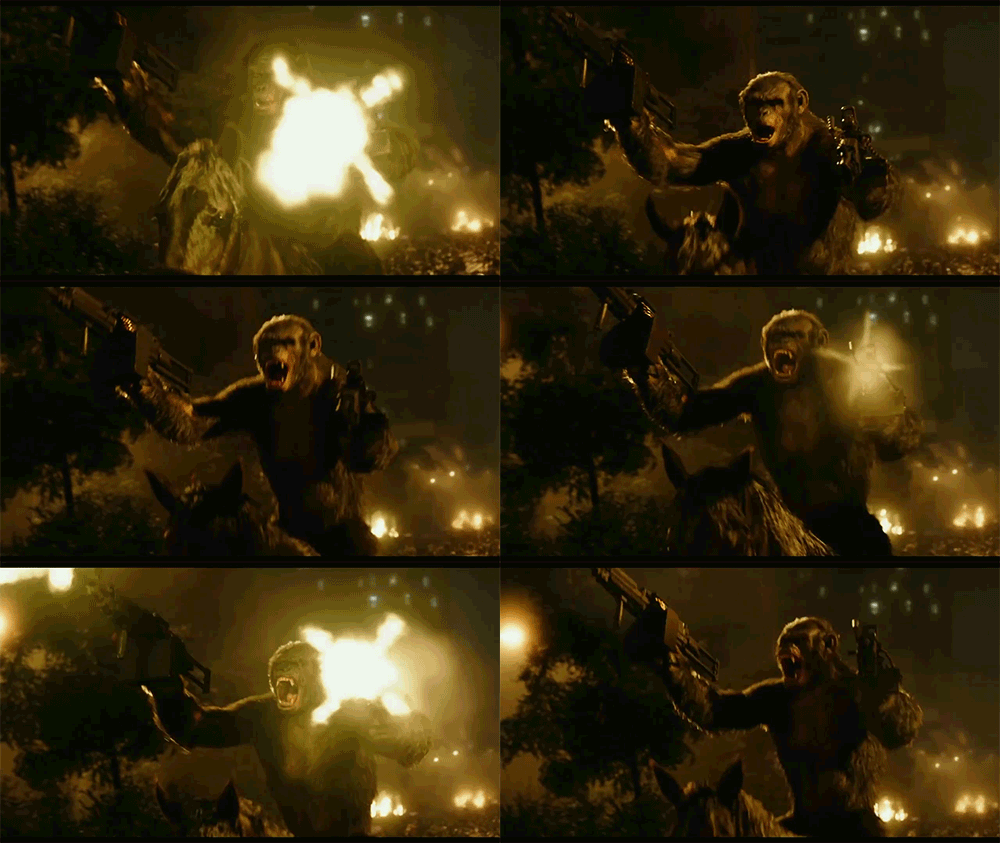
 Without question, the second entry in the Apes trilogy, Dawn of the Planet of the Apes, remains my favorite film in the franchise. There was something oddly wild & unpredictable about that film, which gifted the world one of my all-time favorite action movie images: the ape on horseback simultaneously operating two machine guns. I’m not sure there’s anything to be found in this follow-up that’s half as exciting as that image. Even Woody Harrelson’s character, who’s clearly supposed to echo Brando’s Colonel Kurtz performance from Apocalypse Now, feels fairly run of the mill for a crazed war movie villain. He nonchalantly shaves his head with a straight razor, wears sunglasses at inappropriate times, and eats apple slices off a combat knife; all of that macho posturing feels cinematically overfamiliar. By the time a Jimi Hendrix needle drop finds him listening to Vietnam War era rock alone at his boozy command station I felt as if I had already met this character a thousand times before. It was a beat that made me roll my eyes just as hard as any of Steve Zahn’s attempts to resurrect Pauly Shore humor or his silent little girl companion’s similarly cliché visual representations of Wartime Innocence (complete with tenderly earnest offers of a single flower). If it weren’t for the presence of CG apes in its central roles or the movie’s lengthy, silent stretches of sign language communication, War for the Planet of the Apes wouldn’t feel much different from any number of big budget war movies or grim franchise-closers. It’s competently made and visually impressive. It’s got a strikingly sorrowful brutality to it that helps distinguish it slightly from the other bombastic works of calculated studio bloat floating out there in the summertime blockbuster heat. Still, titles like Dawn or, better yet, Okja are exciting reminders that CG spectacle can be something much more idiosyncratic, more passionate, and more memorable than that. At least Kong: Skull Island is a fresh-on-the-mind counterpoint signaling that it also could’ve been much worse.

-Brandon Ledet

Ray Bradbury’s Return to Tormenting Suburban Children in The Halloween Tree (1993)

There’s something instantly familiar about the spooky, vintage Midwest suburbs of the Ray Bradbury-penned feature Something Wicked This Way Comes, our current Movie of the Month. Even watching the film for the first time in my 30s, I felt as if it had already been in my life forever, despite my familiarity with Bradbury’s work typically falling solidly under sci-fi, not horror. The spooky bygone suburbs of the film felt very much akin to horror movies I had grown up with as a kid, titles like Jumanji & The Monster Squads, a setting that’s been evoked & praised in so many Ebert reviews I don’t even know where to start citing them. Apparently, it’s a setting Bradbury had mentally returned to often himself, a spacial & temporal locale he had framed many of his children-targeted short stories & novels in, despite only one being adapted to a major motion picture release. Something Wicked This Way Comes does have some Bradbury-penned company in its nature as a feature length adaptation, though, just not anything with the financial backing of a live action Walt Disney production. Instead, its closest spiritual relative in nostalgic suburb horror would be a made-for-TV animated feature, a much cheaper mode of entertainment all around.

The Halloween Tree looks like an animated recreation of Something Wicked This Way Comes’s exact tone & setting, though it feels slightly behind that work in every way. Its fantasy novel source material was written in 1972, ten years behind Something Wicked’s 1962 publication date. It was produced as a late Hanna-Barbera animation, while Something Wicked was working with Disney dollars, which go a long way. Even in its central themes, which more or less amount to a history lesson on The True Meaning of Halloween, it pales in comparison to the much more complex subject matter of its predecessor, which explores intangible subjects like fear & desire. It’s difficult, then, to think of The Halloween Tree as anything but a minor work by comparison, but that doesn’t mean it’s charmless or worth excluding from the Something Wicked legacy. Bradbury himself was at least invested in the work’s value, providing a storybook-style narration for its framing device. The hand-drawn animation is much more complex than most Hanna-Barbera productions are afforded. Speaking from a personal standpoint, I’d also say it was nice to see a plot structure usually reserved for The True Meaning of Christmas applied to a holiday I actually give a shit about. The Halloween Tree feels somewhat like a scrappy echo of Something Wicked (which was something of a bomb itself), but it’s got enough of its own charm & personality to justify its existence outside that superior work’s shadow.

The spooky Midwest suburb setting The Halloween Tree shares with Something Wicked really only serves as a framing device. A group of kids preparing to trick ‘r treat on Halloween night see their sick friend’s ghost running through the woods just outside their suburb. Following his specter, they bump into a creepy old ghoul (voiced by an unrecognizable Leonard Nimoy) who seems to be threatening to claim the boy’s soul as he succumbs to appendicitis complications. In the process of bartering for their sick friend’s existence, the children are mocked for not understanding the meaning behind their various Halloween costumes: a mummy, a witch, a skeleton, etc. Chiding them, “All dressed up for Halloween and you don’t know why,” the old ghoul takes them on a temporal road trip through historical Halloween-type cultural traditions that relate to their costumes. Vignettes touching on Egyptian mummification, Stonehenge, witch trials, Día de Muertos, and so on provide meaning to the children’s various costume choices as they inch closer to saving their friend’s life through bleeding heart negotiation tactics. Much like with Something Wicked, the resolution to the threat of death is much more saccharine than the stakes appear during the conflict but the film could still potentially haunt an audience who catches it at a young enough age. The two movies’ real connection, though, is the way Bradbury makes a small crew of suburban scamps feel as if they’re the only kids in the world, saddling them with the responsibility of waging a metaphysical Good Vs. Evil battle.

To be honest, if I weren’t watching this film on Alli’s recommendation during our Movie of the Month conversation or I wasn’t aware of Bradbury’s involvement, I’m not sure The Halloween Tree would have immediately reminded me of Something Wicked This Way Comes. My mind likely would have gone more readily to Over the Garden Wall, a recent animated story that shares The Halloween Tree’s religious reverence for Jack-o-Lanterns & Halloween costuming. The similarities shared with Something Wicked are not at all difficult to reach for, however. By the time the gang of suburban tykes reach an abandoned circus where the attractions are haunted by an evil magic, Bradbury’s wicked fingerprints are detectable all over it. The most immediately noticeable difference in this version of his aesthetic is that one of the kids is a girl, which feels out of line with Something Wicked’s distinctive boyhood POV. That detail was apparently added in its adaptation from book to screen, a smart choice that helps broaden its appeal. For anyone looking to introduce children to horror as a genre, you could probably do no better than a double feature of these two Bradbury-penned works after a long night of trick ‘r treating under suburban streetlights. He’s got a welcoming touch to his spooky children’s fare that should prove to be invitingly universal, even if the settings are so consistently specific it’s difficult to tell them apart from work to work.

For more on July’s Movie of the Month, the Ray Bradbury-penned Disney horror Something Wicked This Way Comes, check out our Swampchat discussion of the film and last week’s look at its Bette Davis-starring predecessor, The Watcher in the Woods (1980).

-Brandon Ledet

American Fable (2017)

Anne Hamilton’s directorial debut is a film that floats between several recognizable, marketable genres without firmly landing on any single one in particular. American Fable is an 80s-set kids-on-bikes supernatural adventure film, except without any of the overt Amblin nostalgia that made Stranger Things a hot topic last winter. It feels like a Southern Gothic supernatural thriller at its edges, but its Midwest farmland setting & fairy tale tone distance it from that genre’s hallmarks. It flirts with the fairy tale horror tones defined by filmmakers like Terry Gilliam & Guillermo del Too, but never fully commits to the darkness of either influence. This genre-defiant, difficult to pin down quality is fascinating to watch unfold, because its various destinations are left wholly unpredictable. At the same time, its loopy dream logic paths through its own fantasy space can also be frustrating, since they never decisively choose a tonal direction to command its overall aesthetic. It’s easy to leave American Fable both vaguely let down by its ultimate effect, yet gleefully enthusiastic over the power Hamilton already wields behind the camera so early in her career.

In its experiments with a wide sampling of genres & tones, American Fable‘s one consistency is in sticking with the storytelling focus indicated by its title. Parables, fairy tales, bedtime stories, and even straightforward lies shape the logic & the narrative of its farmland tale of a young girl in crisis. Early on in American Fable, our young protagonist requests a bedtime story from her father that’s scary, but ultimately has a happy ending. As her own story unfolds, it becomes increasingly unlikely that it will meet both of those requirements itself, though it certainly follows the rhythms of a bedtime story as a narrative anchor. Suffering the shitty end of Reaganomics, the girl’s family is on the verge of losing its farm, its livelihood, to mythically greedy real estate developers who have been eating up the region. This leads to a version of the parable “The Lion and the Mouse,” except reimagined as “The Farmer and the Real Estate Mogul.” Our protagonist is asked to keep the secret that a wealthy man is being imprisoned in her farm’s empty silo, knowing that he’s likely to buy the land from under them if he’s ever freed. The imprisoned man is sweet to her. He buys her time & sympathy with the currency of well-told stories, but he’s still a potential danger if she grants him freedom, due to his basic nature as a wealthy businessman. Themes of power, control, and economics, as well as the negotiation & mechanism of the wealthy man’s imprisonment, are filtered through the dream logic rhythms of films like Paperhouse or MirrorMask. American Fable crumbles under any literal interpretation of its seemingly simplistic plot, but leaves behind an impressive impact in its wake.

The most immediately impressive aspect of American Fable is the way it captures an imaginative child’s POV. The film is often shot as if it were a child peering from under a table or through a cracked door while adults passionately, but quietly discuss a world they’ve been locked out of. The film also has the sweeping, breathless pacing of an 80min montage that, while undercutting the in-the-moment emotional impact of a few potentially powerful scenes, plays directly into a child’s eccentric view of the world. This perspective allows for the film’s haunted carnival imagery & its long stares at a horned witch on horseback who guards the silo-turned-prison to feel just as natural to its farmland setting as children catching fireflies in Mason jars at dusk. In an early scene an injured baby deer’s hospice is lit with the drastic dream world colors of a giallo film; the detail feels no more or less out of place than any of its outright fantasy spaces. This is likely a film made for an adult audience (not necessarily because of any “adult” content), but because of the tones & perspective Hamilton chooses to work with I feel like I might have been much more in tune with its headspace as a young child.

American Fable is an often exciting film, even it’s not a wholly satisfying one. Much like the recent Netflix-distributed indie Dig Two Graves, it reaches for an ambitious sense of otherworldly mystery & awe that sometimes outsizes its means, but it’s consistently impressive for reaching that far at all. Anne Hamilton undeniably shows promise in the potency her imagery. I also very much respect her confident looseness in narrative & genre constriction, even if I ultimately was left scratching my head over the totality of its effect. I didn’t especially love the film, but I was constantly fascinated by it, recalling the feeling of listening to an improvised bedtime story with no clear destination, but strange enough details to entertain along the way. I’m not sure this is the kind of film that’s going to attract big studio attention on its own merits, but I’d love to see what Hamilton could do in the future with the kinds of budgets del Toro & Gilliam have been afforded in the past. I’m sure it’d be a dream.

-Brandon Ledet