Roger Ebert Film School, Lesson 24: Camelot (1967)

hobbit

Roger Ebert Film School is a recurring feature in which Brandon attempts to watch & review all 200+ movies referenced in the print & film versions of Roger Ebert’s (auto)biography Life Itself.

Where Camelot (1967) is referenced in Life Itself: On page 153 of the first edition hardback, Ebert mentions that he lacks a formal film education and that he learned a lot about filmmaking as a craft by visiting sets as a journalist. He writes, “I spent full days on sound stages during movies like Camelot and Butch Cassidy and the Sundance Kid, watching a scene being done with a master shot and then broken down into closer shots and angles. I heard lighting and sound being discussed. I didn’t always understand what I was hearing, but I absorbed the general idea. I learned to see movies in terms of individual shots, instead of being swept along by the narrative.”

What Ebert had to say in his review: Camelot is exactly what we were promised: ornate, visually beautiful, romantic and staged as the most lavish production in the history of the Hollywood musical. If that’s what you like, you’ll like it.” – from his 1967 review for The Chicago Sun-Times

hobbit

Looks like I finally hit the inevitable crossroads in this project where Ebert & I greatly differ on our enthusiasm for a work. The late, great critic was ecstatic about the mid-60s movie musical Camelot, a towering production that managed to stretch across 170 minutes of celluloid despite omitting several musical numbers from its stage play source material. Personally, I only see the same uninspiring Big Studio bloat here that Ebert chided in our last lesson, the John Wayne action epic Hellfighters, except without that film’s stray moments of immense beauty. Arriving at a time when New Hollywood rebels like Bonnie & Clyde and The Graduate were re-energizing an increasingly workmanlike, dispassionate movie industry, this three hour swashbuckling Ren Faire musical feels lame, stale, uninspired. I can totally see how musical theater geeks or folks obsessed with Arthurian folklore could be enamored with the late-era Old Hollywood spectacle of Camelot (Ebert doubly so, since it was one of the first film sets he was invited to visit as a writer), but the movie just did nothing for me. Outside of providing some extratextual context for the recent film Jackie & boasting a delightfully mischievous performance from a young, scene-stealing Vanessa Redgrave, Camelot weighed on me heavily as an overlong bore. I couldn’t even take pleasure in its period-specific costuming, which had all of the visual interest of a local, underfunded Ren Faire.

Is there any point to summarizing the plot of this Arthurian legend? King Arthur, Merlyn, Excalibur, Guenevere, Lancelot, and the Knights of the Round Table should all be familiar names in the public conscious, even if by secondhand knowledge through Disney’s The Sword and the Stone or a half-remembered Wishbone episode. Besides a dirty hippie version of Merlyn nearly pulling off a proto-Rob Zombie look, there’s really not much deviation worth describing here. The one thing Camelot does differently from most tellings is delivering most of its character work through song, a result of its nature as a cinematic Broadway adaptation. The film’s main crisis centers on a love triangle vying for Guenevere’s affections, a tension that leads Lancelot & Arthur to engage in battle. The battling itself, depicted through carefully staged sword fights, isn’t nearly as important as the forbidden three-way Hollywood romance, a conflict conveyed through a series of characters noticing each other notice each other with intensely jealous eye contact. This might be compelling if all three participants in this doomed Arthur-Lancelot-Guenevere trio were interesting as individual characters, but only Vanessa Redgrave’s portrayal of Guenevere registers as particularly memorable. In her first two musical numbers, Guenevere sings about the simple joys of living single and how Springtime makes her horny, a one-two punch of strikingly modern numbers with entertainment value never touched by Richard Harris’s nostalgic/sappy performance as King Arthur. Unfortunately (but understandably), Arthur’s whiny inner conflicts eat up a majority of the runtime and Redgrave isn’t given nearly enough screentime to counterbalance the film’s overlong chore of a slow-drip narrative & uninteresting visual appeal.

Obviously, it’s highly likely that I’m the one who’s wrong about Camelot‘s entertainment value & filmmaking merits. After all, Ebert was likely much better equipped to judge the worth of a musical theater adaptation than I, a cynical outsider to the genre, and it did win three Academy Awards for its efforts: Best Art Direction, Best Costume Design, and Best Music. As heavily referenced in Jackie, the original musical version of Camelot was also a personal favorite of John F. Kennedy’s, so the musical & this adaptation surely held a strong cultural & historical significance in the years following his 1963 assassination. I’m okay with being the modern philistine who can’t relate with the material, because it’s just so far outside what I usually seek out in my entertainment media. It would take a very specific kind of theater/Ren Faire nerd to fully embrace Camelot as a first watch in 2017 and I just don’t fit the type. I will say, however, that Vanessa Redgrave’s performance, particularly in her musical number about Springtime horniness, almost made the three limp hours that surround it worthwhile. She’s that great.

EPSON MFP image

Roger’s Rating: (4/4, 100%)

fourstar

Brandon’s Rating (2/5, 40%)

twostar

Next Lesson: Butch Cassidy and the Sundance Kid (1969)

-Brandon Ledet

Searching for Divine Inspiration at Walt Disney World

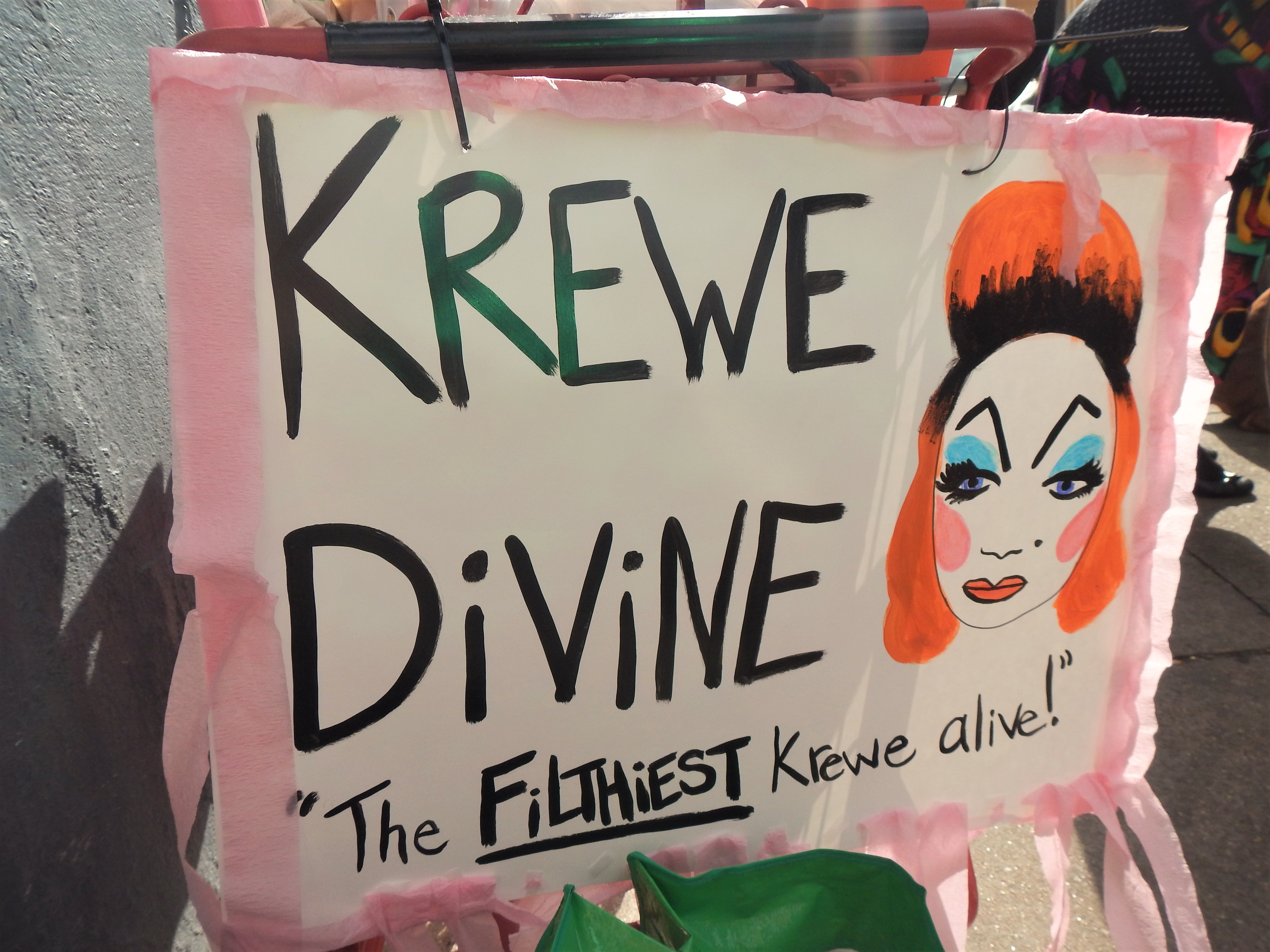
Mere hours after debuting our Divine-inspired, Swampflix-sponsored Mardi Gras krewe this past Fat Tuesday, CC & I found ourselves riding in the back seat of an SUV, exhausted, and headed toward Disney World. An immersive, three day adventure to the Happiest Place on Earth is always going to be a disorienting vacation no matter what mental state you’re in. Yet, there was something especially absurd about diving head first into such a wholesome fantasy space after running rampant through the French Quarter all morning, dressed as famous drag queen and frequent John Waters collaborator Divine in the alcohol-enhanced sunshine. 

At first, I wasn’t sure exactly what I wanted to accomplish while at Disney World besides checking off a few boxes as a film buff. That part was easy. A visit to a Walt Disney memorabilia museum titled One Man’s Dream, a similar Star Wars exhibit, a charmingly outdated 3-D Muppets screening, and a regularly-running “short film festival” of interactive Disney & Pixar selections all satisfied my apparent addiction to sitting in the dark, watching moving images. What was a much more difficult itch to scratch was maintaining our focus on our previously most recent task of keeping Divine’s legacy alive. You’d think that finding anything related to Divine or John Waters at large would be an impossible feat in such an aggressively clean environment, but Divine’s presence can be found in all things. And in Disney World, it can be found in Ursula.

The sea witch Ursula, of course, is the main villain in Disney’s modern animated classic The Little Mermaid. Although the construction of her persona can be attributed to many different influences, including both Elaine Stritch & Joan Collins, Ursula’s physical form was directly modeled after Divine (the top, non-octopus half was, anyway). The Little Mermaid‘s animators scrapped an initial idea to adorn Ursula with a hairstyle similar to the one Divine rocks in Pink Flamingos for being “too over the top,” but they did notably maintain her signature eye makeup & unmistakable body type for Ursula’s final form. The characters’ resemblance isn’t exactly uncanny, but it is blatant.

Ursula’s gigantic presence in The Little Mermaid, both physical & narrative, is a difficult effect to replicate in a kids’ amusement park, not least of all because the park would likely want to avoid scaring the shit out of children. It makes sense, then, that human actors would only be asked to portray Ariel from the film for the park’s rigidly scheduled photo ops & daily Festival of Fantasy parade. That doesn’t mean Ursula (and, by extension, Divine) has been locked out of the park entirely, though. She’s lurking around with her slithering eel accomplices (mostly in the form of large animatronic puppets) if you know where to look for her. Hopefully our search for Divine inspiration within Disney World parks will help expedite others’ in the future, in case anyone finds themselves visiting Orlando while as thirsty for Divine content as we were.

We started with the most obvious place you’d think to find Ursula lurking in the Walt Disney World parks: Magic Kingdom. There is exactly one The Little Mermaid-themed ride in Disney World’s oldest & most iconic park: Under the Sea – Journey of the Little Mermaid. Outside the ride you can wait in line to meet & take pictures with a professional Ariel cosplayer in her “grotto.” In line for the actual ride, Scuttle, the hoarder seagull, tries his best to simplify & recount the film’s plot in a digestible morsel to temper your boredom & distract you from heat exhaustion. Once inside, you’re strapped into a slow-moving clamshell vehicle that glides peacefully by two animatronic Ariels. One sings, “Part of Your World” and the other dances along to the ride’s centerpiece: a colorful, puppet-filled rendition of “Under the Sea” that’s doused with the widest variety of day-glo paint you’re ever likely to see in a single room.

None of that underwater glitz & glamor is our concern here, though. We’re looking for Divine. Ursula arrives in the ride just after the second Ariel in the “Under the Sea” number, isolated all by herself in a dark cove. She is a beautiful, oversized mechanical puppet I can only picture in my memory as cackling maniacally, even though in reality she sings a song. The purple sea witch is a breath of fresh, menacing air in a literal sea of smiling faces. Soak it in, because it will not last for long. After a glorious moment of hearing Ursula belt out the chorus of her show-stopping number “Poor Unfortunate Souls” in front of her giant crystal ball, she fades from the rest of the ride (or at least her inhuman, Divine-inspired form does), never to be heard from again. It was an all-too-brief Ursula encounter, but it fortunately wouldn’t be our last.

The next stop for Ursula content was a little less obvious and just happened to be something we stumbled into. As a park, Disney’s Hollywood Studios (formerly Disney-MGM Studios) is a little less cartoon-heavy than Magic Kingdom. This will be especially true once its current in-progress overhaul bulks up its Star Wars & MCU-themed attractions (for obviou$ rea$on$). The park is intensely focused on live theater, though, with attractions like The Tower of Terror & whatever the monstrously obnoxious Aerosmith rollercoaster is called existing as total outliers in an environment typically dedicated to more traditionally dramatic modes of entertainment. We were already having enough fun in the park being traumatized by the uncanny valley nightmare of the Robert Osbourne-hosted The Great Movie Ride (R.I.P.) and the distinctly Norman Bates theatricality of our server at the 50’s Prime Time Café, but there’s no good time that can’t be improved by a little Divine. Thankfully, the Divine lurking in Hollywood Studios was a large one. Freakishly large, even.

Located in the park’s Animated Courtyard area, the routinely performed indoor show Voyage of the Little Mermaid is very similar in content to the Journey of the Little Mermaid ride at Magic Kingdom (as if you couldn’t tell by their titles). Fish sing “Under the Sea;” Ariel sings “Part of Your World;” Ursula sings “Poor Unfortunate Souls” and then promptly disappears before the happily ever afters. It’s the same tidy retelling of the animated film with one major exception: the puppets. Whereas the Journey of the Little Mermaid ride is all 100% animatronic puppetry, the Voyage of the Little Mermaid is more of a mixed media affair. The fish puppets are all hand-operated by performers working in the stage’s shadows, Ariel & her boy toy Eric are portrayed by live human actors (as is the more degrading role of Eric’s dog), and the whole show is substantially beefed up by projections from the original animated film, laser light displays, and a waterfall curtain that smells authentically like seawater (whether or not the effect is intentional). It’s a totally pleasant, refreshingly cool way to spend 17 minutes of your life in the park, but what’s most impressive is the way the mini-play brings Ursula to life.

While Ariel & her fishy friends are given a new form of representation in Voyage of the Little Mermaid to distinguish them from Journey of the Little Mermaid, Ursula remains animatronic puppet. She’s so much more impressive in the show than she is in the ride, though, as her size is blown up to 12 feet high & 10 feet wide. I already fell in love with the mechanical puppet from the Little Mermaid ride (which is the more strikingly beautiful one in terms of basic visual craft), but it’s just absolutely dwarfed by the intimidatingly gigantic puppet from the show. It’s the kind of scale & magnificence that almost makes you want to fall to your knees in worship. In other words, it’s absolutely Divine.

That giant puppet would be the last Divine presence we located at Disney World, but, honestly, her magnificent size would’ve been difficult to top by any other display. Maybe there was an Ursula lurking somewhere in one of the three parks we didn’t have a chance to visit (Animal Kingdom, Typhoon Lagoon, Blizzard Beach), but that seems highly unlikely. The only other places to search for our Divine inspiration, then, would be the park’s other other main attraction besides rides & shows: merchandise.

Disney villains from decades-old cartoons aren’t going to move nearly as much merch as the likes of an Elsa or an Olaf or an, um, Other Thing from Frozen. That doesn’t mean there’s no Ursula merch to be found in the parks, though. You just sometimes have to accept her as a package deal with other characters. For instance, outside the Finding Nemo ride at Epcot (which dumps you into a surprisingly decent aquarium), there’s an underwater-themed gift shop that sells a collection of Little Mermaid “squeeze toy” figurines. Ursula’s included, but you have to buy the whole collection to get her. Similarly, I found (and, of course, purchased) a purple baseball cap that features several of Disney’s more infamous female villains like Maleficent, the Evil Queen from Snow White, and, duh, Ursula. According to a brief search of the term “The Little Mermaid” on Disney World’s creepily helpful Disney Go app, there were some really nice Ursula “couture de force” figurines, art prints, and blouses for sale, but we never laid eyes on them (and they would’ve been far outside our price range anyway).

If you really want to take home Ursula’s visage isolated on some affordable merchandise, your only viable option is to find her on an enamel pin. We happened to purchase some Ursula pins at a kiosk located outside Space Mountain, but Disney has a surprisingly strong, park-wide enamel pin culture. You could probably find the damn things in any shop you poke your head into, as a lot of the stores seem to carry overlapping merch. (The same also goes with the squeeze toy figurines we found outside the Finding Nemo ride.) There’s also a lot of annual turnover on the merch that’s sold within the parks, so not only is it possible that we missed out on some sweet Ursula gear when we happened to be there, but you can also likely find excessed deadstock of old Ursula merch at the various Disney outlet malls sprinkled throughout Orlando.

We really have no clue where Krewe Divine’s headed in the future in terms of scale or membership. It’s only a matter of time until one of us dresses as Ursula on Fat Tuesday, though, so it really was a treat to cap off our first year as a microscopic Mardi Gras krewe by treating Walt Disney World like an unofficial Divine scavenger hunt. As the release of The Little Mermaid is already nearly three decades behind us, it’s likely that Ursula’s Divine presence within the amusement park is on borrowed time. As is, she’s seemingly only represented in the form of two (beautiful) animatronic puppets and a few enamel pins already. Even that’s enough representation worth celebrating, though. I was overjoyed to see her there in any form. In a way it’s a kind of a miracle that there was ever any John Waters-adjacent content to be found at Disney World at all. It’s even more of a miracle that it happened to be Divine.

-Brandon Ledet

Roger Ebert Film School, Lesson 23: Hellfighters (1968)

EPSON MFP image

Roger Ebert Film School is a recurring feature in which Brandon attempts to watch & review all 200+ movies referenced in the print & film versions of Roger Ebert’s (auto)biography Life Itself.

Where Hellfighters (1968) is referenced in Life Itself: On page 153 of the first edition hardback, Ebert gloats about how great being a professional critic was in his glory days. He writes, “It was a honey of a job to have at that age. I had no office hours; it was understood that I would see the movies and meet the deadlines. I loved getting up from my desk and announcing, ‘I’m going to the movies.’ A lot of my writing was done at night and on the weekends. I saw about half of the movies in theaters with paying audiences, sinking into the gloom to watch John Wayne fighting flaming oil wells in Hellfighters at the Roosevelt, or Pam Grier inventing blaxploitation at the Chicago.”

What Ebert had to say in his review: “Out in front of the Roosevelt Theater there’s a big photo of John Wayne and this quote, attributed to him: ‘I’ve made a lot of action pictures but never one as exciting as this.’ I doubt that Wayne volunteered this information; it sounds more like a studio publicity idea. The fact is, Wayne has made a lot of action pictures, and over the years he has gotten to be about as good at it as anybody. He must have been miserable during the filming of Hellfighters, which is a slow moving, talkative, badly plotted bore.” – from his 1968 review for The Chicago Sun-Times

EPSON MFP image

When praising the young, energetic talent that reignited American art cinema in the late 60s’ so called New Hollywood movement, it’s all too easy to overlook the undeniable virtues of the system those films were bucking against. The John Wayne action epic Hellfighters is a perfect snapshot of Big Studio glut when compared to its more forward-thinking contemporaries like Bonnie & Clyde and The Graduate. While these smaller New Hollywood upstarts were pulling influence from still-exciting sources like the French New Wave, the lumbering, old-fashioned Hellfighters more closely resembles instantly outdated modes of entertainment like Earthquake, Airport, and The Towering Inferno. Ebert was right to praise those smaller, more experimental works in his reviews while labeling Hellfighters “a slow moving, talkative, badly plotted bore.” I can’t disagree with a word of that. The dirty secret, though, is that although formally & thematically outdated in the face of smaller, more passionate films being made around them, Old Hollywood ghosts like Hellfighters effortlessly pulled off mesmerizing visual spectacles that were never truly touched by the likes of a Bogdanovich or a Friedkin or a De Palma. Even if its superiority was simply a question of budget, there’s an immense beauty to the costume designs, sets, framing, and rich colors of Hellfighters that could’ve been transcendent if were applied passionately instead of with workmanlike competence.

As with all John Wayne movies, whether or not they’re set in the dusty West, Hellfighters is often classified as a Western. This makes even less sense here than it does with the London-set cop drama Brannigan, since Wayne’s tuxedo’d firefighter lead doesn’t even carry a gun. Loosely based off the real world personality Red Adair, Wayne plays infamous oil field firefighter Chance Buckman (man, I love that stupid name) as he travels across the globe putting out dangerous oil well fires with barrels full of dynamite. Real manly stuff. Based on that description, you might think that the art film version of Hellfighters might be Sorcerer or its predecessor Wages of Fear, but it actually more closely resembles a film from the late 90s. Much like Bruce Willis’s tough guy hero in Armageddon, Chance Buckman is an oil industry legend who bullheadedly infantilizes his adult daughter by attempting to protect her from a twofold danger: the physical danger of his industry & the emotional danger of the womanizing men who work within it. It’s not at all difficult to imagine Michael Bay growing up fond of Hellfighters, thanks to its hyper-masculine self-delusion & over-indulgence in practical effects explosions. The John Wayne film often mirrors Armageddon‘s bullshit romanticization of the hard working men who risk their lives for oil & the worried women who love them, despite the constant danger of loss. Where Armageddon employs this ludicrous narrative & attention to visual craft for a punishingly kinetic live action fantasy, however, Hellfighters is content to lie still & talk its audience to death. It’s an entire movie built around the idea that large spouts of fire look cool. It’s not exactly wrong, just too long to justify that thin of a premise and too lethargic to fully command its audience’s attention, even as beautifully decorated it’s production design can be. If Hellfighters could’ve operated with Michael Bay’s punishing sense of immediacy it might’ve been an all-time classic. At the very least, it could’ve shot John Wayne into space to fist fight an asteroid the size of Texas. There’s pretty much no one who wouldn’t pay to see that.

A large part of what makes Hellfighters feel desperately old-fashioned is its constant glorification of traditionalist masculinity. So many bare knuckle punches are thrown without any real consequence in bar rooms, brothels, gambling holes, and hospitals that they start to register more like a handshake between bros than an act of violence. News reporters are whiny little wimps who can only get in the way while Real Men do the Important Work, the kind that requires muscles & explosives. The women of Hellfighters are wives, daughters, and secretaries, completely extraneous to the plot outside a fresh-from-The Graduate Katherine Ross, whose virtue & emotional well-being Chance Buckman is tasked to protect. The closest the movie comes to passing the Bechdel Test is a single scene where Buckman’s wife & daughter are golfing alone together, but their entire conversation centers on whether or not it’s worth the worry to love an oil field firefighter. Buckman himself is a stoic emotional void, only budging in his rock solid confidence to express annoyed frustration & mild worry with the women in his life who needlessly complicate his profession. Otherwise he just does what he does best: exploding fires into oblivion & unconvincingly delivering oil-themed one-liners like “If you’re coming to me for advice, I’m a dry hole” with a distinct lack of passion.

In the years since the New Hollywood takeover, directors have learned (and have been better funded) to apply Hellfighters‘s workman sense of extravagant spectacle to the energetic narratives that deserve it. Instead of overtalking its virtues between this piece, my initial review, and a subsequent podcast episode, I do believe Michael Bay’s Armageddon is a perfect example o how well that visual craft could be utilized with just a little creative gusto, even while holding onto its idolization of toxic masculinity. Hellfighters was an overlabored, undercooked movie industry dinosaur when compared to the more exciting, artier New Hollywood films that upended its place in the world, but that doesn’t mean it’s a film without value. When gazing into the rich color, impeccable costuming, gorgeous sets, and mesmerizing explosions that Hellfighters wastes on a going-through-the-motions John Wayne action epic, there’s an undeniable sense of missed opportunity. The film could’ve been something truly memorable if its better aspects weren’t helmed by a sleepwalking studio system that misread what its audience was interested in seeing. I can’t recommend Hellfighters as an entertaining work to anyone other than the most diligent John Wayne completist imaginable. However, I do think it works as a valuable reminder that there was a lot of untold merit in the bloated studio system that the late 60s broke apart with its scruffy batch of babyface auteurs.

EPSON MFP image

Roger’s Rating (1.5/4, 38%)

onehalfstar

Brandon’s Rating (2.5/5, 50%)

twohalfstar

Next Lesson: Camelot (1967)

-Brandon Ledet

Roger Ebert Film School, Lesson 22: The Graduate (1967)

EPSON MFP image

Roger Ebert Film School is a recurring feature in which Brandon attempts to watch & review all 200+ movies referenced in the print & film versions of Roger Ebert’s (auto)biography Life Itself.

Where The Graduate (1967) is referenced in Life Itself: On page 153 of the first edition hardback, Ebert gushes about the wealth of great cinema that he was lucky to cover at the beginning of his career as a critic. He writes, “The big events of that period were movies like Bonnie and Clyde, The Graduate, and 2001: A Space Odyssey. The French New Wave had reached America. TIME magazine put ‘The Film Generation’ on its cover. A few months later they did a piece about me in their Press section, headlined ‘Populist at the Movies.’ Pauline Kael had started at the New Yorker, and movie critics were hot. It was a honey of a job to have at that age.”

What Ebert had to say in his review(s): “Nichols stays on top of his material. He never pauses to make sure we’re getting the point. He never explains for the slow-witted. He never apologizes. His only flaw, I believe, is the introduction of limp, wordy Simon and Garfunkel songs and arty camera work to suggest the passage of time between major scenes. Otherwise, The Graduate is a success and Benjamin’s acute honesty and embarrassment are so accurately drawn that we hardly know whether to laugh or to look inside ourselves.” – from his 1967 review for The Chicago Sun-Times

The Graduate, released in 1967, contains no flower children, no hippies, no dope, no rock music, no political manifestos and no danger. It is a movie about a tiresome bore and his well-meaning parents. The only character in the movie who is alive–who can see through situations, understand motives, and dare to seek her own happiness–is Mrs. Robinson. Seen today, The Graduate is a movie about a young man of limited interest, who gets a chance to sleep with the ranking babe in his neighborhood, and throws it away in order to marry her dorky daughter. […] When the movie was first released, I wrote of the ‘instantly forgettable’ songs by Simon and Garfunkel. History has proven me wrong. They are not forgettable. But what are they telling us? The liberating power of rock and roll is shut out of the soundtrack (‘The Sound of Music’ plays on Muzak at one crucial point). The S&G songs are melodic, sophisticated, safe. They even accommodate the action, halting their lyrics and providing guitar chords to underline key moments. This is Benjamin’s music; Mrs. Robinson, alone with her vodka, would twist the radio dial looking for the Beatles or Chuck Berry.” – from his 1997 review at the time of the film’s 30th Anniversary

EPSON MFP image

The reputation of the New Hollywood staple The Graduate has changed drastically over the years as our culture has evolved slightly in its gender politics, while the film has obviously remained static as its own. I assumed when reading Ebert’s inclusion of the title among the most exciting films of his early career as a critic that this might be the first lesson in this series where we’d have drastically different takes on a film’s merits (as opposed to my minor quibbles with his emphatic takes on stuff like Apocalypse Now and Abbot & Costello Meet Frankenstein). Indeed, Ebert’s 1967 review of The Graduate is the exact glowing, enthusiastic celebration of the film’s minor rebellions I expected. It’s a reading that experiences the film’s central conflict through the eyes of its protagonist, Benjamin (a fresh-faced Dustin Hoffman). On my most recent rewatch of The Graduate I didn’t sympathize with Benjamin at all, but rather with his infamous seductress Mrs. Robinson (the smokily poised Anne Bancroft), a character the film often tosses aside & vilifies despite her having the moral high ground. Ebert, in his admirable life-long pursuit of humility & empathy, had of course reached this conclusion decades before I did, when he revisited this landmark work for its restoration in 1997. In his second review he kicks himself for not recognizing how much of a heartless ass Benjamin had been to the tragic Mrs. Robinson. It’s a revelation that might only come with age & maturity, both for the individual viewer and for the audience as a culture.

The Graduate opens by heavily leaning into Benjamin’s personal crisis of early 20s ennui. Freshly finished with his college degree & unsure of how best to utilize his overabundance of idle time, Benjamin is turned off by every opportunity offered by his parents & their colleagues. When viewed as a young audience, this refusal to play along can feel like an existential dedication to anti-establishment principles, a sort of small scale protest through deliberate inaction. As an adult, watching Benjamin float around a pool & pound cheap beer looks like a lazy, bratty waste of unearned privilege. In the midst of this directionless drift, Benjamin is seduced unapologetically by the much older wife of his dad’s business partner, Mrs. Robinson. Bored, ignored, and underappreciated, Mrs. Robinson is similarly idle in her untapped potential, but it’s a life imposed on her rather than a deliberate choice. She sleeps with Benjamin, whom she watched grow up, over a summer-long affair in an attempt to shake the cobwebs, enacting agency in her own search for pleasure in a way she’s often not allowed. The film’s central conflict, besides Ben’s annoyed desire to be treated like an adult instead of a sex toy, arrises when his parents & her husband pressure the directionless bum to date Mrs. Robinson’s daughter (the beautiful, big-eyed Katherine Ross). When Mrs. Robinson forbids him to sleep with her daughter, Ben is offended that she doesn’t think he’s good enough for her progeny, only serviceable as an older woman’s plaything. His brattiness spirals out from there, causing the two former lovers to inflict vicious harm upon one another as often as they can, ending with Ben stealing his mistress’s daughter away from the altar at a marriage much less . . . complicated in its central dynamics.

If there’s any room for me to disagree with Ebert’s ultimate assessment of The Graduate, which has widely become the critical consensus, it’s in the intent of that final scene, the disrupted wedding. In his 1997 reassessment, Ebert was confused that he had ever celebrated the film’s conclusion, writing “As Benjamin and Elaine escaped in that bus at the end of The Graduate, I cheered, the first time I saw the movie. What was I thinking of? What did the scene celebrate? ‘Doing your own thing,’ I suppose.” My only question about that confusion is whether or not director Mike Nichols ever intended for that scene to be played as celebratory in the first place. As soon as the excitement of escaping the wedding settles & the new fugitive couple settle in the back of the bus to the oft-repeated soundtrack of Simon & Garfunkel’s “Sound of Silence,” The Graduate loops back to the young brat ennui that opens its narrative. The characters are stone-faced, visibly scared about what they’re going to do with themselves. This is exactly why Mrs. Robinson has a point about Ben’s unworthiness to court her daughter (despite the obvious gross-out factor of having slept with her first). It’s possible to argue that, as the adult, she was wrong for pressuring a young man into sleeping with her despite his initial unease. However, she does say to Ben, “If you won’t sleep with me this time, you could call me whenever you want.” Mrs. Robinson vulnerably offers her body to Benjamin for a shared pleasure, a proposition he eventually accepts of his own free will. After a prolonged affair, she learns how directionless & selfishly cruel the overgrown child truly is, which means she’s a pretty great judge of whether or not he’s prepared to be a good suitor for her only child (not that their own shared sex life isn’t enough to shut that down outright). The worst thing Mrs. Robinson does to prevent that doomed coupling is claiming that Benjamin had raped her, which is a lie fittingly portrayed like a cruel betrayal. I’m not convinced, however, that it’s any more cruel than Ben describing the affair with Mrs. Robinson to her face as “the sickest, most perverse thing that’s ever happened” to him. I’m also not convinced that the movie wasn’t aware of that cruelty on both sides, despite it taking most audiences a few decades to catch up to the full implications of its thematic minefield.

The Graduate is far from the masterpiece of auteurist anti-establishment storytelling it was initially misunderstood to be, but it’s still a well-made, memorable film. Its Simon & Garfunkel-soundtracked ennui commands an intentionally minor look & tone that suggests maybe a life played by the rules isn’t the most ideal path for personal fulfillment. When you’re young it’s tempting to seek that lesson in Benjamin’s directionless, impulsive narrative, but if you can learn to empathize with Mrs. Robinson’s tragically unfulfilled character instead, the film is a whole lot more satisfying. I like to think that aspect of The Graduate was its initial intent, but it’s easy to see why Ebert & so many others would disagree, especially since as a collective audience misread the film’s central romantic dynamic so boneheadedly wrong for such a long time.

EPSON MFP image

Roger’s Rating: (3/4, 75%)

three star

Brandon’s Rating (3.5/5, 70%)

threehalfstar

Next Lesson: Hellfighters (1968)

-Brandon Ledet

Movie of the Month: What’s Up, Doc? (1972)

Every month one of us makes the rest of the crew watch a movie they’ve never seen before & we discuss it afterwards. This month Britnee made Alli, Boomer, and Brandon watch What’s Up, Doc? (1972).

Britnee: As far as screwball, madcap comedies go, Peter Bogdanovich’s 1972 film, What’s Up, Doc? is up there with the greats. It’s also, in my opinion, the greatest Barbra Streisand film of all time. Yes, it’s even better than Yentl. Streisand was quite the “funny lady” from the late 1960’s through the 1970’s, and Judy Maxwell is by far one of her most hilarious roles. The film also stars a young Ryan O’Neal, who is Judy’s depressed and confused love interest, Dr. Howard Bannister. Both leading characters have such conflicting personalities: Judy is a free-spirit who gets off on starting trouble between strangers, and Howard is a walking zombie in an unhealthy relationship. There’s not much romantic chemistry between the two, but they are a great comedy duo.

The main plot of the film revolves around a mix-up between several identical bags that belong to completely different individuals that are staying at the same hotel in San Franscicso (Bristol Hotel). The bag mix-up is so confusing that it’s almost impossible to explain, but in all honesty, the whole film is confusing because there are loads of plot lines occurring at the same time. I’ve seen this movie at least 30 times, and I didn’t really put all the pieces together until about the 5th viewing. Strangely enough, the confusion of the film is one of the things I love most about it. You could watch What’s Up, Doc? over and over again without getting bored. There’s always something different to focus on.

Actually, after watching it for Movie of the Month, I realized how horrible Madeline Kahn’s character, Eunice Burns, was treated. Seriously, this poor woman was put through hell for this entire movie, and she’s made to look like the bad guy. She’s Howard’s fiancé, and while the two aren’t in the best relationship, Judy randomly swoops into their lives and basically steals Eunice’s identity. After Eunice is made a fool of in front of an entire banquet of people, kidnapped and most likely assaulted by a group of mobsters, etc., it’s difficult to see her as the annoying fiancé she’s portrayed to be.

Boomer, what are your thoughts on the real Eunice Burns? Did you feel any sympathy towards her? Did you feel as though she was portrayed to be a villain when she was actually a victim?

Boomer: I didn’t realize that the audience was supposed to see Eunice as unattractive until the end, when the Judge responded to Eunice’s complaints that she had been inappropriately touched by the jewel fences with “That’s . . . unbelievable.” Because, I mean, come on, Khan’s a knock-out. That unusual perception is not unique to her character, however, as Ryan O’Neal is probably the most tan, studly, and barrel-chested hunk of man to ever play a milquetoast Iowan academic.

As to whether she’s made out to be a villain or a victim, I’m less sure. It’s unusual for me to sympathize with a character like Judy, a kind of proto-Manic Pixie Dream Girl who also happens to be a whirlwind of disaster, but Streisand plays her with enough aplomb and likability that Judy comes off as charming. This was a bit of a surprise for me, as someone who only really thinks of Streisand as a face on a CD cover in a stack of albums sitting next to the stereo of a deeply closeted Baton Rouge hair stylist (you know who you are). I also have nothing but love for Khan, and as such I think I might have been more inclined to sympathize with her than the producers intended, given that she was a complete unknown cast as the romantic rival to the more well-known Streisand. Eunice is certainly demanding and a poor match for Howard, but I read her as more of a Shakespearean archetype of a woman who appears to be a shrew only because of the character with whom she is paired but who will fit seamlessly with someone else, which is essentially exactly what happened with her arc.

So, I suppose I didn’t find her to be a villain or even presented as one, nor did I find Judy to be a “bad guy” either, even though her entire story resolves around falling for an engaged man and doing everything in her power to subvert Eunice in her “rightful” place as Howard’s lady love. I can’t even quite put my finger on it, but there’s something about Judy that makes her eminently likable despite her objective villainy. Alli, did you feel the same way, or not? If you agree, perhaps you’re better able to articulate why?

Alli: I also liked Judy against my better judgement. She’s entitled, disrespectful, and dangerous, but somehow still endearing. Probably because she’s free and she’s got a great sense of humor, which is able to shine through because of her stunted, immature nature. I think the thing about Judy isn’t that she’s a villain so much as she’s just chaotic, and there’s something charming about chaos. Reasonable people would never rip around the town impulsively, but we all have flashes of that instinct. Judy is the embodiment of that instinct, free from society’s pretensions and facades.

A major theme here is sort of a clash between absolute chaos and rigid order, the inner child vs “propriety.” Not to get too pretentious here, but this movie almost seems to be about the old debate over “the state of nature” vs society and reason. Eunice is order, “reason,” Judy obviously pandemonium, “savagery,” and Howard is the neutral ground that they’re fighting over. But at its heart What’s Up, Doc? is a wacky, briefcase switching comedy and I doubt that the intent was a debate about the true nature of humanity and society. It’s hard to take away any serious dramatic themes in a movie this cartoonishly bizarre.

The world it’s set in, while relatively realistic, is simultaneously surreal. There’s exaggerated sound effects, slapstick, and just a general bending of rules. One of my favorite examples of this is when they’re at the banquet underneath the table and Eunice gets dragged away, leaving skid marks and squeaking. Brandon, did any moments to you stand out as particularly cartoonish? Do you have a favorite?

Brandon: If nothing else, “cartoonish” is such a perfect word to describe what Barbara Streisand’s doing in this movie as Judy. At this early, most successful stage of Peter Bogdanovich’s career, the director scored a string of hits dripping with nostalgia for the cinema of his youth, with What’s Up, Doc? being sandwiched between fellow classics The Last Picture Show & Paper Moon. The interesting thing to me about What’s Up, Doc? that distinguishes it from those other two films is that it not only calls back to madcap mix-up comedies of the 1930s, which are traditionally staged at these grand hotels, but it also pulls influence from a much more unexpected source: Looney Tunes. Judy’s role as a benign source of comedic chaos is 100% Bugs Bunny tomfoolery and the film winds up feeling just as much equal parts Tex Avery as Bringing Up Baby. It makes this influence as explicit as possible too, with one of Judy’s first comedic moments being staged around her eating a carrot and her final exchange with her hunky Elmer Fudd (Ryan O’Neal) including the titular line, “What’s up, Doc?” The film even closes out with Porky Pig stuttering his way through “That’s all, folks!” on an airplane television. So, yeah, while we might not want Judy mucking up our lives with her literally cartoonish antics, it’s easy to see why we wouldn’t find her any more villainous than Bugs Bunny or his obvious source of inspiration, Groucho Marx.

Bogdanovich’s choice to bring in the surreal slapstick of Looney Tunes to disrupt the relatively realistic world of traditionalist screwball comedy was a brilliant move, mostly because screwball comedies are already pretty damn cartoonish in their own right. Although I found Babs’s Bugs Bunny antics as Judy to be a large part of the movie’s charm, she actually had very little involvement in my favorite gag from the film. There’s a scene about midway through What’s Up, Doc? where Howard is trying to hide Judy’s presence in his hotel room from Eunice by asking her to hang perilously off the balcony. The combination of Eunice’s interrogation, Judy’s demands to re-enter the room, other guests frantically trying to steal their desired variation of the identical luggage, and a waiter calmly preparing a meal Judy ordered as room service reaches a comedic fever pitch where Howard’s hotel room is destroyed in a fire, a moment that had me howling. Now, this visual punchline is much more closely tied to the film’s 1930s screwball roots than anything related to its cartoonish surrealism, but it’s also so absurdly over the top in its gradual escalation that it’s a great insight into why those two aesthetics were so easy to marry into one humorous feature.

Something that felt a little less natural & easy to me were the motivations for the two sides of that coin. Judy’s motivation for pursuing Howard as a romantic partner is a little muddled for most of the picture. Her instant attraction to him is oddly intense, making it unclear whether she’s genuinely into seducing him or if she’s just an opportunist who needs a place to stay and is having fun toying with a milquetoast, but handsome pushover in the meantime. The engine that drives the screwball humor was also a little confusing, as the identical cases of luggage (one containing diamonds, one containing Top Secret government documents, and one containing, I don’t know, more carrots for Judy to chew on like a cigar) were difficult to keep track of. Some of that confusion was obviously deliberate, but it didn’t help at all that the two thieves attempting to steal the luggage were both bald schlubs I couldn’t really tell apart because the film was far more interested in the machinations of the Judy-Howard-Eunice love triangle (and rightly so).

Britnee, considering that you selected the tonally similar, hotel-set 1930s throwback comedy Big Business for a Movie of the Month last year, it seems that you’re somewhat of a fan of this kind of Old Hollywood madcap humor. For you, does the exact, clear status of who’s in possession of which bag at what time and who’s trying to steal what from whom matter at all in these kinds of stories? Without the luggage mix-up and the thieves that follow, there’d be less people involved in this film’s insane, climactic car chase through the streets of San Francisco, which would definitely be a shame. Do the mix-up or the motivations of the romance need to be any more clear or necessary than that for you to find them worthwhile or is it enough that they provide a backdrop for the comedic antics of a Barbara Streisand or a Better Midler or whoever the particular film’s de facto Bugs Bunny/Groucho Marx happens to be?

Britnee: It’s never dawned on me until now that I have a thing for hotel comedies. Just yesterday, I recommended Four Rooms to a friend as a fun weekend movie. There’s just something hilarious about hotel settings, and I really think it has a lot to do with the gaudiness of hotels. All that brass, ridiculous patterned carpet, and over-the-top chandeliers are just oozing with tackiness, making it the perfect background for a comedy. Hotels are also perfect for a trashy murder mystery for the same reason (1972’s Private Parts particularly comes to mind).

As for the mystery of the bag mix-up, finding out if each bag makes it back to their owner doesn’t really matter. It’s strange because I usually find satisfaction watching belongings find their way back to their owner in a film, but I honestly could not have cared less if Judy ended up losing her underwear and became stuck with top secret documents or if Howard lost his rocks and ended up with a buttload of fancy jewels. It doesn’t really matter because the humor would still be there. The same goes with the romance between Judy and Howard. Who cares if they end up getting together in the end? The comedy wouldn’t suffer if they didn’t get together, and that’s really all that matters in films like this one. If the romance and bag mix-up were to be stripped away from What’s Up, Doc? without taking away the funny characters, shenanigans, and of course, the comedy of Streisand, the film wouldn’t suffer one bit.

Although the romance and bag mix-up are not very important to the film’s success, the San Fransisco setting is. The car chase throughout the city’s steep streets (especially Lombard Street), the run-in with the Chinese dragon during the Chinatown parade, and the cars running off the pier are just a few funny moments that wouldn’t be the same if the film wasn’t set in San Fransisco.

Boomer, do you think that the film’s San Fransisco setting was important? Would any other location have made a big difference in the film?

Boomer: I have to admit that I didn’t give much thought to the film’s setting initially. When the climactic show-stopping car chase began, I thought “Oh, it’s in San Francisco because of Bullit.” That film likewise centers around a final car chase through the famously hilly city, and I assumed that Bogdanovich had merely been inspired to make a more comedic version of said vehicular pursuit. Reading a little more about the film, it looks like that was, in fact, the reasoning: this homage is merely one of many that occur in the film, and as it relates to a contemporary piece of pop culture that is less well-known than some of the older (but more culturally revered and thus more “permanent” fixtures in our cultural landscape) references, like to Looney Tunes. For instance, there was an ad that touted the VW Bug’s real ability to float in water, as seen at the end of the film when Howard and Judy launch into the bay; the reference was more pertinent and familiar in its day, but still works as a sight gag even without that knowledge.

Of course, the placement of the film in San Francisco also allowed for some nice touches that would have been lacking had the film been set elsewhere, like New York or Los Angeles (i.e. the two places where probably 85% of American media is set). The scene with the Chinese New Year parade, and the resultant accidental theft of the parade’s crafted dragon, could only take place in SF, for instance. As noted above, the hills of the city make for a particularly interesting place for car chases, here used as they had been in Bullitt, to more comedic–if no less thrilling–effect. Larrabee himself is distinctively West Coast in that his mannerisms are unconventional and excited; he rolls with the punches. One could even argue that, since his personality clashes so strongly with the unlikable (but no less comically delightful) Hugh Simon, and since that character is a parody of New York’s most unpleasable (and most unpleasant) critic John Simon, a criticism of this artistic and individual dissonance between East and West Coast is made implicit in the text.

There’s a scene in one of the early episodes of Scream Queens in which a character is breaking into an office and uses a glass cutter to cut a hole in the in-door window, through which they attempt to reach in and unlock the door; after a protracted time of s-l-o-w-l-y cutting, the character reaches through, and the glass shatters. Every time I see it, I have to rewind because of how hard I’m laughing. It’s a great sight gag, and the build-up is great; it’s just so pure. It’s one of the best jokes in the whole series, and is inarguably the best non-quip laugh the show elicits. The two-men-carrying-a-pane-of-glass gag in What’s Up Doc? is similar but writ large, and is the best such visual joke I’ve ever seen. Alli, can you think of any other contenders for the top version of the TMCAPOG gag? And could you better put into words why this version of the cliché works so well?

Alli: I’m going to have to come clean here and say that while that gag is in everyone’s mind and feels so pervasive in popular culture this might be the only time I’ve actually seen it used in context. (It makes me wonder where it even came from and why we all know it.) Given it’s prevalence and predictability (there’s a sheet of glass therefore it will shatter inevitably), it’s impressive that What’s Up, Doc? manages to still make it so funny. The problem with this movie and its humor is that it’s very difficult to try to explain what is so funny about it. There’s so many old gags and silly one liners, but they just work. I think maybe it has to do with the pacing. It’s just spitfire. There’s just joke after joke, so if one doesn’t land the next one probably will.

Not to use the played out, “They don’t make them like they used to,” but you don’t see a lot of this sense of humor in movies anymore and I miss it. The jokes are so carefree and for the most part inoffensive, minus the jabs at Eunice. Probably why I’ve never actually seen the sheet of glass gag in action is because it’s not used as much anymore. When’s the last time a movie had an earnest pie in the face? A lot of comedy these days seems to rely on crude, gross, or vulgar humor. I don’t really have a problem with tastes changing, but there’s such a timelessness and charm to so many of the gags in this film.

Brandon, you mentioned the nostalgia aspect of What’s Up, Doc? Do you think more movies could benefit from more of the nostalgic impulse? Have you seen any recent comedies that remind you of this one in any way?

Brandon: It’d probably be a little foolish to ask for more nostalgia in our current pop culture climate, but I do believe revision & tradition has been a part of cinema as long as cinema has been around. Current comedies seem to be looking back to the absurdist gross-out humor directors would have enjoyed in their 80s & 90s youth, just as Bogdanovich would have been fondly looking back to Marx Brothers/Bringing Up Baby-type hotel mix-ups when he made What’s Up Doc? in the 1970s. I don’t think the classic screwball tradition is at all dead, though. It’s just moved away from broad, commercial films to what we’d be more likely to consider “smart” comedies. Filmmakers like Wes Anderson, Noah Baumbach, and the Coen Brothers all work in various forms of comedy that draw from the same influences as Bogdanovich (and likely from Bogdanovich himself as well), but dress up their screwball antics in enough meticulous visual craft & tonal melancholy that they’re considered “art house” instead of commercial humor.

For specific examples from the last decade, I suppose Wes Anderson’s Grand Budapest Hotel would be a great reference point, considering its setting & ensemble cast structure. Baumbach collaborator Rebecca Miller’s recent film Maggie’s Plan also has a sort of screwball structure to it, including a mix-up at a hotel conference between emotionally immature academics. I’ve also recently watched the British ensemble comedy Death at a Funeral for the first time, which reminded me if this kind of old-fashioned comedic tradition in that all the attendees at what should be a quiet, civil event are trying to keep their goofball antics under wraps to not draw attention to themselves, only for it all to blow up spectacularly at the climax. The Coens’ recent triumph Hail, Caesar! also makes nods to the genre (along with every other Old Hollywood genre imaginable), right down to the convoluted luggage heist.

What distinguishes these comedies from the kinds of works that would be headlined by a Melissa McCarthy, a Seth Rogen, or a Kevin Hart is that they’re just more openly conscious of their participation in cinematic tradition. What’s Up, Doc?‘s spirit, borrowed wholesale from its own set of traditional works, is still alive in our current comedic landscape. Keeping it alive is in itself a kind of scholarly, traditionalist act, though, so the films where you’d hear its echoes are often considered to be stuffy, highbrow art films, despite being as absurdly goofy in tone as the genre originally was in the 1930s.

Lagniappe

Alli: I just want to say how much I liked this movie. Immediately after watching it, I ended up recommending it to people. I think it’s been a weird, rough month for a lot of us and it was good to unwind with something charming and hilarious. It was my first Barbara Streisand movie, and now I feel like I really need to watch more. 

Brandon: Of the handful of Barbara Streisand films I’ve seen, this is the only one I’d consider to be a strict comedy, so I wasn’t at all prepared for how little singing there’d be. I have a habit of picking up her movie soundtracks long before I actually see their corresponding films (Streisand vinyl is oddly ubiquitous at thrift stores), so now I have to wonder what a What’s Up, Doc? soundtrack would even be. Besides a brief duet with Ryan O’Neal on piano, I don’t remember any other musical numbers. Is this indicative of the way her comedies usually go? I’m curious to look into it.

Britnee:  The outfits in What’s Up, Doc? are absolutely amazing! I know that they blend in well with the fashion of the time, but of all the films I’ve seen that take place in the early 1970s, nothing compares to the costume design of What’s Up, Doc? Basically, I want to own everything in Judy’s closet, no offense to Eunice.

Boomer: I also noticed the similarity between this film and Big Business, with each film having a 20th Century Diva, a hotel setting with a sardonic and world-weary desk clerk, and shenanigans that come from mistaking identical people/bags. I thought Britnee was pulling a long con on us. Further, I also was annoyed by the lack of visual differentiation between Harry and Mr. Jones, as Brandon was, given that the other characters were much more distinct in appearance. Finally, depending upon how much you hate yourself, you can find John Simon’s hold-nothing-back blog here, or just enjoy this fun batch of excerpts.

Upcoming Movies of the Month
April: Boomer presents Head Over Heels (2001)
May: Alli presents Mikey and Nicky (1976)
June: Brandon presents Cool As Ice (1991)

-The Swampflix Crew

Krewe Divine’s Maiden Voyage

EPSON MFP image

There comes a time in your adult life when maturity & experience leads you to making tough decisions and strengthened dedication to the things that matter most. That’s why a few of us here at Swampflix have decided that it’s time to get serious about Mardi Gras. Every Carnival season there’s always some kind of personal crisis about what to wear or what themes to play off of while costuming in the Quarter, but that’s something that never seems to be a problem for krewes that stick with a consistent theme in their annual masquerading. Those revelers always seem to have their shit together. Since Swampflix was launched two years ago, we’ve tried our best to find the ways cinema is represented in Mardi Gras festivities, whether by covering the Star Wars celebrations of Chewbacchus or by costuming as the titular plague from the Vincent Price classic The Masque of the Red Death. It never quite feels like enough, though. As it’s time to get serious about how we can contribute to cinema’s presence in Mardi Gras festivities, we’ve decided to find our own sense of dedication & consistency in forming a new costuming krewe that celebrates one of our all-time favorite onscreen performers: Divine.

Arguably the greatest drag queen of all time, Divine was the frequent collaborator & long-time muse if one of our favorite filmmakers, John Waters. Her influence on the pop culture landscape extends far beyond the Pope of Trash’s Dreamlanders era, however, emanating to as far-reaching places as the San Franciscan performers The Cockettes, the punkification of disco, RuPaul’s Drag Race, and Disney’s The Little Mermaid. We hope to honor the Queen of Filth in all her fabulously fucked up glory by forming a new Mardi Gras tradition in Krewe Divine, a costuming krewe meant to meet in the French Quarter on every Fat Tuesday from here to eternity. Our initial krewe is a small group all made of Swampflix contributors: site co-founders Brandon Ledet & Britnee Lombas, podcast co-host CC Chapman, and former podcast guest Virginia Ruth. There’s no telling how Krewe Divine will expand or evolve from here as we do our best to honor the Queen of Filth in the future, but for now, enjoy some pictures from our 2017 maiden voyage as Swampflix’s official Mardi Gras krewe:


-The Swampflix Crew

The Dentist (1996) and Brian Yuzna’s Search for His Very Own Horror Franchise

EPSON MFP image

One of the few minor details that bugged me about Brian Yuzna’s otherwise satisfying class politics body horror Society was that it left its abrupt conclusion open for a sequel instead of chasing a more logical narrative end. It’s now been over two decades since Society‘s initial release and, although the idea of expanding the original film’s scope to include other shunting-obsessed wealthy circles like Hollywood or Washington DC sounds promising, there still has yet to be a proper sequel. Leaving Society open in that way, then, has only weakened its own fortitude as a standalone film. Yuzna would have to look elsewhere to establish a horror franchise all of his own the way Nightmare on Elm Street is closely associated with Wes Craven and Alien is associated with Ridley Scott. Yuzna directed two Re-Animator sequels, Bride of Re-Animator & Beyond Re-Animator, and served as a producer on the first, but that series truly belongs to Stuart Gordon. He also directed two sequels for the Christmas-themed slasher series Silent Night, Deadly Night, but that franchise is way too loose & haphazard to claim an authorial voice. Brian Yuzna’s very own horror franchise wouldn’t be found in completing works others had started, but in staking his own ground as the director of both The Dentist (1996) & The Dentist 2 (1998). The Dentist may not have the cult classic staying power of Society as a continually referenced horror work, but its effect is just as equally, brutally fucked up, and it’s easy to see how a single madman could be responsible for both acts of cinematic sadism.

Usually when you rewatch a movie that scared you as a kid, it turns out that it wasn’t so traumatizing after all. That wasn’t my experience with Yuzna’s 1996 body horror slasher The Dentist. If anything, The Dentist felt ten times more nightmarish than it did to me as a kid on this most recent watch. It’s a deeply, almost unforgivably upsetting work, playing as if the shunting sequence from Society were stretched out to feature length instead of capping off an otherwise conventional late 80s horror. Co-written by Yuzna & Re-Animator‘s Stuart Gordon, The Dentist stars Corbin Bernsen as a killer dentist eventually known as Dr. Caine, who on the surface wouldn’t be all that different from any other cliché of a refined sadist who listens to classical music while slaying/mutilating his victims, except that he hurts them through the delicate nerve centers of their mouths. Some people have a difficult time stomaching on-screen violence directed towards eyeballs or fingernails or groins or any number of specific locations on the body because of a physical aversion to witnessing its depiction. I’m that way with dental-themed gore. The visual of a tooth being pulled or a tongue being split physically hurts me every time, so The Dentist wouldn’t have to do much to make me sweat in fear & anxiety. In fact, it’s likely that catching this film on HBO at a young age is partly why I’m that particular kind of squeamish in the first place. With the first The Dentist film, however, Yuzna & Gordon found a way to make the premise even creepier by aligning the audience POV with the mind of the deranged killer who would inflict that kind of pain in the first place. It is, on every conceivable level, a deeply uncomfortable experience.

In what’s essentially a slasher film take on Falling Down, The Dentist aligns the audience’s perspective with that of a hateful, Conservative monster who has a total meltdown once his marriage starts to fall apart. After wrestling with paranoid suspicions that his wife is sleeping with the pool boy, Dr. Caine does some sleuthing & catches the two lovers in the act (on their anniversary, no less) and suffers a full-blown psychotic break. In his pitch black misogynist fantasy, he confronts the pair mid-fellatio and forces his wife to bite the pool boy’s cock at gunpoint in a moment to so hateful against women as a species it would make even Russ Meyer blush. This is the exact seething anger lens we see the world through in this film. We already know Dr. Caine is evil because he fantasizes about hurting his own wife and obsesses over the state of every one he meets’ teeth, but even that isn’t enough for Yuzna, who doesn’t traffic in subtlety. Enraged by the witnessed infidelity, Dr. Caine shoots a dog out of spite, goes to work at his dental practice to mutilate multiple victims (mostly women & children) during sadistic oral procedures, and eventually cuts out his own wife’s tongue as a gift on their big anniversary date. It’s deeply, spiritually upsetting stuff, misanthropic violence paired with creepy internal monologues about how, “Nothing, no matter how good or pure is free of decay. Once the decay gets started, it can only lead to rot, filth, and corruption.” Divorced from Dr. Caine’s hateful paranoia about a “lack of respect in a world that goes on ignoring dental hygiene” and his personal hangups about how sex = filth, The Dentist is still a horror show. In close-up, medical detail, gums are punctured by hooked teeth scrapers, teeth are violently yanked from their grooves, tongues are stabbed with high-pitched drills, molars are ground into white powder, etc. Yuzna shoots these nightmare visuals through an unflinching fish-eye lens, something usually reserved for a children’s Saturday morning TV show, a music video, or a comedy, but it’s impossible to take the gore lightly. Still, it’s in marrying that visual terror to an even uglier, more difficult to stomach world view and never allowing a second of escape from either that Yuzna found a way to sustain the abject disgust of Society‘s shunting sequence for the entirety of a feature film.

The Dentist 2 (1998) would not be able to repeat that trick. Leaving behind the philosophical monologues on tooth & soul decay that made the first one so especially unnerving, this sequel follows the same pattern of a lot of horror follow-ups and focuses instead on increasing the gore. Yuzna even brings in Society collaborator Screaming Mad George to contribute to the film’s horrific special effects (one of ten shared projects between the two sick bastards), tipping his hat to the fact that gore had become a priority over writing. Escaping from the pristine, dream space psych ward where he had been locked up at the conclusion of the first film, Dr. Caine hides under a false identity in a small, isolated town where he’s now the only qualified dentist (after brutally murdering the one already operating there, of course). The first The Dentist film already stretches audience belief of how long Dr. Caine could possibly get away with killing & mutilating patients before being stopped either by law or by mob rule, but the second one really has no concern for anything resembling reality. The plot isn’t anything to speak of, other than that the dentist is made to feel jealous by a new woman’s sexual desires in a new locale while his mutilated wife from the first film hires a PI to track down his whereabouts. Instead of philosophical diatribes about filth & decay, the film signifies its killer’s murderous insanity through his constant hallucinations of rotting teeth, roaches crawling in his parents’ mouths, and non-existent demons with cartoonishly long tongues (who would’ve fit right in with members of Society). Dr. Caine periodically cuts his arm to relieve these hallucinations, at one point giving himself a crimson mask once they become unbearable in their persistence. There are a couple noteworthy moments, like Dr. Caine joking that “Pulling teeth is like, well, pulling teeth!” during an interrogation, a single-scene cameo from Clint Howard, and the wife from the first film finger fucking the dentist’s mouth to tease out his tongue for a fitting act of revenge, but for the most part The Dentist 2 is all gore! gore! gore! And you know what? It kinda works. I was sweating in fear during the oral horror scenes as much in the sequel as I was with the first film, despite logically knowing that it was a desperately inferior work.

Diminishing returns and forgotten thematic nuance is a large part of the nature of horror franchises as an art form, though, and it’s fitting that Brian Yuzna’s only franchise all to his own got to see that roundabout way of success. The Dentist 2 left its conclusion just as open-ended as Society‘s for a sequel that likewise never came, but Yuzna had already succeeded in scoring his very own franchise just by getting two films deeo. You can feel it as soon as Dr. Caine delivers the first film’s declaration, “I am the instrument of hygiene, the enemy of decay and corruption, The Dentist. And I have a lot of work to do.” Unfortunately, I don’t believe The Dentist has been treated with the same cult classic longevity as Society, a film it rivals at the very least in pure shock value. It’s so overlooked that its entire “Production History” section on Wikipedia reads, “The Dentist was shot in Los Angeles in a residential home.” That can always change, though. Maybe Society‘s Trump-era cultural resurgence will inspire more people to look back to The Dentist the way I just have or maybe people will dig up the first one just to see Baby Mark Ruffalo make an appearance in a few brief scenes. Either way, whether it remains obscure or not, Brian Yuzna has succeeded in creating a horror franchise in the way Society never became. It’s a damn disturbing one too.

For more on February’s Movie of the Month, the satirical class politics body horror Society, check out our Swampchat discussion of the film, this look at its highly questionable DVD-mate Spontaneous Combustion (1990), and last week’s celebration of minor scream queen Heidi Kozak.

-Brandon Ledet

The Swampflix Guide to the Oscars, 2017

EPSON MFP image

There are 47 feature films nominated for the 2017 Academy Awards. We here at Swampflix have reviewed little more than half of the films nominated (so far!), but we’re still happy to see so many movies we enjoyed listed among the nominees. The Academy rarely gets these things right when actually choosing the winners, but as a list this isn’t too shabby in terms of representing what 2016 had to offer to cinema. Listed below are the 25 Oscar-Nominated films from 2016 that we covered for the site, ranked from best to . . . least-best based on our star ratings. With each entry we’ve listed a blurb, a link to our corresponding review, and a mention of the awards the films were nominated for.

EPSON MFP image

1. 20th Century Women, nominated for Best Original Screenplay

“Although 20th Century Women is constructed on the foundation of small, intimate performances, it commands an all-encompassing scope that pulls back to cover topics as wide as punk culture solidarity, what it means to be a ‘good’ man in modern times, the shifts in status of the American woman in the decades since the Great Depression, the 1980s as a tipping point for consumer culture, the history of life on the planet Earth, and our insignificance as a species in the face of the immensity of the Universe. For me, this film was the transcendent, transformative cinematic experience people found in titles like Tree of Life & Boyhood that I never ‘got.’ Although it does succeed as an intimate, character-driven drama & an actors’ showcase, it means so much more than that to me on a downright spiritual level.”

2. Kubo and the Two Strings, nominated for Best Animated Feature Film, Best Visual Effects

“A lot of what makes Kubo and the Two Stings such an overwhelming triumph is its attention to detail in its visual & narrative craft. As with their past titles like Coraline & ParaNorman, Laika stands out here in terms of ambition with where the studio can push the limits of stop-motion animation as a medium. The film’s giant underwater eyeballs, Godzilla-sized Harryhausen skeleton, and stone-faced witches are just as terrifying as they are awe-inspiringly beautiful and I felt myself tearing up throughout the film just as often in response to its immense sense of visual craft as its dramatic implications of past trauma & familial loss. The film also allows for a darkness & danger sometimes missing in the modern kids’ picture, but balances out that sadness & terror with genuinely effective humor about memory loss & untapped talent.”

3. Hail, Caesar!, nominated for Best Production Design

Hail, Caesar! is not performing well financially & the reviews are somewhat mixed so it’s obvious that not everyone’s going to be into it. However, it’s loaded with beautiful tributes to every Old Hollywood genre I can think of and it’s pretty damn hilarious in a subtle, quirky way that I think ranks up there with the very best of the Coens’ work, an accolade I wouldn’t use lightly. If you need a litmus test for whether or not you’ll enjoy the film yourself, Barton Fink might be a good place to start. If you hold Barton Fink in high regard, I encourage you to give Hail, Caesar! a chance. You might even end up falling in love with it just as much as I did & it’ll be well worth the effort to see its beautiful visual work projected on the silver screen either way.”

EPSON MFP image

4. Fantastic Beasts and Where to Find Them, nominated for Best Costume Design, Best Production Design

“The cast of Fantastic Beasts reminds me a lot of the cast of the Harry Potter films. Their camaraderie really comes across in their acting, and there’s just good vibes all around. The film’s director, David Yates, also directed the last four Harry Potter films, and he’s known for being a pleasure to work with. This is cinema that’s made with so much passion and love, and I cannot wait to see the next four!”

EPSON MFP image

5. Silence, nominated for Best Cinematography

“It’s going to take me a few years and more than a few viewings to fully grapple with Silence. My guess is that Scorsese isn’t fully done grappling with it himself. What’s clear to me is the film’s visual majesty and its unease with the virtue of spreading gospel into cultures where it’s violently, persistently rejected. What’s unclear is whether the ultimate destination of that unease is meant to be personal or universal, redemptive or vilifying, a sign of hope or a portrait of madness. Not all audiences are going to respond well to those unanswered questions. Indeed, most audiences won’t even bother taking the journey to get there. Personally, I found Silence to be complexly magnificent, a once-in-a-lifetime achievement of paradoxically loose & masterful filmmaking craft, whether or not I got a response when I prayed to Marty for answers on What It All Means and how that’s reflected in his most sacred text.”

EPSON MFP image

6. Zootopia, nominated for Best Animated Feature

Zootopia is at its smartest when it vilifies a broken institution that has pitted the animals that populate its concrete jungle against one another instead of blaming the individuals influenced by that system for their problematic behavior. A lesser, more simplistic film would’ve introduced an intolerant, speciesist villain for the narrative to shame & punish. Zootopia instead points to various ways prejudice can take form even at the hands of the well-intentioned. It prompts the audience to examine their own thoughts & actions for ways they can uknowingly hurt the feelings or limit the opportunities of their fellow citizens by losing sight of the ideal that “Anyone can be anything.”

7. Hidden Figures, nominated for Best Picture, Best Adapted Screenplay, Best Supporting Actress (Octavia Spencer)

“As with all historical films, it’s not wholly clear how precise Hidden Figures is in its details (I must admit that I haven’t read the book on which the film is based), but that’s largely irrelevant to the film’s message. Does it matter whether or not the real-life Al Harrison took a crowbar to the ‘Colored Ladies Room’ sign and declared that ‘Here at NASA, we all pee the same color,’ after learning that his best mathematician had to run a mile to the only such lavatory on the program’s campus every time she needed to relieve herself? Not really. What matters is showing young people (especially young girls) of color that although barriers exist, they can be surmounted. It also reminds the white audience that is, unfortunately, less likely to seek this film out that the barriers that lie in place for minorities to succeed do exist despite their perception of a lack of said barriers.”

8. Moonlight, nominated for Best Picture, Best Director (Barry Jenkins), Best Cinematography, Best Editing, Best Adapted Screenplay, Best Original Score, Best Supporting Actor (Mahershala Ali), Best Supporting Actress (Naomi Harris)

“In Moonlight, Jenkins somehow, miraculously finds a way to make a meditation on self-conflict, abuse, loneliness, addiction, and homophobic violence feel like a spiritual revelation, a cathartic release. So much of this hinges on visual abstraction. We sink into Chiron’s dreams. We share in his romantic gaze. Time & sound fall out of sync when life hits him like a ton of bricks, whether positively or negatively.”

EPSON MFP image

9. Arrival, nominated for Best Picture, Best Director (Denis Villeneuve), Best Cinematography, Best Editing, Best Production Design, Best Adapted Screenplay, Best Sound Editing

Arrival is a film about two species, human and alien, learning to communicate with one another by the gradual process of establishing common ground between their two disparate languages. Similarly, the film has to teach its audience how to understand what they’re watching and exactly what’s being communicated. It’s often said that movies are about the journey, not the destination, a (cliché) sentiment I’d typically tend to agree with, but so much of Arrival‘s value as a work of art hinges on its concluding half hour that its destination matters just as much, if not more than the effort it takes to get there. This is a story told through cyclical, circular, paradoxical logic, a structure that’s announced from scene one, but doesn’t become clear until minutes before the end credits and can’t be fully understood until at least a second viewing. Whether or not you’ll be interested in that proposition depends largely on your patience for that kind of non-traditional, non-linear payoff in your cinematic entertainment.”

EPSON MFP image

10. La La Land, nominated for Best Picture, Best Director (Damien Chazelle), Best Cinematography, Best Original Screenplay, Best Actor (Ryan Gosling), Best Actress (Emma Stone), Best Costume Design, Best Editing, Best Original Score, Best Original Songs (“Audition (The Fools Who Dream)”, “City of Stars”), Best Production Design, Best Sound Editing, Best Sound Mixing

La La Land manipulates its audience from both ends. It opens with a big This Is For Musical Theater Die-Hards Only spectacle to appease people already on board with its genre and then slowly works in modern modes of the medium’s potential to win over stragglers & push strict traditionalists into new, unfamiliar territory. The ultimate destination is an exciting middle ground between nostalgia & innovation and by the film’s final moments I was eating out of its hand, despite starting the journey as a hostile skeptic.”

EPSON MFP image

11. I Am Not Your Negro, nominated for Best Documentary

“It seems inevitable that I Am Not Your Negro will be employed as a classroom tool to convey the political climate of the radicalized, Civil Rights-minded 1960s, but the form-defiant documentary is something much stranger than that future purpose would imply. Through Baldwin’s intimate, loosely structured essay, the film attempts to pinpoint the exact nature of the US’s inherent racism, particularly its roots in xenophobic Fear of the Other and in the ways it unintentionally expresses itself through pop culture media. These are not easily defined topics with clear, linear narratives and your appreciation of I Am Not Your Negro might largely depend upon how much you enjoy watching the film reach, not upon what it can firmly grasp.”
EPSON MFP image

12. Rogue One: A Star Wars Story, nominated for Best Visual Effects, Best Sound Editing

Rogue One frames the rest of the series in a much darker light. It brings a revived urgency and anxiety to the franchise, which I hope was probably there when Star Wars was first released in 1977. It manages to make the Death Star not just an impractical super weapon and the Empire a floundering bureaucracy that can’t teach its Stormtroopers how to aim. No, the Empire is a real frightening threat. Despite Disney’s CEO insisting that this is not a political movie, there’s quite a bit of war imagery and themes that are being presented in a time when the threat of fascism seems to loom. I mean, the movie itself is about a rebellion.”
EPSON MFP image

13. Star Trek Beyond, nominated for Best Makeup And Hairstyling

“Although this film is being billed as a return to Star Trek’s roots or a real ‘classic style’ Star Trek story, that’s not entirely true. Of course, given that the same thing was said about Insurrection back in 1998 (and, for better or worse, that’s a more or less true description of the film’s premise if nothing else), that’s not necessarily a bad thing. This is still a film that takes characters from a fifty year old television series where most problems were solved within an hour and attempts to map them onto a contemporary action film structure, which works in some places and not in others. Other reviews of the film have also stated that Beyond is a more affectionate revisitation of the original series than the previous two films, which is also mostly true. The film does suffer from the fact that the opening sequence bears more than a passing resemblance to a scene in Galaxy Quest, which is a stark reminder of the kind of fun movie that can be made when someone loves Star Trek rather than simply sees it as a commercial venture. Overall, though, you’d be hard pressed not to get some enjoyment out of this film, Trekker or no.”

bear

14. The Jungle Book, nominated for Best Visual Effects

The Jungle Book is a two-fold tale of revenge (one for Mowgli & one for the wicked tiger Shere Khan) as well as a classic coming of age story about a hero finding their place in the world, but those plot machinations are somewhat insignificant in comparison to the emotional core of Baloo’s close friendship with Mowgli (which develops a little quickly here; I’d like to have seen it given a little more room to breathe). So much of that impact rests on the all-too-capable shoulders of one Bill Murray, who delivers his best performance in years here (outside maybe his collaborations with Wes Anderson).”

EPSON MFP image

15. Captain Fantastic, nominated for Best Actor (Viggo Mortensen)

“Six kids wielding knives, late-night gravedigging, and skinning animals all sound like elements to a rather disturbing horror movie, but, surprisingly, all exist in Matt Ross’s latest comedy-drama, Captain Fantastic. Those with a slightly darker sense of humor will get a kick out of this film, but it really has something to offer everyone, such as family values, brief nudity, religious humor, and a heart-wrenching love story. I had no idea who Matt Ross was, and I was surprised to see that he directed less than a handful of movies because he did such a ‘fantastic’ job with this one.”

EPSON MFP image

16. The Lobster, nominated for Best Original Screenplay

“There’s a fierce, biting allegory to this premise that combines the most effective aspects of sci-fi short stories & absurdist stage play black humor to skewer the surreal, predatory nature of the modern romance landscape. It takes a certain sensibility to give into The Lobster‘s many outlandish conceits, but it’s easy to see how the film could top many best of the year lists for those able to lock onto its very peculiar, particular mode of operation, despite the sour word of mouth at the post-screening urinal. It’s basically 2016’s Anomalisa, with all the positives & negatives that comparison implies.”

EPSON MFP image

17. Jackie, nominated for Best Actress (Natalie Portman), Best Costume Design, Best Original Score

“As much as I admire Jackie‘s search for small character beats over broad dramatization, I think it could have benefited from the campy touch of a drag queen in the lead role. Jackie is delicately beautiful & caustically funny as is, but I’m convinced that with a drag queen in the lead (I’m thinking specifically of Jinkx Monsoon) it could have been an all-time classic.”
EPSON MFP image

18. Manchester by the Sea, nominated for Best Picture, Best Director (Kenneth Lonergan), Best Original Screenplay, Best Actor (Casey Affleck), Best Supporting Actor (Lucas Hedges), Best Supporting Actress (Michelle Williams)

“What I was most impressed by in Manchester by the Sea wasn’t at all the heartbreaking drama Affleck skillfully conveys under the falsely calm surface of each scene. Rather, I was most struck by the way the film clashes a take-no-shit Boston bro attitude with devastating moments of emotional fragility to pull out something strikingly funny from the wreckage. The film works really well as a dramatic actors’ showcase, but it’s that act of black comedy alchemy that made it feel special to me.”

EPSON MFP image

19. Nocturnal Animals, nominated for Best Supporting Actor (Michael Shannon)

Nocturnal Animals feels most alive when Ford drops the pretense of trying to make a point and instead lovingly shoots his beautiful sets & impeccable costumes without any semblance of making them narratively significant. His art curator framing device works best as an instruction manual on how best to appreciate what he’s trying to accomplish in the film, rather than a participation in its thematic goals. I have very little interest in the way Ford’s narratives clash fragile artsy types against the unhinged threat of dangerously macho hicks, but any abstracted moment where he carefully posed naked bodies before blinding red fabric voids on top of a classical music score had me drooling in my chair. I’m not convinced Nocturnal Animals has anything useful or novel to say about the frivolity of revenge or the human condition, but it often works marvelously as an art gallery in motion (when it’s not hung up on watching Amy Adams think & read herself through another lonely night).”

EPSON MFP image

20. Loving, nominated for Best Supporting Actress (Ruth Negga)

Loving finds Nichols returning to the muted, sullen drama of Mud, this time with a historical bent. It isn’t my favorite mode for a director who’s proven that he can deliver much more striking, memorable work when he leaves behind the confines of grounded realism, but something Nichols does exceedingly well with these kinds of stories is provide a perfect stage for well-measured, deeply affecting performances. Actors Joel Edgerton & Ruth Negga are incredibly, heartachingly sincere in their portrayals of real-life trail-blazers Richard & Mildred Loving and Nichols is smart to take a backseat to their work here, a dedication to restraint I respect greatly, even if I prefer when it’s applied to a more ambitious kind of narrative.”
EPSON MFP image

21. Hell or High Water, nominated for Best Original Screenplay, Best Supporting Actor (Jeff Bridges), Best Film Editing

“I totally believe people when they say Hell or High Water is their favorite movie of the year so far, but I suspect these folks are just more finely tuned to the intricacies of its genre & tone than I am. For me, the film is formally a little flat, playing like what I’d imagine a modern Showtime drama version of Walker, Texas Ranger would look like, right down to the wince-worthy music cues. However, even as an outsider I did find myself entertained, especially by the film’s showy dialogue & muted performances.”

EPSON MFP image

22. Fences, nominated for Best Picture, Best Adapted Screenplay, Best Actor (Denzel Washington), Best Support Actress (Viola Davis)

“Pushing aside any concerns with Fences‘s uncinematic tone, strange sense of pacing, and iffy final moments of redemption for a despicably cruel character (that seems to go even further than the source material in their cautious forgiveness), there’s a lot worth praising in what Washington & his small cast of supporting players accomplish here. Besides the obvious merit of bringing a play he greatly respects to a much wider audience who would not have had the opportunity to see he & Davis perform on stage, Washington does the quintessential thing actors-turned-directors are often accused of: crafting a work as an actor’s showcase above all other concerns. I may have some reservations about Fences being suitable for a big screen adaptation on a tonal, almost spiritual level (although I do very much appreciate the play as a text), but there’s no denying the power of the performances Washington brings to the screen with the project. The film is very much worth a look just for that virtue alone.”

EPSON MFP image

23. Suicide Squad, nominated for Best Makeup And Hairstyling

“Instead of portraying one of the few enjoyable characters in its roster suffering repetitive abuse, Suicide Squad instead re-works her love affair with Mr. J as a Bonnie & Clyde/Mickey & Mallory type outlaws-against-the-world dynamic, one with a very strong BDSM undertone. Affording Harley Quinn sexual consent isn’t the only part of the studio-notes genius of the scenario, either. The film also cuts Leto’s competent-but-forgettable meth mouth Joker down to a bit role so that he’s an occasional element of chaos at best, never fully outwearing his welcome. Not only does this editing room decision soften Leto’s potential annoyance & Ayer’s inherent nastiness; it also allows Harley Quinn to be a wisecracking murderer on her own terms, one whose most pronounced relationship in the film (with Deadshot) is friendly instead of romantic. I know you’re supposed to root for an auteur’s vision & not for the big bad studio trying to homogenize their ‘art’, but Suicide Squad was much more enjoyable in its presumably compromised form than it would have been otherwise.”
EPSON MFP image

24. Doctor Strange, nominated for Best Visual Effects

Dr. Strange is a feast for the eyes, but fails to nourish on any comedic, narrative, spiritual, philosophical, or emotional level. For a work that’s inspired over a year of think piece controversy and a few weeks of hyperbolic Best of the MCU praise, it mostly exists as a flashy, but disappointing hunk of Nothing Special.”

EPSON MFP image

25. Elle, nominated for Best Actress (Isabelle Huppert)

Elle vaguely echoes ideas about what it’s like to mentally relive a trauma once it’s ‘behind you,’ having to encounter your abuser in public social settings without acknowledging the transgression, the ineffectiveness of reporting sexual assault to police, and the misogynistic & sexually repressed aspects of modern culture that lead to rape in the first place, but all of those concepts exist in the film as indistinct whispers. Mostly, the rape is treated like a cheap murder mystery, with all of the typical red herrings & idiotic jump scares you’d expect in a whodunit. It’s a paralyzing trauma that has little effect on the story outside the scenes where it’s coldly detailed onscreen and the real shame is that it sours what is otherwise an excellently performed black comedy & character study by leaving very little room for laughter, if any.”

-The Swampflix Crew
Heidi Kozak: Undersung Scream Queen

EPSON MFP image

There’s a lot to be shocked about in February’s Movie of the Month, Brian Yuzna’s satirical class politics body horror Society, but long before the incestuous, gore-soaked surrealism of the film’s climactic shunting began I found one of my biggest shocks in a very minor casting choice. The protagonist’s Valley Girl brat girlfriend was a very much unexpected face, the same actress who played the drummer in one of my favorite discoveries last year: Slumber Party Massacre II. Heidi Kozak has a tidy little career as a television actor to her name, most notable from her arc on the long-defunct drama series Dr. Quinn, Medicine Woman. Her feature film career, however, is much more limited. After a single scene debut as a street tough in the Sharon Stone/Adam Ant cop thriller Cold Steel, Kozak enjoyed a brief run as an undersung scream queen in three 80s horror classics: Slumber Party Massacre II, Friday the 13th Part VII – The New Blood, and, of course, Society. Her respective roles as Sally, Sandra, and Shauna in these films were never big enough to snag top bill or make her anything close to a household name, but Kozak did find a way to leave a huge impression on horror schlock as an art form in just a few years’ time.

EPSON MFP image

Sally

I ran through the entirety of the Slumber Party Massacre trilogy twice last year, not because each entry in the series blew my mind, but because the second film in particular was a life changer. Slumber Party Massacre II is an MTV-inspired fever dream of slain teenagers & nightmarish hallucinations that completely reinterpreted its straightforward slasher predecessor as a kind of surreal live action cartoon. All four girls in the film’s central garage rock band (a surprisingly decent The Go-Go’s knockoff) who embark on the titular doomed slumber party road trip are exciting to watch as performers. Courtney’s got the Final Girl timidity, Amy’s got the Best Friend sincerity, Sheila’s got the Rock Star sex appeal: each are entertaining in their own right. Still, I’d argue that Heidi Kozak’s performance as the band’s drummer, Sally, is a definitive show stealer. She not only features prominently in the movie’s most stomach-churning practical effects showcase (just one of her two onscreen deaths in the film), but she also brings a distinct Valley Girl cheese to the character that would make the actor so easily recognizable in her later horror works.

We don’t know much about Sally as a character except that she’s boy-crazy and she’s a drummer. The drumming part is something Kozak sells hilariously unconvincingly, endlessly miming the same repetitive motions with her drumsticks while the soundtrack does its best to make her seem competent. She does sell the character’s boy-crazy delirium quite well, though, chiming in as often as she can with announcements like, “I met this outrageous guy! He was such a babe,” and “I know what Courtney’s getting for her birthday . . . a boyfriend!” Sally seems to be her social group’s air headed cut-up, prone to shouting half-formed thoughts like, “Someday we’re going to be in movies and rock videos and everything,” and “Do anything you want to! Good times!” It’s easily the most dialogue Kozak is afforded in any of her works as a minor scream queen and she makes Sally out to be such a fun, bubbly character that every moment she’s onscreen is a gift. This is especially true of the first of her two onscreen deaths in the film, when Courtney hallucinates that a pimple Sally’s been worried about all weekend grows to encompass the entirety of her face and explodes all over the bathroom. It’s hideous, highly effective gore work and a much more memorable moment than when she’s later impaled by the killer’s phallic guitar drill. Poor Sally.

Most Killer Outfit: In the pillow fight scene, Sally sports a yellow crop top with Daisy Duke cutoffs and an asymmetrical ponytail. It’s the perfect outfit for any summertime sleepover, but it’s especially sporty for when you might need to flee from a demonic sex monster and his giant, guitar-shaped drill.

Sandra

A year after her scream queen debut in Slumber Party Massacre II, Kozak hit it big time (as far as mainstream horror franchises go). Friday the 13th Part VII: The New Blood practically lifted the Sally character wholesale from her previous film, only leaving behind her beloved drum kit. I can’t say that I especially enjoy this late-in-the-game franchise entry, but I do appreciate that it occupies the sillier end of Jason Voorhees lore that makes movies like Jason X and Jason Takes Manhattan, some of my favorites of the series. In this loosely sketched out version of Crystal Lake mythology, Jason’s dead body is reanimated & freed from its watery grave when a troubled young teen accidentally exercises her Carrie-like telepathic abilities in his general vicinity. Unfortunately, the film finds a way to make this ludicrous premise punishingly dull, despite some promising ideas about Jason functioning as a supernatural curse. There’s only two worthwhile aspects to The New Blood once the plot gets stuck in its by the books slasher rut: an inventive kill in which Jason smashes a girl zipped up in a sleeping bag against a tree (a kill later satirized to even greater effect in Jason X) and the casting of Heidi Kozak as inevitable victim Sandra.

Again, there isn’t much difference between Sandra & Sally in terms of character work, except that Sandra actually gets to act on her boy-crazy teen horniness while Sally only got to gush about it. In her introductory scene, Sandra is shown sunbathing and ogling a nearby hunk. In her second scene, she’s screwing a different boy, her boyfriend, in the back of a van, essentially marking herself as ineligible for Final Girl status, a surefire victim for Jason’s swinging machete. It’s in this romantic pairing that we get to see a different side of Kozak that wasn’t already covered in Slumber Party Massacre II. Because her wealthy boyfriend is hosting a teen party at his uncle’s Crystal Lake cabin, Sally winds up playing party mom during a large portion of the film’s first act. She’s still operating within her usual ditzy Valley Girl caricature, but now with a flustered sense of responsibility that has to negotiate between her oversensitive boytoy and some rowdy teens who just want to get drunk & screw. She makes no show of hiding why she’s with the wealthy dipshit either, answering his question, “When did you fall in love with me?” with a teasing, “The first time I saw the enormous size of your beautiful . . . wallet. The bulge in your pants was calling my name. Sandra, Sandra!” Unfortunately, Sandra’s life on this Earth is cut short when she gets the idea to go skinny dipping in Crystal Lake, one of Jason’s biggest pet peeves. She watches in horror as her boyfriend is decapitated on the shore and her naked body double is subsequently drowned. It’s a shame too, because she was one of the few compelling characters in a film that desperately needed more of them, yet she was one of the first to go.

heidikozakf13vii

Most Killer Outfit: In accordance with her status as a more horned-up replica of Sally, Sandra sports a skimpier version of the yellow crop top & short jorts outfit from the previously mentioned pillow fight in her big skinny dipping scene. This time, however, it’s paired with a nude body double instead of an asymmetrical ponytail.

EPSON MFP image

Shauna

Society is easily the strangest film in Kozak’s trio of horror outliers, depite each work being uniquely goofy in their own unique ways. Kozak reprises her Valley Girl routine for one final go-round in Brian Yuzna’s cult classic body horror, but not as a participant in the gore-soaked “shunting” climax, neither as a victim nor as a wealthy mutant “sucking off” the life force of the lower class. Instead, Shauna is a total outsider to the entirety of the plot. She’s just as clueless as the film’s protagonist as to what supernatural evils lie under the surface of the film’s well-to-do Society, but instead of investigating the Truth, she spends the entire film trying to join the ranks of a ruling class that has no use for her. Her character traits aren’t much different than Sally’s or Sandra’s, but Shauna’s ditzy, boy-obsessed teen routine is put to a much stranger use, likely because Society itself is much less structurally formulaic than the two straightforward slashers she worked on previously.

Shauna has exactly one goal in Society: to earn an invitation to rich cad Ted Ferguson’s party. She does not succeed. The high school cheerleader schemer pretends to be so into and in love with the protagonist, Bill, but her interest in him seems to be a political move based on his football star social status and potential election as senior class president. When Bill finds himself entangled with a potential love interest that actually wants to have sex, Shauna is incensed not because she’s jealous of the affair, but because she wasted so much emotional work with Bill and never earned that Ted Ferguson invite she wanted so badly. Once their romance is fully dissolved, Shauna’s storyline is left by the wayside and she disappears before the climactic shunting, forever an outsider, never to be heard from again.

As an actor, Heidi Kozak similarly disappeared. Her work as a minor scream queen dissipated within three glorious, but short years and it’s doubtful she’d be remembered for any other popular media contributions, except maybe by the most dedicated Dr. Quinn, Medicine Woman fans. I’d say she fully deserves to be remembered now, though. All three of her horror projects have proven to be such strange genre outliers with unexpected cult status longevity and she makes a striking presence in each instance. She’ll never enjoy the status of a Neve Campbell or a Jamie Lee Curtis, but she’ll always be a cherished scream queen to me.

Most Killer Outfit: In the scene when Shauna confronts Bill for his cheating ways, she shows up at his house in a skin tight denim dress, paired with a candy red sports car. She looks incredibly powerful in that getup and Bill was a fool to let her go in his pursuit of the truth about the shunt, especially since his eventual fate was entirely unavoidable.

For more on February’s Movie of the Month, the satirical class politics body horror Society, check out our Swampchat discussion of the film and last week’s look at its highly questionable DVD-mate Spontaneous Combustion (1990).

-Brandon Ledet

Cross-Promotion: The 2016 Phantom Awards on The Bangers n’ Mash Show

inaworld

I was recently invited to contribute to The Bangers n’ Mash Show’s annual Phantom Awards episode to once again highlight the Best Films of 2016. According to the episode description, “Mr. Bangers and Mr. Mash welcome the new year with [their] annual tradition: The Phantom Awards! As [they] do every January, [they] gather to give awards out to the best sci-fi, horror, and fantasy films of the previous year.” I submitted a few audio clips to the episode along with several other contributors (including Crushed Celluloid’s Marcus Jones) to throw some much deserved praise towards the Kevin Spacey talking cat comedy Nine Lives, the under-seen home invasion thriller Emelie, and my beloved The Neon Demon.

Give a listen to the 2016 Phantom Awards below! And if you like what you hear, give a listen to more episodes of The Bangers ‘n Mash Show on their YouTube playlist.

-Brandon Ledet