The Funhouse (1981), Tourist Trap (1979), and Tobe Hooper’s Influence on the Unconventional Slasher

EPSON MFP image

The DNA of the slasher can mostly be traced back to the giallo murder mysteries of the 1960s & 70s where the gloved, off-screen killers of titles like Deep Red and Blood & Black Lace ran through disturbingly high body counts (of mostly young, beautiful women) in a distinct style-over-substance fashion. Filter the giallo genre through non-Italian titles like Psycho & Peeping Tom and direct its mayhem at the rebellious spirit of the American teenager and that’s more or less how you wind up with a Jason Voorhees or a Michael Myers or what have you. Not all slashers fit that mold, however, and a lot of the genre’s stranger outliers seem to point back to an entirely different source of inspiration: Tobe Hooper. Hooper’s The Texas Chainsaw Massacre introduced a level of grime & idiosyncrasy to the early stirrings of slasher horrors that was almost unimaginable in 1974. Cautious not to repeat himself, he entirely shifted focus for his 1986 sequel to that iconic work, turning it into an absurd horror comedy (not unlike the curious shift in the MTV-themed cartoon Slumber Party Massacre 2). When Hooper first returned to the straightforward slasher in 1981’s The Funhouse, however, he brought back the same isolated weirdos vs. disrespectful teen brats dynamic of the first Chainsaw along with that film’s unmistakable grime, but shifted the details drastically with the specificity of a travelling carnival setting. By then, Hooper’s work had already influenced an entire crop of weirdo slasher outliers, though, and The Funhouse had a little too much company to stand out as a radical work the same way 1974’s Chainsaw did.

The best example I can think of that adapts Hooper’s slasher deviations into a weird genre outlier is a film Britnee recommended during our evil doll movies conversation on the podcast. Her description of the 1979 horror oddity Tourist Trap sounded eerily similar to The Texas Chainsaw Massacre, but with just enough quirk to distinguish itself from being a mere knockoff. In both films a group of suburban teens are slaughtered by an isolated family of outsider weirdos in the no-man’s-land of rural America. The major deviation in Tourist Trap is that the main killer’s backwoods family is made entirely of mannequins. Our terrifying hick killer commands telepathic abilities that allows him to animate his mannequin family so that they can physically attack his victims while singing in angelic voices or laughing maniacally. The supernatural element of these kills is largely different from Hooper’s style in his own slasher films (although not at all out of line with his titles like Poltergeist, Lifeforce, and Invaders from Mars). There’s an unmistakable, disturbing quality to the tone in Tourist Trap that points directly to the blueprint of a Hooper slasher, however. By the time the killer is wearing a doll mask & trying to make mannequins out of his teen victims Dead Silence-style, it’s all too easy to trace his origins back to Leatherface, who liked to uphold curious familial bonds of his own. Tourist Trap also has a weird crossdressing element that recalls the common slasher point of reference Norman Bates and as a whole is certainly unique enough to stand out on its own as an original work, but it owes a lot of its outlier status in the slasher genre to the strange space Hooper carved out with The Texas Chainsaw Massacre.

Released just two years after Tourist Trap, Hooper’s The Funhouse is in good company with the strange little supernatural horror. The Funhouse keeps its terror anchored in the real world in a way Tourist Trap’s telepathy doesn’t, but the grime & specificity of its carnival setting matches the eeriness of that film’s disturbing mannequin-covered roadside attraction. Also, although the dolls of The Funhouse don’t move on their own via magic, there are animatronic dolls in the film that add to a menacing atmosphere shared by Tourist Trap as soon as the opening credits. Adding a supernatural element to The Funhouse’s carnival-set genre thrills made for a laughably goofy experience in Ghoulies II, but Tourist Trap is too much of a nightmare to laugh off in that way. The way its killer (much like Gunther in The Funhouse) continually searches for love & validation despite his own brutality makes for too disturbing of a watch for the film to be brushed off as mere camp. Its laughing, singing, murdering mannequins have a sort of humor to them, but only in a cruel, twisted way that’s far more reminiscent of Hooper’s work than it is of Charles Band’s, despite that schlockmeister’s career-long obsession with killer dolls (and Tourist Trap director David Schmoeller later working on the Band-produced series The Puppet Master).

When we first discussed The Funhouse in our Movie of the Month round table we asked why it didn’t quite have the cultural staying power it deserved. The answer might be that because Hooper already opened the door for weirdo slashers like Tourist Trap years earlier, The Funhouse had too much company to stand out as its own strange work of nasty mayhem. Hooper had already changed the game in an earlier work & The Funhouse was mostly just a nightmarish continuation of that initial deviation. It found some really strange company in similar continuations, though, not least of all in this strange killer mannequins slasher.

For more on October’s Movie of the Month, Tobe Hooper’s grimy carnival slasher The Funhouse, check out our Swampchat discussion of the film and last week’s comparison of its carnival-setting horrors with those of Ghoulies II (1988).

-Brandon Ledet

Cross-Promotion: The Fly (1958) on the We Love to Watch Podcast

inaworld

I was recently invited to join in on an episode of the We Love to Watch podcast to discuss the iconic 1958 Vincent Price sci-fi horror The Fly. It’s always great to have a chance to talk about the original version of The Fly, which is generally overshadowed by its wonderfully grotesque Cronenberg body horror remake, because has its own merits & idiosyncrasies that can often be too easily dismissed or misremembered. On a more personal note, though, it was also just fun to join in on a podcast I listen to regularly as a fan.

It’s already pretty rare to find a podcast as in tune with my own taste in film as We Love to Watch, but the show is even more remarkable in the way it approaches its selections from an honest & receptive place. Co-hosts Pete Moran & Aaron Armstrong have the easy chemistry of long-time friends, which makes for a consistently pleasant listen, even when they disagree or digress at length. More importantly, though, they discuss all films sincerely and humbly. They always looking for the legitimate value in a work, no matter how prestigious or seemingly insignificant, instead of an excuse to tear it down, which is exactly the way we strive to approach criticism in our own reviews on this site.

Give a listen to We Love to Watch’s episode on The Fly below! For fans of the Cronenberg remake, check back with them next week for an episode on that practical effects masterwork as a point of contrast. You can also dig through old episodes & clips on their blog & their YouTube page if you like what you hear. They tend to cover a lot of the same territory we do here, both on our own podcast & in our reviews (The Thing, Southland Tales, Possession, High-Rise, Phase IV, etc.), often with a completely different, playfully enlightening take on the material. Enjoy!

-Brandon Ledet

Watching The Dark Crystal (1982) with Toby Froud

EPSON MFP image

I’ve been a huge Jim Henson fan basically my entire life. I grew up with The Muppet Show, Sesame Street, Fraggle Rock, and all of the Muppet movies. Given all of that, The Dark Crystal was a movie I watched a lot as a kid, but at that time, I don’t think any of the important detail stuck. It wasn’t until watching it last year as an adult I finally really appreciated it. The Dark Crystal functions in such a dense, beautiful world. It’s got new cultures, strange creatures, and symbols on top of symbols. I recently got the chance to see it with a Q&A by Toby Froud that expanded upon the time and love it took to create this masterpiece.

The Dark Crystal is an epic. It was Jim Henson’s passion project. He wanted to be known as a filmmaker and not just The Muppet Guy. It took Henson five years to make along with a team of highly dedicated creatives with a wide range of talents (jewelry making, costume designers, puppeteers, writers). Among them were Brain Froud who was the designer for The Dark Crystal and Wendy Midener who sculpted and created the Gelflings. They met working on the film. Toby Froud is their son and, following in the footsteps of his parents, a puppet fabricator for Laika. (He also was the baby in  Labyrinth.) Although The Dark Crystal was before he was born, he grew up with goblins and Gelflings all around, and has a unique perspective. It obviously was extremely influential for him.

Toby showed a slideshow of original concept art, screen tests, behind the scenes messing around, and supplied anecdotes to go along with each one. The Dark Crystal is one of the only movies in the world that is all puppetry. So many of the pictures showed just how much work and ingenuity these creatures took: men being stuck into Garthim suits, faces being sculpted, strange contraptions to figure out exactly how things would realistically move. Everything was crafted from the ground up. There was no story even to begin with. Jim Henson just started with images of creatures and ideas about the world; everything else just came as they started making things. People dedicated their time. Some people even risked their lives walking on stilts in Landstrider costumes on top of raised sets.

Given the dense nature of the world a lot of material has been written to expand it. There are the Creation Myths graphic novels and an upcoming full length novelization of events that occur after the original story. There have been rumors of a sequel coming for years, some sounding more serious than others. Toby Froud even said not to count the possibility out. That got me wishful thinking. A Laika-made Dark Crystal sequel is something that I would line up to see.

-Alli Hobbs

The Maries of Daisies (1966) vs The Merrye Girls of Spider Baby (1964)

EPSON MFP image

Daisies is a well-respected surrealistic art film from the Czech New Wave. It’s been discussed at length for its important status as a feminist film. Spider Baby, on the other hand, is a cult favorite, an oddball movie that, sadly, has mostly been forgotten. Despite those pretty major differences, there’s a key similarity that deserves discussion: the main pairs of characters in both films are almost the same people, right down to one being a brunette and the other a blonde. Both pairs are immature, mischievous, and have very little concept of real life consequences.

Spider Baby focuses on the Merrye family, which is so inbred that they suffer from a terrible condition which causes individual members to mentally regress as they age until they become savages. The Merrye clan lives in seclusion, and once a member of the family has fully regressed they get isolated further until they become such a threat to everyone that they get moved to their own section of the basement. Virginia and Elizabeth are two of the three remaining family members of their dying line, not yet old enough to be shoved into the basement. Being isolated from society gives them a dark, sprite-like quality. Due to their regression they have no knowledge of circumstances for their actions. Together they wantonly romp about the house, taking in pet spiders, eating bugs and suspicious fungi from their yard, and bickering almost constantly. Elizabeth is as volatile as a three year old on a bad day. Virginia regularly “plays spider,” which is a handy euphemism for murder. In their isolation, they act outside of society, with unkempt hair and make-believe games gone too far.

Daisies is a critique of Czechoslovakia under communist rule and the laws and regulations within. Marie and Marie are bored and disgusted with society. They decide one day to “go bad”. They turn into savages in flower crowns. The Maries of Daisies act stuntedly, but rather than being isolated, they’re wanton and disrespectful in public. They rip through the town, taking advantage of men, getting drunk, stealing, and eating to excess every time they get the chance. Despite their quirky destruction ultimately being intolerable, they never quite progress to murder, (though in their lawless chaos, killing doesn’t seem that far away). It is actually because of that chaos and anarchy the film was banned in its own country and from export at the time of it’s release, which resulted in Věra Chytilová being prohibited from filmmaking for 7 years.

Daisies is pointed to as a landmark of feminist cinema. Part of that distinction is that it’s an arthouse film directed by woman, but the other part comes from its idea of agency. The two Maries of Daisies are immature, “unladylike”, and savage by choice. They relish in the idea of bucking society, no matter how despicable they become. It’s no real surprise that Spider Baby would be neglected in a conversation of feminist films (or really any critical conversation about cinema), even though it features two distinct, disturbed women presented pretty sympathetically. One thing that discounts it from being a feminist film is that Elizabeth and Virginia are not given agency. They inherit their savagery via a family curse. They can’t help how wretched and impulsive they are. This makes them an object of pity and even demotes them to a damsel status resulting in them needing to be saved from society. Also, Spider Baby is directed by a man, so there’s that.

From a filmmaking standpoint, Daisies in an arthouse masterpiece and Spider Baby is a low budget horror-comedy that brings to mind the best moments of any Ed Wood film. From a character standpoint, they’re surprisingly similar. Marie and Marie don’t have a demented family in the basement, but that doesn’t stop them from being regressively chaotic like Elizabeth and Virginia. There’s a similar theme of chaos in both films that comes from presenting women who actively and violently don’t conform. Especially when, in the end, nonconformity is both sets’ downfall.

-Alli Hobbs

The Nightmare Carnival of The Funhouse (1981) Vs. the Goofy Cartoon Carnival of Ghoulies II (1988)

EPSON MFP image

When we were discussing our current Movie of the Month, Tobe Hooper’s grimy slasher The Funhouse, I asked Alli if she thought the film’s carnival funhouse setting could’ve maybe opened it up to some supernatural play with the laws of reality. In my mind, I guess I was conjuring the climax of the Adam Wingard film The Guest, where the titular killer seemingly becomes a supernatural force in the smoke & mirrors setting of a hand built funhouse in a high school gym. Alli bucked against the virtue of that idea, positing that The Funhouse was more terrifying as is, because “The real world grounds the movie in a way that makes it believable.” She explained, “I’m not trying to rule out the idea of demon-possessed funhouse completely, but anytime the supernatural is involved a movie really starts pushing it towards cheesy.” I can’t disagree. Even part of what makes the conclusion of The Guest so memorably enjoyable is its somewhat cheesy nod to the film’s sly, genre-based sense of humor. Tobe Hooper’s film is much more fully committed to its straightforward slasher grittiness, one that likely needs to stick to its real world limitations to remain convincing. What I couldn’t shake from my mind when Alli mentioned the potential cheese factor there, however, was that I had already seen a demon-possessed funhouse horror film and it indeed was a thoroughly cheesy affair.

Charles Band’s production company Full Moon Features isn’t exactly known for a high mark in quality. Full Moon is at best a well-oiled schlock machine, one that churns out such distinguished titles as Dollman Vs. Demonic Toys & Puppet Master 12: The Littlest Reich at a blinding rate of release. The Ghoulies franchise, in particular, is a shameless Gremlins knockoff best known for featuring a tiny evil demon (a “ghoulie,” if you will) lurking  in a toilet, waiting to strike. If you’re an adult, that image isn’t likely to affect you much outside maybe a chuckle, but I’m told experiencing it as a child will inspire bathroom anxieties for at least a week. Ghoulies expanded from its Gremlins-riffing origins only slightly, mixing it up by shipping its cute little devils to exotic locations. The series might have reached peak ridiculousness with its third installment, Ghoulies Go to College, but for my money the most enjoyable film in the franchise is the carnival-set second entry. Directed by Charles Band’s father Albert Band, Ghoulies II is in many ways the exact film Alli was describing in her response to my question. Cheesy to the point of ostensibly being a gory children’s film, Ghoulies II trades in the seedy real world horrors of The Funhouse for cheap supernatural genre thrills in which rambunctious, doll-size demons overrun a carnival’s funhouse attraction and dispense with dumb teens in increasingly goofy ways. They’re both slasher films set in carnival funhouses, but the supernatural element of Ghoulies II significantly cheapens & trivializes its setting (to the point of cartoonish hilarity) while the real life grime of The Funhouse affords it a genuine, near-believable terror.

Ghoulies II actually follows a fairly similar narrative approach to the concept of a carnival funhouse horror, except with a shifted perspective. While The Funhouse follows a group of unsuspecting teens as they discover the nastily violent personalities of the travelling carnies, Ghoulies II makes the carnies the sympathetic viewpoint as they struggle to put on a show for today’s jaded, uncaring youth and avoid getting shutdown by the greedy Reagan-era businessmen who haunt nearly every late-80s picture. In this way, the titular ghoulies who invade the film’s funhouse, quaintly titled Satan’s Den, to murder snot nosed teens & terrorize evil accountants are at once hero & villain. Sure, they get out of hand & threaten the lives of the innocent, but because they’re mistaken for animatronic funhouse attractions they also save the day by driving Satan’s Den ticket sales through the roof. When a ghoulie pukes hideous green goo onto two disrespectful teens making out in the funhouse, you’re supposed to cheer for their victory over the punk brats. Even the alcoholism of The Funhouse is softened in this film. Instead of making the carnies mean & scary, liquor makes the owner of Satan’s Den pathetically vulnerable. He & his nephew are far from the barker & the monstrous Gunther from The Funhouse. They’re kinder, more relatable, and a hell of a lot less real.

It’s fair to say applying a little supernatural Ghoulies cheese to the grimy slasher vibe of The Funhouse might’ve been a tonal disaster. I do believe Ghoulies II is an interesting counterpoint to Hooper’s film, however, especially in the way it plays a lot of the same carnival-specific horror elements for cheap humor instead of nightmarish dread. It’s a film I’ve watched way more times than I probably should have, one that’s remarkably accomplished for what it sets out to do. Like with most Full Moon features, Ghoulies II occupies a strange space between kids’ comedy & gory creature feature, but it stands above a lot of other films in the production company’s staggeringly extensive catalog. The stop motion effects, dumb teens bemoaning the loss of their “tunes” (boombox), little person character actor Phil Fondacaro doing his best Vincent Price, and carnival specific kills, including a nasty round of bumper cars, all combine to make for a memorably silly B-Picture. There’s even a go-for-broke kaiju finish & a loving homage to the The Pit & The Pendulum murders of the Corman-Poe Cycle. In the end, Alli is probably right that The Funhouse benefited from sticking to a real world scenario with no supernatural trickery in the details of its funhouse setting, but I’m glad Ghoulies II exists to explore the exact opposite extreme of the same teens-slain-at-a-carnival scenario. They’re two sides of a highly specific, easily cherished coin.

For more on October’s Movie of the Month, Tobe Hooper’s grimy carnival slasher The Funhouse, check out our Swampchat discussion of the film.

-Brandon Ledet

Halloween Report 2016: Best of the Swampflix Horror Tag

EPSON MFP image

Halloween is rapidly approaching, which means a lot of cinephiles & horror nerds out there are currently trying to cram in as many scary movies as they can before the best day of the year (except for Mardi Gras, of course) passes us by. We here at Swampflix watch a lot of horror films year round, so instead of overloading you with the full list of all the spooky movies we’ve covered since last year’s Halloween report, here’s a selection of the best of the best. We’ve tried to break it down into a few separate categories to help you find what cinematic scares you’re looking for. Hope this helps anyone looking to add some titles to their annual horror binge! Happy hauntings!

Art House Horror
EPSON MFP image

If you’re looking for an escape from the endless parade of trashy slasher movies & want a more formally refined style of horror film, this list might be a good place to start.

The Neon Demon (2016): “The Neon Demon is consistently uncomfortable, but also intensely beautiful & surprisingly humorous. Days later my eyeballs are still bleeding from its stark cinematography & my brain is still tearing itself in half trying to find somewhere to land on its thematic minefield of female exploitation, competition, narcissism, and mystic power. This film is going to make a lot of people very angry and I’m certain that’s exactly the reaction Refn is searching for, the cruel bastard. At the same time it’s my favorite thing I’ve seen all year. I’m caught transfixed by its wicked spell & its bottomless wealth of surface pleasures, even as I wrestle with their implications. This is where the stylized form of high art meets the juvenile id of low trash and that exact intersection is why I go to the movies in the first place. The Neon Demon may not be great social commentary, but it’s certainly great cinema.”

The Witch (2016): “A lot of times when you tell people that you really liked a horror movie the first question they ask is ‘Was it scary?’ Now, that’s not a requirement for me to enjoy myself at a horror showing. Horror can be funny or gruesome or just eccentric or interesting enough to make questions about whether or not it was scary to even be relevant. With The Witch, however, I can actually answer that question bluntly & with enthusiasm. The Witch is a scary movie. It’s a haunting, beautifully shot, impossibly well-researched witchcraft horror with an authenticity that’s unmatched in its genre going at least as far back as 1922’s Häxan, so it has many virtues outside the simple question of whether or not it was a scary movie, but yes, The Witch succeeds there as well. At times it can be downright terrifying.”

High-Rise (2016): “High-Rise is, at heart, a mass hysteria horror, a surreal exploration of a weird, unexplained menace lurking in our modern political & economic anxieties. Instead of simply leaving the titular building when things go horrifically sour, its inhabitants instead party harder and their drunken revelry devolves into a grotesque, months-long rager of deadly hedonism & de Sade levels of sexual depravity. The people of the high-rise are portrayed as just another amenity, one that can malfunction & fall apart just as easily & thoroughly as a blown circuit or a busted water pipe. It only takes weeks for the societal barriers that keep them in line to fully degenerate so that the entire high-rise society is partying violently in unison in their own filth & subhman cruelty. If this is a version of America’s future in consumerism & modern convenience, it’s a harshly damning one, a confounding nightmare I won’t soon forget.”

Tale of Tales (2016): “It’s beautiful, morbidly funny, brutally cold, everything you could ask for from a not-all-fairy-tales-are-for-children corrective. It’s sometimes necessary to remind yourself of the immense wonder & dreamlike stupor a great movie can immerse you in and Tale of Tales does so only to stab you in the back with a harsh life lesson (or three) once you let your guard down. This is ambitious filmmaking at its most concise & successful, never wavering from its sense of purpose or attention to craft. I’d be extremely lucky to catch a better-looking, more emotionally effective work of cinematic fantasy before 2016 comes to a close. Or ever, really.”

The Boy (2015): “Much like the empty, existential trudge through life at its desolate motel setting, The Boy brings its pace down to a slow crawl for most of its runtime. Most of the film plays like a lowkey indie drama that turns the idea of morbid fascination into a mood-defining aesthetic. It isn’t until the last half hour so that the film becomes recognizable as an 80s slasher version of Norman Bates: The Early Years. It takes a significant effort to get to the film’s horror genre payoffs, but allowing the film to lull you into a creepily hypnotic state makes that last minute tonal shift all the more satisfying.”

The Body Snatcher (1945): “The Body Snatcher is surely one of the best of Karloff & Lugosi’s collaborations and a fitting note for the pair to end their work together on. The film’s promotional material promises The Body Snatcher to be, ‘The screen’s last word in shock sensation!’ which might not be true for cinema at large, but is at least literally true in the context of Lugosi & Karloff’s appearances together on film. It was the final word.”

Goodnight Mommy (2015): “Goodnight Mommy is a smart, taut movie that is beautifully composed and cinematically crisp, full of beautiful exterior landscape shots that highlight the isolation of the two boys and contribute to the logic of their slowly building paranoia in a home that no longer feels safe and a caregiver they cannot recognize.”

Silent Horror
EPSON MFP image

If the above list of art-house horror titles is a little too modern for your tastes & you’re curious about the genre’s origins in the 20s & 30s, here are some particularly great examples of horror cinema’s early beginnings.

A Page of Madness (1926): “A whirlwind of rapid edits, bizarre imagery, and an oppressive absence of linear storytelling make A Page of Madness feel like a contemporary with, say, Eraserhead or Tetsuo: The Iron Man instead of a distant relic of horror cinema. It’s an early masterwork of disjointed, abstract filmmaking and it’s one that was nearly lost forever, considered unobtainable for nearly four decades before a salvageable (and significantly shortened) print was re-discovered.“

The Phantom Carriage (1921): “The Phantom Carriage is well worth a watch even outside its massive influence on the likes of Kubrick & Bergman. The film was noteworthy in its time for innovations in its ghostly camera trickery and its flashback-within-a-flashback narrative structure. Those aspects still feel strikingly anachronistic & forward-thinking today, especially the gnarly phantom imagery, but you don’t have to be a film historian to appreciate what’s essentially a timeless story of brutally cold selfishness & heartbreaking remorse.”

The Bat (1926): “The Bat is a must-see work of seminal art. It’s not some antiquated bore with an antagonist that was plucked from lowly ranks for a higher purpose. The film directly influenced the creation of Batman, but it also achieves its own, exquisite Art Deco horror aesthetic that recalls the immense wonders of the Hollywood classic The Black Cat, except with more of a creature feature lean.”

Destiny (1921): “Released in the wake of the seminal Swedish masterpiece The Phantom Carriage, Destiny (sometimes billed as Behind the Wall or Weary Death) offers yet another striking image of Death as he conducts his business of harvesting expired souls (this time depicted as a passenger in a carriage instead of the driver, oddly enough). The early German expressionism landmark expanded the limitations of film as a medium, even cited by legendary directors like Alfred Hitchcock & Luis Buñuel as proof that cinema had potential & merit as an artform. The film’s ambitious special effects, unconventional storytelling, and morbid mix of death & romance all amount to a one of a kind glimpse into modern art cinema’s humble silent era beginnings.”

The Lost World (1925): “The same way the blend of CGI & animatronics floored audiences with “realistic” dinos in Jurassic Park‘s 1994 release, the stop motion dinosaurs of 1925’s The Lost World were an unfathomable achievement at its time. When the source material’s author Sir Arthur Conan Doyle screened test footage for the press (at a magician’s conference of all places) The New York Times even excitedly reported ‘(Conan Doyle’s) monsters of the ancient world, or of the new world which he has discovered in the ether, were extraordinarily life like. If fakes, they were masterpieces.’ Imagine writing that ‘if fakes’ qualifier in earnest & how quickly that writer’s head would have exploded if they got a glimpse of Spielberg’s work 70 years later.”

The Golem: How He Came into the World (1920): “An ancient German Expressionism creature feature about Jewish mysticism, The Golem: How He Came Into the World bounces back & forth from being an incredible work that nearly rivals Méliès’s A Trip to the Moon in sheer beauty & ambition and the most standard issue silent horror you can conjure in your mind.”

Giallo

Dario Argento is one of the all-time horror movie greats, right up there with Mario Bava as one of the masters of the highly-influential giallo genre. His work is a perfect blend of art house cinema & trashy genre fare, the exact formula Swampflix treasures most. Boomer was in the midst of tirelessly covering all of Argento’s films at the time we posted our Halloween Report last year. He’s since finished the project and covered a few non-Argento giallo pictures in its wake. Here’s the best of what’s been posted since.

The Stendhal Syndrome (1996): “What separates art and sculpture from prose, film, drama, and music is that those media incorporate time as an element of the story, progressing in a more or less linear fashion from beginning to end. Paintings and sculptures do not have this luxury, and thus must evoke an emotional rapport and create a rhetorical space through a still image, implying motion with static visuals. The Stendhal Syndrome, in many ways, acts as a series of set pieces that are presented out of order, and must be ordered after viewing. You cannot read The Night Watch from left to right like a sentence; you first see the figures highlighted by chiaroscuro, and then focus on other faces, or the figures’ clothing. Syndrome is much the same, and the attempt to recreate this kind of experience on film is laudable in its audacity and its success. I simply wish that they appeared in a movie that was praiseworthy for the content of its story as well.”

The Church (La chiesa) (1989): “So much is left unexplained that La chiesa fails under minimal scrutiny. That having been said, this is still a very effective and scary film. The gore here is shocking because so much of the terror comes from slowly-building tension of watching possessed people act in eerie and creepy ways toward the unsuspecting innocents they have infiltrated. There are visuals here that I don’t think Argento would have been able to realize with his own skill sets, and there’s a writhing mass of dead bodies at the end that’s truly glorious in all its grotesque hideousness.”

Sleepless (2001): “Sleepless isn’t necessarily a return to form with regards to inventive cinematography, but it does feature several set pieces that effectively ramp up the tension while also being visually dynamic in a way that Argento hadn’t shown an aptitude for in the nineties–not even once. The first of such set pieces, the chase aboard the train, stands out as being particularly remarkable, and may be one of the best from the director’s entire career.”

Body Puzzle (1992): “Body Puzzle is a fun little giallo thriller, with delightful cinematography and a plot that works, for the most part. The tension builds slowly as it becomes apparent that there is no safe place for Tracy no matter where she goes, and the final reveal is foreshadowed in a manner that is utterly unexpected but fits all the clues that we have seen so far, minus a red herring that I am certain made most contemporary reviewers rather pissed, given the film’s overall low aggregate rating.”

The House with Laughing Windows (1976): “There’s a lot to unpack in The House with the Laughing Windows, and I like that the entire village is in on the murders, a la the original Wicker Man or the modern classic Hot Fuzz, although the reason for why the consent to be complicit in the murders requires inspection. As is the case with many gialli from this era, there is a larger cultural context that I am unfamiliar with, and that knowledge may lend itself to a clearer interpretation of the film’s themes.”

Confined Space Thrillers
disaster

One of the more unexpected trends of 2016 is how many high quality confined space thrillers have terrorized filmgoers throughout the year. Here’s some of the best examples of claustrophobic horrors we’ve seen this year.

10 Cloverfield Lane (2016): “10 Cloverfield Lane is less of a ‘sister film’ sequel to the (shrill, annoying, insufferable) 2008 found-footage sci-fi horror Cloverfield & more of a tense, horror-minded thriller about the monstrous spirit lurking within doomsday prepper culture. I’m not sure that it’s the first film to depict the selfish nastiness & misanthropy at the heart of ‘survival’ types in the context of the horror genre, but it’s the first I’ve seen and it’s damn effective.”

The Invitation (2016): “The isolation of the main character’s skepticism makes The Invitation feel just as much like a psychological horror as it does a reverse home invasion thriller (where the victim is invited as a guest to the threatening stranger’s home). With the production value just as cheap as the fictional party’s wine looks expensive, The Invitation has a way of feeling like everything’s happening inside of its protagonist’s head as he works through painful memories in a storied space, as if he’s navigating a nightmare or a session of hypnotherapy. Thankfully, the film goes to a much more interesting & terrifying place than an it-was-all-just-a-dream reveal, but the psychological torment of the film’s nobody-believes-me terror adds a layer of meaning & emotional impact that would be absent without that single-character specificity.”

Don’t Breathe (2016): “Even with all of its flaws, Don’t Breathe is a delightfully wicked and taut horror thriller with great influences from other films in the same genre and outside of it. Beyond the ‘blind person fends off home invaders’ similarities to Wait Until Dark and the superficial similarities to The Edukators, there’s a lot of The People Under the Stairs in Don’t Breathe’s DNA (minus that film’s exploration of the race-related nature of economic disadvantage, which is lacking here).”

Green Room (2016): “Green Room‘s authenticity doesn’t stop at its depictions of D.I.Y. punk culture. The violence is some of the most horrifically brutal, gruesome gore I’ve seen in a long while, not least of all because it’s treated with the real life severity that’s often missing in the cheap horror films that misuse it. Each disgusting kill hits with full force, never feeling like a frivolous indulgence, and the resulting tone is an oppressive cloud of unending dread.”

Emelie (2016): “It’s rare that a thriller can get away with being this tense while showing so little onscreen violence. Emelie knows exactly what buttons to push to sell the discomfort of its children in peril scenario, especially when the kids are forced into exposure to above-their-age-range experiences like witnessing a python’s feeding habits or passionate fornication. If it had somehow worked those same provocations into its desperate-for-distinction conclusion I would’ve been much more enthusiastic about its value as a complete product. I really like Emelie, but with a better third act I could’ve fallen madly in love with it.”

Creature Features

EPSON MFP image

Do you want to see some weird/gross/creepy/goofy monsters? Check out these bad boys.

Alligator (1980): “Campy creature features were a hot commodity around the time Alligator was released (Piranha, Humanoids from the Deep, C.H.U.D., etc.), and usually the film gets thrown into that group. Yes, there are many campy moments in Alligator, but it’s actually an excellent, well-rounded film. I would go as far as to say it’s close to being on the same level as Jaws.”

I Was a Teenage Werewolf (1957): “The main innovation I Was a Teenage Werewolf brings to the table is the very basic idea of a teenage monster. It’s difficult to imagine modern horror cinema without teenage monsters. Transforming into a heinous, bloodthirsty monstrosity is a perfect metaphor for the hormonal powder keg of puberty and has been put to effective use in countless horror pictures. Even the werewolf teenager picture has evolved into its own genre, including titles like Ginger Snaps, Cursed, and, duh, Teen Wolf. In 1957, however, this idea was entirely foreign & even somewhat controversial.”

Pulgasari (1985): “Even without its exceedingly surreal context as a document of unlawful imprisonment under Kim Jong-il’s thumb, Pulgasari would still be highly recommendable as a slice of over-the-top creature feature cinema. I’m far from an expert in the hallmarks of kaiju cinema, but the film felt wholly unique to me, an odd glimpse into the way the genre can lend itself to wide variety of metaphors the same way zombies, vampires, and X-Men have in American media over the years. The titular monster ranges from cute to terrifying, from friend to enemy over the course of the film, which is a lot more nuanced than what I’m used to from my kaiju.”

Yokai Monsters: Spook Warfare (1968): “Perhaps the strangest detail about the ghost monsters in Yokai Monsters: Spook Warfare is just how kid-friendly they look. I don’t use the comparison to the soon-to-follow work of Jim Henson and Sid & Marty Krofft lightly. Many of the creature designs are just aching for plushie doll or action figure merchandise, a sensation backed up by the film’s broad physical comedy & the fact that they befriend children in the film. What’s strange about this is that so much of the film would be a nightmare for certain young audiences. Ghosts take shape from magical, colored mists in spooky swamps. Buckets of giallo-crimson stage blood is spilled in the film’s many brawls. Adult language like ‘damn’, ‘bastard’, and ‘hell’ are liberally peppered throughout the script. This is all jarring at first, but when I think back to staging action figure battles on the living room carpet, that sort of violent crassness actually makes total sense. Children can often be goofy & violent in the same breath, so then it’s really no surprise that Spook Warfare was somewhat of a cultural hit upon its initial release. Even as an (admittedly goofy) adult, the mere sight of the film’s gang of monsters was enough to win me over as a fan, effectively bringing out my inner child enough to sidestep any concerns with plot or general purpose. Sometimes monsters brawling really can alone be enough to make a great film & Spook Warfare stands as a prime example of that maxim.”

Attack the Block (2011): “There are plenty of reasons for sci-fi & horror fans to give Attack the Block a solid chance. It’s a perfectly crafted little midnight monster movie, one with a charming cast of young’ns, a wicked sense of humor, and some top shelf creature feature mayhem. The film doesn’t need John Boyega’s teenage presence to be worthy of a retroactive recommendation & reappraisal, but that doesn’t hurt either.”

Clown (2016): “Without any intentional maneuvers in its fashion, music, or narrative, Clown effortlessly taps into a current trend of reflective 90s nostalgia by lovingly recreating the horror cheapies of that era. It does so by striking a very uncomfortable balance between horror comedy & gruesome misanthropy, forging a truly cruel sense of humor in a heartless, blood-soaked gore fest featuring a killer clown & his tiny tyke victims. You’d have to change very few details of Clown to convince me that it was actually a Full Moon Features release made twenty years ago. Besides small details like cell-phone usage and the inclusion of ‘That guy!’ character actor Peter Stormare, the only noticeable difference is that, unlike most Full Moon ‘classics’, it’s a genuinely great product.”

Daikaijû Gamera (1965): “Gamera is essentially a too-soon remake of Godzilla, but it’s a Godzilla remake that features a gigantic, fire-breathing turtle that can turn its shell into a flying saucer. I don’t think I need to explain any more than that to get the film’s basic appeal across. It’s a concept that pretty much sells itself.”

The Shallows (2016): “The film’s basic 1-shark-vs.-1-woman premise has a campy appeal to it. However, the shark attacks do have a real gravity to them as well. There’s intense gore in the film’s moments of self surgery & genuine heart-racing thriller beats when our hero & her friend the seagull have to stave off real-life dehydration & cabin fever. The Shallows is satisfied relegating itself to a 100% trashy surface pleasure ethos, but it doesn’t let up on the practical results of its central scenario’s violence & confinement and that dual goofy/scary balance is what makes this such effective summertime schlock.”

How to Make a Monster (1958): “Instead of staging a logical physical altercation of the Teenage Werewolf & Teenage Frankenstein from the previous pictures, How to Make a Monster instead depicts a movie production of that altercation. Set on the American International Pictures movie lot, the film centers on the make-up artist who created the look of the Teenage Werewolf & Teenage Frankenstein and his mental unraveling during the production of a film where the two monsters meet onscreen. It’s the exact kind of meta horror weirdness I was a huge sucker for in Wes Craven films like New Nightmare (except maybe a little cheaper & a little goofier) and it works like gangbusters.”

Weirdo Outliers
Halfway between high art & the depths of trash, these titles occupy a strange middle ground that defies expectations. They also are some of the scariest movies on the list in completely unexpected ways.

Tourist Trap (1979): “Tourist Trap instantly became one of my favorite horror films of all-time. I literally got goosebumps several times throughout the film, and I’m not one who gets scared easily. I highly recommend Tourist Trap for anyone remotely disturbed by mannequins or psychopaths.”

#horror (2015): “An explosion of emojis, group texts, cyber-bullying and, oddly enough, fine art, #horror is an entirely idiosyncratic film, a sort of modern take on the giallo style-over-substance horror/mystery formula, with its stylization firmly in line with the vibrant vapidity of life online in the 2010s. It’s such a strange, difficult to stomach experience that it somehow makes total sense that the film premiered as The Museum of Modern Art in NYC before promptly going straight to VOD with little to no critical fanfare.”

Hardware (1990): “The onslaught of roboviolence that dominates the final 2/3rds of Hardware is a chilling glimpse into Cronenberg’s America. Hardware‘s basics are very simple: a damsel in distress is trapped by a scary monster (robot) and any attempt to rescue her leads to more bloodshed. As trashy & campy as these genre films can be, however, Stanley manages to make them uniquely terrifying & unnerving. Hardware is both exactly just like every other creature feature I’ve ever seen before & not at all like any of them. I don’t know what to say about the film’s particular brand of horror other than it subliminally dialed into a part of my mind I prefer to leave locked up & hidden away. Stanley’s debut feature is both a schlocky horror trifle & an unholy incantation that puts the ugliest aspects of modernity to disturbing, downright evil use.”

The Nightmare (2015): “Ascher’s follow-up applies Room 237‘s judgement-free presentations of wild supposition to a different subject entirely: the phenomenon of sleep paralysis. Halfway between the late night paranormal radio broadcast Coast to Coast AM & the hyper-artificial dramatic re-enactments of Rescue 911, The Nightmare pushes the boundaries of what a documentary even is & what it possibly could be. Ascher’s approach has little concern for evidence or context, but instead builds narratives from the oral history end of anthropology.”

Trick ‘r Treat (2007): “Although Trick ‘r Treat is far from perfect in terms of consistency & tone, its reverence for Halloween as a social & spiritual institution makes it a perfect candidate for the annual revisits I usually reserve for The Monster Squad & The Worst Witch. As soon as one of the first characters introduced is brutally murdered for offense of griping, ‘I hate Halloween,’ and talking down their decorations a day early, the film establishes its mission statement: to protect the sanctity of dressing up in costumes & eating candy at all costs.”

Bone Tomahawk (2015): “Bone Tomahawk strikes a satisfying balance between living out a (possibly outdated) genre (or two)’s worst trappings & subverting them for previously unexplored freshness. Part of what makes it work as a whole is the deliciously over-written dialogue, like when David Arquette’s ruffian thief complains to the sheriff, ‘You’ve been squirting lemon juice in my eye since you walked in here,’ but mostly it’s just nice to see Kurt Russell back in the saddle participating in weird, affecting genre work.”

Southbound (2016): “As a modern horror anthology, Southbound mostly delivers both on its genre-specific surface pleasures & its interest in boundary-pushing narrative innovation, which is more than you can say for most modern horror films it resembles. Besides, it features David Yow wielding a shotgun like a raving lunatic. Where else are you going to find that? (Please don’t ever tell me there’s an answer to that question.)”

Horror Comedy

EPSON MFP image

Here’s some recommendations in case you’re looking to have some yucks along with your scares.

Goosebumps (2015): “I personally would’ve preferred if Goosebumps had been anchored more by practical effects rather than its somewhat tiresome CGI (although there were some genuinely effective visual cues like a beautiful funhouse mirror sequence & a sad little box labeled ‘Dad’s Stuff’ in the film) but the younger generation of kids in the audience are highly likely not to care about that distinction. For them, the film is more or less perfect as a primer for horror & horror comedy as a genre, CGI warts & all and, honestly, that’s all that really matters.”

Krampus (2015): “Other than it being a horror film about a murderous Christmas beast, one of the weirdest things about Krampus is that it made it to the big screen. Most Christmas horror movies go straight to DVD. I can’t even remember the last time a Christmas horror film was in theaters. It may have been the 2006 remake of Black Christmas, but I’m not quite sure. Anyway, it’s always a good sign when a campy movie makes it to theaters. Krampus brought in over $16,000,000 on its opening weekend, which is pretty impressive considering its campy reputation. Bad taste is alive and well!”

Ghostbusters (2016): “It’s subtle, but there’s a lot of love and respect for Ghostbusters as a franchise in this film, no matter what you’ve heard. Some of the more slapsticky moments went on a little long for me, but there’s too much fun to be had to stick your head in the sand and ignore this movie just because the ‘Busters aren’t the same ones that you grew up with. And, hey, if Dave Coulier replacing Lorenzo Music as the voice of Venkman in The Real Ghostbusters or the creation of the Slimer! shorts to pad out the Slimer and the Real Ghostbusters hour didn’t destroy the Ghostbusters legacy, this certainly won’t either.”

The Final Girls (2015): “If you happen to be a fan of 80s ‘camp site slasher films’ like Friday the 13th & Sleepaway Camp and you enjoy meta genre send-ups like Scream & The Last Action Hero, please check out The Final Girls as soon as you can. Save reading reviews (like this one, for instance) for after you give the film a chance. It’s best to go into this movie cold if you can manage it. I wish I had, anyway.”

Deathgasm (2015): “On the surface, Deathgasm has a lot more in common with the chaotic 1980s horror franchise Demons than it does with zombie fare like Dead Alive. It’s just that the films’ eye-gouging, throat-slitting, head-removing, blood-puking mayhem is played almost entirely for grossout humor instead of the discomforting terror inherent to films like Demons. This is especially apparent in the gore’s juxtaposition with rickroll gags & the goofy image of kids in corpse paint enjoying an ice cream cone. The horror comedy of Deathgasm is far from unique, though. What truly makes Deathgasm stand out is its intimate understanding of metal as a subculture. It’s easily the most knowledgeable movie in that respect that I’ve seen since the under-appreciated Tenacious D road trip comedy Pick of Destiny. I mean that as the highest of compliments. The difference there is that Pick of Destiny (besides being relatively violence free) got a lot of the attitude right, but didn’t have bands with names like Skull Fist, Axeslasher, and Beastwars on the soundtrack. Deathgasm not only looks & acts the part; it also sounds it, which is a rare treat.”

Campy Spectacles
If you’re looking for a little irony in your horror comedy yucks, these films tend more towards the so-bad-it’s-funny side of humor, sometimes intentionally and sometimes far from it. They’re the best we have to offer in terms of bad taste.

My Demon Lover (1987): “I honestly didn’t expect My Demon Lover to be much different than the other hundreds of campy 80s comedies out there, but it actually does a great job standing out on its own. At first, the film didn’t seem like it was going to be anything but a cheeseball comedy about a fruit burger-eating airhead that falls for a perverted homeless guy who may or may not be a killer demon. Thankfully, things become much more interesting as the film goes on. The monster movie and romcom elements of My Demon Lover come together to create a rare combination that makes for one hell of a memorable flick.”

Slumber Party Massacre 2 (1987): “The Slumber Party Massacre II gets everything right on its approach to slasher-driven mayhem. The origins & specifics of its killer rock n’ roll sex demon are just flat out ignored. All you know, really, is that he kinda looks like Andrew Dice Clay (although I’m sure they were aiming for Elvis) with a Dracula collar on his leather jacket & a gigantic power drill extending from the neck of his electric guitar (or ‘axe’ in 80s speak). He mercilessly disembowels & impales teen victims on his monstrously phallic weapon/musical instrument all while shredding hot licks & doling out generic rock ‘n roll phrases like ‘This is dedicated to the one I love’ & ‘C’mon baby, light my fire’ before each kill.”

The Flesh Eaters (1965): “The Flesh Eaters is horrifically violent for a mid-60s creature feature, paying great attention to the special effects of its blood & guts make-up. Many credit the film as being the very first example of gore horror & it’s difficult to argue otherwise. The anachronistic-feeling intrusion of extreme violence in what otherwise feels like a standard Corman-esque B-picture is beyond striking. Although I’ve seen far worse gore in films that followed in its wake, the out-of-place quality the violence has in The Flesh Eaters makes the film feel shocking & upsetting in a transgressive way.”

The Boy (2016): “I expected The Boy to play out more or less exactly like the last PG-13 evil doll movie to hit the theaters, the largely disappointing Rosemary’s Baby knockoff Annabelle, but the film sets its sights much higher than that light supernatural tomfoolery. It’s far from wholly original as a horror flick, but instead it pulls enough wacky ideas from a wide enough range of disparate horror movie sources that it ended up being an enjoyably kooky melting pot of repurposed ideas.”

Mother, May I Sleep with Danger? (2016): “It’s a well-informed balance between heady subject matter & campily melodramatic execution that makes Mother, May I Sleep with Danger? such a riot, a formula that holds true for all of Lifetime’s most memorable features whether they focus on co-ed call-girls, wife-mother-murderers or, in this case, lesbian vampires. This film has the gall to approach topics as powerful as grieving over familial loss, coming out to your parents, and the horrors of date rape, but does so only as a means to a tawdry end, namely inane mother-daughter shouting matches & young, lingerie-clad girls making out in spooky graveyards. It’s wonderfully trashy in that way, the best possible prospect for made-for-TV dreck.”

Cursed (2005): “I wouldn’t rank Cursed up there with Wes Craven’s best or anything like that, but I don’t think the director was aiming for that kind of accolade with this film anyway. Cursed finds Craven relaxed, having fun, and paying tribute to the monster movies he grew up loving. Throw in a time capsule cast & some classic werewolf puppetry/costuming from special effects master & John Landis collaborator Rick Baker (when the film isn’t indulging in ill-advised CGI) and you have a perfectly enjoyable midnight monster movie pastiche.”

Victor Frankenstein (2015): “Victor Frankenstein‘s latent homosexuality (which really does stretch just beyond the bounds of bromance), laughable atheism, and grotesque body humor all play like they were written in a late-night, whiskey-fuelled stupor, the same way the film’s monster was constructed by the titular mad scientist drunk & his perpetually terrified consort. I know I’m alone here, but my only complaint about this film is that it could’ve pushed its more ridiculous territory even further from Mary Shelly’s original vision, with Victor planting wet kisses on Igor’s cheeks & Rocky Horror’s ‘In just seven days, I can make you a man . . .’ blaring on the soundtrack.”

Death Ship (1980): “It’s hard to pinpoint what exactly it is that makes Death Ship engaging. It’s a disappointment in most regards. The acting is terrible, the characters are under-developed (to the point of wondering if anyone even tried at all), and the premise is never really fully explained. There are some shocks, but they’re too hokey to be convincing or effective. In fact, there’s almost nothing redeemable about this film at all. Yet, I still enjoyed it. Maybe not as a spooky Shining-esque boat horror I assume they intended, but as a campy masterpiece.”

Cooties (2015): “Cooties may be a dirt cheap horror comedy, but it finds a downright lyrical, disorienting visual language in the spread of its central epidemic. You feel like a little kid who just spun too fast while playing ring around the rosie watching the film’s violence unfold. It’s fun to watch as a horror fan, but it must’ve been even more fun to film for the little kids who got the chance, given how much of the film’s violence resembles typical playground activity.”

Rubber (2011): “A full-length feature film about a killer car tire might sound a little narratively thin to wholly succeed, but Rubber sidesteps that concern by adding a second plot line concerning meta audience participation to its formula. Rubber is not only an unnecessarily gritty/gory version of the classic short film The Red Balloon; its also a tongue-in-cheek indictment of the audience who would want to see such a gratuitous triviality in the first place.”
Special Features

Every link listed above is for a review we’ve posted on the site. If you’re looking for lists or articles from our horror tag instead, check out our look at the horror works of comedic director John Landis, our comparison of the vampire mafia in Landis’s Innocent Blood with the zombie mafia of Shrunken Heads, our guide to the onscreen collaborations between horror legends Bela Lugosi & Boris Karloff, and this list of five must-see, sharkless Jaws knockoffs.

And as if that weren’t enough already, we also have podcast episodes on Felt#horrorBoxing Helena, evil doll movies, AlligatorA Page of MadnessMartyrsThe Flesh Eaters, The Fly, and Possession.

Happy Halloween!

-The Swampflix Crew


An Evening with Richard Kelly: A Southland Tales (2007) Q&A

EPSON MFP image

“No film is every really finished, just abandoned by the filmmaker.”

This is the philosophy, or rather one of the facets of the real-life and filmmaking philosophies, of Richard Kelly. In something of a MotM miracle, I received an email last week advising that Austin’s Alamo Drafthouse would be hosting a screening of Kelly’s 2007 opus Southland Tales, with an introduction by the director and a Q&A following the film. As discussed in our email roundtable, I was a fan of Donnie Darko when it was first brought to my attention in 2003, when a DVD of the film was passed around like wildfire at the Louisiana School for Math, Science, and the Arts. Although time and distance (and a strong wave of hype backlash as the film caught on outside of the cult scene) have dulled my teenage enthusiasm for the film, my interest in Kelly’s work was piqued again by our viewing of The Box, a film I didn’t love but haven’t been able to stop thinking about. I never got the chance to see Southland Tales before this past Sunday, but I’m glad that my first viewing experience was on the big screen and not limited to the comparatively tiny television in my living room.

What’s the film about? I’ll try to be as succinct as I can: Southland Tales takes place in an alternate 2008, where post-9/11 paranoia and the overreach of infringement upon civil liberties that followed that incident has been further exacerbated by a nuclear attack on American soil (Texas, to be precise). The draft has been reinstated, interstate travel is extremely restricted, and citizens are heavily monitored via the use of information network USIdent and the deployment of heavily militarized Urban Pacification Units, which seem to have taken the place of standard police forces. The Republican Party, most notably represented by Texas Senator and potential VP Bobby Frost (Holmes Osborne) and his wife, NSA Deputy Director cum USIdent overlord Nana Mae (Miranda Richardson), is seeking to swing California to the red in order to ensure the continued power of USIdent and the party. Popular action star Boxer Santaros (Dwayne Johnson), the husband of the Frosts’ daughter Madeleine (Mandy Moore), has recently awoken in the desert with amnesia; he makes his way into the arms of Krysta Now (Sarah Michelle Gellar), a psychic porn star seeking to expand her media and merchandise empires through diversification. Krysta has recently completed a screenplay entitled The Power, which foretells the end of the world.

Elsewhere, the underground liberal forces of the Neo-Marxists oppose the Republican Party (this entire group is composed almost entirely of former SNL cast members, including but not limited to Nora Dunn, Amy Poehler, and Cheri Oteri). Their current plan involves staging a racially-motivated police shooting committed by haunted veteran Roland Taverner posing as his twin brother Ronald (Seann William Scott), an UPU officer; the intention is to have this captured on film by Boxer during a ride-along for research purposes, then use the footage to discredit Bush’s apparent successors. Their machinations are held in check by a series of double-crosses that undermine their ability to take any real political action. Elsewhere elsewhere, the wizard Baron von Westphalen (Wallace Shawn) has invented both a device that uses the power of the ocean to generate wireless electricity as well as several injectable liquids of various colors that are used as drugs for both recreational and psychic purposes. He and his band of assorted cronies (Bai Ling, Curtis Armstrong, Zelda Rubinsten, and Beth Grant) move throughout the various factions at play, gaining political power and prestige while well aware that the alternative energy source that they have created could bring about the end of humanity. And all of this is narrated by Pilot Abilene (Justin Timberlake), a former movie star whose face was disfigured by friendly fire in Iraq after he was drafted. And, hey, if you were starting to think any of this was too straightforward, don’t worry; there are also stable time loops, predestination paradoxes, mistaken identities, and all the other Kelly elements you’ve come to know and, perhaps, love. Plus a lip-synch music video.

Part multimedia experiment, part time travel film, part jeremiad prophecy of the dangers of unchecked rightwing expansion into surveillance and homeland policing, part philosophy lecture, but mostly a political satire, Southland Tales has been called many things: unwatchable, convoluted, pretentious, and incomprehensible. For my money, however, the film (and its expanded materials, which I hesitate to call “supplementary” given that they were always intended to be part of the experience) is simply too ambitious to ever have any kind of mainstream penetration, even on the level that Darko did. There’s also been a lot of name-calling and assumptions with regards to Kelly’s ego and affectations of intellectualism, even from those of us here at Swampflix; in person, however, Kelly comes across as approachable, well-spoken, thoughtful, and shy (and he’s a total babe as well– look up a picture or two if you haven’t already done yourself this great service; those triceps are poppin’). Kelly directed this film when he was twenty-nine; that’s my age, and all I have to show for a life is a stack of unopened mail and a heap of student loan debt that I’ll finish paying off seven years after I’m dead– if I’m lucky.

In case you weren’t aware, Southland was originally envisioned as the final three chapters in a six-chapter arc, with the first three components released as graphic novels (Kelly said that when these materials, which were not quite complete at the time of the Cannes premiere, were given to the press, they sneered). There is a certain feeling of incompleteness that can be felt in the film as a result, but this is not the same thing as saying that the film is, as Kelly said in his introduction, “unfinished.” There’s certainly an element of that in play in the theatrical version that was screened, but I didn’t find it as distracting as others have. He discussed the nature of the release of the film, the way that certain visual effects were never quite completed due to the fact that the money for said polishing was to have come from one studio that held the international distribution rights, but there were issues with the domestic distributor. It’s all information that you can find elsewhere, I’m sure, so I won’t get into it here. There were some new tidbits that were shared in the Q&A that I’ll share here, though.

Why is Janeane Garofalo in the final scene? In the earlier, longer version of the film that was screened at Cannes, there is an additional subplot in which Garofalo plays a general who is engaged in a Dungeons & Dragons game with veteran Simon Theory (Kevin Smith) and a couple of other characters, with that game serving as an additional metaphorical layer to the events of the film, just line the screenplay for The Power. (I did see a credit for a D&D consultant in the final credits, which confused me until this was explained.)

Was this movie inspired by Brazil? Yes, Kelly loves Brazil.

Where did the character names come from? Kelly discussed that there’s a music to character names, and described how some come from more obvious sources (like the Robert Frost-quoting Senator Bobby Frost), and some a bit more obscure from sources both historical (like the von Westphalen family, whose true allegiances are obvious from the outset for those who know Jenny von Westphalen was the wife of Karl Marx), and literary (the Taverners share their surname with Jason Taverner, protagonist of Philip K. Dick’s Flow My Tears, the Policeman Said, which shares a rightwing autocratic dictatorship with Southland). So, like many of the references to extratextual real-world works that we mentioned in The Box discussion, they’re present less because Kelly wants to prove how smart he is and more because he thinks we’re all on his level, which is a compliment more than anything else.

Why so many Saturday Night Live actors? Besides the aforementioned Poehler, Oteri, Dunn, and Garofalo, other SNL alums include Jon Lovitz and John Larroquette. I really liked Kelly’s answer to this question; when we talk about political satire, at least in America, SNL is the troupe that is on the cutting edge of that discussion.

Is the recurring theme of free will versus predestination representative of a personal philosophy or just something that Kelly finds intriguing to play with on film? This was my question, and was admittedly a little longer in the actual asking (which involved referencing the Job-like structure of The Box and eschatological nature of Southland, leading Richard Kelly to compliment me personally, so take that, world!), but Kelly stated that this was something that he thinks about a lot, that humans beings are often bandied about by forces outside of their control, and how much agency any of us have at all (one audience member asked about Krysta Now’s agency in regards to the film, but I missed the answer to that one trying to calm myself enough to ask my question). Kelly had previously mentioned that Southland was intended to be a cathartic film experience; given that the themes of the film boil down to the idea that salvation comes from forgiving the self, which is an entirely internal emotional journey, I think that this could be reflective of that idea. Forgiving one’s self, like Taverner does in the film’s final moments, removes the external elements of predestination and is purely an act of personal decision, and through that comes real existential relief.

Whatever happened to the Norma Lewis prosthetic foot prop? This one I had to ask for Britnee, per her final thoughts on The Box. As it turns out, Kelly’s father, who really did work on the Mars Viking Lander project, did something similar for Kelly’s mother, whose own foot was disfigured, not unlike Norma’s. As for the prop, Kelly said he would have to make some calls to be absolutely certain, but he’s pretty sure it’s in a props warehouse in Boston.

For more on September’s Movie of the Month, Richard Kelly’s sci-fi mystery thriller The Box, check out our Swampchat discussion of the film and last week’s look at how the film works as a literary adaptation.

-Mark “Boomer” Redmond

Roger Ebert Film School, Lesson 20: Help! (1965)

Roger Ebert Film School is a recurring feature in which Brandon attempts to watch & review all 200+ movies referenced in the print & film versions of Roger Ebert’s (auto)biography Life Itself.

Where Help! (1965) is referenced in Life Itself: On page 152 of the first-edition hardback, Ebert praises a Chicagoan revival house cinema called The Clark Theater. He wrote, “It was there one Sunday, while sitting in the balcony watching Help! with The Beatles, that I saw a fan run down the aisle, cry out ‘I’m coming, John!’ and throw himself over the rail. Strangely, there were no serious injuries.”

What Ebert had to say in his review:  Unfortunately, if he ever officially reviewed the film, it’s not currently available on his website.

Richard Lester’s first collaboration with The Beatles, the classic 1964 boyband comedy pioneer A Hard Day’s Night, has a flippantly absurdist edge to it, but mostly remains grounded in reality as the Fab Four navigate a world where fans & the press are ravenous for more, more, more. Help! trades in that absurdist tinge for all-out surreality & psychedelia, mostly to the film’s detriment. It’s as if A Hard Day’s Night captured their boozy, pill-popping rock band phase & Help! happened to catch them just a year later after they had just smoked pot for the first time. Every half-baked highdea Lester & the boys had made it to the screen without filter and the results can include some great gags & striking imagery in the film’s long string of throwaway moments. However, as a whole Help! is messy in a druggy, pot-addled way that a lot of comedies would come to be in the decade that followed. Still, you could do much worse that watching the greatest band of all time get stoned off their asses & act like goofballs in-between tour dates for two hours & Help! remains consistently entertaining, even in its blasé, ramshackle state of dazed giddiness.

For the entirety of Help!’s opening scene, I thought for sure I had popped in the wrong DVD. A Hindu-adjacent Indian cult (ostensibly modeled after the Thugee) prepare a human sacrifice to their in the flesh god-king only to discover that *gasp* she’s not wearing the sacrificial ring necessary to complete the act. Smash cut to The Beatles performing a proto music video rendition of the song “Help!” where it’s revealed that, duh, Ringo is wearing the ring. Somehow catching that detail on their era’s version of MTV (a reel-to-reel projector), a group of higher-ups in the cult go on a mission to steal the ring back from the goofball drummer. The quest to reclaim Ringo’s ring (which seems to be magically stuck to his finger) beings in London, but follows his band all over Europe (presumably between a hectic schedule of tour dates). Magic, science, and high concept hijinks all fail to remove the ring from Ringo’s finger. The espionage-themed antics that ensue recall James Bond by way of Benny Hill and the movie constantly shifts gears as it sees fit, occasionally dropping the storyline in favor of allowing The Beatles to perform music video renditions of songs like “Lose that Girl” & “Ticket to Ride”, as well as to be cute & cheeky in their downtime. It’s in some ways more of the same after A Hard Day’s Night, except with a bigger budget & a more obvious attempt to shoehorn a plot into its very loose structure.

If I had to liken Help!’s comedy style to anything more specific, I guess I could see how it would’ve had an influence on its ZAZ-style comedies like Airplane! & Naked Gun that would follow over a decade after its premiere. In true ZAZ fashion the film throws so many gags at the wall that it doesn’t at all matter that they don’t all stick. If the film’s flamethrower umbrella doesn’t elicit a chuckle then maybe you’ll laugh at its killer hand drier or its ludicrous undercover espionage costumes (of which Ringo’s gradually would become true to life over time) or whatever else flies at the screen from moment to moment. Also true to ZAZ comedies, Help! has an obvious problem with cultural . . . insensitivity when it comes to othering its neighbors from the East for their kooky religious ways. The Beatles likely included the Indian cult in their film to acknowledge their growing interest in incorporating Eastern sounds into their music, but it’s hard to watch Help! & believe this was the most ethical way of going about that. The problem is especially noticeable in a repeated gag where John Lennon chides an Indian woman for her “filthy Eastern ways,” a running joke that only gets increasingly uncomfortable with each occurrence.

According to Richard Lester, Duck Soup was a huge inspiration for the making of Help!, but I can just barely see the connection myself. I guess The Beatles have always had a Marx Brothers style of rapid-fire banter & the film does devolve into the chaos of warfare in its final act the way Duck Soup does, but Help! is done no favors by being compared to, in my opinion, one of the greatest comedies of all time. Personally, I think the film is much more reminiscent of the down-the-line ZAZ comedy Top Secret!, except that it was pulling form contemporary James Bond titles like From Russia with Love (including that film’s cultural gawking) instead of Bond films of the 80s. There are some inspired moments in the whimsical set designs, especially in The Beatles’s color-coded flat & a scene where Paul McCartney is shrunken down to thumbsize among towering, oversized props. For the most part, though, Help! is a nonstop assault of Looney Tunes goofery run amok, a dedication to irreverence that can vary from moment to moment in terms of entertainment or annoyance.

According to my extensive online research (a quick Google search), The Beatles had indeed been introduced to the dysfunctional joys of marijuana by Bob Dylan in the year prior to writing & performing Help!. If anyone can get away with dicking around while stoned on camera & still make it charming, however, it might as well be The Beatles. Help! probably could’ve used a second draft & a editor, but it’s still a joy to watch due to the inherent charm of its blitzed moptops.

EPSON MFP image

Roger’s Rating: (N/A)

Brandon’s Rating: (3/5, 60%)

three star

Next Lesson: Bonnie & Clyde (1967)

-Brandon Ledet

Kraftwerk 3-D and the Modern Concert as Cinema

At the time I’m writing this it’s been over a week since I’ve seen a proper movie, which is likely the longest stretch I’ve gone without watching one in at least two years. Thanks to the ever-expanding grey area of what does & does not qualify as cinema, however, I feel like that itch is being scratched elsewhere, with a surprising amount of that content relating to pop music. For instance, long form music videos like Beyoncé’s Lemonade or our former Movie of the Month Girl Walk //All Day and prestige television shows like Baz Luhrmann’s recent chaotic mess of a hip-hop disco musical The Get Down all feel cinematic without being what’s traditionally considered cinema. Gallons of ink have already been spilled about how television is becoming more like film & vice versa (in the form of never-ending franchises like the Marvel Cinematic Universe),but what’s been of particular interest to me lately is how music videos & live concerts have been doing the same. This might explain why while attending a 3-D Kraftwerk concert in New Orleans last Friday I found myself (between spaced out, gin & soda fueled dancing) asking “Is this cinema?” I don’t know if it was because I hadn’t watched a film in days & was desperate to tap myself into that headspace, but I wound up deciding that yes, it was. And it was one of the best movies I had seen all year.

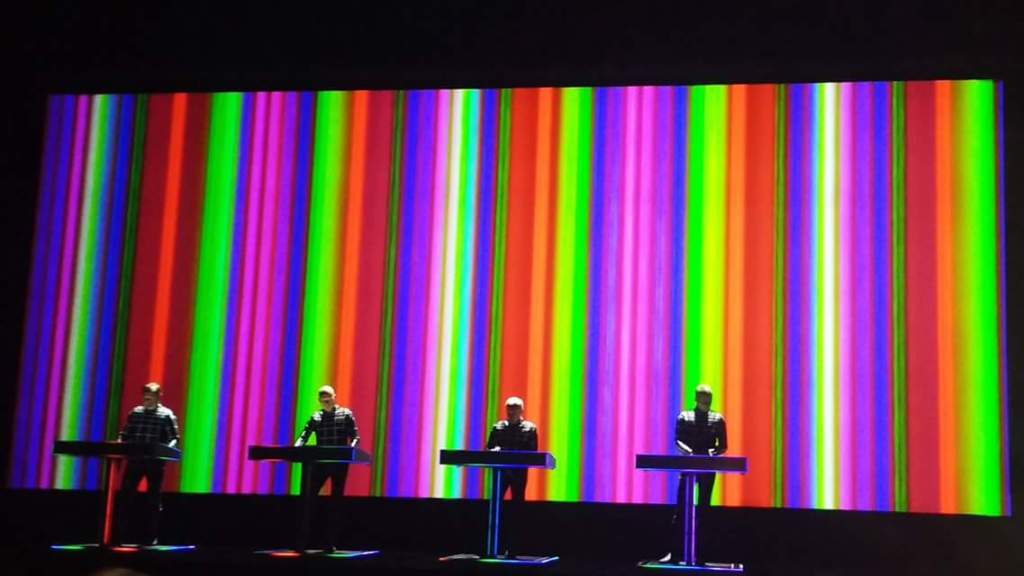
If you’re wondering, like I was before I reached the Orpheum that Friday, exactly what a “3-D concert” is (besides watching three-dimensional musicians perform in a three-dimensional space), Kraftwerk basically performed in front of a stage-sized screen that displayed a moving image to correspond with each song, not unlike a live music video. These images were made to look 3-D through cardboard glasses specifically printed for the show & distributed at the entrance. Now, watching a screen at a live event isn’t all that novel for a 2010s concert experience. In fact, it’s almost become standard. Besides attendees watching acts through their view-blocking, media-capturing smartphones, bands often use projections & display screens to enhance the live music experience. From metal bands doing living room sets in front of projections of silent horror relics to gigantic crowd music festivals using jumbotrons to reach the folk miles form the stage, we’ve all witnessed 2-D visual media incorporated as part of the live concert experience. The concept goes back pretty far down the history of rock n’ roll too, touching on the rudimentary light shows of 60s psychedelia & the multimedia assault on the senses of acts like The Butthole Surfers. There’s something different about the way Kraftwerk is crafting their live experience that makes it more of a recognizably cinematic endeavor, however, and that difference has a lot to do with the immersion & the gimmickry of the 3-D experience.

When trying to conjure the ways live music is gradually becoming more cinematic the first thing that might come to mind is the live performance of movie scores for public screenings. Radiohead’s Jonny Greenwood performed live versions of his There Will Be Blood score for recent events. Prog rock legends Goblin embarked on an entire international tour where they performed their killer score for Dario Argento’s Suspiria along with screenings of the movie. Local musician Hellen Gillet recently performed a live score for Fritz Lang’s silent masterpiece Metropolis at an outdoor screening outside the US Mint in the French Quarter. These examples of cinema seeping into the live music experience are exciting, but they’re also more traditional than they might initially appear. Think back to the early days of silent cinema where soundtracks would be performed by a live, in-house pianist. Updating that dynamic for a pop music context is exciting, but it’s not necessarily the innovation of a homogenous live music & cinema blend that acts like Kraftwerk have been bringing to concert venues.

What’s fascinating to me lately is the film-concert hybrid, a cinematic experience specifically designed to be engaged with as a live musical act. The multimedia performances of Björk’s Biophilia & Laurie Anderson’s United States I-IV were brave steps in that direction, but the first live music cinema experience I can remember attending myself was Dan Deacon’s collaboration with visual artist Jimmy Joe Roche. Live performances of their visual album, the blisteringly psychedelic Ultimate Reality, were singularly overwhelming experiences. Two live drummers set up on opposite sides of the stage in front of an oversized projector screen. They played mechanically in sync over a recording of Deacon’s trademark synth assault, accompanied by a mid-length feature film collage of bright, kaleidoscopic imagery lifted from various Arnold Schwarzenegger films. Ultimate Reality pushes its concert-cinema hybrid even a step further by marrying its aural & visual assault with a loose narrative in which all of Arnold’s movies, from Total Recall to Junior, are melted into an incomprehensible mess of a storyline that doesn’t exactly resemble the story structure of even the loosest, most Lynchian of film narratives or the vibe-driven, movement-based structure of a live concert. Ultimate Reality occupies a strange gray area between those two extremes, the same cinematic live music territory I experienced while watching Kraftwerk 3-D.

Kraftwerk is a seminal band, having played the role of innovator for nearly half a century. Listening to them perform live you can detect the early beginnings of pop music genres as varied as hip-hop, techno, industrial, and (duh) new wave lurking in the sparse, cold sounds of their digital meditations. They marry this slow, synth-soaked hypnosis, each song stretching on for dozens of minutes at a time, with a stark, minimalist, stage show. All four members of the band are centered at their own synthesizer podiums, remaining stoically still as they mix their digital soundscapes into a cohesive whole. It took me almost two songs into their set to even realize that the vocals were being provided live by one of the members. Everything felt so fixed & so clinical. Behind those four synth-commanding demigods stands a gigantic projector screen, which of course displays 3-D imagery related to each song performed. The imagery can range from archival footage of supermodels of the 1950s (during my personal favorite Kraftwerk tune “Das Model”) to crude digital renderings of a pixelated car on the highway (during the song “Autobahn”), an intentionally outdated aesthetic that recalls the look of certain Tim & Eric segments or, perhaps more appropriately, the music video project that accompanied the Death Grips album Government Plates. The rudimentary, elemental nature of these images matched the sparse genre seedlings of Kraftwerk’s music and transported their audience into a cinematic headspace that’s foreign to most concert experiences, even ones aided by higher tech on their display screens.

Unlike Ultimate Reality, 3-D Kraftwerk didn’t form its individual vignettes into a larger narrative whole. Instead, each music video experience was allowed to exist as its own separate meditation, functioning almost like a horror anthology, with the concert hall itself standing in as a wraparound segment. One song dove into the ever-present threat of nuclear war. One meditated on the machine-like efficiency of athletes who participate in the Tour de France. One provided a visualization of the digital landscape where the band’s Tron-like costumes might be considered high fashion. A particularly playful rendition of “We are Robots” had the band replaced onstage with mannequins propped up behind their synth podiums & projected in 3-D behind them. That last moment in particular pointed to the absurdity of paying to see a band so rooted in the artistry of music studio production perform “live” in the first place. The very idea of “a 3-D concert” is an exceedingly ridiculous concept on its own and the band never shied away from pointing to that absurdity. Instead of pursuing a more kinetic stage show, they turned their songs into a collection of short films with live music accompaniment, each devolving into long form meditations on concepts like international travel & “computer love”. The result felt a lot like watching a movie. Instead of feeling comradery with the band, like being within arms’ reach at a $5 punk show, you feel as if you’re watching a collection of mannequins stand before a silver screen; it’s distancing, but it’s also dazzling.

3-D technology has always been a William Castle-type gimmick meant to sell extra movie tickets to audiences looking for a novel & immersive cinematic experience. It was a perfect choice for Kraftwerk to draw an audience in with that cinema-specific gimmick because their live show already feels so similar to watching a movie in the first place. As the screen-heavy multimedia approach to the live concert becomes increasingly cinematic it’ll be interesting to see where other bands can take the basic idea explored by 3-D Kraftwerk, Dan Deacon, and others into new, more narrative territories. It’s not a perfect fit for every musical act, but in a struggling industry suffering long-term declines in album sales the idea of live music cinema could be a great potential moneymaker for bands more prone to in-the-studio tinkering than live rock n’ roll antics. More importantly, though, it could lead to innovative modes of great, cinematic art, the next evolution in both the movie going & live music experiences as we know them. It’s only appropriate that Kraftwerk would be one of the acts on the forefront of that innovation, as they have been with so many other musical advancements since the late 1960s.

wp-1474123650255.jpg
-Brandon Ledet

From Playboy Magazine to Cult Classic Contender: The Box (2009) as a Literary Adaptation

EPSON MFP image

Richard Kelly’s sci-fi mystery thriller The Box might not ever earn the legitimate cult classic status it most certainly deserves. Kelly’s other two features, Donnie Darko & Southland Tales, have already found their own dedicated of cult followings out there in the wilderness of cinematic nerdom, but The Box remains largely unchampioned. There are many, varied complaints detailing exactly why The Box “doesn’t work,” but one of the most common is that it expanded upon a basic premise that needed no depth of context or detail. Before The Box was a sprawling, two hour critical & financial misstep it was a nine page story in Playboy Magazine & a 20 minute episode of the Twilight Zone. When it comes to adapting literary text for the big screen, the critical impulse generally tends to favor the source material in terms of legitimacy, especially in the case of something like The Box, which shows very little, if any regard for solely sticking to the script of its short story origins. By exploding the central mystery of its source material into a galaxy of other unanswered questions, however, The Box far exceeds its origins’ ambitions & successes in my mind. Its DNA in Playboy Magazine & The Twilight Zone is interesting for sure, but nowhere near as fascinating as the places Kelly took the story in his go-for-broke adaptation/bastardization.

Consider the shifted stakes & the heavy-handed morality lesson of The Box’s very first incarnation, a very brief short story published by Playboy Magazine in 1970. The Richard Matheson-penned story “Button, Button” is for the most party reminiscent of what Kelly later brought to the screen. Even its central character names remained largely unchanged: Arthur, Norma, Arlington. However, the story’s scope is ludicrously miniscule as a comparison point, with these three characters more or less representing the totality of relevant players. In “Button, Button” the mysterious agent Arlington Steward drops off a box featuring a button under the cover of a glass dome. He informs the married couple of Norma & Arthur Lewis that if they press this button someone they do not know will die & they will receive $50,000 cash. The husband urges the wife not to push the button out of basic human decency, but she does so anyway, as she does in all three versions of the story (it’d be a pretty go-nowhere plot if she didn’t). What differs in the original text is its last minute twist in which Arthur is the one who is killed the promised $50,000 is collected from his life insurance policy. Incensed, Norma calls out Arlington for claiming that the person who would die would be someone she did not know. Steward retorts by questioning if Norma ever truly knew her husband. As far as morality tales go “Button, Button” is a little slight, but very efficient. However, it raises a lot of interesting, open-ended questions about the origins of its mysterious box & the menacing organization who carry out its machinations, an ambiguity its down-the-road adaptations would greedily revel in.

“Button, Button” was published too late in the game to be included in the classic black & white, Roger Sterling era of The Twilight Zone. Instead it appeared in the much cheaper, much less charming 1980s run of the show. Its basic premise remains faithful to its Playboy Magazine roots, but it does make some significant changes to the details. In the Twilight Zone version the prize for pushing the murder button skyrockets to $20,000, along with an escalation in the economic state of the couple in question. The televised Norma & Arthur live unhappily in abject poverty, with Norma playing the thankless role of a nagging shrew wife & Arthur struggling to provide for the household in a less than glamorous economy. Their philosophical conversations around whether or not to push the button are largely the same as they are in the original story, but they’re nastily heated here in a way that low income couples arguing about money often tend to be. Unfortunately, because the production value of the episode is so ungodly cheap, their tension is conveyed mostly through shouty braying, two performances that might even stand out as over-the-top in an early John Waters provocation.

Besides altering the economic tension of the central philosophical crisis, the televised version of “Button, Button” also crucially changes the detail of its gotcha ending. Instead of killing Arthur, the box only instigates Arlington Steward paying the couple their previously discussed amount, then informing them that it will be “reprogrammed” & passed along to a new household, someone they do not know. Just like the original story, it’s a tidily little morality play, although in this case the lesson is shifted from what it means to truly know someone to the value of the Golden Rule, which was the lesson of most Twilight Zone episodes anyway.

Part of the sprawling brilliance of Richard Kelly’s The Box is how it’s a pretty faithful adaptation of both of these works, yet still drowns out their central life lessons with a deafening sea of existential concerns and batshit crazy plot twists. So much of Richard Kelly’s film adaptation is eerily faithful to its source material, from the exactly look & name of “the button unit” (mostly lifted form the Twilight Zone verson of the story) to the intense focus on domesticity & the home (very strongly emphasized in the Playboy version, if you can believe it). It’s all represented in the first 20 minutes or so of The Box before Kelly blows the whole tightly controlled story apart into something infinitely more expansive & strange. You can tell Kelly was a huge, adoring fan of his source material. It’s just that he gets hopelessly lost in his fascination with its minor details. In the Twlight Zone version, Norma asks “What is this, some kind of survey or something to see who will and won’t push it?” Kelly wants to know what that survey would look like, what it would mean, and what other similar surveys it would constitute. In the Playboy version, Steward admits that he “represents and organization of international scope,” but keeps the details vague & menacing. Kelly wants to know exactly how large & powerful such an organization would have to be to function. You can even see Kelly’s admiration for his movie’s “Button, Button” roots in the details he does decide to change. For instance, when he gives Norma & Arthur a child, he can’t figure out exactly what the child is good for in the story, except as a plot device that allows for more button unit-type moral/existential dilemmas once the plot becomes truly unwieldy.

The Box has a tendency to over-explain or provide too much context for what’s basically a very simple story, but Kelly leaves the overall ambiguity of his source material’s scenario exactly how he found it. He pokes & questions initial vague details presented in the early versions of “Button, Button,” but only so that they give way to even more immense & vague details once they’re prodded. The mistake a lot of reboots, prequels, and reimaginings make is in providing too much context & background info so that all mystery is sucked out of the room in favor of mediocrity. No one liked Death Vader better after knowing he was a little blonde boy who built C-3PO & held his beloved at the lakes of Naboo. However, the kind of context Kelly piles on how somehow makes the story feel more contextless. A lesser, more disciplined mind might’ve stuck to the basic outline of “Button, Button”, but stretched it out to a feature length slog of a moral dilemma. Kelly instead gives it the exact length of time it needed to work itself out on an episode of television, then expands his scope from there, chasing his fascination with the story’s vague, menacing details once the business of a faithful adaptation was out of the way. I don’t think I’ve ever seen a literary adaptation quite like it, even from other films that started as Phillip K. Dick short stories or slight Roald Dahl novellas for children.  Kelly’s film is at once a faithful adaptation and a brazen, no-cares bastardization. Its gaze into the infinity can be at once both cripplingly silly & devastatingly impressive, but looking back to its roots as a miniscule 9 pages in Playboy Magazine only makes Kelly’s fascinating sprawl all the more puzzling. The question, then, is whether or not you find that puzzle entertaining.

For more on September’s Movie of the Month, Richard Kelly’s sci-fi mystery thriller The Box, check out our Swampchat discussion of the film.

-Brandon Ledet