You Can Now Purchase Swampflix Zines @ the Non-Society Hands Shop in the Bywater

EPSON MFP image

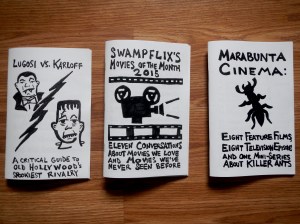
Attention, Swampflix readers in the New Orleans area! We’re now selling the zines we printed for last year’s NOCAZ & N.O. Bookfair exhibitions at the Non-Society Hands shop @3700 Claiborne Ave in the Bywater. This includes print versions of our “Marabunta Cinema“, “Lugosi Vs. Karloff“, and “Wrestling Cinema“pieces, as well as 2015’s Movie of the Month conversations in their entirety. They all feature dozens of new illustrations & hand-transcribed text from the site and the Movies of the Month zine is a ~90 page whopper featuring work from everyone who contributed to the site last year.

DSCN1455 (Modified (2))

DSCN1456 (Modified (2))

dscn1460-modified-2

For more info on Non-Society Hands check out their website and follow them on Instagram. Or, better yet, just drop in on them sometime (Tues-Sat, 12-6 @3700 St. Claude Ave), because they carry lots of other beautiful & strange things you’re going to want to see & touch in person.

3700_2

-The Swampflix Crew

Roger Ebert Film School, Lesson 11: Shiloh (1997)

EPSON MFP image

Roger Ebert Film School is a recurring feature in which Brandon attempts to watch & review all 200+ movies referenced in the print & film versions of Roger Ebert’s (auto)biography Life Itself.

Where Shiloh (1997) is referenced in Life Itself: On page 64 of the first edition hardback, Ebert reminisces about his childhood dog Blackie & all of the cinematic dogs he’s fallen in love with over the years. He writes, “Every time I see a dog in a movie, I think the same thing: I want that dog. I see Skip or Lucy or Shiloh and for a moment I can’t even think about the movie’s plot. I can only think about the dog. I want to hold it, pet it, take it for walks, and tell it what a good dog it is. I want to love it, and I want it to love me. I have an empty space inside myself that can only be filled by a dog.”

What Ebert had to say in his review: “Adults may have the power to take away a kid’s dog and tell him a story about it, but they do not have the right. Some of those feelings came into play when I saw ‘Shiloh,’ which is a remarkably mature and complex story about a boy who loves a dog and cannot bear to see it mistreated. It isn’t some dumb kiddie picture. It’s about deep emotions, and represents the real world with all of its terrors and responsibilities.” -from his 1997 review for the Chicago Sun-Times

If My Dog Skip was proof that fluff films about dogs can easily escape criticism by relying on the cuteness of their puppy protagonists and Wendy & Lucy proved that the human-dog relationship could actually be put to a higher dramatic purpose, where does that leave Shiloh, the third film in the dog-centric trio Ebert narrowed in on as exemplifiers of canine cinema? The answer is somewhere in the middle of those two extremes. Much like My Dog Skip, Shiloh has a cheap, oddly nostalgic schmaltz to it that makes you wonder how it ever escaped straight-to-VHS purgatory in the first place. However, its central story carries a striking brutality that feels way out of place with its generic kids’ movie trappings, aligning it more with Wendy & Lucy‘s emotional harshness on a thematic level. Shiloh is a difficult film to pigeonhole due to the clash of its Hallmark Channel cheese with its the-hard-facts-of-life coldness and the resulting tone is deeply off-putting at times due to this internal struggle. It’s at times exactly what you’d expect from a film about a boy & his beagle and at times the darkest, furthest thing from it.

Shiloh opens with a heartless hunter beating a young beagle due to its stubborn inability to perform simple commands. He eventually kicks the poor pup so hard that it runs away & seeks a new owner in a young boy. In a simpler film the boy’s family would’ve helped him keep the dog away from the evil, abusive hunter. Shiloh surprises by instead raising moral crises about responsibility, honesty, and ownership. The boy’s father insists that he return the dog to the dark-souled hunter, as the dog is legally his property. The hunter treats the dog as a worker or an appliance, not even assigning it a name. The boy loves the animal as a pet, but that doesn’t necessarily give him the right to keep it. He spends his entire summer trying to earn the ownership, attempting to win the dog back both through above-the-board means like money earned from physical labor and through shady practices like theft & dishonesty. The drunken hunter’s villainy is just as much of a grey area as the means through which the boy tries to earn “his” dog back. His coldness is a result of a lifetime suffering through the cycles of abuse & the boy can’t quite fully bring himself to hating the brute, despite his constant threats to kill & maim the dog he loves.

I’m not entirely on board with Shiloh‘s central man-up message that values a very rigid, old-fashioned version of masculinity that honestly is losing its relevance in the modern world. There’s a small amount of criticism of this attitude in the film, like when the hunter explains “It’s just like the Bible says, animals are put here for us. They ain’t got no other purpose or feelings.” This is obviously untrue & is meant to play as a despicable attitude, but there’s still plenty of “A man is only as good as his word” & other toughen-up cliches that rub me the wrong way here. Still, I give the film a lot of credit for raising the stakes so high in its central conflict and making a very real, very terrifying threat of abuse the centerpiece of a children’s movie about a cute beagle. I can see why Ebert was so impressed with how willing the film was to grapple with hefty moral issues. It probably also struck a particular chord with the critic because his own childhood dog, Blackie, was part beagle, a bias he has no problem openly admitting at length in his review. Still, I can only see the film as a very minor work that’s a little overlong for its message & probably undeserving of its two (!!!!) sequels. Although it’s more serious-minded than the suffocating cheese of My Dog Skip I think they’re about on the same level in terms of overall quality. The only film in this makeshift doggy trilogy that deserves to be treated as a work of art is Wendy & Lucy, which is truly fantastic & touching in a way the other two films don’t even approach.

EPSON MFP image

Roger’s Rating: (3.5/4, 88%)

threehalfstar

Brandon’s Rating (3/5, 60%)

three star

Next Lesson: Mean Streets (1973)

-Brandon Ledet

Agents of S.W.A.M.P.F.L.I.X.: Ant-Man (2015)

EPSON MFP image

Superhero Watching: Alternating Marvel Perspectives, Fresh and Longterm, Ignoring X-Men, or S.W.A.M.P.F.L.I.X., is a feature in which Boomer (who reads superhero comics & is well versed in the MCU) & Brandon (who reads alternative comics & had, at the start of this project, seen less than 25% of the MCU’s output) revisit the films that make up the Marvel Cinematic Universe from the perspective of someone who knows what they’re talking about & someone who doesn’t have the slightest clue.

Boomer: Ant-Man came very close to being the second Marvel feature, as a script was shopped around to different studios just a few years after the release of George Lucas’s Howard the Duck. In 1989, Stan Lee presented a basic script treatment to New World Entertainment, of which Marvel Comics was a subsidiary at the time (if you’re wondering about how the film corp that gifted us such cult classics as Rock ‘n’ Roll High School and The Slumber Party Massacre came to own the House of Ideas, I recommend checking out Chuck Sonnenberg’s “The Rise and Fall of the Comic Empire”). Ultimately, production began but was never completed because Disney was working on Honey, I Shrunk the Kids at the time. Depending upon conflicting reports, New World either didn’t want to put out a film that would have similar concepts as the much higher-budgeted Disney film, or they didn’t want to be perceived as copycatting the more successful studio; whatever the reason, the movie was not meant to be. Over a decade later in 2000, after the surprising success of Private Parts, shock DJ extraordinaire Howard Stern attempted to purchase the rights to make an Ant-Man film, but this concept never came to fruition either.

In 2003, a couple of years after the end of his successful British comedy series Spaced (starring frequent collaborators Simon Pegg and Nick Frost, as well as Jessica Hynes nee Stephenson, who won a best newcomer award for her performance on the program) but a year before the release of surprise cult hit Shaun of the Dead, writer/director Edgar Wright and his writing partner generated a treatment for Ant-Man. There are still large parts of Cornish/Wright’s ideas present in the final film despite the number of cooks who had a hand in the broth, like the idea that Scott Lang is a burglar, but Wright himself has said he doesn’t think the script ever made it very high up the chain at Artisan, where it was being pitched. Wright also cited influence from the novels of Elmore Leonard, author of Rum Punch (i.e., the source material for Jackie Brown) and Get Shorty, but was advised to make the script more family friendly, which he did before pitching a new script to Kevin Feige in 2004. This script had even more conceits that filtered into the 2015 film, like the inclusion of both Lang and original Ant-Man Hank Pym, and that the plot point that the two would become reluctant partners. Feige loved the concept, and when the first partnerships that would eventually bring the MCU into being were being forged in 2006, Marvel officially hired Wright to handle the Ant-Man film.

The development of the film from there was slow. Wright made occasional announcements about the film over the next five years; as Ant-Man was not a flagship character like Captain America who could carry a tentpole feature, production on the film was a fairly low priority, with Wright and Feige working on refining the script over the course of a few years. As a result, the MCU took off and gained popularity while Wright’s script kept being polished; by 2010, Wright had announced at SDCC that the film would not line up with The Avengers (putting to bed rumors that Ant-Man would be a founding Avenger, as he was in the comics). This further fueled speculation that Ant-Man wouldn’t be anchored in the greater narrative of the MCU at all, as Wright said his origin story didn’t quite fit. This, too, became a part of the final film, as the origin story for the original Ant-Man takes place in a time period not previously seen in the MCU, with Hank Pym acting as a secret hero during the Vietnam War. Finally, in 2013, Feige announced that Ant-Man would be produced as part of Marvel’s Phase Three, although the film would ultimately end up closing out Phase Two instead.

In March of 2014, rumors began to swirl that Wright might be leaving the picture. By this time, Michael Douglas and Paul Rudd had both been cast in their roles as Pym and Lang respectively, and Evangeline Lilly had just joined the film as Hope van Dyne. The film was on either its fifth or sixth draft, and Wright seemed to be increasingly frustrated with Marvel’s attempts to cram in as many connections to the rest of the franchise as possible, which Wright felt cheapened his vision. Two months later, Wright and Marvel announced that he had left production, and it was unclear what would happen to the project; Variety suggested that Cornish could take over, but Marvel chose not to go that way. Director Adam McKay, who was best known for his collaborations with SNL alum Will Ferrell (including Anchorman, Talladega Nights, Stepbrothers, and The Other Guys), was tapped as a potential new director, but his campaign for the role ended after a single day. McKay was kept on to rework the script (along with Rudd), and Peyton Reed (who had helmed Bring It On as well as a few episodes of the last season of Mr. Show, including the acclaimed finale) was brought on to direct. Although there was some concern that the shake-up would lead to a lack of success for the film, it garnered a decent enough box office return to secure a sequel.

Brandon, what did you think of Ant-Man?

EPSON MFP image

threehalfstar

Brandon: When trying to piece together exactly where Ant-Man fits in with the rest of the MCU, it seems that Guardians of the Galaxy is the only viable comparison point. Both properties exist almost in total isolation from the rest of the franchise (so far), tenuously connected only through a brief cameo from lower-tier characters like Falcon or Thanos or S.H.I.E.L.D.. More importantly, though, due to this isolation they’re both the only MCU properties allowed a certain amount of freedom in straying from Marvel’s so-called “house style”. In Guardians of the Galaxy, director James Gunn’s usual madman sadism was tempered somewhat by the PG-13 mold Marvel has aimed for in each of its individual properties, but the compromise between the two extremes wound up producing one of the best, most crowd-pleasing works in the franchise to date. Ant-Man is less of a success story in the tiny auteur vs. gigantic corporation divide. Edgar Wright has a very strong comedic voice that carries across as distinctly his own in films like Shaun of the Dead & Hot Fuzz and it’s that very voice that made the idea of him directing Paul Rudd in a movie about an ant-sized superhero super exciting. (I’m currently going through the same excitement phase with Taika Waititi’s upcoming Thor sequel.) Wright was ultimately less able to compromise with Marvel than Gunn over how much creative control he was willing to cede and the movie suffers somewhat from him having been pulled from the project before completion. Bring It On‘s Peyton Reed was a serviceable replacement & there’s still tons of Wright’s personality lurking under the surface here, but it’s difficult to watch Ant-Man without wistfully imagining the film that could’ve been with Wright fully at the helm.

Whether or not the final product is somewhat compromised by the behind-the-scenes shenanigans, Ant-Man is still remarkably charming as is. There’s honestly too much going in the film’s favor for it not to be. I mean, Paul Rudd is cute & all, but a miniature Paul Rudd? Who could resist that? I have, as I’m sure many people do, a bad habit of geeking out over how cute miniature models are, so whenever they pop up in a film like Beetlejuice or Pee-wee’s Big Holiday much of my critical eye goes completely blind & I’m enraptured. For instance, while recently watching the animated Batman movie Mask of the Phantasm I was fascinated by the climactic brawl with the Joker inside his Gotham miniature and it ended up being my favorite hand to hand combat scene in any Batman film. Ant-Man features a somewhat similar climactic battle involving a child’s train set that’s likely to be the closest we’ll ever come to seeing a live action version of that altercation in a superhero film. That’s not the only aspect of the film that checked off my particular boxes either. I went on a huge kick of watching films about giant ant attacks last year (there’s more than you’d think!) that put in me in the exact right frame of mind for this movie’s insectoid thrills. The innerspace visuals of microscopic shrinking-down touched on my affinity for cosmic psychedelia. The classic comedy structure of the film’s plot was a perfect primer for the silliness of its premise (where a Nolan-level of seriousness would’ve failed miserably). On paper Ant-Man does everything exactly right, if not exactly Wright.

So much of Ant-Man is endearing merely by default that it’s almost disappointing that it’s a really good film instead of a stunningly great one. As a self-contained episode within a franchise that has to bend over backwards to include all of its moving parts in films like Age of  Ultron it’s  a a nice break from the norm. There’s no true way to tell if the film could’ve been more than that if Wright had stayed in the driver’s seat, but that nagging question will always remain. I guess we’ll have to see how the promised sequel, Ant-Man and the Wasp, does without his guidance entirely.

EPSON MFP image

fourhalfstar

Boomer: My review of Ant-Man was the first thing I wrote for Swampflix, and after re-watching it, I stand by my high score of it and my appreciation for its themes, scope, imagery, and ideas. The sight of tiny Scott Lang running around in ant tunnels and riding a flying insect like a mighty steed is perfection, and I wouldn’t have wanted anything other that what we have here.

On the other hand, it would have been a lot of fun to see how the film would have been composed if Wright had been kept on to complete production. Shaun of the Dead might be his most popular original film, but I have the softest of spots in my heart for Hot Fuzz; when I’m having a bad day and need to laugh a lot, Hot Fuzz is the movie I turn to in order to lift my spirits. It’s a comedy that parodies over-the-top buddy cop flicks, but the best thing about it is that it doesn’t sacrifice a good mystery plot in order to focus on references and allusions. The film presents you with enough hints that you can solve the mystery alongside Pegg’s Sergeant Angel, but when he reveals his solution to the crime he’s wrong, despite all of his logic being completely sound and his assumptions being consistent with all available clues. That’s a stroke of brilliance that most best-selling mystery peddlers can’t pull off, and Wright managed to do it in a film that was first and foremost a pastiche comedy. As good as Ant-Man was, I can only assume that most of its best moments came from Wright, and I wish I could see the film as he wanted it to be seen.

I’ll also reiterate how much better this film is than Age of Ultron. When I first saw Ant-Man, it had been a few months since I saw the Avengers sequel, and I had only seen both films once. Although my opinion of Ultron has actually gone up in the intervening time, as I mentioned in our Agents review of that film, Ant-Man still stands head and shoulders above that film in regards to characterization and fun. The bedroom-based fight between Lang and Yellowjacket, for instance, is more dynamic and exciting than ten overlong Sikovian slow-mo panorama fights, no matter how much we were being directed to find those sequences epic. I’ll admit it: Thomas the Tank Engine being thrown through the air and bursting out of Paxton’s house was more exciting than watching a knock-off CGI-garbage Transformer make a city fly off from its moorings. I can’t say enough good things about Ant-Man, except to say that if you’re reading this and you miss the days when “nerd humor” was actually nerdy and not regurgitated trash like The Big Bang Theory, you should really check out Spaced.

EPSON MFP image

Lagniappe

Brandon: Paul Rudd is very funny in this film & deserves all the attention he gets in the starring role, but Michael Peña steals the show for me. He nails the film’s oddball humor with every line-reading afforded him, which is no surprise given Peña’s history in excelling in comedic scumbag roles. What did surprise me, though, is that the actor more or less resurrected his exact character from the underappreciated Jody Hill black comedy Observe & Report here. Both Peña roles are a wonderfully absurd collection of self-contradictions & pitch-perfect deadpan and if you love what Peña delivers in Ant-Man I highly recommend giving Observe & Report a gander, since his gives his particular weirdness a little more room to breathe.

Boomer: So, where does this film fit into the larger MCU? Well, we get another look at the new Avengers facility after the team relocated to an abandoned Stark production plant following the realization that putting their headquarters in the middle of New York was a horrible idea (I will miss the tower, though). We also get to see Anthony Mackie again, which is always a lot of fun, and the scene between Falcon and Ant-Man (while probably the kind of thing that Wright was looking to avoid) was a good way to connect this film to the larger universe without making room for more heroes. The plot also has Lang ask why the Avengers shouldn’t be called in to help out in this situation (a question that a lot of viewers have, although this has never been something that mattered to me), and we get the legitimate answer that not a lot of people have faith in them, which will tie into the plot of the upcoming Civil War. And I personally can never get enough of best-MCU- character Peggy Carter, so getting to see her as an older S.H.I.E.L.D. leader was delightful.

This may also be the last time that Hydra plays a significant role in the MCU as (spoilers for Agents of S.H.I.E.L.D.), this week’s episode “Singularity” saw Coulson and Agent May watching as the evil organization’s remaining bases of operation were wiped off the map. This comes on the heels of a season and a half of plots that mostly focused on the rise of the Inhumans, and recently tied the two together with the revelation that pre-Nazi Hydra was a cult devoted to worshipping an ancient Inhuman that was banished to a distant planet. It was a bit of an (intentionally) anticlimactic end to an organization that went from being a relatively character-specific antagonistic force to the unified faction of evil that permeated many of the films (and programs) that followed, but I’m looking forward to an MCU that doesn’t feel the need to tie all of its antagonists back to Hydra in some way. This was another one of Ant-Man’s strengths, insofar as Yellowjacket’s plans to sell the suit prototype to Hydra was a matter of irresponsible capitalism (the greatest of evils) and not a devotion to their questionable ideals. Given that Marvel has withdrawn the upcoming Inhumans film from its production schedule, it looks like there may be even more divergence between the film and TV franchises in the future.

As a comic book reader, the thing that I liked least about the way that the MCU has adapted different plotlines is that Scott Lang’s inclusion in this film meant that the Scott-Luke-Jessica love triangle that was so well handled in Brian Michael Bendis’s Alias (the inspiration for Netflix’s Jessica Jones) couldn’t end up on the JJ show. I was always a fan of how Jessica’s relationship with the two different men and their respective worlds (with Scott as a member of the Avengers and Luke as a man who was more on Jessica’s level) said a lot about Jessica as a person and the things that were important to her. Still, Jessica Jones was a great show and definitely worth the minimal time investment it asks of you.

EPSON MFP image

Combined S.W.A.M.P.F.L.I.X. Rating for Ant-Man (2015)

fourstar

-Agents of S.W.A.M.P.F.L.I.X.

Movie of the Month: Girl Walk // All Day (2011)

EPSON MFP image

Every month one of us makes the rest of the crew watch a movie they’ve never seen before & we discuss it afterwards. This month Brandon made Boomer & Britnee watch Girl Walk // All Day (2011).

Brandon: Mashup DJ Gregg Gillis, better known by the stage name Girl Talk, releases all of his sample-based mixtapes for free through an imprint collective named Illegal Art. This isn’t necessarily a choice based in artistic integrity (although Gillis himself does have a lot to say about the legitimacy of copyright laws), but rather a product of the circumstance that Girl Talk tapes would be illegal to sell commercially. In an industry where hip-hop artists & pop music producers are careful not to get sued over borrowed melodies & uncleared samples, Gillis composes his music entirely out of repurposed, previously copyrighted material. His work as Girl Talk is fantastic party music, but it’s also commercial suicide. I assume Gillis makes most of his money mixing songs at live gigs since the art he’s most well known for is decidedly “illegal”.

Having this uncopyrightable material floating around out there has its advantages, though. For instance, a rogue dance crew could, say, make a full-length music video centered around one of your mixtapes without any fear of legal persecution (at least not from the DJ). Girl Walk // All Day is a movie-length dance video constructed around Girl Talk’s 2010 album All Day (which is still his most recent full-length mashup release). The film (and I do think it qualifies as a legitimate film) seems to take Gillis’s “illegal art” imprint as a mission statement. Stealing its soundtrack & candid reactions from outside sources and operating around what presumably had to be permitless film shoots, Girl Walk // All Day has an inherent sense of danger at its center that makes the film feel like it shouldn’t exist. Yet, its star dancer Anne Marsen (billed simply as “The Girl”) brings a childlike exuberance to every scene that makes the movie feel like it does have a right to exist even if it’s on earthquake-scale shaky ground legally, as if good vibes & positive intentions should outweigh any potential scandal. Girl Walk // All Day is frequently removed from YouTube & broken into annoying chapter segments on Vimeo due to its inability to secure an official release, but when you watch the film you’re left wondering exactly why someone (or some corporation) would want to crush or erase a work so joyful & goodhearted in the first place, uncleared music samples or no.

Legality aside, I feel like the first thing we have to address about Girl Walk // All Day is whether or not it has a legitimate claim as a feature film. It screened at film festivals, it made critic David Elrich’s Top Films of 2012 countdown, it has several narrative arcs that run throughout its 74 minute runtime (one about The Girl’s personal growth as an antonymous woman, one about a love triangle where she’s caught between The Creep & The Gentleman, and one about the sprawling structure of NYC), but it’s easy to see how someone could brush the film off as an overlong music video. Britnee, where do you fall on this divide? Is Girl Walk // All Day a modern spin on the dying art of the cinematic musical or does its thin, near dialogue-free narrative exclude it from consideration as a legitimate motion picture?

Britnee: First and foremost, I was unaware of the legality issues with Girl Talk’s music prior to this conversation. I always thought that he had permission to use all the popular music samples in his mashups. I’m far from being a Girl Talk expert, but the thought just never crossed my mind. It’s amazing how his musical career is so huge while he’s surrounded with so many copyright issues. This makes Girl Walk // All Day seem so dirty, and I like that.

As for your question of Girl Walk // All Day being considered an actual film, I would have to say that it’s most definitely a legitimate film. I can also see how some would consider it to be an “overlong music video,” but I consider many music videos to be the equivalent of short films. Take Madonna’s “Like a Prayer” or, more recently, Adele’s “Hello” music videos for example. How could those not be considered cinema? Music videos are directed, contain acting, and tell a story. Is that not what makes a film, well, a film? Girl Walk // All Day does contain quite an interesting plot, and although the film contains no dialogue whatsoever, emotions are portrayed through expressive dance and facial expressions. That doesn’t make it less of a film; it just makes it a little different.

The dancing in Girl Walk // All Day was so contagious. Just watching The Girl dance her heart out all over New York City gave me such a sense of freedom, to the point that I was getting a bit lightheaded (I was only drinking water during the viewing). Boomer, if you were one of the many bystanders during this film’s production, would you join The Girl in quick jig or would you walk on by? Did you find her to be a likable main character or did you find her to be annoying and intrusive? What exactly did you make of The Girl?

Boomer: That’s a good question. At multiple points throughout the film, I found myself identifying with many of the people that The Girl encounters, the willing and unwilling participants alike. Although several of these passersby seemed disinterested in participating, she actively seemed confrontational with many of them (the one which stands out in my mind is the man whose hand she grabs while wearing the “Dance With Me” sandwich board), which didn’t sour me on the character but did leave a bit of a bad aftertaste in my mouth. Having lived in a few different cities, I can certainly say that my experiences with unsolicited engagement with others is not always pleasant. Over the course of the film, I found myself very much wanting to dance with The Girl in theory, but I don’t know if I would have actually had that desire in practice and in the moment. It’s pretty unlikely that the Girl Talk tracks that appear in the film were diegetic, given the movement from place to place and general public reaction, and as such I feel like my first instinct would be to avoid a potentially dangerous person approaching me, dancing to a song that I cannot hear. Other factors, like what kind of mood I might happen to be in when The Girl chanced upon me and whether I was in a hurry to get to work or another engagement would also affect how willing I would be to join in her movements, sublime though they might be. I want to answer your question with a resounding “Yes,” but I just don’t know if I would actually do so should the opportunity arise.

I’m talking, of course, about those scenes in which she is dancing through crowds and on the streets. Some of the Staten Island ferriers are utterly disinterested in her performance, and many of the people who seem taken aback by her look like NYC tourists to me. It makes sense that residents would be nonplussed by The Girl and her apparent mania, in contrast to visitors who are less accustomed to every performer within a 25 mile radius desperately fighting for attention and notice. Still, as fun and flouncy as the narrative is, there was an undercurrent to it that felt off, as none of the people captured on film seemed to have given their prior consent to being filmed, which is troubling despite how much joy I, as a passive observer, got out of the performance. I don’t know that I would find her annoying, and I really wish I could unequivocally say that I would have given in to the movement, but I know that I would have found her intrusive.

That may be why I got more enjoyment out of the less candid scenes. The opening scene in the ballet class and the overpass breakdancing dance off were a lot more fun to me, as was The Girl’s voguing in an alley with no other people around. There’s an exhilaration to the street scenes that I would find anxiety-inducing were I to be involved as a performer, and I like that the more rehearsed sequences felt a little calmer (but no less exciting) in that regard. Still, I didn’t care for The Creeper dancing with flowers in the park, despite the fact that it was one of the sequences that did not feature non-performers. It lacked some of the verisimilitude (insofar as that word has any meaning in a film like this) of the rest of the film, and I found it lacking as a result. What do you think, Brandon? Did you prefer the sequences that featured random people being pulled into the mix, or the more standard, “closed set” sequences?

Brandon: The individual set-ups in Girl Walk // All Day work for me on kind of a case-by-case basis. There’s so much going on in this film (which, although manicured to an extent, must’ve been a chaotic shoot) that each of the moving parts can be hit or miss depending on the execution. I’d agree that the closed set shoots do feel more purposeful in a general sense than the candid shots of The Girl interacting with the public do, but they sort of have to for the film to make sense narratively. Take, for instance, the graveyard flowers scene Boomer just mentioned. It’s a somewhat jarring tangent when the flowers first appear because they exist outside the Girl-Creep-Gentleman dynamic we’re used to until that point. However, the scene does carry a lot of significance to the film in a narrative sense, since it’s in that moment that The Creep literally grows a heart inside that dancing skeleton of his and makes the transition from antagonist to socially inept beau. The only “scripted” scenes I was lukewarm to, honestly, were the ones centered on The Gentleman, since he was the most static, least interesting character of the central trio. I guess it was fun for a moment to watch the random hardcore parkour dude steal his hat, but that’s about all there is worth mentioning.

As for the candid video interactions with the public, I think Anne Marsen’s performance as The Girl has a lot to do with how they go individually. She has an insanely infectious smile that can make you want to join in as well as a cartoonish grimace that can make you want to back way, way off. Marsen has incredible control over her physical language & expression (as I’m sure most talented dancers must) that can make interactions either inviting or confrontational depending on her desired effect. I’m in total agreeance with Boomer that the discomfort of these scenarios isn’t something I’d necessarily want to live through as a passerby, but The Girl’s mock aggression does make for some especially great moments in the film. I’m thinking not only of the aforementioned “Dance With Me” sandwich board sequence where she’s shown mentally unraveling & a scenario where’s she’s booted from a baseball game by the nonplussed security team, but particularly of the glorious moment when The Girl appears loaded with shopping mall ephemera in a high society fashion bitch outfit to taunt Occupy Wall Street protestors. It’s a beautifully over-the-top exchange that not only solidifies Girl Walk // All Day as a work of highly-functional performance art, but also a document of a very specific moment for NYC/America at large.

In most cases it’d be a massive cliché to say that New York City itself is a character in a piece of film criticism, but I feel that faux pas is inescapable here as it’s quite literally true. Not only are citizens (and tourists) of NYC roped into the production as performers, but The Girl’s personal journey (into adulthood? autonomy?) is more or less told through a guided tour of The Five Boroughs. Historical markers like Occupy Wall Street & the pop songs Girl Talk samples on the soundtrack are also very specific to the cultural zeitgeist of a particular time. Britnee, how much different would Girl Walk // All Day be if this physical & temporal setting were shifted? How different would the film be if it were set in, say, 2016 New Orleans? Are the time & place of its setting and the era of its pop music soundtrack entirely essential to its existence the way they’d be in a documentary?

Britnee: I’m quite unfamiliar with NYC as I have never visited the city nor do I personally know any residents, so I probably missed a good bit of symbolism that NYC offered Girl Walk // All Day. However, I am not that out of the loop and thoroughly enjoyed the hilarious yet profound Occupy Wall Street scene. I do think that the film would be very different if set in a different time and place. Music style and social issues change through time and by location, and these are major components of the film. The film’s essential message of self-acceptance and personal freedom might be the only thing that would not be all that different if this film were not set in 2011 NYC. It’s interesting that you brought up the question of the whether or not the film’s setting and music serve the same importance in the film as in a documentary. I definitely think that the importance of time and place in Girl Walk // All Day is very similar to that of a documentary. Her actions and the film’s music would hold a different meaning if she were to dance through Miami in the late 1980s or Atlantic City in the 1930s.

If set in modern day New Orleans, the film would be slightly different as New Orleans seems to be really different from NYC. Current issues New Orleans faces include gentrification, social segregation, and uncontrollable crime. I’m sure that the same issues occur in NYC, but not on the same level as they do in New Orleans. I can imagine The Girl dancing up a storm out in the Bywater to one of those extra-long bounce remixes Q-93 plays on Saturday nights. As she dances her way through the neighborhoods, life-long residents pack moving trucks while white upper middle-class families unpack moving trucks, carrying boxes to their new homes. Oh, and she would need to definitely leave that windbreaker behind since it’s always hot as hell down here.

Boomer, would you like to see more films in the style of Girl Walk // All Day? What particular album (from any artist) would you like to see turned into a film? And where would the setting be?

Boomer: Oh man, what a great question. The first album that springs to mind is The Decemberists’ Picaresque, if only because that album already has a particularly narrative quality. A film version of Picaresque would have to take a different approach, acting as more of a series of vignettes through which a dancer could travel; I would also see this as having more of an exaggerated, fantastic visual leitmotif, perhaps moving through several different areas inside a vast theater with individual plots being acted out in different small set pieces (or perhaps I’m just being too influenced by the album artwork in my imagining, as the characters I’m picturing all have the same ghoulish, caked-on white makeup as the members of the band). I would also love to see a film set entirely to Visions by Grimes; I imagine it as a Miyazaki style animated feature following Grimes herself as she makes her solitary, heroic way through a colorful jungle, a barren desert, a village full of people who refuse to interact with her (maybe they’re ghosts?), and other familiar Hero’s Journey locations, with each new track bringing her to a new locale.

Moving back to something more grounded (again, as much as that word can apply to anything in Girl Walk), I’m having a hard time trying to think of a particular album that’s actually New Orleansy enough to work in this context. Although they’re Brooklyn-based (or were 5 years ago, the last time they updated their Facebook page), I’ve always thought that Snakes Say Hisss! had a dirty South synth aspect to them, and I’ll Be Loving You feels right for something like Girl Walk filtered through a South Louisiana lens. The film could start in the Bywater (I imagining the film opening just like the video for NOLA-based Jean-Eric’s track “Better than Good”) with “Talk,” then move into the Marigny with “We Are Hot” before getting deep into the Quarter with the next few tracks before hitting the CBD with “Take It Slow” and “Right Behind You” (this track in particular makes me think of the rich carpetbaggers in suits hanging around the offices near Ampersand and Jos. a Bank). “I Control the Wind” is totally MidCity, as is “Avalon,” despite its region-specific references. I could go on, but I encourage people to listen to the album and trace their own journey, really. Of course, this runs the risk of locking non-Louisianans out of the loop, but that’s never really been a concern for large scale productions set on the coasts, has it?

Lagniappe

EPSON MFP image

Britnee: I love how this film made me insanely happy the entire time. There wasn’t a moment when I felt even the slightest bit disinterested. Films that contain the amount of good vibes given off in Girl Walk // All Day are a rarity.

Boomer: I agree with Britnee; this movie was a delight and it made me want to dance. In the intervening time since the viewing, I’ve found myself dancing to myself in spite of the general inappropriateness of the given situation. And although this isn’t a complaint (merely a fact of life), I’m with Britnee in her hesitant appreciation for the NYC-specificity of the film overall. I recently had a conversation with a friend (well, a member of a rival trivia team, but whatever) who was shocked that we were familiar with the Queensborough Bridge. He hails from New Jersey and was shocked that Southerners would know about a relatively unremarkable landmark in New York; I had to explain to him that all of America lives under the iron fist of NYC’s cultural stranglehold, for better or worse. Still, given the rate at which gentrification is rotting the soul of that city (as it is in New Orleans, and here in my new home in Austin), it’s entirely possible that Girl Walk may one day be remembered as one of the last pieces of real art to come out of the boroughs before all the artists actually starved to death.

Brandon: Besides whole-heartedly backing Britnee’s concept for a New Orleans version of Girl Walk set to a Q-93 Social Shakedown mix (not a bad idea for a Kickstarter campaign, honestly), I’d also like to conclude my thoughts here by highlighting my favorite section of the film: the shopping mall sequence. Just before The Girl emerges to taunt the Occupy Wall Street crowd, she gets through a butterfly-like metamorphosis at the shopping malls of Times Square. I’m typically a sucker for shopping mall delirium in film, anyway; it’s usually the imagery that sticks out for me when it’s done right, with Clueless, The Night of the Comet, Invasion USA, and the 2007 Dawn of the Dead remake being a few key examples off the top of my head. However, I think part of the reason it sticks out so much here is that it’s one of the better moments where The Girl is allowed to focus on herself instead of her place in the Girl-Creep-Gentleman love triangle. The self-reflective nature of consumerist pleasures like make-overs & fashion upgrades provides The Girl a lot of personal space to emerge as an oversexed butterfly in a moment that oddly glorifies & satirizes femininity as a performance & an identity.

This sequence always makes me so happy & by the time The Girl appears crunking in her Tell Me About It, Stud leather get-up at the end of it, I always get a little overly giddy. If the idea of watching Girl Walk // All Day in its entirety sounds a little too exhausting for some folks, I at least suggest checking out that particular chapter in isolation, especially since the film is often broken down into those rigid divisions anyway (instead of its ideal state as a fluid, continuous work).

Upcoming Movies of the Month:
June: Britnee presents Alligator (1980)
July: Boomer presents Citizen Ruth (1996)

-The Swampflix Crew

That’s So Ava!: Only Lovers Left Alive (2014)’s Potential Second Life as a Multi-Cam Sitcom

There’s a certain crop of 90s art house films that I can never quite fully give into despite their consistently positive reputations. Titles like Clerks, Slacker, and Living in Oblivion are supposedly essential to the voice of a disaffected, laid back generation of arty farty types, but I often have a difficult time connecting with what they’re selling (possibly because they pretend not to be selling anything at all). Gen-X cinema often purported to be the laid back slacker counterpoint to the over-enthusiastic, grandiose generations that came before, but in actuality felt more try-hard & fresh out of art school than ever. The king of this I Don’t Care At All (But I Secretly Care Too Much) aesthetic is, in my mind, one Jim Jarmusch. Jarmusch’s intentional art house pretension leads to some interesting moments that all too often get drowned out by the suffocating self-indulgence that surrounds them. There are some amazing small moments & images in Jarmsuch titles like Mystery Train, Broken Flowers, and Coffee & Cigarettes, but all three of those examples leave me so frustrated because they ultimately feel like wasted potential when considered in their fatally affected totality.

As much as I can be frustrated with Jarmusch’s overall product, I genuinely enjoy his sillier flourishes. Besides poking fun at his own self-serious mystique on the show Bored to Death & appearing as the “French fried potater” salesman in Sling Blade, the director always includes a flight of fancy or two in his works that catch my attention & delight me. Bill Murray serving diner food to the Wu Tang Clan, Steve Buscemi getting hung up on Lost in Space trivia, and (in my only pet favorite from the director’s catalog) Roberto Benigni annoying the piss out of Tom Waits are the kinds of breath-of-fresh-air moments of sublime humor that nearly save his work for me. Nearly. If Jarmusch dealt exclusively in broad, yuck-it-up comedy instead of using it to punctuate his more intellectual tendencies toward existential self-reflection I might even be willing to call myself a fan.

I waited as long as possible to catch up with Jarmusch’s most recent work, the vampiric existential crisis piece Only Lovers Left Alive, despite my burning fan worship of bonafide changeling Tilda Swinton (who was on fire that year, considering her work in Snowpiercer & Grand Budapest Hotel). Something about the film’s promo material struck me as a lowkey remake of The Hunger (I still don’t think I was entirely off-base there), which is one of those delicately immaculate cult films that probably should not be touched or even cautiously approached. Buried somewhere deep in the film’s ennui & self-pity, however, was one of those typical Jarmusch saving graces I’m prattling on about here. Mia Wasikowska, who has dazzled me before in titles like Crimson Peak & Maps to the Stars, absolutely steals the show in Only Lovers Left Alive. There’s some kind of self-important rock star cool at the heart of Tom Hiddleston & Tilda Swinton’s titular vampiric lovers that honestly bores me to no end in the film, but Wasikowska’s wonderfully disruptive, chaotic presence brings the film, well, back from the dead with the minuscule screentime she’s allowed. Swinton’s matriarch vampire Eve (her vampy hubby’s name is Adam btw *puke*) is struggling with the tedium of centuries-long survival, but her younger, still-stoked sister Ava is a frivolous hoot. She consistently fucks up, wreaks havoc, and over-indulges like a spoiled brat, a behavioral pattern Adam indicates is habitual . . . which finally brings me to my pitch.

Imagine for a minute an alternate, preferable universe in which Only Lovers Left Alive isn’t a stuffy art house film about addiction or romantic ennui or whatever, but instead a multi-cam sitcom with a laugh track in which Wasikowska’s vampire brat Ava crashed the gloomy party every week in spectacular fashion. I want to go to there. Adam & Ava have an exquisitely balanced Odd Couple dynamic. His gloom & her glitz clash beautifully & hilariously, but aren’t given nearly enough screen time to fully play out. Fairly soon after Ava arrives from Los Angeles & burns Adam’s entire life to ground, he’s stuffing her into a cab so that he can pout & whither with Eve in Europe somewhere. Boring. It’s not fair to me as a trash-loving citizen of the movie-going audience. I demand more goofy, disastrous Ava antics, preferably delivered to my television set on a weekly basis with a laugh track prompting me on when to chuckle & slap my knee. Wasikowska delivers a stellar performance here as a bubbly (unintentional) antagonist brat & I could watch her do that shtick for at least 100 syndicated episodes of a formulaic sitcom.

Unfortunately, Wasikowska feels like she’s performing in an entirely different movie form everyone else (Amy Heckerling’s underrated gem Vamps, maybe?) and, although I understand the sentiment is far from universal, it’s a movie I’d much rather be watching. This film’s Gen-X aesthetic hangover just doesn’t do it for me the way an Ava vs. Adam sitcom would. I’m totally okay with how vapid that makes me sound; I just also wish that I had the funding to make the ultimate reality where we had a That’s So Ava! sitcom meld with our own. The world would be a much better place for it.

-Brandon Ledet

Scott Valentine’s Other Over-Sexed Demon Feature: To Sleep with a Vampire (1993)

EPSON MFP image

As Boomer mentioned in our Swampchat discussion of April’s Movie of the Month, the romantic horror comedy My Demon Lover, the film’s star Scott Valentine had struck it somewhat big as a bad boy heartthrob on the televised sitcom Family Ties, but mostly failed to convert that success into a long term film career. It wasn’t for lack of trying, though. Valentine had a long string of starring roles in minor titles throughout the 80s & 90s, but his turn as the titular monster in My Demon Lover would mark the high point of a career that never truly took off. Topping out with My Demon Lover might help explain why the actor later returned to the antiheroic position of romantic love interest/supernatural threat in the straight-to-VHS oddity To Sleep with a Vampire six (six six) years later. To Sleep with a Vampire & My Demon Lover are two vastly different films working in two entirely separate genres (the erotic thriller & the romantic comedy, respectively), but Scott Valentine’s starring roles as the dangerous, titular love interest in both works serve as a clear connecting piece between them.

Some of the genre markers of To Sleep with a Vampire are seemingly at war with themselves. The film opens with Scott Valentine stalking back alley as if he were the brooding antihero in a self-serious neo-noir, immediately announcing himself as a vampiric threat. Once the film shifts gears, Valentine does his brooding in a cheap strip club, revealing the film’s true nature as a sleazy erotic thriller. To Sleep with a Vampire commits a little too earnestly when it reaches the strip club, indulging in so many passionless strip teases that it started to feel like a strange, vampiric modernization of the Ed Wood-penned “classic” Orgy of the Dead. Thankfully,the film eventually moves on and blossoms as being . . . actually pretty great? Valentine’s vampiric sex demon materializes at a sleazy strip club not only to oggle, but to search for a potential victim, one he finds in a down-on-her-luck stripper who is hopelessly suicidal due to an estranged relationship with her young son. The stripper, who’s essentially hit rock bottom on this particular night (and, thus, more attractive to her vampire predator, since killing someone suicidal is justifiably more ethical), is convinced to follow the bloodthirsty beau back to his bachelor pad (lair?) to discuss the delicacies of mortality until he plans to feast on her blood just before sunrise. Eventually, they bone.

A straight-to-VHS triviality produced by Roger “The Best There Ever Was” Corman, To Sleep with a Vampire is far more entertaining than it has any right to be. At times threatening to devolve into a deeply misogynistic masturbation fantasy for immature man-children, the film gradually reveals itself to be something much more poignant. Its all-in-one-night plot structure eventually morphs the film into something of a glorified stage play (from way, way, way, way off Broadway) akin to Steve Guttenberg’s passion project PS Your Cat is Dead. It’s far from the vampiric romance of titles like The Hunger, Near Dark, Only Lovers Left Alive, Innocent Blood, or A Girl Walks Home Alone at Night in terms of quality, but there’s still an interesting back & forth in the film’s understanding of gender politics through a vampiric lens & Scott Valentine’s monstrous heartthrob really does have great chemistry with his sex worker victim (Charlie Spalding) despite the predatory aspect that relationship dynamic implies. This is an atmospheric work where the gloomy, horny atmosphere is often undercut by an overbearing sense of camp, but it’s a compromised formula that works surprisingly well. In particular, the objectively bad acting of the two leads makes their overwrought characters seem all the more “human”. In a more tongue-in-cheek work, the exchange “Tell me about the daylight. How does the sun feel on your skin?” “How the hell should I know? I work nights,” might’ve been worthy a hearty eye roll, but the deadpan performances sell it wholeheartedly here.

That’s not to say that To Sleep with a Vampire is anything more than a campy trifle. There’s plenty to scoff at here: the black & white vampire cam, the titular antihero’s oversensitive concern with vampire stereotypes, weird exchanges where the mismatched protagonists become physically a combatitve & then immediately make out, an inevitable love-making scene that nearly outdoes The Room in sheer audacious cheese, etc. However, the movie still has a surprising emotional weight to it, especially in its exploration of the vulnerability in following a complete stranger home for casual sex. Scott Valentine also shows a surprising amount of range here. His two portrayals of sex-obsessed demons could not be more different. In My Demon Lover he’s pure cartoonish id, not unlike a murderous version of Rik Mayall’s performance in Drop Dead Fred. In To Sleep with a Vampire he goes full Batman in his performance (this was the Tim Burton era of the character’s popularity spike, mind you): gruff, brooding, misunderstood, conflicted. Again, it’s difficult to discern which is the better film out of To Sleep with a Vampire & My Demon Lover because they are so artistically disparate (and so politically regressive in their own unique ways), but both are transgressively entertaining in an odd way & both do their best to showcase Scott Valentine’s talents as a dangerous bad boy sex symbol. My Demon Lover is more readily recommendable to potential Scott Valentine fetishists in its (minor) cultural significance & its commitment to let the actor run wild, but To Sleep with a Vampire features the 80s semi-icon wearing only a pair of leopard print bikini briefs on a moonlit beach, so who’s to say which is more essential in that regard? Either way they compliment each other nicely & they’re both worth a watch for the shlock-inclined.

For more on April’s Movie of the Month, the 1987 romantic horror comedy My Demon Lover, check out our Swampchat discussion of the film, this look on how it reflects the work of director Ate de Jong, and last week’s unlikely, uncomfortable look at how it compares with Harold Ramis’s 2000 remake of Bedazzled.

-Brandon Ledet

Dr. Strange, Marvel’s Race Problem, and Conscientious Objection

EPSON MFP image

Marvel has a race problem. There’s really no arguing with that, unless you’re just not paying attention. So far, black men in the MCU have largely been relegated to secondary roles; Anthony Mackie’s Falcon and Don Cheadle’s James “Rhodey” Rhodes are great characters who play important roles in their respective films, but they’re still essentially sidekicks for the white main characters. Even in Age of Ultron, white newcomers Wanda and Pietro get more screentime than Falcon or War Machine; the two black characters are stuck on the second string. Idris Elba is awesome in the Thor films, but he’s still consigned to staying out of the action and isn’t treated with the same kind of importance in the rest of the MCU as other members of Thor’s supporting cast (like Stellan Skarsgård’s scientist or Loki, both of whom appeared in Avengers, with Dr. Selvig even making his way back to the action for Age of Ultron*). I understand that Gamora is green in the comics, but that doesn’t change the fact that Guardians of the Galaxy featured the biggest role so far for a black woman in this franchise but also saw her ethnicity being erased in the most literal sense imaginable. The problem isn’t that they kept Gamora green, it’s that it  took that long for a black actress to feature so prominently in one of these films. How many Asian characters can you count in the films? There’s Hogun, whose appearances in the Thor films maybe add up to ten minutes of screentime, and there’s Helen Cho, the doctor from Age of Ultron. But that’s pretty much it, isn’t it?

Frankly, it’s kind of pathetic that Agents of S.H.I.E.L.D. has managed to have more POC in major roles than the MCU proper has (with superpowered characters like Daisy, Jiaying, Giyera, Joey, Yo-Yo, and Raina along with non-powered people like Mack, Mike Peterson, Melinda May, Blair Underwood’s Andrew, Edward James Olmos’s interim SHIELD director, and others). It would be easy to say that, for instance, Jessica Jones has thirteen episodes a season and thus more time to develop the character of Luke Cage, or that Daredevil has more time to focus on Rosario Dawson’s Claire Temple, but that’s essentially making the argument that white characters are of primary import, and non-white characters need only be included “if there’s time.” I can already hear the objection that there’s a Black Panther movie coming out soon, so can’t I just be happy about that? And, hey, I am! But I can’t ignore that it took over a dozen films to get to the point where Marvel was willing to “take a risk” on developing a film about a black superhero. This is especially ironic given that the MCU wouldn’t exist were it not for the surprise success of Blade, which we’ve been talking about over in Agents for a while now (it’s not surprising that Blade’s importance has been largely erased from film history; how many articles have you read talking about how Deadpool is “the first R-rated comic book movie”?).

All of this is a long-winded introduction to say that Brandon and I will not be doing an Agents of S.W.A.M.P.F.L.I.X. feature for Doctor Strange while the film is in theatres. He might take the opportunity to review the film independently, but I can’t in good conscience contribute to the box office for this movie. Batman v Superman was not a good film (rants from defensive fans aside), but there will be sequels because of what a financial success it was. Even though the contribution that I made to that success with my ticket fare is largely negligible, I cannot divest myself of some sense of responsibility. Doctor Strange’s whitewashing of the source material, and the blatant monetary reasons for doing so, are not something that I can condone or participate in, so I will not be seeing the film in theatres. Brandon may view the film in order to review it, but readers should not expect an Agents point/counterpoint review until after I have the opportunity to view the film without contributing to it financially.

If you’re upset about this, decrying that Doctor Strange has never been depicted as a POC in the mainstream Marvel continuity and therefore the MCU is not beholden to make him non-white in the adaptation, then my guess is that you are already in the comments section letting everyone in the world know that you’re a low-key racist. But if you’re still with me, here are a few things to bear in mind. First, the argument that characters who are white in the comics should remain so in any and all adaptations because it stays “true” to the original vision of the creators ignores the history of representation (and the lack thereof) in entertainment history. The reason that there aren’t that many black or Asian or Latinx characters in comics isn’t because this is a natural result of reader interest. The reason that the Jay Garrick and Barry Allen Flash characters aren’t white in the comics is because they are of a different era, when accepting that white maleness was the default was the status quo; we live in the future, and it’s time to accept that. When you’re looking at a medium that is 95% white characters, expanding the number of characters who are non-white from 5% to 10%, 15%, or 20% is barely progress, and yet there are people who will fight tooth and nail to keep Johnny Storm, Wally West, and Stephen Strange white.

Secondly, it’s important to look at who is being left behind. Stephen Strange and Danny Rand (of the upcoming Netflix Iron Fist series) in particular are characters that would benefit from solidifying their ties to the Asian cultures that are relevant in their narratives (or, in Iron Fist’s case, connecting the character to something real rather than a fantasized fictionalized Asian culture). Iron Fist exists as a character because Marvel writer Roy Thomas caught a kung fu movie and thought it would be fun to do a kung fu storyline in the comics; Danny Rand’s basically a character that exists because of seventies films that reduced all cultures of the East into a single monoculture for the purposes of exploitation, just as Luke Cage was born out of the popularity of blaxploitation flicks. Yes, the character of Danny Rand is a white guy who is trained by the inhabitants of fictional K’un L’un, but he’s such an obvious choice to diversify the MCU that it boggles the mind that the powers that be chose to cast white actor Finn Jones instead of an Asian actor (off the top of my head Osric Chau comes to mind, or Godfrey Gao if you want to skew a little older). The Netflix adaptations up to this point had actually been somewhat radical in that they focused on characters who exist in marginalized spaces: the handicapped (Daredevil), women in general and abuse survivors specifically (Jessica Jones), and African American men (the upcoming Luke Cage). Casting a white actor as Iron Fist is a total fumble and isn’t even internally consistent with the other Defenders programs.

But when it comes to Doctor Strange, it’s not just a matter of severing ties to an exoticized and fetishized “Orientalism” that was the ground from which Iron Fist sprang. Stephen Strange, in all adaptations, is a conceited surgeon whose fine motor control is lost due to an accident resulting from his hubris, ending his medical career. Confronted by his limitations, he must be apprenticed to the Ancient One, a centuries-old magic user who trains young sorcerers; he is drawn to Strange because he believes that the younger man will one day become the new Sorcerer Supreme, the most powerful wielder of magic of this generation. The history of the Ancient One is that he was born in a Himalayan community known as Kamar-Taj, in what is now Tibet. And that’s where Marvel runs into a problem.

It’s a natural end result of globalization (and cultural colonialism as American  media is distributed around the world) that the international market be taken into consideration with regards to marketing and distribution. Films can live or die these days on the international box office, and China is one of the largest consumers of American film as a consumer good outside of the domestic sphere. As much as we hear complaints these days from regressive pedants about media “pandering” to “SJWs” because of the inclusion of gay, trans*, queer, and POC characters (you know, like people who live in the real world), the most obvious example of pandering in film is the way that films set themselves up to play to the Chinese market. For the most obvious example, just look at the most recent Transformers film, which relocates its action to China in the final third of the film’s runtime, including product placement for Chinese companies that have no foothold in the U.S. You don’t have to pay that much attention to the news to know that Chinese citizens live under an information embargo, with strict censorship laws and an inarguably totalitarian government (unlike the U.S., where we live under a totalitarian economy that controls the government, but the internet is open enough that even flat earthers and anti-vaxxers can voice their absurd beliefs). Transformers 4 went so far as to actually prop up the Chinese government, which is, frankly, amoral. Can you imagine if The Beast from 20,000 Fathoms was made in 1940 instead of 1953 and featured a 40 minute finale sequence set in Germany, with characters asking if they should contact Der Fuhrer for help fighting off a monster, because he’s such a good leader? Yeah, mull that over for a minute.

What does that have to do with Doctor Strange? Well, sweet summer children, the mythos of the comic is strongly tied to Tibet, which was annexed by China and placed under the control of the Chinese People’s Liberation Army in 1951. Ostensibly, the PLA wanted to leave Tibet to operate autonomously, even guaranteeing the people of Tibet the right to religious freedom, but this was a colossal falsehood (the PLA was particularly anti-religious, and the Tibetan monks’ willingness to provide asylum and safe haven for rebels fighting against the oppression of the PLA made them particularly vilified). Tibetan sovereignty essentially died with the Cultural Revolution (1966-1976), when Chinese officials destroyed monasteries, temples, and religious icons in an act of inarguable cultural genocide. Religious leaders and highly educated people were forced to undergo re-education, and exposure of these atrocities to the public eye (most notably with the famous photo of the protestor in Tienanmen Square) brought some attention to the plight of the Tibetan people, but the fervor of Western support was shallow and ultimately short-lived.

References to Tibet in media are, obviously, strictly censored in China. The government bans pretty much any person or piece of media that mentions Tibet at all; the possession of a Tibetan flag is a criminal offense in China. The Communist Party of China (CPC) has effectively destroyed an entire culture and is actively working to erase the history of their atrocity and the people affected by it from the face of the earth, which is sickening. My problem with Doctor Strange is not merely that Marvel cast Benedict Cumberbatch instead of a non-white actor, or that they cast Tilda Swinton as the Tibetan Ancient One, which is basic whitewashing of the character and problematic in its own right. My major issue is that, in doing so, Disney/Marvel is actively participating in the erasure and cover-up of a cultural genocide against the Tibetan people, all for the sake of ensuring that they can continue to see high profit margins on the international (and specifically Chinese) market. Marvel has changed their source material not to keep up with the times, but in order to cowtow to a regime. I am but one man, and a very privileged one at that, but I can recognize that this is amoral at best, and as such I will not be purchasing a ticket to see Doctor Strange. I hope that you will stand with me and do the same.

*I didn’t forget that Idris Elba is also in Ultron, but only in a dream sequence Thor has, which hardly counts.

-Mark “Boomer” Redmond

Star Trek Beyond, and Beyond

EPSON MFP image

Okay, folks, let’s talk about Star Trek.

When I was a kid, I was really into fantasy books. I loved The Chronicles of Narnia, The NeverEnding Story, and the Oz books (Tik Tok of Oz was my favorite) and I read them over  and over again. Then, the summer after I turned nine (1996, if you care), I spent the days with a trio of home schooled boys and their mother, who ran a de facto home daycare out of her home. Our days were pretty structured, with outdoor time and reading time, and we would watch a movie every day after lunch; frequently, this consisted of watching various Star Trek films, usually Wrath of Khan, The Search for Spock, or The Undiscovered Country (I had actually seen The Voyage Home many times before, as it was one of the few VHS tapes we owned, but had never connected it to a larger franchise, thinking of it only as “the whale movie”).

An obsession took root and hollowed me out. When the local NBC affiliate started syndicating reruns of The Next Generation in the afternoons, I suddenly had direct access to the franchise every day. My family didn’t have a lot of money, but they did their best to help buy action figures of the characters; the ones I didn’t have I made out of Happy Meal toys by painting Starfleet uniforms on them. I built a custom bridge playset out of  discarded scraps from my father’s woodworking and created new worlds for my favorite characters to explore. We didn’t have UPN, so my aunt who lived in Raleigh would record episodes of Voyager on tapes and mail them to me, and I watched those same twelve episodes until I could recite them by heart. I lived, ate, and breathed Star Trek for the better part of a decade, much to my father’s chagrin, with only occasional bouts of superhero interest. Later that year, I was taken to my first convention (with guest George Takei!) at the now-defunct Baton Rouge Hall Convention Center, where I was one trivia question away from winning an original script from the filming of classic Star Trek episode “Mirror, Mirror.” Knowing that the captain of the Reliant was Captain Terrell was not enough; knowing that McCoy’s daughter was named Joanna was not enough. Can you imagine how much smaller my student debt would be now if I had a Takei-signed copy of a “Mirror, Mirror” script? My developing brain learned a new lesson that day: every bit of information about Star Trek must be absorbed and stored, for the rest of forever, in case it came in handy again.

After the premiere of Battlestar Galactica, I had to take some time away from Star Trek. BSG was just so unlike it (or anything else) and so steeped in the contemporary political landscape that, to my cynical teenage self, Star Trek seemed immature in comparison. It didn’t help that the last TV series, the prequel Enterprise, had been reprehensibly awful for nearly all of its run; Star Trek was a dead franchise. There’s a reason that I wrote my master’s thesis on Battlestar and not Voyager. And so, with the last two feature films with the cast of NextGen being colossal failures (Insurrection received mixed reviews initially, but 2002’s Nemesis was the lowest grossing ST feature of all time), the well was capped in 2005, with the airing of the series finale of Enterprise. For the first time since 1987, there was no new Star Trek.

I’ve touched on this briefly in a few other things I’ve written here (and on my personal blog, and on bathroom walls, and interjected verbally into conversation without invitation), but Star Trek is an optimistic, progressive vision of humanity at its very core. From 1966, when the original pilot for the classic series saw a woman as second-in-command of the ship (an idea that NBC executives immediately rejected) and the series proper showed POC and women in positions of authority and respect, the show has tested the boundaries of social stigmas by pushing against them. The original series saw the first scripted interracial kiss on television in the episode “Plato’s Stepchildren,” and, despite being a Cold War product, saw a passionately patriotic Russian crewman take his place on the bridge alongside characters representing various ethnicities and backgrounds. The show was not without flaw in this arena; on the one hand, instead of casting a real Indian woman as Lieutenant Rhada in “That Which Survives” and “Requiem for Methuselah,” it appears that they cast a white actress and put her in brownface and a bindi. On the other hand, given the era in which the series was being broadcast, it’s commendable that some effort was made at all. Another example is Mexican actor Ricardo Montalban, who was cast as Indian Khan Noonien Singh; although this is problematic in that it it endorses the idea that POC of different ethnic backgrounds are interchangeable, it was groundbreaking and progressive for its day, and that humanism and progressivism is Star Trek’s best quality. No other media franchise has done so much for the cause of representation. In her autobiography Beyond Uhura, Nichelle Nichols called the series “a vehicle for [progressive] ideals about equality, freedom, and personal accountability,” for “audiences to enjoy, cherish, and incorporate into their own hopes fot the future and humanity.”

What I’m getting at here is that I’ve spent large portions of my life thinking about the world of this franchise, its implications, its role in society, it’s fictional society’s role in the text, etc., for better or worse. I’m not a Star Trek fan, I’m a Star Trek academic, with all the intense scholarship and rigorous thought that such a term implies. I’ve spent time pondering the role of the capitalism-free Federation in the larger galactic economy, what it’s like to serve aboard a starship as a civilian scientist, and whether or not it makes any sense that Sisko’s father could really run a Creole restaurant in the French Quarter (represent!) given that no one uses money. I’m a proponent of considering Galaxy Quest the tenth Star Trek film in order to maintain the integrity of the odd/even law of quality. If you want my quick rundown: the original series is Star Trek at its purest, NextGen is Star Trek at its best, DS9 is Star Trek at its smartest, Voyager is the Star Trek with the most squandered potential, and Enterprise is Star Trek at its most tired. Wrath of Khan is undoubtedly one of the most literary science fiction films ever made and is a personal favorite. My favorite author in the extended universe is Peter David, and his New Frontier series is a delight for a long term fan; I also highly recommend Greg Cox’s Rise and Fall of Khan books and anything by Diane Duane. The best fanseries is Star Trek Continues, although Renegades is laudable for its concept even if its goals are a little lofty, and Of Gods and Men gives me the warm and fuzzies. Are we all on board now? Are my credentials well established? Ok.

I considered watching and reviewing all of the Star Trek films that came before in the leadup to Star Trek Beyond, which will premier this summer. I ultimately decided not to do so, not simply because there are so many and the time between now and then is so short, but because the last thing(s) the internet needs are more reviews of the Star Trek movies. If you took all of the reviews of the films that that have ever been written, then printed them out at size ten font on a strip of ticker tape paper, the text would go all the way to Romulus and back (don’t question my math or astronomy). That’s a fact.* I do think it’s a good time to talk about the reboot in general, however, with the sequel looming on the horizon and a Bryan Fuller-produced TV series set to begin airing next year. So, let’s talk about JJ Abrams.

Abrams is a real, Spielbergian film-maker. I know that there are some who consider this heretical, and I understand their objections on the grounds that their output is of significantly different qualities. Cloverfield may have had equivalent cultural impact to Jaws, one could argue (in that both hit theatres and changed the landscape for years afterward with regards to style and tone), but it couldn’t come close to having the same kind of longevity and quality. As much as Super 8 (a movie that is 95% perfection) apes E.T., it had no hope of ever being as well-beloved. Until The Force Awakens, nothing Abrams made had the kind of staying power that Spielberg did; this is despite the similarities between the two men. I touched briefly (in my Blood Massacre review) on the fact that Abrams wrote to Don Dohler and composed the music for his Galaxy Invader, but that’s really only the tip of the iceberg when it comes to his interest in getting into film from an early age. Abrams is undoubtedly passionate about his work and his features are generally enjoyable if fleeting in their relevance.

Was he the right man to reintroduce Star Trek to the masses? Even in hindsight, it’s not really clear. The last time the franchise had any real mainstream penetration was with Deep Space Nine, as both Voyager and Enterprise were considered niche television in comparison to the relatively well-known shows that had preceded them. As a result, it had been nearly ten years since anyone outside of insiders had thought about Star Trek in any real way, and Abrams was riding high on the surprise success of Cloverfield when his name was bandied about to direct the reboot. To look back at the franchise’s history for a comparison, consider what happened British novelist Nicholas Meyers was hired to take over the film series and direct the first sequel, Star Trek II: The Wrath of Khan. The first film, Robert Weiss’s Star Trek: The Motion Picture, wasn’t well-received critically but generated sufficient revenue to warrant a second picture; Meyers had a reputation as a man who could bring a film in on time and under budget, so Paramount tapped him to bring the entire Star Trek franchise to its conclusion. The young director had never seen a single episode before, so he watched the entire series from start to finish to get a clearer idea of how to pay homage to the show and create something that would appeal to the masses and long term fans.

To do so, he chose to bring back longtime favorite villain Khan and make the film a direct sequel to the 1967 episode “Space Seed.” In it, Kirk and company find Khan and his acolytes in suspended animation in space, genetically engineered supersoldiers left over from a catastrophic war on Earth in the dark days of the 1990s (time marches on). Khan and his coterie attempt to hijack the Enterprise; when Kirk eventually defeats him, he mercifully maroons Khan and the others on an idyllic world where they can live out their lives in relative freedom rather than in a prison cell. Meyers took this idea and turned it into Paradise Lost writ large across the Star Trek universe, interpreting this as Kirk literally casting Khan down from the heavens and crafting his film around the return of Khan as a somewhat sympathetic figure of evil who seeks Ahab-like revenge against Kirk. The truly genius thing about the narrative is that the knowledge of what happened in the series adds to the intrigue but is not required for the enjoyment of the film overall; as a result, the film was such a critical and financial success that Paramount decided to make more sequels, extending the franchise and leading to its further growth.

In comparison, JJ Abrams’s Star Trek is not as successful. Abrams freely admitted that he didn’t spend much time revisiting the Star Trek of yesteryear for thematic or narrative inspiration. Instead, his first film focused more on echoing the cinematic aesthetics of the original 1977 Star Wars film, including the destruction of planets, frenetically energetic action scenes, cantinas with strange aliens, and other ideas that, arguably, don’t belong in Star Trek. There was a distinct lack of the philosophical humanism and social commentary that characterized what this franchise is supposed to represent. So did I hate it?

No, actually. The 2009 Star Trek film is delightful, in my opinion. Yes, it’s different from the canon. Yes, it’s not “my” Star Trek. Yes, it makes a lot of mistakes. Yes, its reboot/requel nature means that the only element of the franchise that remains in canon is the regrettable prequel series Enterprise. Yes, a lot of the elements make no real sense (why the hell would you build a starship of that size in a quarry in Iowa instead of in orbit?). Yes, it’s loud and kind of dumb. Yes, it was sexist in ways both obvious (nuKirk isn’t just a horndog, he’s a straight up creep) and small (Starfleet crewmembers’ rank is shown by the pleating on the wrist; by making women’s uniforms sleeveless, the film literally strips them of their rank). I’m not ignorant of or necessarily “okay” with all of that.

But for me personally, the first film in this new series did not have to be philosophical in the way that the original series and its descendants usually were (First Contact is a straight up zombie body horror movie set in the Star Trek universe, and I love it despite its tonal inconsistency with the rest of the films). Abrams’s Star Trek had one job: to get people interested in Star Trek again, to bring to the masses a sense of excitement and majesty and wonder about this world and its characters. And, hey, mission accomplished. The movie didn’t have to address human nature or racism or the inherent evils of totalitarianism or the rights of sentient technological intelligence or the importance of tolerance. The film needed to grab attention, so that Abrams could address all of those things in the next film, returning Star Trek to its humanistic and optimistic roots.

But Star Trek Into Darkness didn’t do that. Instead, it doubled down on the blockbuster elements of the first film, with more fights and more out of character moments. Having Spock fly into a rage in the first film, in defiance of what that character should do, was an interesting moment, but having him do the exact same thing in Into Darkness was a huge mistake; how is the audience supposed to set a baseline expectation of who the notably stoic and logical Spock is supposed to be when he flies off the handle in every appearance? Having Uhura pester Spock about their relationship in the middle of a mission damages all of the positive work that was done expanding her character in the first film. And, worst of all, they made Khan a white guy. And not just any white guy; the most British, whitest, most casually ableist, classist actor out there: Benedict Cumberbatch (I’ll be writing more about this soon, when I finish a write-up about why we won’t be performing an Agents of S.W.A.M.P.F.L.I.X. review of Doctor Strange until after the film is out of theatres). Yes, as discussed above, Khan was originally played by a Mexican actor and not a Hindu one, but that was progressive for its time, and casting a white actor in a Hindu role, the way that Into Darkness does, would have been regressive two decades ago. There are a lot of fun moments in Into Darkness (and if you don’t have a fetish for Chris Pine in a wetsuit, get ready to develop one), but it failed utterly on the whole to be Star Trek, instead just being a forgettable sci-fi action adventure wearing its clothes. As The Mary Sue recently asked, where are the radical politics of modern Star Trek?

In recent months, we’ve heard very little about the upcoming third film in the reimagined franchise. Concerns that were raised early in the production, like those that arose from Abrams handing the reins over to Fast/Furious franchise director Justin Lin, were largely put to bed when it was revealed that cast member (and notable “one of us” nerd Simon Pegg) would be working on the screenplay. Since then, there’s largely been a dearth of information about the film. That’s not a good sign. This year is the franchise’s 50th Anniversary (and the 20th Anniversary of my induction into the fandom), but where is the hype? Compare this to the lead up to the 50th Anniversary Special of Doctor Who from a couple years back, which featured retrospective specials, an anniversary team-up, a new line of merchandise, and the introduction of a new direction for the franchise. We’ve got a new film coming out in less than three months, and so far we’ve had one trailer, which was met with a collective “meh.”** As Gizmodo recently asked, why aren’t we hearing more about this movie?

Overall, as a Star Trek fan, I’m cautiously optimistic. Beyond could be the return to form that we’ve been waiting for all this time. But to be honest, I’m more excited about the upcoming television series, for a lot of reasons. For one thing, the film franchise will continue to be beholden to the skeleton of the original series, which means sticking to the characters from that show and not being able to expand as much as a new series would. For another, a new series means more material, with new Star Trek to watch every week rather than every few years. Further, Bryan Fuller has previously said that, given the opportunity to helm a Star Trek TV series, he would love to cast Angela Bassett as the captain, which is an idea that I am so on board for. More recent news has led to speculation that the new series will not be a continuation of the NextGen chronology but take a step back to cover the adventures of the Enterprise-B under the command of Sulu’s daughter Demora; this would be set during the middle of the century jump from Kirk to  Picard, and would also be the first time that we had an Asian (specifically Japanese) captain. (News that Demora will be mentioned, and perhaps even seen, in Star Trek Beyond has further fueled this belief.) In even more recent news, Nicholas Meyers, who brought Star Trek back from the edge of death before, has been announced as a consultant on the new series; frankly, there’s no reason to suspect that the new series will be anything other than perfection, and I’m really looking forward to it.

What are your thoughts on Abrams’s Star Trek, and the Star Trek that is to come? Are you excited about Beyond?

*No, it isn’t.

**It’s time for everyone to accept that there will never be a sci-fi/Beastie Boys mashup better than the BSG music video treatment of “Sabotage”. Here’s the side-by-side comparison, just for your edification.

-Mark  “Boomer” Redmond
Bedazzled (2000) as the Gender-Swapped My Demon Lover (1987) of My Nightmares

EPSON MFP image

During our Swampchat discussion of April’s Movie of the Month, the romantic horror comedy My Demon Lover, I proposed than a potentially interesting way to remake the film for a modern audience would be to swap the genders of its protagonists. In the 80s version there’s something really off-putting about the idea of a crass man who turns into a literal, life-threatening demon every time he becomes horny. When the film tries to make you root for this demonic loverboy’s romantic connection with a schleppy, single woman trying to make it on her own in The Big City all you can do as an audience is scream for the love interest to run for her life. There’s a predatory aspect to this gender dynamic that I think could be entertaining in the context of a raunchy modern comedy if the two leads’ genders were swapped. I’m picturing an Aubrey Plaza or an Ellie Kemper transforming into a murderous demon every time they’re turned on and I’m chuckling instead of fighting back the urge to call the police.

The problem is that I have seen a similar concept play out on the screen before in the 2000 Harold Ramis comedy Bedazzled. A remake of a darkly funny Dudley Moore classic, Ramis’s Bedazzled changes up the formula of its predecessor by casting The Devil as (gasp!) a woman, supermodel Elizabeth Hurley to be exact. The plot lines of My Demon Lover & Bedazzled don’t exactly run parallel, but both films do tell the stories of lovelorn losers shaken out of their romantic ruts by the supernatural intervention of eternally-horny demons. Instead of seducing her schleppy victim over the course of several balloon-themed montage dates in Central Park, however, Elizabeth Hurley’s Devil is much more metaphysical in her intervention. She’s not a devil, but The Devil, after all. When recent MOTM vet Brendan Fraser’s geeky office drone wishes of a fellow coworker “Dear God, I would give anything to have that girl in my life,” Hurley’s Princess of Darkness takes him up on the offer. She pressures the foolish wimp into signing a contract that cedes his very soul in exchange for several wishes designed to win his crush’s hearth through magical coercion. Each wish, of course, blows up in the dolt’s face and The Devil takes full advantage of his hubris & naivete.

There’s a little more to the difference between these two films’ central premises than gender-swapped leads & a third party romantic interest. There’s also a major shift here in terms of character likeability. In My Demon Lover the lovelorn schlub Denny is instantly endearing in her down-on-her-luck romantic struggles & the demonic Kaz is revolting in his attempts to woo her. Bedazzled works sort of in the opposite way. Brendan Fraser’s self-absorbed, Nice Guys Finish Last nerd is unlikely to inspire anyone to wish for his happiness and Elizabeth Hurley’s large than life antagonist is, well, devilishly fun to watch. If the two characters had also swapped their allotted screen time, Bedazzled might’ve actually been a campily fun romp with an occasional mean streak. Hurley has a blast here, going through more costume changes than a millionaire drag queen (nurse, meter maid, fashion bitch, etc.) & cheekily intoning lines like, “Most men think they’re a god. This one just happens to be right,” and [in response to the indignation of “You can’t have my soul!”] “What are you, James Brown?” The problem is that nearly every minute without Hurley is an eternity of agony. Only the most devoted of Brendan Fraser fanatics could possibly stomach all seven or so versions of him on display here. As he cycles through personalities like dimwitted basketball player, oversensitive poet, and Colombian drug lord, each more broad than the last, it’s easy to see why in his heyday his comedic stylings were mostly relegated to children’s media where he could find reasons to wind up shirtless.

There’s a lot more going against Bedazzled than just the imbalance of Hurley & Fraser screen time. As soon as several racist, offensively lazy gags play over the opening credits, its easy to tell that this isn’t the young, inspired Ramis of Ghostbusters & Groundhog’s Day yesteryear. The film only gets lazier & more insensitive from there and when Fraser appears in brownface as a Colombian drug lord in the first wish segment, I was in shock that I actually saw this piece of shit movie in the theater with my parents as a kid. I don’t think Bedazzled exactly stands as a warning against my desire for a gender-swapped My Demon Lover, though. If anything, Elizabeth Hurley’s horny demon antagonist was the sole bright spot in a film that could’ve used a whole lot more of her sinful charm. Bedazzled is more of a warning that gender-swapping My Demon Lover‘s central characters isn’t enough of an instant fix to patch all of the film’s moral pitfalls. There’s plenty of room for the premise to stumble without the right creative minds to steer the ship. In other words, be careful what you wish for or the results could be a nightmare. Bedazzled taught me that, but perhaps not in the way it intended to.

For more on April’s Movie of the Month, the 1987 romantic horror comedy My Demon Lover, check out our Swampchat discussion of the film, and last week’s look on how it reflects the work of director Ate de Jong.

-Brandon Ledet

Thoughts on The Congress (2014) and the Question of What, Exactly Modern Celebrities are Selling

EPSON MFP image

One of the most wildly imaginative sci-fi films in recent memory, for my money, was the often-overlooked, “technophobic” film industry satire The Congress. In the film, Princess Bride actress Robin Wright plays a fictionalized version of herself facing an exponentially shrinking list of potential career options thanks to an industry that has a long history of underserving women as they age past their 20s & 30s. Wright’s agent uses this professional crisis to pressure her into allowing a major movie studio to digitally capture (or, in the movie’s lingo, “hermetically scan”) her very essence, essentially selling her tangible soul to a media conglomerate. This leads to a psychedelic existential crisis involving an animated wonderland of dystopian terror that makes The Congress one of the most visually bizarre films I can remember from the last couple of years.

As eccentric as The Congress‘s visual pallet can be, it isn’t exactly what’s been keeping the film fresh in my mind since I first reviewed it last year. There’s been a recent string of news stories reminiscent of the ways The Congress depicts movie studios owning actors’ likeness that feel oddly off-putting in a way the film seemed to forewarn, keeping it fresh in my mind. For example, during the press tour for the recent Zack Snyder debacle Batman v Superman: Dawn of Justice, eccentric Lex Luthor actor Jesse Eisenberg went into great detail about the fake Michael Shannon body double used in the film. Shannon, who played the villainous Emperor Zod in Snyder’s Man of Steel, didn’t fully reprise his role in the sequel as Zod’s corpse (who could blame him?), but instead allowed the studio to include him via lifeless dummy created based off his headcast. Where it gets really creepy is in Eisenberg’s description of the fake Michael Shannon, which appears in the film completely nude. According to Eisenberg, the Shannon doll was entirely, unnecessarily anatomically correct to the point where the detail was a little disturbing (long story short, he had a penis).

There are, of course, even more direct comparison points to Robin Wright’s fictional plight in the way celebrity actors are being represented & altered digitally. Actors appearing posthumously in commercials for beer, junk food, vacuum cleaners, etc. is crass enough of a concept in itself and has been around long enough to likely have influenced some of The Congress‘s digitizing paranoia. Things have snowballed even since the film’s production, however, including two high profile instances of actors being digitally inserted into feature-length works they didn’t live to see completed (Paul Walker in Furious 7 & Phillip Seymour Hoffman in Mockingjay Pt II). Even actors who did film their role to completion are being subjected to digital alterations in post-production. Sometimes this can be as simple as removing a pimple or a blemish or the effects of aging with computer magic (Paul Rubens in Pee-wee’s Big Holiday is a recent example) or as horrifying as the very recent reports of Paramount & DreamWorks allegedly testing a digital technique to make white actors appear “more Asian” in post-production for the already-controversial live action Ghost in the Shell adaptation starring Scarlett Johansson. Whether or not you agree with the actors’ decision to accept those roles/paychecks in the first place, you have to admit it’s super shady that the studio attempted to dress them in digital yellowface after the fact (presumably without their knowledge or consent).

The question at large here is what, exactly are celebrities selling to movie studios when they sign a contract for a big budget role? In the past (and, indeed, in smaller current productions) actors were strictly selling a performance, a record of work delivered. Modern celebrities, however, seem to be selling much more than that. They’re not selling a record of their work so much as the rights to their personalities & essence. This current era of digital recreation & the ownership of celebrity likeness is on much shakier, creepier ground and it’s difficult not to think of The Congress‘s sci-fi celebrity culture dystopia as each of these news stories crop up. The film didn’t do so well critically or financially upon initial release, but I find that its pointed satire about Hollywood’s future gets more eerily relevant on almost a daily basis. It’s difficult to say for certain exactly why The Congress failed to strike a chord with a larger audience. I’ll admit that it plays a little off-balance & unsure in moments, but if nothing else I greatly respect the film’s tendency to swing for the fences even when what it delivers lands way off target. I also am continuously taken aback by just how much the film has to say about modern celebrity culture, especially when I see modern celebrity culture talking back.

-Brandon Ledet