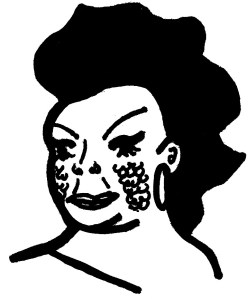
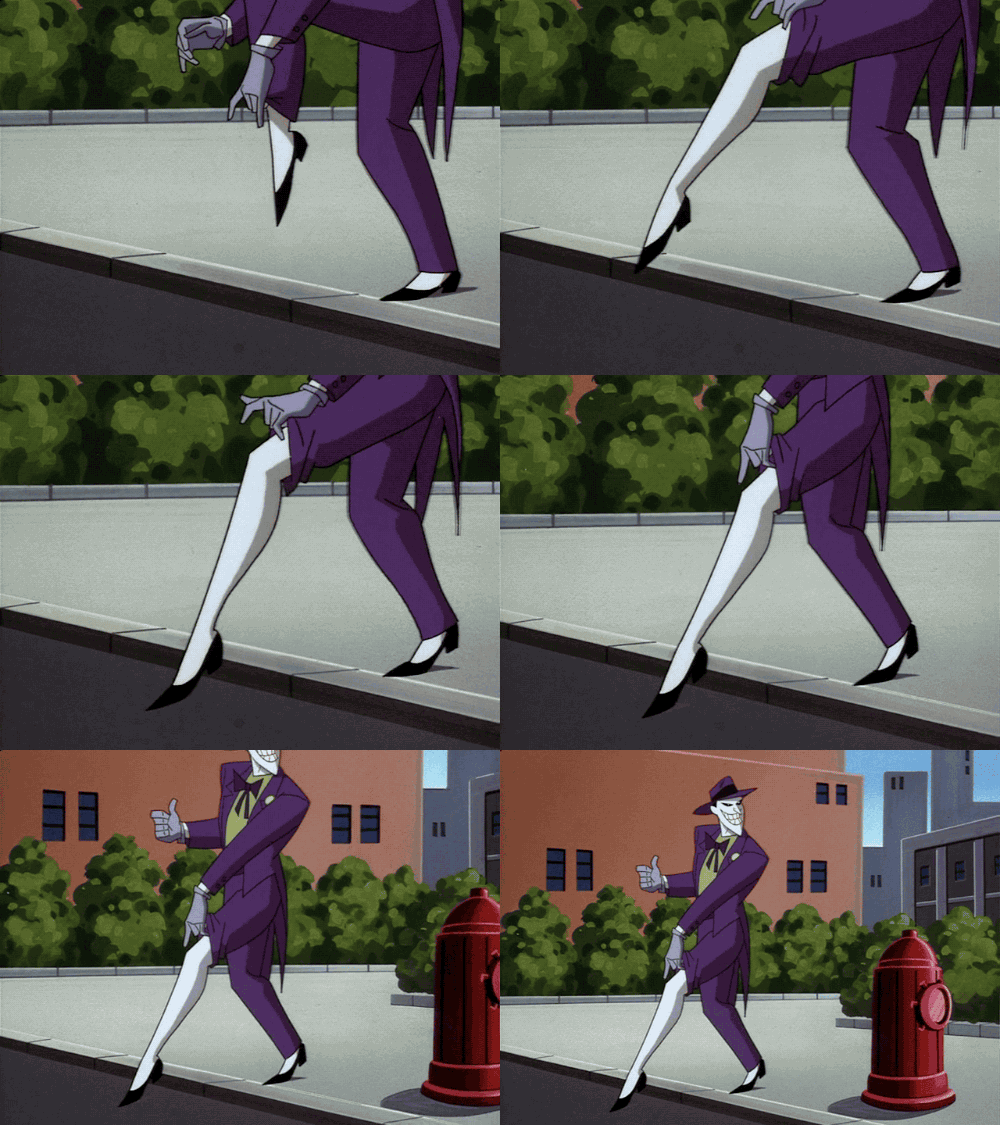
It’s almost inarguable that the most iconic performance from Divine, the greatest drag queen of all time, was her role as Babs Johnson in Pink Flamingos. John Waters may have later scored a wider cultural impact with Hairspray(his last collaboration with Divine before her death), but if you ask anyone to describe Divine as a persona, it’s the yellow hair, red flamenco dress, and curbside dog shit of Pink Flamingos that most readily defines her in the public conscience. As gloriously filthy as Pink Flamingos is within the John Waters pantheon, though, it’s not the most fully illustrative showcase for Divine’s talents as an onscreen presence. Babs is a kind of static constant throughout Pink Flamingos—hilarious, but unchanging in her filthy, filthy ways. It’s that film’s follow-up, Female Trouble, that really allows the full spectrum of Divine’s version of defiant American femininity to shine. In Female Trouble, Divine charts the moral corrosion of a high school teen turned mass murderer over a decade’s worth of increasingly despicable criminal acts. Pink Flamingos might be Divine’s most recognizable achievement in establishing a tone & defining her look, but Dawn Davenport is her greatest creation as a cinematic performer.
After signing the film’s theme song herself (a preview of her disco career to come), Divine begins Female Trouble as one of the 1960s hair-hoppers Waters lovingly profiled in Hairspray. Dawn Davenport is a bratty teenage delinquent. She smokes in school bathrooms, sneaks eating meatball sandwiches during class lectures, and responds to concerns about schoolwork with sentiments like, “Fuck homework. Who cares if we fail?” This attitude sets her up for failure at a traditional American lifestyle, something that becomes no longer sustainable after her parents refuse to buy the one Christmas present she demands because, “Nice girls don’t wear cha-cha heels.” After destroying the Norman Rockwell Christmas tableau of her parents’ home like Godzilla tearing through Tokyo, Dawn Davenport hits the open road as a teenage runaway. She attempts a mundane life that does not suit her: raising children, waiting tables, gossiping at the beauty salon. The most alive Dawn appears as a young adult woman is when she’s sweatily stripping as a go-go dancer and abusing her hyperactive daughter, both verbally and physically. The first half of Female Trouble is a grimy portrait of American femininity, one frustrated with the prison of boredom & tedium that plagues well-behaved women, especially single mothers. The increasingly violent crimes she commits throughout the film are selfish, hateful, and morally grotesque, but they’re also a political rejection of traditionalist gender roles she’s expected to conform to at all ages in her perversely American life.
The poster for Female Trouble “warns” of (read: promises) “scenes of extraordinary perversity,” the kinds of onscreen stunts both Divine & Waters were largely known for, if not only because of the shit-eating stunt that concludes Pink Flamingos. When Dawn Davenport introduces herself to strangers in the film, she explains “I’m a thief & a shitkicker and I’d like to be famous.” She achieves this fame the way only a thief & a shitkicker would: by impressing the public with the daringness of her crimes. As an adult criminal, Dawn finds wealthy, erudite patrons (David Lochary & Mary Vivian Pearce) who fund her criminal activities for the artistry that they truly are, fanatically believing that “crime enhances one’s beauty.” It’s an ingenious setup that provides Divine a stage to perform various criminal stunts, including smashing her overgrown child (a deranged Mink Stole) with a dining room chair, warring with her leather fetishist neighbor (Edith Massey) to the point of imprisoning her in a birdcage & axing off her hand, and breaking prison rules by entering a long-term lesbian relationship while locked up. In-story, this absurdist crime spree climaxes when a scarred-up Dawn with a protopunk haircut locks a literally captive audience into a crowded nightclub for her Cavalcade of Filth routine and fires a gun directly at them, indiscriminately. If crime enhances beauty, this is Dawn Davenport at her most gorgeous, something she announces upfront in the line “I’m so fucking beautiful I can’t even stand it myself.” The bizarre truth is that the biggest stunt in the film occurs long before the Cavalcade of Filth, though, when Dawn Davenport is still a teenage delinquent. Hitchhiking away from her destroyed parents’ home on Christmas morning, Dawn is picked up by a monstrous drunk played by Glenn Milstead (out of his Divine drag). Upstaging the earlier stunt where Divine is raped by a giant lobster in Multiple Maniacs, Divine effectively rapes herself in this scene. The details are horrendous: a roadside mattress, shit-stained tighty whities, felching. It’s a truly hideous display, a stunt that could only be topped by watching Divine perform mundane domestic work in later titles like Polyester& Hairspray. It’s this hitchhiking sequence where Divine truly outdoes herself (by literally doing herself, appropriately).
Desperate Living is my personal favorite John Waters film, but it’s one that Divine backed out of before production. I’m sure she could have only improved the film with her immaculately trashy presence, but I doubt even that performance would have bested the all-encompassing showcase Dawn Davenport afforded her. Divine’s performances as Babs Johnson, Edna Turblad, and Francine Fishpaw are all flawless, iconic filth, but they only afford her one comedic angle per picture. Dawn Davenport, on the other hand, allows Divine to transform from teenage reprobate/petty criminal to full-blown Charles Manson maniac in 90 wild minutes, taunting her audience from the perch of an electric chair with the speech, “I’d like to thank all those wonderful people who were kind enough to read about me in the newspaper and watch me on the television news shows. Without all of you, my career would have never gotten this far. It is you that I murdered for and it is you that I die for.” Female Trouble affords Divine a stage to perform her most gloriously fucked up stunts on celluloid, then directly comments on our fascination with those wicked deeds and with crime as entertainment in general. More importantly, though, it allows her to perform the full spectrum of American femininity as, to borrow the title of a Lifetime movie, Wife-Mother-Murderer in the post-hippie grime of the mid-1970s. Dawn Davenport is multiple generations & evolutions of the misbehaving woman, a perfect template for Divine to perform a full floor show of varying proto-punk looks & sneering femme attitudes. She may have starred in a few better movies, but few performances ever served her better as a top bill entertainer & the center of attention. Besides, where else are you going to watch Divine fuck herself? It’s impossible to overvalue the novelty of that experience.
Listening to an interview with Kay Cannon promoting her film Blockerson Ira Madison III’s Keep It podcast, it was exciting to hear her acknowledge the film’s intended purpose as a major studio femme subversion of the losing-your-virginity teen sex comedy. The teen sex comedy is just dripping with machismo as a medium, as it’s most clearly defined by the bro-friendly boundaries of titles like Superbad, American Pie, and Porky’s. As many of my recent favorite comedies have been femme subversions of traditionally macho subjects (The Bronze& Wetlandsbeing particular standouts), I 100% welcome Blockers as a continued corrective to the exhausting omnipresence of bro sex humor. However, I do wish Blockers wasn’t being critically framed as an innovator within that corrective, since that claim ignores 2013’s already criminally overlooked The To Do List. Another sex-positive, femme subversion of the raunchy, losing-our-virginity sex comedy, The To Do List was critically buried upon its initial release for its perceived overreliance on 90s nostalgia to sell its humor. Every passing year it becomes increasingly difficult to fathom caring about such a triviality, especially when you consider the film’s other virtues. If we can forgive the cult classic Romy & Michele’s High School Reunion for featuring adult comedians reliving their 1980s heyday in extended flashbacks, I‘d like to think we can accept The To Do List expanding that bit into the next decade, especially considering the level of talent on-hand: Bill Hader, Andy Samberg, Donald Glover, Lauren Lapkus, D’Arcy Carden, Alia Shawkat, and (in the starring role) Aubrey Plaza. The To Do List is overdue for critical reappraisal as a modern comedy sleeper, both on its own terms and as an active subversion of the same teen sex comedy tropes challenged by Blockers.
Aubrey Plaza stars in The To Do List as a high school valedictorian who fears her dedication to book-smarts has left her unprepared for practical social interactions. Most significantly, she expects college to be a nonstop orgiastic bacchanal that she will be out of the loop for as a nerdy virgin who hasn’t even shared a kiss. As an overachiever, she attempts to correct this problem by dedicating the entire summer before college to methodical, scientific sexual experimentation. It’s a plan that extends beyond shedding her virginity to include activities most high school students wouldn’t dream of attempting: rimming, motorboating, pearl necklaces, etc. This pursuit of sexual experience leads to inevitable John Hughesian tropes of Plaza’s in-over-her-head protagonist being confronted with the choice between two suitors: the “bad boy” she lusts for and the “good guy” who longs after her. In that moment of crisis, she smartly chooses neither, pointing out the impermanence & ultimate insignificance of most high school flings. Sex is paradoxically explained to not be a big deal, but also requiring careful consideration for your partners’ feelings. It’s a complex, but necessary lesson for high school kids to learn, one coupled with matter-of-fact statements of sexual intent & partners’ enthusiastic consent. A large portion of the plot is also dedicated to three teen girls’ lifelong friendship and their frequently thwarted plans to watch a rented VHS copy of Beaches together at some point during their last summer before college. Blockers explores a very similar friendship dynamic, although it admittedly better spreads the narrative focus around to each member of the group (and the overprotective anxieties of their respective parents). Both films are thoughtful explorations of femme teen sexuality & friendships without feeling at all leering or exploitative, likely in part because they were both helmed by women (The To Do List was written & directed by Maggie Carey).
The charm of both Blockers & The To Do List is that their sex-positive politics & wholesome emotional indulgences are allowed to co-exist with the typical gross-out gags that accompany the raunchy teen sex comedy. Although it tends to cater to straight male sensibilities, this is a genre that owes its space under the mainstream comedy umbrella to the raucous envelope-pushers of John Waters’s early career, particularly Pink Flamingos (even if by way of its influence on the Farrelly Brothers). Blockers goes for broke in its own gross-out moments of teen puke & butt-chugged beers, but The To Do List hits even closer to home in echoing its Pink Flamingos roots by depicting Aubrey Plaza defiantly chomping on a turd. Cinema is beautiful, y’all. Both films also mine a lot of awkward humor from parents being trapped in the same space as their children in the middle of sexual congress, going as far into The To Do List as having them lock eyes with their kids mid-orgasm or shaking the hand of the person currently fucking them. Dismissing The To Do List outright for blatantly adult comedians playing young or for 90s-nostalgic references to things like Hillary Clinton & jean skorts is an oddly reductive way of looking at a comedy that actively challenges the same gendered, double standard sex comedy tropes later subverted in Blockers. It’s even arguable that The To Do List is the more aggressive of the pair in that subversion, as its dedication to gross-out raunch is much more prolonged & pronounced. If nothing else, The To Do List was also prescient of the losing-your-virginity-on-top gag later repeated in the critical darling Lady Bird. That’s gotta be worth something, right?
Blockers is a great film that deserves to be celebrated for its femme subversions of a long-established comedic boys’ club that only gets sourer every passing decade. I don’t at all mean to detract from what Cannon accomplished there. I would just want to stress to anyone desperate to see more of that subversion out in the pop media landscape that The To Do List is well worth a critical reevaluation in the same context (along with the equally underrated The Bronze). If we could be gifted with one heartfelt, femme gross-out sex comedy a year like Blockers or The To Do List, the world would be a better, filthier place. We deserve more movies like them, but in the mean time we should give proper due to the ones we already have.
I attended many strange pro wrestling rituals when WrestleMania34 descended upon New Orleans like a body odor blanket last month. I watched a cheeseburger/bear hybrid wrestle other kaiju-costumed nerds at a midnight show adorned with cardboard cities. I stood in the world’s longest bathroom line at a Ring of Honor event because the bro-to-lady ratio at indie wrestling shows is way out of hand. I may have even joined in with the “This is awful!” chants that concluded Mania proper, despite the previous seven hours of sports entertainment making me look like an ungrateful turd for doing so (I honestly can’t remember if I participated in that complaint or not, but the show was exhausting). However, no Mania Moment was as strange as watching the raunchy teen sex comedy Blockers with John Cena in a theater packed with his biggest fans, an experience that only feels more bizarre the further I get away from it. This year’s WrestleMania happened to coincide with Blockers’s opening weekend, so a John Cena promotional appearance at a screening of the film makes logical sense from a marketing standpoint, but the event clearly didn’t factor in the nature of Cena’s usual pro wrestling fanbase. Thanks to AMC, John Cena, and the Universal Pictures marketing machine, I watched an R-rated teen sex comedy with a crowd of very young, very impressionable children who only wanted to meet their pro wrestling superhero. It was hilarious.
John Cena’s transformation into R-rated comedy wildcard has been a gradual one. Three whole years ago, I wrote a piece in the wake of Trainwreckanticipating his transition “From the PG Era to a Solid R,” noting how drastically different his comedic presence in films like that Amy Schumer breakout and the then-upcoming Tina Fey project Sisterswas from his usual “Never give up”/”Eat your vitamins” superhero character in-ring. Cena was the face of WWE as it shifted away from the gruesome violence & in-your-face sexuality of the company’s storied Attitude Era to a dedication to producing more child-friendly content. Recently, the attention paid to performers on the roster has spread more evenly, leaving Cena free to develop his comedic persona outside of the ring. Unlike The Rock, however, Cena has never fully detached from the WWE and still regularly appears in-ring as a competitor between film productions (including a squash match with the now-unretired Undertaker at this year’s Mania). This division of his time has lead to some truly bizarre self-contradictions in his public persona, like, say, the superhero to children everywhere butt-chugging a beer and handling Gary Cole’s testicles in an R-rated, femme sex comedy. Nothing has illustrated how absurd that dual career overlap can be to me than AMC’s Q&A screening of Blockers in New Orleans, though, which lured young children into a room to meet their wholesome hero, only to be faced with the raunchiest details of his onscreen career to date (including his naked ass in a final humorous coda).
One of the most charming things about John Cena is his self-aware wit, something he’s likely learned from working crowds of thousands simultaneously chanting & booing his name (older, smarkier fans have long soured on his wholesome superhero routine). His first remark during the Q&A portion of the Blockers screening was that “So many kids have grown up so fast” as his eyes nervously scanned the room. His improvisational crowd-work was continually impressive as he fielded questions about what he likes about New Orleans (drive-through daiquiris), his current opinion of The Rock (left WWE too early), and his decision to appear naked onscreen (“I didn’t think anyone could see me”). It’s honestly less surprising that that he has fit in so well with the post-Apatow style of improv-heavy comedic filmmaking than it is that more pro wrestlers haven’t been tapped for the opportunity, given how life on the road immediately responding to vocal crowds train you for the skill. For my own part, I got to directly ask Cena a question that’s interested me since that eye-opening performance in Trainwreck: why has he been so clearly drawn to R-rated, adult comedies in recent years? The answer, unsurprisingly, was a well thought-out and entirely self-aware history of his career onscreen as a film actor, only confirming that the motivation I inferred was a deliberate, personal choice.
Cena answered the question by dialing the clock back to the early years of WWE Studios in the nu-metal 2000s, when he starred in more straight-forward, The Rock-ish action pictures like The Marineand 12 Rounds (the latter of which was set in New Orleans, appropriately enough). He explained that he participated in those productions to satisfy a desire from his “boss” (presumably WWE owner Vince McMahon) to expand the pro wrestling behemoth’s media brand. According to Cena, those were “bad” movies he filmed as a kind of contractual obligation (I personal enjoy both titles he referenced a lot more than he seems to), while newer projects like Blockers & Trainwreck have been much more personally fulfilling. He’s grateful to have “a second chance”s on the big screen and is finally doing what he wants to do . . . by appearing in R-rated sex comedies? John Cena is a 41-year-old man and, thus, not the clean-cut supehero character he’s developed in the ring. In an effort “to grow up” and “expand” his “depth of character” in his public persona, he’s deliberately choosing projects to challenge the wholesome image he’s developed within WWE in a shrewdly practical (and seemingly fun) way. What he didn’t admit, if you’ll allow me some room for editorializing, is that he’s also damn good at it. His roles in Trainwreck & Blockers especially got a lot of comedic mileage out of contrasting his straight-laced muscle man image with comedically incongruous raunch. It only makes the juxtaposition funnier to know that he’s incredibly aware of that image & how to actively subvert it.
To be honest, having children in the room for a raunchy sex comedy wasn’t even the most absurd touch to the Blockers Q&A. What was really bizarre was the image of a theater full of wrestling fans pawing at Cena for handshakes & autographs once they realized security was not going to impede their approach. It felt like watching the third act of mother!, except most of the admirers were children and a pro wrestler was attempting to maintain control at the godlike center. Children love John Cena and it’s not too difficult to see why. Hell, I think I love John Cena, even though I would have had a much more muted, complicated reaction to his persona just three or four years ago. My own turnaround on his presence is partly a response to WWE’s recent allowance for his spotlight to drift to other worthy performers on their roster, but it’s likely just as much due to his deliberate expansion of “depth of character” by participating in R-rated, horned-up comedies like Blockers. However, unlike The Rock, Cena still wrestles on TV fairly regularly, which means he’s maintaining his younger, more wholesome fanbase at the exact same time. For one wonderfully bizarre afternoon at the start of WrestleMania weekend I got to see both halves of that bifurcated fanbase converge for a screening of a very good, very much adult sex comedy. Only one end of the John Cena fanbase divide could have been corrupted or traumatized by that experience, though: the children. Oh, won’t somebody please think of the children?!
There has only been a handful of actors who’ve played Batman on the big screen over the decades (unless you want to be a stickler and include the 1940s serials), a role that seems like it’s been passed around more from actor to actor than it has. Within that elite club of cinematic Caped Crusaders, there’s a lot of wiggle room in how to interpret the character. Ben Affleck & Christian Bale play him as a gloomy Gus; Adam West & George Clooney lean into his Saturday morning cartoon camp potential; Michael Keaton turned the Bat into a Horned-up weirdo; Val Kilmer played him comatose. It’s a range of variation that’s befitting of Batman’s journey in the comic books, which has taken many different tonal directions over a near-century of different writers & illustrators tasked to continue his legacy as The World’s Greatest Detective. Oddly, that freedom of interpretation is largely missing from the animated versions of Batman, despite their proximity in medium to his comic book form. Kevin Conroy, who voiced the titular vigilante through 85 episodes of Batman: The Animated Series, has become the defining standard of what Batman sounds like as an animated cartoon character. He’s a universally beloved fan-favorite, a status any one of the more divisive live-action performers have yet to achieve. As a result, almost all subsequent interpretations of animated Batmen, no matter who’s writing the text, have felt like faithful imitations of Conroy’s voice work for the character, leaving little room for creative variation. Bruce Greenwood, who voiced Batman in our current Movie of the Month, is just one of these many dutiful imitators, even if a competent one.
Less than halfway into 2018, there have already been three entirely new animated Batman films released, each with a wildly different tone and a different actor voicing the Caped Crusader. As there are now dozens of animated DC movies exploring the usual dynamics of the comic book brand’s more well-known characters, this year’s offerings each rely heavily on a high-concept gimmick to keep their interpretations of Batman relatively fresh. One film explores the possibilities of Batman’s ninja training by translating the character through the anime medium. Another teams up the fearless goth detective with Scooby-Doo in the classic Hanna-Berbera crossover tradition. The gimmick in Bruce Greenwood’s latest Batman project isn’t nearly as interesting as either of those movies sound; it sticks much closer to the Kevin Conroy template than the deviations in either premise. Greenwood reprises his role as Batman for the first time since he played the character in 2010’s Under the Red Hood, our current Movie of the Month, in an animated feature titled Batman: Gotham by Gaslight. Like Batman Ninja and Scooby-Doo! & Batman: The Brave and the Bold, Gotham by Gaslight attempts to keep Batman fresh by viewing him though a gimmicky contextual lens, this time a Gothic murder mystery. The problem is that the gimmick isn’t exactly a deviation at all, but rather a reinforcement of what was already in the forefront in the Kevin Conroy era. Much of the appeal of Batman: The Animated Series was its Gothic literature overtones, which created nice tension with the show’s modern urban crime thriller narratives (borrowing a page from Tim Burton’s book). DC’s animated movies have been chasing that creative high ever since, but Gotham by Gaslight takes the faithful diligence even further than most projects by transporting its narrative to an actual Gothic literature setting, robbing it of all its aesthetic tension.
19th Century Batman is the same philanthropist sleuth as he is in any other timeline, this time dedicated to solving the case of Jack the Ripper. Familiar faces like Harvey Dent, “Constable” Gordon, Selina Kyle, and Poison Ivy (an erotic dancer stage name in this context) populate a From Hell -style story about a mysterious serial killer who targets female sex workers in dank London alleyways. In a way, Batman’s crimefighting presence makes more sense in this world than it does in a modern one. It’s almost expected that a local wealthy eccentric would have the bizarre nighttime hobby of dressing up like a humanoid bat to beat up the local peasants for petty crimes. Many people even suspect him of being Jack the Ripper, recalling the same parallels between masked criminal & masked vigilante that drove Under the Red Hood. Even Batman’s cape & utility belt make more sense in this context, though he is outfitted with a more traditional trench coat collar for flair. The problem is that Batman makes too much sense in this context, especially after the Gothic literature foundation laid about by The Animated Series. Outside a few strong details like a zeppelin-set knife fight and a steampunk motorcycle, Gotham by Gaslight does little to exploit the possibilities of its gimmick and instead plays its material straight. The film occasionally pretends it has larger gender equality issues on its mind (mostly through the crossdressing, sex work-championing exploits of Selina Kyle), but it’s mostly a straightforward murder mystery styled after the literary trappings that define its setting. Batman: The Animated Series made that aesthetic interesting by clashing it against a modern(ish) urban setting. Gotham by Gaslight isn’t sure what to do without their central juxtaposition. Once the enticing gimmick of its Batman vs Jack the Ripper premise settles into a comfortable narrative groove, the film leaves very little room for novelty or surprise.
Batman: Gotham by Gaslight is billed as the 30th film of the DC Universe Animated Original Movies brand, which I don’t think even covers films like the recent animated Adam West campy reboots. That’s a whole lotta Batman content, with only two titles under Bruce Greenwood’s belt as the vigilante weirdo. Much like how Gotham by Gaslight does not do much to separate itself from the previous achievements of The Animated Series, Greenwood mostly serves as an echo of the excellent work Kevin Conroy has achieved in the vocal booth. Being that kind of placeholder in the brand can fulfill a lofty purpose, though, particularly when it anchors a well-written story. The dozens of animated DC movies have filtered through writing teams as frequently as any comic book writing stable would, so a consistency in different actors’ vocal performances as the same character is beneficial to maintaining a calm surface that covers up the movement underneath. Bruce Greenwood has voiced Batman in two animated movies, one great (Under the Red Hood) and one dull (Gotham by Gaslight). The quality disparity between these two pictures is entirely on the writers’ shoulders, as Greenwood’s performance changed very little, if at all, between them. Under the Red Hood is a self-contained narrative that brings a comic book storyline to the screen that Batman fans rarely to get to see in motion. Gotham by Gaslight, by contrast, turned the subtext of an animated show with nearly a hundred episodes into up-front text, making its aesthetic less interesting in the process. Bruce Greenwood was present for both, but had very little effect on their outcomes even as the voice of their shared central character. Live-action Batmen have found plenty of room to leave their marks on their respective franchises over the years, but the animated ones mostly come across as a copy of a copy of a copy of a . . . Bruce Greenwood is just one of many.
One of the most infamous scenes of onscreen cinematic violence is not actually as gratuitous in its visual depiction of brutality as you might think. Alfred Hitchcock’s staging of the shower stabbing in Psychocrams 78 camera setups and 52 individual cuts into 45 seconds of footage (which is where the documentary on the scene, 78/52, gets its name), bewildering its audience with a fractured visual narrative that makes us feel like we’re seeing more explicit violence than we are. Our minds fill in the gaps. Director Lynne Ramsay’s latest grime-coated vision of a real-world Hell sustains this technique for the entire runtime of a feature-length crime narrative. You Were Never Really Here is being frequently compared to the violent third act catharsis of Taxi Driver, which is understandable considering its on-paper premise about a mentally strained brute singlehandedly taking down a child prostitution ring while simultaneously uncovering a larger political conspiracy. Ramsay’s approach to violence is much less explicit & blunt than what’s delivered in Taxi Driver, though, obscuring its emotional release by instead focusing only on the violence’s anticipation & resulting aftermath, never the act itself. You Were Never Really Here’s artistic merits are found almost entirely in its editing room tinkering, searching for freshly upsetting ways to depict onscreen violence by both lingering on its brutality and removing all of its tangible payoff. It’s remarkably similar to the Psycho shower scene in that way, a connection acknowledged several times in the dialogue (thanks to serendipitous adlibbing from Dead Silence‘s Judith Roberts, who plays the would-be stand-in for Norman Bates’s mother in Ramsay’s film). If you’re looking for a prolonged echo of the bloody catharsis that concludes Taxi Driver you’re not likely to find it here, no matter how similar the two films might sound in concept.
Joaquin Phoenix stars as a mercenary muscle who specializes in rescuing underage girls from child prostitution rings. When this grueling job overlaps with a larger web of political intrigue involving a governor, a senator, and one particular underage victim, he suddenly finds himself alone in the world, attempting to take down an Evil force much larger than one man could possibly handle. He attacks this problem with brute strength by way of his peculiar weapon of choice, a ball peen hammer, but any minor successes he can achieve only open his life to more violent and emotional chaos. This one-dude-vs-a-human-trafficking-network narrative is now common enough to be its own genre, if not only through Liam Neeson’s recent catalog alone. Where films like Taken or Brawl in Cell Block 99 often feel like macho power fantasies, though, You Were Never Really Here shows little to no interest in offering any such release. Our broken macho man anti-hero cannot successfully beat his problems to pulp. Instead of making him come across like a heroic badass, his horrific line of work leaves him weeping, codependent with his elderly mother, and in desperate need of a kind stranger to hold his hand or kiss his cheek. Physical, masculine strength is a debilitating force for Evil in this picture. Our protagonist is haunted by past childhood, wartime, and occupational atrocities that we only glimpse in flashes, but leave him effectively crippled. In crime thriller terms, this is less the stylized romance of Drive than it is the dispiriting grime of Good Time. It resembles the skeletal structure of a Liam Neeson-starring Dadsploitation power fantasy, but its guts are all the emotional, gushy stuff most action films deliberately avoid. And because this is a Lynne Ramsay picture, those guts are laid out to rot & fester. We linger on her characters’ emotional pain without being offered any clear catharsis.
It never feels right to discuss a Lynn Ramsay film in terms of plot, since so much of her storytelling is paired own to elemental indulgences in imagery & sound. Radiohead’s Johnny Greenwood enhances the film’s emotional discomfort with slightly off-rhythm guitars, violins, and percussions. Any visual information missing from the obscured bloody hammer attacks is supplanted with the menacing specificity of other off-kilter images: burning photographs, mouths sucking on thin plastic, bloody tissues piling on an office desk, sugar peeling off a crushed jellybean, etc. If the film draws an aesthetic comparison to another title in Ramsay’s (depressingly limited) filmography it’s Morvern Callar, her most strikingly grimy descent into emotional chaos to date. Not only does You Were Never Really Here share that film’s impossibly dark humor and (despite its absence of heavy Scottish accents) necessity for subtitles, it’s also at its core an editing room achievement in cinematic sight & sound. This may be Ramsay’s closest adherence to a genre structure to date, outweighing even the Bad Seed & Omen vibes of We Need to Talk About Kevin, but it’s deeply seated in the increasingly fractured mental space she’s been carving out as far back as Ratcatcher. The film’s security camera sequence is also her most impressively staged set piece outside the hellish house party that opens Morvern Callar, a very high bar to clear for any filmmaker. Whether you want to compare individual details from the film to Taken, Psycho, Taxi Driver, or any number of past stylized crime thrillers (Nocturama also comes to mind, based on the fractured imagery of its own security cam sequence), there’s no denying that this is pure Lynne Ramsay. The director obscures, subverts, deconstructs, and viciously tears apart a traditionally macho genre until its only viable comparison point is the furthest reaches of her own sublimely upsetting oeuvre.
The production company Platinum Dunes’s recent trajectory is an illustrative microcosm of where mainstream horror filmmaking is currently situated in the 2010s. The Michael Bay-funded production brand got its start in horror in the early 2000s, buying up the rights to bankable intellectual properties like Friday the 13th, The Texas Chainsaw Massacre, and A Nightmare on Elm Street and reshaping them into big budget Hollywood blockbusters, much to horror fans’ . . . horror. These passionless remakes, combined with that same era’s torture porn grime, painted a grim picture of where horror was going as a medium. Platinum Dunes made a sizable profit off a genre it only saw value in as a vehicle for making a sizable profit, but in the long-term found that exercise both creatively unfulfilling for themselves and alienating to the genre fans they were catering to (at least according to producer Brad Fuller in a recent interview with Shock Waves). Recently, they found much greater success by producing an original property helmed by a creative voice with a personal vested interest in seeing it done right. A Quiet Place has already made over $200mil on a $17mil budget without retracing the steps of a previous classic and without alienating the genre film fans that made it a success. Along with last year’s adaptation of IT, A Quiet Place’s overwhelming success indicates that although it’s possible to make a tidy profit off the horror audiences studios usually take for granted with thoughtless dreck, it’s even more rewarding to pay attention to the quality of the work instead of using the genre as an “Anything’ll do” placeholder. A Quiet Place is in many ways as a traditional mainstream horror with wide commercial appeal, but it’s an example of that medium done exceptionally well. It’s a shame Platinum Dunes and other well-funded production companies didn’t realize the financial potential for that balance back in the grim nu-metal days of the early 00s.
Although tracking A Quiet Place’s arrival through the trajectory of Platinum Dunes is illuminating in picking apart the status of the modern horror, the true auteurist voice behind the picture is The Office vet John Krasinski (another repeat Michael Bay collaborator). Like the producers behind the film, Krasinski admits to not typically being a fan of horror, but fell in love with the original script’s premise when presented an opportunity to play the lead role. Krasinski’s passion is exactly what was missing from the company’s early remakes of horror classics. He not only signed on to play the father figure at the center of the film’s dystopian creative feature nightmare, but also insisted on personally rewriting major elements of the screenplay, directing, and eventually casting his own wife (consistently impressive badass Emily Blunt) as his co-lead. This isn’t exactly the mainstream horror flick equivalent of John Cassavetes putting his own family through hell in projects like A Woman Under the Influence, but Krasinski does make this mainstream genre flick feel surprisingly personal. It’s easy to detect what drew him to the project. A real-life father, Krasinski turns this high-concept monster movie into an expression of fatherly anxiety over the traditionally macho concerns of serving as protector over a vulnerable wife & children. It’s a remarkably Conservative (and rigidly gendered) way of depicting a family-in-crisis dynamic (Michael Bay is involved, after all), but one that’s self-reflective & repeatedly challenged as it falls apart in the face of impending doom. Although each character in A Quiet Place’s drastically limited cast gets their share of the spotlight and their own internal conflicts, the film overall feels like a solid Dad Horror movie, a nice compliment to all the great Mom Horrors of recent years: The Babadook, Goodnight Mommy, We Need to Talk About Kevin, etc. The trick is that even if these macho protector anxieties are as personal to Krasinski as they were to Trey Edward Schults in the superficially similar It Comes at Night, the Platinum Dunes commitment to commercial appeal makes sure they don’t distract the movie from delivering the traditional horror genre goods. It’s one of those rare instances where the personal & the commercial reach a wonderfully harmonious equilibrium, true movie magic.
The surprise of A Quiet Place’s commercial success is neither Platinum Dunes finding a second chance on the horror media landscape nor how personal Krasinski made the project feel. It’s that a largely silent, subtitled monster movie was able to appeal to such a wide audience. In the not-so-distant future, a species of blind, bug-like creatures with an exceptional sense of hearing has seemingly wiped out the majority of the human race. This isn’t explained in an opening text crawl or expositional dialogue, but rather the block letters of newspaper headlines that were used for similar information dumps in 1950s sci-fi B-pictures. A small family carefully maneuvers through this environment, speaking only subtitled sign language and tiptoeing barefoot in avoidance of the aggressive monster-bugs that will destroy them if they make a single peep. This delicately quiet environment sometimes makes for a distracting theatrical experience (I was very aware of the rest of the audience and the sounds of Avengers: Infinity War bleeding over through the walls), but it also sets the mood for an excellent jump scare environment. Loud noises and sudden monster attacks are heart-stopping in their intense clash with the near-silent atmosphere they erupt from. It also helps that the monsters themselves are impeccably designed (appearing to be a gumbo of details borrowed from Alien, Cloverfield, and Starship Troopers), with features that only become more interesting as their onscreen exposure increases late in the runtime. The “If they hear you, they hunt you” gimmick is a fantastic starting place for a horror film, but given general audiences’ aversion to subtitled dialogue and impatience with quiet builds (that were a few compulsive cellphone-checkers in my own audience) it’s amazing that the film could make its world so instantly accessible to so many people. It’s probably the closest a largely silent feature film has had to wild commercial appeal since the Oscar-winning comedy-drama The Artist nearly a decade ago.
While the wonderfully tense creature feature atmosphere is what got butts in the seats, it’s Krasinski’s commitment to the film’s familial drama that affords it a lasting effect. This is the story of a flailing father figure struggling to maintain traditional family values (with prayer before meals, clearly defined gender roles for his children, the whole deal) in a world thrown into chaos by hearing-sensitive monsters. Early on, when he’s shown surveying his farmland dominion from atop a silo while his wife preps a nursery for their unborn baby inside, the movie feels like a North-Western survivalist power fantasy where the bearded flannel men of Instagram can daydream about their macho roles as Protector after the inevitable downfall of society. The subversion of this Doomsday Prepper fantasy is much subtler than the critique that drives 10 Cloverfield Lane, but the initial rustic Pinterest calm is thoroughly disrupted by the film’s chaotically violent conclusion. The first cracks in his macho armor are presented by his deaf teen daughter (Wonderstruck’s Millicent Simmons, whom Krasinski smartly insisted on casting over hearing-abled actors), who is vehemently frustrated with the traditionally femme domestic roles he attempts to force on her. This is matched by her perpetually petrified brother’s reluctance to being trained as a hunter-gatherer future-Dad. What’s even worse is the father’s failure to protect his wife & kids form the monsters invading their idyllic Norman Rockwell homestead. When his wife asks, “Who are we if we cannot protect them?” you can see Krasinski slipping into an existential Conservative Dad crisis both in front of and behind the camera. For all A Quiet Place’s merits as an adventurous, high-concept creature feature with wide commercial appeal, it’s that protective paternal anxiety, especially skewed towards Macho Dads, that makes the film feel like a substantial work. Disregarding Platinum Dunes’s shaky reputation within the horror community and Cinema Sins-style logic sticklers’ nitpicky complaints about its premise & exposition, it’s remarkable how much personality & genuine familial tension Krasinski was able to infuse into this genre film blockbuster; it’s the most distinctive film to bear Michael Bay’s name since Pain & Gain.
Most discussions of cheap cash-in horror sequels are framed as if they were a phenomenon born of 70s & 80s slashers that have carried over to the modern day. The truth is that it’s a time-honored tradition almost as old as horror cinema itself. For a classic example of the shameless cash-in horror sequel, 1933’s Son of Kong serves as a fascinating specimen. Rushed to market just nine months after the 1933 creature feature classic King Kong, Son of Kong is a massive, kaiju-scale step down from masterful to cute. At a mere 70 minutes, this incredibly thin sequel aims for a lighter, more comedic tone than its predecessor to cover up the fact that it couldn’t match that picture’s scale of production. Grand sequences of stop motion spectacle depicting tribal warfare & a dinosaur stampede were cut for time & budget, leaving the film hanging without a third act. The titular monster was also a goofy echo of the original film’s infamous ape, offering audiences a cutesy, infantile version of a creature they once feared (like, less than a year earlier). Baby Kong’s adorability is almost irresistible as a novelty, though, and the film that contains him is likewise charming in its own limited, misshapen way. Like most modern horror sequels, its genuine thrills are cheap echoes of its predecessor’s former glories, but there’s something amusingly absurd about the lengths it goes to keep an already concluded story alive & open to profit.
The disappointing thing about Son of Kong is that, on a script level, it has a decent foundation for an interesting King Kong sequel. A month after the city-destroying tragedy of the previous film, Kong capturer/promotor Carl Denham is left in unfathomable debt & legal trouble for the damages caused by his now-dead super ape. It’s the logical fallout of an illogical conflict, one the movie talks itself out of as it constructs a reason for Denham to return to Skull Island to meet Kong’s orphaned baby. Exhausted by his status as a public pariah and fearful of rumored criminal indictments, Denham again sails on an explorer’s mission that leads him back to Skull Island in search of legendary (and nonexistent) treasure. There, he’s met with the consequences of his greedy transgressions in the first film: a mutinous crew that refuses to return to the dangerous island, native tribes that embargo the entrance of white colonists because of his theft, and most notably Kong’s helpless baby ape who can barely fight off the island’s other monsters as a goofball orphan with no parental projection. Denham bonds with this pitiful, adorable creature (as well as a female musician he picked up along the journey), feeling immense guilt for the harm he inadvertently caused it. The trouble is that the return of his presence on the island is still unwelcome and puts Baby Kong in just as much danger as his dead ape father.
Although the reduced shooting schedule & budget wiped out her planned third act spectacle, screenwriter Ruth Rose did a commendable job of both keeping the mood light and upping the active involvement of the female co-lead, dampening the original film’s damsel in distress dramatic impulses. The jokes are plentiful and often surprisingly funny, especially in a pure anti-comedy sequence where a musical band of trained monkeys perform for unenthused bar patrons for a relative eternity. Other deadpan reactions like “My father is dead.” “What a tough break,” and a stammering “Well, uh, captain, uh . . . about that mutiny,” also play surprisingly well as the movie often finds genuine humor without delivering outright jokes. Still, it’s difficult to determine exactly how humorous Baby Kong is intended to appear, as many of his action sequences are repeats of the exact stop-motion dino fights that served as genuine special effects spectacle in the first film. Son of Kong is essentially the opening, island-set half of King Kong without the third-act payoff of the city-destroying conclusion, except now everything is twice as goofy & half as visually impressive. The sequel unfortunately also echoed the racist impulses of the first, even adding to its depictions of native savages & undertones of interracial romance paranoia by introducing the character Charlie the Chinese Cook. As amusing as the film can be at any given moment, its faults are both plentiful and glaring.
Cheap sequels have long relied on audiences’ contentment (and even enthusiasm) for reliving former pleasures on a smaller scale and with a goofier flavor. Yes, the creature battles in King Kong are more technically impressive and lead to a more spectacular end, but Son of Kong still features a sequence where a giant ape fights a giant bear in an all-out brawl. Take your entertainment where you can get it. It also helps that the film is at times genuinely humorous in a way that suggests its overall camp value may be somewhat intentional (for those willing to be a little forgiving). It’s difficult to imagine looking at Baby Kong’s exaggerated, googly-eyed mug and suppose the filmmakers were looking to deliver a serious-serious masterpiece, even if is ultimate trajectory is dramatic. Comparing Son of Kong to the original King Kong does it no favors, but it still has an interesting enough premise for a sequel to a film that obviously didn’t need one. In this way, it persists as a mildly delightfully oddity, which has been more than enough to justify fandoms of other cheap, rushed horror sequels released in the decades since. At the very least, I’d like to submit the film’s musical monkeys scene as a genius stroke of proto-Tim & Eric anti-humor, a 90 second stretch of pure cinema bliss that more than justifies the rest of the film’s existence:
One of the most oddly entertaining aspects of Doris Wishman’s first collaboration with the impossibly buxom Chesty Morgan, Deadly Weapons, was how frustrating it was in its avoidance of delivering on its premise. As the title suggests, Deadly Weapons was billed to feature Chesty Morgan dispensing of bad-guy criminals by killing them with her enormous breasts. It’s a novelty that only occurs twice onscreen in the film, absurdly late into its comically short runtime. Wishman’s punk amateurism & effortless ability to de-sex the sexploitation genre carried the movie through as a bizarre delight, and the film was followed up with a “spiritual sequel” in Double Agent 73. There’s only one boob-related kill in Double Agent 73, and it involves Chesty’s chest being smothered in poison instead of crushing or suffocating her criminal victim. Her titty-enabled espionage takes on an entirely different flavor in this follow-up, one that elevates the entire concept to an even more absurd level of camp cinema delight. Here, Morgan’s weaponized bosom is made to be an espionage tool instead of a lethal weapon. Through surgery, her rack is fashioned into essentially being the world’s largest, most conspicuous “hidden” camera. The results aren’t as sexy as they may have been intended to be, but they are far more hilariously absurd & more plentifully deployed than the killer tits conceit of Deadly Weapons, which stands out as the lesser Wishman-Morgan collaboration (a minor distinction, but an important one).
Chesty Morgan stars as the titular Agent 73, a James Bond-modeled international spy who hides in plain sight as a burlesque dancer. Her latest mission is to assassinate an evil syndicate of heroin dealers headed by the mysterious crime boss Toplar (sometimes humorously referred to as “Mr. T” for short). Toplar’s true identity and Agent 73’s descent down the heroin crime ring rabbit hole are obviously not the main draw in this soft-core nudie thriller. The glory of the movie’s hook it that a spy camera is surgically implanted in the buxom agent’s ample breasts. She’s instructed by her higher-ups to assassinate several men within the heroin ring and to take a picture of every kill after completion, a mission that conveniently requires her to frequently strip to the waist. Her camera isn’t necessarily aimed at anything in particular when she snaps these photos and every deployment of it is matched with a loud shutter sound that consistently elicits giggles. It’s difficult to pick a favorite deployment of the titty-cam conceit in the film: The post-surgery nurse-kill where she takes a picture even though the camera is still covered by a bandage? The scene where she sneaks into a criminal’s office to whip out her titties over a stack of top secret documents? The Deadly Weapons callback with the poison bosom? Double Agent 73 gets a lot more mileage out of its booby-themed espionage than its predecessor, while still sticking to that sweet, sweet 70min runtime.
I’m still getting accustomed to what distinguishes A Doris Wishman Film from other examples of blissfully absurd sexploitation, but Double Agent 73 more than earns her signature cartoon title card in the opening credits. Wishman has a distinctly anti-erotic approach to filmmaking that’s on full display in this movie’s uncomfortable close-ups, heavy breathing, and bizarre intrusions of bloody violence. A trip to a nudist camp recalls her early nudie cutie works like Nude on the Moon. A bizarrely edited homage to the shower scene from Psycho recalls her total-meltdown slasher A Night to Dismember. The snazzy jazz & sped-up fistfights recall her roughies like Bad Girls Go to Hell and Another Day, Another Man. In its own way, Double Agent 73 might be the distilled ideal of a Doris Wishman film: it’s short, blissfully absurd, oversaturated in aggressively unerotic nudity, and follows through on its over-the-top premise in a way more of her films could stand to. There’s a consistency to Wishman’s D.I.Y., unerotic filmmaking craft that never changed over her decades as a schlockteur, for better or for worse. The gems in her catalog, then, are naturally going to be the ones built on ludicrous premises like Double Agent 73’s. It’s not only her best collaboration with Chesty Morgan; it’s likely one her most worthwhile films overall.
Welcome to Episode #55 of The Swampflix Podcast! For our fifty-fifth episode, we continue our recent 90s nostalgia streak as Brandon & Britnee discuss the Honey, I Shrunk the Kids franchise. Also, Brandon makes Britnee watch the big-bug monster movie Them! (1954) for the first time. Enjoy!
Every month one of us makes the rest of the crew watch a movie they’ve never seen before & we discuss it afterwards. This month Boomermade Brandon ,Alli, and Britnee watch Batman: Under the Red Hood (2010).
Boomer: Cards on the table: Under the Red Hood is my favorite Batman movie. Obviously I prefer it over Zack Snyder’s take on the character, but I also find it superior to both Tim Burton and Christopher Nolan’s respective series, although there are elements of both that work well and that I quite enjoy. This may not be my favorite version of Batman (that honor always has been and presumably forever shall be the Bats of Batman: The Animated Series), but it’s the best self-contained feature that both feels like a true standalone while also addressing the character’s long history. There’s no origin story, no belabored backstory showing how and why Bruce Wayne came to be the Batman, no attempts to make the character feel like he fits in a modern context or make the gadgets and gizmos seem “realistic,” and no damned pearls in an alley (note, even Batman v Superman did this, two years after the linked video pointed out that it was a cliche). I said it two years ago and I’ll say it again: Batman has the second most famous origin story in the world, surpassed only by the birth of Christ; we don’t need to see it on screen ever again. Instead, this film jumps in at a point in time pretty far into the detective’s career.
Under the Red Hood opens in Sarajevo, where The Joker (John DiMaggio playing against type) has savagely beaten Jason Todd (Jensen Ackles), the second of Batman’s sidekicks/apprentices to bear the codename “Robin,” nearly to death with a crowbar. Batman (Bruce Greenwood) races to the scene, but arrives too late, as a bomb destroys the warehouse in which Jason was left behind. Years later, The Joker is safely locked away and the majority of Gotham City’s criminal element reports to the Black Mask (Wade Wilson), but the leaders of various crime families are confronted by a new player: The Red Hood. The Hood has knocked off several of the families’ top players to demonstrate his prowess, and his hijacking of a major weapon brings him to the attention of Batman and Dick Grayson/Nightwing (Neil Patrick Harris), the first Robin. Batman realizes early on that The Red Hood knows his true identity and is haunted by his past mistakes and failures, the worst of which was his inability to save Jason. The crime war between Red Hood and Black Mask escalates to the point that the Mask is so desperate he breaks The Joker out to take down his rival, leading to a confrontation that forces Batman to confront his mistakes, morality, and the nature of his war on crime.
This is a grim story, with a bleak ending that gives me chills every time. I’ll not bother with the spoiler alert as this movie is over ten years old and the comic on which it was based was published five years before that, and the film itself does little to disguise the reveal that The Red Hood is, in fact, Jason. This is a departure from the comic, which preserved this mystery for as long as possible, which makes for a richer story as it allows for a deeper rumination on the ways that devotion to an absolute moral code can have unforeseen consequences, and how a bad seed can take root in the soul despite the best attempts to provide a moral compass. As Bruce says in one of his introspective moments, the responsibility for the life and death of Jason Todd falls on his shoulders: “My partner. My soldier. My fault.” How Jason came to be The Red Hood and his motivations are instead the crux of the film’s mystery, and it’s all the more poignant for it. I find myself thinking about the emotional gut punch of the final scene fairly frequently: after the apparent death of Jason (again), violently and pointlessly, we return to the cave and a memory of Jason’s first day as Robin, as he excitedly dashes around with the kind of effortless exuberance that only a child can have, before declaring that it’s the “best day of [his] life.” And we fade out on that image of the hopeful, blindingly optimistic beginning of a journey that we as the audience have just seen come to a brutal, bitterly violent end; it’s a closed, nihilistic loop that gets me every single time.
Comparisons to Winter Soldier were common thirteen years ago when Judd Winick was writing the comic on which the film was based, titled simply Under the Hood. It was a common joke for decades that “no one in comics [stayed] dead except for Bucky (killed in action in 1945, as revealed in Avengers #4 in 1964), Jason Todd (killed in 1988’s Death in the Family storyline by Jim Starlin), and Uncle Ben (killed in the first appearance of Spider-Man, Amazing Fantasy #15 in August 1962).” Winick started building his mystery in late 2004; in early 2005, Ed Brubaker was helming the fifth volume of Captain America, and he, like Winick, introduced a new enemy who proved to be a long-dead supporting character brought back to life. Both have since been adapted, although 2014’s Captain America: Winter Soldier obviously has the higher profile, being a part of the MCU. In that film, however, directors Anthony and Joe Russo preserved the revelation that The Winter Soldier was Bucky until the end of the second act, although given the fact that Sebastian Stan has a memorable face and comic book fans already knew the identity of The Winter Soldier, your mileage may vary based as to how successful that reveal is. Brandon, given that you’ve seen both films and aren’t really a devotee of superhero comics, which approach do you think works better? My money is on Under the Red Hood, but I can’t quite imagine what it would be like to be a first time viewer of either film without the knowledge that comes from the source material. Is it better to not attempt to preserve the mystery? Do you think that one approach or the other is geared towards a different kind of fan?
Brandon: One of my very favorite aspects of Under the Red Hood was, indeed, that the reveal of Jason’s vigilante resurrection as The Red Hood was not saved for a last-minute shock. In my mind, there wasn’t anyone the Red Hood could have been but Jason that would have been satisfying, considering that the movie opens with a lengthy depiction of his murder at the hands of The Joker. Ebert even coined a name for that scenario in his Glossary of Movie Terms. He describes it as “The Law of Economy of Characters”, writing, “Movie budgets make it impossible for any film to contain unnecessary characters. Therefore, all characters in a movie are necessary to the story— even those who do not seem to be. Sophisticated viewers can use this Law to deduce the identity of a person being kept secret by the movie’s plot. This ‘mystery’ person is always the only character in the move who seems to be otherwise extraneous.” As a direct-to-video, animated feature, Under the Red Hood may have had more freedom to play around with extraneous characters than a megacorporate, every-minute-wasted-is-money-lost production like The Winter Soldier, but it would still be odd to waste so much screentime on Jason’s demise at the top of the film if it weren’t going to become significant to The Red Hood’s identity later.
I’d be lying if I said I could exactly remember how that relates to my reaction to the very similar Bucky reveal in The Winter Soldier, since we reviewed that film over two years and nine MCU entries ago. In our Agents of S.W.A.M.P.F.L.I.X. piece, I only mentioned Bucky once, saying that I had spoiled the mystery of his identity for myself by watching the MCU films late & out of order before we had started the project. I can say, though, that on principle I believe revealing the twist early was the smarter move, to Under the Red Hood’s credit. Ebert’s being a little snobbish when he says “sophisticated” viewers will be the ones to see through this kind of mystery before the reveal; I’d be more likely to use the word “seasoned.” I can’t speak for how shocking the Bucky or Red Hood reveals were in the comics, since those characters had ostensibly been dead for decades in the canon. However, anyone who’s seen more than a few movies, which require a much stricter storytelling economy, should see through the “mystery” almost right away. In a cinematic context, I’d say the Winter Soldier approach of withholding the character’s true identity until as late as possible will likely work best for younger fans who haven’t already puzzled their way through similar mystery plots in other works. By contrast, Under the Red Hood benefits seasoned vets who’ve been there too many times before and are eager to move onto the next story beat.
Part of what’s so wonderful about the early reveal of The Red Hood’s past life as Robin the Boy Wonder 2.0 is that it raises questions instead of answering one. Jason’s death at the start of the film is brutal, with a distinct finality to it. The Joker mercilessly beats the poor boy with a crowbar, splattering PG-13 blood & gore around the room. Jason is then subjected to a close-range bomb explosion, with Batman personally carrying his charred body from the rubble. The movie does a decent job of justifying his choice to reemerge as the Red Hood persona, which is explained to be a communal, anonymous part played by many villains in the past, including The Joker himself. It also uses The Red Hood’s predilection for gun violence (he’s essentially a less “Ain’t I a stinker?” version of Deadpool in tactics & design) to establish the classic vigilante conundrum that plagues most superheroes: How far is too far to keep citizens safe? What really separates these masked fighters from their violent opposition.? The questions that remain, then, are not why Robin 2.0 reemerged as The Red Hood, but how. He was established to be very, very dead— a mystery that confounded Batman himself, one of fiction’s great detectives, to the point that he excavates the unfortunate child’s grave for clues. Answering that question is much more complicated & dramatically fruitful than merely waiting for his hood to be pulled off in a climactic confrontation to reveal a character that other movies have trained us to expect.
In general, I agree with Boomer that more live-action adaptations of the Batman comics could learn from Under the Red Hood’s avoidance of an origin-story narrative in favor of a just-another-episode approach. Still, dropping into this particular scenario in medias res was especially jarring to me. There are not only a near-century of Batman comics I’m unfamiliar with, but now also decades of animated DC movies this entry could have been a part of in series that I would have been completely blind to. The Joker beating Robin to death at the top of the film felt like a “Previously on. . .” catch-up reel. Learning later that the dead Robin was actually the second Boy Wonder in a continued lineage was also news to me, since it has yet to come up in the live-action adaptations despite being what I assume is common knowledge to well-read comic book folks. In one way, constantly resetting the rotary dial back to Batman’s origin story is preventing the character’s live-action movies form moving onto fresh, lesser known storylines like Under the Red Hood’s. At the same time, though, the endless soap opera quality of comic book storytelling risks leaving the uninitiated behind by requiring too much knowledge of decades of backstory to get all viewers on the same page. Britnee, how do you feel about the balance Under the Red Hood strikes in giving comic book fans an opportunity to see something other than Batman’s origin story for a change and catching outsiders up on the info they need to understand its basic plot? Were you more baffled or delighted by being dropped midway into a Batman storyline you were wholly unfamiliar with?
Britnee: I don’t really watch many superhero movies or read many superhero comics (I stay within the Elf Quest realm for the most part), so I’m generally unfamiliar with the storylines of Batman, Superman, Captain America, etc. Straight-to-video animated superhero films like Under the Red Hood have always intimidated me a little, as it seems like they are made strictly for the super-fans. There are no big name actors or any substantial marketing behind them like with the live-action superhero films, so there’s really nothing to drive the non-superhero fans to grab a copy.
Under the Red Hood has disproved my assumptions of animated straight-to-video superhero films. It was fantastic! Initially, I felt like I was a little late to the party as the beginning of the film was so fast paced, but it turns out that I wasn’t. I got caught up in trying to figure everything out within the first 5 minutes because I assumed that this was specifically made for those with intense Batman knowledge, but it turns out that the beginning of the film would eventually be thoroughly explained later on. All I needed was a little patience. The film didn’t feel like a dumbed-down version of a Batman story either, as it wasn’t really focused on Batman all that much. This movie was about the origin of Red Hood, so it does offer something exciting to even the biggest Batman fans. It mustn’t have been easy to “get the balance right” *wink to Depeche Mode fans*, so I truly appreciate the thought and work that went into this story.
I love that Red Hood is an antivillain, so his story is much more complex than one of a hero or villain. It’s never obvious which side he’s on or if his next move will be good or bad. The mystery of it all is just so thrilling. Alli, I’m not sure if you’re a Batman fan or not, but do you consider Red Hood to be an antivillain, antihero, villain, or hero? And why?
Alli: I know just enough about Batman to know that I’m not a fan of his persona. I’ll get to that later.
I think of The Red Hood as a hero. I was rooting for him from the very beginning when he commanded that The Black Mask not sell drugs to children. He knew how to better the city of Gotham. He knew how to turn the true criminals against each other and how to control them in general. His plan to save the city was sophisticated, strategic, and effective. In a single crime spree, he totally changed the power structure of Gotham’s criminal element, got major drug lords off the street, and nearly killed The Joker. That’s more than Batman has ever done is his long, long life of “fighting crime.” Jason was a street kid with street-smarts saving his own streets, and he was doing a damn good job of it. The only thing that got in the way was his sentimental, burgeoning on codependent need for his father figure Bruce Wayne to accept his philosophy. Had The Red Hood kept going, crime would be down and there’d be an actual sense of community in this city plagued by extreme class disparity and fear.
On that note, let’s get right down to my dislike of Bruce Wayne. This is a rich, rich guy, rich enough to afford endless gadgets, cars, helicopters, and a literal man cave. Instead of using his money (inherited and presumably acquired through exploitation of underpaid workers) to help end poverty on a mass scale, he just finds an orphaned little boy here and there that just happens to remind him of his younger self, puts the kid in a costume, and trains him to fight crime too. Batman is the neoliberal of superheroes. Honestly, I wouldn’t be surprised to learn that some of these crooks who have chosen a life of crime are working class folks underpaid by one of Wayne Enterprise’s many ventures. He’s a rich guy who takes to streets he’s not even that familiar with to throw people into a prison system that seems even less effective and ethical than the real life American one. He approaches crime fighting like a man drunk with power playing god, which is probably exactly how the heads of his family before him conducted business. He may refuse to kill people or wield a gun, but that doesn’t mean he’s not also just constantly feeding into the cycle of crime. It’s no shocker to me that this capitalistic, neoliberal masked crusader is squared up against a foe of his own making under the moniker “The Red Hood,” a name that brings to mind “The Red Scare.”
Boomer, I’m going to admit upfront that I only have peripheral knowledge of Batman coming from a childhood of weekend cartoons and an adulthood being friends with comic book nerds. Is my characterization of Batman unfair? Do you think The Red Hood’s plan would have worked?
Boomer: I love this question! Your description pretty perfectly encapsulates my mixed feelings both about Batman as a character and as a cultural icon. It’s interesting to me, however, that you mention weekend cartoons; in my opinion at least, Batman: The Animated Series is the default Batman that I think of and is the best version of the character, even more than in the original comic texts. This is a Batman who was born of a perfect confluence of events: the popularity of a darker, more metatextually introspective Batman of the 1980s embodied by (for better or worse) Frank Miller’s 1986 opus The Dark Knight Returns and Tim Burton’s 1989 Batman theatrical release; the rise of merchandise-driven children’s television programming in the 1980s (think Transformers, G.I. Joe, and Rainbow Brite) after Reagan and his raging hard-on for so-called free-market capitalism abolished the regulations from the 1960s that were intended to decrease commercial interest and increase educational content in children’s programming; and the backlash against this deregulation. In 1990, Congress approved legislation to give TV industry officials an antitrust exemption to permit joint meetings to delineate guidelines on TV violence, confirmed in 1992 (the year that Batman TAS premiered). Violence must be “relevant to the development of character, or the advancement of theme or plot”, while it must not be glamorized, excessive, easily imitated by children, or used merely for shock value. As a result, we ended up with a perfect Batman adaptation, one in which the villains were psychologically complex and they were rarely defeated through violence. Instead, more often than not, Bats dealt with his nemeses through the revolutionary idea of talking to them, understanding their reasons for doing what they do (think of the Mad Hatter or Baby Doll) and talking them down from their activities before ensuring that they got the help they needed, not just breaking mentally ill people’s bones and then sticking them into the prison system.
Contrast this to my least favorite Batman adaptation: The Dark Knight Rises. I despise this movie, although not for the reasons that most people do. I think Batman Begins is good, and The Dark Knight is pretty great, but Rises feels like a personal affront. It came out at the height of the Occupy movement, and the first trailer made it seem like the film was poised to directly address the problem of Bruce’s millions, with Anne Hathaway’s Selina Kyle giving a pretty great little speech: “You think this [abundance] can last… there’s a storm coming, and you and your friends better batten down the hatches because when it hits, you’re all going to wonder how you thought you could live so large and leave so little for the rest of us.” I was pumped for this kind of deconstruction, because this was following a few years after my own realization that, as a character, Batman was kind of the worst. You are absolutely correct that there is something not-quite-right about idolizing a man who is the “World’s Greatest Detective” but also has a child’s understanding of crime and criminality. The question of why so much low-level crime exists (that is to say, economic inequality and the often insurmountable barriers to any kind of upward mobility) is rarely addressed in any kind of media, but Batman became a particularly problematic fave as I got older and became more socially aware. His adventures are, after all, those of a wealthy-beyond-measure man who takes to the streets and beats up poor people instead of, as Alli notes, investing in infrastructure or addressing the ways that intense stratification of wealth and the accumulation of great wealth in the hands of the elite are the primary factors in creating the inequality that breeds crime in the first place. And I really thought that Rises was going to tackle that conversation head on! How fucking naive of me.
Instead, Rises is a movie that not only treats the people associated with Occupy as simpletons who would willingly (and in fact gleefully) submit to the will of a terrorist because he gave them what they want, or rather what screenwriter David S. Goyer thought they wanted. Selina’s little friend is perfectly happy nearly starving in what is essentially post-apocalyptic Gotham in that film, content with having nothing, because no one has anything. No doubt Goyer is completely blind to the irony of the fact that, like Batman and his immature understanding of criminality, he outed himself as someone who not only had no clue what Occupy’s purpose and desire was and is while making himself come off as a smug jerk (his net worth is $12M, by the way). He’s not just an asshole, he’s a stupid asshole whose ego is so bloated he has no desire to entertain the possibility that those who disagree with him politically may have valid points; he’d rather just paint them as terrorist collaborators. This not only makes Rises a bad movie, but also morally reprehensible and socially dangerous.
So we have our great Batmen and our terrible Batmen, with decades of storytelling lying in between, with various men (and too few women) articulating a variety of worldviews using the dark knight as their mouthpiece. Sometimes there is a self-awareness of the problematic nature of the character and we end up with something like Batman TAS or even The Brave and the Bold (which is a delight), and sometimes you have an actual monster at the helm and end up with a blindingly ironic situation. Most of the stories fall somewhere in between, and some writers have actually addressed this directly (on more than one occasion, Bats deprived an enemy of his henchmen by referring all of them to Wayne Industries and promising them jobs), but Alli’s point of view is completely valid. I think that part of the appeal of Under the Red Hood for me, and I’m only just realizing this as I write it, is that Jason Todd represents my own personal journey as a Batfan. As I grew up I bucked more and more against his worldview, until part of me wanted nothing more to do with him, but he was still one of my first heroes and thus too important for me to let go of completely. And when I look back at the youngest version of myself, watching Batman TAS every day after school starting from kindergarten and going forward, I see that optimistic little Robin, ready for his first mission, with so, so far to fall ahead of him.
For what it’s worth, I don’t think that Red Hood’s plan would have done much to make Gotham a better place; by wiping out entire crime families and eliminating drug cartels, all that would be left would be a bunch of desperate people and a massive power vacuum. The first few days, when addicts wouldn’t be able to get their fix, would be madness as violence erupted across the city. On The Wire, there’s mention that one corner could pull in $5000 a day, and those slingers are selling heroin at $10 a pop, so that’s 100 people a neighborhood; conservatively, if there’s 500 junkies in just a few of Gotham’s neighborhoods all going through withdrawal at the same time, that’s going to be a disaster. Someone is going to swoop in and take advantage of that to build their own criminal empire. It might seem like a good plan in the short term, but the only real long-term solution is what you previously mentioned: infrastructure improvement. I cou moral quandry he presents feels so at hould be wrong, though.
Brandon, how do you feel that this film’s thesis holds up, especially in comparison to other Batman films, which are much less self-aware and critical of the hero? I’m pretty critical of The Dark Knight Rises, but are there other Batflicks that you’ve seen that you would argue have worse moral or ethical problems?
Brandon: I honestly didn’t dwell for too long on the political ethics at the heart of Under the Red Hood, because they didn’t stick out to me as especially unique within the superhero genre. Now that there are roughly a dozen major superhero releases annually, the stories are more varied, but for a while it felt as if the majority of them were hinged on the moral conflict of what, exactly, separates the masked vigilantes from the masked criminals. The Red Hood is an interesting foil because his Bad Guy status is a grey area, but the “What if Batman, but too much?” moral quandary he presents feels so at home in a superhero storytelling context it would be safe to call it a cliche. As for Batman’s own ethics, it was initially jarring to hear Alli describe him as a neoliberal fantasy figure, since I’m so used to his politics being criticized for their undertones of right-wing fascism. That subtext is likely a stain left on the Batman brand by the Christopher Nolan trilogy (which, as Boomer points out, really went out on a wet fart with The Dark Knight Rises). As perversely fun as Heath Leger’s performance as The Joker can be and as welcome as it was to see Anne Hathaway challenge her usual typecasting as Catwoman, that trilogy has left a sour taste in its wake, especially in the way its been adopted as gospel by the more Conservative, Reddit-flavored corners of the internet. I don’t think the political stance Batman takes in Under the Red Hood is nearly that well-defined and the movie’s moral dilemma is more about the opposing virtues between extremism & moderation than it is about arguing any specific ideology.
I personally don’t need a specific, clearly defined political ideology to enjoy my Batman media, though. My favorite interpretations of the character are when he’s defined mostly as the ringmaster werido at the center of a fetishistic freakshow. Tim Burton & Michael Keaton’s collaborations are the pinnacle of that horned-up werido-pervert version of Batman (which is why Batman Returns has long been my favorite episode in Caped Crusader cinema), but it’s something you can see echoed in plenty kinky Batman interpretations (and real life kink play) elsewhere. I suspect it’s partly why I enjoy the over-the-top Joel Schumacher monstrosity Batman & Robin so much, since it shifts that kinkiness closer to a queer spectrum (while also subversively doubling down on the Saturday morning cartoon kids’ fluff aspects of the material). I didn’t think much about the political quandary at the center of Under the Red Hood, since my own experience with Batman is more as a kinky psychosexual id. As such, I found myself instead fixating on the two former Robins’ relationships with Batman and how they resembled spurned romantic exes. It’s probably best to ignore the usual insinuations about Batman & Robin’s power dynamics as master & ward (though I will say that scenes of a teen Robin running around in little green panties did make me very uncomfortable), but the way the two Robins shed their former identities to don wholly new personas, Nightwing & The Red Hood respectively, felt like watching someone experiment with a drastic haircut or a cross-country move to shake themselves out of the emotional fallout of a nasty breakup. They both still desperately need Batman’s attention & approval, too, despite trying to appear aloof in his presence. There’s always an undercurrent of romantic & sexual power dynamics lurking under Batman’s interactions with other masked weridos, whether friend or foe, and I found his relationships with his ex-Robins here to be a more complex expression of that than most. The movie intends for their relationships to play as entirely paternal, but my growing up with Batman as a horned-up kinkster makes it impossible not to see it through that lens.
Britnee, feel free to ignore my fixation on Batman’s function as a romantic kink icon, but I am curious what you thought of the character’s relationships with his ex-Robins here. Is there anything especially unique about the Batman & Robin dynamic in Under the Red Hood, besides there being more Robins than usual? What do you make of Nightwing & Red Hood’s compulsion to continue to be around a crime-fighting loner weirdo who doesn’t seem to share that enthusiasm?
Britnee: I love that we were introduced to two Robins in this movie. Bringing in Nightwing added so much more to this short, action-packed animated flick. Even though Nightwing has a bigger personality than Batman, their crime fighting guidelines are quite similar. Catch the bad guy without killing him, and let the incompetent justice system take over at that point. Red Hood is the rebel in this unusual family. Sick and tired of the endless cycle of catching a bad guy only to have him escape his confinements, Red Hood kicks it up a notch when it comes to crime fighting. Nightwing and Red Hood have a relationship similar to siblings that are close in age. One always seems to be the goody two-shoes while the other is angsty and misunderstood.
Batman is meant to be seen as their paternal figure, but he comes off more as a “daddy” than an actual father. What I found interesting about Under the Red Hood‘s unconventional family dynamicwas Nightwing’s and Red Hood’s need for Batman’s approval. Both were just waiting for a pat on the back or an “I’m proud of you” to come from Batman, but of course, that never happened. I’m not sure if this is a result of great mentorship or abuse. Speaking of abuse, I have to admit that I too was very disturbed by pre-teen/teen Robin running around in green panties in front of Batman, who does have a bit of a leather daddy vibe. Thankfully, Robin eventually earns a pair of tights to cover up his bare legs, but I’m not sure exactly what he had to do to earn them. This may all be innocent, but if we flip Robin’s gender for a minute, a young girl running around in the bat cave with green panties would 100% make Batman look like a pedophile. I know that this is just a cartoon, but I really disliked those young Robin scenes. This also makes me wonder why he gets a new Robin when one leaves the nest (or the cave). What’s preventing him from keeping a Robin around to assist him with fighting crime? It could be that Batman wants to work alone once his Robins are ready to fight crime on their own, which is ridiculous because two crime fighters working together is always better than one, or it could be that Batman wants to have a younger partner at his side.
Alli, why is it that Batman just can’t hold on to his Robins? Would you prefer a duo with Batman and one Robin until the end of time? Or do you enjoy the process of Robins becoming their own superheros and new Robins filling in their place?
Alli: Gosh, here we get into more of my dislike of Batman, but this time it’s his personality. (And I know the personal is political, but I’ll try to stay on-topic.)
Batman has got to be hard to live with. He broods all day in his batcave. He holds onto a decades-old trauma to the point of exacting revenge on criminals who weren’t responsible for it. He’s incapable of forming any personal bonds out of emotion or affection. And as you said, nothing is ever good enough to warrant praise from him. Of course, as a young sidekick gets older they’re going to figure out how messed up all of this is and, while it’s permanently changed their life, leave to be on their own.
I think this is a lot like the standard idea of parenthood in general. Batman may be a freak in a leather suit with a broody man cave, but by God, he’ll be portrayed as going through at least one of the normal processes of parenthood by having the kids move out. It seems to be a lesson to the audience, of children, that one day they too will have to move out, even if their parents have a massive mansion with more than enough room to accommodate their need for privacy.
Seeking out new Robbins seems like an another aspect of Batman dealing with his trauma. It’s what psychologists call “trauma compulsion,” which is when you repeat the traumatic circumstances over and over again. He relives secondhand the act of losing his parents through these kids over and over again, which explains his actions pushing them away once they become adults as well. He’s stuck in this stage, permanently stunted. Instead of growing and fixing himself, he just gets new boy toy after new boy toy, replaying his fears over and over again. That’s pretty messed up.
So yeah, I like the idea of all the various Robins going out on their own. I think they need to find a new path and learn to appreciate themselves & their own strengths unlike their surrogate father figure. Until Batman grows up, I don’t think he can properly work with anyone who is an independent adult. Two heroes are better than one, but no Batman is also better than one.
Lagniappe
Alli: I was super impressed with the quality of animation and how well this film was made! Usually your expectations of a cartoon Batman movie don’t include well-animated smoke plumes and amazing sound design. I was really blown away by that. This was a technically amazing piece of animation, and it bears being said since we didn’t get to it.
Britnee: Under the Red Hood has sparked my interest in animated superhero films and television series. In an episode of Superman: The Animated Series, Batman and The Joker are present for whatever reason, and there’s a scene where the Joker is hitchhiking and shows a little leg. That image is the first thing that comes to my mind when I think of Batman, and it’s one of my favorite things in the world. If that was just one scene from one episode, imagine all the other funky stuff that is just waiting for my discovery.
Boomer: I’m always curious how other people interpret the Batman/Robin relationship, especially with regards to the appropriateness (or not) of the Robin costume in general. In general, the Robins are young, generally getting started at the cusp of adolescence. For me, though, my first and still-primary image of Robin is of the character as played by Burt Ward in the classic, campy 1960s Adam West era. That costume was the classic, hot pants version, although Ward was given a pair of nude hose to wear, and it was an awakening for young Boomer. (It’s worth noting that Yvonne Craig’s Batgirl outfit was far slinkier and more intentionally titillating despite covering the entirety of her body.) The next Robin to come along was in Batman Forever, when I was eight years old, and that one also leaned hardinto the “sexy Robin” template, and that was only more of an eye-opener. Robin was rarely present in the animated series when I watched it as a kid, and even his first appearance, in the episode “Fear of Victory” (aired 09/29/92), firmly established him as being a college student. Given that Ward was 21 in 1966 when he donned that cape and those ridiculous elf boots and that Chris O’Donnell was 25 in Forever, I never conceived of Robin as being all that young until I got older and started reading comics, at which point Dick Grayson was already active as Nightwing, Jason Todd was dead, and even Tim Drake was presented as being in his late teens; it wasn’t until Damian Wayne was retconned in that there was ever a child Robin in anything that I read. As such, I never read his costume (or relationship with Batman) as being exploitative until later in life, when thinkpieces about the inappropriateness of Robin went through a period of fad intensity. As someone trapped within the horizon of his experiences with the text, I have to admit that I can see how others would read the mentor/ward hero/sidekick relationship as inappropriate or exploitative, I prefer to reject that interpretation, although I admit that part of that is just to keep my Robin crush, developed in childhood toward older actors, intact— without it getting creepy or weird. On the other hand, if finding the subversiveness in everything is your cup of tea, the Venture Brothers episode “Handsome Ransom” inspects that issue with the creators’ trademark acerbic iconcolasm, with Batman TAS voice actor Kevin Conroy (my Batman) in the role of Captain Sunshine, a Superman expy with… questionable predilections.
Brandon: Alli’s criticism of Batman as “a rich guy who takes to streets he’s not even that familiar with to throw people into a prison system that seems even less effective and ethical than the real life American one.” immediately reminded me of a recent SNL sketch about Bruce Wayne being confronted by the community he supposedly protects. The sketch, titled “Wayne Thanksgiving,” is a quick, hilarious watch that feeds directly into the questions of Batman’s political ethics discussed in the conversation above. I highly recommend giving it a look:
Upcoming Movies of the Month June: Alli presents Gates of Heaven (1978) July: Brandon presents Born in Flames (1983) August: Britnee presents Blood and Donuts (1995)