Lagniappe Podcast: Sirocco and the Kingdom of the Winds (2024)

For this lagniappe episode of The Swampflix Podcast, Boomer, Brandon, and Alli discuss the Belgian-French animated fantasy adventure Sirocco and the Kingdom of the Winds (2024).

00:00 SEFCA’s Top 10 Films of 2024

07:49 Strangers on a Train (1951)
13:13 Laufey’s A Night at the Symphony (2024)
19:46 The Not-So-New 52
24:05 My Neighbor Totoro (1988)
30:09 Soundtrack to a Coup d’Etat (2024)
35:43 Nosferatu (2024)
40:14 Holding Back the Tide (2024)
43:45 Nickel Boys (2024)
48:50 Daaaaaalí! (2024)
52:04 Yannick (2024)
57:17 Wicked Part 1 (2024)
59:46 Flow (2024)

1:00:42 Sirocco and the Kingdom of the Winds (2024)

You can stay up to date with our podcast through SoundCloudSpotifyiTunesTuneIn, or by following the links on this page.

– The Lagniappe Podcast Crew

Lagniappe Podcast: House (1977)

Boomer, Brandon, and Alli celebrate a Lagniappe Podcast milestone by discussing Nobuhiko Obayashi’s psychedelic cult classic House (1977).

00:00 Episode 100

07:00 No Country for Old Men (2007)
13:32 Challengers (2024)
20:55 The Beast (2024)
34:38 Dial M for Murder (1954)
45:33 The People’s Joker (2024)
49:06 Humane (2024)

55:48 House (1977)

You can stay up to date with our podcast through SoundCloudSpotifyiTunesTuneIn, or by following the links on this page.

– The Podcast Crew

The Cassandra Cat (1963) 

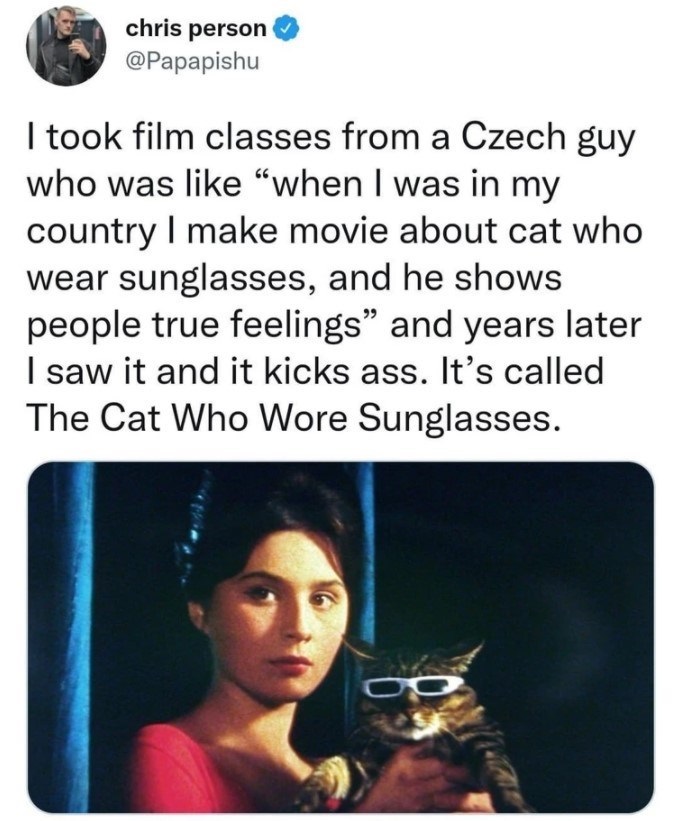
One of the sharpest reminders that the Internet is not real life that I’ve gotten recently was the sparse attendance at a local screening of The Cassandra Cat.  Also distributed under the English titles When the Cat Comes and That Cat, The Cassandra Cat is best known (to me) as the subject of a viral tweet, recommended by a film student whose Czech professor bragged about making a movie about a cat who wore sunglasses called The Cat Who Wore Sunglasses.  I certainly didn’t expect that one tweet would exalt The Cassandra Cat up to the level of household Czech New Wave standards like Daisies or Valerie and Her Week of Wonders, but it is one of those tweets that rattle around in the back of my mind the same way serious film scholars can quote lines of criticism by Kael, Sarris, and Godard.  So, when there were fewer than ten people in attendance for The Prytania’s afternoon screening of its recent restoration, I was shocked.  I could not believe so few people showed up to see a half-century-old Czech film about a magical cat that I’ve only ever heard about via Viral Tweet.  So weird.

Y’all missed out.  The Cassandra Cat is a wonderfully imaginative children’s film about collective action, holding adults accountable for being liars & cheats, and about how cats are excellent judges of character.  The titular cat is a trained circus performer who arrives to a small Czech village with an army of talented coworkers: a ringleader magician, a gorgeous trapeze artist, and a legion of faceless, supernatural puppeteers.  Their act initially goes over well with the townspeople until the final routine, in which the trapezist takes off the cat’s sunglasses so he can stare his naked cat eyes into the audience.  It turns out that the cat’s direct gaze has the magical power to expose people’s true nature by making them glow like mood rings (an effect achieved through body paint & gel lights).  Adulterers glow yellow, revealing secret affairs hidden from their spouses.  Selfish careerists glow violet, exposing their greed to higher-minded comrades.  Lovers glow red, revealing their pure, earnest hearts as artists & true friends among their careerist counterparts.  This, of course, causes a riot among the adults, who spend the rest of the film attempting to banish & discredit the cat in front of the children who witnessed their secret selves.

There is some political allegory to The Cassandra Cat that might not entirely translate to modern audiences unfamiliar with the day-to-day complexities of the Czech Republic pre-Prague Spring.  Mostly, though, it’s fairly easy to follow as the Czech New Wave version of “The Harper Valley PTA”.  That’s what makes it such a great children’s film, especially once the magical cat is weaponized by the town’s schoolchildren, who stage a mass classroom walkout until he’s surrendered to their care & use.  It’s also a great children’s film because of its vintage sense of magic & whimsy, recalling other psychedelic children’s media of bygone eras like H.R. Pufnstuf, The Peanut Butter Solution, and The 5,000 Fingers of Dr. T.  There were no actual children present at that afternoon screening at The Prytania, just a few stray adult weirdos who had nothing better to do in the breezy sunshine outside.  At this point, The Cassandra Cat is a film exclusively for weirdo shut-ins, the kid who file away hit tweets in the back of their minds in case the forgotten Czech films referenced therein happen to pop up on the local repertory schedule.  Maybe that makes us losers, but if like to think that if a cat stared at us that day we’d at least glow red.

– Brandon Ledet

Suzume (2023)

It’s generally hackneyed for Western critics to compare any (or, in some egregious cases, all) modern anime directors to the legacy of Hayao Miyazaki, but it’s especially hackneyed to invoke that name when praising Makoto Shinkai, who’s been slapped with the ill-fitting label “The Next Miyazaki” at least since he made 5 Centimeters per Second two decades ago.  I am a little guilty of this hack behavior myself, having compared the way Shinkai lovingly illustrates the beauty of urban settings with the way Miyazaki illustrates the majesty of Nature – twice, when reviewing both his breakout hit Your Name. and its lesser loved follow-up Weathering with You.  And even though his latest film, Suzume, is partially set in the Japanese city of Miyazaki and features a direct shout-out to the Miyazaki-penned Whisper of the Heart, I really need to break the habit of typing that name every time a new Shinkai picture rolls through American cinemas.  We all do.

At this point, Shinkai’s closest comparison point might be someone who only occasionally dabbles in animation: Wes Anderson.  The 50-year-old industry long-timer has tripled down on his schtick so hard since Your Name. broke out in 2017 that his stubborn resistance to explore new visual or thematic territory has become endearingly stubborn in a distinctly Andersonian way.  I know exactly what I’m going to get from a Makoto Shinkai picture long before I buy a ticket and accompanying popcorn bucket: a supernatural romance between youngsters distanced by Japan’s urban/rural divide – their lives eventually united though fast-moving trains, widespread disaster, and the transformative power of love.  Shinkai’s non-existent lenses will “flair” across his CG-smoothed train rides and exquisitely detailed hand-drawn backdrops in the exact same way every single picture, and the only question, really, is what supernatural device he will use to keep his lovelorn teens apart.  He’s been so consistent in his recent output that he’s inspired his own crop of shameless imitators (as evidenced by other, lesser teen romances like Fireworks & I Want to Eat Your Pancreas) the same way that Wes Anderson’s retro, symmetrical wit inspired aggressively unwitty flicks like Garden State & Napoleon Dynamite.  The thing with both directors is that no matter how familiar & insular their respective filmmaking styles have become, they’re both still delivering vividly entertaining work every project.  I don’t know that Shinkai will ever match the soaring teen emotions of Your Name., but the artistry of his two triple-down follow-ups still coasts miles above most modern animation.  Like with Anderson, his work remains impressively gorgeous & earnest in the moment even if it’s no longer surprising or novel in the larger context of his career.

In this particular game of Makoto Shinkai Mad Libs, a rural teenager stumbles across a magical doorway guarded by a stone cat figurine that her touch brings to life.  When the impish cat-god scampers away, the unguarded door opens to unleash gigantic flaming tendrils from The Other Side that slam down on her unsuspecting hometown, threatening to destroy everything & everyone she knows in devastating earthquakes.  A college-age hunk she immediately crushes on teaches her how to close & lock this dangerous door, then joins forces with her to return the cat-god to its rightful station.  Only, the little feline prankster turns the hunk into a talking chair, which makes the heroic pair’s already awkward romance even more uneasy.  From there, Suzume and her wooden-chair beau chase the kitten around Japan, closing all the doorways to the afterlife that open without its protection along the way.  The wide-scale tragedy of the resulting earthquakes is treated seriously and is eventually tied to the 3/11 tsunami disaster that devastated Japan in 2011.  That historical context piles a lot of emotional heft onto the youngsters’ flirtatious relationship, but it’s also lightened by the physical awkwardness of their predicament.  In some ways turning the older boy into a talking chair makes him a less threatening object of desire for his teen-girl counterpart, but the movie still has cheeky fun in moments when he is visibly flustered that Suzume sits in his “lap.”  When she asks, vacantly, “Um, why are you a chair?” in perfect teenage aloofness, Shinkai is winking a signal that it’s okay to giggle at the outlandish premise.  Even so, the physical object the boy inhabits is eventually afforded its own emotional heft in Suzume’s backstory, so that his transformation is rooted in a tsukumogami Japanese folklore tradition instead of a LOL, So Random flippancy.  By the time Suzume crosses the gates of Hell to rescue her chair from the afterlife and defeat the flaming earthquake tendrils for good, there’s no question how seriously we’re supposed to take their relationship.

As easy as it is to become jaded about Shinkai’s tendency to repeat himself, there’s also no denying that he’s good at what he does.  By the film’s fiery emotional crescendo where Suzume is struggling to dislodge her new chair friend from his Arthurian stone prison while the world ends around them, it’s incredible how breezy the journey to get there felt in retrospect.  It’s as if you were so distracted by the frustrations of retrieving an escaped kitten that you didn’t even notice you opened the forbidden Hell door from Little Nemo’s Adventures in Slumberland during the frantic search (a formative film that I beg you not to scan its production credits, to spare me further self-inflicted accusations of hackiness).  Shinkai has a way of building to immense wonder & awe even if you start out assuming you’ve seen it all before, and I’m starting to hope he never changes course.  I want him to follow the Wes Anderson career path where every subsequent Makoto Shinkai movie will be the most Makoto Shinkaingest movie the world has ever seen.  May we all survive the disasters of climate change long enough to see his anime equivalent of The French Dispatch in 2032.

-Brandon Ledet

Lagniappe Podcast: The Cat Returns (2002)

For this lagniappe episode of the podcast, BoomerBrandon, and Alli discuss the Studio Ghibli novelty The Cat Returns (2002), an anime fantasy film about a kingdom of anthropomorphic cats.

00:00 Welcome

02:40 My Winnipeg (2007)
03:40 The Twentieth Century (2020)
05:40 The Snyder Cut (2021)
11:30 Hannibal (2001)
13:15 Red Dragon (2002)
14:30 Hannibal Rising (2007)
15:40 The Boy Next Door (2015)
18:20 What Lies Below (2020)
25:00 Godzilla vs Kong (2021)
28:00 Mothra vs Godzilla (1964)
30:15 Godzilla vs Mothra (1992)

32:17 The Cat Returns (2002)

You can stay up to date with our podcast through SoundCloudSpotifyiTunesStitcherTuneIn, or by following the links on this page.

– The Lagniappe Podcast Crew

Brandon’s Top 20 Genre Gems & Trashy Treasures of 2019

1. Fighting With My Family This melodramatic biopic about WWE wrestler Paige does an excellent job conveying the appeal of pro wrestling as an artform, offers empathy to every character its story touches without shying away from their faults, and properly sketches out how much respect for women’s wrestling has evolved in the last decade (and how influential Paige was in that sea change). It’s also way dirtier than I expected, often playing like an R-rated Disney Channel Original.

2. Ma Octavia Spencer slums it as an unassuming small-town vet tech who parties with neighborhood teens in order to enact revenge for their parents’ past wrongs. It’s at first baffling to learn that Tate Taylor, the doofus responsible for The Help, also directed this deliciously over the-top schlock, but it gradually becomes obvious that the goon simply loves to watch Spencer devour scenery and it just took him a while to find the proper context for that indulgence – the psychobiddy.

3. Child’s Play An in-name-only, shockingly fun “remake” of the classic killer doll thriller by the same name. Much like the original, this is the exact kind of nasty, ludicrous horror flick kids fall in love with when they happen to catch them too young on cable, and it directly pays homage to that very canon in references to titles like Killer Klowns From Outer Space & Texas Chainsaw Massacre II.

4. Paradise Hills An impressive coterie of young actors (Emma Roberts, Awkwafina, Danielle McDnonald, Eiza Gonzalez) square off against veteran badass Milla Jovovich in a near-future Patriarchal hell. It’s essentially Guillermo del Toro’s Stepford Wives staged on the set of the rose garden from the animated Alice in Wonderland. A femme fairy tale that takes its over-the-top, Literotica-ready premise refreshingly seriously despite the inherent camp of its (sumptuous) costume & production design.

5. Read or Not A list of things that make this Clue & You’re Next genre mashup immensely enjoyable: the careful attention to costume design, the Old Dark house sets, Samara Weaving, Aunt Helene, that “Hide & Seek” novelty record and, most importantly, the rapid escalation of its final ten minutes into full unrestrained delirium. Great nasty fun.

6. Saaho A Indian action blockbuster that opens as a fairly well-behaved Fast & Furious rip-off in its first hour, then pulls an outrageous twist I’ve never seen in an action film before, and finally reveals its title card and the announcement “It’s showtime!” The next two hours are then a throw-it-all-in-a-blender mix of Mission: Impossible, Fast & Furious, The Matrix, John Wick, Iron Man, Fury Road and practically every other action blockbuster in recent memory you can name. Pure maximalism.

7. Pledge A nasty little VOD horror about a fraternity rush week from Hell. The dialogue and performances are alarmingly good for something on its budget level, which makes it all the more horrifying when characters you kinda like are tortured in extreme gore by frat bro monsters for a solid hour of “hazing.” It also sidesteps a lot of the usual misogyny of the torture porn genre by making both the victims & villains All-American macho types.

8. Good Boys Superbad is often praised for its final emotional grace notes shared between teen-boy BFFs who’ve struggled to maintain a tough masculine exterior throughout their entire preceding gettin’-laid adventures, to the detriment of their relationship. Here, the earnest vulnerability & emotional grace notes are constant & genuine from frame one, providing some much-needed hope for the men of the future. These are very good boys.

9. Braid Two amateur drug dealers escape police scrutiny by returning to the childhood home of a mentally unwell friend who’s trapped in a never-ending game of violent make-believe. A total mess but also a total blast. Gorgeous costumes & sets, gloriously self-indulgent film school cinematography, and genuinely shocking over-the-top turns in the “plot” every few beats. Think of it as Heavenly Creatures for the Forever 21 era.

10. War Between this & Saaho, my two favorite action movies of the year are both big budget, Twisty blockbusters from India. This one is basically a beefcake calendar as directed by Michael Bay. It’s 70% abs & pecs, 20% stadium guitar riffs, 10% homoerotic eye contact, and I guess somewhere in there is a plot about a super soldier’s mentor who’s “gone rogue.”
11. Glass M. Night Shyamalan explodes his small-scale women-in-captivity thriller Split into an MCU-scale superhero franchise, but hilariously dodges all the accompanying genre spectacle that his budget can’t afford. I am very late to the table as a Shyamalan apologist, but by the time I was the only person in the theater cackling at his attempt to connect the mythology of his own cameos in Split & Unbreakable into a cohesive narrative arc, I was converted for life. What an adorable nerd.

12. Crawl A lean, mean, single-location creature feature in which a father-daughter duo fights off killer CG alligators during intense hurricane-related flooding. Only could have been improved by an alternate ending where they survive the storm only to discover that the entire planet has been taken over by gators while they were trapped inside. Should have ended with gators piloting the “rescue” choppers.

13. Escape Room Basically the ideal version of Saw, with all the nasty torture porn & (most of) the nu-metal removed for optimal silliness. All storytelling logic & meaningful dialogue/character work are tossed out the window in favor of full, head-on commitment to an over-the-top, truly preposterous gimmick: an escape room, except For Real.

14. The Head Hunter A medieval monster slayer seeks to add the head of the beast that killed his daughter to his trophy collection. An impressive feat in low-budget filmmaking that knows it can’t convincingly stage battle scenes on its production scale, so it makes up for it by leaning into what it can do well – mostly delivering grotesque creature designs & a nihilistic mood.

15. Booksmart Maybe not always the most hi-larious example of the modern femme teen sex comedy (in the recent The To Do List/Blockers/Wetlands/Slut in a Good Way tradition) but one with an unusually effective emotional core and more Gay Stuff than the genre usually makes room for. If nothing else, it felt good to know that the kids of Gen-Z are more than alright.

16. Greener Grass A warped Adult Swim-style comedy of manners about overly competitive soccer moms, featuring performances from D’arcy Carden, Mary Holland, Janicza Bravo, Beck Bennett, and similar Los Angeles comedy folks. Total illogical chaos and menacing irreverence from start to finish, with a particular debt owed to John Waters’s post-Polyester suburban invasion comedies.

17. The Breaker Upperers A New Zealand comedy about professional break-up for hire artists, a premise that’s pretty much a wholesome 2010s update to Dirty Work by way of Taika Waititi. Zings quickly & efficiently with incredibly well-defined characters, like a The Movie adaptation of a sitcom that’s already been going for years & years.

18. The Banana Splits Movie A SyFy Channel Original that’s somehow a genuine delight? It imagines a world where its eponymous Hanna-Barbera children’s show starred killer animatronic robots instead of failed actors in mascot costumes. Goofy & violent enough to be worthwhile despite how thin its character work is (with some especially nasty practical gore gags), which is more than you can say for most of the originals that network broadcasts.

19. Countdown Beyond just appreciating that there was a mainstream horror about a killer smartphone app in megaplexes this past Halloween, I admired this for adding three very distinct angles to the technophobic Killer Internet subgenre: the eerie unknown of user agreement text that no one reads; the startling menace of app notifications that unmute themselves every phone update; and car backup cam jump scares.

20. CATSTom Hooper’s deranged stage musical adaptation is the exact horned-up, ill-advised CGI nightmare that Film Twitter has been shouting about for months on end and I’m happy it’s been celebrated as such. Admittedly, though, I was absolutely exhausted by pro film critics’ competition to see who could dunk on the film online with the loudest or the funniest zingers, which tempered my enthusiasm before I got to enjoy its spectacular awfulness for myself (opening week!). As such, I suspect this is the camp gem of 2019 that will improve the most in years to come, once the hyperbolic discourse around it settles and it remains just as bizarre as ever.

-Brandon Ledet

Lily C.A.T. (1987)

There were countless Alien knockoffs that followed in the wake of Ridley Scott’s genre-shifting 1979 classic. Roger Corman alone produced three I can name offhand (Galaxy of Terror, Humanoids from the Deep, and Battle Beyond the Stars) and even that notorious schlockteur’s takes on the Alien template weren’t the cheapest or most derivative of the bunch. Within that crowded field, the straight-to-video cheapie Lily C.A.T. had very little chance of standing out as something especially unique or worthwhile. Yet, as it escalated to its own grotesque, cosmically horrific creature-feature crescendo, I found myself gradually convinced that I was watching something truly special, something that reaches beyond the confined-space creature feature dread of its obvious inspiration source to achieve its own rewarding, unnerving effect. If you’re going to be an Alien knockoff, you might as well strive to be the best Alien knockoff, or at least the most distinct.

Part of what saves Lily C.A.T. from devolving into sub-Alien tedium is that it’s more of a mutation of that seminal work than it is a Xerox copy. The film is immediately distinct from its fellow Alien riffs in its distinction as a mid-80s anime, converting the cheap sets & limited practical effects resources of this genre template into a freeing, visually impressive handdrawn animation style. It’s also, smartly, only an hour-long – firing off its checklist of genre requirements with rapid-fire efficiency where most cheap-o Alien riffs risk drifting into boredom in their half-hearted attempts to stir up atmospheric dread. Early in the film a character even asks aloud, “Hey captain, when are we getting to work? This is getting boring,” as if to signal to the audience that no time will be wasted in getting to the goods. Lily C.A.T. also mutates the Alien template by crossbreeding it with other creature feature influences: Cronenberg, The Thing, and any number of post-Lovecraft cosmic horrors you can conjure. It’s a quick, nasty little monster movie rendered in intricately handdrawn animation – the perfect genre nerd cocktail.

The story told here is so familiar it almost doesn’t require repeating for anyone who’s ever seen a spaceship-bound horror film. A motley crew of wisecracking Corporate employees are distracted from their stated mission by a distress call & a subsequent onboard alien invasion. They’re only broadly defined as “time-jumper” types: mercenaries who use the decades of hibernated sleep associated with deep-space travel to avoid personal troubles left back on Earth. Their individual archetypes are only developed from there in the way they’re drawn (uncomfortably so in the only black character’s exaggerated facial features) and their motivations for jumping time on their home planet (uncomfortably so in the main woman’s petty revenge on a romantic rival by returning twenty years younger than her). Their personalities matter less & less as they’re picked off by the invading alien creature, of course, although the film does generate suspense in an early reveal that there are dangerous intruders hiding among them under false credentials.

The threat of an intruder lurking among the crew is only an introduction to a larger theme of imposterism, which plays out in a much more grandiose fashion with a non-human member of the crew: the titular cat. Lily C.A.T. seems to be fascinated with the implications of traveling through the far reaches of outer space with a common housecat, and expands that detail from the original Alien film to generate the majority of its creature feature chills & thrills. While the crew assumes that it only has one cat onboard, that feline is actually copied by two of its own uncanny imposters. One cat is a robotic spy that secretly answers to Corporate back home behind their backs. In fact, it’s not a cat at all, but rather a C.A.T. (a Computerized Animal-shamed Technological Robot). The other imposter cat is a shapeshifting alien creature that fills its victims’ lungs with deadly body-morphing bacteria and gradually transforms into a grotesque Lovecraftian tentacle monster that absorbs the features of its growing list of victims in an exponential creepout. The original cat, unfortunately, does not make it too long into the film’s runtime, and we’re treated to a grisly confirmation of its . . . organic nature when its time onboard is up.

Weirdly, I’m not sure if Alien superfans would be the first audience I would recommend Lily C.A.T. to, unless their favorite detail from the original film happens to be Ripley’s relationship with her cat. This cheap DTV animation never had a chance to stack up to the original in a direct comparison, nor does it really attempt to. This film’s built-in audience is more likely nerds who salivate at the idea of any horror-themed anime or, more to my own alignment, weirdo genre enthusiasts who salivate over ludicrous killer-cat creature features like Cat People ’82, Sleepwalkers, and Night of a Thousand Cats. Surely, there’s some significant overlap between those two camps who will find Lily CA.T.’s shapeshifting-feline-tentacle-monster genre thrills exactly to their tastes. If nothing else, it’s a very specific niche that strikes a tone no other Alien knockoff ever could—animated or no.

-Brandon Ledet

Night on the Galactic Railroad (1985)

I didn’t really grow up with anime as a child, or even a teen. It was something I first explored in my early twenties in the aughts when it seemed like the last remaining sanctuary for hand-drawn animation in modern cinema. And even since then my familiarity with anime has been very surface-level, defined by major genre touchstones like Miyazaki, Sailor Moon, and Satoshi Kon. The one major exception I can think of in this late-to-the-table anime exposure was my childhood VHS tape of Little Nemo: Adventures in Slumberland, an 80s relic (and a Japanese-American co-production) that I watched countless times as a kid despite it being a drowsy, unhurried mess. Watching its contemporary peer Night on the Galactic Railroad for the first time recently felt like a weirdly comforting return to those childhood viewings of Little Nemo – one of the rare anime titles where I felt at home with the tone & artistry instead of in over my head with a genre I don’t know nearly enough about. Night on the Galactic Railroad is a soothing, hypnotic film for me, which is odd because it’s intended to play as a devastatingly somber fantasy drama.

This is an adaptation of a popular 1930s children’s novel from Japan, in which a lonely young boy escapes the isolation of caring for his sick mother in a small town where hardly anyone notices him by riding a magical late-night train with his only friend his age. For reasons unexplained, the movie decided to remain faithful to the book’s plot but recast most of its characters as talking cats. But not all of them! It’s in no rush to emphasize or justify this major alteration to its source text (or to clarify exactly why most characters are cats, but some remain human). In fact, it’s in no rush to do anything at all. It takes nearly 40 minutes for the titular magic train to arrive, before which we mostly watch our melancholic feline protagonist attend to his daily chores at work, school, and home. Once on the train, he has lowkey conversations about the immensity of the galaxy and the meaning of life with a series of passengers – including his aforementioned bestie and, most surprisingly, passengers of The Titanic. The tone is grim & low energy, slowly chugging along to a major reveal about what riding the train symbolizes in its closing minutes, long after an adult audience would have guessed the twist. If young children had the attention span to follow its story and parse out its symbolism, it’s devastating enough that it could really fuck them up. Instead, it plays like a minor-notes lullaby, a warm naptime blanket made entirely of grief & regret.

Besides my recollections of Little Nemo, Night on the Galactic Railroad reminds me of when I had Final Fantasy on Gameboy as a kid but didn’t really know how to play it, so I would just wander around the game’s villages talking to fictional strangers. Absolutely nothing happens in this movie and the feline character designs stray disturbingly close to online furry art, but it still works like a soothing salve on a troubled mind. This film is potent catnip for anyone who can lose themselves in the pleasures of looking at cute cats & outer space imagery for the eternity of a lazy afternoon. Its unrushed tedium isn’t boring so much as it’s a time distortion device, making 100 minutes stretch on for 100 pleasantly melancholic hours – like contemplating the nature of Death while drifting through outer space all by your lonesome. It’s not the dazzling, intricate artistry and propulsive excitement of anime that I’ve come to appreciate in recent years as I’ve sought out the legendary standouts of the medium, but rather the dozy nostalgia-prone slow-drift of 80s anime that I grew up with as a kid.

-Brandon Ledet

Ghost Cat (2003)

There’s an instant absurdist appeal to making a live action cat movie that I find endlessly entertaining, whether it be a “lighthearted” family comedy like Nine Lives or a weirdo genre film like The Night of 1,000 Cats or something in-between like The Cat from Outer Space. 2003’s made-for-Animal Planet TV movie Ghost Cat also splits the difference between those feline cinema subcategories. Starring a before-she-was-famous Ellen Page, still firmly in the Trailer Park Boys/I Downloaded a Ghost phase of her career, Ghost Cat is a cheaply ugly & transparently vapid time-waster of a family picture. Alternately marketed as a family drama under the titles Mrs. Ashboro’s Cat and The Cat that Came Back, it was only packaged as a feline horror thriller as an afterthought. Ghost Cat doesn’t have the heart to make a villain out of its titular threat, instead playing the ghost cat as a hero to animals everywhere & giving her the not-at-all-threatening name Margaret. Still, I found myself at least mildly charmed by the film’s quaintly campy thrills throughout and left it with a big, dumb smile on my face. The inane pleasures of a live action cat movie are that inherently strong.

Ghost Cat’s titular animal spirit is too lovable to demonize, so the film instead turns to the most tried & true villains of children’s media (and life in general): white businessmen. Greedy white men conspire to rob an old lady of her family home and her friendly neighbor of her animal rescue operation to make way for an Evil Real Estate Development Deal. Once the old lady dies alone at home, along with her cat (yikes! that’s depressing) the only thing standing in the way of the evil real estate development is the cat’s ghost and its only living human friend, a young girl played by Page. The ghost cat initially appears in the young girl’s stress-induced nightmares about her own dead mother, wildly meowing in an artfully inane montage of flames and black & white photographs. From there it does things you’d expect a cat’s ghost to do: mysteriously knocking items off shelves, walking across piano keys, and invisibly “making biscuits” on bedspreads. The cat’s ghostly deeds become more purposefully heroic as the film goes on, though, and Margaret eventually saves the day several times over by scratching the evil white men in the face and thwarting their shady contract deals by getting the right papers in the right people’s hands.

Made soon after national stories like the Enron scandal and Martha Stewart’s insider trading conviction, Ghost Cat has a surprising amount to say about how financial institutions are gleefully willing to rip off & tear down the people. The film even solidifies the threat by having its business cretins directly attack the most innocent victims possible: abused & neglected animals. It’s bad enough when they start the film pressuring an old woman to forfeit her property, but by the end the ghost cat has to stop them from literally gassing an entire animal shelter’s worth of rescues to death. That’s some top shelf TV movie villainy right there. Unfortunately, focusing the story’s weight on the evils of white man business dealings means there’s less room in the runtime for ghost cat tomfoolery, which is obviously the film’s main draw. I was satiated by the few ridiculous cat cam & feline nightmare sequences the film could afford me, but for the most part there just wasn’t nearly enough ghost cat in my Ghost Cat. This film is strictly for mid-afternoon lazy-watching, an easy on the brain indulgence that somewhat satisfies in its titular inanity, but leaves a lot of room to explore in future feline spirit realm cinema. I’ll be there for those future ghost cat experiments in TV movie artistry, but sadly I doubt Ellen Page will be joining me for the ride. She’s got better things to do. I don’t.

-Brandon Ledet