Sleeping Beauty (1959)

Once upon a dream, Disney was in the business of producing world-class visual art. Now they’re just in the business of business — corporate acquisitions and such. The dream is over. So it goes.

That corporate culture shift didn’t happen overnight. At minimum, it happened over a decade. The 1950s saw Disney’s earliest, mightiest strides to diversify its portfolio, expanding into television and amusement parks after spending its first couple decades focused on its core mission: overworking & union-busting animators. Still alive, engaged, and at the helm, Walt Disney himself was conscious of the ways his company’s corporate expansion could dilute the quality of its feature films, so he made a point to reaffirm dominance in the field through technically accomplished pictures like Cinderella, Alice in Wonderland, and Peter Pan. Fittingly, the studio closed out the decade with the most back-to-basics title of the batch, 1959’s fairy tale romance Sleeping Beauty.

This feature-length adaptation of Tchaikovsky’s thinly plotted ballet is, above all else, a formal flex. Narratively speaking, Sleeping Beauty doesn’t accomplish anything that wasn’t already covered by Snow White or Cinderella. It’s yet another princess-in-distress fairy tale of a fair maiden being rescued from a jealous hag’s curse by a macho hero’s kiss. Only, it’s stripped of any defining characteristics that would make its doomed lovers lastingly memorable. Nothing about Princess Aurora is especially iconic, to the point where she’s more often referred to nowadays by the film’s title than by her proper name. All memorable character quirks are instead reserved for the women in charge of her fate: the three goofball fairies who protect her from Evil (Flora, Fauna, and Merryweather) and the villainous Mistress of All Evil (Maleficent, the only character here deemed worthy of her own spinoff franchise).

Without any of the usual pesky plotting or character concerns getting in their way, Disney’s team of technicians could focus entirely on the animation’s visual majesty. Afforded an extreme “Technirama” aspect ratio to paint his elaborate backdrops within, artist Eymind Earle crafts an extravagantly detailed tableau in every frame. Walt Disney tasked his crew with evoking Medieval tapestries in the film’s design, and Earle goes so overboard in his traditionalist craftsmanship that he upstages the characters that populate his backdrops.  In turn, his collaborators create an incredible depth of field through cell animation techniques, especially in early sequences where the wicked witch Maleficent and her fairy foes bless & curse the newborn baby Aurora through a series of magic spells. Roses, specters, lightning, and other abstract premonitions swirl in psychedelic montage as Aurora’s fate is decided at the foot of her royal crib. It’s a divine intersection of the fairy tale traditionalism of Snow White and the pure orchestral illustration of Fantasia — two mighty Disney triumphs from decades past, the best animation money can buy.

I have no interest in recounting Aurora’s troubled path to womanhood here. She’s cursed to die on her 16th birthday but is saved by a good nap and a classic case of puppy love. The rest is all arranged royal marriages, goofy sidekick antics, and sitcom-level mistaken identity hijinks. Even the mighty Maleficent is more memorable for her visual design than for her words or actions. We love the drag queen pageantry of her devil-horned headpiece. We love the green-on-black color scheme of her magic spells. We love her climactic transformation into a purple, fire-breathing dragon — another grand achievement in classic, hand-drawn animation. When the evil witch is defeated and Aurora is saved by the kiss of her sweetheart prince, the picture ends with the young couple dancing in the clouds. That’s also where the audience’s heads are supposed to be, not sweating the details of the storytelling on the ground.

When was the last time Disney was more focused on the visual majesty of it’s animation than on the marketability of its characters? Every in-house Disney production is now shrewdly designed to stock some toy shelf, amusement park attraction, or T-shirt screen press with fresh, sellable IP. It’s difficult to imagine an instance where they’d set aside character quirks & catchphrases to wow an audience with a return to classic, elegant animation. At this point, the company’s animation wing is a product delivery mechanism, like an assembly line conveyor belt. It used to be their entire raison d’être.

-Brandon Ledet

Something Wicked This Way Comes (1983)

It’s been over eight years since I first saw Something Wicked This Way Comes, the 1983 Disney Pictures adaptation of the Ray Bradbury novel, when we covered it for “Movie of the Month” in July of 2017. In looking back over what I wrote, it seems that at the time I was most interested in communicating how the film differed from the novel and allowing my cohort to get more into the meat of what the film meant to them. In that discussion, there’s mention of the fact that this film works best on VHS, but I recently got to see the digital, full screen version that was just added to streaming at the beginning of this month, and it was virtually a brand-new experience for me. I’m not sure if it was because the tape I had was substandard or I was suffering with some kind of mind-numbing flu at the time of my initial viewing, but this felt like a brand new movie to me, as if I had never seen it before, and I felt the need to revisit it in writing as well. 

I’ve been toying around with creating a bit of an “80s kid horror syllabus” lately, which has involved a first-time watch or a rewatch of some of the mini-genre’s greatest hits: The Watcher in the Woods, Labyrinth, Return to Oz, Paperhouse, The Dark Crystal, and, regrettably, Transylvania 6-5000. I remember being somewhat less than impressed with Something Wicked upon first viewing, but this time around, I found myself utterly captivated by it. The film is told from the point of view of an adult Will Halloway, about the final days leading up to his fourteenth birthday on Halloween, sometime in the 1950s. The young Will (Vidal Peterson) tells us early on that this is really the story of his father, Charles (Jason Robards), and the way that his father saved Will and his best friend Jim Nightshade (Shawn Carson) from a dark and mysterious force that appeared in their small midwestern town of Green Town. This evil is mostly represented in the forms of carnival proprietor Mr. Dark (a delightfully malevolent Jonathan Pryce), his brutal right hand man Mr. Cooger (Bruce M. Fisher), and the enigmatic “dust witch” (Pam Grier) who charms men to their doom. 

I mentioned it way back when, but Something Wicked (the novel) undoubtedly had an effect on Stephen King’s Needful Things, so much so that the latter work bears as much similarity to this film as, say, Mike Flanagan’s Midnight Mass does to King’s own work. What I was struck by on this watch was how much it must have also influenced IT, given that the narratives both revolve around young children on the cusp of adolescence who resist the machinations of an intangible force of evil to which adults are blind (or blinded). The difference is that in IT, Pennywise seeks to consume the fear of children because their fears are much more concrete than those of adults and thus are something it can manifest while its supernatural powers make it nearly imperceptible to adults while, in Something Wicked, Mr. Dark’s mystical offers to the adults of Green Town are specifically aimed at the regrets that age has wrought on them. It’s telling that his offers are mostly lost on Will, a boy with two loving parents (even if his father is in poor health) and who has experienced only one traumatic event, while Jim, a boy living with a single mother because his father disappeared years ago and who can’t wait to grow up, is much more susceptible to Dark’s machinations. Jim and Will represent the two sides of fantasy; while Will still has the childlike imagination that inspires play, Jim’s daydreaming is maladaptive and, thus, makes him more vulnerable to being taken advantage of by Dark (and darkness). 

In that above-linked “Movie of the Month” discussion, there was a general consensus that Mr. Dark and his legion were preying upon people’s selfishness, but I see something different in it now. For some, their temptation may be related to something that we could call weakness—Miss Foley, once the town’s greatest beauty and now an old spinster, desires her youthful grace vainly; Mr. Tetley the cigar-peddler has piddled away his money on lottery tickets greedily; Mr. Crosetti the barber desires the company of a woman as apparently the only single man in a town of married women lasciviously (although I think the last of these is arguable). But I think maybe we were all operating under our own youthful blindness back then, because we failed to identify that what Dark was offering wasn’t the opportunity to indulge in a variety of selfish, carnal desires but to overturn the regrets of the past. This is made most manifest in two characters: Mr. Halloway (naturally, as the main character), but more blatantly in the form of the town’s bartender, Ed, played by real life amputee James Stacy. Ed is a strange figure, as he still wears his old football jersey around the town and can’t stop talking about the good old days, and if he were still an able-bodied man, we would pity him for being the kind of guy who peaked in high school and never shuts up about it. As it is, since he has lost an arm and a leg, we are sympathetic both to his fond remembrances of the past as well as the ease with which he is seduced by Dark’s promise of making him “whole” again. This reveals that there’s more than mere selfishness (or vanity, greed, or lust) at the heart of Dark’s bargains, but the false promise of a life without regret, and sets up the offer that he makes to Mr. Halloway. 

This is a wonderfully clever bit of narrative misdirection. Mr. Halloway’s greatest regret isn’t that he’s not wealthier or younger, but that his being a relatively older father and thus not being strong enough to save Will when he was swept up in a current at a riverside picnic means that he failed his son. Halloway’s regret lives outside of him; it’s in the way that his son panics and tries to run from the adult conversation about what happened that day at the river. Dark can only perceive that Halloway desires to be young and strong again, and his offer to return his youth to him fails not just because Halloway isn’t calloused and heartless enough to give up his child for a few more decades but because Dark can’t see that Halloway’s heartache exists in relation to another person. Turning the clock back for the elder Halloway won’t magically erase his failure to save Will from drowning (allowing the drunken and long-disappeared Mr. Nightshade the opportunity to be the unsung hero), and won’t mystically restore what fractured between father and son that day on the riverbank. The irony is that what Dark offers and what defeats him is the same: regression. He can only offer Halloway the chance for mystical rejuvenation by regressing him to an earlier age, but it’s Halloway’s regression to the state of childlike optimism that starves the carnival, since it feeds on negative emotions, allowing a chance for Dark to hoist his own petard aboard the aging/de-aging carousel. 

This film is also a visual marvel. Now that it is widely available again, it’s entering The Discourse, and I’ve seen several neutral(ish) criticisms that the film is wonderful “despite” that the “visuals don’t hold up.” I would disagree wholeheartedly, as I don’t think that the representations that we see on screen were ever meant to fully evoke “reality.” As the malevolent train rolls into town, eerie wisps of smoke are drawn over the frames, and this same smoke attempts to capture the two boys later in the film, but it was never really meant to be smoke, it was “smoke” in a more ephemeral sense. Several vistas are clearly matte paintings with the occasional distant, twinkling light in them, but it’s only “unconvincing” if you expect the film to perfectly reproduce a landscape, and I feel that the film informs us that we shouldn’t be expecting that from the first moments, when the adult Will tells us via narration “This is really the story of my father and that strange, leaf-whispery autumn when his heart was suddenly too old and tired and too full of yearning and regrets, and he didn’t know what to do about it.” This is the old home town through the eyes of a child, and what most modern viewers mistake as the “fakeness” of the images used to convey this narrative is an externalization of the mysteriousness of the world to a boy on the cusp of young adulthood, inevitably putting him on the path to being a man whose regrets will crystallize into something manipulable. It’s expressionistic, like Das Cabinet des Dr. Caligari, or Metropolis, or the non-narrative “fictional” interludes in Mishima: A Life in Four Chapters. To hold Something Wicked to a standard of photorealism is to miss the point utterly, and the film’s visual beauty lies in the way that it plays with this self-mythologizing of one’s own childhood, the way that the real becomes the surreal in mind and memory. 

I can’t recommend a revisit (or a first-time watch) of this one more highly, especially in these twilight hours of the spooky season (or, depending on when this goes live, in the dawning days that follow it). Even if you, like me, watched this one once upon a time and weren’t entranced by it, give it another shot. You won’t be disappointed.

-Mark “Boomer” Redmond

Coonskin (1975)

The 1928 animated short “Steamboat Willie” entered the public domain last month, which has inspired a lot of speculation about what perverted things people are going to do to and with Mickey Mouse now that his copyright protection is loosening up.  Unfortunately, there isn’t likely to be much great cinematic payoff to this historical pop culture moment, at least not if last year’s dreadful slasher Winnie the Pooh: Blood and Honey is any indication.  There might be a couple “Steamboat Willie”-inspired public domainsploitation horrors released in the near future, but it’s likely that our imaginative play with Mickey Mouse’s image will stop there.  That’s what makes it so wild that animator Ralph Bakshi already warped & perverted the cursed rodent’s image 50 years ago in his ironic minstrel cartoon parody of Disney’s Song of the South.  The brief appearance of a disc-eared rat might not rank among the top 100 wildest things about 1975’s Coonskin, but it’s still indicative of how limited our imagination has been as icons like Mickey & Winnie have entered the public domain recently – not to mention our litigious cowardice when it comes to playing with fair-use parody (The People’s Joker innocent).

Given that Coonskin was produced three decades after The Song of the South, it cannot be totally contextualized as a direct response to that nostalgic Disney apologia for slavery-era racism in the American South.  Rather, the film ties a long history of racial caricature in American media together for one confrontational comedy of discomforts, with Song of the South standing as the nexus.  Coonskin is effectively an animated take on blacksploitation cinema, both mocking and indulging in the Black action filmmaking aesthetics of its own era.  The broad-stereotype caricature of 1970s blacksploitation tropes is emphasized here as a revival vintage blackface iconography, sometimes literally so in archival photographs that provide the animation’s multi-media backgrounds.  Song of the South was far from the only animated continuation of that racist iconography into the 21st century; it just happened to be the most racist.  You can also see classic minstrel imagery reflected in the white gloves and blackface mugging of classic Looney Tunes character designs (which are also alluded to in Coonskin through the repurposing of the classic “That’s all folks!” Merry Melodies backdrop) as well as the original design of Steamboat Willie himself.  Bakshi’s nightmare perversion of “Mickey Mouse” may only materialize for a brief few seconds of screentime (as a rat who is executed by gunfire from an unnamed character, mid-anecdote) but his ugly, racist legacy as Disney’s mascot is a specter that haunts the entire picture.

The question of whether white men like Bakshi (namely him & contemporary Robert Crumb) were doing anything politically valuable by resurrecting this incendiary racial iconography has been debated since they first started on the 1960s underground comics scene.  I first encountered that moral grey area in the 2001 high school drama Ghost World (directed by R. Crumb documentarian Terry Zwigoff), which includes a climactic art show controversy about whether it’s more racist to dredge up these vintage minstrel-show images for fresh debate or to pretend they never existed in the first place – effectively locking them away forever in the Disney Vault.  I felt no more comfortable with that question watching a Ghost World VHS rental as a teenager in the early 2000s than I did watching a repertory screening of Coonskin with a live crowd in my 30s.  Hell, I felt deeply embarrassed just saying the title aloud at the box office.  Bakshi’s film is transgressive in a way that truly feels dangerous & subversive half a century later, which I can’t honestly say about most Cult Cinema provocations of its kind.  It can be a productive discomfort at times, at least in its willingness to acknowledge that America is a racist country with an even more racist past (something politicians have been struggling to avoid admitting to news cameras this year).  At other times, it just feels like Bakshi regurgitating the racist iconography of his youth without much purposeful subversion of the tropes.  Often, it’s both.

There isn’t much plot to hang onto here, as Bakshi films are more about experiment in form than coherence in narrative.  A live-action jailbreak sequence provides a framing device for a narrated parody of Song of the South, chronicling the many adventures of an animated rabbit, fox, and bear in 1970s Harlem.  The three animal friends go on the lam, Sweet Sweetback-style, after killing a white Southern sheriff and hustle their way up the Harlem hierarchy to local positions of power – outmaneuvering phony preachers & activists, grotesque mobsters, and an endless supply of even more racist cops during their ascent.  Like the cartoon animals of the famous “Zip-A-Dee-Doo-Dah” sequence in Song of the South, Rabbit, Fox, and Bear are animated on top of live-action cinematography; only, Bakshi pushes that mixed-media style to point of experimental psychedelia.  Sometimes the background is a still image.  Sometimes the camera spins in a nauseating circle.  Sometimes the real, hip citizens of Harlem mix with the vintage-minstrel cartoons that reduce them to stereotypes.  The only constant is that every hand-drawn character is a grotesque exaggeration of an American cliché, from the racial caricatures of the main protagonists to the scrotal monstrosities of their white oppressors to the homophobic condemnation of the ninnies who play both sides.  The only exception to that treatment is the personification of America herself: a buxom blonde who seduces the Black men beneath her to their peril, releasing machine gunfire from between her legs.

The more I think about it, the only truly subversive thing artists could do with the Steamboat Willie image at this point is to return Mickey Mouse to his racist minstrel-show roots to expose how rotten American culture is at its core.  Maybe that approach is better suited for a quick Robert Smigel gag in a TV Funhouse sketch than it is for a feature-length comedy, but Bakshi still gets major credit for fearlessly getting to the punchline early and punching it harder than he really had any right to.  I’d also like to give major credit to WW Cinema (the local screening program formerly known as Wildwood) for daring to publicly exhibit this film in the 2020s, which in some ways feels even more dangerous than if they went straight to the source and screened Song of the South.  It was an uncomfortable night at the movies, productively & memorably so.

-Brandon Ledet

Petite Ourse

In the opening minutes of the coming-of-age fantasy Turning Red, I was crushed by the stomach-pit realization that the movie was Not For Me.  Overwhelmed by the sugar-rush hijinks of the soon-to-be-ursine heroine introducing all of her goofball friends & personality quirks in rapid, smooth-surface CG animation, I nearly ejected the DVD and rushed it back to the library in panicked defeat.  I’m mostly glad I stuck it out.  I understand that Pixar is respected as the current high standard of children’s media, but I’m too disconnected from the comedic sensibilities & visual artistry of modern computer animation to distinguish the gold from the pyrite.  It all looks & feels the same.  Still, I did appreciate Turning Red as life-lesson messaging for little kids, who are ostensibly Pixar’s target audience even if they’re not the pundits tweeting hyperbolic praise for the studio.  The last couple Disney animations I remember watching (Coco & Encanto) taught kids to obey & forgive Family at their own expense; Turning Red directly conflicts that poisonous wisdom, encouraging children to rebel & grow into their own individual selves no matter how uncomfortable it makes their parents.  It also frankly discusses menstruation and the other bodily changes of puberty, which feels remarkable & commendable for a film with such a young target audience (even if they’re discussed through the same talking-animal fantasy device that accounts for most modern mainstream animation). Both of these life lessons—that your personal autonomy & chosen community matter more than your family’s wishes and that the daily functions of your body are nothing to be ashamed of—inspired mini online nontroversies among Conservative parents when the film first hit Disney+ a couple months ago, which is how I know that it’s a special work even though it superficially resembles so much mediocre #content in the same medium.  Turning Red might not be For Me, but I respect that it’s a genuine good in the lives & brains of the young people whom it is for.

I normally wouldn’t criticize a film I didn’t expect to enjoy from the outset, but there is one moment from Turning Red that has stuck with me in the way it recalls the premise of a recent film that was For Me.  Throughout Turning Red, a 13-year-old mama’s girl struggles to distinguish her own personality from the expectations of her supportive but overbearing mother, an already complex dynamic that’s further complicated by both the mother & daughter transforming into gigantic red pandas when they get too emotional.  Within their climactic panda fight that threatens to destroy downtown Toronto (or at least ruin a well-attended boy band concert in downtown Toronto), they finally connect on an intimate, honest level – meeting in a calm, psychic space represented by a dense forest.  In that forest, the daughter encounters a younger version of her mother when she was 13 and emotionally struggling, comforting her until she regresses from her angry panda state.  That moment is strikingly similar to the latest Céline Sciamma picture Petite Maman, in which an 8 year old girl meets & comforts the 8 year old version of her own mother in the woods behind the mother’s childhood home.  The mother-daughter dynamic in Sciamma’s film is more distanced than combative, but the conflict is resolved in the exact same way first-time director Domee Shi approaches it in Turning Red.  If I were a more well-rounded audience (or, more likely, if I were just a parent), I’d be able to enjoy Turning Red & Petite Maman as unlikely sister films that happened to approach generational bonding & maternal conflict through a similar time-travel fantasy device.  Instead, that momentary flash of Petite Maman-style calm in Turning Red only further contrasted Shi’s style against Sciamma’s in my mind, and it only made it clearer that my preferences are heavily weighted to the serener end of that scale.

Petite Maman is quietly magical & emotionally complex.  It’s not Sciamma’s best, but it does touch on everything that makes her work great (especially the observational childhood growing pains of Water Lilies, Tomboy, Girlhood, and My Life as a Zucchini, as well as the tragic limitations of time in Portrait of a Lady on Fire) without ever making a big show of it.  While Turning Red frantically runs in circles making sure every image & moment is exciting! wacky! and fun!, Petite Maman isn’t in a rush to say or do anything.  A young girl magically time-travels to become close friends with a younger version of her mother, but the resulting events of that miracle aren’t especially flashy nor thrilling: play acting, making crepes, having a sleepover, decorating a tree house, etc.  I’m not saying that low-key, understated approach is inherently better or more virtuous than the frantic talking-animal hijinks of Turning Red; it just happens to be my tempo.  That’s likely because it calls back to a calmer style of live-action children’s media from my youth like The Secret Garden, A Little Princess, and The Secret of Roan Inish that doesn’t have many modern equivalents in a post-Pixar world.  It’s funny that the one moment when Turning Red slows down to match that tempo, it happens to depict a scene straight out of the woodland mother-child time travel premise of Petite Maman.  I don’t know that most kids would have the patience to sit with that quiet, unrushed magic while reading subtitled dialogue for the length of a feature film (only a slim 73 minutes in Petite Maman‘s case), but it’s nice to know that it still exists somewhere in modern mainstream children’s media, even if only for a brief reprieve.

There is no reason to pit these two movies about magical mother-daughter relationship repair against each other.  Even Céline Sciamma sees the value in Domee Shi’s more chaotic, hyperstimulating storytelling style.  In a recent LA Times interview, Sciamma acknowledges that “Pixar’s latest resonates with Petite Maman as a part of a matriarchal mythology finally coming to fruition in cinema as more women are able to tell their own stories.”  She says, “A film about the libido of kids is so politically bold.  And [Turning Red is] so tender in the release it gives to kids about friendship, about their hearts.  It’s an important film.  If I had seen it at 10 years old, it would have been my favorite film.  I would have been obsessed with it. […] I’ve already seen it three times.  I keep telling people to watch it, especially if you have a kid in your life.”  Personally, I’m surprised that I made it through Turning Red just the once, but I do agree that its political boldness & emotional tenderness is commendable.  That same interview also notes that Sciamma’s film almost resembled Turning Red even more, explaining, “Initially Sciamma was certain Petite Maman should be an animated feature.  The locations and otherworldly aspects, she believed, would lend them to be hand-drawn.  Also, she thought, an animated version could prove more democratic for children if dubbed to avoid subtitles.”  I’m glad that she backed away from the animation sphere, even though it would have been more accessible to younger audiences.  Not only does Sciamma’s insistence that Petite Maman works better as a tangible “ghost story with real bodies” ring true, but if there were a hand-drawn animated feature out around the same time as the sugary CG hijinks of Turning Red, I would have been a much, much harsher in my contrarian comparisons of their merits & themes.  I should likely stop trying to see the magic most audiences see in Pixar, since I’m just not getting it, but if Sciamma is among its enthusiasts, the problem must be with my eyes & ears, not the content.

-Brandon Ledet

Cruella (2021)

So far, I’ve done a pretty good job of avoiding Disney’s live-action reheats of its own stale leftovers.  2019’s Lion King, 2017’s Beauty and the Beast, and 2015’s Cinderella have all been massive commercial successes for America’s favorite Evil Corporation, but I personally don’t understand their appeal.  Why would I want to see the expressive, imaginative artistry of animation classics re-interpreted in lifeless, colorless CGI?  If I ever catch myself feeling pangs of nostalgia for Aladdin, Dumbo, or The Jungle Book, the original works are just one library loan away – no substitutes necessary.  Unfortunately, my resolve to avoid Disney’s de-animated retreads is much weaker when it comes to the spotlight origin stories for their classic villainesses.  In 2014, I somehow found myself watching the de-animated prequel Maleficent in a near-empty multiplex, and this year I was helpless but to repeat the ritual (from the safety of my couch) with its spiritual successor, Cruella.  Neither movie is especially terrible (nor especially great), but do I resent that I got sucked into their middling orbits.  The Disney marketing machine comes for us all eventually, and my personal weakness as a potential mark is apparently misbehaved women who toe the line between couture and drag.

As a convoluted prequel to 101 Dalmatians, Cruella is an embarrassment.  In order to reorient its dog-skinning, chain-smoking sociopath from villain to anti-hero, Cruella has to change every single aspect of her persona until she’s unrecognizable.  Emma Stone might wear the right wigs and drive the right cars to signal her performance as Cruella De Ville cosplay, but the movie goes miles out of its way to make it clear that she loves dogs and refuses to wear fur.  Confusingly, as much as it wants to disassociate Cruella from her future sins, the movie also frantically runs around London collecting as many minor characters & callbacks to 101 Dalmatians as it can for cheap nostalgia pops, so that the source material is never allowed to drift from the audience’s mind.  The central couple of Roger & Anita from 101 Dalmatians have no tangible impact on the plot at hand but are afforded distracting amounts screentime to underline the film’s flimsy connection to the animated original.  Even the shoe-horned inclusion of dalmatians in Cruella’s origin story feel weirdly out of place, not least of all because they’re rendered in uncanny CGI that doesn’t resemble any breed of dog that’s ever walked the earth.

As Disney’s version of a “punk” film, Cruella is even more of an embarrassment.  A young, chaotic fashion designer sandwiched between the glam & punk eras of 1970s London, our haute-to-trot anti-hero is clearly modeled after Vivienne Westwood, and the tattered glamour of her work shines through in Cruella’s fashion designs in a really fun, authentic way.  However, the visual iconography that frames that lookbook-in-motion feels much less like first-wave punk than it does like jacket art for an early-aughts Avril Lavigne CD.  The unrelenting, ungodly expensive soundtrack places at least one classic pop song into every single scene—so that the entire film plays like a 134min trailer for itself—but actual punk songs are few & far between.  The best you can hope for is the most recognizable singles from safer, venerated punk acts like Blondie & The Clash.  Otherwise, there’s a neutered cover of The Stooges’ “I Wanna Be Your Dog” with all its grimy Iggy-isms shielded from children’s ears, and a nighttime car chase is set to a fast-paced Queen track as if there aren’t a thousand punk singles that could’ve easily taken its place.  At the very least, it would’ve been nice to see Siouxsie Sioux, Exene Cervenka or, I dunno, the estates of Poly Styrene & Ari Up pick up an easy paycheck and a boost in Spotify streams here.

As much as I’m griping about Cruella‘s shaky punk credentials and sweaty desperation as a character-rehab prequel, I wouldn’t call it a total waste of time.  As a superhero movie for fashionable gay children, it’s a hoot.  Combining the Big Bad Anna Wintour drag routine of The Devil Wears Prada with Jenny Humphrey’s gate-crashing fashion shows on Gossip Girl (speaking of Avril Lavigne chic), Cruella is remarkably fun as an origin story for an emerging couturier on a revenge mission.  The costumes are fabulous, the (unskinned) underdog story is rousing, and Emma Thompson’s performance as the queen-bee villain is classic camp.  Instead of concluding with direct tie-ins to the opening notes of 101 Dalmatians, Cruella should’ve just signed off with its fully ascended anti-hero watching over London from the rooftops, wielding her sewing machine as a superweapon to avenge all the crimes of fashion on the streets below (à la The Dressmaker).  I might not understand this film as nostalgia bait or as punk rock posturing, but I do see its merits as a power fantasy for the future drag queens of America.  I hope they’re able to get their little hands on Cruella™ brand black & white wigs while they’re still young the same way Batman masks & He-Man swords were hot commodities when I was a kid.  It’s nice to have tangible props to help complete the fantasy.

Just like “Wells for Boys,” if you don’t get who Cruella is for, “That’s because it’s not for you, because you have everything.”  Personally speaking, the movie gave me everything I wanted out of it along with a bunch of stuff I never want out of anything. I recognize its many, many faults, but I also know that I’ll be suckered back into this exact scenario again as soon as Disney’s Ursula hits movie theaters in 2026.  Hopefully they cast an actual drag queen next time just to keep the routine fresh, but I’ll likely show up either way.

-Brandon Ledet

Black Widow (2021)

About every 1.6 weeks, someone gets on Twitter and asks some variation of “What’s the best tweet of all time?” There is always of course, the trotting out of the greats, like this one, this one, this classic, this jab, this burn, this zing, mockery of the New York Post, a personal favorite, someone who presumed the universality of a ludicrous idiosyncratic belief and chooses to dickishly ignore that they’re completely wrong, and of course, the truly greatest tweet of all time (and these two, which go out to my friends back home). But what’s “best” anyway? For me, all of these pale in comparison to this tweet, which I think about at least once a week: 
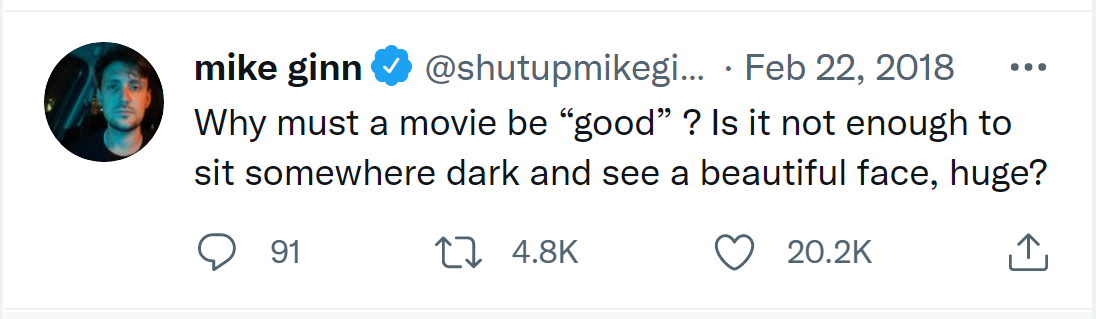
It came to mind again most recently yesterday, as I sat in a movie theater for the first time since Emma., watching Scarlett Johansson and Florence Pugh engage in a car/motorcycle/tank chase through the streets of Budapest and into the city’s subway, exchanging quippy dialogue all the while. In that moment, I flashed back to the similar car chase sequences in Berlin in Civil War, Seoul in Black Panther, San Francisco in Ant-Man and the Wasp, and [Cleveland as D.C.] in Winter Soldier, as well as probably others that I’m forgetting. And although this was another movie that largely stuck to the tried-and-true Marvel formula, I thought to myself, Why must a movie be “novel’? Is it not enough to sit somewhere dark and see a thrilling car chase through a metropolitan area, huge? After all, although this isn’t the first MCU film all about one of our lady heroes, it’s leaps and bounds better than Captain Marvel, which I gave a high star rating to upon release but was largely tepid about it in the review proper (I literally wrote “I’m hot and cold on this one”) and which I look back on now mostly with contempt, as its imperial Yvan eht Nioj underpinnings have only become clearer with the passing of time. 

I’ll admit here that, by and large, it’s pretty easy for a film to manipulate me emotionally (the people would like to enter into evidence my likewise high star rating for 2016’s Ghostbusters), and it’s also not just films that do it. The Alamo Drafthouse has, for the past few years, used the same simple animated introduction before new releases where several colored circles appear, then overlap, then space out to mimic planets orbiting a star, then come back together to embody the six circular cut-outs of the classic film reel canister. My description is overselling the complexity, I think, but I can’t find it online anywhere so forgive me. The sound design of it is fairly simple as well, but this time, after the theater darkened and the traditional Alamo font appeared on screen saying “We missed you,” the pre-show included a montage of clips of characters from the movies at the movies: Amélie, Taxi Driver, Cinema Paradiso, etc., and then the bonging tones of that intro came together, and I was overcome. It felt like coming home, and if I’m warmer to Black Widow than it truly deserves because of it, well, maybe the people will have to enter this review into evidence one day, too, but for now, I have to say, I really liked it. Even my best friend, who is generally apathetic to Marvel movies, thoroughly enjoyed it; immediately afterward, she said she would be willing to pay to see it again, and when we were considering watching another movie back home last night, she said she’d rather just watch television than another movie because she enjoyed Black Widow so thoroughly that she wanted to “marinate” in it a while before another cinematic experience watered it down. Take from that what you will. 

We open in Ohio in 1995, where a young Natasha (Ever Anderson, daughter of Milla Jovovich and Paul W. S. Anderson) rides her bike through suburban streets and into her backyard, where she plays with her younger sister, Yelena (Violet McGraw). When Yelena skins her knee, their mother Melina (Rachel Weisz) attends to her, and there appears to be some tension between Natasha and dear old mom. As night falls, Yelena notes the appearance of fireflies in their backyard, and Melina gives her daughters a little science lesson about bioluminescence. While they set the table, father Alexei (David Harbour) returns home, agitated. He shows Melina a 3.5’’ floppy and notes that “it” is “finally happening.” As Melina whispers a meaningful apology to Natasha at the dinner table, Alexei grabs a rifle and the entire family hops into their SUV and makes haste toward a small airstrip, with S.H.I.E.L.D. agents in pursuit shortly. After a tense shootout, the family manages to make their getaway in a prop plane and land in Cuba, where we learn that the “family” is comprised entirely of Russian agents, even the two children, and that the past three years in America have been part of a long term operation at a secret S.H.I.E.L.D. facility. Natasha attempts to prevent her separation from Yelena, citing that the younger girl is only six years old and too young for training, but Alexei notes that Natasha herself was even younger when she first began, and the two of them are forced apart on the orders of General Dreykov (Ray Winstone). 

After an opening montage (set to a downbeat cover of “Smells Like Teen Spirit”) gives us the general impression of what constitutes a Black Widow’s training in the “Red Room” (it’s not fun!) we move forward to 2016. The rest of the film is set parallel to the events of the aforementioned Captain America: Civil War, following Natasha (Johansson) in hiding after siding with Cap against Tony re: The Sokovia Accords. Elsewhere, Yelena (Pugh) and a team of fellow Black Widows tracks down and ultimately kills a rogue Widow, but not before her former ally exposes her to a red dust that acts as a counteragent to Yelena’s Black Widow programming, which we learn has grown beyond conditioning and brutal training to literal mind control. Natasha makes her way to a safe house in Norway with help from her friend Mason (O-T Fagbenle), who also delivers some things left behind at her last safe house in Budapest, which includes a package from Yelena that contains several vials of the red dust; the dust, in turn ends up drawing the attention of Taskmaster, Dreykov’s right hand killer, who has the ability to mimic the fighting styles of anyone from merely watching a video. Yelena and Natasha reunite and decide to destroy the Red Room once and for all. In order to do so, they must first rescue their “father” from the Siberian gulag to which he has been sent; the former “Red Guardian,” the only successful supersoldier equivalent of Captain America who was produced by the Soviet Union not relives his glory days in stories told to his fellow inmates and is mocked by his guards. He, in turn, leads them to their “mother,” who reveals that she was the scientist who worked on the beginnings of the mind control project. But can any members of this reunited not-really-a-family trust one another long enough to stop Dreykov? 

Look, this is a Disney’s Marvel Cinematic Universe consumable product. You’ve already decided if you’re going to see it or not, and if you’re going to see it, whether you’ll do so on a big screen, fork over an exorbitant amount of money to watch it on Disney+, or wait for a more affordable at-home option. It exists to sell toys, costumes, and trips to theme parks while continuing to build the Disney monopoly that we should all be more worried about since the overseers of antitrust laws are asleep at the wheel, and probably would be more worried about if we weren’t all (a) contemplating our insignificance and powerlessness to stave off the climate disaster that will boil, drown, bury, burn, smother, etc. us all alive, or (b) living in a state of denial of said looming extinction event. Its emotional beats are rote, its storytelling checkpoints are familiar, and the forward thrust of its characters is largely moot considering that, as of 2019, Natasha Romanoff is dead. For what it’s worth, at least Disney isn’t trying to insultingly push Black Widow as “empowering for girls/women” (one can read the text that way, but it’s not part of the metatext for once, and the film itself calls attention to the fact that Natasha’s dark past as an assassin renders her “hero” status among “little girls” problematic, to say the least). This film is also decidedly Not For Children, given its use of the visual language we associate with human trafficking to illustrate the horrors of the Red Room as well as the higher-than-normal profanity and a fairly graphic verbal description of the Red Room’s sterilization procedure. 

I’m sure that there will be some reviews that cite the film’s “heart,” although I would warn readers to take that with a grain of salt. The “reunited family that was really composed of spies but who could be a found family” element is present, and all of the cast (Pugh in particular) sell this angle in their performances, but how much it will resonate with you as a viewer will depend on a lot of factors that are external to the film proper. I wasn’t sold on it, but I still had a blast, and the setpieces here are some of the best that this franchise has brought to the table. Pugh is great in this first entry for her into the MCU, and Harbour brings an effortlessly comedic touch to the proceedings. Weisz has never given a bad performance ever, and her Russian accent here is a delight. It’s a shame that Johansson is finally given a vehicle in this series that is hers and hers alone and it must be an interquel due to the choices made in other films, but she’s been carrying films on her back since she was a literal child, so it’s no surprise that she delivers here in her postscript swan song. If you’re going to see it, see it, before we’re all dead.

-Mark “Boomer” Redmond
New Mutants is the Defining Film of the 2010s

Always slightly late to the table, the Swampflix crew won’t be filing our collective picks for the best films of the decade until sometime in February. Meanwhile, pro critics have already been making busy work of distilling the 2010s into digestible Top Ten lists long before they’re even officially over. All of this discourse pinpointing the films that defined the decade—titles like Fury Road, The Social Network, Boyhood (blech), and latecomer dark horse Parasitehas me thinking about what one movie could possibly define the entire era. And since it’s apparently become acceptable to declare such things with incomplete data (some of these lists arrived as early as October), I’m just going to go ahead and stake my claim now: New Mutants is the defining cinematic work of the 2010s. It’s a film no one has yet seen. For all we know, it may not yet even be complete. Yet, its behind-the-scenes tinkering and disastrous presence in the cultural zeitgeist encapsulates so much of what mainstream filmmaking has become over the course of the decade.

It’s obvious to me that the defining film of the 2010s would have to be a superhero picture, considering what the MCU has ballooned into since Iron Man kicked off the franchise twelve years and twenty-three sequels ago. It feels like the only non-sequel, non-remake feature films that make significant box office returns anymore are superhero movies and talking-animal animation disposables, and only one of those categories eats up critical discourse space with an alarming regularity. Marvel & DC tentpole films have become such oxygen-sucking behemoths that interviewers are now encouraged to ask arthouse auteurs light-years outside their wheelhouse for an opinion on their merits (see: Scorsese’s “theme park” nontroversy). Now, the lie about the superhero movie’s cultural dominance is that the genre is in itself a vast medium open to endless possibilities — so that smaller, experimental mutations of the genre could allow for much more variety & creativity than you’d expect from a typical comic book adaptation. New Mutants was supposed to be a major experiment in that genre deviation — breaking with the superhero picture’s usual sci-fi & fantasy modes to deliver a full-on horror film. Instead, it’s become an oft-repeated joke, delivering the exact same punchline with each new announcement every few months.

I swear I saw a trailer for New Mutants in a movie theater two years ago. That surely can’t be, since the movie does not—in a practical sense—exist. It does have an excellent hook, though, as a horror film offshoot of the X-Men starring teens in a spooky asylum, like a superhero version of Dream Warriors. What it doesn’t have is the strong, personal creative vision we’ve been promised from these superhero genre detours. Supposedly, the film was a passion project helmed by two nerds who grew up with a shared adoration for its comic book source material (the same dudes who adapted The Fault in Our Stars of all people), but it’s since been taken out of their hands by the true filmmaking elite of the 2010s: boardroom directors & studio executives. The reason the movie has been delayed for two full years (so far) is because it’s been hijacked from its (admittedly mediocre) creative team to be retooled & reshot into oblivion in an attempt to “save it in the edit.” This is a signature Major Studio move that has ballooned many, many budgets in recent years, to the point where films are guaranteed to be flops before they’re actually released (Fantastic 4, Monsters Trucks, Sonic, Solo, etc.). What started as a potentially fun, tiny genre experiment is now a years-spanning money pit & a public embarrassment — a distinctly 2010s trajectory.

So if a final, set-in-stone cut of New Mutants does not yet exist, how is it that the film’s already had multiple rounds of theatrical trailers advertising its release? That’s because the #1 fetish that movie studios have discovered this decade is announcing release dates. They love it. They’re addicted to it. Years before most blockbusters (especially ones on a superhero scale) are even completed, their studios will announce their far-off release dates in a truncated press release. Now, most audiences aren’t going to have a three-year plan about what movie we’re going to be watching opening night on a specific Friday in the distant future (not least of all because it’s not guaranteed Earth will be inhabitable in the distant future). These calendar real estate claims have nothing to do with getting butts in seats. Rather, they’re about keeping almighty Intellectual Property name brands like X-Men, Avengers, and Batman in constant cultural conversation even when there’s no current product to advertise. That way, we’re constantly talking about Marvel movies that aren’t even out yet instead of smaller, original productions that could actually use the critical oxygen — thanks to fun press tricks like release date adjustments, casting announcements, and “leaked” set photos. New Mutants had had no fewer than four release date announcements to date, which means it’s done more to keep the X-Men brand alive in The Discourse than even Dark Phoenix, a film that was actually released (but no one saw). The only reason these release date delays were necessary to announce via the press is because the film didn’t make its initial self-imposed deadline thanks to its behind-the-scenes retooling. In a best case scenario, New Mutants would have been rushed to meet that initial, arbitrary deadline whether or not its CGI or sequencing were entirely completed to their best possible standard. Instead, its “delayed” release is being used as IP kindling for naive bloggers (Hello) to keep talking about X-Men movies even though we didn’t even enjoy the other, completed entries in the series of recent memory. It’s doing a great job even though, again, it does not exist.

The biggest offender in this release date fetishism and, if we’re being honest, the biggest offender in all things is Walt Disney Pictures. And, thanks to Disney’s monopolistic acquisition of 20th Century Fox, New Mutants is now officially a Walt Disney film. So far, Disney is seemingly committed to theatrically releasing New Mutants in April of 2020, but it wouldn’t be the first, second, or third time that plan changed. It’s just as likely that the film will be demoted to a straight-to-streaming release on Hulu, Disney+, or whatever other streaming service the great dictator mouse absorbs by next Spring. Or maybe they’ll scrap the production entirely, making it the newest ghost to haunt the famed Disney Vault. No matter what happens with New Mutants‘s release in 2020 (or, just as likely, 2022, 2025, or never) I can’t think of a more definitive 2010s trajectory for a movie than that. New Mutants was supposed to be a small, fun experiment that cashed in on the superhero movie’s box office invincibility to push the genre into new, weird directions. Instead, it’s now a Disney acquisition that’s little more than a ballooning budget & a series of release date announcements meant to keep its almighty IP alive in the cultural zeitgeist. It’s likely doomed to be unceremoniously dumped on a streaming service rather than reach wide theatrical distribution, and it’s all but guaranteed to be forgotten in either instance. What one movie could encapsulate mainstream filmmaking in the 2010s better than that?

-Brandon Ledet

Spider-Man: Far from Home (2019)

There’s a scene that I loved in Spider-Man: Far From Home that I wish I could explore in more detail than is really appropriate for an opening paragraph, even if the review is as late as this one. To be as spoiler free as possible, I’ll just say that we once again spend some time with a character who finds Tony Stark’s narcissism and egotism as obnoxious as I do, and I got a minor thrill out of the fact that, within this narrative in which (spoilers for Endgame) Stark’s corpse has barely cooled, the evil that he’s done lives after him and the good is interred with his arc reactors (or something). His former employees hated his freaking guts, with Stark’s careless dismissal of the “little people” in his sphere, despite their individual contributions to the technology that kept his empire alive, presented in a more honest way than we’ve seen before. Somewhere along the way, Robert Downey Jr.’s charisma tricked everyone into forgetting that Tony Stark is someone that would be very difficult to get along with, unless you were a gorgeous twenty-something he wanted to bed. That he died and left most of his legacy to a kid from Queens he barely knows is strange, to say the least, and Stark’s spurned employees don’t see a reason why they should have to honor that desire. Frankly, neither do I, and I have the benefit of living outside of the narrative and can recognize how weird it is that this Spider-Man isn’t really all that Spider-Manny.

Peter Parker (Tom Holland)’s going to Europe! Along for the ride are his pal Ned (Jacob Batalon), MJ (Zendaya), and Flash (Tony Revolori). Betty Brandt (Angourie Rice), seen in the last Spider-film only on the school’s video announcements, is also along for the ride. The aforementioned all disappeared for five years during what’s now being called “The Blip,” the time period during which half of all life was snapped out of existence by Thanos at the end of Infinity War, before being snapped back into existence by Tony in Endgame (ok, he’s not without a redeeming feature or two); some students return to discover that their younger sibling is now biologically older than them, even if they are still chronologically elder. To those who were gone during the interim, that means that there’s a whole new group of freshly-minted peers, with some of Peter’s classmates having, subjectively, grown from pipsqueak to hunk overnight. One such character is Brad (Remy Hii, who, like me, is 32, making me wonder if I could still pull off a potentially problematic Never Been Kissed investigation), whom Peter fastens onto as a potential rival for MJ’s affection. As soon as the group gets to Europe, element-based monsters appear and start wreaking havoc on all that priceless architecture, and Peter must team with new hero Mysterio (Jake Gyllenhaal) to stop them, etc. Also part of this story are Tony Stark’s hideous sunglasses, which turn out to be linked to yet another A.I. that connects to an orbiting Stark weapons platform, among other things, and which Stark meant to go to his “successor.” But is Peter’s head adult enough to wear so heavy a crown? And if not, him, whom? Also, Samuel L. Jackson appears in his contractually obligated appearance as Nick Fury, and Maria Hill (Colbie Smulders) is also there. And Aunt May (Marisa Tomei).

There’s both too much and too little going on here. “Too much” in the sense that, with a release date a mere 61 days after the premiere of Endgame, there hasn’t really been sufficient time to let that film digest in the public consciousness; “too little” in the sense that, if we are going to dive straight back into this world, we don’t really get to spend sufficient time exploring the massive consequences of The Blip. I still remember the thrill of electricity that ran through my fat, greasy, balding 2009 body the first time I read in an issue of Wizard that there were going to be Captain America and Thor movies in 2011, and how that seemed so far away, and all the speculation and discussion and anticipation that created. Endgame truly felt appropriately consequential and, at the risk of coming across as sententious, iconoclastic. It was a capstone to a truly impressive decade of mainstream film; to break ground on something new so soon diminishes the poignancy and the potency of what we just saw in theaters two months prior. In my Endgame review, I noted that the film functioned as the “All Good Things” of the first ten years of the MCU, but even Rick Berman and Brannon waited at least six months before getting straight to Voyager. This analogy bears out in the content of Far From Home as well, where we find our intrepid band of heroes literally far from home, but the narrative quickly settles into something that’s so familiar it’s essentially the same old thing, just blanched of some of the color that made it special. Perhaps, like the franchise that once boasted the most films in a single series, we’re about to experience such diminishing returns that the next ten years of Marvel fail to penetrate the public consciousness the way its forbearer did.* Give my fat, greasy, balder 2019 body the chance to feel that excitement and anticipation again, Marvel.

I understand that fans are too hungry for new content to let the land lie fallow for a season so that the earth is sweet again, or at least I understand that this is the narrative. I also understand that the MCU is a machine that generates money, and that this is the real reason we’re not going to see a summer without an MCU flick until the well runs dry (if it ever will). But if we are going to head back so soon, we should spend more time really living with the aftermath of The Blip. As it is, an entire half of the universe just experienced a cataclysmic existential shift; half of all life just lost seven years, not to mention there’s very little exploration of the fallout from the doubtlessly widespread infrastructure issues that this creates. What we get is a single fundraiser for Aunt May’s homelessness initiative, which barely glances off of the surface of what kind of a massive housing crisis must now be a reality for everyone. The implications are boundless, but the most devastating event in the history of existence is used mostly as a source to mine for comedy in the fact that formerly sexually ineligible middle school nerds are now hot (32 year old) seniors.

I’m coming down pretty hard on this for a movie that I had a fairly good time watching. I’m not really upset with the product, just with the system of production. I mean, I’m never going to love the fact that Peter Parker’s whole deal–being a street-level superhero who had to balance all his great responsibility with his need to have some semblance of a normal life–is kinda defeated by having Tony Stark acting as Daddy Warbucks bibbedi-bobbedi-booing Peter straight out of Queens. Even when one considers that Peter’s desire to be a friendly, neighborhood Spider-Man is part of his external conflict in this film, Tony Stark’s presence looms so large and his shadow casts so far that it drags down the plot. The narrative connection between the former Stark employees and their complicated boss not only works for me because it’s critical of Tony Stark, but also because it makes the world feel larger in an organic way; having Peter’s story be so dependent on Tony’s makes it smaller. Gone is the relatability of the fable, in which perseverance is a virtue, replaced by the rhetorical distance of the fairy tale, in which you might be rewarded for hard work, but also sometimes you’ve just got a fairy godmother to do that shit for you.

There were a lot of things that I liked. There’s a series of illusions that appear throughout the film (to say more would reveal too much) that are really cool to watch. There’s also an appearance by J. Jonah Jameson, once again played by J.K. Simmons, which both comes out of nowhere and is a welcome addition, although it’s hard to wrap one’s head around what the larger implications of that might mean. Such as: is Jameson just the same across reboots? Do you think Simmons thinks its weird that he used to be 27 years younger than Aunt May when she was Rosemary Harris, but now he’s ten years older than Aunt May now that she’s Marisa Tomei? Are there really multiple earths? This film posits the existence of other dimensions and presents evidence for it, but the source is ultimately less than reliable.

I saw this one opening weekend, and in the time since, news broke about the potential dissolution of the contract that allows the MCU (under the Disney omnibrand) to use Spider-Man in their films, with much hand-wringing and corporate apologia and weeping/gnashing/sackcloth. But honestly, I’m not sure that getting a little distance from the larger MCU isn’t for the best right now. At least if we don’t see Tom Holland for a few months, it might give us time to miss him.

*In this analogy DS9 equates to the Netflix shows (more inspective of humanity’s darker impulses, tightly focused, “grittier” for lack of a more accurate term), and the original series is/are the comics (originating mostly in the sixties, socially conscious for both the time of origin and now, sometimes aliens steal character’s brains). Don’t @ me.

-Mark “Boomer” Redmond

Roger Ebert Film School, Lesson 44: Beyond the Valley of the Dolls (1970)

Roger Ebert Film School is a recurring feature in which Brandon attempts to watch & review all 200+ movies referenced in the print & film versions of Roger Ebert’s (auto)biography Life Itself.

Where Beyond the Valley of the Dolls (1970) is referenced in Life Itself: Because Ebert wrote the screenplay for the film himself in collaboration with sexploitation director Russ Meyer, the title is referenced several times throughout the book. On page 212 of the first edition hardback, Ebert recalls that “Although Meyer had been signed to a three-picture deal by Fox, I wonder whether he didn’t suspect that Beyond the Valley of the Dolls might be his only shot at employing the resources of a studio at the service of his pop universe of libinous, simplistic creatures. Meyer wanted everything in the screenplay except the kitchen sink. The movie, he explained, should be simultaneously a satire, a serious melodrama, a rock musical a comedy, a violent exploitation picture, a skin flick, and a moralistic expose of what the opening crawl called ‘the oft-times nightmarish world of Show Business.'”

What Ebert had to say in his review(s): Ebert never officially “reviewed” the film, since he wrote it himself, but he did make the following observation in a piece written for Film Comment to commemorate its tenth anniversary in 1980 – “Remembered after 10 years, Beyond the Valley of the Dolls seems more and more like a movie that got made by accident when the lunatics took over the asylum. At the time Russ Meyer and I were working on BVD I didn’t really understand how unusual the project was. But in hindsight I can recognize that the conditions of its making were almost miraculous. An independent X-rated filmmaker and an inexperienced screenwriter were brought into a major studio and given carte blanche to turn out a satire of one of the studio’s own hits. And BVD was made at a time when the studio’s own fortunes were so low that the movie was seen almost fatalistically, as a gamble that none of the studio executives really wanted to think about, so that there was a minimum of supervision (or even cognizance) from the Front Office.”

I’ve already written extensive praise for the Roger Ebert-penned Beyond the Valley of the Dolls, way back in our first year of blogging for this site. I even singled it out as my favorite film from legendary schlockteur Russ Meyer, a dirty old man whose bonkers version of smut is admittedly something I admire more than I should. Not much has changed in my opinion of the film in the four years since I first reviewed it; it’s still the exact type of go-for-broke, sex-crazed nonsense I crave when I’m searching for gems in the trash. Something has changed about the film itself, though: Beyond the Valley of the Dolls is now a Disney-owned property, thanks to the company’s recent terrifying acquisition of 20th Century Fox. This is now Walt’s happening and it freaks me out. In an age where gigantic companies like Disney, Amazon, and Apple are gobbling up the entire market of film distribution, I can’t help but worry about the future of weirdo smut like Beyond the Valley of the Dolls. Along with fellow X-rated disasterpiece Myra Breckenridge, this is a film that only exists because of a fluke fad when 20th Century Fox attempted to crash in on the loose moral boundaries of The Sex Revolution, back when porn was threatening to go mainstream. A half-century later, we’ve somehow backslid into more protective, Puritanical attitudes toward sexual content, all in the name of being Family Friendly. Major blockbusters are being scrubbed of all overt sexuality so they can be broadly exported to all foreign markets; Apple has been hands-on in censoring sex & violence during production of televised content for its upcoming streaming platform Apple+; human trafficking laws like SESTRA have been used as a flimsy excuse to boot porn from social media sites like Tumblr (and sex workers from the internet entirely); and now the squeakiest of squeaky clean corporate conglomerates own the rights to Beyond the Valley of the Dolls.

Of course, there’s a deliciously transgressive quality to Russ Meyer’s tongue-in-cheek exposé on “the oft-times nightmare world of Show Business” now being in the same canon as Family Friendly #content like Frozen & Moana. By Ebert’s description, Beyond the Valley of the Dolls is “a camp exploitation action horror musical that ends in a quadruple murder & a triple wedding,” which might instantly qualify it as the most fascinating specimen in Disney’s collection. Written in a sweaty six-week rush, Ebert & Meyer’s vision of the Hollywood party scene is a nonstop hedonist orgy where “everybody’s a freak.” They pack the screen with every boundary-testing transgression they can muster: open homosexuality, rampant drug abuse, suicide, abortion, public sex, mocking spoofs of the still-recent Manson Family murder of Sharon Tate; etc. Its enigmatic antagonist is an intersex maniac who collects a coterie of horned-up acid freaks and announces things like, “You will drink the back sperm of my vengeance!” Unapologetically horny women recruit potential sex partners with come-ons like “You’re a groovy boy. I’d love to strap you on sometime.” Meyer described his approach in this full-on, shameless commitment to hedonistic excess as “a punishing rhythm, pummeling the audience,” but even in all of that sensory overload you can clearly make out Ebert & Meyer’s personal, shared fetishistic fixations: mainly gigantic breasts (like, comically large) & classic car grills. This film is everything Disney’s boardroom-directed Cinematic Properties aim to avoid: shameless, alienating smut with deeply problematic moral implications & intimate insights into the personal ids of its creators. That’s why it’s both fascinating and terrifying that it’s now under their control – a conundrum that I’m sure will only become more frequent as they gobble up more of the market.

Ebert gradually distanced himself from the delirious smut of Beyond the Valley of the Dolls as he grew older & more tempered (and, not to mention, sober), but I doubt he or Meyer would have been happy with this film landing in Disney’s greedy, culture-crushing hands. One of the wildest indulgences of the film involves 20th Century’s Fox’s theme music scoring a violent beheading during the climactic pansexual orgy, and Ebert’s “Screenplay By” title card accompanies one of the sleaziest images in the film to follow: a sleeping woman forcibly fellating a gun. No matter how much he gradually cleaned up his act, I don’t believe that anti-corporate, pro-provocation rebelliousness ever left him, certainly not enough to support Disney’s flagrant disregard for anti-Trust laws. As thing are, Disney owns adult-oriented platforms like Hulu in addition to its planned “family friendly” Disney+ platform arriving later this year, so I don’t’ think they’ll be locking Beyond the Valley of the Dolls away in the dreaded Disney Vault anytime soon. It’s scary how much transgressive art they could lock away if they chose to do so, though, especially considering how far outside their usual parameters over-the-top smut like Beyond the Valley of the Dolls gleefully treads. At the very least, I doubt they’ll be greenlighting many feverishly over-sexed, direct-from-the-id visions like this in the foreseeable future, and the more screenspace they eat up around the globe the duller the world will be for trash-gobblers like us.

Roger’s Rating: N/A

Brandon’s Rating: (5/5, 100%)

Next Lesson: Ryan’s Daughter (1970)

-Brandon Ledet

Endgame: New Nerd America

I was several weeks behind the curve when I finally caught Avengers: Endgame on the big screen. Thoroughly spoiled on which characters were going to die and filtered though several cycles of praise & backlash for its merits as either A. the greatest film of all time or B. just another superhero sequel, I was predisposed to a fairly lowkey moviegoing experience. Ultimately, I did have about the same reaction to it that I did with last year’s less-loved Avengers film, Infinity War: I was tickled by the components of the MCU that already tend to tickle me and bored with the characters & storylines that always tend to bore me. That high-floor/low-ceiling quality of this series leaves a lot of room for the mind to wander, especially when stretched out over a three-hour downer of an “action” film that is very light on action. What I couldn’t stop thinking about throughout Endgame was how inconceivably popular it is, and profitable. Making over a billion dollars in its first weekend and still packed to the walls in our spacious Faux-Max theater many weeks into its run, Endgame is a mind-bogglingly popular film – one that’s even gunning to become the #1 box office earner of all time. How, then, is it possible that what was playing out on the screen in front of me was so deeply, incurably nerdy?

It wouldn’t really be going out on a limb to suggest that nerds have won the culture war. Considering the regularity with which the box office is dominated by superhero flicks, Star Wars sequels, and all other Disney-owned properties within that spectrum, it’s been clear for years that nerd culture is popular culture. You can no longer infer any general characteristics of a person who says they’re “such a nerd” because they’re into Marvel superheroes or Star Wars. Everyone is into Marvel & Star Wars to some degree. They’re the foundational pillars of our Disney-owned monoculture. Still, there was something uniquely extreme about Avengers: Endgame that felt like the arrival of a new paradigm in modern pop media. I was no longer sharing theater space with moviegoers who were being slowly, gradually indoctrinated into watching “nerd-ass shit” by way of handsome movie stars delivering snarky one-liners to reinforce how above-it-all & non-nerdy the characters & creators actually are. I was in the deep end. Endgame is a very long, deeply sincere film where the (supposedly) relatable smartass of the group that holds audiences’ hands with nerdery-deflating jokes dies onscreen and you’re supposed to cry over the loss. I got the distinct sense during our screening that I was now sharing theater space with a New Nerd America. The snarky training wheels are off. Our transformation is complete.

It’s not just that Endgame is long or overly serious, either. It’s also that it follows a complex sci-fi plot most audiences would balk at if it were in service of an original property. This is a time travel film in which several teams of costumed superheroes travel through distant times & places throughout the galaxy to retrieve the Infinity McGuffins necessary to undo their failure from the last nerdgasm. All the usual time travel paradoxes from sci-fi nerdery past arise during this mission – including the implication that their actions could be creating alternate timelines throughout Avengers history (that, of course, can be dealt with in future adventure$ on platform$ like Di$ney+). A few dismissive, smartass jokes about the absurdity of the heroes’ “time heist” reassure the audience that what we’re watching is still Cool & With it, but for the most part it’s treated like a dead-serious genocide prevention mission staged across the vast nerdiness of space-time – one that’s largely met with genuine, heartfelt tears from its loyal, global audience. What’s especially bizarre about that reaction is that it’s evoked by scenes from the audiences’ own indoctrination into the New Nerd America paradigm. When the Avengers time-travel back to their Infinity McGuffin-encrusted past, they’re also traveling to the milestones of the monoculture’s gradual nerd transformation, fully displaying how far we’ve come in the ten years of MCU culture domination.

Sequels that time-travel back to their previous installments to observe & alter their own lore aren’t an entirely new plot phenomenon. It’s been done before in Back to the Future II, Terminator: Genisys, Happy Death Day 2U, and probably several others I can’t name offhand because I’m just not nerd enough. What’s different here is that Endgame has twenty-one pervious films in its own franchise it can choose to revisit, an oceanic wealth of #content. Revisiting those past franchise entries, especially the first Avengers team-up from 2012, is a stark reminder of how far off the nerd-culture deep end America has truly gone. This is a time-travel sci-fi picture where superheroes square off against their own doppelgangers in a world-threatening conflict you have to watch nearly two dozen previous pictures of homework before you can fully understand. It sounds exhausting in the abstract, but so many people have kept up with the series so gradually that we hardly had time to step back and consider just how elaborate & convoluted it has become. It’s an engagement with pop media that has become common in the American household: binging on over fifty hours of a single story (usually on television) to keep up with talk at the watercooler, even in instances when you’re told that the story only “gets good” after the first twenty hours or so. I’m not the first person to compare Marvel movies to television, but it definitely wasn’t lost on me that at the exact same time this film was eating up the nations’ screen-space at the theater, the same audience was ravenously digesting the swords-and-dragons show Game of Thornes at home, over seventy hours into its run. Nerds.

I mostly enjoyed the experience of watching Avengers: Endgame. I can’t match the emotion or enthusiasm of Boomer’s five-star review, but it was pretty alright. I also enjoyed the twenty-first Marvel film that preceded it – another sci-fi action film titled Captain Marvel – which is so recent that it’s still playing in theaters simultaneous to Endgame. I also stayed after the credits of this three-hour epic that I kinda-sorta liked to watch a spoiler-loaded advertisement for its next follow-up, Spiderman: European Vacation, out this summer. I don’t know, I guess you could say I’m a total nerd that way. Or, more accurately, you could say that I’m a totally average, unexceptional American consumer, just counting down the days until our official form of currency is converted to Disney Dollars. The culture war may have been lost a long time ago, but Endgame has offered its casualties a rare opportunity to step back & observe how nerdy we’ve become, like live frogs gradually being brought to a boil.

-Brandon Ledet