For this lagniappe episode of the podcast, Brandon, James, Hanna, and guest Bill Arceneaux discuss a selection of genre films that screened at this year’s Overlook Film Fest, including the exhaustive direct-to-video erotic thriller documentary We Kill for Love (2023).
It’s Film Festival Season right now. If you’re on the level of industry press who get flown around the world, that means you’re dragging your corpse from screening to screening at high-profile fests like Venice, Tribeca, and TIFF, then pretending in your late-night hotel room tweets & podcasts that you’re fully awake and spring-loaded with the hottest takes as you drift into a brief nap before the cycle starts again. And if you’re an amateur movie nerd like me, you’re taking those delirious dispatches from Film Industry Hell as holy gospel, making notes on what movies to look out for much, much further down the distribution path. The problem is a lot of the smaller, weirder titles highlighted in those reports from the ground can take years to reach local screens, if they ever arrive at all. After years of attentive podcast listening, I have serial killer conspiracy theorist notebooks full of scribbled-down titles of movies that functionally do not exist, hoping that something as wonderfully bizarre as an Aline, a Double Lover, or a Diamantino might eventually make it my way. It often pays off! But it’s a madman’s hobby.
I was thinking about this private film fest ritual in recent weeks, listening to festival recaps on podcasts like Film Comment & The Last Thing I Saw while still searching for titles they covered years ago on my weekly trips to JustWatch. And I happened to catch a few of those festival runoff titles in recent weeks: low-budget movies that were briefly highlighted in their festival runs while higher-profile awards seekers premiered in much brighter spotlights at the same venues. I’ve covered local fests like NOFF & Overlook for Swampflix before, but I can’t afford to be the first online with the freshest takes on titles out of Sundance & Telluride that will be widely available in the nation’s multiplexes just a few weeks later. Instead, here are a few quick reviews of smaller-profile indies that premiered at festivals long ago, but just recently got wide distribution.
The Silent Twins
The newest film from The Lure‘s Agnieszka Smoczyńska has enjoyed the quickest turnaround of the festival titles highlighted here, premiering at Cannes just this Spring. That kind of rushed-to-market release usually means a film is vying for Awards Season prestige, but The Silent Twins is too thorny & too fanciful to be mistaken for a crowd-pleaser. Its titular Welsh sisters, June & Jennifer Gibbons, were mutually obsessed to the point of total reclusiveness in real life, refusing to communicate to anyone but each other in their own hushed, made-up language. Smoczyńska uses their personal diaries & surviving scraps of creative writing as inspiration to imagine what their inner world might have been like, since there isn’t much to depict in their near-catatonic external life as the only Black family in their Welsh neighborhood. From the outside looking in, this is a grim, by-the-numbers historical drama. On the inside, it’s a rich fantasyscape that often takes the shape of a grotesque stop-motion music video.
There’s a bizarre mismatch between auteur & genre here, like watching Lynne Ramsay direct Oscar Bait. Smoczyńska is unlikely to ever make another killer-mermaid disco musical, though, so it’s at least cool to see her directing high-profile work with a hint of commercial appeal. The (mostly British) audience who know the Gibbons sisters as a from-the-headlines human interest story have been frustrated with the film’s self-indulgent style and historical inaccuracies, while fans of The Lure will be frustrated that it doesn’t break from reality more frequently & more harshly. Neither side of that divide can walk away 100% happy, but there’s some great tension between its Wikipedia Biopic genre template and its insular, high-style dream logic. And who knows, maybe it’ll make waves at the BAFTAs before it otherwise fades away forever.
Tahara
The road to wide distribution has been much longer for the microbudget coming-of-age drama Tahara, which first premiered at Slamdance, TIFF, and Outfest way back in 2020. This is, of course, the 77min, darkly humorous queer meltdown drama in which Rachel Sennott makes bagels and makes out as an agent of chaos at a Jewish funeral. No, not that one, the other one. Tahara was shot in the moment between when Shiva Baby was just a proof-of-concept short film and when its feature-length version became a critical darling at SXSW & TIFF, earning a spot on many publication’s Best of 2021 lists. Tahara can only suffer by comparison, then, since it’s not as searingly intense nor as robustly funded as Shiva Baby, which puts Sennott’s electric screen presence to much more attention-grabbing use. By the time Bodies Bodies Bodies hit theaters this summer, though, she proved herself to be a legitimate, once-in-a-generation star, which makes the first feature she shot worth a look no matter how redundant its surface details seem.
Oddly enough, Tahara shares more in common with The Silent Twins, stylistically, than it does with Shiva Baby. Sennott stars alongside Madeline Grey DeFreece as a pair of high school BFFs who are so mutually obsessed that they can almost communicate telepathically, chatting in a private body language that director Olivia Pearce helpfully translates into on-screen subtitles. When Sennott’s bratty partygirl hedonist pressures her more bookish bestie into making out for LOLs at a classmate’s funeral, her friend catches feelings and the film slips into Silent Twins-style stop-motion fantasy. However, their interpersonal drama is extremely low stakes in comparison to Smoczyńska’s film, or even Shiva Baby, really. Mostly, this is a charming indie comedy that scores a lot of nervous laughter off the social tension of Sennott causing self-involved havoc in a buttoned-up funeral setting. It’s the exact kind of movie you’d expect to see at a local film fest and hold onto as an “I knew them when” badge of honor as the breakout performer moved onto bigger & better things. Only, Sennott’s rise to fame was much quicker than the movie’s roll-out.
Mother Schmuckers
It’s shameful to admit, but the film from this batch I was most looking forward to was the one most devoid of best-of-the-year potential, awards season prestige, or even basic artistic merit. The Belgian buddy comedy Mother Schmuckers premiered at Sundance in 2021 to total critical indifference, despite its most juvenile efforts to provoke. The 70min novelty gross-out revisits the tipping point when the Farrelley Brothers converted the John Waters gross-out comedy into mainstream crowd pleasers, choosing instead to upset & offend. It’s Dumb & Dumber for the Pink Flamingos crowd, both a revolting abomination and a revolting delight. I can’t recommend it in good conscience, but I also won’t pretend I didn’t enjoy it.
Real-life brothers Harpo and Lenny Guit star as fictional idiot brothers who torment anyone & everyone unfortunate enough to know them, as if they were performing hype house YouTube pranks that no one is around to film. Mother Schmuckers opens with the titular schmucks cooking feces in the family frying pan, then offering it to their incensed mother until she pukes onto the camera lens, providing a slimy green backdrop for the title card. Kicked out of the house and left in charge of the most valued member of the family—their mother’s dog—they get into endless bad-taste shenanigans, ranging from murder to bestiality to necrophiliac prostitution . . . all while searching for an easy meal. The film indulges in a little visual flair to lighten up the severity of these stunts, dabbling in color blind dog-cam POV, vintage picture-in-picture inserts, and Jackass-style found footage camcorder textures. This is not another fantasy-prone-siblings-shunned-by-a-cruel-world heartbreaker like The Silent Twins, though. It’s trash; it knows it’s trash; and any festival programming it would’ve been smart to bury it in the midnight slot where only the most delirious trash scavengers would stumble across it. All that said, I laughed a lot while watching it, which I believe qualifies it as a success. I’m also in total amazement that it scored American distribution, given how many higher-minded films never make it past the festival circuit.
Of the two local film festivals operated by the New Orleans Film Society, New Orleans Film Fest is both the longest-running and the most substantial. The 30th Annual NOFF, for instance, screened hundreds of films all over downtown New Orleans last October, of which we were able to cover 10 features (and a few shorts). We’re only seeing an insignificant fraction of the films screening NOFF every year, making a festival-wide recap something of a Sisyphean task as amateur bloggers.
NOFS’s annual New Orleans French Film Fest is a different matter entirely. The entirety of French Film Fest is located at a single, beautiful venue: The Prytania, Louisiana’s oldest operating single-screen cinema. All films are at least partially French productions, all are shown in subtitled French language, and the large majority of them never see domestic big screen distribution outside of the festival. I see some of my favorite releases of the year at French Film Fest too; 2018’s Double Lover ranked near the top of my favorite films of the 2010s . There are also typically at least two screenings a year that I’d comfortably call all-time favorites after just one viewing, especially in retrospective screenings from auteurs like Agnès Varda & Jacques Demy. New Orleans French Film Fest is the smaller, more intimate festival on the NOFS calendar, but its manageability is more of a charm than a hindrance and I’m starting to look forward to it more every year.
We will be doing a more exhaustive recap of our experience at the festival on an upcoming episode of the podcast, featuring a more fleshed out review of 1945’s Children of Paradise. For now, here’s a ranking of the few films we’ve seen that screened at the 2020 New Orleans French Film Fest. Each title includes a blurb and a link to a corresponding review. Enjoy!
1. Mr. Klein (1976) – “It’s clear from the start where the story is headed, as the movie largely functions as a Twilight Zone-style morality tale, but the point is less in the surprise of the plot than it is in the ugly depths of Klein’s authoritarian, self-serving character. This is a damn angry film about the evils of Political Apathy, and a damn great one.”
2. Deerskin (2020) – “Damn funny from start to end. Not only is the idea of a jacket being so fashionably mesmerizing that it leads to a life of crime hilarious even in the abstract, but the overqualified Jean Dujardin’s straight-faced commitment to the bit sells each gag with full inane delight.”
3. Varda by Agnès (2019) – “It may not be as kinetic or as aggressively stylistic as her career’s greatest triumphs (a contrast that’s unignorable, given those films’ presence on the screen), but it’s still incredibly playful & thoughtful in its own construction, especially considering the limitations of its structure as an academic lecture.”
4. Children of Paradise (1945) – Given this one’s accolades as one of the greatest films of all time, I expected a shift into outright Movie Magic surrealism during its stage pieces that never came. Instead, it’s just a well constructed, stately four-way melodrama with a dark sense of humor and an exceptionally grand budget considering it was partially made under Nazi occupation. It’s really good, but I was prepared to be totally floored (which is my fault, not the movie’s). Looking forward to diving further into it on the podcast.
5. Sibyl(2020) – “Its only major fault is that you could name several movies that push its basic elements way further into way wilder directions; Double Lover & Personaboth come to mind. Otherwise, it’s an admirably solid Movie For Adults, the kind of thoughtfully constructed erotic menace that used to be produced by Hollywood studios at regular intervals but now only seeps quietly through European film festivals.”
6. Matthias & Maxime (2020) – “Incredibly observant about macho bonding rituals & typical group dynamics among basic bros – especially when parsing out what’s considered Normal male-on-male touching vs. what’s considered Gay. It’s just a shame that same thoughtful consideration didn’t extend to knowing how to trim the movie down to its best, most efficient shape.”
7. House of Cardin (2020) – “Not at all interested in matching the avant-garde artistry of its subject in any formal way; it’s about as forward-thinking in its filmmaking style as an I Love the 60s special on VH1. However, the vibrant, playful art of Pierre Cardin more than speaks for itself, and stepping out of that portfolio’s way read to me like a great sign of respect.”
8. Celebration(2019) – “Without any contextual info about how this late-career misery differs from YSL’s earlier, more youthful fashion shows, this behind-the-scenes glimpse fails to communicate anything coherent or concrete. Like the worst of the ‘elevated horrors’ of recent years that it stylistically emulates (if not only in its spooky score), it’s all atmosphere and no substance.”
Welcome to Episode #79 of The Swampflix Podcast. For our seventy-ninth episode, James & Brandon take care of some film festival-related Spring cleaning with a diverse line-up of foreign-language cinema. They discuss selections from this year’s New Orleans French Film Fest and PATOIS: The New Orleans International Human Rights Film Festival. Also, James makes Brandon watch the absurdist French drama La Moustache (2005) for the first time. Enjoy!
Welcome to Episode #64 of The Swampflix Podcast. For our sixty-fourth episode, Brandon & CC discuss the inaugural, Kubrick-heavy Filmtopia Film Festival, held at Prytania Theatre. Also, Brandon makes James watch the French erotic thriller Double Lover (2018) for the first time. Enjoy!
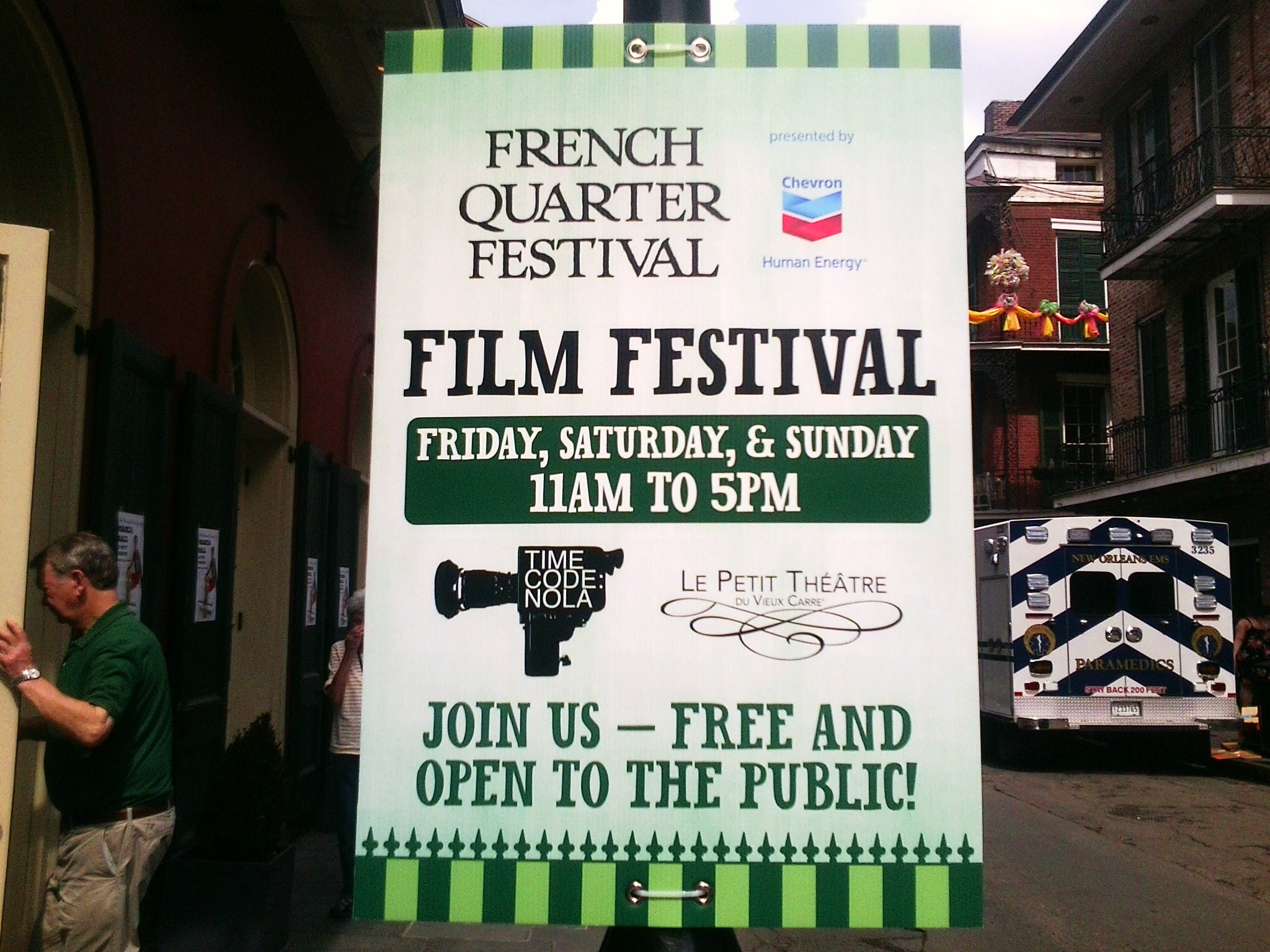
It’s usually around Mardi Gras when the city wakes up from its winter slumber, suddenly coming to life after months of hibernation. Tourists start to arrive in town to drink in the streets & enjoy the sunshine while their friends & loved ones freeze in the snow back home. Locals stop acting like total babies about what passes for “the cold” down here and venture at least as far as their front porches to enjoy the second lines & boiled crawfish. Mardi Gras is only the start to this Spring awakening, however, and the spirit to excess rolls right on into our festival season, which stretches on as long as it can before it’s too hot too drink gallons of beer in the daylight and visitors abandon us for the summer. Jazz Fest stands tall as the most obvious pinnacle of the season, but French Quarter Fest has recently been giving that juggernaut a run for its money. What used to essentially be “Jazz Fest for Locals” is now ballooning to be its own feature attraction, drawing thousands downtown for deliciously cheap local food & free music. To my recent discovery & surprise, it also features a free film festival.
I’ve been to French Quarter Fest a few times over the years, but this year was the first I’d ever heard of a film festival accompanying the better advertised attractions of food, drink, and local brass. Located just outside Jacskon Square at Le Petit Theatre, a venue that traditionally stages live drama, the film festival is a cocoon-like respite in the center of madness, the eye of a drunken storm. After wandering from stage to stage, drinking like a madman & downing hot sauce-soaked poboys in the heat (and unfortunately this year, the rain) it’s difficult to describe just how much of a relief it was to sit in a darkened, air conditioned room and watch movies. Presented by the folks behind Timecode: NOLA, the offerings at the French Quarter Film Fest are a well-curated group of documentaries seemingly selected to make the city look good for visitors. It featured several documentaries I had never seen before as well as ones I already know intimately, essentially upper crust of the kind of New Orleans-praising fare you’d expect to catch on late night PBS.
I attempted to catch one film a day at the festival to get a decent sampling of its offerings, but my Friday afternoon plans got derailed when I coincidentally ran into a friend at a live performance on Royal Street and ended up missing the classic, doc Always for Pleasure. There pretty much is no substitution for the all-encompassing sampling of New Orleans culture in Always for Pleasure, but it’s a film I already know well (and one that’s currently available on Hulu), so I had no qualms with missing it for a chance to enjoy French Quarter Fest’s more traditional offerings of booze & live music. Actually, I feel like it was even more in the spirit of the movie to miss it. Filmed in the 1970s, the Criterion-approved Les Blank documentary truly is the best introduction to local culture that I could possibly imagine. Where else are you going to find soul legend Irma Thomas sharing her red beans & rice recipe and Allen Toussaint explaining the significance of jazz funerals & second lines. There’s also glimpses of crawfish boils, Mardi Gras Indians, St. Patty’s Day celebrations in the Irish Channel, and what essentially amounts to music videos for Wild Thcopitoulas & Professor Longhair. An interviewee in Always for Pleasure describes New Orleans as “The City that Care Forgot” & “The last city in American where you can feel free to live,” and the supporting images that surround those claims make it feel like he might be onto something.
On Saturday, I not only made it to the screening I wanted to catch; I desperately needed to. After sweating it out in the drunken, downtown masses, it was a life-saving sensation to watch the documentary He’s the Prettiest: A Salute to Big Chief Allison “Tootie” Montana’s 50 Years of Mardi Gras Indian Suiting. He’s the Prettiest obviously has a much more focused subject than Always for Pleasure, choosing to narrow in solely on a profile of Mardi Gras Indian Chief Tootie as he dressed for his final outing. Tootie is not only a significant chief because of his 50 consecutive years of suiting, but in the innovative artistry he brought to the practice. Instead of merely continuing the traditional Mardi Gras Indian beading he inherited, Tootie introduced the concept of 3-D designs to his suits, elevating the painstaking bead work to unparalleled levels of intricate design. He’s the Prettiest is less interested in the history of Mardi Gras Indian culture than it is providing a platform for Tootie’s work to shine. It’s essentially a moving art gallery for beautiful designs, a constant tribal soundtrack of thumping tambourines & rhythmic chants providing a rich texture for bead work that would already be dazzling in a silent, still image. It’s an important profile of a brilliant, unfortunately deceased artist whose work doesn’t receive as much formal fine art praise as it should.
On Sunday afternoon, once the rain died off, we caught the final film of the festival, Faubourg Tremé: The Untold Story of Black New Orleans. Initially conceived as a history lesson reviving a forgotten storyline in which New Orleans was a historical forerunner in racial equality & integration, providing then unheard of freedoms for people of color long before the 1960s Civil Rights movement (freedoms sadly poisoned by the years of Jim Crow), the documentary about the historic district of Faubourg Tremé was derailed by a little storm called Hurricane Katrina. The final third of the film captured a time I rarely care to revisit, a time in which most people couldn’t afford to return to the city they knew & loved and the ones that could struggled to piece their lives (and families) back together from the wreckage. It was an emotionally crippling note to end the festival on, but once I stepped back onto the city streets and watched a nameless group of ten-to-fifteen year olds playing traditional brass music draw a lively crowd outside the French Market (most likely the best set I saw all festival) I realized that Faubourg Tremé was for the most part a depressing story because it was an incomplete one. It captured the city’s incomprehensible lows (right down to the storm’s irrevocable psychological damage & a beyond troubled history of race relations), but did not have the time to capture the resiliency that brought the city back to life in the years following the broken levees. We all went through Hell to get here, but there’s plenty of our culture left to make the struggle worthwhile.
The couple of screenings I successfully made it to at this year’s French Quarter Film Festival were surprisingly well-attended, but also decidedly low-key. It seemed to be mostly older couples who, like my lame-ass self, needed a break from the external madness of drunken tourists and admittedly overpriced drinks (hey, at least they pay for the music). More importantly, the films selected had the kind of celebratory quality that gets you genuinely excited about your own city & culture in a heartfelt way, especially in the last minute acknowledgment that we’ve been through Hell together. There were plenty of opportunities for me to fall in love with New Orleans all over again at this year’s French Quarter Festival, like trying my first ever alcoholic snowball (which honestly wasn’t all that different from a daiquiri) or listening to any brass band you can name jamming outside the US Mint or overhearing a cop explain to a couple of passed out crust punks, “Look, if you want to sleep out here, you gotta do it by the river.” That sense of civic & cultural pride was surprisingly just as potent in the mid-afternoon darkness of Le Petit Theater as it was on the busy streets surrounding it; and it was just as simple as watching a couple of movies in the dark with a few strangers/neighbors.






 Swampflix