Agents of S.W.A.M.P.F.L.I.X.: Avengers – Age of Ultron (2015)

EPSON MFP image

Superhero Watching: Alternating Marvel Perspectives, Fresh and Longterm, Ignoring X-Men, or S.W.A.M.P.F.L.I.X., is a feature in which Boomer (who reads superhero comics & is well versed in the MCU) & Brandon (who reads alternative comics & had, at the start of this project, seen less than 25% of the MCU’s output) revisit the films that make up the Marvel Cinematic Universe from the perspective of someone who knows what they’re talking about & someone who doesn’t have the slightest clue.

Boomer: Do you need a history of the Avengers sequel here? The first movie cast such a shadow that it was impossible to escape this film, even if you wanted to (and most people didn’t). Even when it was unclear whether or not director Joss Whedon would return to helm the second film, there were no other potential directors announced before he eventually acquiesced. By the time this movie came out, virtually every blog that is created and consumed by humans had talked about the upcoming film in extreme detail. Next time, when we talk about Ant-Man, there’ll be a lot of production history to discuss, as that film had a long and troubled road from inception to release, but not Age of Ultron. Let’s just get to it, shall we?

EPSON MFP image

threehalfstar

Brandon: When I first reviewed Age of Ultron last summer I had kinda marked it off as a breaking point for the MCU. I enjoyed the film very much as a loud, chaotic action film, but felt like it was stretching itself a little thin trying to please both people like me who (at the time) only casually checked in on the Marvel films every now & then and hardcore fans who had consumed all ten films, three television shows, several DVD-exclusive shorts, and untold amount of tie-in comic books worth of content that preceded it. Age of Ultron was enjoyable to an outsider, but it had to labor fairly heavily to get there & I felt like at some point the franchise would have to leave me behind if it wanted to keep already-established fans engaged in future films. In the past year I’ve since caught up with all of the preceding MCU films & a few of the comic books and it turns out Age of Ultron still feels a little overstuffed & compromised now that I’m somewhat in the know. It’s a sluggish, sprawling mess of an action film that stresses itself out trying to provide significant character beats for each of its many larger than life heroes while also juggling with the introduction of several new supervillains for them to thwart. In a lot of ways Age of Ultron repeats a lot of the highlights and downfalls of the first Avengers films. It’s fun & inspired in moments both big (a stunning slug-it-out fight between Iron Man & The Hulk) & small (the repeated gag with who can/cannot lift Thor’s hammer), but also labored in a way that’s impossible to ignore, especially in its overlong, stop & start exposition.

However, there is a new spark of inspiration at work in Age of Ultron that gives me great hope for where the MCU is headed as a franchise. Now that the individual introductions & character quirks for each Avenger member are out of the way, the series has made a little room for itself to go into unexplored territory beyond the basic novelty of seeing all of these superheroes function as a unit. This development comes twofold. The first & flashiest change afoot here is the breathing space the film allows for its eccentric villainy. James Spader is a total hoot as the titular Ultron, just devouring the scenery at every opportunity he gets (even as soon as his introduction as a disembodied voice). The second development is the very nature of Ultron as a form of artificial intelligence. Thus far, MCU movies have centered on very traditional superhero plots: origin stories, tales of revenge, moral crises over the very nature of heroism, etc. Captain America: The Winter Soldier & Thor 2: The Dark World both promised new lines of narrative with their respective experiments in political thriller & space epic plot lines, but Age of Ultron takes this adventurous genre play a step further. The film’s pedigree as modern A.I. sci-fi makes it surprisingly satisfying & unique as a modern superhero work (and as a result it ranked fairly high on our recent list of the best A.I. sci-fi titles of the 2010s). Age of Ultron may be a little messy in its attempts to juggle so many varied larger-than-life personalities & sidebar plot lines, but James Spader’s over-the-top performance as the central villain & the resulting A.I. sci-fi plot that surrounds him make the film at the very least an interesting, entertaining mess. It’s at least as good as the first Avengers film & promises that there’s even better work to come in the near future (I’m starting to get really stoked about Captain America: Civil War‘s imminent release, as I’m sure most people are).

EPSON MFP image

three star

Boomer: I’m never really sure where to start when talking about this one. Age of Ultron isn’t a bad movie. In actuality, it’s a pretty decent outing for a group of characters that people were losing their minds over the first time we saw them unite. I’d dare say it’s good, if not great. The cinematography is clean, the pacing moves swiftly and cleanly, and the likable characters are terribly likable while the unlikable characters are not.

Buuuuuuuut…. this movie bores me? Maybe “bores” is the wrong word; it’s more that the film just fails to really grab me? Although there are some tonal inconsistencies and narrative problems throughout, the same could be said of Avengers, and I still found that movie enjoyable in spite of its flaws. I’d even go so far as to say that this film might be technically better, but I don’t get the same thrill from it that I still get from the first one. Admittedly, it would have been virtually impossible to capture a second lightning bolt in this particular Marvel-shaped bottle regardless, but I still feel underwhelmed with each viewing. This was my third watch of the film (after seeing it in theatres and then again at Christmas), and this was probably the most rewarding watching experience, but does an Avengers flick need to be the kind of movie that takes multiple rewatches to be fully enjoyed? This isn’t Jacob’s Ladder or Primer that I’m talking about; it’s the eleventh movie in a franchise that walks the thin line between “media made for children” and “media aimed at adults,” a direct sequel to a movie that was so much fun we all willingly ignored the fact that its plot is pretty threadbare and that the villain’s motivations were utterly inexplicable. So how did a follow-up with more explicit character motivation and expanded personal stories for many of the heroes end up being so… blasé?

When Whedon finally announced that he would return to direct Age of Ultron, he said that it was because he “actually started to consider it [and] it became so clear that [he] desperately wanted to say more about these characters.” This is most evident in Jeremy Renner’s Hawkeye, which is ironic given that the actor couldn’t stop putting his foot in his mouth during the press tour. Overall, the film garnered a mixed response among new media outlets: many people interpreted Black Widow’s line about being a monster, a declaration that came on the heels of the revelation that she was sterilized as part of her espionage training, to mean that she considered herself less than a woman because she could not have children (I don’t personally subscribe to this inference, but the placement of that line is unquestionably insensitive and poorly timed). And it’s no real surprise that Whedon got burnt out from working on the film, considering that he was trying to grow the mythology while also being beholden to the Marvel franchise at large. This was a pretty big contributing factor to his eventual departure from social media, which was solidified when people reacted angrily to his accusation that Chris Pratt’s character in the then-upcoming Jurassic World smacked of “seventies-era sexism” (an observation that turned out to be absolutely correct, for anyone keeping score at home).

But those are all things that aren’t specific to the film itself; so, what about the movie? Well… clocking in at 2.5 hours, there are still too many stories that feel unresolved. In my review of Batman v Superman, I mentioned the scene wherein Lois Lane has to retrieve a Kryptonite spear from a flooded building after throwing the damn thing into the water in the first place; both I and the friend with whom I saw the movie immediately referred to this as the “Riker Fights a Monster” moment, referencing RedLetterMedia’s Plinkett Review of Star Trek: Nemesis. In that film, there is a scene in which Jonathan Frakes’s character goes down into the bowels of the ship to fight Ron Perlman’s Nosferatu-esque Reman character for no other reason than to give Riker an irrelevant plot point; as “Harry Plinkett” points out, making a main character run off to engage in hand to hand combat with a monster simply to give that character something to do is a demonstration of utter failure to properly craft a story. The same thing happens here with Thor, who takes off from the Barton farm halfway through the movie to go submerge himself in some magic waters and have a mystical vision, for the sole purpose of getting him out of the way for a little while and providing Thor with the information needed to provide exposition about how the MacGuffins of the MCU are interconnected, even though we kind of already got that explanation from The Collector in Guardians. Because the film has to introduce three new Avengers but Thor is still on the team, he has to be sent off on an irrelevant side quest just to give him something to do.

I didn’t read any books written by men in 2015. The biggest reason for this is that, while I was reading Charles Yu’s How to Live Safely in a Science Fictional Universe last January, I realized I was reading the fifth novel in a row that was about a relationship between fathers and sons, specifically one that was estranged. Like a lot of writers, I also have a strained relationship with my Pops, but I’m sick to death of having to see that narrative device in every piece of media that I consume. It’s been a central thematic element of most of the Marvel films, with Stark having to face off against his surrogate father in Iron Man and Iron Man 2 revolving around him having to finish his father’s work (with bonus daddy issues coming from a parallel story about Whiplash’s own dead father). Thor could have been subtitled “Odin is kind of a bad dad,” and the plot of Thor 2 is basically “Loki has daddy issues some more, and also there are evil elves.” Guardians of the Galaxy has both Nebula and Gamora rebelling against their “father” Thanos, and Star Lord’s father is mentioned several times, setting up more dad-focused shenanigans further down the line. The Incredible Hulk didn’t focus on the patriarch of the Banner family (although Ang Lee’s non-MCU Hulk certainly did), but it did milk drama from the relationship between Betty and General Ross. Even Ant-Man, which I really enjoyed, wrung most of its pathos from the parallel father-daughter relationships between the two Ant-Men and their respective offspring. The only movies that don’t have bad father-child relationships as a central element were the Captain America films. And, hey, I get that, I really do. Assuming that your parents were present in your life, the relationship that you have with them is the first and most formative relationship that you have; further, especially in God-haunted America, the relationship between fatherhood and the divine takes on such familial and social importance that one’s father is often one’s model for how they conceive God. I’m just saying that this is a metaphorical well that has been visited by storytellers so often that they’re hauling up buckets of dust at this point and trying to get us to drink it.

Age of Ultron takes this idea and cranks it up as high as it will go. Wanda and Pietro turned to Baron von Strucker and his experiments as a way of getting back at Stark for the death of their parents. The Barton family farm gives every character the opportunity to reflect on their own place in the world and whether or not that precludes them from starting families of their own: Banner and Widow have a heart-to-heart about how neither of them is biologically capable of starting a family (the idea of adopting, as is so often the case, never crosses anyone’s mind); Stark talks about building Pepper a farm, implying that he is thinking about continuing the Stark lineage (legitimately). Cap’s is a little more subtle, as we see him dreaming about the end of the war and being able to finally dance (and, by implication, settle down) with Peggy, a dream that can never be realized. Even Thor becomes a kind of father by the end, as his lightning gives life to Vision. But, of course, all of this pales in comparison to Ultron and his hatred for his “father,” Tony Stark. It’s thematically connected but ultimately feels hollow.

Where do I even begin with Ultron? For one thing, his design is terrible. The effects team did some excellent work making him look as good as he does, but he still doesn’t quite fit. The Iron Man suits are almost always CGI, but they work for me because they don’t have as many distracting details on them and they aren’t required to imitate real facial expressions; Ultron, on the other hand, has a stupid cartoon face that laughs and speaks and looks absurd. Combined with James Spader’s disarmingly likeable dialogue, this doesn’t work for me at all. I understand that Ultron wants to become more human (even if the film fails to properly explain why this is a goal for him), but he would have been more unsettling if his jokes and attempts to seem more affable had come from a less expressive face. When Ultron first interrupts the after-party at Avengers tower and gives his “I’m alive, father” speech to the gang while inhabiting a broken Iron Legion bot, he’s much more menacing in that moment than he is at any point later in the film, and that’s a problem; a villain should become more frightening as he goes from party-crasher to world-destroyer, but Ultron gets less creepy as the film goes on. If they weren’t going to keep him in a broken robot suit the whole time, the least that could be done would have been to make his face immobile to ramp up the uncanny valley factor.

On top of that, the film sells itself short by having Ultron move into full-blown extinction-event villainy almost immediately. Remember the scene from The Fifth Element in which Leeloo discovers the concept of “War” and briefly has a psychic break before returning to her mission with a renewed vigor? Age of Ultron would have benefited from downplaying Ultron’s maliciousness at the outset. For instance, he could have worked alongside Jarvis for a scene or two, maybe even helping to design the anti-Hulk “Veronica” system, which would have foreshadowed that Ultron would eventually work against the team. Then have him come to the conclusion (after having a Leeloo-like epiphany but with the opposite result) that the world would be better off without humans in general and the Avengers specifically, so that he goes rogue, kills Jarvis, and sets out on his own to unmake life as we know it. This would raise the emotional and thematic stakes without changing the plot all that much, while also making Stark look less foolish by having his “son” turn to evil eventually rather than instantaneously.

All that having been said, do I hate this movie? Not really. I actually enjoyed its mindless summer action flick elements, and I continued to laud the fact that the MCU heroes really are heroic in that they focus their attentions on saving people as much as they do on defeating villains. Compared to the mindless ultraviolence of, for instance, Man of Steel (and the petulantly sarcastic “good thing this island we’re utterly destroying is uninhabited” violence of follow-up BvS), Age of Ultron truly reflects the superheroic ideal in a way that other franchises fail to understand. The trailer for Civil War even shows that there were fewer than 200 casualties in this film, which is mind-boggling, given that an entire city is obliterated in the climax. The action scenes are fun, even if there are so many that the excitement is diluted and diminished (the Iron Man versus Hulk fight is narratively justified but could have been excised with few changes). I also like that the film takes the time to remind us that Tony Stark is a real asshole, and that the character growth he’s experienced over the course of the franchise hasn’t absolved him of the guilt of his past (as evidenced by his recognition of a notable black market arms dealer and the fact that the Maximoffs were orphaned as a result of his company’s war profiteering) or of his pathological egomania (as seen in his accidental creation of what is essentially Skynet and his willful refusal to destroy the experiment that would become Vision, despite all available evidence at the time indicating that this was the best course of action).

Still, the spectacle doesn’t make up for the looseness of the plot this time around, and the film’s thematic focus on progeny and responsibility is neither as strong nor as clever as it tries to be. It’s the quintessential example of a sequel that reduces its narrative world rather than enriches it. It’s a recommended watch, but not a required one.

EPSON MFP image

Lagniappe

Brandon: I’m giving a lot of credit to the character of Ultron here for what makes this film so entertaining as a work of superhero-themed A.I. sci-fi, but Ultron’s philosophical counterpoint Vision is just as fascinating. I know both Ultron & Vision are both inorganic lifeforms entirely dedicated to their respective good & evil plots to “save” the world (Ultron’s Murder Everyone policy is particularly inventive in that regard), but what strikes me most about these two characters is their off-putting sexuality. James Spader has always been something of a creepy sex symbol throughout his career & even though he appears here mostly as a voice, his work as Ultron is no different, so no surprise there, really. What’s really off-putting is the sex vibes I get from his heroic opposite Vision. Vision is creepily sexual in a way that a subtly flirtatious yoga instructor or an enigmatic cult leader would be and it makes me simultaneously super fascinated & super uncomfortable watching him at work. It’s highly probable that this is all in my head, but I still think it was a reaction worth mentioning.

Boomer: As much as I cited the problematic over reliance upon father-child relationship clichés, it is worth pointing out that this is, to my knowledge, the first and only time that anything created by Joss Whedon has a good father archetype. From Buffy (in which literally every single character’s father was either not present, abusive, or both) to Toy Story (in which Andy’s father is notably absent), Joss Whedon has a the same hard-on for bad fathers that Jonathan Safran Foer has for fatherhood in general. Arguably, Fred’s dad on Angel was decent, but Hawkeye is the first good, relevant father that we have ever had in a Whedonverse product.

On a more random note, non-comics character Helen Cho feels like an attempt to fix the comics-to-screen adaptation of Kavita Rao, who was created by Whedon during his Astonishing X-Men run and who was unfortunately ruined by her appearance in Fox’s X-Men: The Last Stand.

I’d also like to point out that I really like Vision. He’s a favorite character of mine from the comics because he’s just such a total weirdo. For those who don’t read the comics, Vision’s neural patterns were based on those of fellow Avenger Wonder Man (who has no analog in the MCU, possibly because he was excised from The Ultimates); when Coulson was killed in the first Avengers film, my theory was that they would bring him back by using his mind as the basis for Vision. I’m not saying that my idea was better, but… okay, I am saying that. Still, I appreciate that the MCU has brought on such a bizarre comic character and I have to admit that I’m really looking forward to seeing what they do with him. I also like that they slyly alluded to his comic-book relationship with Scarlet Witch, with Ultron saying early in the film that she needs something different from/more than a man, and with Elizabeth Olson’s reaction to seeing Vision for the first time (her face basically says “Oh, my, yes”).

Of course, even more than Vision, I love Wanda. She’s a notoriously difficult character to get right, and even though the movie makes some changes for the worse (divesting both Pietro and Wanda of their Roma heritage and instead making them generically Eastern European is unnecessary and insulting, especially considering that you can count the number of Roma comics characters on one hand), her characterization is pretty neat. The Ultimates version of the twins was awful, and the dumbed-down nature of X-Men Evolution meant that she was turned into a pretty generic goth girl with issues, a la Nancy in The Craft. My favorite non-comics version of her is probably from the all-too-brief Wolverine and the X-Men cartoon from five or so years ago; pairing her off on adventures with Nightcrawler made sense thematically (given both character’s connections to the Roma) and making her an ambassador for Genosha allowed her to be involved without making her a part of the team.

As for how this film fits into the wider MCU, we haven’t quite gotten to see the ramifications of these events inform the growth of the franchise in quite the same way as, for instance, the events of Winter Soldier did. When that film was released, it had an immediate and apparent impact on other films, taking away the S.H.I.E.L.D. support system that the characters and the audience had come to rely upon and making Hydra a real threat in the present. This had an obvious and instantaneous effect on Agents of S.H.I.E.L.D., finally refining that program into something worth watching. How does Ultron tie into the program this time around? An off-the-books project is referenced many times throughout the second season, a project so secret that it causes dissension in the ranks (when Ming Na’s Agent May finds out what it is, a few weeks before the audience does, she seems pretty pissed). The big surprise is that this secret project is actually the new helicarrier that is used to rescue the fleeing Sokovians at the end of Ultron, which doesn’t make sense given what Agents showed us and is completely irrelevant to viewers who only follow the films and don’t care about the shows. Ignoring that, it looks like the events of this film will be important in the upcoming Civil War, so that’s something to look forward to. And, of course, we can expect to see more of Andy Serkis’s character when the Black Panther finally gets involved.

EPSON MFP image

 Combined S.W.A.M.P.F.L.I.X. Rating for Avengers: Age of Ultron (2015)

three star

-Agents of S.W.A.M.P.F.L.I.X.

The Late, Great Planet Mirth IV: Judgment (2001)

EPSON MFP image

fourstar

campstamp

Welcome to The Late Great Planet Mirth, an ongoing series in which a reformed survivor of PreMillenialist Dispensationalism explores the often silly, occasionally absurd, and sometimes surprisingly compelling tropes, traits, and treasures of films about the Rapture. Get caught up in it with us!

Fear not, Leigh Lewis fans! Despite all appearances, Helen Hannah did not, in fact, die at the end of Tribulation. I mean, she did; she really, really did. The descending blade of that guillotine in V-World was no joke, but the plot of this film required her to be alive, so here she is, back from the dead for the second time (given that she was pretty obviously about to be executed at the end of Apocalypse as well), which is especially impressive given that the Son of Man himself has only done it the once. I’m not about to go all Annie Wilkes here about how she didn’t get out of the cock-a-doodie guillotine, though, because this film is where Lewis really gets to shine.The LaLondes could kill her at the end of every film and bring her right back like Aeon Flux and I would still be on board. She’s joined here by some real talent, too, which helps carry the film.

The tagline for Judgment is as succinct as it is hilarious: “The Supreme Court versus The Supreme Being…. Let the trial begin.” Of course, the Supreme Court doesn’t factor into this film at all. Instead, the plot focuses on the attempts of O.N.E.’s World Court to charge Helen Hannah with the worst crime of all: hatred of humanity. Mitch Kendrick (Corbin Bernsen) is a lawyer who is reluctantly drafted into acting has Helen’s defense. Kendrick, who previously lost the case that saw his “Hater” (i.e. Christian) father vilified and executed, is being blackmailed by his ex, the ambitious Victoria Thorne (Jessica Steen). Thorne knows that Mitch never actually took the Mark, and that his is a black market fake; she calls him weak and denigrates him for failing to choose a side. Thorne and Judge Wells (Michael Copeman) provide Mitch with a script to follow for the televised trial, one that will ultimately lead to Helen inevitably being found guilty, but  Kendrick latches onto the idea of prosecuting not Helen, but God himself. Franco Macalusso, AKA the Antichrist, AKA Lucifer (Nick Mancuso) finds this idea fascinating, and he tells Wells and Thorne to throw out their script and let this play out.

It’s as goofy as it sounds, but in a oddly compelling way. Whereas Tribulation  featured both silly Charmed warlocks going around and Force-choking random schizophrenics for knowing too much and a scene where the same Satanist characters chillingly murder an alley full of homeless people in cold blood, Judgment is consistent in its absurdity. The court of law that’s depicted herein is completely bonkers. There’s no disclosure of evidence or witness lists pre-trial, and there’s also no jury, just a single judge who both presides and acts as arbiter. The witnesses that we do see aren’t even there to talk about the forensics of the explosion that destroyed a school bus (as seen in Revelation and mentioned here as evidence of Hater terrorism) or anything that would reasonably appear in a case about one woman’s devotion to a “dangerous” cult (or the culpability of a deity). Instead, we see a five-star general testify as an expert witness about how much less dangerous the world is now that Lucifer has taken dominion, and how many parties the Department of Defense has to plan now that war has become a thing of the past. We also get to see the all-too-brief return of now-soulless Willie Spino (Tony Nappo) as he testifies against his sister. None of the court proceedings reflect the real world at all; the legal system of this world as scripted may as well be predicated on a child’s understanding of how the law works based on seeing a few episodes of Law & Order on a fuzzy, muted television at the laundromat. Somehow, though, it has its own dizzying internal logic, and if you can just accept that and go with it, the film is a lot of fun.

There’s also a secondary plot woven throughout that is virtually irrelevant, although it contains some elements that are genuinely novel within Christian cinema. Selma (Mirium Carvell), the leader of the Hater cell who escaped from the fiery furnace in Revelation, is hiding out with several other secret Christians, including J.T. Quincy (the one and only fool-pitier himself, Mr. T) and his wife. Although this plot is pointless, Mr. T gets a black market Mark of the Beast like Kendrick and enlists a young couple named Danny and Dawn to help them break into the detention facility and rescue Helen. The unique thing about these two is that they are neither Christians nor Antichristians, but unbelievers. And not unbelievers like Stone and Kendrick, whose entire narrative arc is to become a believer, but real people in this world who aren’t sure what the truth is. It’s a real problem in our world that Christians (and people of other faiths, I’m sure, but I’m specifically talking about the PMD Christianity that I was raised in and which birthed this series of films) see those with other beliefs and philosophies not merely as misguided, but as people who surely know the truth (as the PMDs perceive it) and are in constant, intentional denial of it. It’s exactly as patronizing as it sounds, and it’s a genuine surprise that Danny and Dawn are as well rounded as those characters on either side of the Christ/Antichrist debate. Dawn isn’t sure that the stories she’s heard about Hater terrorism are false, and Danny’s starving; neither wants to take the Mark because they’ve seen how it changes people, but without it they have no way of getting food or shelter. Neither Dawn nor Danny gets preached to or is harangued about the need to accept Christ before it’s too late, they’re just accepted by the Christians and housed without the thought of proselytization.

Which isn’t to say that this film passes without a little preaching, but at least it’s presented in a dynamic way. In all three previous films in the Apocalypse series, most of the scenes where you as an audience member are supposed to consider your sins and ponder following Jesus were people sitting in a room and dialoguing at each other; here, the Christian safe house is raided (Thorne planted a tracking device on Kendrick in order to find it) and Selma ends up in the same building as the trial, so she stands and testifies on Helen’s behalf and goes on a diatribe about the evidence for a historical resurrection. It’s a nice scene, not least of all because it gives Jessica Steen the chance to do something other than portray a Powerful Female Attorney as envisioned by the repressed, more misogynistic Christian version of David E. Kelley. That’s spot on for how empowered women are usually portrayed in this genre, but I digress. Mr. T ends up breaking Helen and Selma out after all, and they escape.

There are a few other things going on here that are different from standard Christian movies. For one, our main character is a liar. He lies to his ex, he lies to the judge, he lies to society. The only time he ever seems to be telling the truth is when he and Helen are alone, and he spends most of that time yelling at her about how meaningless her faith is. Corbin Bernsen is the closest thing to a movie star that has graced this series (all deference and love to Margot Kidder, but get real). The man was nominated for an Emmy and a Golden Globe! He was in 171 episodes of L.A. Law, and the Major League film series was very popular in its day. Obviously, he brings the things he learned in the former to this role, so much so that even though I have never seen a single episode of L.A. Law, I could still feel the conviction in his voice every time the word “Objection!” came flying out of his mouth. As a result, he brings a lot of dignity to a role that could otherwise be an exercise in ham-fisted moralizing.

Overall, that’s the best way to think about this film: a surprisingly dignified story about one woman struggling with her faith in the face of certain death, and the way that this faith helps her to move metaphorical mountains. It’s full of continuity issues and plot holes, but it still works, for the most part. Of all the films that I have seen that were created explicitly as propaganda, this is one that actually works (mostly) outside of that context.

Stray observations:

● Steen had previously appeared in Michael Bay’s Armageddon and would later appear in Left Behind: World at War, meaning that she has appeared in three separate franchises about the end of the world (four, if you count early nineties sci-fi TV series Earth 2). She also gives a strong performance here, although a lot of characters talk about her and her ambition with lines dripping with misogyny.

● Nick Mancuso gets to give his best performance yet in this series, as he appears as a character interacting with others throughout. I did laugh when Kendrick called him to the stand and he appeared from around the corner instantaneously, though. His sudden appearance, along with the way that Selma appears in the courtroom, contributes to the stage-like feel of the movie, for better or worse; I found it more amusing than distracting, however, so it was a positive for me.

● There are some continuity errors surrounding how the Mark works; previously it seemed to have a Yeerk-like effect where the bearer of the Mark essentially became a different person with no free will. This time around, bearers of the Mark act outside of (and even contrary to) the will of the Antichrist. Thorne is aware that Kendrick’s Mark is fake, but she uses this to blackmail him instead of just turning him in. When she explains this to Judge Wells, she even mentions that his entry on the Mark-bearer registry is forged; previously, the Mark automatically made you part of the telekinetic hivemind and made you turn on anyone you knew. What makes the least sense, though, is when Kendrick peels off his fake Mark in the courtroom, and Lucifer is surprised. Like, really, Satan? You were fooled by this guy’s fake Mark, a fake Mark of You?

● It’s pretty apparent that this film went through more than one draft, which isn’t always the case in productions like this. The subplot about Mr. T and his friends was obviously a vestigial leftover from an earlier version of the plot, especially given how a scene in their bunker and a scene between Kendrick and Helen is intercut awkwardly, as if trying to break up the bunker plot. The only real impact that they have is presenting Kendrick with evidence, which could have been demonstrated by Selma performing a dead drop somewhere for Kendrick to find. Given that the movie ends with Kendrick’s sacrifice and Helen escaping, it would have been more moving if the subplot was cut completely and Selma had been caught trying to get Kendrick this info. She and Helen could have made their own heroic sacrifices to end the film, instead of them getting out of their cell and the film immediately cutting to credits.

● There are no films in this series that follow Judgment. I have to admit that I’m pretty disappointed in this anticlimactic ending. Of all the films to leave Helen Hannah alive at the end of, why the finale? Part of this might be because Cloud Ten was gearing up production on the film adaptations of Left Behind around this time and were concerned about diluting the brand (such as it is), but creating a film series that is leading up to the reappearance of Jesus but doesn’t even include an inkling of resolution is a horrible choice. Oh well.

-Mark “Boomer” Redmond

Movie of the Month: My Demon Lover (1987)

EPSON MFP image

Every month one of us makes the rest of the crew watch a movie they’ve never seen before & we discuss it afterwards. This month Boomer made ErinBrandon, and Britnee watch My Demon Lover (1987).

Boomer: I think that this was bound to happen sometime, and I’m pretty sorry that it happened with regards to a Movie of the Month that was my suggestion: My Demon Lover is not as much fun as a rewatch as it was in my memory. The male love interest comes across much more low-key predatory than I remembered, and the love story overall suffers as a result. Still, the two lady leads are just as likable as I remembered, which helped make this a more tolerable experience than it otherwise could have been.

My Demon Lover tells the story of Denny (Michele Little), a perpetual loser who falls for crappy guys like her latest man, who leaves her on her birthday for having the audacity to want to throw a party for herself. How dare she?! Her best friend Sonia (Gina Gallego) is a modern woman with lots of lovers and no boyfriends, an occasional psychic who runs a new age store. After an encounter with lovelorn loser Charles (Xena alum Robert Trebor, virtually unrecognizable without his trademark beard), Denny is ready to give up on men, until she has a charisma-free meet cute with horndog Kaz (Scott Valentine), a homeless man that she immediately takes into her home. Although there are a lot of problems with this scenario, the narrative focuses on one in particular: Kaz was cursed by the mother of a girl with whom he was sexually experimenting in middle school. As a result, when he becomes aroused, he turns into a monster called a pazatzki, complete with scaly prosthetics and monstrous claws. As a series of murders of young women rack up and are attributed to a serial killer dubbed “The Mangler,” Kaz starts to wonder if he is the one at fault. Sonia has a vision that implies he is, and everything comes to a head in a random castle that appears to be smack in the middle of Central Park.

Debuting at number ten on the week of its release and then quickly falling off of the box office charts, My Demon Lover netted nearly two million dollars in its first week despite not being a particularly good movie. Part of the reason for this was that Valentine was a bit of a hot item at the time, having garnered attention for his portrayal of Nick Moore, the boyfriend of Justine Bateman’s character on eighties sitcom standard Family Ties, appearing in 44 episodes. The character was so well-received, in fact, that there were three separate attempts to spin him off into his own show, titled The Art of Being Nick. One script idea made it all the way to the pilot stage, where Nick’s new love interest was played by Seinfeld star Julia Louis-Dreyfuss and his sister was played by future Buffy mom Kristine Sutherland. Nick’s grandfather in the pilot was portrayed by Herschel Bernardi; Bernardi’s sudden death, combined with NBC’s hesitation to let Valentine leave Family Ties, led to the series not being picked up.

Despite the fact that his character in the film commits lots of micro-and macro-aggressions (including grabbing women on the street like an eighties YouTube pickup artist), Valentine himself has a lot of charm. Little is also very likable as the put-upon Denny, even if the character reads as a parody of unlucky eighties leading ladies. Gallego’s Sonia stands out in her role as the unapologetically sexually liberated modern woman, bringing warmth and sincerity to a role that one would expect to see treated more critically in a film of this era. These are all characters that would have been more successful in a movie wherein the leading man didn’t start out as such an unrepentant creep, and it’s a testament to Valentine’s likability as an actor that Kaz seems at all redeemable, given the aggressions cited above. It’s too bad that what could have been his breakout performance ended up burying him and relegating him to guest appearances in things like Lois & Clark, JAG, and Walker, Texas Ranger.

What do you think, Brandon? Are the likable characters who populate this film charismatic enough to partially cover the more unlikable elements here, or are the performances just adhesive bandages on a fatal wound?

Brandon: I do think you’re being a little harsh on My Demon Lover as a whole, but I can also see how a rewatch could make you cringe pretty hard. The opening stretch of the film constantly, confrontationally raises the essential question “Aren’t you supposed to like the male lead in a romcom? Or at least be able to tolerate him?” The demon lover hobo at the film’s center is a walking, breathing personification of street harassment, the kind of scummy cretin who must’ve scattered & disappeared when Giuliani cleaned up Times Square in the 1990s. My Demon Lover presents the most salacious version of NYC we’ve covered since former Movie of the Month Crimes of Passion & its male romantic lead thrives in its grimy, sex-soaked environment, often as a deadly threat for women navigating the city alone at night. You’d think that a romcom that begins with a man who turns into literal demon when he gets aroused & puts the women around him at risk would have virtually no chance of bouncing back, but My Demon Lover somehow pulls it off. A lot of this has to do with, as Boomer points out, the lady schlub charms of Denny as the demon lover’s love interest, but I somehow was also won over by the demon lover himself before the end credits rolled, a completely unexpected turnaround.

I think I can pinpoint the exact moment my opinion changed on the demon lover Kaz. There’s a really sweet, impossibly vapid falling-in-love montage where the devilish sex fiend learns the meaning of intimacy over a series of Big City dates with Denny that include props like hotdogs, park benches, and balloons. At this point it becomes kind of tenderly sad that Kaz can never become aroused by a woman without becoming a physical threat. It’s an affliction that keeps him from knowing the simple pleasures of romance and helps to explain how his sexuality remains predatory & juvenile without any chance for positive growth. The movie later does a lot of damage control to further repair the demon lover’s character by making his demonic form sort of cartoonishly pathetic & also making it explicitly clear that (huge spoiler) the serial Mangler murders were not his doing. However, it’s silly moments in his getting-know-Denny stretches that first began to redeem the poor little devil in my eyes. In those moments Kaz’s behavior seemed less monstrously brutal & more in line with obnoxious, emotionally stunted, magical characters like Drop Dead Fred.

Erin, you & Britnee both called the narrative twist of the real Mangler’s identity long before the movie revealed the true killer. Do you think that the murder mystery aspect of this film was a mistake, delaying how long it would take to learn to love the demon beau as a cursed goofball? Or was the act of gradually changing your mind on Kaz’s merits as a love interest more entertaining than the film would’ve been as a straight romcom fantasy? What does the Mangler murder mystery add or take away from My Demon Lover’s campy charms?

Erin: You know, I think that the kitchen sink nature of My Demon Lover is part of its appeal.  The movie would function without the mystery of The Mangler, and it would be a perfectly sweet monster-flavored romcom.  I do think that including The Mangler allows for an edge – it gives Kaz’s initial characterization a tinge of danger.  Though he is completely disgusting in his own right, the implication that he is murdering women in the streets makes his meet-cute (meet-gross?) with Denny so much more troubling.  We as an audience already know that she has terrible luck with relationships, and even without being led to believe that he is a blood crazed slasher it seems like a terrible idea for her to keep speaking with him and letting him sleep on her sofa.  Adding The Mangler’s subplot gives the redemption story a stronger and sharper flavor, as we end up having to cover so much more ground to see Kaz as a protagonist.  Instead of zero to hero, it’s like he’s starting at -50.

On the other hand, starting the movie with the implication that Kaz is The Mangler makes the second act of My Demon Lover really jarring and awkward at times.  It’s hard to enjoy sappy love montages and gratuitous makeouts when you have the unsettling feeling that an ingenue is going to be slaughtered in her sleep.  The nightly murders and rising hysteria about The Mangler are also at odds with the main plot of two goofy kids falling in love.  I’m not sure if the incongruity is intentional, or if watching My Demon Lover in 2016 increases the gap in mood.  I think that audiences today might be more sensitive to the portrayal of violence towards women in cinema.

It’s hard to choose the strangest element of My Demon Lover, though.  The magical rules seem inconsistent, with Kaz’s pazzazion manifesting in a thousand different ways.  Denny’s friend Sonia is inexplicably the best character in the movie, and for some reason sleeping with the DA.  The NYPD are following a procedure unknown to any police force in the world.  The balloon budget is strangely high.

Britnee, what do you make of My Demon Lover? What aspect of the movie caught your attention, the romcom elements or the monster movie side?  Do the production values of the movie detract from its charm or add to it?

Britnee: I honestly didn’t expect My Demon Lover to be much different than the other hundreds of campy 80s comedies out there, but it actually does a great job standing out on its own. At first, the film didn’t seem like it was going to be anything but a cheeseball comedy about a fruit burger-eating airhead that falls for a perverted homeless guy who may or may not be a killer demon. Thankfully, things become much more interesting as the film goes on.

The monster movie and romcom elements of My Demon Lover come together to create a rare combination that makes for one hell of a memorable flick. I think that the romcom features of the film stood out more for me than the monster movie elements. If all of that demon jazz was taken out of the film, I think it would still be just as wacky and entertaining. It seems as though we all agree that Kaz is not your average romcom heartthrob, and I think that’s what made this such an amusing experience. I actually found Kaz and Denny to be very annoying lead characters, but that’s not necessarily a bad thing. Their ridiculously irritating traits make them a hilarious, dynamic duo. Denny’s lack of self-respect and poor life choices mixed with Kaz’s disturbing mannerisms and erratic personality work very well together. I remember thinking, “God, these people suck, but is that why I’m laughing so hard right now?” while watching the film. This is the stuff that romcoms are made of.

As for the film’s production values, I would have to say that the film benefits from its cheap qualities. The poorly made demon costumes, Kaz’s limited wardrobe, and, as Erin previously mentioned, the large amount of balloons adds to the movie’s comical value. My Demon Lover wouldn’t have been half as much fun if it was some fancy schmancy high-quality production.

Boomer, of all the strange happenings that occur in My Demon Lover, the portion of the film that takes place in the Belvedere Castle in Central Park caught me off guard more than anything else. It seemed very displaced. Did you feel as though this part of the film seemed like a completely different movie? Also, if you had to choose a different location for The Mangler’s lair, where would it be?

Boomer:  I have to admit that, up to this very moment when I looked up “Belvedere Castle,” I had no idea that there really was a castle in Central Park. I thought that the Central Park castle was a total fabrication! With that knowledge, I’m a little more forgiving of the film’s climax (sorry) for taking place there. It still doesn’t quite work for me, but I can see what the intent was. Just as the vaguely racist “Romanian curse” enacted on a modern man draws a line of connection between the sexpolitik of the Old World and the contemporary one of the film, so too does a climactic castle rooftop showdown with modern weapons (and a little shaggin’ to make the magic happen). Still, you’re absolutely correct, Britnee, in that it doesn’t feel quite right.

I think a more industrial or warehouse location showdown would have been better suited to the film’s aesthetic and its placement in then-modern New York. At the time of the film’s production, it would have been impossible to predict the rise of Giulianni and the Disneyfication of New York that would follow in his wake (Times Square Red, Times Square Blue by Samuel Delany is essential reading to understanding this dichotomy). My Demon Lover is like a time capsule from the real New York, and diverting the narrative to such an Old World location when the story could have had a meatpacking district fight sequence or a battle of wills at a dead subway stop (just think of the passing trains and the potential for interesting lighting schemes!) would have been more in line with the presentation of the city up to that point. There are arguments to be made for shooting in either atmosphere, but I really would have loved to see more of 1980s NYC and its eccentricities (Fruit burgers! Occult shops with weapons that can actually kill a demon!) rather than a locale that seems almost formulaic, even for such an oddball flick.

Brandon, raunchy comedies seem to be popular in brief cycles, with watershed sex flicks like Porky’s, American Pie, and Forty Year Old Virgin inspiring imitators and followers for a few years before the madness dies down and the fields of film are left fallow to allow the next hit to germinate. Do you think that, in the wake of the bro-aggrandizing movies of the past few years (like Neighbors), a modernized remake of My Demon Lover would have the chance to reach a wide audience in the way that the original did not? And, if you were drafting a script for it, would you keep Kaz’s street harassing ways intact (all the better to discuss the issue and create a stronger arc) or forego that character trait altogether (making him a more sympathetic lead from the outset)?

Brandon: It’d be interesting to see a script take a thoughtful, pointed jab at hyper-masculine sexuality through this film’s formula. It could maybe even update Kaz’s toxic sexual persona with recent targets of online feminist social commentary: “manspreading”, “negging”, commands like “You should smile more!”, etc. The truth is, though, that a satirical comedy with ambitions that high would have to toe a thin line to succeed.

A much easier way to update My Demon’s Lover‘s formula would be to swap the genders of its protagonists. My favorite raunchy sex comedies of the past few years have been the ones lead by women. Films like Appropriate Behavior, Wetlands, The Bronze, The To Do List, Bachelorette, and (to a lesser extent) Trainwreck have breathed fresh air into a stale format by making its overgrown, oversexed adult children women for a change, which has been an exciting development when it’s done right. I know it’s not a sex comedy, but consider, for instance, Paul Feig’s upcoming Ghostbusters reboot. In almost every scenario a new Ghostbusters film sounds entirely unnecessary & gratuitous, but with that cast of talented women on board, it actually sounds like it might be kind of worthwhile?

Erin, picture for a moment My Demon Lover with Denny & Kaz’s roles reversed. Kaz is a bumbling nerd who always seems to attract emotionally abusive women & Denny is an oddball love interest who turns into a literal monster every time she gets horny. Would this gender reversal change the film’s fabric in an essential way or would their dynamic remain just as off-putting?

Erin: Oh man.  A gender flipped My Demon Lover might be a lot to process even for modern audiences.  I have two thoughts on switching the genders of Kaz and Denny (could we keep the names? probably?).  I’m also going to assume that you mean a full gender-flip, and that The Mangler is also going to be a female character.

First, I think that a gender flipped My Demon Lover would be a hard sell for the same reasons that other raunchy, female-led comedies seem to struggle.  American audiences are still coming to terms with actresses having full comedy range – comediennes are criticized for being pretty, and therefore unable to be funny, or being funny because they are unattractive and have nothing else going for them, and who wants to watch or listen to an unattractive woman, or trying too hard to be “one of the boys” with gross-out humor, or being unrelatable because their humor is about female experiences, or just being unfunny because women obviously have no sense of humor.  As difficult as it is for an audience to get behind Kaz as a protagonist (and he starts pretty freakin’ low), I think that it would even more difficult to make the turn around for a female character who’s meet cute involves digging through trash and spewing half-chewed food at their romantic lead.  There’s also a lot more judgment leveled at women who are unabashed horn dogs.

Secondly, I think that it might be more difficult to hold the tension that My Demon Lover has with its Mangler plotline.  We still have a hard time convincing the general public that men can be the victims of sexual or violent assault by women.  I’m not sure that audiences will see a female Kaz’s butt-grabbing crawl through Manhattan as the same kind of inappropriate as the male Kaz’s.  The only edge that My Demon Lover has is with the early implication that Kaz is The Mangler, and it could be very difficult to convince audiences that The Mangler’s brand of slash-and-dash is being performed on male victims by a woman, pazzazed or not.

That being said, I think that if the right director came along with the right vision, a gender flipped My Demon Lover would be interesting.  I can’t imagine that it would be worse than the original.  I’m actually pretty curious to see the redemption plot line work out with a gross-out, uber-horny lady lead and a thoughtful, cutie pie dude.  I think that the only way to fix some of the issues that I list above is to push them in public arenas, to familiarize audiences with new concepts and characterizations.  So throw in a few lessons with everything else in My Demon Lover, I’m not sure that you could possibly hurt it any more than it hurts itself.

I think my final assessment of My Demon Lover is that its goofiness makes it fun, but that some of the sexual politics are dated enough to make it uncomfortable to watch.  What do you think, Britnee?  Am I over analyzing a movie that’s intended to be funny and gross and inappropriate, or is there anything to be gained from talking about the parts that came across strangely when we watched the movie?

Britnee: I don’t think that you’re over analyzing this film at all. Yes, My Demon Lover is a total cheeseball of a movie, but the parts of the film that involve Kaz being a total perv are really obnoxious. Kaz’s inappropriate behavior towards women doesn’t add to the film’s comic value like I’m sure it was intended to, but being that this film was released in 1987, this wasn’t too much out of the norm. It’s interesting to think of what the response to the film would be like if it was a current release. I doubt that many viewers would walk out of theaters or pop the DVD out of their players, but I’m sure it would piss off a hell of a lot more people now that it did in ’87. It’s refreshing to know that we all felt discomfort in Kaz’s behavior in the film’s beginning. It’s a sign that the times are changing (though not quickly enough).

All that aside, My Demon Lover was a blast. Any time a film can make you laugh out loud as much as this flick made me, it must mean that something was done right.

EPSON MFP image

Lagniappe

Britnee: When I first heard the film’s title, I couldn’t help but think of how amazing Judas Priest’s “Turbo Lover” would be if “Turbo” was replaced with “Demon.” It would be a great song for the film’s credits.

Boomer: I’d like to voice my support for a gender flipped MDL, and nominate the following: Grant Gustin as Denny and Kat Dennings as Kaz. I’d like to vary up the whiteness of the original film, but putting a POC in either of these roles seems inappropriate (given the real historical and racist oversexualization of WOC in the West). I’ve voiced my general distaste for Emma Roberts in many of my writing projects, but I feel that she could pull off the role of The Mangler with more subtlety than Robert Trebor does here. I’d cast Michael B. Jordan as Sonia (Sonny?) and replace the irascible police chief with Michelle Rodriguez. Plus, because I seriously wish she was in everything I watched, Angela Bassett as Fixer. 

Erin: It must have been a lot of fun to do the monster effects in My Demon Lover.  It looks like the effects team had a pretty long leash and enjoyed every gross minute of it.

Brandon: I’m just going to piggyback on what Erin’s saying here. The visual effects in those demonic transformations are of the highest, almost Rick Baker-level quality. I was surprised to see Britnee call the demon designs “poorly made” since that’s just about the only thing on display not shoddily slapped together. I particularly like the detail of Kaz’s ears being sucked inside his skull in that first transformation. I might forget large chunks of My Demon Lover in the coming years, but those ears receding into his head will likely haunt me forever & they were the first thing that stuck out to us as a crew when we watched the film’s trailer (which is a work of art unto itself).

Upcoming Movies of the Month:
May: Brandon presents Girl Walk // All Day (2011)
June: Britnee presents Alligator (1980)
July: Erin presents [TBD]

-The Swampflix Crew


Batman v Superman: Dawn of Justice (2016)

EPSON MFP image

twostar

I’ll start out saying this: I didn’t hate Batman v Superman … as much as I thought I was going to. I certainly didn’t hate it as much as I hated Man of Steel, for starters. Further, despite the fact that I found co-writer David S. Goyer’s script for the final Christopher Nolan Batman flick to be patronizing and transparent in its privileged take on income inequality, this film wasn’t quite so morally bankrupt in its presuppositions about audience attitudes. I even had a few positive takeaways from the flick, although some of those things were probably in spite of the filmmaker’s goals and not because of them.

I’m not a Zack “The Hack” Snyder hater, either. I know that hating on him is popular and easy, and he certainly deserves some of the criticism that is leveled at him. I’ve heard mixed things about Sucker Punch (although never anything that enticed me into watching the whole thing), and I find that the director’s cut of Watchmen is a decent adaptation of the source material. The problem with Snyder is that he knows and understands that film has a language, but he doesn’t know how to make that language work for him. Snyder just doesn’t grasp how to handle pacing and tension, so, instead of having rising action that grows at a steady rate up to a film’s denouement, everything is metaphorically cranked up to eleven at all times. Snyder knows how to make things look “epic,” but he uses that same technique in every shot; as a result, every action has the same dramatic weight, be it people fleeing in terror from collapsing buildings, potential warnings from the future, nuclear deployment, or uneventful board meetings.

Not all of this is Snyder’s fault, really; it’s the audience’s. The general public took 300, a film that revels in its consistently over-the-top nature and (arguably) succeeds as a narrative within that paradigm, and made it Snyder’s first real mainstream success. We taught Snyder the unfortunate lesson that this style was laudable and commercially viable when it’s actually exhausting. He’s like that classmate of yours who misunderstood the definition of a word from context clues and then proceeded to use it incorrectly all the time because it sounds good to their ear. It’s not that Snyder doesn’t have experience; he’s got several films under his belt now, each one more popular (or at least profitable) than the last. Snyder is simply living proof that sometimes a person can create a worthwhile piece of media without grasping the reason that it works. He understands that using a particular visual rhetorical strategy is something that filmmakers do to elicit a response, but he doesn’t seem to know why they do it. As a result, you can’t really say that there are any “quiet moments” here in Batman v Superman, just scenes and sequences that would be treated with some deftness and gravitas in another, more sensitive movie, a film in the hands of a more mature filmmaker.

Ironically, the audience is expected to assume that the immature Superman of the previous film has grown into a true-blue hero after a short montage of him rescuing people in scenes that appropriate the images of real-life disasters. Just as Man of Steel relied heavily on 9/11 imagery, so too does this film co-opt the images we have seen of the victims of Hurricane Katrina waiting for rescue on their rooftops. What’s more, it seems that the criticism of the previous film’s inappropriate use of this visual rhetoric resulted in an increase in it this time around, which is horrible. The audience is supposed to believe that Superman has learned his lesson about accountability and the value of life despite the fact that, metatextually, Snyder certainly didn’t. Further, he couldn’t figure out how to communicate that idea visually; you know, like making Metropolis a warmer looking place, or subtly lightening the blue of the Superman outfit in order to make him stand out as a beacon of hope in contrast to Batman’s more fear-mongering approach.

Of course, just because their names are in the title doesn’t necessarily mean that either Batman or Superman is really the main character in this film; Lex Luthor is. I wasn’t keeping track of the exact number of lines that each says in the film, but I wouldn’t be surprised if Jesse Eisenberg’s character had as many as Henry Cavill’s and Ben Affleck’s combined. Luthor’s actions kick off the plot, Luthor is behind the false flag operation in Nairomi (which provides the final catalyst for Bruce Wayne to come out of retirement), Luthor kidnaps Ma Kent in order to force Superman’s hand, Luthor creates Doomsday, etc. Luthor even collates the data about potential powered individuals for Bruce to later stumble upon. Every other character is reacting to Luthor’s manipulations, but Eisenberg’s performance doesn’t have the requisite gravitas to make the character work. Eisenberg has been in a few things that I’ve enjoyed and a fair few others that I have not. He’s not necessarily a bad actor, but he is one with a fairly limited range, and, in fairness to him, I don’t know that any performer could have played this role and pulled it off. Luthor is framed as some kind of wunderkind, but any menace that he could possibly embody is undercut by the character’s shrill, foppish affectations. I don’t know if that was a character choice made by Eisenberg or on his behalf, but it’s distracting and obnoxious. Overall, Luthor ends up as a non-threatening villain despite the heinousness of his actions.

Clocking in at just under three hours, Dawn of Justice seems interminable at times, and the above-cited problem with a lack of variation in intensity is only one factor. There are abundant issues with pacing as well. Something like 10% of the film’s 166 minutes, including the very first scene, is taken up with dream sequences (and dream sequences within dream sequences, and imagined conversations with dead relatives). I don’t want to go into too many details in case any of you reading this want to maintain some surprise when/if you get around to seeing it, but there’s a prolonged scene that occurs near the film’s climax which interrupts the preparation for battle to focus on a character watching a series of video files. This sequence exists solely for the purpose of planting the seeds for DC’s attempt to create a Marvel-style interconnected film franchise, and its placement  in the film is utterly baffling. There’s a basic misunderstanding of narrative at play here with DC’s embarrassing attempt to play catch up with the House of Ideas. I can’t tell if it’s a blatant attempt to differentiate their business model from Marvel’s or a stubborn unwillingness to take the time and effort to give individual characters the needed breathing room for an audience to get to know them before forcing an Avengers style team-up with the upcoming Justice League (Part I… ugh). Either way, Batman v Superman doesn’t work as a cornerstone for the building of this larger universe or as a notable film in its own right.

There are occasional hints of a better narrative throughout (for instance, having Lex act as both a corrupt businessman and a bit of a mad scientist, as he has been portrayed as both in the past/comics, was a good idea that was poorly executed). I would even go so far as to say that the first half of the film works surprisingly well, especially with Holly Hunter acting circles around every other person onscreen in her performance as Senator June Finch. It’s really all downhill once she’s no longer present, with the second half feeling like a completely different movie. Amy Adams’s Lois Lane spends most of the climax struggling to retrieve a kryptonite spear from an underwater location that she herself threw it into in an earlier scene; that’s a first draft plot problem if I ever saw one. In one particularly noteworthy scripting problem, Lois’s Senator informant tells the President that the monster Bats and Superman are fighting only gets stronger each time that they attack it. This occurs after they attack Doomsday only once; sure, the knowledge that Doomsday gets stronger with every defeat is something that certain parts of the audience will know because of a familiarity with the source material, but why does this character have this knowledge?

I am sure that defenders of this film will find ways to justify the problems with the narrative, just as there were many who bent over backwards to make excuses for Man of Steel and its poor choices. We live in a world where there are people who will look you in the eye and defend the Star Wars prequels, so there’s no possibility that I could ever again be caught off guard by individual tastes and perceptions, no matter how alien they seem to be to me. This is an objectively bad movie, but I’m certainly not here to judge (I’m writing this next to a DVD shelf that contains both Dead Heat and Astro Zombies, after all). I will say, however, that I cannot fathom getting sufficient enjoyment from this movie to merit dealing with the long swathes in which there is nothing that could offer the smallest amount of filmic pleasure.

In the interest of full disclosure, I should cite the film’s good elements. I mentioned Holly Hunter’s strong performance above, but Gal Gadot does good work here with the limited screen time they give her, and there really is nothing quite like finally seeing Wonder Woman on the big screen for the first time (not counting The Lego Movie), and I gave the movie an extra half star for her appearance alone. The guitar-heavy track that serves as WW’s leitmotif is strange, but it does effectively differentiate her musical arrangement from Clark’s and Bruce’s even if it is an unusual choice. I also appreciated that the film trusts the audience to infer that Bruce was once the Batman and has since retired, even though Snyder apparently felt the need to show the Waynes getting gunned down in an alley for approximately the millionth time, complete with falling pearls, as if this wasn’t the most well-known origin story on the planet other than the birth of Christ. There’s a fun cameo from a Major Ferris (i.e. Carol Ferris from the Green Lantern comics) as well as some other Easter Eggs, and I’m always happy to see Lauren Cohan (Mrs. Wayne) getting work.

If you were already planning to see this movie (or not), one more negative review on top of all the others that are floating around isn’t going to make much of a difference to you. Still, even if you (like me) are enticed solely by the prospect of Wonder Woman, don’t waste your money trying to catch this flick in theaters. Like the Luthor character, Dawn of Justice is less interested in being clever than it is in investing time in making itself seem more clever than it really is, and ultimately ends up being incoherent for all its effort.

Random Remaining Questions (spoilers for both this film and Man of Steel):

● In the trailer for the film, we see Bruce getting a piece of hate mail that says “You let your family die,” and we see this same scene in the film. In context, this makes no sense, as no members of the Wayne family were killed during the showdown that ended Man of Steel, just Wayne Enterprises employees. So what was the point of that, other than to mislead people with the trailer?

● At the end of the film, Lois is hanging out in a bedroom in the Kent farmhouse. From the look of it, it seems like it’s supposed to be Clark’s room from before he left for college. So did Ma Kent really have the house recreated so exactly after its destruction in the first film that they duplicated this room, right down to its rural teen aesthetic?

● When will TV and films realize that an atmospheric detonation of a nuclear weapon is exponentially worse than one that occurs on the ground? Heroes got called out for doing this same thing ten years ago at the end of their first season; was no one listening?

● This one was pointed out to me after the fact by my friend who saw the film with me: was Luthor intercepting Wally’s mail for eighteen months before he used him to infiltrate the senate subcommittee? My reading of the situation was that Wally was returning his checks to Wayne Enterprises for all that time and then came to Luthor’s attention following his public arrest for vandalism of that hideous Superman statue, at which point Luthor approached Wally to help him. But later Luthor seems to admit that he sent the final piece of mail to Bruce personally, implying that he was behind the returning of checks this whole time. So which is it?

● I know that the locations of Metropolis and Gotham City are not fixed and as such they sometimes are close to each other and sometimes further apart, but putting them across the bay from each other really bothers me for reasons that I can’t quite put my finger on. I guess I feel that you shouldn’t be able to see one city from the other? Like, if any random person in Metropolis could look toward the waterfront and see the Bat-Signal in Gotham City, it really strains credibility that these two characters would have never interacted previously.

-Mark “Boomer” Redmond

Agents of S.W.A.M.P.F.L.I.X.: Guardians of the Galaxy (2014)

EPSON MFP image

Superhero Watching: Alternating Marvel Perspectives, Fresh and Longterm, Ignoring X-Men, or S.W.A.M.P.F.L.I.X., is a feature in which Boomer (who reads superhero comics & is well versed in the MCU) & Brandon (who reads alternative comics & had, at the start of this project, seen less than 25% of the MCU’s output) revisit the films that make up the Marvel Cinematic Universe from the perspective of someone who knows what they’re talking about & someone who doesn’t have the slightest clue.

Boomer: There was a great deal of consternation in the nerd and mainstream communities when Guardians of the Galaxy was first announced. Eagle-eyed viewers (and readers of Wizard) had already spotted an appearance by the Infinity Gauntlet in Odin’s weapons locker in Thor, and many had correctly guessed that the Tesseract that appeared in Captain America was one of the Infinity Gems, meaning that an adaptation or re-imagining of Marvel’s Infinity War storyline would eventually be on its way. With that in mind, there had to be a way to incorporate more of Marvel’s cosmic mythology into the MCU, but no one was certain which form this would take. Within the comics, space-based plotlines generally revolved around either the Shi’ar Empire or the Kree-Skrull War; neither of these two elements lent themselves to the MCU, however, because of the rights issues surrounding each. The Shi’ar are mostly linked to the mythology of the Phoenix Force (and thus the X-Men) and the Skrulls were a longtime recurring enemy of the Fantastic Four; with the film rights for both of those teams tied up at Twentieth Century Fox, there was much debate as to how the MCU would be able to address interstellar plots. Notably, Avengers had taken the Skrull stand-ins from the Ultimate books, the Chitauri, and made them the alien invaders in that film. Ultimately (no pun intended), the Kree play a role in this film, although the Skrulls go unmentioned.

Kevin Feige hinted in 2010 that a film bearing this title could be on its way, and confirmed in 2012 that the film was in production. Initial announcements named Peyton Reed as the director, although at that point his biggest successes were over ten years behind him, having helmed a few episodes of the last season of HBO’s terrific Mr. Show with Bob and David and 2000’s underrated Bring It On. Writing/Directing duo Ryan Fleck and Anna Boden (the team behind Ryan Gosling vehicle Half Nelson) were also in talks to create the film and its world, but the project eventually found its way into the capable hands of James Gunn. Gunn only had two features under his belt as director, horror satire Slither and Rainn Wilson’s superhero pastiche dramedy Super, but the majority of his work was in writing, including the 2004 Dawn of the Dead remake. Joss Whedon, director of The Avengers, was kept on by Marvel as a consultant for the films leading up to the (then untitled) sequel to the team-up film, and he was vocal in his excitement about Gunn’s hiring, citing the director’s enthusiasm and cinematic eye.

A virtual unknown, Nicole Perlman, was later announced as the film’s screenwriter. She had previously acted as an uncredited script doctor on a draft of Thor, and she was given free reign to choose which Marvel property she wanted to draft a script for, choosing Guardians because of her fondness for space opera. Although Disney’s screenwriting program no longer exists, Perlman was one of the last to graduate from it, and her script for Guardians was the only reason the film ended up being made, according to Variety in 2012; Senior Editor Marc Graser wrote at the time that Marvel “was high on” her initial script treatment. Since then, Perlman has admitted that she’s also written a draft of a potential Black Widow script that has yet to see the light of day, and she has also been announced as the screenwriter for the upcoming Captain Marvel film due out in 2019. Perlman’s name is also frequently banded about as the potential writer of a rumored reboot of Jim Henson cult classic Labyrinth (although talk of a reboot has largely died down in the wake of David Bowie’s recent passing). In the meantime, however, she has not one single IMDb entry that does not relate to the MCU, which is heartening considering what a boys club the franchise can seem to be at times.

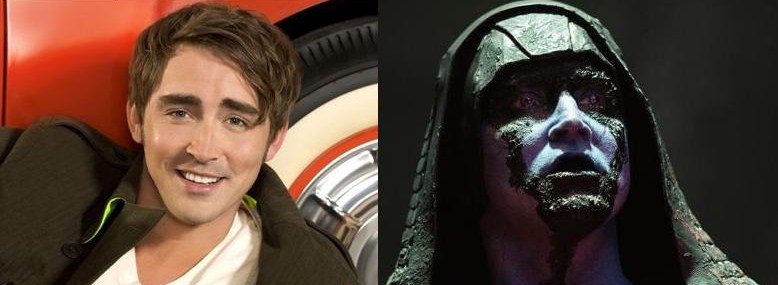
Casting for the film’s default lead, Star Lord, began in September 2012, with a laundry list of people who tested or read for the role: Eddie Redmayne, Joseph Gordon-Levitt, Joel Edgerton, Jack Huston, Michael Rosenbaum, and many, many others. Lee Pace also auditioned for the role, ending up instead slotted into the role of Ronan, the film’s main antagonist. Five months later, Marvel finally announced that they had found their man in Chris Pratt. Jason Momoa auditioned for the role of Drax, but he was passed over in favor of Dave Bautista (Momoa, of course, is slated to appear as Aquaman in DC’s upcoming attempted franchise). The nature of this new film meant that none of the MCU’s previously appearing characters could not reasonably make cameos in this film, although Buffyverse alum Alexis Denisof reprised his role as The Other, Thanos’s emissary who gave Loki his marching orders in Avengers. There was little publication surrounding other roles and testing for them, but the film’s cast was finalized by mid-2013 (minus Vin Diesel, whose vocal acting for Groot was only confirmed after the end of principal photography), and filming began in July of that year.

For those of you who have forgotten everything about the film except for a wisecracking raccoon and freshly-buff Chris Pratt being hosed down while flouncing about in underwear, a quick refresher: Young Peter Quill fled the hospital where his mother was dying in 1988 and was picked up by an alien ship. Years later, Quill (Pratt) acts as a scavenger in a fleet led by Yondu (Michael Rooker), a blue alien with an inexplicable Southern accent; he finds and takes a valuable item from a space tomb and ends up on the run from Kree radical Ronan (Pace). Multiple bounty hunters are sent to apprehend Quill, including Rocket Raccoon (voiced by Bradley Cooper) and his partner Groot (Diesel) and assassin Gamora (Zoe Saldana), who was kidnapped from her home by intergalactic warlord Thanos (Josh Brolin) and trained as a killer. These four untethered people are eventually captured and detained in a space prison; when they escape, they are joined by fellow inmate Drax (Bautista), who has his own axe to grind with Ronan and Thanos. They are opposed by Ronan and Gamora’s warrior “sister” Nebula (Karen Gillan) and the police-like Nova Corps, led by Nova Prime (Glenn Close). These decidedly-not-team-players reluctantly accept that no one else is in a position to save the galaxy from total annihilation and rise to the challenge.

Brandon, what did you think about Guardians of the Galaxy? If I remember correctly, this was one of the MCU flicks that you had seen before starting this project; does it fare better or worse now with more of a background in this world? Or, given that this film that lies outside of the MCU’s reach for the most part, does that context change your opinion at all?

EPSON MFP image

fourhalfstar

Brandon: I’m starting to feel extremely foolish about how I received Guardians of the Galaxy at the time of its release a couple years ago. I liked the film well enough as a loud, vibrant action comedy that provided a much-deserved starring role for America’s affable older brother (or boy toy sex symbol, depending who you are) Chris Pratt. However, I remember buying into the idea that the Marvel “house style” had significantly put a damper on the over-the-top exuberance of madman schlock director James Gunn. Gunn was familiar to me as the dark soul behind depraved camp titles like Slither and Tromeo & Juliet, so it was weird to see his style somewhat homogenized into a Luc Besson-style space epic. The truth is, though, that Gunn’s version of an uninhibited MCU entry probably would’ve turned out more like the grotesquely asinine Deadpool film I’ve spent the last month brooding over. In fact, Gunn already directed a nastily misanthropic superhero film, simply titled Super, that I generally enjoyed, but also found difficult to stomach at times due to the lighthearted way it depicts sexual assault. I don’t know if this is me getting increasingly sensitive with age, but another The Fifth Element, Star Wars-style space epic with Kevin Feige & company keeping Gunn’s sadistic id in check actually sounds preferable now to what might’ve been delivered otherwise. It might also be the case that the act of catching up with the rest of the MCU’s output in recent months has helped me realize just how unique Guardians is as a modern superhero popcorn flick & just how much of Gunn’s personality is noticeably present on the screen.

In any case, returning to Guardians of the Galaxy with fresh eyes was a revelation. This is a fantastic work of crowd-pleasing action cinema, the exact kind of delirious spectacle I look for in blockbusters. In that respect, the only film that might‘ve topped it in the year or so since its release is Mad Max: Fury Road & I mean that with full sincerity. The film’s detailed, lived-in version of space opera is literally worlds away from the rest of the MCU. Its superheroes aren’t truly heroic or even all that super. They’re mostly thieves, murderers, aliens, and the bi-products of cruel science experiments. Something that largely got by me the first time I watched Guardians of the Galaxy was just how emotionally damaged its central crew of space pirates are. Their families are dead. They’ve never known true friendship. They’re sometimes prone to drunkenly curse their own very existence. The film’s tendency for 80s nostalgia & crowd-pleasing action set pieces are really fun in an overwhelming way that I think often distract from just how devastatingly sad its emotional core can be. I never knew an anthropomorphic raccoon grimly complaining, “I didn’t ask to get made!” could make me so teary-eyed, but Guardians has a way of making the emotional pain of its damaged, nonhuman non-heroes feel just as real as the physical space they populate looks. That’s no small feat.

That’s obviously not to say that all of Guardians is deep-seated emotional pain. The film is mostly a riotously fun action comedy with broken hearts & bruised egos only peppering its blockbuster thrills. I love how inane its outer space worldbuilding is. Blue people, green people, purple people, and purple people eaters all roam about as if they are on a silly 60s sci-fi television show. Villains are known to say absurd things like “Nebula, go to Xandar and get me the Orb.” The MCU’s ultimate MacGuffin, the Infinity Stones, actually feel at home in this kind of space age gobbledy gook. It’s also fun to watch this atmosphere clash with Pratt’s womanizing bro humor as Star Lord, as I feel like I’ve lived in this kind of space adventure before, but I’ve never met anyone I could describe as a “space bro” as comfortably as Star Lord. I particularly enjoyed the line when describing the filth of his space ship/bachelor pad he confesses, “If I had a black light these walls would look like a Jackson Pollock painting.” The kicker is that Guardians not only has the most successful humor of the MCU’s output so far; it also has some of the most exhilarating action sequences in the franchise. The Kyln prison break in particular is a beaut & watching Rocket Raccoon operate his homemade weaponry gives me the same thrill I caught watching primates operate automatic machine guns in 2014’s Dawn of the Planet of the Apes.

4120537-7008853704-kclkd

the-brew-buzz-19

I could probably prattle on about how my favorite two MCU entries so far, Guardians of the Galaxy & Captain America: The First Avenger, thrive on their own strengths by distancing themselves from the rest of the franchise, but I don’t believe that best captures what makes Guardians so special. Honestly, the film’s own mixtape gimmick is a better access point to understanding its wide appeal. A mix of crowd-pleasing songs like “I Want You Back” & Escape (The Piña Colada Song)” and offbeat essentials like “Cherry Bomb” & “Moonage Daydream“, the film’s mixtape soundtrack mirrors its larger mashup of action comedy marketability & cult film tendencies. In retrospect the marriage of James Gunn’s mean nerd exuberance & the MCU’s action comedy accessibility is a match made in blockbuster heaven. It delights me to no end that you can actually purchase a copy of Star Lord’s beloved mixtape cassette. That piece of comic book movie ephemera actually seems more to the heart of the film’s appeal than a Rocket Raccoon figurine or even a Blu-ray copy of the film could ever be.

EPSON MFP image

fourstar

Boomer: Last time we were here, I mentioned how much Captain America: Winter Soldier reminded me of Star Trek VI and how that only made me love the former all the more. I have to admit that I was one of the naysayers with little hope for Guardians. By the time it came out, I was sick to death of the endless stream of advertisements for the movie; in every commercial break and before every YouTube there was a clip of Chris Pratt slowly flipping off John C. Reilly. But what I found when I saw the film was that I actually loved it, but mostly because it was the closest I felt we would ever come to having a Farscape feature.

The parallels don’t track perfectly, but they are obvious. We have the wise-cracking American thrust into an interstellar society made up of various societies and factions (Peter Quill/John Crichton), who has a relationship with a woman who was taken at birth and trained to be a deadly soldier and assassin (Gamora/Aeryn Sun). They’re joined by a large warrior with ritual scarrification and tattoos (Drax/D’Argo), a pint-sized wiseass (Rocket Racoon/Rygel), and a living plant (Groot/Zhaan). Farscape’s premiere episode even involves a prison break in which many of the main characters escape captivity, and both ragtag crews eventually find themselves drawn into the greater war going on around them in spite of their individual desires to simply overcome the traumas of their past. Both Drax and D’Argo have lost their wife and child (although D’Argo’s son is still alive, albeit enslaved), and both Gamora and Aeryn slowly warm to the human crewmate that helps them feel closer to their (in)humanity. The sequence in which the titular Guardians visit a mining colony inside of a once-living giant is even reminiscent of the episode in which the crew of Moya find a mining colony inside of the budong, an ancient spacefaring being of humongous proportions.

For the most part, the similarities end there, however. Although Groot and Zhaan are both plant people, the former lacks the metaphysical wisdom and spirituality of the latter. Although Rocket is full of himself, he lacks the imperial pomposity of the dethroned Rygel. Still, once can’t help but feel that Guardians is a spiritual sequel to Farscape, and that greatly contributes to my enjoyment of the film. I have to admit, however, that this rewatch wasn’t the thrill ride that I remembered fro my first few viewings. Guardians is undoubtedly the coolest of the MCU flicks so far, but the repetition of the jokes from the film in the real world has stolen some of the luster from their enjoyment. There’s still a lot to enjoy here, but Guardians doesn’t hold the endless rewatchability for me that Winter Soldier does, despite being much more fun than the comparably dour Captain America sequel. It was a smart move on Marvel’s part to follow up a somber MCU installment with a film that was exhilarating in a different way and for different reasons, but Guardians has a problem that the other films don’t have.Whereas the previous ensemble in The Avengers had the luxury of multiple individual films to flesh out the members of the team (minus the characters who were supporting players in previous installments, with Hawkeye never being fully realized as a character until Age of Ultron), Guardians has the unenviable task of introducing all five of its mains as well as their world and the ramifications thereof in a very short amount of time. The script is excellent in that the film doesn’t feel overloaded, but reflection upon the movie does lead to some questions that feel unanswered. We know that the Kree and the Xandarians have recently reached a peace accord, but what was their relationship beforehand? Are many of the Kree fanatics like Ronan, or is he an outlier, and, if so, why does Nova Prime have such difficulty getting the Kree ambassador(?) that she contacts late in the film to make a political statement decrying Ronan? And why wouldn’t the Kree condemn a terrorist anyway? This scene and others blow past so quickly that viewers may not realize just how much information is needed, but scenes like this have a way of niggling the subconscious.

Still, Guardians is a lot of fun. When I first saw it in theatres, I would have given it five stars, but time and distance have made me a bit more critical of it. Maybe I just wasn’t in the right frame of mind this time around, but the film just doesn’t have the magic for me that it did in 2014.

EPSON MFP image

Lagniappe

Brandon: It’s impossible to talk about Guardians‘ likability without addressing the absurd strength of its cast. Besides the appeal of Chris Pratt’s affable bro humor & “pelvic sorcery”, watching James Gunn regulars like Michael Rooker & Lloyd Kaufman appear among Hollywood heavyweights like Benicio Del Toro & Josh Brolin is a strange delight. Goofball comedic actor John C. Reilly interacting with Glenn Close is equally enjoyable as novelty. Bradley Cooper appears as a CG raccoon wearing people clothes. Vin Diesel outs himself as a huge D&D-oriented nerd as a talking tree. Bautista & the much-hated (among cinephiles, anyway) comic book prankster Howard the Duck both make a massive impact, which combine to make it feel as if this film were aimed to please my own particular nerdy obsessions: bad movies & pro wrestling.

The only complaint I might have about Guardians‘ insanely stacked cast of always welcome faces is the way it largely wastes the eternally-underutilized Lee Pace. I enjoyed Pace’s turn as impossibly cruel Ronan the Accuser more than I did the first time around but I do still think it was a huge mistake to cover up his luscious eyebrows with the alien makeup. Those might be the most handsome eyebrows in Hollywood. They deserve to run free.

tumblr_na2ozpjnfv1rfbi2jo1_1280

Boomer: For anyone reading this who is still mourning the loss of Farscape, I recommend current sci-fi series Dark Matter. It has fewer obvious commonalities with Farscape than Guardians, but its tone is the closest thing to Farscape’s that I’ve been able to find in a long time, even if it lacks the older series’s humor.

When joking in our earlier review about the fact that the Ninth Doctor appeared in Thor 2 and that the Tenth Doctor had played the villain of Jessica Jones, I had completely forgotten about the fact that Karen Gillam, who played the Eleventh Doctor’s companion Amy Pond, played Nebula in this film. There’s also the fact that Tobey Jones, who portrayed a nightmare version of the Doctor a few years back in “Amy’s Choice,” portrayed the evil Doctor Zola in both Cap flicks. Were it not that Jenna Coleman (who portrayed Clara Oswald, companion to the Eleventh and Twelfth Doctors) played a minor role in Captain America, all the Doctor Who alums who have thus far appeared in the MCU would have portrayed villains.

Regarding how the film plays into the larger mythos of the franchise, the plot elements from Guardians have largely only been important in how they affect Agents of S.H.I.E.L.D. Just as one of the main characters on the program was revealed to be a Hydra mole near the end of the first season, the second season featured major developments in the form of the revelation of the existence of the Inhumans and that another member of the squad was one such being. The Inhumans, for those who understandably gave up on Agents early on, are a subspecies of humanity who possess abnormal physiological traits as the result of a Kree genetic engineering campaign in Earth’s distant past. It’s also an easy way for the MCU to introduce large numbers of super-powered individuals despite not having the right to use the term “mutant,” what with the rights to the X-Men franchise still tied up at Fox. For those of you playing along at home, there is also a planned Inhumans film slated for release in 2019.

EPSON MFP image

Combined S.W.A.M.P.F.L.I.X. Rating for Guardians of the Galaxy (2014)

fourhalfstar

-Agents of S.W.A.M.P.F.L.I.X.

9 Mildly Interesting Things I Learned from the Mrs. Winterbourne (1996) Press Kit

The I Luv Video outlet near me on Austin’s Guadalupe Street is closing down and consolidating with their other location. There’s been a sign out front for weeks now advertising that a lot of their old fare is for sale. I went hoping to find some Dario Argento DVDs like Phenomena or Tenebrae, and although the good stuff was all gone (there are two copies of Eldritch abomination Phantom of the Opera and one of Jenifer, for those of you who hate yourselves and have a few dollars rattling around that you would prefer not to have), I did stumble across a small trove of press kits for nineties flicks. And what should I find among them but a folder labeled Mrs. Winterbourne?

IMG_20160305_180240

What’s a press kit? Well, whippersnappers, back in the day before the internet made the acquisition and dissemination of information easy and manageable, production companies would distribute press kits to media outlets. These packets contained information about the production, statements from cast and crew, and glossy photos from the film itself, all ready for inclusion and quotation in previews and reviews. There’s little information in them that can’t be found online these days, but there were a few things in the press kit for Winterbourne that were interesting and that we didn’t know before watching the movie. Look, this isn’t Buzzfeed, I’m not going to tell you that any of these facts with “change the way you look at [x] forever,” or pretend that any of them are “mind blowing.” But they are neat, so without further ado, here are 9 Mildly Interesting Facts I Learned from the Mrs. Winterbourne Press Kit:

1. Brendan Fraser was the last person to join the cast. Ricki Lake was actually first cast, with Shirley MacLaine cast shortly after. According to page 7, Fraser “came into the cast […] only days before rehearsals were scheduled to begin.”

2. Fraser’s casting was at the behest of Lake. From page 8: “Fraser is a friend of Lake’s and was suggested by her.”

3. Fraser was also making a name for himself on stage in the nineties. Fraser’s bio on page 11 delineates a theatre career that includes a B.F.A. in acting from the Actor’s Conservatory as well as performances at Seattle’s Intiman Theater, The Laughing Horse Summer Theater, and “rave reviews for his work as a tortured writer in John Patrick Shanley’s play Four Dogs and a Bone.”

4. Loren Dean (Steve DeCunzo) also worked with Shanley. In addition to winning a Theatre World Award in 1989 (for something called Amulets Against the Dragon Forces, which isn’t underlined or italicized, so it’s unclear what kind of work that is), he also originated roles in the aforementioned Four Dogs and a Bone and Shanley’s other play Beggars in the House of Plenty.

5. Susan Haskell (the real Patricia Winterbourne) is a scientist. From page 13: “A native of Toronto, Canada, Haskell graduated cum laude from Tufts University with a Bachelor of Science degree in Bio-Psychology.”

6. Director Richard Benjamin won the 1975 Golden Globe Award for Best Supporting Actor for his role in The Sunshine Boys.

7. Producer Dale Pollock began his career as a journalist. This phase of his career lasted 12 years, during which he was a film critic and box office analyst for Daily Variety and a writer for the LA Times. He also wrote George Lucas’s biography, Skywalking, which had the good fortune to be released before the Star Wars prequels.

8. Writer Phoef Sutton won a comedy award. Although his main claim to fame was as a writer/producer for Cheers (which earned him a Golden Globe, a Writer’s Guild Award, and two Emmy Awards), he won the Norman Lear Award for Comedy in 1980, and he received a National Endowment for the Arts Playwright’s Fellowship in 1983.

9. Writer Lisa-Maria Radano worked on The Tracey Ullman Show. Radano also founded a small Manhattan theater company called Shadowfax and received a New York Council for the Arts grant for her play The Secret Sits in the Middle in 1988.

IMG_20160305_180202.jpg

For more on March’s Movie of the Month, 1996’s Mrs. Winterbourne, check out our Swampchat discussion of the film.

-Mark “Boomer” Redmond

Movie of the Month: Mrs. Winterbourne (1996)

Every month one of us makes the rest of the crew watch a movie they’ve never seen before & we discuss it afterwards. This month Erin made BoomerBrandon, and Britnee watch Mrs. Winterbourne (1996).

Erin:  Picture it:  1996.  Clothes are big, scrunchies are bigger, and a Hollywood team looked at the script for Mrs. Winterbourne and decided that this was the perfect vehicle to launch Ricki Lake into Leading Lady-hood.

The same Hollywood team also thought that the best way to adapt a gritty noir novel about a pregnant woman escaping domestic abuse in the midst of a deadly train wreck and a grieving family was as a lighthearted romcom.

That’s right.  Mrs. Winterbourne is a romantic comedy about a pregnant teenager (Connie, played by Ricki Lake) escaping her scummy, abusive boyfriend, surviving a train wreck that kills another pregnant woman and her kind husband, and being mistakenly taken in by the in-laws (Shirley MacLaine and Bredan Fraser as mother- and brother-in-law) of the dead woman as they attempt to put their hearts back together.  That’s only the first act.  In the second act, just as Connie is starting to connect to the Winterbournes and is struggling with the decision of either revealing her true identity or keeping up the charade indefinitely, her slimy ex-boyfriend comes back to blackmail her. There’s singing! Dancing!  A makeover montage! Murder!

Although I really enjoy Mrs. Winterbourne, the incongruity between the gritty (and bizarre) premise and the lighthearted style in which it is presented makes for a weird movie-watching experience.  There’s a lot of whiplash as the film attempts tell a gritty noir story through the lens of a quirky romcom.

The supporting cast does several things rather well – Shirley MacLaine as the elder Mrs. Winterbourne might be the true heart of the film, and there is real chemistry between her and Lake’s Connie and Fraser’s Bill.  Miguel Sandoval, as the Cuban ex-pat chauffeur, is truly charming as he slings knowing glances and come-to-Jesus talks left and right.  Loren Dean brings a completely awful character to life in Steve DeCunzo, throwing change at a pregnant Connie through his window as she begs for help in pouring rain and stomping around in the baby’s playpen as he threatens blackmail.

Honestly, the least believable thing for me in this movie is the lack of chemistry between Lake and Fraser.  Brendan Fraser had hit his stride in the mid ‘90s, playing hot and goofy leading men after a few years of playing stoner and college roles.  He still had George of the Jungle (1997), Gods and Monsters (1998), and The Mummy (1999) to come.  Ricki Lake, while she never really hit leading lady status outside of Mrs. Winterbourne, was a ‘90s fixture, and would start her talk show in 1998. Despite being in their respective zones in 1996, they just don’t really connect, which is a shame.

Over all, I think that Mrs. Winterbourne is a fun watch.  It’s good natured about its downer plot line, and has a few really funny and touching moments.  I like strange movies, and this one is definitely strange enough to keep my attention.

Brandon, Mrs. Winterbourne is pretty wacky.  What are your first impressions of it? How does well does the romcom genre flesh out the noir bones? What caught your attention about Mrs. Winterbourne?

Brandon: Yeah it’s difficult to write my first impressions on this film without zeroing in on the fact that it’s a fish-out-of-water romcom with a “hilarious” comedic set-up that’s put into motion by a pregnant woman dying in a train wreck. The film’s moody vibe as a neo-noir is in direct conflict with its more lighthearted comedy stylings: a pregnant & homeless Ricki Lake wandering aimlessly in the rain, a butler who escaped homophobic persecution in Cuba through prostitution, a third act murder mystery, the fact that Brendan Fraser’s cad finds himself falling in love with a woman who might be his dead twin’s widow. So much of Mrs. Winterbourne is so darkly fucked up that it’s jarring to watch the film wrap itself in the soft-edge confines of the romcom genre. My favorite moment where these two tones clash is when Ricki Lake’s pregnant/homeless Jersey Girl shouts to her deadbeat baby daddy “I’m about to have your baby out on the street! Wanna come watch?” Uncaring, he tosses a quarter at her feet & shuts his window. Later the baby daddy’s new baby mama recognizes Lake’s protagonist only as “The Bitch Out in the Rain With the Quarter.” I shouldn’t have gotten such a hearty laugh out of that but I shrieked with delight. What a messed up “gag”.

The weirdest part about the film’s compromised tone is how much weight it puts on Ricki Lake’s shoulders. She’s asked to deliver most of the film’s yuck-it-up comedy, which I’d say she accomplishes with just as much bright eyed enthusiasm she brings to John Waters’ (utterly flawless) Serial Mom. At the same time, I’d say that the sole reason the film’s central romance plays like a joke is the very same Ricki Lake performance. Brendan Fraser is entirely believable as the romcom heartthrob, but Lake is too much of a bumbling fool for me to genuinely commit to her end of the romance angle. Maybe it’s all those years of watching her host a Jerry Springer-style talk show that keep me from forgetting the clownish aspects of her screen presence, but I think her making homelessness amusing was an asset, but her making romance funny might’ve been somewhat of a detriment.

Where do you fall on Lake’s performance, Boomer? Is she a sold lead in this role or did the film ask too much of her in too many directions for the performance to be taken seriously?

Boomer: I have a confession to make; I used to hate Ricki Lake. This was through no fault of her own and was based entirely on Baton Rouge NBC affiliate WVLA’s decision in 1997 to replace their daily 4 PM rerun of Star Trek: The Next Generation with her syndicated talk show. In the many years since this great sin was committed, I’ve actually come to like Lake quite a bit, especially as I came to be aware of her partnerships with John Waters in my teenage years. She’s a perfectly serviceable actress, and she’s genuinely likable in this role, which could so easily have not been the case with a plot like this that revolves around deception (although Connie does admirably make every effort to correct misconceptions up to the point where revealing the truth could potentially literally kill a woman). Her weakest acting moments come in the scenes in which she is called upon to be histrionic and melodramatic that she comes across more like one of the sideshow people who populated her television stage. Lake can act; she just can’t overact, and she works best when she’s playing off of MacLaine, who brings a warmth to her performance that Lake can’t help but reflect back at her.

The weakest acting link, frankly, is Fraser, who comes across as a bit of a hack here. He seems to think that “playing rich” requires foppishness that borders on recreating stereotypical portrayals of gay men, up to and including the fey and effete way that he drops his napkin in his lap in affected shock at Connie’s initial appearance at the dinner table. There are many other ways to play a man of privilege who assumes that the new family member in his midst is an interloper, but Fraser read his part and went straight to “dandiest dandy that ever dandied,” and the later scenes that show him as a man with the potential to be more open doesn’t erase his performance in his introduction. In fact, when he first started falling for Connie, my assumption was that the film was leading into his public confession that he had latched onto her in an attempt to disprove his homosexual leanings. But no, it was just that Fraser made poor character choices when filming the earlier sequences in the film, and, admittedly, I came around on his character by the end, even if he is stiff and wooden when confronting Connie about having (he assumes) killed Steve.

The standout performance was MacLaine’s, and I especially liked how I expected the plot to unfold in the opposite direction that it does (i.e., that the rich patrician mother would be slow to warm to the new bride her son took an instant liking to, rather than the other way around). This twist helps the film feel less stale than it otherwise could. What do you think, Britnee? Did MacLaine help make this movie “work” for you, or no?

Britnee: MacLaine’s performance was nothing short of perfection. Every line she spoke and move she made was so effortless. I just couldn’t take my eyes off her! However, she officially stole my heart when she hid a lit cigarette in her mouth. It’s definitely not the kind of behavior one would expect from an elderly socialite, and that’s the kind of shock value that I live for.

When I think of how the film would be if there was no MacLaine, I have to say that I still would have enjoyed it. Of course, it wouldn’t be as pleasurable without her, but it would still be a great film. As a fan of Ricki Lake, I can’t help but feel as though she was the one who stole the show. She brings this sort of ridiculous yet unique style of humor to every film I’ve ever seen her in, and this is especially true with Mrs. Winterbourne. Lake as Connie Doyle was beyond entertaining. She does a good bit of overacting throughout the film, especially when she bring her Jersey Girl sass to the upper-class society of Boston. While overacting is usually viewed as a acting flaw, it’s a huge part of Lake’s comedic style, and it always brings out tons of laughs from me.

It’s interesting how this film and our previous movie of the month, Big Business, share the “poor girl in a rich world” theme. Erin, what are your thoughts on this similarity? Does this theme work better with Mrs. Winterbourne’s style of comedy as opposed to Big Business?

Erin: You know, Britnee, it didn’t occur to me that Mrs. Winterbourne and Big Business are similar in their fish-out-water, mistaken identity plots.  Now that we’re looking at similarities, I think the over all feel of these movies has something else in common – while Big Business feels like an Old Hollywood screwball comedy, Mrs. Winterbourne is based on a 1948 noir novel.  I think that the old camp melodrama present in both movies gives them a feeling of a previous era in which audiences might have had more forgiveness for such silly premises.

I’m not sure if either movie works “better” with the “poor girl in a rich world” theme.  Big Business is a madcap comedy, and hardly touches the ground at all.  It’s a hysterical rush through a farcical plot.  Mrs. Winterbourne attempts to have some soul or grounding in drama, but all in all seems to have trouble straddling the line.  Both movies take that particular plot point, as well as the mistaken identities and old school feel, to push different stories along.

I think that one of the biggest differences between Mrs. Winterbourne and Big Business is something that I only noticed in this viewing.  Big Business holds its main characters as intrinsically subjective within the world of the movies.  The movie starts with something beyond their control, the baby swap, but then only advances with actions of the characters.  The Sadies and the Roses are shown, despite their immersion in a comically out of hand situation, to make the world of their movie theirs.  Connie, despite being the main character of Mrs. Winterbourne, is almost completely an object in her own world. She decides to leave her father’s house in the first minutes of the movie, and then everything else happens to her.  Her attempts to take actions are either preempted by other characters or she is talked or coerced out of decisions.

I’m not sure how to understand or interpret this lack of subjectivity in the main character.  Brandon, what do you think?  Any thoughts on why Connie is so objective in her own story, and what that means for Mrs. Winterbourne?

Brandon: If you’re looking to further solidify Mrs. Winterbourne‘s connection with Big Business, consider that they not only both deal in mistaken identities & fish out of water humor. Their plots also revolve around sets of estranged twins, which is kind of an obscure angle for a comedy. Ricki Lake’s protagonist has no twin in this film, though, which is unfortunate, as it would’ve been fun to see her match the eccentricity of the rest of the cast. She also doesn’t, as Erin points out, ever really enact the changes in her life that transform her from homeless Jersey Girl to wealthy heiress. The film’s events just sort of swirl around her as if her rightful place among the affluent was simply a matter of fate.

I think the passive aspects of Connie’s personality transforms parts of Mrs Winterbourne from a silly romantic comedy to a kind of a fairy tale. And I mean fairy tale in the sense of fantasy wish fulfillment more so than Brothers Grimm. Connie never really learns any lessons or grows as a person throughout the film. She mostly just allows the world to pave the way for her road to happiness in which Brendan Fraser is the closest thing to a prince a modern girl could wish for & a milquetoast life surrounded by immense wealth is the height of happily ever after. Keeping Connie passive & grounded leaves open a hopeful It Could Happen to You interpretation for the audience at home, which is not far from the kind of escapism romcoms aim to sell in general. The details that make this fairy tale angle in Mrs Winterbourne feel tonally bizarre, though, are the film’s darker plot points: a miscarriage, a train wreck, a murder. It seems that, according to the film, happily ever after often comes with a body count on its price tag.

What do you think, Boomer? Is Connnie’s passiveness an intentional choice that allows the viewer to step into her shoes & live out her (somewhat deadly) fairy tale or did the writers merely fail to consider giving their protagonist a sense of agency?

Boomer: I’m glad that Erin brought up the original novel above, because I was shocked to learn when viewing Winterbourne‘s Wikipedia page that it was adapted from a Cornell Woolrich novel. I went through a noir phase in my teens and although I never read the novel from which this film drew inspiration, I did read some of his other works, and this movie is quite dissonant tonally. I recently reviewed the Francois Truffaut film The Bride Wore Black, which was also adapted from a Woolrich novel of the same name, and that film is much more in line with the Woolrich vision. As counterparts to each other, Bride and Winterbourne couldn’t be more dissimilar, because Brandon is right; this flick is essentially a fairy tale of wish fulfillment.

Connie doesn’t exhibit much in the way of agency in any of the directions that her life takes. This makes sense if you think of her as a rags-to-riches fairy tale girl. Cinderella doesn’t do much but have decisions made for her and be lucky enough to have a magical godmother; Rapunzel is stuck away in a tower until the plot finds her; Talia is comatose in a castle until her “hero” comes along. Connie is much the same; she gets conned, kicked out into the street, pushed onto a train that she doesn’t intend to board, and wakes up after it crashes wearing a dead woman’s nightgown and life. The film is smart to counterpose the agency-free Connie with Grace (and even give them both names that are virtues, as we learn “Connie” is short for “Constance” in the final scene). Although Paco and Bill pester her about taking her medication and not drinking or smoking, it’s evident that Grace runs the Winterbourne household. We would normally see a woman like Connie, who is moved about like a chess piece by other people, used to prop up the story of her love interest. Instead, her more static narrative is used to expand Grace’s dynamic story. In a lot of ways, the film ends up being more of a love story between Grace and Connie than Connie and Bill.

The film is also smart to allow Connie time to make multiple attempts to tell others that they have mistaken her for somebody else only to be ignored, and she still considers it up to the point where she realizes that the truth could literally kill the elder Mrs. Winterbourne. It helps keep the audience’s sympathy with Connie instead of against her. I know you said above that you feel Lake’s broader approach to the material helps it play as funnier than it would otherwise. Imagine that Lake was not available; who would you cast in her part, and why? If you could recast one other person, who and why?

Britnee: Ideally, I would love to see a young Barbra Streisand play the role of Connie. Not only is she my favorite “funny lady,” but she knows how to pull off a romcom, which, as much as I adore her, Lake just can’t seem to accomplish. Unfortunately, Streisand would be more suited for the role of Ms. Winterbourne during the time of the film’s release, so this an impractical choice. Being a little more realistic, I would without a doubt cast Natasha Lyonne for the role of Connie. I can’t help but think of how perfect she was as Vivian in Slums of Beverly Hills, and I see a lot of Vivian in Connie. Two sassy, street smart ladies trying to make their way in this big, cruel world.

If I was given the choice to recast another person, it would definitely be Brendan Fraser. He was just so bland and almost robotic. I understand that his character (Bill) is supposed to come off that way for the most part, but when Connie becomes his love interest and he goes through his little personality change, it just doesn’t feel natural. However, I do have to say that he was excellent in George of the Jungle and Airheads, but I’m not sure if that’s necessarily a good thing. When it comes to recasting Bill, I would chose  James Spader because he is perfect for that type of role. He’s great at being a total snob (Pretty in Pink), but he’s even better at being a romantic snob (White Castle). Spader and Lyonne would have been such an iconic romcom couple.

Lagniappe

Erin: It’s a shame that Brendan Fraser and Ricki Lake have such little genuine chemistry.  The plot is already pretty forced, and some real passion between Fraser’s Bill and Lake’s Connie would have given an ounce or two of believability to a storyline that requires a man to fall in love with his twin brother’s widow.

Britnee: Connie’s little “makeover” was so unnecessary. I could understand the need for a makeover scene if she had ratty hair and holes in her clothes, but her hair was gorgeous and her outfits were so on point. All they did was give her shorter hair and a couple of new tops. Lame!

Brandon: One of the more absurdly funny aspects of Mrs. Winterbourne was how undercooked Connie’s baby looked in the film. I’m not sure if they cast an infant that was too young for that kind of physical labor or what, but the way Connie’s child was always helplessly thrusting its little arms in the air as a wide range of actors jostled & played with it was so dangerous looking in a way that made me laugh fairly consistently (through my heartfelt concern, of course) whenever it was being passed around. I’d like to check back in with the now-20 year old Mrs. Winterbourne Baby in 2016 to see how their neck & limbs are doing, because I could swear the camera caught some permanent damage somewhere in there.

Boomer: I didn’t expect that the truth would be revealed by the appearance of Connie’s ex; I was looking for the late Mrs. Hugh Winterbourne’s family to look up their daughter and discover Connie living her life. Given that this never happens, I can’t help but wonder what will occur when they come to visit their grandchild. Further, considering that all their problems were resolved by a stranger murdering the loose ends, I hope they just send letters. It’s bad luck to interfere with the Winterbourne family destiny, apparently.

Upcoming Movies of the Month
March:
Boomer presents My Demon Lover (1987)
April:
Brandon presents Girl Walk//All Day (2011)
May:
Britnee presents Alligator (1980)

-The Swampflix Crew


The Late Great Planet Mirth III – Tribulation (2000)

EPSON MFP image

twohalfstar

Welcome to The Late Great Planet Mirth, an ongoing series in which a reformed survivor of PreMillenialist Dispensationalism explores the often silly, occasionally absurd, and sometimes surprisingly compelling tropes, traits, and treasures of films about the Rapture. Get caught up in it with us!

Hoo boy, this is a weird one. The back of the box for Tribulation, the third film in the Apocalypse series, claims that the film is roughly 101 minutes long, but the movie really clocks in at less than 90, in the low eighties if you discount the overlong opening credits. Revelation also had a similar problem, as that film started with a long pan through Thorold Stone’s house while a cover of Rapture anthem “I Wish We’d All Been Ready.” The difference is that Revelation picks up from there and goes the distance (…mostly), while Tribulation is too down to earth, despite paradoxically also being absolutely bonkers. It takes a risk by crafting (for lack of a better word) a Rapture story that includes elements from sources other than Hal Lindsay’s Premillenial Dispensationalism™, but the more ostentatious features of the movie are at odds tonally with the previous films. It also feels like something you’ve seen in any DTV conspiracy thriller because, despite taking place in the world created by the first two films, Tribulation barely bothers to include the Antichrist, instead playing out like a bargain basement pod people movie interspersed with televangelical talking heads.

Tom Canboro (Gary Busey; yes, that Gary Busey) is a cop in Anytown, USA. His lovely wife Susie (Sherri Miller) is some kind of television producer. Busey says at one point that life isn’t like her show, where she finds “the most romantic angle” for a story; this, combined with the fact that she is friends pre-Rapture with Helen Hannah (returning champ Leigh Lewis), is all the information that we really get about her. Tom has remained close in adulthood with kid brother Calvin and their older sister Eileen (Lois Lane herself Margot Kidder), who’s a bit of an overbearing Bible-thumper. The Canboros also share their home with Susie’s younger brother Jason (Howie Mandel), who is interested in the philosophy of rising European Union figurehead Franco Macalusso (Nick Mancuso).

That’s right! Macalusso is just a minor politician at this point. Tribulation doesn’t start during the Tribulation at all; half of this movie’s runtime takes place pre-Rapture, spending nearly 45 minutes establishing character relationships that won’t matter in the back half. In fact, this film doesn’t feel like it has multiple acts, instead feeling like two parts of a TV two-parter. It is established that Jason is mentally unstable, although it’s apparent that he’s written by someone who has no concept of how mental illness works. Jason is frequently manic, excitedly telling the small family gathering about Macalusso’s idea that if all the people on earth were united in their ideas, man could essentially become like unto a god. Jason is also stated to have a past history of psychological hospitalization and an interest in the occult, which are explicitly linked. He uses a non-copyrighted ouija board, which somehow gives him the clue that Macalusso’s ideas are related to Genesis 11:6, which is in the middle of the story the Tower of Babel. You can look that up in whichever translation suits you, but they’re all essentially a variation on the idea that the builders of the tower could perform any feat they imagined because of their unified language and intention. Don’t let it surprise you that the film ends up having the villains treat this verse like the loophole in a contract with God, but I’m getting ahead of myself. Jason ends up wreaking havoc in the family kitchen while explaining how one group of monkeys spontaneously learned a skill that another monkey group (from which they were isolated) learned independently; this is definitive proof, he says, that Macalusso is right about the boundlessness of human potential. Jason and Eileen argue about their perspective worldviews. I wouldn’t even mention it, but it leads Busey to utter one of the greatest lines ever committed to film while he puts on his badge and gun (I gave the movie an extra star for this alone):

“I gotta go. There’s a whole lotta people in this city who don’t take much comfort in God or a clean banana.”

Elsewhere, a group of Satanists (led by a guy who intentionally looks like Anton LaVey) are standing around under a pentagram, focusing on a model of the Tower of Babel and, well, babbling about how God himself admitted in Genesis 11:6 that mankind is capable of overpowering him. Because the movie needs a scene to drive home how dangerous they are, they possess the sleeping body of a guy who teaches a night course in parapsychology,which is hilarious for a few reasons. First, the fact that the screenwriter specified that this was night school in order to capitalize on the creep factor is adorable. Secondly, after revealing this fact, one of the Laveys hilariously says “This guy’s mind is wiiiide open,” because the Laveys share the same ironically dismissive attitude about New Age concepts that Evangelicals do. The possessed man starts attacking his Christian wife, screaming that she is a “Hater” (thereby establishing that this term for Christians predates the Rapture in this world, answering a question that nobody asked). Tom responds to the domestic disturbance call and confronts the possessed man, who threatens his wife and then leaps through the window of their 14th floor apartment. Intercut (although that word implies a mastery of editing that is not on display here, which I’ll get to in a bit) with this are a couple of scenes showing Jason confronting Susie and demanding to see Eileen, calling her a “hater.” Although we only see the aftermath, Tom is called away to the hospital because Jason also jumped out of a window, but was luckily only on the first floor.

At the hospital, the Canboros learn that Jason will likely be remitted to a psychiatric facility, much to his distress. Lavey Prime astral projects into the room and uses Force Choke on Jason, as he had picked up on broadcasts that weren’t meant for him. Lavey Prime is repelled by the presence of Eileen, like a vampire with the weirdest weakness of all time. While Tom goes to check on the body of the man from the domestic disturbance in the morgue, Susie decides she’s just going to kidnap her brother from the hospital. Eileen is on board because she totally believes his ramblings about the cabal of Laveys and their murderous ways, despite the fact that a psychic Babel cult plays no role in the Hal Lindsey PMD™ beliefs that she is seen to espouse. A couple of minor Laveys brag to each other about having killed the night school instructor, and Tom overhears; he flees the hospital right behind Susie and the others, but the Laveys cause him to crash his car. If this really were a TV two-parter, this is where the ominous “To be continued…” would appear.

We flash-forward to the post-Rapture world established in Revelation, where Tom wakes from a coma in a world he doesn’t understand, presaging similar plot developments from Danny Boyle’s 28 Days Later and The Walking Dead, except that those narratives don’t spend an inordinate amount of time in the pre-crisis world. The hospital room in which he awakes is shared with an amputee, who warns him not to let anyone know that he is awake, as he will then have to put on the VR glasses and choose death or Macalusso’s Mark. Tribulation doubles down on Revelation’s weird ableism (the amputee seems genuinely panicked that he will be forced to don the goggles but acquiesces to take the Mark almost immediately after realizing that doing so will restore his missing arm), and Tom barely escapes detection before taking heart when he sees that one of Macalusso’s broadcasts is interrupted by archive footage from Jack van Impe’s TV show. We learn that these hacks are being perpetrated by Helen and Susie, along with Jake (Patrick Gallagher, who was also a member of Helen’s underground in Revelation), operating out of a broadcast van and staying on the run. We also learn that Thorold Stone was captured and executed between the previous film and this one.

Tom struggles to comprehend the Tribulation in which he has awoken and seeks out Eileen. Every person he encounters turns on him after learning he is not Marked, and the Laveys almost capture him in a disturbing scene in which they murder a group of homeless people hanging out in an alley through which he escapes. Eventually, he makes his way to his and Susie’s old house, where he encounters Calvin, who has taken the Mark and does not remember Eileen; she no longer even appears in photos from their childhood. Calvin attempts to force Tom to take the Mark, but Tom bests him and flees to a sentimental place: a tree that Eileen had designated as a meeting place for them as children should they ever get lost in the woods. There, he finds Jason, who has successfully avoided taking the Mark but still refuses to accept that Eileen’s warnings are playing out exactly as she predicted. Meanwhile, Helen is captured by the Antichrist’s forces after the latest broadcast. Tom sets out to find Susie, hoping that they can reunite before the end of the world.

Tribulation is by far the most bizarre entry in the canon of Rapture flicks, using decidedly non-PMD ideas like the concept that humanity might be capable of defeating God if united in one purpose in an attempt to build a conspiracy thriller. Ultimately, however, it fails to be as engaging as Revelation, which hit the ground running relatively quickly. There’s also a step backward in regards to production value this time around, as the editing in this film is utter garbage. There are splices that are so random that at first I wondered if the DVD was skipping before remembering that I was watching a VHS; in the kitchen scene that establishes character relationships, there is a sudden jump to Jason’s upstairs room, where he is accidentally tapping into the Laveys’ transmissions, a shot that lasts ten seconds before jumping back to the kitchen below. Later, when Tom is confronting the possessed night school instructor, there are similar splices to a seemingly random scene in which Jason is screaming at Susie about his need to find and kill Eileen; we cut back to the domestic disturbance site, see the possessed man leap to his death, and then a quick cut back to the Canboro house, where Jason is lying on the ground outside, seemingly with no cause. It’s only in retrospect that the audience is led to the realization that Jason was receiving the same psychic orders as the dead man. This happens again and again throughout the plot, and it makes for a distinctly disorienting viewing experience. This could be forgiven if it seemed at all to be an intentional ploy to put the audience in the same headspace as Tom, but the only way that could work is if these scenes started after his awakening, which they don’t.

There’s another issue with the narrative, which is what we could call the Problem of Eileen. After Tribulation was released, Margot Kidder famously claimed that she had no idea that the film was meant to be a Christian propaganda piece, and Howie Mandel has made similar statements. Viewing their contributions to the film in isolation, Mandel’s statement is more difficult to believe, given that his character endures the Tribulation and ends up becoming a believer by the end. I’m more inclined to give Kidder some credit, though, for a few reasons. Firstly, her character is taken in the Rapture, meaning that she only appears in the first half of the film and may not have been given a complete script, which lends some credibility to her claims. Secondly, Eileen as presented in the film isn’t the best representation of Christianity; she comes across as obsessive and overbearing, and although these are not uncommon character traits among some believers, Kidder seems to be playing Eileen that way intentionally, as if the viewer is supposed to find her at least somewhat disagreeable. Although her drug use problems have rendered her the butt of insensitive jokes, Kidder’s not a bad actress, and I think that if she had known that Eileen was supposed to be the voice of reason (rather than a fundamentalist with kooky views that she won’t shut up about, the way Kidder plays her), she would have given a more nuanced performance. Finally, given Kidder’s own troubles with mental illness, I doubt she would have agreed to play a character who treats Jason’s instability as something that can be prayed away if she had realized that the filmmakers intended her to be right. Unfortunately, there are a lot of people in Christian families in the real world who do not get the professional help they desperately need for this same reason.

There are myriad problems here above and beyond those noted in the plot synopsis. All of the Laveys dress like Charmed warlocks, which severely undercuts the menace of their presence. Their wanton murder of a dozen homeless people adds some of that villainy back in, but the tone deafness of that scene (which follows the shooting of an unarmed black Christian man named Ronnie by the police) and the film’s apparent lack of consideration for the real world implications lacks social awareness. The film would have been better served to illustrate the parallel between the Tribulation and our present and how both worlds are in need of redemption, but blind support of police and blanket privileging of Christianity in our society are both tools that support and reinforce the status quo, so no criticism of the violence and fascism of contemporary America can be made. As a result, this sequence is nearly as offensive in what it doesn’t say as Apocalypse was in its appropriation of footage of real world violence, just in reverse.

As always, this film is not without redeeming features. Busey gives a good performance here as well. Not for an actor, mind you, but for a Busey, he’s quite good. It’s too bad that what could have been a decent outing for him in the twilight of his career takes place in such a shoddily constructed movie. Lewis continues to outshine the material she is given to work with. The sequence that works best is when, post-capture, she is taken into the VR world to confront Macalusso. Lewis plays the internal war between faith and fear admirably, giving a powerhouse performance, and Mancuso’s Macalusso shines more brightly here than in Apocalypse, despite that he never actually appears, being seen only in the VR world and giving addresses on television. Still, there’s not enough here to make up for the poor scripting, inconsistent performances, and overall feeling of cheapness. This movie is only marginally better than Apocalypse in the end, even once you factor in Lewis’s performance. Skip this one.

EPSON MFP image

Final Thoughts

  •  It’s inconceivable that the Laveys have nothing better to do in this film than spend the entire second half trying to track down one wayward Busey, who isn’t much of a threat. If anything, it only further serves to highlight Tom’s irrelevance to the plot. In Apocalypse, Stone actually had a purpose in the narrative other than to find salvation, since he had the disc that was smuggled to him by the underground; here, it’s Helen who makes the ultimate sacrifice (although she will reappear in Judgment, the final film in the series) in order to get Macalusso’s confession on tape and expose his lies. Tom does nothing to contribute to this plot, as Helen is captured before he even makes contact with the resistance
  • This introduces yet another problem, which is that the ending implies that those with the Mark can somehow overcome their brainwashing, as Macalusso’s television address following the broadcast of his Engineered Public Confession finds him angrily demanding that his flock return to him. Up to this point, those who take the Mark are treated like vampires from Buffy: you are no longer yourself, instead surrendering wholly to a new being that inhabits your body and has your memories but isn’t you. This further cements the fact that this is a body snatcher film, not one about possession.
  • It’s also worth noting that Tom’s escape from the O.N.E.-controlled hospital takes so long that Lavey Prime is notified he has awoken and disappeared but still has time to get to that location before Tom even makes it outside. It’s just one more plotting problem on top of so many that have come before.

-Mark “Boomer” Redmond

The Swampflix Guide to the Oscars, 2016

EPSON MFP image

Including short films, there are 57 movies nominated for the 2016 Oscars. We here at Swampflix have covered less than half of the films nominated (so far!), but we’re still happy to see so many movies we enjoyed listed among the nominees. The Academy rarely gets these things right (last year’s Birdman Best Picture win comes to mind in that regard), but as a list this isn’t too shabby in terms of representing what 2015 had to offer to cinema. Listed below are the 19 Oscar-Nominated films from 2015 that we reviewed for the site, ranked from best to . . . least-best (*cough* Fifty Shades *cough*) based on our star ratings. With each entry we’ve listed a blurb, a link to our corresponding review, and a mention of the awards the films were nominated for.

EPSON MFP image

1) Ex Machina, nominated for Best Original Screenplay, Best Visual Effects

“There’s something about Ex Machina’s straight-forward, no nonsense approach to sci-fi storytelling that struck a real chord in me. It’s not likely to win over folks who are looking to be surprised by every single development in its plot, but for those willing to enjoy the movie on its own stripped-down terms there’s a lot of intense visual rewards & interesting thematic explorations of, among other things, masculine romantic possessiveness that can be deeply satisfying.”

EPSON MFP image

2) Mad Max: Fury Road, nominated for Best Picture, Best Director (George Miller), Best Cinematography, Best Film Editing, Best Production Design, Best Costume Design, Best Makeup and Hairstyling, Best Sound Mixing, Best Sound Editing, Best Visual Effects

“In a time where a lot of movies, such as Zombeavers & WolfCop, intentionally aim for a cult film aesthetic, it’s refreshing when something as authentically bizarre as Fury Road comes along and earns its rabid, isolated fan base naturally. Although the movie is less than a month old, it’s already gathered a cult following so strong that I doubt that there’s any praise I can throw at it that hasn’t already been bested elsewhere. I loved the film. I thought it was fantastic, wonderfully distinct, up there with The Road Warrior, The Witches of Eastwick, and Pig in the City as one of the best things Miller has ever released onto the world. I still feel like that’s merely faint praise when compared to some of the more hyperbolic reactions out there.”

EPSON MFP image

3) Star Wars, Episode VII: The Force Awakens, nominated for Best Film Editing, Best Original Score, Best Sound Mixing, Best Sound Editing, Best Visual Effects

“The overall feeling I got while watching The Force Awakens is “What more could you ask for?” Abrams has successfully walked the Star Wars tightrope & delivered something sure to please both newcomers & skeptics and, more importantly, something that’s deliriously fun to watch when divorced from the burden of expectation.”

EPSON MFP image

4) Straight Outta Compton, nominated for Best Original Screenplay

Straight Outta Compton is not a particularly great example of a historical document, but damn if it didn’t achieve an incredible Cinematic Aesthetic in every scene, somehow managing to squeeze out a great biopic with exactly zero deviations from the format (unlike more experimental films like Love & Mercy). The cinematography, provided by longtime Aronofsky collaborator Matthew Libatique, confidently supported the film’s surface pleasures (including an onslaught of still-great songs & pandering nostalgia) to the point where any & all faults were essentially irrelevant.”

EPSON MFP image

5) Anomalisa, nominated for Best Animated Feature

Anomalisa is a great film that draws you into its headspace with compelling imagery. While the plot may not be as much of a technical masterpiece as its cinematography, its potentially played-out story is sufficiently fleshed out (again, no pun intended) that it will likely remain culturally relevant long after the genre of paint-by-numbers privileged-white-guy-versus-ennui has receded back into the ether from which it came. If not a masterpiece, then the film is definitively a cinematic experience that demands to be seen.”

EPSON MFP image

6) Creed, nominated for Best Supporting Actor (Sylvester Stallone)

“The pugilist protagonist (played by an all-grown-up The Wire vet Michael B. Jordan) of Creed‘s narrative may go through the motions of successes & failures the audience sees coming from miles away, but the movie is visceral enough in its brutal in-the-ring action & tender enough in its out-the-ring romance & familial strife that only the most jaded of audiences are likely to get through its runtime without once pumping a fist or shedding a tear before the end credits.”

EPSON MFP image

7) Carol, nominated for Best Actress (Cate Blanchett), Best Supporting Actress (Rooney Mara), Best Adapted Screenplay, Best Cinematography, Best Original Score, Best Costume Design

Carol is a handsome, but muted drama about homosexual desire in a harsh environment where it can’t be expressed openly. The subtle glances & body language that make the film work as an epic romance are very delicate, sometimes barely perceptible. In fact, if you had no idea what the film’s about going in, it’s possible it’d take you a good 20min or so to piece it together. That kind of quiet grace is in no way detrimental to the film’s quality as a work of art. It’s just that the critical hype surrounding the picture puts an unnecessary amount of pressure of what should be experienced as a collection of small, deeply intimate moments shared between two star-crossed lovers.”

EPSON MFP image

8) Inside Out, nominated for Best Original Screenplay, Best Animated Feature

“The way Inside Out visualizes abstract thoughts like memories, angst, imagination, acceptance, and abstract thought itself is incredibly intricate & well considered. Its central message of the importance of sadness in well-rounded emotional growth is not only admirable, but downright necessary for kids to experience. Even if I downright hated the film’s visual aesthetic (I didn’t; it was just okay), I’d still have to concede that its intent & its world-building were top notch in the context of children’s media.”

EPSON MFP image

9) The Hateful Eight, nominated for Best Supporting Actress (Jennifer Jason Leigh), Best Cinematography, Best Original Score

“At one point in The Hateful Eight, Samuel L. Jackson’s balding, ex-military bounty hunter says, ‘Not so fast. Let’s slow it down. Let’s slow it way down.’ That seems to be the film’s M.O. in general. Tarantino is, of course, known to luxuriate in his own dialogue, but there is something particularly bare bones & talkative about The Hateful Eight. It’d say it’s his most patient & relaxed work yet, one that uses the Western format as a springboard for relying on limited locations & old-fashioned storytelling to propel the plot toward a blood-soaked finale.”

EPSON MFP image

10) Joy, nominated for Best Actress (Jennifer Lawrence)

“Expectation might be to blame for what turned a lot of audiences off from Joy. Based on the advertising, I know a lot of folks expected an organized crime flick about a mob wife, not the deranged biopic about the woman who invented the Miracle Mop that was delivered. Even more so, I believe that audiences expected a lighthearted drama from the guy who made Silver Linings Playbook. Instead, Joy finds Russell exploring the same weirdo impulses that lead him to making I ♥ Huckabees, an absurdist comedy that might be the very definition of “not for everyone”.”

EPSON MFP image

11) Sicario, nominated for Best Cinematography, Best Original Score, Best Sound Editing

“Much like how the recent Johnny Depp vehicle Black Mass gets by purely on the strength of its acting, Sicario might be a mostly predictable film in terms of narrative, but it creates such a violent, foreboding atmosphere that some scenes make you want to step out in the lobby for a breath of fresh air (or to puke, as the cops who discovered the early scenes’ in-the-wall corpses couldn’t help doing).”

12) Steve Jobs, nominated for Best Actor (Michael Fassbender), Supporting Actress (Kate Winslet)

“Between Sorkin & Fassbender’s work here, the myth of Steve Jobs is most certainly an arresting contrast between genius & emotional sadism. He’s a true to form Sorkin protagonist who’s better judged by his work than his persona. I’m not sure I left the film knowing any more about the real Steve Jobs than I did going in, but I’m also not sure that matters in terms of the film’s failure or success.”

EPSON MFP image

13) Room, nominated for Best Picture, Best Director (Lenny Abrahamson), Best Actress (Brie Larson), Best Adapted Screenplay

Room is not all broken spirits & grim yearnings. The film can at times be quite imaginative & uplifting, thanks to young Jack’s warped sense of reality & Jacob Tremblay’s wonderful performance. Room‘s strongest asset is how it adopts a child POV the way films like The Adventures of Baron Mucnchausen, The Fall, and Beasts of the Southern Wild have in the past. Because Jack has only known life inside Room (which he refers to as a proper noun, like a god or a planet), he has a fascinatingly unique/warped perception of how life works & how the universe is structured.”

EPSON MFP image

14) Amy, nominated for Best Documentary (Feature)

“By giving so much attention to a person who obviously did not want it, Winehouse’s unwitting fans made a market out of her gradual death. Again, it’s very similar to what slowly killed Kurt Cobain as well & I’m sure there are to be more examples in the future. A lot of what makes Amy interesting as a documentary is not necessarily the details of Winehouse’s personal life that it turns into a fairly straight-forward narrative, but rather the way it subtly makes you feel like a murderer for wanting those details in the first place.”

bear

15) The Revenant, nominated for Best Picture, Best Director (Alejandro G. Iñárritu), Best Actor (Leonardo DiCaprio), Best Supporting Actor (Tom Hardy), Best Cinematography, Best Film Editing, Best Production Design, Best Costume Design, Best Makeup and Hairstyling, Best Sound Mixing, Best Sound Editing, Best Visual Effects

“At times the film itself feels like DiCaprio’s broken protagonist, crawling & gurgling blood for days on end under the weight of an over-achieving runtime. Shave a good 40 minutes of The Revenant by tightening a few scenes & losing a shot here or there (as precious as Lubezki makes each image) & you might have a masterful man vs. nature (both human & otherwise) revenge pic. As is, there’s an overbearing sense of self-importance that sours the whole ordeal.”

EPSON MFP image

16) The Martian, nominated for Best Picture, Best Actor (Matt Damon), Best Adapted Screenplay, Best Production Design, Best Sound Mixing, Best Sound Editing, Best Visual Effects

“Despite facing almost certain death in The Martian’s first act, Watney logically explains the details of exactly how/why he’s fucked as well as the practical day-to-day details other films would usually skip over, such as the bathroom situation in a Martian space lab. Speaking of the scatological, there’s a surprising amount of poop in this film. You could even say that poop saves the day, which is certainly more interesting than whatever control room shenanigans solve the conflict in Apollo 13 or other similar fare.”

EPSON MFP image

17) Shaun the Sheep, nominated for Best Animated Feature

“As always, Aardman delivers fantastic stop-motion work here, but although their films are consistently entertaining, there’s something particularly special about Shaun the Sheep that makes it feel like their best feature at least since 2005’s Curse of the Were-Rabbit. Because the movie is largely a non-verbal affair, its success relies entirely on visual comedy that feels like a callback to the silent film era & it’s incredible just how much mileage it squeezes out of each individual gag.”

18) Brooklyn, nominated for Best Picture, Best Actress (Saoirse Ronan), Best Adapted Screenplay

“Outside Saoirse Ronan’s effective lead performance, I mostly found Brooklyn entertaining as a visual treat. Its costume & set design are wonderful, particularly in the detail of Eilis’ wardrobe – beach wear, summer dresses, cocktail attire, etc. That’s probably far from the kind of distinction the Brooklyn‘s looking for in terms of accolades, but there’s far worse things a film can be than a traditional, well-dressed romance.”

EPSON MFP image

19) Fifty Shades of Grey, nominated for Best Original Song (“Earned It,” performed by The Weeknd)

“The best-selling erotic novel Fifty Shades of Grey recently made its long-awaited debut on the silver screen and, as a fan of the book series, I was very curious to see how this film could possibly be tame enough for movie theaters. What could have been one of the most iconic movies of the year turned out to be a total snoozefest. Literally. People in my theater were sleeping so hard they were snoring.”

-The Swampflix Crew

Agents of S.W.A.M.P.F.L.I.X.: Thor 2 – The Dark World (2013)

EPSON MFP image

Superhero Watching: Alternating Marvel Perspectives, Fresh and Longterm, Ignoring X-Men, or S.W.A.M.P.F.L.I.X., is a feature in which Boomer (who reads superhero comics & is well versed in the MCU) & Brandon (who reads alternative comics & had, at the start of this project, seen less than 25% of the MCU’s output) revisit the films that make up the Marvel Cinematic Universe from the perspective of someone who knows what they’re talking about & someone who doesn’t have the slightest clue.

Boomer: It seems silly now to think that the ongoing existence of the Thor franchise was not a given. Prior to the first film’s release, Kevin Feige announced that there would be a second Thor following the release of The Avengers, but Kenneth Branagh wasn’t so sure. In fact, his response to the news seems almost pessimistic, as he stated that he felt the audience would have to decide. At the time, there was gossip that this was a response to what must have been seen more and more by the individual directors as executive influence. Although our culture has a tendency to think of studio influence as an inherently negative contributor to a film’s overall quality (probably because its impact is negative in most cases), but there are examples of this kind of oversight working. Two prominent examples in this same genre are Star Wars and Star Trek: The Next Generation: in both cases, once the creator had full creative control the content took a nosedive, and the material itself vastly improved when the property was returned to more corporate oversight. Although this would later (famously) be the reason that Edgar Wright would leave the Ant-Man project, Branagh’s stated reasons for leaving Thor 2 were that he was hesitant to get straight back into production so shortly after the first film was completed, given the long lead times that effects-heavy films like the Marvel spectacles have.

Branagh’s successor was originally slated to be Brian Kirk, and the film would have been his feature debut after working as a frequent director on Game of Thrones. He entered negotiations for the project in August 2011, but ultimately backed out, citing contractual issues. Patty Jenkins, who had previously directed the biopic Monster and who is slated to direct the upcoming Wonder Woman, was brought on to direct, although she too left the project in December of 2011; this time, the cited reasons were creative differences. Ultimately, Alan Taylor, who had also previously worked on Game of Thrones as well as Mad Men, was brought on to helm the picture. Don Payne, who had a hand in the script for the first film, was brought in to draft the script. Payne lost his battle with bone cancer in March of 2013, and it can be assumed that he may not have been able to contribute in the creative process after his initial script treatment. Whether or not his declining health took him off the project, Robert Rodat was brought on to give it another pass. Rodat was most well known at the time for his scripts for Saving Private Ryan and The Patriot, and there’s a darker text to this film than the first that can be attributed to his influence.

On the casting side, Mads Mikkelsen was in talks to portray a villain in the film (presumably Malekith) but was was offered Hannibal and took that opportunity instead. The role of the Malekith ultimately went to Christopher Eccleston, a British actor known for his portrayal of the Ninth Doctor in the Doctor Who franchise and who is currently starring in HBO’s series The Leftovers. All major cast members were set to return, as well as virtually all of the minor characters. One of Thor’s buddies, Fendral, was recast; ironically, Zachary Levi was set to play him in the first film but had to back out due to commitment to Chuck, but he replaced Joshua Dallas in the role when the latter was pulled away by his obligations to Once Upon A Time. Adewale Akinnuoye-Agbaje was cast as Algrim, an elf supersoldier (yeah) who takes on the name “Kursed.”

For those of you who saw the movie once and then kind of forgot about it while waiting for the next Marvel movie, the plot is this: Once upon a time, Thor (Chris Hemsworth)’s grandfather Bor took a magical liquid McGuffin known as the Aether from the leader of a race of “dark elves.” These elves existed before there was light in the universe and who, as a result, hate lightness, goodness, and pretty much life itself. In the present day, an interdimensional alignment is occurring where all the different “realms” that Thor talked about in the first film will line up and physics will be a little wonky. Luckily for him, Jane Foster (Natalie Portman) is on the scene investigating these strange phenomena. The alignment allows her to get lost inside another realm, where she stumbles upon Bor’s hiding place for the Aether, and she becomes infected by it. The plot contrives to trap Thor in Asgard, so he must enlist the help of Loki (Tom Hiddeston) to cross over to Earth and save the day from the villain who keeps trying to kidnap his girlfriend so she can help him destroy the universe itself.

Brandon, what did you think?

EPSON MFP image

three star

Brandon: There seems to have been a monumental shift in the Thor franchise here. If you boil the series down to its most basic parts there’s exactly two contrasting realms where the narrative operates (although its internal folklore is heavily tied to their being nine realms, the rest of which are mostly relegated for brief visits): Earth (or some kind of variation of Earth that has seen modern contact with gods, aliens, and supermen) & Asgard, some kind of golden city of the gods that rests somewhere across the dimensions & can only be reached by a rainbow bridge. The first Thor film staged a familial, Shakespearean drama on the mighty purty Asgard, (which was a perfect fit for director Kenneth Branagh’s background), but for the most part it was a fish out of water comedy set on Earth. Although an near-immortal god, Thor was buffoonish in his attempts to adapt to Earth life & spent most of his MCU debut acting like a profoundly handsome & powerful Mr. Bean. Thor 2 takes a wildly different approach to its superheroics, borrowing a little Chris Nolan gloom to dampen down the good mood (right down to the wormhole fascination & the emphasis on the “Dark” aspect of its title). One of the things I enjoyed most about the first Thor film was that it lightened the mood of the MCU in a sincerely wholesome way. It felt like the start of what many people consider Marvel Studios’ “house style”. The Dark World ditches that bright outlook for a much gloomier aesthetic, but I ended up enjoying the film well enough anyway. After seven un-Nolan superhero movies the MCU can easily afford to go angsty for a single picture.

Completely ditching the fish out of water comedy of the original Thor film, The Dark World instead delves deeper into the distant world of Asgard. There are some comedic elements to the film (mostly in Kat Dennings’ strait -out-a-CBS-sitcom comic relief goof Darcy), but the plot is for the most part dead serious. A lot of the same Asgardian concerns about who will take the throne when it’s left vacant by an aging Odin (played again by an even-more-game-than-last -time Anthony Hopkins) & who exactly The Gatekeeper of Asgard (an equally more-engaged Idris Elba) is faithful to play out exactly like they did in the previous film, just with enough time & attention to take the main focus. Thor is still gleefully oblivious of his obligations to the throne. Loki is still an evil, manipulative weasel who teases playing nice before he pulls the rug form under his gullible brother. Aliens from other realms are still trying to cut deals with Loki to take over the Universe. All is right in the world(s). Instead of dragging Thor back to Earth to make more of a fool of himself, it’s Natalie Portman’s scientist hottie Jane’s turn to make a fool of herself on his world. While investigating a “gravitational anomaly” (the aforementioned wormholes) Jane is infected with something called The Ether, which is essentially purely-concentrated space evil. This is no run of the mill space evil, either. It’s an “ancient force of infinite deconstruction” that turns matter into dark matter or some such hooey. Some alien baddies seek to reclaim & harness the space evil & there you have the basic makings of a ludicrously overstuffed Marvel Studios movie plot.

By far the best aspect of The Dark World is the film’s visual treats. If I weren’t watching the film for the purpose of this review it’d be the exact kind of thing I’d zone out for just to drool over the imagery in isolation. It’s the exact way I interact with (don’t shoot!) the Lord of the Rings franchise. I’ve seen Jackson’s adaptations countless times, but can name you only a few of the characters’ names without Google’s help & know very little of the plot outside the endless walking & the quest to destroy The Ring. I treated The Dark World much of the same way. It’s a feast for the eyes, a gloomy trudge through so many alien bests, war ships, and swirling storm clouds that any given farm outside of the Earth scenes could easily pas as a heavy metal album cover. I didn’t evoke that Lord of the Rings comparison lightly, either. As soon as the film opens with Hopkins intoning the Epic Tale of the Dark Elves & warning of the One Ether to Rule Them All, Jackson’s work was already at the forefront of my mind. I was prepared to space out & maybe confirm some plot details on Wikipedia after the end credits. Honestly, that’ s probably something I should still work on. The details are a little fuzzy, but I really enjoyed what I saw.

EPSON MFP image

twohalfstar

Boomer: I forgot about everything that happened in this movie pretty much the moment I walked out of the theatre in 2013. I remember enjoying it as a pleasant diversion, but it’s apparent that this movie is spinning its wheels. The number of different directors who were at one point attached to the property makes one feel that there is a lot of welding between different ideas for the film, and not all the of the connections work. There’s also the fact that there are parts of this film that feel like the first Thor in tone but are out of place in this darker overall film. It also feels like there was a lot cut out of the movie, especially with regards to the motivations of the villains. Loki’s motives are the same as they always are, and his arc (such as it is) feels largely like a retread of everything we’ve already seen. They even have him reprise his “you must be truly desperate…” line from The Avengers, which feels less like an echo and more like a cynical cut-and-paste from one script to the next. Eccleston is particularly underutilized, as he has virtually no distinguishing features that separate him from all of the other generic genocidal dictators that make their home in this genre. The man is probably the best actor to portray a villain in this franchise since Jeff Bridges, and he’s utterly wasted in a role that a mannequin could play.

The tone is too dissimilar from the first film as well. Thor took place almost entirely in New Mexico and Asgard (give or take a couple of field trips to Jotunheim), and the bright sun of the former and the boisterous lighting of the latter gave that film a warm quality, and the gray overcast skies of the British Isles are a stark contrast. That dissonance characterizes The Dark World from its predecessor, and the tonal shifts within the film itself, along with the handing off of writing duties from Payne to Rotan, leads me to infer a few things. There may have been a hesitation to throw out too much of a dying man’s work, but Rotan’s tendency toward darker storytelling highlights the scenes that retain Payne’s lighter take from the first film and makes them stand out even more. There’s an argument to be made that, should you find yourself watching A.I., you can see the moment when Kubrick died and Spielberg took over to complete the film, because their individual visions conflict with more than complement each other. There’s an element of that here, where you can see Rotan take over from Payne, and the end result is a bit of a mish-mash of ideas.

The women in Thor’s life take it the worst this time around. Although Jane’s scientific knowledge comes through at the end of the film to save the day, she spends most of the movie in near catatonia, saying few lines and having to be protected constantly. The MCU has largely avoided the damsel-in-distress routine that seemed to be the standard in comic book film (give or take your Pfeiffer Catwoman) up to this point, but this is an all but a textbook example. Rene Russo’s Frigga has the best scene in the film (when she protects Jane from the invading elves), and her funeral is the closest the film comes to having a tone that works both as an amalgam of Payne and Rotan’s approaches and to a compelling feeling overall, but it’s not enough. Kat Dennings gets more to do this time out and, although I find her screen presence enjoyable, it didn’t do more to expand our understanding of Darcy, instead simply repeating character beats from the last time we saw her. In no other film is it more apparent that the MCU is killing time. Kevin Feige likely made a mistake by committing the film to a 2013 release date before locking in a creative team, because the final product feels somehow both rushed and overproduced. I think the upcoming third Thor film, Ragnarok, will be a step up, but only time will tell.

Lagniappe

Brandon: It wasn’t entirely intentional, but I’ve mostly relegated my thoughts on the MCU’s post-credits stingers to these “Lagniappe” segments so that they’ve become sort of a meta post-review stinger in a weird way. So, I guess I should touch on the two that occur here. One is a teaser for the (then) upcoming Guardians of the Galaxy movie that worked perfectly well by accomplishing two succinct missions: introducing Benicio del Toro’s weirdo “collector” character & relegating talk of the Infinity Stones MacGuffin to the credits, both of which were fine by me. Even more innocuous was a second stinger that served as one last romantic beat for the Me Thor You Jane relationship, which, again, was fine. I’m usually a lot more likely to be annoyed when the stingers are the sole tie to other properties in the MCU through a quick two-line cameo. That quick cameo actually occurs much earlier in The Dark World in a scene where Loki mocks the ultra-wholesome (and all-around best Avenger) Captain America in a one-off goof. I don’t know if it’s just that I like Cap so much or what, but that gag was actually quite amusing for me. It was at least funny to watch Chris Evans mime Loki’s sardonic version of himself.

Speaking of Loki, The Dark World really turned me around on that little scamp. I wasn’t particularly invested in his character as anything more than a pissant weasel before, but things took a much more interesting turn here: he reveals himself to be hurt & emotionally vulnerable in a way that never felt quite as convincing before. This turn toward the occasionally sympathetic makes his acerbic brutality all the more interesting when he inevitably changes his mind & commits himself to evil. Not that his Kylo Ren emo tantrums weren’t still amusing. I got a particularly good giggle out of the exchange where Thor confesses “I wish I could trust you” & Loki responds “Trust my rage.” That’s some high quality angst right there.

Boomer: Now that we’ve had Chris Eccleston play a villain in this film and David Tennant as Kilgrave on Jessica Jones, I guess it’s only a matter of time before we see Matt Smith in this franchise. Also, it’s such a bummer that they killed off Frigga in this film, but I am hopeful that they may find a way to bring her back for Ragnarok. A trip to the afterlife isn’t entirely out of the question for this franchise, right?

Combined S.W.A.M.P.F.L.I.X. Rating for Thor 2 – The Dark World (2013)

EPSON MFP image

three star

-Agents of S.W.A.M.P.F.L.I.X.