The Five Most Surprising Comedic Actors Lurking in Galaxy Quest (1999)


EPSON MFP image

As a full-length ode to what made the original Star Trek television series such a joy to watch, you can’t do much better than 1999’s sci-fi comedy Galaxy Quest. I guess you could argue that there’s a little influence from the The Next Generation incarnation of Star Trek mixed into the film’s DNA, considering that the spoofy homage was contemporary with titles like Nemesis, particularly noticeable in the design of the space crew’s alien enemies, but for the most part it feels true to the original Star Trek run. I suspect our resident Trekkies Alli & Boomer could do a better job explaining exactly how Galaxy Quest captures & lovingly mocks the post-Lost in Space philosophical ponderings of Gene Roddenberry’s 1960s cultural landmark, but I can say for sure that it’s difficult to think of an example of an homage that does old-line Star Trek better than Galaxy Quest. The depressive black comedy Space Station 76 might come close and JJ Abrams’s reboot of the franchise might nail a few stray details, but Galaxy Quest is more or less the pinnacle of lovingly farcical Star Trek sendups.

Besides the film’s accomplishments in capturing the spirit of its obvious, but unspoken source material, what always strikes me about Galaxy Quest is the strength & likeability of its ridiculously stacked cast. The film follows the actors who played characters on a Star Trek-esque sci-fi show as they’re misunderstood to be a real deal spaceship crew and unwittingly recruited by an alien species they mistake for enthusiastic fans of the show for a real, life-threatening outer space adventure. The casting of the Galaxy Quest crew has always struck me as inspired. The sadly deceased Alan Rickman is perfectly pitched as a Leonard Nimoy surrogate: a self-serious stage actor who’s annoyed by his genre nerd celebrity, yet still wears his prosthetic alien makeup around the house as he glumly performs simple chores. Tony Schalhoub turns “phoning it in” into his own artform as an in-over-his-head engine room technician amidst a constant state of crisis. Sam Rockwell’s role as a bit part actor justifiably paranoid about dying on the mission because he played a one-line, no-name character on the show is great meta humor. Similarly, Sigourney Weaver’s space bimbo with no real purpose on the crew besides displaying her breasts is a great subversion of her resilient, insanely competent role as Ripley in the Alien series. Even Tim Allen is a joy to watch here, bringing his iconic role as Buzz Lightyear to full live action glory as the crew’s self-important ass of a captain. Once Galaxy Quest hits its narrative groove each of these crew members helplessly find themselves slipping into their scripted roles and lift tactics from old episodic plot lines to problem solve their way back to Earth, much to the delight of their extraterrestrial fans/kidnappers.

Those famous actor crew members are largely what makes Galaxy Quest such an iconic work in the first place. It was on my most recent watch, however, where I discovered that they’re far from alone in terms of recognizable faces in the cast. It’s been a good few years since I’ve revisited Galaxy Quest, which always struck me so one of the heights of easy, pleasant viewing, and I was surprised by how well both its humor & its CG special effects have held up in the past couple of decades. What really surprised me, though, was the number of familiar faces lurking behind the film’s main flashy space crew. Here are the five Galaxy Quest supporting players that most caught me off-guard, listed form least to most exciting.

mathesar1

5) Enrico Colantoni

I really shouldn’t be surprised that Colantoni is in this movie because as a kid I probably knew him just as much for his role here as an alien nerd as I knew him as the chauvinist photographer from Just Shoot Me (I watched a lot of trash television as a youngster). In the years since its release, however, memories of Colantoni in the role had faded thoroughly to the point of vague déjà vu and I’ve come to think of the actor solely as Keith Mars, one of the great television dads (from the cult show Veronica Mars, in case you’re unfamiliar). Colantoni is damn funny as the lead alien kidnapper/nerd here, bringing a distinct Coneheads vibe to the performance. However, I’d be a liar if I didn’t admit that I was waiting for him to say “Who’s your daddy?” at some point during the production, a moment that obviously never arrived.

2ta4ecw

4) Missi Pyle

The eternally underutilized character actor Missi Pyle probably shouldn’t surprise me by popping up in a bit role as one of Colantoni’s alien underlings. Pyle’s career has long been relegated to supporting player parts on TV comedies & straight to DVD/VOD farces (she’s actually pretty phenomenal in her role as a drunken loser in the mostly unseen Parker Posey/Amy Poehler comedy Spring Breakdown, a part that seemed tailor made for Jennifer Coolidge). I think I was mostly surprised by Pyle’s inclusion in the Galaxy Quest cast because I had mentally placed Milla Jovovich in the role as I reflected back on the film. Her character’s space goth visage recalled amalgamation of Jovovich’s roles in Zoolander & Resident Evil and her super geeky, posi, genuine vibe in the role recalls Jovovich’s most iconic performance as Leeloo in Luc Beson’s ludicrous space epic The Fifth Element (a film Galaxy Quest resembles in a few production details, especially in the design of its alien weaponry).

34370-24796-0

3) Justin Long

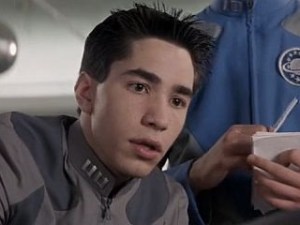
Much like Missi Pyle, Justin Long has been in almost-famous purgatory for decades, never quite breaking out of bit roles in low profile comedies while his friends & collaborators “make it big” without him. Outside a few standout parts in comedies like Idiocracy & *shudder* Tusk, he’s mostly a background player who’s asked to allow other comedians to take the spotlight. That small potatoes status is still true in his diminished role as a geeky, convention-going superfan in Galaxy Quest, but looking back I had no idea he was in this movie at all. It’s no wonder that I didn’t recognize Justin Long in 1999, since Galaxy Quest is listed on IMDb as his first credited roe, but I was still surprised to see him onscreen here, all bright eyed & babyfaced. His few scenes as the Galaxy Quest crew’s #1 (human) superfan, the kind of dweeb who obsesses over decades-old plot holes that don’t quite match the blueprints of a fictional spaceship, is more serviceable than scene-stealing, but he was still a pleasant addition to the cast. It’s a status I’m sure he’s used to filling.

JZIfMH9

2) Rainn Wilson

In case you’re not noticing a pattern here, a lot of the more surprising supporting players in the Galaxy Quest cast are the alien kidnapper/fans that kick the film’s plot into action. Although the presence of Pyle & Colantoni caught me off-guard, what really threw me off was that Rainn Wilson was lurking among them. Much like with Long, Galaxy Quest was a kind of a career-starter for Wilson, who had only appeared in an episode of a soap opera before joining the ranks of this sci-fi comedy’s geeked-out aliens. As an unproven newcomer (this was obviously years before Wilson’s star-making turn as Dwight Schrute on The Office), Wilson mostly lurks in the background as a stealthy member of the extraterrestrial superfans. However, he fits in perfectly with his compatriot dorks & the film stands as an early glimpse at the total-weirdo energy he’d later bring to his iconic television role, as well as the strange diversity in his choice of projects, which include recent strange outliers like Cooties & The Boy.

kevinmcdd

1) Kevin McDonald

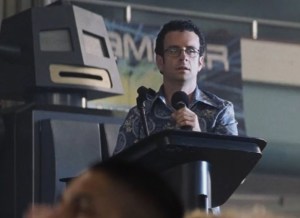
Speaking of the ridiculous range of underutilized talents lurking in the film’s geeky alien troupe, I spent a lot of Galaxy Quest asking myself “Is that Kevin McDonald? No, it’s not. But is it, though?” while watching character actor Patrick Breen fill out their ranks as a Spock-like superfan of Rickman’s eternally inconvenienced personification of nonplussed stoicism. Patrick Breen, it turns out, is not Kevin McDonald. They are two separate people. Imagine my surprise, then, when the Kids in the Hall vet did show up in the film’s closing minute in a thankless, jokeless role as a sci-fi convention MC who announces the arrival of each crew member as they make their inevitable return to the Earths’ surface. Just when I thought Galaxy Quest could hold no more room for further casting surprises, Kevin McDonald swooped in at the last second, as if the film were reading my mind.

I guess that’s to be expected in a movie where Sam Rockwell plays a full-length tribute to the very nature of a thankless bit role actor, but how could Galaxy Quest’s casting director Debra Zane have known that all of those supporting players would eventually become such big names in the first place? Her intuition seems to have been just as futuristic as the film’s sci-fi setting and her work of gathering up all of these strong personalities is a large part of what makes the film such an enduring delight.

-Brandon Ledet

Movie of the Month: The Box (2009)

EPSON MFP image

Every month one of us makes the rest of the crew watch a movie they’ve never seen before & we discuss it afterwards. This month Brandon made Britnee, Alli, and Boomer  watch The Box (2009).

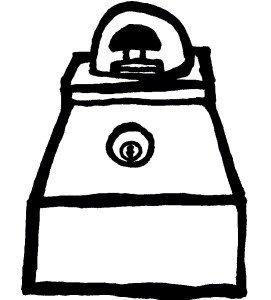
Brandon: “Your home is a box. Your car is a box on wheels. You drive to work in it. You sit in your home staring at a box. It erodes your soul while the box that is your body inevitably withers, then dies, whereupon it is placed in the ultimate box to slowly decompose.”

No, that’s not lyrics to a Bright Eyes song or a page ripped from your 15 old self’s poetry-filled diary (or both if you’re Conor Oberst). It’s an explanation from The Box’s mysterious villain Arlington Sterward when he’s asked the simple question, “Why a box?” Steward’s rambly, heavy-handed response (delivered expertly by character actor Frank Langella) is a typifying example of writer-director Richard Kelly’s filmmaking style in that it’s both far outside any semblance of normal human communication and it represents a nonstop torrent of ideas that Kelly can’t help but spill onto the page all at once. His debut film, Donnie Darko, was a weird 80s throwback sci-fi horror that’s just bonkers enough to serve as art film training wheels for disgruntled teens (it worked for me, anyway), but also stylistically restrained in a way Kelly hasn’t been since. His follow-up, the sprawling & delightfully incomprehensible Southland Tales, is a punishing assault of strange ideas that plays like a big budget adaptation of a crackpot conspiracy theorist’s 4,000 page manifesto on the state of the modern & supernatural world. The Box, Kelly’s most recent film to date, splits the difference.

As Kelly put it himself, The Box was an attempt “to make a film that’s incredibly suspenseful and broadly commercial, while still retaining [his] artistic sensibility.” I’d say it’s almost successful in that way, tempering Kelly’s bottomless wealth of bizarre ideas with a familiar realm of cinematic tones that lands somewhere between Hitchcock suspense and the Spielbergian throwback horror of titles like Super 8 & Stranger Things. I honestly believe The Box is his best work to date. However, if Kelly thinks that this overwhelming tale of deadly ultimatums, alien invasions, mind control, interdimensional gateways, and spiritual ascension has “broad commercial appeal” he’s gotta be out of his fucking mind (and I’m sure there’s more than a little truth to that). Audiences hated The Box. It’s one of the few films to ever receive an “F” Cinemascore, which is typically a very forgiving grading system. It flopped financially in 2009 & has since been largely forgotten by time. General audiences have been known to hate a lot of great art, though, and I think that there’s an argument to be made that this film deserves to be recognized as such.

The first half hour or so of The Box might actually be the work of “broad commercial appeal” Kelly believed he was delivering. The film opens as a retelling of the classic Twilight Zone episode “Button Button” in which a young couple receives a mysterious box that prominently displays a giant button and comes with an even more mysterious offer: if the couple pushes the button someone they do not know, somewhere in the world, will die & they will receive $1million cash. Long story short, the couple pushes the button, receives the cash, and are informed that the box will now be passed onto a new couple, someone they do not know. Like the best of The Twilight Zone, “Button Button” is a tight, efficient story of supernatural dread that reinforces the value of The Golden Rule: treat others as you would wish to be treated. Kelly faithfully delivers that tight, controlled life lesson and then, leaving broad commercial appeal behind, explodes it into a galaxy of strange ideas that explore the identity of the man who delivers the box (or “the button unit” as Steward puts it”), the question of whether or not humanity is an enterprise worth preserving, and theories on what could possibly exist beyond our basic understandings of reality & mortality. All of these heady topics are interjected with whatever weird ideas pop into Richard Kelly’s head from moment to moment – say, lightning as a means of alien-to-human communication, motel pools as gateways to other worlds, entire armies of It Follows-style demons (“employees” of Steward), etc. etc. etc. It’s all perfectly overwhelming and I enjoy every frame of it, but I can’t fathom a world where it could’ve been a runaway commercial success.

Richard Kelly seems very much interested in trying to convey the vague menace of the unknown here, an overreaching ambition that leaves a lot of character development by the wayside in favor of otherworldly ideas & never-ending suspense. As a result, a lot of the film’s dialogue & character motivations can fall just on the campy side of eerie. It can also be a little difficult to care about any particular character’s fate, including the film’s central family, since they remain near-strangers for the entire runtime as they try to piece together exactly what’s happening to them. As unnerving as The Box can be, its lack of compassion for its characters & its subversively campy humor can play just as thick as Cameron Diaz’s godawful Virginian accent (she really is laughably bad in her lead role as the matriarch).

Britnee, how do the corny acting & unclear character motivations play into the film’s nonstop assault of spooky ideas for you? Are they a distraction or do they add to the film’s strange, off-putting appeal?

Britnee: First of all, when I found out that The Box was going to be the September Movie of the Month selection, I got it confused with the 2015 film The Gift. Jason Bateman graced the cover of The Gift, so I kept waiting for him to make an appearance in The Box, which, of course, he never did. It turns out that movies about mysterious boxes are more popular than I thought.

The insanity that is The Box should come with a warning label. Those with severely high blood pressure or epilepsy should never watch this movie because they will end up in the emergency room before the film is over. The constant twists and turns are just too much to handle, but I loved them all. The acting of just about every character, especially Cameron Diaz and James Marsden, really contributes to the movie’s wacky charm. Diaz’s performance as one of the film’s main characters, Norma Lewis, really sticks out for me. It’s really as bad as it gets, but her horrible accent, unconvincing attitude, and missing toes all come together to make The Box a hell of a good time. As Brandon mentioned previously, it’s difficult to give a damn about the fate of any of the film’s characters because viewers aren’t given the opportunity to really connect with them, and that’s not necessarily a bad thing. I enjoyed not worrying about whether or not Norma and Arthur would survive the terrors brought on by the box because I was able to focus my attention on the all the confusing supernatural happenings.

There were many times in the film where I thought the movie was concluding, such as when Arthur goes through his chosen portal in the library and ends up in his bedroom with Norma, but then the film continues and the story develops even more. Alli, did you find the constant twists in the film to be irritating or did you enjoy them? Was there any point in the film where you thought it should’ve ended?

Alli: It’s hard to say when a movie this in-over-its-head in a bizarre concept should have ended. I think maybe somewhere on the writer’s desk someone should have come in and asked about some plot holes and maybe talked Kelly out of some of them. But as you guys are saying, they’re all a part of this movie’s goofy charm. After a certain point of being jerked around I kind of gave up and just let it take me along for this strange little ride and part of me even felt like it could have kept going, honestly. There were so many more questions than answers. Not that I think I could have stood Diaz’s accent for another hour, but I really wanted to know more about these employers of Mr. Steward. I want to know more about this film’s philosophy as well.

A thing this movie brushed over and possibly unintentionally made a argument about was free will. In the end, did the new family being offered the box have a choice at all? He clearly knew that everyone he offered these options to were going to choose the easy way out, if you can call it that, otherwise some sort of transmitter would actually have to be in the box for him to know. I know there’s an argument to be made for supernatural surveillance, but it seems like he and his employers knew all along what human nature would lead these people to do. I was a little disappointed that there wasn’t a heavy-handed monologue about that.

But then again, this is a movie that only left me half satisfied. We’re vaguely introduced to aliens but we don’t learn much more about them other than they want to prove humans are unworthy. We’re given some suspense but nothing too bad, except for like Brandon said the occasional It Follows moment of a stranger being outside the window. We’re given an ideal suburban family in an ideal suburban town that’s slightly claustrophobic but not quite. Everything seems to fall just barely short of hitting whatever target he was aiming for. Boomer, is there anything you really wish had been expanded or clarified that wasn’t?

Boomer: Honestly, I had the opposite feeling. Although I definitely like the spookiness of the Steward hive mind followers and the general impenetrability of concept that is a hallmark of Richard Kelly’s work (like Brandon, Donnie Darko served as a kind of Baby’s First Jacob’s Ladder for me as well), there’s a certain simplicity to the existential dread of the original Richard Matheson short story that is absent here. In the short “Button, Button,” the story ends with the enigmatic Steward retrieving the button in a box from the protagonists, departing as he “reassures” the couple that they should not worry, as the next recipients of the box won’t be anyone that they know, with all the implications thereof. Does that mean that there is a direct link between the immediate recipients of the button and the previous button-pushers, or just a chilling reminder that their karmic comeuppance will come someday, without warning? It’s classic Matheson that way, and I adore the story (it’s adaptation in the eighties Twilight Zone revival has a different, more obvious ending, and I, like Matheson, don’t care for it; he went so far as to have the story idea credited to a pseudonym). There’s a quietness and intrigue to the original story that this film, which uses the original story less as a template and more of a jumping-off point for spiraling but utterly watchable madness, doesn’t possess.

That having been said, there were some things that I would have been interested to see more of. I was particularly intrigued by the use of realistic grounding in the life of the family before the box arrives, like the discussion of Norma’s foot injury and Arthur’s spacey aspirations. While it’s true that much of what makes the film captivating is the unexpected paths that it takes, I would have preferred to see the story retain that level of grounding throughout rather than grow exponentially more wild. It’s as if there are two films here, and I would have liked to see a Kelly flick that had the alien test plot and a second, different film that followed the mundane lives of the Lewises after the button is pushed, as they navigate the quandary of the immoral actions taken as a result of Steward’s visit. As it is within the film, everything that follows Norma’s impulsive push that affects them is an external force, not an exploration of the fallout of committing such an act, which would have been a more interesting film to me.

As far as other elements that I would have liked to see more of, Deborah Rush is criminally underutilized here as she was in her previous MotM appearance in Big Business, and every time I see her in any role I wish she had more to do. I also would have liked to know more about what Steward was like before he became the host for the alien entity that is sitting in judgment of humanity; was he chosen because of a similarity between his pre-possession personality and the ideas of the Hive? Was he the opposite? It could have been interesting to see the dichotomy between his former self and his new one, especially as a mirror of the change in personality between some of the button-pushers we saw pre- and post-button mashing; an objective correlative metaphor is never a bad idea, and could have illustrated the difference in the self that occur as a result of chance (Steward) versus those that follow deliberate action (the Lewises). What do you think, Brandon? You mentioned that the campiness and spectacle of the movie are its big draws for you; would you feel that you would enjoy it more, or at least as much, if it had been more of a character piece than a moderately coherent, not-quite-on-target, effects-heavy scifi fable?

Brandon: I’m a little amused by that question because I assume Kelly believes he was delivering a character piece, or at least his version of it. I don’t think stripping the film of its excess of The Day the Earth Stood Still-modeled sci-fi ideas on testing humanity’s worthiness through complex alien puzzles would necessarily improve its narrative in terms of entertainment value, but I do agree that the film starts weaving some interesting threads about the Lewises that might’ve lead to some truly powerful character-based moments had they been given enough room to breathe & develop. For instance, the family’s early financial troubles, born solely of their apparent disinterest in living within their means, is played merely as motivation for their activation of the button unit, but could’ve instead lead to genuine dramatic tension were Kelly interested in building it. He also suggests an interesting spousal dynamic when the couple negotiates the button unit’s terms & conditions and Marsden’s scientist-dolt husband asks, “What is it to really know someone? Do you know me?” I wouldn’t trade those lines of inquiry for the ludicrous sci-fi spectacle we’re gifted with instead, but I do think they would’ve been better received if they had been more fully developed, ideally without sacrificing the sci-fi backdrop that contrasts them.

The problem with fitting the character study elements and Kelly’s immense idea flood into a single vehicle might be a question of form. In some ways a two hour feature film isn’t nearly expansive enough to encompass everything The Box wants to contain. The film takes the idiom “biting off more than you can chew” as a direct challenge & a mission statement, an approach that doesn’t always sit well with a movie-going audience. I feel like the property’s ideal self would be as a prestige television series on AMC or HBO, a medium that would fix several immediate problems like allowing more room for grounded character study, giving each out-there sci-fi idea time to breathe instead of running through them all at once, forgiving a little bit of the television-grade acting choices made by Diaz & Marsden, etc. I’m imagining it like a Twin Peaks or a Welcome to Nightvale, where monster-of-the-week alien threats (or in this case, alien puzzles) would all inexplicably occur in a single town & follow a small family unit as they struggle to make sense of the phenomenon. The first episode of The Box: The Television Series would be the same “Button, Button” remake the movie uses for a launching point, except that it would end with the couple pushing the button in a cliffhanger, waiting for the story to be picked up at the beginning of episode 2. As I’ve said, though, a large part of the fun of The Box for me is in being overwhelmed by its wealth of ideas in such a short amount of time & I think there’s a value to experiencing all of that otherworldly absurdity in a tightly paced, cinematic punch that is somewhat lost when you’re, to risk referencing something so of-the-moment twice in one conversation, binge-watching all 8 hours of Stranger Things over the course of a week.

Speaking of the sprawl of sci-fi ideas included here, one of my favorite concepts in The Box didn’t come from Richard Kelly himself, but is instead a quote from sci-fi writer Arthur C. Clarke, conveniently read aloud for the viewers following along at home: “Any sufficiently advanced technology is indistinguishable from magic.” Unable to resist piling even more literary quotes onto the film’s DNA, Kelly also makes several allusions to Jean-Paul Satre’s play “No Exit,” both mining its title for easy existential dread & expanding its infamous line, “Hell is other people” to “Hell is other people seeing you for who you truly are,” in an offhand stab at literary analysis. Kelly’s pulled off this trick before in Donnie Darko as well, which includes an extensive classroom analysis of the Graham Greene short story “The Destructors.” Britnee, do you think these two literary references, Clarke & Satre, as cool as they are, provide any legitimate sort of insight into what kind of story Kelly was trying to tell in The Box or were they just easy modes of injecting profundity into what’s at heart a very pulpy sci-fi premise? Was their inclusion earned in the film’s content or did it come across as a little try-hard?

Britnee: Kelly’s use of the Clarke and Satre references you mentioned, Brandon, caused me to give a big eye-roll as I was thinking back to when they occurred in the movie. It’s difficult for me to take anything in this film seriously, so I would definitely have to say that the presence of these literary references is a little ridiculous. Obviously, Kelly didn’t throw them into the film to add to the campiness, but ultimately, that’s exactly what happened. I get what he was attempting to accomplish, but this movie was just too silly for anything profound to exist within it. Then again, my knowledge of anything by Clarke and Satre doesn’t go beyond Brandon’s previous statement, so maybe I’m the crazy one and Kelly’s got the right idea.

I feel like I’m being a little harsh on The Box. There were a few moments where I caught myself thinking about monumental life choices I’ve made and what motivated me in my decisions. The Lewis family painted a picture of how ugly being selfish and greedy really is, which is why I didn’t have much sympathy for them. The fact that they decided to take the life away from another human being so they could keep up with their suburban lifestyle made me sick to my stomach. Alli, do you think the film’s “protagonists” would have been more likeable if they were worse off (e.g. Their kid was dying, and they needed money for a lifesaving transplant)?

Alli: You know, I actually do think they would be more likeable if they were in more dire circumstances, but I think making them shallow suburbanites is either some sort of misguided attempt in a post-2008 financial crisis world to say, “This is you!” to the audience or to do the high and mighty, “Yes, you as the audience gets it. Look at the normies struggling with their mixed up priorities.” And if it was the second I’m not sure if they were ever supposed to be likeable at all and it’s just about the schadenfreude. Given the smug literary references and all of Donnie Darko, pretty much I’m leaning towards that interpretation, but it seems like there’s a lot of ways to read this movie.

Even though I never liked them and never sympathized as the movie progressed, I managed to like them even less as it went on, until finally it reached a point where I actually despised them. That point was at the end when they have to choose between having a deaf and blind son or Arthur shooting Norma. I hope I’m not spoiling too much by saying this, but what the hell? The idea of a disabled son being worse than a dead wife is really upsetting to me, especially when you have a million dollars and can afford to find ways to make your life more accessible. Not only is it a cheapness of life thing but just some casual ableism thrown in. And I just shudder to think that someone watching this somewhere probably thought that that was a reasonable choice to make.

Boomer, was there any point more “upsetting” (I’m not quite sure that’s the word I’m looking for) than others to you or did nothing really stand out to all?

Boomer: The most upsetting thing to me was seeing poor little Britta passing through the long hotel hallway while being met with the stares of various Steward acolytes. I know that a lot of people find hotels to be inherently creepy automatically (I’m not one of them) and so they probably found this even more unsettling than I did, but there was something about her apparent innocence and the way that she was bandied about by forces outside of her control. I don’t recall that we ever really get much of an explanation as to who she is or what she was doing; was she, like the man from the previous box cycle from whom Arthur learns about the nature of Steward, an escapee from the “plan” who was trying to make sense of her upturned world? Was she merely an unwilling accomplice in the larger goals of the mysterious entities? It is perhaps my fondness for Gillian Jacobs alone that led me to be so thrown off by this sequence, but it was generally disturbing.

I disagree with your reading of the final scene, however. Not that there are no ableist connotations in the scene (that interpretation is certainly valid), but I don’t feel that Kelly’s intent was to make it seem that having a blind/deaf child was worse than a dead wife/mother, but was more of a demonstration of Steward’s willingness to give Norma a second chance to prove that she could make the “right” decision, since it was her impulsive pushing of the button (despite Arthur’s hesitation and apparent ultimate refusal) that doomed the family in the first place. In response to your question, what was perhaps most disturbing was the fact that Steward and his overseers were testing “free will” in a way that influenced the participants; in fact, given that none of us can come to an agreement as to whether there is free will in this situation (given the way that deaths of previous users of the box rely upon the next user making the wrong decision), it’s unclear what, if anything, could be gleaned from these experiments.

Although I hesitate to sympathize with the Lewises because of their vapid engagement in consumerism (it’s important to note that the original story did, in fact, feature a family in a much worse economic situation than the Lewises), they were living within their means until Steward manipulated events in their life, like causing Arthur to lose his candidacy for promotion and taking away the tuition reduction plan that the family relied upon in order to send their son to the best possible school In a way, the film could be seen as a modern(ish) retelling of the story of Job, substituting mild setbacks for utter familial destruction and replacing faith in God with the willingness to perform acts which enact the greatest good for the largest number of people. Viewed through this lens, Norma and Arthur have their faith tested and Norma fails, but is given the opportunity to correct this wrong through self-sacrifice. I don’t necessarily think that this is the reasonable choice, but I feel like this was more likely to be Kelly’s intent. Regardless, just as with Job, none of the characters that we see would be in the situations in which they find themselves without divine (or unholy) intervention. Maybe this means that The Box is really an exploration of the philosophical conceit that if (a) the divine is all knowing and pre-ordains all actions and (b) humans are thus unable to exercise free will despite the appearance that they can, then (c) punishing mankind for acting in accordance with preordination is unreasonable and perhaps evil. Probably not, though.
EPSON MFP image

Lagniappe

Britnee: While The Box left me with loads of unanswered questions, what I want to know more than anything else is the current whereabouts of the prosthetic silicon foot that Arthur made for Norma (using materials from his workplace!). Did Diaz take it home as a souvenir from one of her most desperate roles? Does Kelly keep it in a curio cabinet in his family room?

Alli: Coming back to the disabilities/deformities thing. I just really think it’s super messed up that someone like Norma, who lives with a limp has some sort of hierarchy of disabilities. Like, Mr. Sterling’s face makes her feel better about herself instead of her being able to identify with him. I know she’s worried about the teasing and ridicule when it comes to her son, but it’s still terrible.

Brandon: There’s so much to cover in The Box that I feel like I could never touch on all of it even if this conversation went on for two more rounds. There’s the curious case of its Arcade Fire-provided score that never reached physical media release, the weirdly wonderful feeling of seeing a babyfaced Gillian Jacobs in an early dramatic role, the peculiarly detailed prop of that Human Resource Exploitation Manual Arlington Steward supplies to his employees, and a whole lot more I could never get to with all the time in the world. Instead of trying to gather all these details like so many Pokémon, I’d just like to follow up on a couple things Alli & Boomer mentioned that interested me.

I totally agree with their assessment that the film’s musings on free will are muddled at best. This is never more apparent to me than at the film’s climax when two couples are given an ultimatum by Steward and they make their decisions simultaneously, one directly affecting the other. Whose free will is being exercised there? It’s a question (among many) that the movie is far from interested in answering. A heavy handed Steward monologue on the subject would’ve been nice. However, I do want to buck Alli’s assertion that not enough suspense is earned through interactions with the It Follows “employees”. They’re creepy as all hell and, unlike most of the film, tastefully employed in small doses. The three big moments I’m thinking of are the aforementioned zombified man in the kitchen window; the babysitter’s long, troubling walk down a motel hallway; and that incredible sequence in the library where the employees threaten to form into an angry mob. I know I’ve poked fun at how ludicrous The Box can be from minute to minute, but I do believe the suspense it generates is genuine and a lot of it comes from those creepy, dead-eyed employees of Steward’s.

Boomer: When I was working at the Urban Outfitters in the French Quarter in grad school, James Marsden came in to shop (I think he was working on the remake of Straw Dogs at the time). I rang him up and I cannot tell a lie: he really is that pretty in real life. I’m not going to say that I got lost in his eyes or anything, but I’m also not going to pretend that I didn’t. The most beautiful thing I’ve ever seen in my life was the gradation of colors in the rings of Saturn through a refraction telescope at the top of the observatory in college; the viewer was the size of a dinner plate, and from ringtip to ringtip, the rings were six inches across, with nothing between me and this distant planet but glass and space. It was humbling, awe-inspiring, and absolutely stunning. The second most beautiful thing I’ve ever seen was James Marsden buying tank tops. Take from that what you will.

Upcoming Movies of the Month:
October: Britnee presents Funhouse (1981)
November: Boomer presents  The Paperhouse (1988)
December: Alli presents Last Night (1999)
January: The Top Films of 2016

-The Swampflix Crew

Creative Control (2016)

EPSON MFP image

three star

“It’ll be weird when we all have chips in our brains.”
“It won’t seem weird then. It’ll seem inevitable.”

Some of the most effective sci-fi works are the ones that don’t have to reach too far into the future to find something worth saying. The recent indie cheapie Creative Control doesn’t say exactly what year it’s supposed to be set in, but it might as well be next year, maybe even next month. Walking through the CBD in New Orleans every week, I see tons of tiny tech startups clacking away on their Apple computers in the giant, unobscured windows of their rented, cubicle-free workspaces. I usually assume most of these businesses are in the search optimization market or something similarly intangible, but there’s no reason why they couldn’t be hammering away at creating or advertising Augmenta, the central technological advancement that drives the plot of Creative Control. The film starts from an entirely plausible place & doesn’t stray too far from that contemporary anchor, a decision that helps keep its technophobic paranoia surprisingly relatable, despite its hamfisted smartphone addiction shaming & the general unlikeablility of its characters.

The fictional technological advancement Augmenta, in case you haven’t guessed it, is posed as the next logical step in augmented reality. Housed in the clear plastic frames of hipster glasses, Augmenta is much more stylish than the Borg-ish look of Google Glass & aims for a Steve Jobs-esque attention to clean, fashionable visual aesthetic. The company hired to sell this product is a hipster Brooklynite version of Mad Men, complete with rampant alcoholism, model-chasing adultery, and hypermasculine ennui. This is cheap, casual sci-fi with occasional moments of off-putting acting choices, but it’s grounded in a very specific world of money-chasing advertisers & profit > people manufacturers that’s likely never going away, so it actually comes across as relatively pertinent to our current consumer culture. Creative Control toes the thin line that divides technology & magic, exploring the way that A.R. advancements attempt to “enhance real life with a magical layer in front of it.” It uses the uncanny, inevitable future of every consumer wearing a “face computer” to moralize about a modern society increasingly “addicted to misery & pain” and decreasingly engaged with life head on as characters multitask in both the real & digital worlds simultaneously, never fully focused on a single interaction in a constant attempt to focus on them all. Creative Control presents big ideas about digital & tangible interactions in a very realistic future, but those concerns merely color the anxieties of its beyond-grating cast of capitalist brutes rather than lead to some kind of grand, epiphanic statement about where our culture is headed.

For all of its see-through smartphones, holographic lap dances, and strange, geometrically-shaped pills, the world of Creative Control is still very much like our own. It’s even crawling with the same cocaine-numb bro monsters, douchebag fashion photographers, and overly flirtations yoga instructors that currently infest the masculine end of modern hipsterdom as we speak. Creative Control’s plot mostly revolves around a tangled web of adultery & romantic jealousies where an ad agency jerk (with a Yoni Wolf fashion sense) satisfies his lust for a skirt-chasing buddy’s girlfriend by masturbating to her avatar in his Augmenta-created fantasy world. In the process he loses touch with his girlfriend’s wants & needs and the basic demands of his job as he slips further into a drug & alcohol fueled confusion that blends reality & fantasy into a difficult-to-parse mess of petty romantic betrayals.

No one in the male-dominated film isn’t an asshole except the two girlfriends who get sucked into their partners’ corrosive bullshit and they’re treated like a nagging shrew & a magic pixie dream girl ideal, respectfully. The one exception there is Reggie Watts, playing himself as Augmenta’s chosen spokesman. It’s in Watts’s prankster-minded screen presence and in the film’s crisp, black & white digital cinematography that Creative Control finds its own voice as a distinct work. Its fretting over technology addiction & its anxious gaze into modern romance is a little less special, but also a natural element of its pedigree as a contemporary sci-fi drama. I left Creative Control glad to see Reggie Watts get paid for being his wonderfully weird self (along with a cameo role H Jon Benjamin) and super glad that I don’t have to deal with the film’s tech startup bros in my own life, though I know for sure that they exist. It worked pretty well for me in that way even if it wasn’t the cinematic breakthrough equivalent of augmented reality or “face computer” technology.

-Brandon Ledet 

April and the Extraordinary World (2016)

EPSON MFP image

twohalfstar

Movie magic is complicated alchemy. The hand-drawn French animation feature April and the Extraordinary World seems tailor made to have me on the floor, drooling. It’s a welcome reprieve from the flat, CG animation style that’s dominated nearly everything outside Studio Ghibli productions & stray stop-motion animations for the past couple decades. It stars a cool, fiercely independent female scientist & her sarcastic cat sidekick in its lead roles. It begins with an impressively ambitious alternate history sci-fi premise that sets the table for a grand, one-of-a-kind adventure. By all means I should’ve been over the moon with what the film delivers, but it never quite clicked for me. April and the Extraordinary World has all necessary ingredients to make movie magic, but there’s something noticeably off in the recipe.

Part of the problem might be that the movie throws so much of its narrative weight into its go-for-broke premise that there’s not much room left for genuine wonder after its opening exposition. Before we meet our scientist & feline heroes we’re steamrolled with a history lesson in an alternate timeline where famous scientists are abducted by a totalitarian French Empire of Napoleonic lineage and the resulting world is a steampunk’s wildest dream of coal-powered inventions & antiquated-yet-futuristic doohickies. There’s an awe-inspiring aspect to the film’s Future in the Past fantasy realm that recalls Miyazaki works like Howl’s Moving Castle, but never quite touch that master’s skill for emotional impact or his patience with luxuriating in the worlds he creates. The film somehow boils its vast, exciting plot into a generic chase film in which our two outsider heroes must protect a magical MacGuffin (a fix-all cure to death, aging, seemingly any illness) out of the hands of a malicious government & a mutated pair of failed experiments hellbent to destroying the planet. Once you strip it of a few quirks, the story is more or less interchangeable with that of any bloated superhero summer blockbuster of the past decade, which is a damn shame considering the massive potential of its launching point.

April and the Extraordinary World is a beautifully animated film, but I spent most of its runtime passively enjoying that visual treat without engaging with its emotional or narrative core. There are a couple ideas at play that make great use of its premise – only the older generation remembers a world with trees thanks to pollution & the world’s remaining scientists are forced into either hiding or weapons production – but for the most part it crams its extraordinary sci-fi ambition into an extra ordinary action chase plot. April and the Extraordinary World has all the necessary pieces to construct a gorgeous work of sheer wonder, but I found myself instead often wondering when it would finally be over. I hope its formula is more impactful for other people intrigued by the various charms of its individual building blocks, but I mostly zoned out on its emotionless proceedings & focused on the pretty lights & sounds. The movie is almost passable as pretty good, but it’s made of some fantastic material, an alchemist’s formula that should have produced pure gold.

-Brandon Ledet

Equals (2016)

fourstar

Is it all transgressive or radical anymore to point out that Kristen Stewart is a divinely talented actor? Have her Twilight days been sufficiently been wiped out by the ever-expanding wealth of killer onscreen work she’s put in outside that franchise? I hope so, because it’s becoming tiresome starting reviews like this (my third defensive preamble for her talents after American Ultra & The Clouds of Sils Maria). Kristen Stewart’s main problem, if she has one at all, is that the film industry often seems confused about exactly how to utilize her detached onscreen cool, a visible lack of urgency that lands her presence somewhere between James Dean & Lauren Bacall in its smooth, smoky, effortless charm. Although it nearly approaches the YA romance territory that has threatened to pigeonhole her career, the dystopian sci-fi drama Equals does know what to do with Stewart’s detached cool. Besides indulging in an always-welcome, heartachingly sincere story of sci-fi romance, Equals presents a future where emotion has been outlawed, a perfect platform for Stewart’s own emotive talents, which are typically communicated through subtle body language & small shifts in tone. It’s not my favorite Stewart performance by any stretch, but it might serve as a convincing argument on her behalf for those still on the fence in regards to her immense, underappreciated talent.

As much as I’m rambling on about the many merits of Kristen Stewart here, the true protagonist of Equals is a man named Silas, played by Nicholas Hoult. Silas navigates a cold, clinical world in which war has been eradicated by outlawing human emotion. As a member of the emotionless Collective, Silas lives & works in a society of Spocks. Everything is bland, uniform, and designed for logical, streamlined function, the entire world an Apple Store. Silas’s peaceful life as an illustrator of “speculative non-ficiton” is threatened when an outbreak of the disease S.O.S. (or “switched on syndrome”) starts to trigger “behavioral defects” (emotions) in members of The Collective, including our protagonist. Silas dutifully takes his prescribed pills, but continues to feel anyway (likely a comment on the effectiveness of anti-depressants), and eventually finds himself dangerously infatuated with a coworker, played by Stewart. His love interest is dealing with her own rapidly-progressing S.O.S., however undiagnosed & unmedicated, and initially treats his advances like the unwanted attentions of any other workplace creep. Their attraction is inevitable, though, and sets up an achingly sincere, doomed-to-fail romance full of secretive, tender sexual encounters that put both Hoult’s & Stewart’s characters at risk for correctional “defective emotional therapy” at the hands of The Collective’s governing elite, a “treatment” that often ends in encouraged suicide.

Equals is mostly a slow, sensual drift through a cold, calculated future defined by its clean lines & blue lighting. Its romanceless dystopia most closely resembles the surrealist fantasy of this year’s The Lobster, but it approaches the subject from a more sincere, open-hearted place that recalls the sci-fi romance of titles like Her & Upside Down. There’s a metaphor to be found in the way this future society values “productive” lives over genuine mental health, but its true bread & butter is in the nervous, trembling touches Hoult & Stewart share as two young lovers unaccustomed to intimate human contact. The film finds its own visual language in the way it zooms in on actors’ bodies & faces in search of the tiniest of emotive responses, shrinking even the subtle bodily flirtation of Carol to a more microscopic stature (until, you know, it becomes full-on boning). There’s a little dose of subtle comic relief mixed in with this chest-heaving sensuality in the emotionless delivery of lines like, “You’re going to live, pal,” and [upon witnessing a coworker’s suicide] “That’s unfortunate,” but the film works best for those easily won over by sincere romance juxtaposed with a clinical sci-fi setting, an aesthetic I’ll admit I’m a huge sucker for.

Nicholas Hoult does a great job of selling the heartbreaking sincerity of this futuristic love connection (and, speaking of underappreciated actors, The Diary of a Teenage Girl‘s Bel Powley shows up to support the main cast), but Equals is Stewart’s show, not only because it fits the detached cool of her already established persona so well. As much as I appreciate the cold, clinical future presented here, it mostly makes me wish for a not-too-distant future where Stewart’s recognized for the full scope of her talent, not for being the girl from Twilight. Equals is a welcome step in that direction as well as a great, self-contained love story heightened by an oppressive air of emotional restraint.

-Brandon Ledet

High-Rise (2016)

EPSON MFP image

fourhalfstar

One of my favorite movie genres is something I’ve dubbed the “Party Out of Bounds,” a kind of storytelling structure where guests at an initially civil social event are compelled beyond reason to stay once polite society de-evolves & things get primally nasty. The exit is open, but they decline & instead choose to duke it out with their fellow “party” guests. As much as I enjoy the realistic examples of this (admittedly made-up) genre like Who’s Afraid of Virginia Woolf?, The Boys in the Band, and this year’s A Bigger Splash, I really get excited when the “Party Out of Bounds” story gets supernaturally twisted, like in the genre’s crown jewel The Exterminating Angel or in the recent dystopian period piece High-Rise. High-Rise is a particularly interesting case because its party starts from a seemingly dangerous, chaotic place and gets even more wild & savage from there, expanding the scope of its hedonism & cruelty to a months’ long, seemingly supernatural descent into the darkness of the human soul. It’s a sight to behold, a sinisterly amusing & deeply unsettling sight that stands as one of the best “Party Out of Bounds” stories I can remember ever seeing onscreen (and in subsequent nightmares).

Adapted from a novel by J.G. Ballard, the madman who penned the source material for Crash (1996’s incredible Cronenberg provocation, not 2004’s shameless Oscar bait), High-Rise is a reflection of 1970s anxieties about “luxury lifestyle” commodity & spiritually-erosive consumer culture as funneled through an aggressive, vague menace of existential dread. The film posits the modern consumer as a “bio robot,” a soulless machine who cannot function without their various gadgets & devices of “convenience.” Tom Hiddleston’s relatively well-adjusted protagonist begins his journey into a bleak, 1970s version of the future when he moves into a high-rise condo complex, a towering work of architectural Brutalism. It’s easy to believe you understand where the film is headed in his early interactions with the high-rise & its inhabitants. The building is a self-contained class system that matches the rigid haves-vs-havenots societal structure of works like Snowpiercer; the wealthy live on upper floors while the middle & lower class fight for their crumbs on the bottom. As the Talking Heads would put it, the building “has every convenience,” from a grocery store to a gym to a rooftop terrace complete with gardens & horseback riding (that only the upper floor wealthy can access, of course). The rich divert & hoard the best of the building’s resources, setting up an anti-capitalist uprise that we’ve seen play out in many (if not most) dystopian sci-fi works in the past. High-Rise begins its journey into human depravity from this familiar place, but completely unravels & sets fire to the genre expectations that accompany its starting point. I don’t think I’ve ever seen anything exactly like it before, which is what makes it such an exciting, terrifying work.

In addition to their addiction to modern convenience, the inhabitants of the titular high-rise are also addicted to partying. As a seemingly well-to-do surgeon (whose professions appears curiously specific to peeling faces off cadavers), Hiddleston’s protagonist is just wealthy enough to get a glimpse of the Victorian-style excess of the parties on the upper floors (as orchestrated by the building’s owner/architect, portrayed by Jeremy Irons), to mingle with the swinging 70s drug orgies of the middle floors, and to kindly visit with the little kids’ birthday parties of the lower working class floors (dutifully lorded over by Elizabeth Moss’s eternally pregnant, much put-upon matriarch). Hiddleston’s role as an entry point to each layer of the literally stratified society within the high-rise is a great starting point for establishing the scenario’s social structure, but ultimately becomes meaningless as the walls dividing these groups begins to break down. After the high-rise experiences an unexplained power outage the entire building devolves into total chaos. In a literal sense the structure begins to crumble: the water stops flowing, the gym is dismantled, the food in the grocery rots & molds, etc. There’s something much stranger going on in this shift, however, something that feels akin to a Persona-style psychological break. High-Rise is, at heart, a mass hysteria horror, a surreal exploration of a weird, unexplained menace lurking in our modern political & economic anxieties. Instead of simply leaving the titular building when things go horrifically sour, its inhabitants instead party harder and their drunken revelry devolves into a grotesque, months-long rager of deadly hedonism & de Sade levels of sexual depravity. The people of the high-rise are portrayed as just another amenity, one that can malfunction & fall apart just as easily & thoroughly as a blown circuit or a busted water pipe. It only takes weeks for the societal barriers that keep them in line to fully degenerate so that the entire high-rise society is partying violently in unison in their own filth & subhuman cruelty. If this is a version of America’s future in consumerism & modern convenience, it’s a harshly damning one, a confounding nightmare I won’t soon forget.

As much as the nastier details of High-Rise‘s eventual descent into cannibalism, rape, and animal cruelty (the majority of which, it’s worth noting, thankfully occurs offscreen) is obviously far outside my own experience with what happens when a party goes out of bounds, I do recognize a little truth in the initial power outage as a source for the mayhem. Anyone in New Orleans (or elsewhere in the coastal South) who’s gotten through the weeks-long power outages that follow hurricanes by drinking gallons of liquor in the darkness & heat should be able to recognize some of their own despair & depravity in the scenario, even if just a little. No matter how much you love the people you ride out a hurricane outage with, the confined space, oppressive boredom, and uncomfortable living conditions of the situation can increase tensions exponentially on a daily basis. The alcohol doesn’t help either (except maybe with the boredom). As I multiply that scenario in my head by the hundreds of people occupying this fictional high-rise & the economic tensions already driving them mad before the outage, this movie’s complete descent into subhuman depravity sort of makes perfect sense. Sort of.

There’s plenty of high art craft that goes into High-Rise‘s trashy version of Cronenberg mania, a marriage of aesthetics represented nicely in its off-putting soundtrack of nervous proto-punk jams & various spooky covers of ABBA‘s “S.O.S.” The film puts a lot of care in constructing its traditional sci-fi dystopia beginnings, distinguished only in details like its The Diary of a Teenage Girl/Space Station 76 faithfulness to its grim 70s era origins and its willingness to ogle at a male actor’s naked body for a change (Hiddleston’s, of course). When the setup gives way to the blindingly chaotic & inhumanly cruel punchline, though, the film finds its own distinctive space of cinematic innovation. High-Rise pushes its initially-familiar story into new, surreally wicked territory that makes for a more memorable experience than what the first act would lead you to expect and then lingers there for an uncomfortably long time. I’ve seen plenty movie parties go out of bounds before, but this is the one that most convincingly sets fire to the path back to civilization in the process. Its an entirely unique obliteration of the thin line that separates the modern consumer from the wild, bloodthirsty beast, a nightmare of a good time that will surely become a strong contender for cult classic status once more people have a chance to fall under its terrifying hypnotic spell.

-Brandon Ledet

Star Trek Beyond (2016)

EPSON MFP image

fourstar

A few months back, I wrote about the then-upcoming release of Star Trek Beyond and discussed my hopes for the film and the franchise in general. I wasn’t particularly excited after the first trailer, but the second trailer seemed a bit better, and the fact that Simon Pegg was one of the credited writers was certainly a point in the film’s favor, given his actual fondness for the franchise (in comparison to Roberto Orci, which I’ll get to in a minute). A generally favorable early critical response was also heartening, despite the general dearth of any significant marketing push for the film. I did see the same TV spots play before almost every YouTube video I watched in the past three weeks, but I can never tell if that’s marketed to me specifically as a Star Trek nerd scholar or indicative of a larger initiative. And, as a scholar, was I satisfied?

Yes? Mostly? This is definitely a fun movie, and a major improvement over the tone deaf Into Darkness, which was bad on a such a high number of levels that it’s difficult to nail down which one was most absurd. Was it the nonsensical nature of the motivation of the film’s antagonists? Was it the fact that their motivation might actually make sense when viewed through the lens of the particular madness of screenwriter and notable 9/11 truther Roberto Orci (there’s a decent article about this on BirthMoviesDeath, which is pretty great even though I have mixed feelings about Devin Faraci)? Was it the recasting of a character whose name is Indian and was previously portrayed by a person of color with Benedict Cumberbatch? It was probably that.

I went into greater detail about my feelings about both of the previous films in this reboot timeline in the previous article, so I won’t get into it here, but I will say that, although this film is being billed as a return to Star Trek’s roots or a real “classic style” Star Trek story, that’s not entirely true. Of course, given that the same thing was said about Insurrection back in 1998 (and, for better or worse, that’s a more or less true description of the film’s premise if nothing else), that’s not necessarily a bad thing. This is still a film that takes characters from a fifty year old television series where most problems were solved within an hour and attempts to map them onto a contemporary action film structure, which works in some places and not in others. Other reviews of the film have also stated that Beyond is a more affectionate revisitation of the original series than the previous two films, which is also mostly true. The film does suffer from the fact that the opening sequence bears more than a passing resemblance to a scene in Galaxy Quest, which is a stark reminder of the kind of fun movie that can be made when someone loves Star Trek rather than simply sees it as a commercial venture. Overall, though, you’d be hard pressed not to get some enjoyment out of this film, Trekker or no.

The film opens 966 days into the Enterprise’s five year deep space exploration mission, and Kirk (Chris Pine) is beginning to feel the weight of both the mission and the impossibility of living up to his father’s legacy. When the ship docks at Starfleet’s newest starbase, Yorktown, a ship appears from a nearby nebula containing one alien astronaut, who says that her ship crashed on a mysterious planet within said nebula and asking for assistance. In true Federation fashion, Kirk and Krew jump at the chance to help out, but are immediately attacked as soon as they penetrate the nebula; the crew is forced to abandon ship, ending up scattered and/or captured by the villainous Krall (Idris Elba), who seeks a doomsday MacGuffin in order to exact violence against the concept of peaceful unity in general and the Federation in particular because of its idealization of these virtues. Along the way, Scotty (Pegg) meets a woman named Jaylah (Kingsman’s Sofia Boutella), who helps him reunite the crew and to plan a rescue and escape.

There’s a lot to love here. There are references peppered throughout to other parts of the franchise, and instead of feeling hamfisted or forced as in previous installments of the reboot series, they feel natural here. There are more overt connections, with the basic plot about a dangerous planet that acts as a graveyard for various interstellar travelers and their ships being somewhat reminiscent of the animated Star Trek series episode “The Time Trap,” as well as one of the proposed fates of a starship lost a century previous being that it was snatched by a giant green space hand, which happened to the original Enterprise in “Who Mourns for Adonis?” Kirk’s opening log even references the fact that there’s a lot of shacking up going on aboard the ship during its mission, which is undoubtedly a reference to the fact that NBC balked at Gene Roddenberry’s proposal that the coed Enterprise crew be composed of roughly half men and half women; the story goes that one exec stated that this would make it seem like there was an awful lot of “funny business” going on. Likewise, Roddenberry’s original script treatment was about a starship that bore the name Yorktown, not Enterprise, leading to the starbase in this film being named for the former. Those are pretty obscure references to pull out and use for the plot of this movie, and that’s pretty indicative of how much this film cares about the fandom. More obscure references, like discussion of the dissolution of the MACOs and the Xindi and Romulan Wars (all of which are references to Star Trek: Enterprise), the possibility of accidentally splicing two people together with transporters (transporter accidents are fairly common in the franchise, but this is probably a shout out to the Voyager episode “Tuvix” in particular), Kirk’s birthday melancholy and even some of the lines he uses in his toast (from Wrath of Khan), and the appearance of a Commodore Paris (the Parises being a family with a long history of Starfleet ervice, most notably Tom Paris of Voyager) are scattered throughout and are, frankly, quite welcome.

Of course, references do not a great Star Trek film make. There are some things that don’t quite work, and given that the film runs just shy of 2 hours and that there has been some discussion of what was cut (mostly backstory for Krall and Jaylah, but smaller moments like Sulu kissing his husband as well), there are some things that don’t quite read as well on screen as they likely did on the page and/or before the film was edited down. I’m also never going to be completely on board with the use of high speed land-based chases in Star Trek; I know that Justin Lin comes from the Fast/Furious franchise so that’s really his wheelhouse, and as a result these sequences at least work better than previous attempts (I’m looking at you, Nemesis). And I know that it’s nitpicky to point this out, but there’s a lot of Hollywood science going on in this movie. First of all, nebulae are not composed of giant rocks; they’re made up of mostly dust and ionized gases. The film presents the nebula surrounding the mystery planet as being more like the Hollywood imagining of what an asteroid belt looks like, with city-sized rocks knocking into each other; real asteroid belts are mostly empty space with some rock throughout (in space, such a small area with such large pieces of debris would mean that the rocks the Enterprise works so carefully to navigate would pulverize each other into dust within a very short time, relatively speaking).

But, this is still a good movie. There is a classic Star Trek idea here, in that Krall hates the idea that the galaxy is uniting under a banner of peace instead of strength/valor and will do terrible things to demonstrate his devotion to his anti-Federation ideals, as well as the fact that he is opposed and ultimately defeated by the strong bonds that the crew of the Enterprise have and their devotion to the ideals of unity and exploration. It’s not a terribly deep humanistic ideal, and is so faintly traced that the film could be accused of paying lip service to that idea more than actually exploring it, but the fact that this film actually bothers to have this idea means that this movie is actually Star Trek, and not just JJ Abrams’s Star Wars demo reel wrapped in Star Trek’s clothes. The new additions to the cast are very engaging as are the old standards, and there’s a lot of story here that makes it well worth investing in a visit to the theatre. The end of the film legitimately left me with damp cheeks (for those of you who have already seen it, I’m talking about the photo that nuSpock finds in Spock Prime’s possessions), and I can’t wait to see it again. It’s not a five-star movie, but it has my seal of approval.

Final thought, though: The Franklin is said to be the first ship capable of achieving Warp Four; on Star Trek: Enterprise, the NX-01 Enterprise is said to be the first ship capable of achieving Warp Five, even though the Franklin seems to have come later in the timeline given that her captain’s service record includes participating in the Xindi conflict, which followed shortly after Enterprise’s first few years of service. I’m not saying that this can’t work (the Franklin could actually be older than the Enterprise but Captain Edison took command of her later, like how OG Kirk took over command of the Enterprise from Christopher Pike, took command when Robert April was promoted to Commodore). I’m honestly just pointing this out because if I don’t mention it, someone will call me out on it.

-Mark “Boomer” Redmond

Resident Evil (2002)

EPSON MFP image

three star

campstamp

I’m not a video game nerd. The last legitimate gaming system I got excited about was the Nintendo 64. The only one I’ve bought since was a used Wii and that beaten-up relic served exclusively as an emulator for NES games. As such, I’ve never had much interest in the Resident Evil film franchise. My limited knowledge of the series, based entirely on vague hearsay about its video game source material, has been that it’s about a lady who shoots zombies in some kind of underground bunker. While I’m not over the moon about video games as an entertainment medium, I do actively seek out eccentrically inane movies, but there was just never anything about yet another zombie action horror starring a sexy lady with a pile of guns that had much promise for Super Mario Bros. levels of potential silliness in a cinematic video game adaptation. There are now five Resident Evil movies in what has become a decade-long franchise, however, which lead me to suspect that there was more going on here than just a walking dead genre pic with little to no distinguishing features in a crowded field of zombie media. It’s true, too. Resident Evil is more than just a zombie-filled shoot-em-up featuring a beautiful woman with a giant gun. In fact, it actually kinda holds its own as one of the sillier & more entertaining video game adaptations out there, much to my surprise.

While I wasn’t exactly wrong in assuming Resident Evil centered on a widespread epidemic of generic zombie mayhem, I did the movie a huge disservice by reducing its setting to a mere underground bunker. The symbolically named Umbrella Corporation (a detail I assume was carried over from the video game), which periodically deals with very normal corporate modes of money making & privately makes most of its profit off of biochemical weaponry, is the owner of said underground bunker, known as The Hive. The bunker’s underground employees, blissfully unaware of the company’s warmongering, are transformed into the aforementioned zombie horde when one of the more volatile chemicals they work on is released through the bunker’s vents (supposedly) by mistake. As the infected, undead Umbrella Corporation employees transform into monsters, they also become moving targets for a team of leather-clad supersoldiers & a Borne Identity/American Ultra type badass who can’t remember her past but seems to know more about the facility than she should. As her memory slowly returns, our hero must piece together whether or not she’s responsible for the initial outbreak or if there’s some kind of other, larger betrayal unfolding before her. Meanwhile, The Umbrella Corporation’s surveillance cameras seem to be recording these supersoldiers’ every move as they become unwitting participants in a zombie-killing, viral experiment. Also, some strange, not at all human creatures & a childlike AI hologram pop in to push the movie past its zombie-stomping roots into some strange sci-fi horror territory. Its all a lot more fun & complex than I expected, however corny & hamfisted.

Resident Evil comes from a time when video game adaptations were attempting to move on from children’s movie fare like 90s productions Street Fighter & Double Dragon into something more violent & “adult,” like Doom. Director Paul W.S. Anderson splits the difference & lands the film halfway between PG-13 & R (not that the MPAA saw it that way) in terms of sensibility. There’s a violence & grittiness in the film’s nonstop parade of zombies on fire, exposed muscle Rottweiler demons, undefinable The Thing-type mutants, and flashbacks to a blurred sexual encounter the film appears to find very important to the plot, but something about the way they’re handled makes it play like kids’ stuff, just like Anderson’s surprising violent (and even more surprisingly competent) Mortal Kombat adaptation. This is a teenager’s sweet spot in terms of maturity level, a tone easily recognizable in the film’s choice to dress its star, Milla Jovovich, in a post-apocalyptic negligee for most of its runtime & two sheets of paper-thin hospital gauze at its climax. Jovovich’s ass kicking commitment to the role, combined with similar sincerity from Fast & Furious “family member” Michell Rodriguez, cuts down on some of that teenage boy booby-ogling, though, to the point that it mixes with the intense body horror, George Romero brand zombie mayhem, and stray notes of otherworldly sci-fi (an aesthetic Anderson accomplished a lot more with in his film Event Horizon) to make for a fairly decent, amusingly campy action cheapie I would’ve loved had I seen it when it was haunting theaters & I was 15. I appreciate Resident Evil‘s teen nerd immaturity & casual adoption of weird video game ideas in its matter-of-fact silliness. At the very least, its a far better adaptation than the Rock vehicle Doom, which aims for a similar aesthetic, and it got me curious enough about where the series could go from such a ludicrous starting point that I just might check out Anderson’s five gratuitous followups now that I’ve finally been initiated.

-Brandon Ledet

Super Mario Bros. (1993)

EPSON MFP image

fourstar

campstamp

There are few films, campy or otherwise, that better exemplify the fine wine rule than Super Mario Bros. The first & only live action Nintendo adaptation continuously gets better with age & I fall further under its intoxicating spell every time I watch it. This is a box office bomb critics have long slammed as definitive proof that video game adaptations are an inherently bad idea, but those marks against its character matter less with every passing year. Super Mario Bros. is a cartoonish fantasy comedy that somehow, unfathomably marries elements of Blade Runner, Jurassic Park, and Who Framed Roger Rabbit? into one unholy cacophony of cinematic cheese & bloat. I marvel at this film’s sheer audacity every time I watch it, just as I find myself continually reeling from its grocery store joke book humor in the exact same breath. Without the pressure for Super Mario Bros. to prove or disprove that a video game adaptation could possibly be worthwhile (there’s now a crowded field of examples to swing that conversation either way you want it to go), the film has found a nice, comfortable space of its own as a cult-worthy camp fest. It’s thoroughly ridiculous, but it’s ridiculous in a fun & above all memorable way that dares you to sour on its 90s relic antics, but never gives you a solid reason to. Super Mario Bros. is a great film. It’s a little sad that three decades later it still feels a little transgressive to say so.

The only video game imagery that graces the screen in Super Mario Bros. is an opening prologue featuring pixelated dinosaurs in a fictional version of reality where the force of the meteor that extinguished the dinos & started the Ice Age created an alternate dimension in which humans evolved from reptiles instead of apes. If that doesn’t sound like a video game to you, much less the plumber-and-princess adventure game that iconically defines the medium, that’s because this movie is floating in its own bizarre orbit lightyears outside the property it’s supposedly adapting. There are video game-type dinos in that opening prologue, though, which proves that the husband-wife directorial team that helmed this major studio disaster are aware that Super Mario Bros. previously existed as a game with its own characters, motivations, and basic aesthetic. They just chose to ignore all that in favor of their own bonkers sense of whimsy, a fantasy realm that calls into question whether or not they’re also aware that there’s no possible way that the dino-killing meteor crash site could’ve been in Brooklyn or that a reptilian-evolved humanity would be so different from our primate selves that they’d be almost entirely unrecognizable as humans at all. No matter. This is a big budget kids’ fantasy adventure at heart, so its faithfulness to video game lore or basic science is almost entirely beside the point in the question of its entertainment value.

There are, admittedly, a few details of the Super Mario Bros. film that vaguely resemble their video game source material. They at least included some of the same characters: Mario & Luigi are Italian plumbers from Brooklyn, NY, which feels about as faithful to their video game visages as you can get. Princess Peach is now Princess Daisy for some unexplained reason, but it’s a mild change at best and the boys still have to venture out to rescue her from the reptilian clutches of an evil monarch named Koopa, which is more or less where the video game’s narrative begins & ends. Other details begin to get a lot fuzzier, though. Instead of being a giant, scary turtle-dragon motherfucker that lives in a castle full of lava, Koopa looks an awful lot like Dennis Hopper doing a dead on impersonation of Donald Trump (complete with the gaudy tower & political grandstanding). Toad is the furthest from his original form, ditching his miniature guru looks from the game in favor of a delightfully out-of-place, full-sized Mojo Nixon singing dumb protest songs about King Koopa on street corners. Staying faithful to the video game can be a double edged sword, though, as is exemplified by the baby dino Yoshi, who is cute as a button in this film, but also much more along the lines of Jurassic Park-type dinosaur puppets than what his video game creators likely intended. One of the reasons Super Mario Bros. stands out as such enjoyable schlock is that it embraces this damned if you do, damned if you don’t mentality whole-heartedly and just runs wild with the freedom adapting a video game with a very thin backstory affords it. It includes just enough characters & visual cues to resemble the Super Mario Bros. game at a glance, but does anything but keep it safe in the way it fleshes out their universe.

The most common argument against cinematic video game adaptations is that they necessitate a backstory where none is truly needed. No one playing the Super Mario Bros. game is likely to care exactly how or why the princess they’re rescuing was captured by an evil dino turtle dragon; they just hop in the green pipes & smash the mushroom-shaped baddies that get in the way of saving her. A movie requires a little more narrative coddling & a lot of the fun of Super Mario Bros. is in tracking how it either stays faithful to the game’s basic layout or disregards it completely on a minute to minute basis. The film is confident enough in its own right to exist as a standalone property that it ditches the fantasy genre brick & mortar castles of the video game for a distinct Blade Runner-style of urban dystopia. However, it also bends over backwards to include a way for Koopa’s guards to shoot the video game’s fireballs or make sense out of the role mushrooms & fungus have to play in all this (in the shape of a hideous fungal life form that would give Cronenberg nightmares). In some ways the film completely runs wild, like in its creation of an alternate dimension where the entire globe is one vast desert outside a single metropolis or in its de-evolution weapons that can turn people “back” into lizards. There’s also a few areas of compromise between the two extremes, like an inclusion of goombas that makes them out to be de-evolved lizard people instead of tiny mushroom monsters so that both properties can get equal representation. Super Mario Bros. plays along just enough to pass as a video game adaptation, but takes tremendous glee in constructing its own over-the-top fantasy realm where lizard people fight over a dino dictator’s crumbs & dance “Thriller” video-knockoff routines to bullshit like “Everybody Do the Dinosaur.” It’s an insane spectacle from front to end and because it feels little need to stay close to its source material’s limited backstory beyond its basic sketch and it’s a pleasantly unique spectacle at that.

Divorced from its source material, Super Mario Bros. is barrels of vapid fun. I honestly believe there are few children’s films from its era that match it in terms of ambitious set design, campy humor, and pure, directionless inanity. A lot of the film’s charms are a credit to the performances of Bob Hoskins & John Leguizamo as Mario Mario & Luigi Mario (speaking of video game background info that didn’t need to be developed), as well as Hopper’s Koopa-Trump & Harry Potter’s wicked aunt, Fiona Shaw, as his soul-sucking sidekick. Hoskins in particular is pretty great as the titular plumber & I honestly believe this film is his best work outside his iconic turn in Who Framed Roger Rabbit?. It’s way too easy to buy Hoskins as a spaghetti-slurping Brooklynite, to the point where I’m never truly convinced that the now-deceased actor actually hailed from Britain. Besides the cartoonish performances from the cast, I also appreciate how intricately detailed its production design can be. There’s a consistency in the leather spikes fashion wear that seem so popular in Koopa’s alternate dimension Brooklyn & I’m always picking up on new, small details hiding elsewhere in the fake city’s dingy nooks & crannies: Mario’s NYC apartment features a plunger rack instead of a gun rack; there are tiny lizard rodents fighting over the city’s plentiful trash; the de-evolution chamber is operated by a Duck Hunt controller; Mario & his girlfriend have plans to attend WrestleMania; a run-down cinema is screening I Was a Teenage Mammal, etc. Then there’s the now-disturbing shot of the Twin Towers partly dissolving thanks to Koopa’s evil deeds, an image that looks strikingly similar to a real life tragedy from a decade after this film’s release. As much fun as these grimy details can be, however, this is still just a silly children’s media fantasy, a fact that becomes apparent when everything magically, inexplicably reverts back to normal once Koopa is defeated (in a moment punctuated by Mario delivering the glorious one-liner “Later, alligator” to the evil, reptilian brute).

It’s a shame that Super Mario Bros. was scorned for its absurd deviations from its paper thin source material in its time. In the decades since it’s become increasingly apparent that devotion to its video game roots would have left the film far more mild & forgettable that it ended up being by learning to cut the kite strings & float on its own over-the-top, over-budget inanity. This is one remarkably silly movie and it’s amazing that it ever managed to reach theaters in the first place. My only complaint at this point is that it teased a sequel that never arrived because audiences were more than eager to let it die on arrival. Continuing down this absurd path could’ve lead to something even more amusing & special had audiences given it the chance.

-Brandon Ledet

Episode #10 of The Swampflix Podcast: Top Ten Time Travel Movies & Martyrs (2008)

inaworld

Welcome to Episode #10 of The Swampflix Podcast! For our tenth episode, James & Brandon discuss their top ten time travel films of all time with author/blogger/friend Bryan Perkins. Also, James makes Brandon watch the French-Canadian “extremist” horror Martyrs (2008). Enjoy!

Production note: The musical “bumps” between segments were also provided by James.

-James Cohn & Brandon Ledet