Before Mark Lester Gazed Into the Dismal Near-Future of Class of 1989 (1989), He Warned of the Much More Imminent Class of 1984 (1982)

EPSON MFP image

“Teachers sucks!”

If there were any doubt about our November Movie of the Month Swampchat’s assertion that the bizarre technofuture of Class of 1999 was born out of fear of escalating violence among Regan-era youths, you’d have to look no further than the original entry in Mark Lester’s Class of 19__” series. 1982’s Class of 1984 opens with the following warning: “Last year there were 280,000 incidents of violence by students against their teachers & classmates in our high schools. Unfortunately, this film is partially based on true events. Fortunately, very few schools are like Lincoln High . . . yet.” While Class of 1999 pushes the paranoid fear of bloodthirsty, sex-crazed youths to an absurd extreme crawling with cyborg teaching units & mind-melting future-drugs, Class of 1984 gives off a much more distinct feeling of believing its own bullshit. There’s an air of satire in the way Class of 1999 warns of future school systems having to function like high tech prisons in order to survive, while Class of 1984 plays much more like a grim warning of the moral cesspool our country is supposedly becoming as if it were originally conceived during an old curmudgeon’s drunken rant. In their depictions of a crime-ridden future gone to shit, Class of 1999 is the satirical Robocop to Class of 1984‘s heartfelt Death Wish.

Class of 1984 starts by depicting basic teen activities that already horrify parents: graffiti, marijuana use, the donning of leather jackets & *gasp* mini-skirts, etc. The transgressions obviously escalate from there, as the movie goes on to depict an absurdly organized network of gang violence & drug trade, one that eventually includes casual instances of rape & murder. I’m not sure that there’s a single trace of irony or satire in Class of 1984. Its depiction of school systems as surveillance-state prisons & the edict that “Teaching is something you do in spite of everything else” plays as entirely justified, serving as a wake up call in case parents (rightfully) believe that the state of things actually isn’t all that bad. In Class of 1999, teachers are ultra-violent & ultimately in the wrong. In Class of 1984, they’re victims to the rapid teen menace supposedly ruining this country.

Even though Class of 1999 is more of an exaggerated cartoon than its 1982 predecessor, I find that it reads as a much more level-headed & nuanced exploration of the ridiculousness of paranoid fears about out-of-control teens, whether its satirical camp was entirely intentional or not. Class of 1984, on the other hand, is too straight-forward to be read as anything but a conservative nightmare brought to life. It’s essentially the epitome of 80s & 90s inner-city-teachers-in-crisis movies like Dangerous Minds & Lean on Me brought to their most ridiculous extreme. The two films do share a lot of similarities in their details, including unanswered questions about why the teens choose to go to school in the first place, the use of “suburbanite” as an insult, depictions of beyond-rowdy punk concerts, and a climactic, after-hours gauntlet in a high school’s hallways that results in a body count. They even share a performance by Roddy McDowell, but it’s difficult to say if the continuity of his character makes total sense between them. Class of 1984 stands as the more grotesque of the pair, though, extensively fulfilling the rape only threatened in Class of 1999 & depicting the kids as bored, rich teen sadists instead of criminals born of an economic system that left them behind.

With contributions from Big Names like Alison Cooper & a baby-faced Michael J. Fox, Class of 1984 isn’t exactly a dismissible trifle, but it is significantly less . . . classy in its politics than its absurd sci-fi sequel. Thanks to the thoroughly pointless Class of 1999 II: The Substitute it can’t be said that Class of 1984 is the worst of the Mark Lester trilogy, but it was surely outdone by its 1989 sequel. It’s an interesting film, a grotesque insight into conservative paranoia in the Reagan era, but that distinction is not nearly as exciting or unique as the campy Terminator-knockoff shenanigans of the film that followed.

For more on November’s Movie of the Month, 1989’s Class of 1999, check out our Swampchat discussion of the film, our look at the diminished returns depths of its shoddy sequel, and this glimpse of its unlikely Australian counterpart, Future Schlock.

-Brandon Ledet

Australia Had Its Own Class of 1999 (1989) in Future Schlock (1984)

EPSON MFP image

Five years before our November Movie of the Month, Class of 1999, was released in America, Future Schlock, a similarly-minded low-budget dystopian fantasy film, was released in Australia. Class of 1999 is far superior to Future Schlock in terms of quality & cultural shelf-life, but its all too easy to see echoes of the near-future class politics of 1999 in its Australian new wave punk predecessor. Both films only managed to recoup half of their respective budgets in their lackluster theater runs, but there’s no denying that Class of 1999‘s $5 million price tag afforded it a generous head start that Future Schlock‘s comparatively minuscule $½ million couldn’t compete with. That may account for a lot of Class of 1999‘s staying power in terms of cult classic potential, but there’s plenty of fascinating, shabby ideas at play in Future Schlock that make for an interesting watch, however flawed, especially when you’re coming fresh from Class of 1999‘s similarly-oriented dystopian charms.

Class of 1999 predicts a ten-years-down-the-line cyberfuture in which unruly Reagan-era youth have become such a menace that entire sectors of Seattle have been ceded to them in order to protect the law-abiding adults that live in surrounding suburban areas. Future Schlock looks slightly further into the future, say 15 years, warning of The Middle Class Revolt of 1990 that leaves Melbourne legally segregated by oppressively rigid class lines. Similarly inspired by the fallout of Reaganomics, Future Schlock forecasts a period of class stasis after the revolt in which upward mobility has been eliminated & suburban mediocrity is mandatory by law. Much like the walled-in, teen-run free fire zones of Class of 1999, Melbourne’s working class community is imprisoned in an inner-city ghetto where police beatings are not only routine, but officially encouraged and the ruling middle class suburbanites visit to gawk, as if entertained by animals in a zoo. As bleak as all that sounds, there’s actually a great deal of irreverent comedy that overpowers any of the film’s doomsaying politics, the same as it does in the much superior Class of 1999.

Part of what feels so off about Future Schlock‘s quality as a finished product is that its central narrative is decidedly loose. Class of 1999 tells a clear story about rival teen gangs, The Razorheads & The Blackhearts, banding together to destroy their murderous teacherbots (or “tactical education units”) in order to prevent their impending mutual demise. Future Schlock is more of a chaotic collection of comedic sketches meant to flesh out the film’s central, high-concept premise, held together as a single story only by a documentary-style narration track. In the worst of the film’s segments a pair of violent police officers track down infamous, ghetto-imprisoned bandits with the aliases Cisco Kid & Sancho Panza. The cops are belittled for being fruitcakes & pansies in an unwelcome reminder of just how ultra-macho & backwards the 1980s could be, apparently even in the era’s punk rock cinema. Slightly better are segments that follow Cisco Kid & Sancho Panza’s true selves, Sarah & Bear, a pair of new wave punk performance artists who perform songs with lyrics like “Everybody, fuck ’em. Fuck ’em, everyone,” nightly in a ghetto cabaret. As their bandit alter-egos, Sarah & Bear go undercover to freak out the milquetoast suburban normals, but they’re honestly much more interesting when they’re performing synth pop songs of protest to drunken, ghetto revelers as the crowd cheers loudly, performs public cunnilingus, and just generally establishes that their sloppy punk ways are more far more enticing than the dull tidiness of middle class suburbia.

The problem is that we don’t see nearly enough of that middle class mediocrity to draw a proper distinction between that world & the punk ghetto alternative. Much like with Class of 1999, a lot of Future Schlock‘s best moments happen in the classroom, where the film establishes how its laws of mandatory conformity, detailed in “The Standard Set of Middle Class Guidelines” are passed down to the brainwashed youth. Of course, the youth in Future Schlock are much more docile & subdued than the machine gun-wielding teens in Class of 1999, but the way their education system is set up to break their spirits & dull their personalities is very similar in tactic. Honestly, I just wish there was more of that perspective of what a mandatory milquetoast society would be like. There wasn’t much insight into how the suburban areas outside of Class of 1999‘s teen-run free fire zones would operate on a daily basis, but I assumed they hadn’t changed too much since the youngster takeover, so that wasn’t too big of a deal. In Future Schlock, on the other hand, a lot of time wasted on the peculiarities of Sarah & Bear’s sexual habits & homophobic humor aimed at the ghetto’s abusive cops could’ve been pointed at exploring what suburban Melbourne would look like in this particular, dystopian future after The Middle Class Revolt of 1990.

Ultimately, it doesn’t make too much sense at this point to complain about how much better Future Schlock could’ve been with a bigger budget & some thematic tweaking. The film is more or less inconsequential in its current, forgotten state, of interest only for fleeting moments of absurd brilliance & for its context in terms of how it relates to Class of 1999, which I will vehemently contend deserves more traction as a cult classic than it gets. In the spirit of celebrating Future Schlock‘s highlights instead of mulling over its obvious flaws, I’m going to conclude this piece with a transcription one of the film’s best moments: a revised Australian national anthem, updated for the nightmarish suburban middle class state detailed in the film’s opening classroom scene. Along with Sarah & Bear’s aforementioned “Fuck ’em” anthem, it’s a moment that shines as a standalone piece of high art, one that almost justifies the rest of the film’s wasted potential:

“Australia’s sons, let us rejoice, for we are middle class. We’ve golden soil and sun tan oil. Our home is girt by grass. Our land is drowned in swimming pools. The barbie’s over there. The Carlton Light and cask of white are in the frigidaire. A pie and sauce, a winning horse. T.V. and easy chair. Australia’s homes are brick veneer. We own a Betamax. We’ve Commodores and sliding doors. We cheat a bit on tax. A microwave and Magimix. A dishwasher as well. We’re good at golf. Three cheers for Rolf! We’re in the R.S.L. At Christmas time we choose our gifts from Myers and K-Tel. Of course, we all like Chinese food and own a caravan. Electrolux and flying ducks. A non-stick frying pan. K-Mart’s our fashion saving place. The shopping mall’s our shrine. Our homes are clean. We drink Ben Ean while watching channel 9. I’m sure the neighbours would approve. Their taste’s the same as mine.”

Beautiful stuff. Brings a tear to my suburban eye.

For more on November’s Movie of the Month, 1989’s Class of 1999, check out our Swampchat discussion of the film & our look at the diminished returns depths of its shoddy sequel.

-Brandon Ledet

A Belated 2015 NOFF Report

EPSON MFP image

The 26th Annual New Orleans Film Fest stretched across the city about a month ago & I’m finally getting around to submitting this better-late-than-never journal of my experience. My relationship with the festival is usually fairly removed, amounting to a single screening a year. It’s typically where I catch limited release indies that played months earlier in larger cities before they arrive at Netflix purgatory. It’s where I first saw the grossout romcom Wetlands, the grossout grossout Human Centipede 2, and the not-gross-at-all documentary Jiro Dreams of Sushi. This year, on the other hand, I was up close & personal with the festival. I’m currently working at a movie theater that serves as a NOFF venue, so the fest literally swirled around me on a daily basis during its run. I’d liken that experience to what it might be like if a small mom & pop record store were used as a venue for a large music festival one week out of the year. It’s pretty intense. More importantly, though, I actually exceeded my quota & got to see triple my usual amount of NOFF screenings this year. It’s far from what more dedicated attendees gobbled up while they had the chance, but I’m still proud of myself for making the effort. The three movies I saw have already been covered on the site, but here’s a quick report of how the screenings went.

The very first screening I caught was the Roy Ferdinand documentary Missing People at the Ogden Museum of Southern Art’s Howard Memorial Library. If you’ve never seen that space before, you should really check it out as soon as you get a chance. It’s a gorgeous room, one I’ve seen at various poetry readings & museum-curated events, but never fail to be impressed by. Watching a movie about fine (outsider) art in that context elevated the material a great deal, especially since the Ogden is one of the few venues in New Orleans that still displays Ferdinand’s work & is located mere blocks away from some of the film’s establishing shots. Also strengthening the atmosphere was a post-film Q&A featuring the documentary’s director David Shapiro, the owner of Barrister’s Art Gallery Andy Antippas, and the deceased Ferdinand’s surviving sisters. The director added some context of interest, especially in the details of his relationship with the film’s other subject, art collector & Ferdinand enthusiast Martina Batan. Shapiro had first met Batan when she collected a piece of his work & it took two full years of knowing her before she trusted him to film in her Brooklyn apartment. He also revealed that Batan’s real-life MRI scans were included in the film & that the word “missing” in the title was meant to be read as a verb & a noun. Ferdinand’s sisters were even more fascinating, though, however sad. They joked about Roy’s claim about being an OG in the film, but mostly they lamented that they never had a chance to collect their brother’s work (and had seen most of if for the first time while watching the film) and argued with Antippas about how Roy’s ashes (which they donated to Barrister’s) are currently displayed in a Voodoo alter instead of a Christian display. It was a little awkward, as was Antippas’ nitpicking of the film’s Batan-Ferdinand content balance, but it was also a fascinating, one-of-a-kind experience.

Just a couple hours after Missing People concluded, I zipped Uptown to catch a BYOB, midnight screening of John Carpenter’s The Thing at the Prytania Theatre. Although it technically wasn’t an official NOFF screening, it directly followed one & the crowd very much felt in the festival spirit. It was somehow my first time ever seeing The Thing, as I’ve mentioned before, and that communal, loopy, nearing-2am atmosphere was more or less the perfect introduction to the immortal creature feature. After watching the film a second time in dead-sober daylight, I’m perfectly willing to declare it a masterpiece & am proud to have it included in The Swampflix Canon. It only sweetens the deal that I pushed through after the Missing People screening (and a boozy intermission at The Kingpin) to catch it on the big screen.

The next NOFF screening I caught was the second & final showing of Driving While Black at the Theatres at Canal Place. The movie itself was hilarious & politically provocative, playing very well with a large crowd (as opposed to watching comedies in the silent room of at-home streaming). The post-screening Q&A with director Paul Sapiano, however, was more or less fruitless. The questions were less frequent, less enthusiastic, and less interesting than they were at the Missing People screening. This might’ve had something to do with Sapiano’s visible fatigue with self-promotion, which was gradually edging towards open hostility. There were some interesting revelations nonetheless, even if they were mere confirmations of things I had already assumed. For instance, he & the film’s lead actor Dominique Purdy started writing the film as a comedy, but it took a much darker turn from there in terms of tone. Also, Purdy improvised a lot of his own lines, while Sapiano was responsible for the majority of the racist cops’ dialogue. Makes sense to me. I also liked Sapiano’s confession that, “I get bored easily in movies, so I like to keep things moving,” when questioned about the movie’s pace. Otherwise, the screening was mostly significant due to the game-to-laugh audience & the accompaniment of a short film titled Traction, which more or less amounted to a 5min one-liner about mock outrage vs. true-life racism. I found myself wishing after the screening that Purdy were there to answer questions instead of Sapiano & I doubt the director himself would disagree with that sentiment. He seemed pretty exhausted with the process.

The third & final screening I caught this year was on the closing night of the festival. I made it out to Chalmette Movies for Goodnight Mommy, an Austrian art house horror film that I had been itching to see since Boomer reviewed it for the site. Because of that review’s warnings I spotted the film’s (admittedly overblown) plot twist long before its third act revelation, but I still wasn’t prepared for the gruesome violence ahead of me. For a film so crisp & so beautiful, it’s surprising how willing Goodnight Mommy is to devolve into schlocky brutality, setting its creepy children antagonists free to gruesomely torture a woman they believe is not their mother, but an imposter. As with Driving While Black, it was great to see the film with a full-capacity audience, as their discomfort (along with my own) with the film’s intense, intimate violence was very much audible. It was a great way to close out the fest for me, personally, because it took me back to the uncomfortable squriming of my past NOFF experiences with Wetlands & Human Centipede 2. I have no idea if I’ll be able to squeeze in as many screenings next year as I did this time, but I hope to have at least one of those uncomfortable group experiences again if possible. There’s an incredible sense of camaraderie that comes from surviving screenings like that as a group, especially when the audience is caught off-guard by what’s coming (let’s face it; film fest audiences can paradoxically be both stuffy & unassuming). Those are the experiences I live for & this year wouldn’t have felt complete without one, so it was a perfect note to end on.

-Brandon Ledet

The Cheap, Diminished-Returns Depths of Class of 1999 II: The Substitute (1994)

EPSON MFP image

November’s Movie of the Month, Class of 1999, is by no means a great movie. It’s a strange, didactic, dated, entertaining, culturally intriguing piece of mindless cyborg action with misguided social commentary, but while it’s a movie that holds a special place in my heart, there’s nothing groundbreaking or objectively iconic about it. For all its strengths and weaknesses, it’s a movie that truly commits to its fictional world and its boundaries and stays within those strictures: the grime is grimy, the robots are robotic, and the violence-prone teenagers are teenaged and prone to violence. The idea that armed, militant teenagers whose schools are at the heart of free fire zones would continue to attend class is absurd, but the movie never winks at this idea. Sure, the dieselpunk armored vehicle chase that opens that film is ridiculous, but the movie plays it with sufficient sincerity to make it, if not believable, at least explicable. The sequel? Not so much.

Class of 1999 II: The Substitute isn’t just a movie with a title that combines Arabic and Roman numerals in an attempt to drive classicists insane, it’s also one of those sequels that features no returning cast members and seems to have missed the point of the first film. I hardly know where to start here—there’s almost nothing right about this movie and so very much that’s wrong. According to the poorly composed Wikipedia plot summary of the film, Substitute is, like the original Class, set in “a violent future metropolis where gangs rule the hallways.” This is a lie; the setting of Substitute is somewhere in the featureless American midwest, judging by the area surrounding the school, in a building that the crew wasn’t allowed to alter in any way. Early in the movie, a character stands atop the school’s roof, and the entire background is just rural dusty nothingness, where cars move slowly and lazily down a traffic-free highway. With regards to set design, the graffiti that covers the walls of the school is clearly painted on translucent plastic sheeting that moves in the wind, demonstrating zero effort to maintain the illusion that this isn’t just some random school that was open for filming on weekends. A teenage wasteland it most definitely isn’t.

The plot follows John Bolen (Sasha Mitchell), a substitute-of-fortune who happens to be a decommissioned and repurposed military android, just like the three killer bots from the first film, apparently the last of his kind still wandering the earth. He is being pursued—if lackadaisically and perfunctorily following the trail of a killer robot can be called a pursuit—by a man whose sole purpose is to provide voice-over exposition in the form of digressive verbal journal entries, named G.D. Ash (Rick Hill). Bolen’s left a trail of bodies behind at every school that has had the misfortune of playing host to one of the iterations of his cycle of violence, and he’s just arrived at a new school. Jenna McKenzie (Caitlin Dulany) is a teacher there, although she’s suffering harassment at the hands of gang members who support Sanders (Gregory West), a gangbanger against whom Jenna is planning to testify; she’s the only one who saw him intentionally aiming at a fellow student who was supposedly killed by an accidental gun discharge. Her boyfriend, Coach Grazer (future Alpha Dog director Nick Cassavetes), is also the curator of the local military history museum, and he pleads with Sheriff Yost (Jack Knight) to increase his protection of Jenna, but Yost doesn’t have the manpower (in fact, there is not one other police officer in the entire film, seeming to imply that Yost is the beginning and end of this town’s police force). Bolen shows up and immediately starts killing students. He also develops an attraction to Jenna, whom he protects from attacks by Sanders’s goons.

You’ll notice that there’s scarcely a mention of students in the above paragraph, or of classes, or of school. Unlike the previous film, wherein the teenage students were the protagonists, here they are indistinguishable cannon fodder, with Jenna and Grazer as the unmemorable leads. With Class, even if the characters were thinly defined, there was a supporting group of recognizable people with different clothes and hairstyles rounding out the main cast of teen characters like Angel, Cody, and Hector. Here, every single teenager wears a prison orange jumpsuit, even though they’re not incarcerated or even particularly violent; the only two teenagers of consequence are Sanders and his lieutenant Ice (Diego Serrano), and neither of them are ever seen attending school. We never even find out what subject Jenna teaches! Grazer doesn’t mention that he’s a coach until well into the film and long after the audience has made the assumption that he’s just some survivalist who Jenna happens to be dating, like Burt Gummel from the Tremors series. Class was about kids whose teachers happened to be military killdroids. Substitute is, instead, about a killer robot who happens to be a teacher, and only the former is relevant. There’s no reason that this narrative needed to be set at a school at all; the plot could be transposed to a law firm, a diner, or a grocery store with no significant effect on the storyline, which is a problem when your title has the word “class” in it.

I hate to keep coming back to the problem with the film’s setting and the difference from Class, but it’s quite distracting, especially since the movie itself refuses to let you forget that it’s a sequel, what with all the reused footage that illustrates Ash’s expository narration. The editing in Substitute is already schizophrenic, but Ash’s presence in the story is particularly poorly integrated, as his stream of information feels like it was initially written as one long monologue that was then chopped up and distributed throughout, played over unconnected footage from the first film. Case in point: one sequence of the film features Ash describing Bolen’s M.O., “His method is to cap off a series of onesie/twosie murders with a mass kill.” This information is relayed over footage from Class of the P.E. teacher’s Terminator walk, the teachers’ Taurus flying over the edge of a dock, and a random fire. This is followed by a scene of Jenna and Grazer talking about their relationship, which is itself followed by more expository monologuing that begins with “This is consistent with his infiltration programming….” The monologue is one uninterrupted thought that is artificially broken up into incomplete chunks. That’s madness.

That’s not even getting into the nitpicky inconsistencies with Class‘s worldbuilding, such as it is. The entire plot against Jenna hinges upon the fact that Sanders claims his gun went off in class accidentally, ignoring that the first film made it abundantly and explicitly clear that weapons were confiscated at the entrance and students had to go through metal detectors, not to mention that this would have gotten a kid in 1994 charges of criminal negligence and possession of a firearm at the very least. There’s also the fact that the excesses of 1989 made their way into Class‘s vision of the future, while the relative drabness of real-world 1994 meant that Substitute‘s aesthetic was more realistic but much less visually intriguing. Class‘s northwestern shooting locations rendered that film’s post-apocalyptic world in an effective perpetual overcast, whereas the glaring sun in this movie makes for a complete tonal reversal, further distancing Substitute from its predecessor. And I haven’t even mentioned that the big, violent setpiece that serves as this movie’s anticlimactic climax is a paintball game, whereas Class ended with full-on warfare between killer droids and a unified teenage front comprised of rival gangs. Comparatively, imagine that Rocky II had boiled down to Stallone battling the antagonist at Rock ‘Em Sock ‘Em Robots, or that the conclusion of Terminator II featuring Sarah Connor and the T-1000 settling their differences with laser tag.

This movie is cheap in every conceivable sense of the word. Its sets are cheap, its actors are cheap, its plot is cheap, and it’s not really all that entertaining. The bizarre editing sometimes makes the movie seem to have more energy than it actually does, which is a mark in favor of the editor. The few jokes that we get about the future are likewise cheap, like references to the impeachment of Bill Clinton (“hahaha”) and the reference to American domination of Japan in the realm of computer advancement, a jingoistic attitude that carries over into the film’s inexplicable and sudden occasional fervor for and idealization of the war machine and military history. Substitute also has the ultimate cheap ending: Bolden isn’t even a military droid after all! He’s actually the son of Robert Forrest, the creator of the robots, memorably portrayed by Stacy Keach in Class. His robotic behavior is the result of PTSD, and all those times he was shot and kept going was because he was wearing Kevlex, silvery spandex that can stop bullets! To be fair, I did find myself wondering early in the film why he would be out taking a jog if he didn’t need exercise, and why he would be programmed to sweat while experiencing lustful thoughts, but the explanation that he’s actually human doesn’t make sense either, given all the buildings and precipices he leaps from with impunity.

It’s really no surprise that the director of the film has never made another feature, although he helmed several episodes of the terrible 90s series Team Knight Rider and has credit as a second unit director on 72 projects, although his major area of expertise is in stuntwork. Writer Mark Sevi appears to have rooted his entire career in drafting scripts for bad DTV sequels to forgotten and forgettable fare like Excessive Force and Relentless; it was not until his ninth script that he wrote something that didn’t have Roman numerals in the title, and two of his last five writing credits appear to be creature features of the Asylum Studios mold. Star Sasha Mitchell was arrested a year after release for alleged domestic assault, and a year after that he was briefly a fugitive after skipping out on his probation, a debacle that cost him his lucrative main cast role as lovable dimwit Cody on TGIF staple Step by Step; his career never really recovered. No one emerged from this movie unscathed, save for Cassavetes, who will still be remembered by history as the man who directed The Notebook, so the curse touched him as well.

If this were just a standard review, this would be the point where I would say “avoid this movie” and award a star value, but this movie is more than just a 1.5 star piece of DTV detritus, it’s a time capsule that reminds us of a period when sequels were all but guaranteed to be cheaper, less imaginative retreads of a more successful movie, and not even one that was particularly popular or noteworthy. It represents the beginning of the era we live in now, where everything from My Big Fat Greek Wedding to Sinister to Cars can and will get a sequel that sees a theatrical release. It was a sequel that required no knowledge of the first film, and one which actually makes no sense in the original’s context. It has a place in history, but isn’t worth celebrating.

For more on November’s Movie of the Month, 1989’s Class of 1999, check out our Swampchat discussion of the film.

-Mark “Boomer” Redmond

Get Excited! Swampflix is Exhibiting at This Year’s NOCAZ Fest

EPSON MFP image

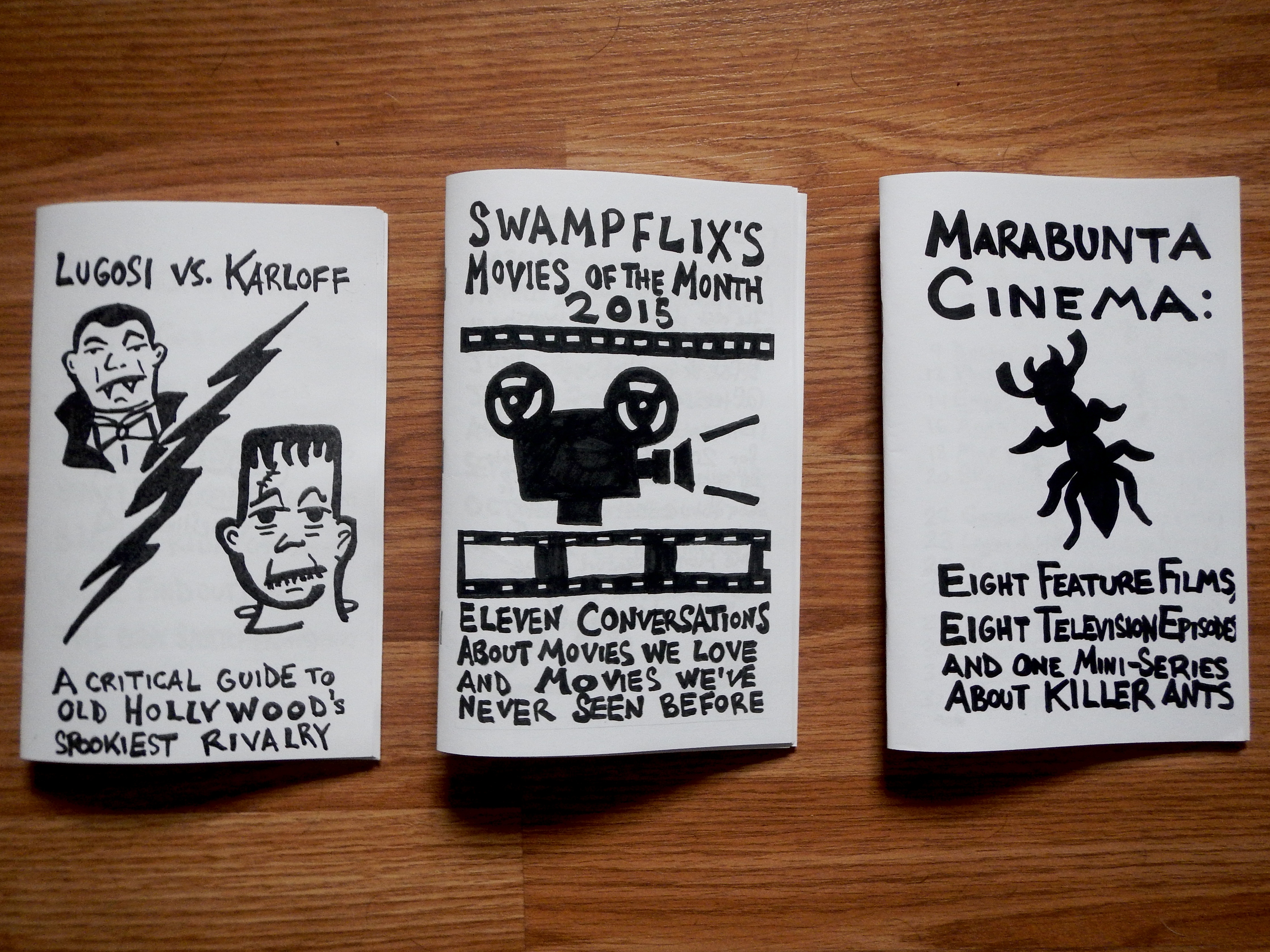
Attention, Swampflix readers in the New Orleans area! Swampflix will be exhibiting tomorrow (November 14th) at the second annual New Orleans Comics & Zines Festival along with a bunch of other super cool comics & zines exhibitors. We will be selling print versions of three Swampflix pieces (“Marabunta Cinema“, “Lugosi Vs. Karloff“, and a collection of our Movie of the Month conversations) from 11am-5pm at the Main Branch of the Orleans Public Library on Loyola Ave.

DSCN1455 (Modified (2))

DSCN1456 (Modified (2))

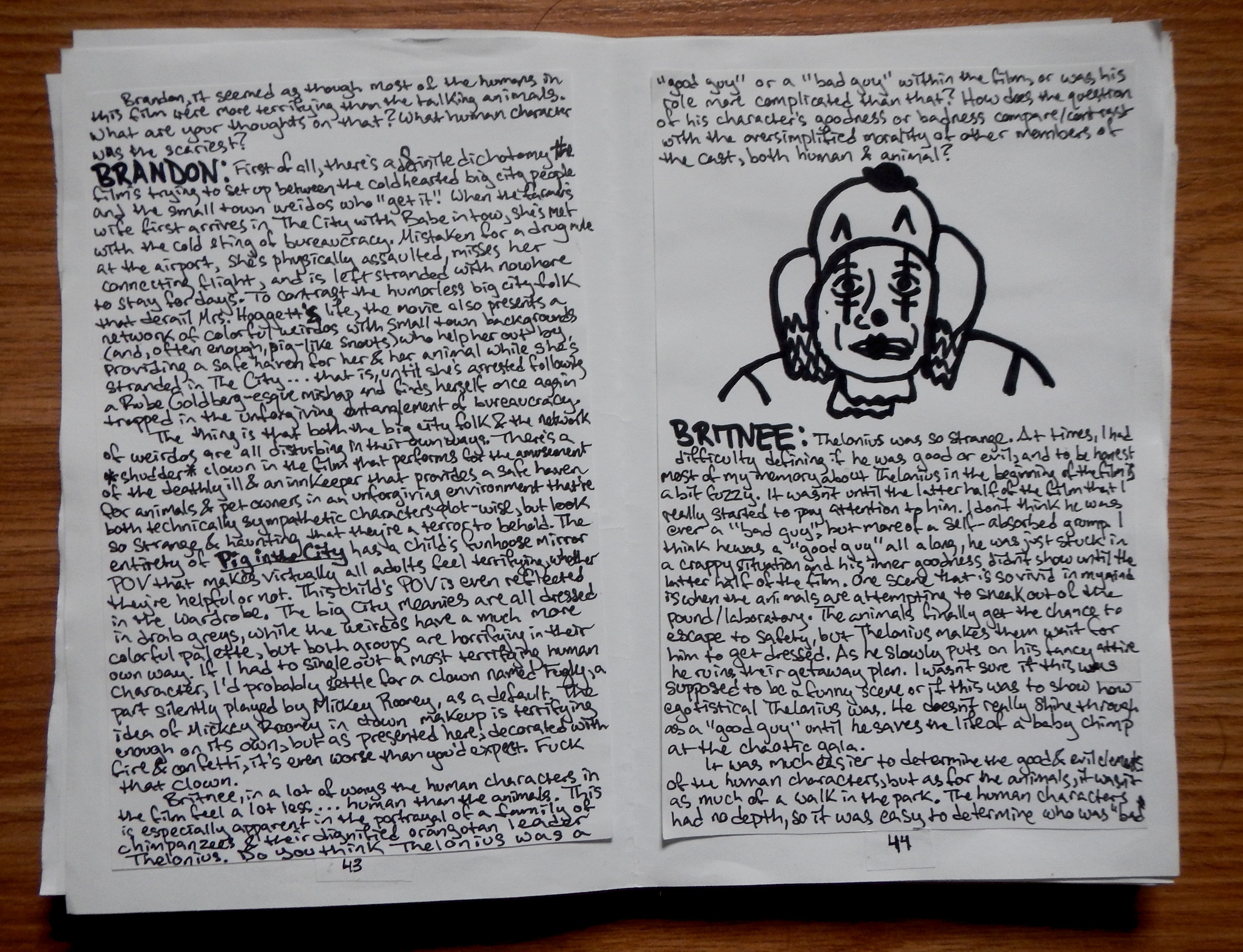
That middle piece is a ~90 page whopper featuring work from everyone who’s contributed to the site this year. All three feature dozens of new illustrations & hand-transcribed text from the site and, of course, all three will be dirt cheap.

For more info on the festival, check out their website at Nocazfest.com & refer to the poster below.

static1.squarespace.com

We hope to see y’all there!

-The Swampflix Crew

Lugosi Vs. Karloff: A Critical Guide to Old Hollywood’s Spookiest Rivalry

EPSON MFP image

Bela Lugosi & Boris Karloff were incredibly gifted actors from the Old Hollywood studio system era. They possessed a natural, unteachable screen presence that would literally haunt audiences well after they left the cinema, inspiring many a nightmare over the past century through mere body language & subtle vocal manipulation. Unfortunately, the pair’s natural knack for horror did them wonders in the Universal Pictures “famous monsters” series, but in the longterm left them pigeonholed in a genre that relies mostly on fads. It’s rare that an actor gets the opportunity to embody a role as iconic as Lugosi’s Count Dracula or Karloff’s turn as the Frankenstein monster, but perfectly nailing that type of character can unfortunately lead to decades of typecasting if you don’t play your cards right (or if you are contractually obligated to play whatever role your studio hands you). Lugosi & Karloff’s time as famous monsters left a huge mark on cinema & the public consciousness echoed years down the line in films as disparate as Tim Burton’s arguably perfect Ed Wood & weirdo, abstract art films like The Spirit of the Beehive. They also left the actors very little to stand on in terms of career growth.

Cursed to toil away in horror pictures of varying quality for the remainder of their careers after the decline of the famous monsters series, Lugosi & Karloff’s success & choice of projects largely depended on the ebb & flow of the horror genre’s profitability. When times were dire, the two often would have to fight over the scraps tossed their way, which lead to a not-so-secret professional rivalry between the actors. It surprised me, then, to recently discover that Lugosi & Karloff were frequently paired in unlikely collaborations, sharing screentime in no less than eight feature films. This rivalrous union lasted for a little over a decade, on & off again, as their personal tension grew increasingly malignant. The best thing about the Lugosi-Karloff collaborations is how the pair’s offscreen rivalry was echoed in the majority of their characters’ onscreen clashes in personality, adding a meta level of fascination to a handful of (sometimes impressive, mostly minor) horror pictures.

Here’s a complete list of the eight Lugosi-Karloff collaborations, each ranked & reviewed and arranged in chronological order. For a more complete/academic history of the spooky duo’s onscreen collaborations & offscreen clashes, you might want to track down the massive book Bela Lugosi & Boris Karloff: The Expanded History of a Haunting Collaboration by Gregory William Mank, which details the overlap in their careers in an extensive 700 page study. The piece you’re reading now is instead intended more as a quick & dirty critical guide to what Old Hollyood’s most haunting rivalry & most unlikely collaboration has to offer to audiences (both modern & otherwise) in terms of entertainment.

The Black Cat (1934)

fourhalfstar

“Suggested by the immortal Edgar Allan Poe classic” (to borrow the title card’s language) that inspired later adaptations by none other than Roger Corman in the Tales of Terror anthology film & Dario Argento in his segment of Two Evil Eyes, 1934’s The Black Cat is about as loose as a literary adaptation can get. The only element the film shares in common with Poe’s short story is the appearance of a black cat that is murdered in a fearful rage, then reappears unharmed. If you’re looking for a (slightly) more faithful cinematic adaptation of the story, I’d suggest looking to Corman’s Tales of Terror (which also features versions of Poe’s “Morella” & “The Facts in the Case of M. Valdemar”). 1934’s Unversial Pictures production of The Black Cat is fascinating not because it’s a loose, full-length adaptation of a Poe short story, but because it features the first collaboration between Lugosi & Karloff. It’s an alarmingly violent film that allows the two actors to stray from their usual typecast roles as Count Dracula & the Frankenstein monster, playing more recognizably human characters, however just as horrific.. Even though The Black Cat stands as the first collaboration of eight, it would eventually prove itself superior to all of the films to follow. No other Lugosi-Karloff collaboration could possibly match the delicious old school horror aesthetic achieved in The Black Cat. It’s an incredible work.

The Black Cat begins with a young couple meeting a recently imprisoned psychiatrist, Dr. Vitus Verdegast (Lugosi), while honeymooning in Hungary, In a scene typical to the film’s unnerving violence, the trio suddenly find their plans derailed in a gruesome bus crash. Lugosi’s Verdergast lays on the creep factor early, gently stroking the hair of the sleeping female passenger because she reminds him of his deceased wife. After the bus crash, he leads the unsuspecting couple to recover at the spooky mansion of his bitter rival, the mentally unhinged architect Hjalmar Poelzig (Karloff). As the situation gradually sours, it becomes apparent that Poelzig is, in fact, the true villain of the story. He traps Vendergast & the newlyweds in his (gorgeous Art Deco) home, planning to include them in an elaborate Satanic ceremony at an celestial event dubbed “The Dark of the Moon”. Karloff’s Poelzig is an intense dude. Among other strange traits, he’s known to brood in a darkened dungeon stocked with the bodies of deceased women he keeps pristinely preserved in glass cases, all the while stroking his titular black cat (who curiously appears alive in the film even after Lugosi’s Verdergast kills it in a frightened rage). When Poelzig’s plans of a Satanic ritual finally come to fruition (after being thoroughly researched in a book helpfully titled The Rites of Lucifer), he brings to a head a decades old rivalry he’s enjoyed with Verdergast, ending it once & for all in an alarmingly dark, violent display that threatens the lives of all four parties involved.

Although, as I said, Lugosi & Karloff are allowed to stray from their infamous roles as Dracula & the Frankenstein monster here, there are of course slight nods to those hallmarks of their careers in the film. Lugosi’s psychiatrist is for the most part a sympathetic, broken man, but before this gentleness is revealed his early actions towards his wife’s young dead ringer recall Dracula’s modes of hypnosis & seduction. Karloff’s architect also shows shades of the Frankenstein monster in his earliest scenes, especially when he’s introduced as a gigantic, lumbering silhouette. Otherwise, they’re spooky in a way that’s divorced almost entirely from the “famous monsters” they were asked to play time & time again. One of the best aspects of the film is watching Karloff & Lugosi trade ominous spooky phrasings back & forth, like “Death is in the air,” “We shall play a little game, a little game of death,” and – in response to the accusation “Sounds like a lot of supernatural baloney to me” – “Supernatural, perhaps. Baloney, perhaps not.” Both their onscreen & offscreen rivalries are intensely palpable throughout the film, even represented in the heavily-acknowledged metaphor of a longterm game of chess, delicious meta treat for fans.

Perhaps what’s so surprisingly enjoyable about The Black Cat is that it has a lot more to offer beyond the obvious pleasures of Lugosi & Karloff spookiness & rivalry. The Art Deco set design is not quite Metropolis-sized in its opulence, but it is still a sight to behold. The way the camera glides throughout its crisp, cramped corridors reminded me of the simple visual effectiveness of this year’s Ex Machina. This is not a half-assed horror film Universal Pictures slapped together on a quick shooting schedule. It’s an elaborate production that proved to be the studio’s biggest box office hit of 1934, one that was boldly violent & sacrilegious for its time. The Black Cat is a short, simple film with only a few moving parts to work with, but it still makes room for stabbings, car crashes, torture, shootings, a murdered pet, a robed Satanic ceremony, a gigantic special effects explosion, and one of the two main players being skinned alive (!!!!!). All of this mayhem is set to a constant old school horror soundtrack that gets deeply satisfying once it devolves into relentless onslaught of heavy organs. To wrap it up at The Black Cat‘s conclusion, a character reads a movie review in the newspaper about how a (fictional) director should stay away from horror as a genre & stick to things that could actually happen, perhaps allowing the film to preemptively scoff at potential critics. It’s hard to imagine critics either now or 80 years ago brushing The Black Cat off so easily, anyway. Considering the time of its release as well as the strength & rarity of its Lugosi & Karloff performances, the film is near perfect,. faithfulness to Poe be damned.

Gift of Gab (1934)

inaworld

twostar

Although it was pretty apparent from the get-go that The Black Cat would be the Lugosi & Karloff’s best & most significant work together, it was not so apparent that their very next picture would be of no significance at all. A vague comedy about a slick-talking radio announcer, Gift of Gab has the everything but the kitchen sink, vaudeville style of yuck-it-up humor of the Old Hollywood studio system on comedic autopilot. True to oldschool major studio comedy form, the film is more like a variety show than a work with any consistent tone or purpose. At various times it aims for romance, humor, death-defying action, intrigue, musical performances, and (the reason why I tuned in) a little bit of spookiness to boot, all with no attempts to connect with one another. In trying to be everything to everyone, Gift of Gab ended up being nothing to anyone at all, a trifle of no consequence.

Should I even bother you with the plot to this movie? I’ll at least try to keep it quick. A fast-talking snake oil salesman named Phillip “Gift of Gab” Gabney cons his way off the streets & into “the radio racket” as the successful host of a kind of variety show meant to promote a rich drunk’s failing brand of chicken livers. Gabney also cons his way into the heart of the radio station’s “working girl” program director. And somewhere in there we’re treated to an obnoxiously long sequence about sneaking radio equipment into a football game for a pirate broadcast. There’s also some antics involving someone parachuting out of an airplane. None of it matters. The film’s plot is mostly a vague pretense meant to provide a structure for the film’s musical performances & painfully stale vaudeville routines. My favorite synopsis of Gift of Gab is this concise, one-sentence take on IMDb: “Conceited radio announcer irritates everyone else at the station.” That about sums it up.

As for Bela Lugosi’s & Boris Karloff’s contribution to this forgotten “treasure”, the two horror giants are relegated to the roles of bit players in the film’s long list of on-air radio performers. In a four minute radio sketch (which is for some reason staged like a play), Lugosi & Karloff appear as threatening, ghoulish rogues in a goofy short-form murder mystery. Lugosi’s entire contribution in this scene is to appear from behind a closet door, hold a gun, and ask “What time is it?” (which I’m sure played great on the radio) and Karloff tops him merely by having two lines, taking time to light a cigarette, and laughing maniacally upon his exit. There are some cute touches to the sketch, especially in the way that murderous, knife-wielding arms appear from offscreen (again, on the radio) to threaten the goofball detectives who can’t quite solve the murder, despite Karloff announcing himself as The Phantom & donning a Jack the Ripper-like costume of a cape & a top hat. The whole thing more or less amounts to one of those Saturday Night Live sketches where a politician pops in for a quick cameo as themselves to get a cheap pop from the audience.

The story goes that The Three Stooges were originally scheduled to appear in Gift of Gab & I assume that they were going to play the bonehead detectives in this scene, a sort of a short-form precursor to Abbott & Costello Meet Frankenstein.  Alas, that didn’t happen and what’s left isn’t much to speak of. If you’re morbidly curious about watching Karloff & Lugosi appear in a brief bout of broad comedy, do yourself a favor & skip the other 66 minutes of Gift of Gab. Instead, just watch the most easily accessible, low-quality YouTube clip of their contribution to the shoddy variety show comedy. It’s for time savers like these that YouTube was launched in the first place.

The Raven (1935)

EPSON MFP image

fourstar

Although it’s difficult to imagine a more perfect collaboration between between spooky superstars Bela Lugosi & Boris Karloff than their first film together, The Black Cat, their next tribute to the work of Edgar Allan Poe at least comes close to matching it. After making a brief appearance in the vaudevillian trifle of a romantic comedy Gift of Gab, Lugosi & Karloff returned to what they do best: being generally creepy & making meta references to their offscreen professional rivalry. The Raven doesn’t alter much of the pair’s The Black Cat dynamic. They merely switch roles as victim & villain, this time with Lugosi taking the reins as the film’s murderous creep with a spooky mansion & Karloff talking a backseat as the bitter, broken prey. Otherwise, it’s essentially just more of the same. When then “the same” is as great of a benchmark as The Black Cat, though, that’s not exactly a problem.

Much like with The Black Cat, The Raven starts with a car crash that leaves a young woman in Lugosi’s medical care. This time Lugosi plays a surgeon, Dr. Richard Vollin, instead of a psychiatrist, but the dynamic is still remarkably similar. In The Black Cat, Lugosi’s doctor falls for his patient because of her resemblance to his deceased wife. In The Raven, he falls for his patient because she portrays the (deceased wife) character Lenore in a staged performance of Poe’s “The Raven” (an especially beautiful one that looks like a sequined masquerade). Vollin is a Poe collector & enthusiast to an obsessive degree, something he calls “more than a hobby”, so the possibility of seducing a real life Lenore is too tempting to pass up. He lures his faux Lenore, along with her father & her beau, to his spooky mansion as part of a plan to not only live out the tragic love story of Poe’s “The Raven”, but also the torture chamber antics of the Poe story “The Pit & The Pendulum.” To help him with this dastardly plan, Vollin volunteers to perform plastic surgery on an escaped convict (played by Boris Karloff, of course) only to physically maim the poor lout & turn him into a monster. Lugosi intones to Karloff, “Monstrous ugliness brings monstrous hate. Good! I could use your hate,” and essentially turns the mangled convict into his own personal Igor (perhaps as a nod to Karloff’s long history of playing Frankenstein’s monster).

Although Karloff receives top billing for The Raven, something he was also awarded in The Black Cat, this is unmistakably Bela Lugosi’s show. Watching the horror legend recite Poe’s “The Raven” in front of an exaggerated raven’s shadow, don surgical gear to apply a knockout gas to the camera lens, gleefully give tours of his torture chamber, and recite lines like “Death is my talisman, Mr Chapman. The one indestructible force, the one certain thing in an uncertain universe. Death!” are all priceless moments for oldschool horror fans. I like to think that Vincent Price was a fan of this specific Lugosi performance & modeled his own effete murderers in Roger Corman’s Poe productions, particularly in The Pit & The Pendulum and The Masque of the Red Death, after the horror icon.

As for the film itself, it didn’t do so well financially & seemed to ruffle a few feathers with its playfully morbid atmosphere, despite it being very much toned down from what was delivered in The Black Cat. This reception reportedly lead to a temporary ban on the horror genre in England & just a general slump in production of major studio horror films for a long time to come, much to the detriment of Lugosi’s & Karloff’s careers. This shift in attitude is even detectable in the film’s press kit which asks, “Was Edgar Allan Poe a mental derelict?” and goes on to suggest that Poe’s characters were “but a reflection of himself.” It’s a shame that the film mostly fell flat with audiences, since another success like The Black Cat could’ve lead to more work for Lugosi & Karloff where they didn’t have to play Count Dracula & the Frankenstein monster every damn film. The Raven is a pretty great alternative to that overwhelming portion of their work, one that continues the meta-rivalry of the chess game in The Black Cat in yet another great, loose tribute to Poe. I’d say that even though Karloff had the upper hand this round in receiving top billing, it was Lugosi who scored the victory. He’s just so much fun to watch here & all of the movie’s best moments are dependent upon his performance.

The Invisible Ray (1936)

EPSON MFP image

three star

One great thing about these Lugos-Karloff collaborations was, of course, that they allowed two actors to stray from their legendary roles as the Frankenstein monster & Count Dracula. Unfortunately for Lugosi, the 1936 picture The Invisible Ray only allowed him to stray as far as the role of a mad scientist, something he had played almost as often as he portrayed the world’s most famous vampire. Fortunately for the audience, the film made enough room for two mad scientists, so Karloff & Lugosi could continue living their offscreen professional rivalry in meta, fictional contests. Karloff always gets top billing in these pictures, which I’m sure drove Lugosi mad, but in their first few movies together they typically traded the narrative spotlight back & forth. In The Black Cat they shared it. In The Raven Lugosi stole the show. In The Invisible Ray Karloff actually earns his top billing, playing the more interesting, omnipresent mad scientist of the pair.

The best The Invisible Ray has to offer is in the spooky mad scientist sci-fi horror in the the two segments that bookend the duller half of the film. The promise of this antiquated sci-fi horror glory is apparent as soon as the film’s “Forward”: “Every science fact accepted today once burned as a fantastic fire in the mind of someone called mad. Who are we on this youngest of planets to say that the INVISIBLE RAY is impossible to science? That which you are now to see is a theory whispered in the cloisters of science. Tomorrow these theories may startle the universe as a fact.” So what “science fact” are we to look forward to in the future? Apparently an alien element known as Radium X, delivered to Earth via a “few thousand millions of years” old asteroid crash has been discovered by Karloff’s maddest-of-all scientist. Karloff has a million & ten different uses for Radium X that range from curing blindness to the creation of a sort of death ray. Too bad exposure to the element causes his skin to glow in the dark & the gentlest of his touches to kill on contact. Lugosi’s less-mad scientist wants to use Radium X to help prove his vague theories about how “the Sun is the mother of us all,” and although the two men work together on the element’s discovery & procurement, they disagree on its practical applications, something that gives Lugosi’s dissenter the moral high ground once Karloff’s touch becomes luminous & deadly. Again, this conflict reflects their real life professional rivalry, seeing how they both had a distaste for one another, but worked on eight feature films together anyway.

I’ve skipped over a lot of the film’s second act shenanigans, which involve a lengthy expedition to Africa in the quest to harvest Radium X from the asteroid crash site. This being a 1930’s film, there’s a lot of unseemly representation of black characters in these scenes as subservient, easily frightened native tribesmen, but if nothing else this is the first instance I’ve seen of a non-white character having a speaking role in any Karloff-Lugosi collaboration to that poing. There’s also some thought given to how women’s contributions to the scientific community, represented here in Karloff’s much-suffering wife & mother, are often attributed to men. Of course, these instances of non-white, non-male representation are a little thin & undercooked. At best, it’s a modest start & not much more.

As I said before, the best The Invisible Ray has to offer is in its mad scientist spookiness. Early scenes featuring a Frankenstein-esque castle being repurposed as a planetarium provide some great, oldschool outer space weirdness, which combined with Karloff’s transformation into The Very Visible Man supplies The Invisible Ray with its most memorable elements. Karloff is particularly captivating in the film, whether he’s donning a stunning welding mask & cape combo (complete with rubber gloves), glowing like a nightlight, or dispensing of his enemies with the simple act of a genteel handshake. By comparison, Lugosi’s presence is far more understated, distinguished only by a goatee that makes him look like a mid-90s alt bro. The Invisible Ray was far from the pair’s best collaboration (that would be The Black Cat), but it’s also far from their nadir. In short, it’ll do.

Son of Frankenstein (1939)

EPSON MFP image

twohalfstar

Both the break from Lugosi & Karloff’s famous monsters work & the peculiarity of the duo’s ongoing, onscreen meta-rivalry are unfortunately missing from Son of Frankenstein. The final film in Karloff’s trilogy of Universal Pictures Frankenstein productions, Son of Frankenstein is a dreary, by-the-numbers affair. The first Frankenstein film had a strange, otherworldly magic to it already dubbed on this site The Spirit of The Spirit of the Beehive. Its followup, The Bride of Frankenstein, is remarkable for its prowess as an early example of the horror comedy. The third film has, what, Bela Lugosi’s first performance as Igor? A replacement Dr. Frankenstin Jr. with a John Waters mustache? The first appearance of the Frankenstein monster’s fur vest? These might be interesting images in isolation, but they hardly amount to justification for a 100 minute feature, by far the lengthiest of the Lugosi-Karloff collaborations.

This spirit of creative bankruptcy is apparent in Son of Frankenstein as soon as Franken-junior is introduced with the line, “This one’s probably just as bad as his father!” Franken-junior also laments early on that people often get his father mixed up with his monstrous creation, upset that his family name is synonymous with horror & monsters. That pretty much sums up the entirety of the film’s interesting dialogue. Franken-junior is, of course, met with a cold reception when he moves into his deceased mad scientist father’s spooky castle and, of course, becomes obsessed with recreating Franken-senior’s work. Through a little bit of revisionist cheating, it’s revealed that the Frankenstein monster (played by Karloff, of course) & Igor (played by Bela Lugosi, as mentioned), are still for the most part physically intact, despite certainly being destroyed in the earlier films. Somewhere along the way Franken-junior’s little moppet offspring, Franken-junior Jr., “adorably” gives his dad away to the cops in a high-pitched squeak that pretty much made me want to watch the little bastard drown in a fire. That’s the most I felt of the film’s conflict. The only element of interest, really, is that Karloff’s monster & Lugosi’s Igor are good buddies, forming a sweet sort of symbiotic relationship in a world that wasn’t made for them, to say the least.

Although Karloff’s reign as the top-billed performer continues here & you’d think that Lugosi’s secondary role as Igor would push him to the side,  Son of Frankenstein actually stands as a victory for Lugosi in terms of the actors’ longterm struggle to hog the spotlight. It’s not the best of their joint efforts, but at least Lugosi got more lines? He’s oddly captivating as Igor, especially in his Wolfman-like make-up (why did Lugosi never play the Wolfman?!) complete with a broken neck from a past lynching, while Karloff is remarkably dull as the monster he’s played so well in the past. In a completely non-verbal performance, his sole moment of interest is a scene in which he smashes Franken-junior’s very sciency science lab in a blind rage, an image that’s begging for an “open up this pit” meme. The rest of the film is just Karloff going through the motions while Lugosi tries to make the most of his role as a hairy, deformed Igor.

Son of Frankenstein arrived in the midst of a career slump for both Lugosi & Karloff. The decline of monster films that followed The Raven had limited the amount of roles the spooky duo were offered, but a successful double bill re-release of the original Dracula & Frankenstein films renewed interest in the Universal Pictures “famous monsters” brand, which lead to Son of Frankenstein‘s production. Although the film was a financial success for the studio, it’s a creatively weak endeavor at best, amounting to not much more than a collection of “what if?”s. What if, as originally planned, horror icon Peter Lorre had played the role of Franken-junior? What if Bela Lugosi had played the Wolfman instead of Igor & battled Karloff’s monster in a continuation of their meta rivalry? What if Franken-Junior Jr died a slow, agonizing death in a fire, putting an end to his annoying little squeaks forever? Alas, nothing so satisfying is delivered in Son of Frankenstein. That didn’t stop the studio, however, from returning to the well at least one more time in Ghost of Frankenstein. Karloff smartly declined to reprise his role for that trifle, obviously growing tired of the limitations of his most famous character. Unfortunately, Lugosi’s escape from the franchise was not so easy, as he returned as Igor in the Lon Cheney film. Poor Bela.

Black Friday (1940)

EPSON MFP image

twostar

After the last gasp for air in Universal Pictures’ famous monsters brand in the creatively bankrupt Son of Frankenstein, there wasn’t much work to go around for actors Boris Karloff & Bela Lugosi. The drought that followed for the eternally typecast horror movie heavyweights is perhaps what turned up the heat on their professional rivalry & turned their next collaboration, 1940’s Black Friday, into such a disastrous bore. A bland gangster film with only the slightest hints of horror or sci-fi in its formula, Black Friday is a shameful what-could’ve-been experience, one made dull by Lugosi & Karloff’s refusal to play nice & share the scraps that Hollywood had left for them to fight over.

In Black Friday, Boris Karloff plays a brilliant neurosurgeon who saves his close friend’s life by replacing his brain with that of an infamous mobster. Once a meek college professor, Karloff’s buddy starts to show personality traits of the gangster his surgeon-savior-friend effectively murdered to extend his life. The split-personality professor now has the hots for the deceased gangster’s showgirl girlfriend, drinks & smokes with the same mannerisms, threatens violence in a way far outside his normal character, and (much to Karloff’s surgeon’s piqued interest) talks of a hidden fortune stashed before his death. Rival gangsters & the showgirl dame rush to uncover the fortune before the surgeon can beat them to it, while he’s not fighting off suspicion about what happened to his once genteel friend. It’s even less exciting to watch this all unfold than it sounds, exhausting even for a feature barely more than an hour in length.

If you’re asking where Bela Lugosi fits into all of this, you’re not alone. The original script cast Lugosi as the troubled neurosurgeon & Karloff as the split personality professor-gangster. That formula might’ve actually been interesting. Alas, Karloff insisted on playing the surgeon & instead of taking the role of the professor-gangster Karloff had left vacant, Lugosi was relegated to the much smaller part of a rival gangster. Perhaps the reason they didn’t switch roles outright was that playing the rival gangster allowed Lugosi to avoid ever filming a scene with Karlof? It also allowed him to continue their onscreen meta rivalry that dated all the way back to the actors’ first collaboration, The Black Cat. As a result, although Lugosi is second billed he only has a bit role in the film and does not appear in a single scene with his rival.

There are only a few isolated moments of interest in Black Friday. The film’s opening credits play over a calendar reading Friday the 13th & are followed by an intense death row march that promises a much more horrific vibe than what follows. The film’s sole moments of outright horror are a brutal car crash stunt & an onscreen brain surgery, both motifs echoed from earlier Karloff-Lugosi collabs The Black Cat & The Raven. Watching Lugosi play gangster & Karloff don surgical gear are fantastic images, but aren’t put to much use. The only line of dialogue that really stuck with me was when Karloff’s daughter pesters him about his professor friend’s sudden change in personality & he snaps, “Haven’t you guessed?! The operation I performed was a brain transplantation,” as if that were the most obvious explanation for the change. The rest of Black Friday is a forgettable slog made hopelessly dull by two great actors who were visibly tired of working with each other on occasional projects & fighting over the scraps of the rest.

You’ll Find Out (1940)

EPSON MFP image

three star

I was pretty harsh on the concept of the ensemble cast radio play comedy as it was presented in The Gift of Gab, the single Bela Lugosi/Boris Karloff collaboration that brought me absolutely no joy. Perhaps it was the fact that Lugosi & Karloff were only two of thirty featured Universal Pictures stars fleshing out the vaudevillian vignettes meant to support the Phillip “Gift of Gab” Gabney vehicle. Perhaps I was just too high coming off the glorious heights of the pair’s first & best collaboration, 1934’s The Black Cat, and Gift of Gab was a letdown of a follow-up. Maybe it’s just a terrible movie. Either way, after less awe-inspiring titles like Son of Frankenstein & Black Friday, another Lugosi-Karloff ensemble comedy doesn’t play nearly as disappointingly. You’ll Find Out is far from the most exciting project Karloff & Lugosi worked on together, but since it came from a time after the decline in popularity of Universal’s famous monsters brand that made their careers, it’s about all you can ask for in terms of Karloff-Lugosi content. You’ll Find Out exceeds Gift of Gab both in quality & quantity; what was essentially minuscule cameos in Gab are fleshed out into featured parts as antagonists here. They also threw in a role for Peter Lorre, making this the only instance that he & Lugosi appeared together onscreen despite their shared Hungarian origins & similar career paths. A nice piece of lagniappe, that.

Unfortunately, You’ll Find Out isn’t exactly a Karloff-Lugosi vehicle like The Black Cat or The Raven. Instead, the film was meant to capitalize on the popularity of real-life radio personality Kay Kyser. Kyser was famous for hosting a music quiz called Kay Kyser’s Kollege of Musical Knowledge (oh God, don’t focus on the first three letters of that acronym). On the program, Kyser, often dubbed “The Ol’ Professor” & dressed in a scholar’s cap & gown, asked live audience members for bits of musical trivia and followed up their answers with obnoxious, “humorous” questions like “What’s the difference between a weasel, a measel, and an easel?” (in tandem with a rendition of “Pop Goes the Weasel, of course), much to the delight of an easily-pleased public. Har har. As this was during the height of big band music’s peak popularity, Kyser & his live orchestra rode the success of the craze for all it was worth, including just as many feature films that Lugosi had managed to film together in their unlikely, rivalrous collaboration – eight.

Kyser & his wacky crew are a little shrill & old-fashioned in the outdated comedy shenanigans that threaten to sink You’ll Find Out. If it weren’t for Lorre, Karloff, and Lugosi, the film would be a total wash. In a flimsy plot involving the Kyser clan entertaining an heiress during a part she’s throwing at a spooky castle (“What a beautiful spot for a murder!”) the band ends up saving her life from three oldschool horror creeps (guess who) conspiring to take hold of her inheritance. Karloff plays a seemingly congenial judge & friend of the family who pretends, poorly, that he has the heiress’ best interests in mind, despite being an obvious creep. Lugosi has the much more entertaining role of a turban-wearing mystic named Prince Saliano. Saliano insists that he communicates with the dead & that “The spirits are strongly displeased with the skeptical,” a sentiment that gives him free reign to torture the party guests. Lorre, for his part, plays a supposed “psychic expert”, brought in by Karloff’s corrupt judge to “expose” Saliano as a phoney to the unsuspecting heiress. Lorre is obviously not who he says he is & the three creeps are obviously in creepy cahoots.

The best moments of You’ll Find Out are the mere pleasure of seeing Karloff, Lorre, and Lugosi share a single frame. This happens exactly twice in the film: once when they’re quietly conspiring in a study & again at the climax when they’re holding the entire party hostage at gunpoint. In that second instance, Karloff & Lorre are brandishing pistols while Lugosi, again establishing himself as the ultimate horror movie badass, is sporting a fistful of dynamite. Although Lorre & Karloff are billed before Lugosi, Lugosi delivers what is by far the most interesting performance of the trio. As the same fate also befell him in The Raven, Son of Frankenstein and, arguably, even The Black Cat (although that last one is easily the most well-balanced of his Karloff collaborations in terms of sharing the spotlight), that distinction seemed to be his curse. Not only does Lugosi’s Prince Saliano get his own secret dungeon packed with high-tech gadgetry in You’ll Find Out; he also gets to put all the gadgets to use in the film’s centerpiece – an over-the-top séance in which he plays with Tesla coils, shows the heiress a vision of her dead father, and tries to kill her with a falling chandelier. During this séance, Lugosi delivers the film’s best line: “Presently I shall assume a state of trance in which the outer mind merges with the astral portion of the human ego. The Spirit of Evil is trying to enter this room, but the Fires of Death will guard us.” There’s also a great moment in the climactic scuffle where all of his séance equipment goes off at once, making the mansion look like an automated haunted house on the fritz.

You’d be forgiven for believing that You’ll Find Out is a trfile of an antiquated studio comedy. It most certainly is, especially in early scenes that focus on Kay Kyser’s hokey big band shenanigans. Any oldschool horror fan with a little bit of patience will have plenty of fun with the Lorre-Karloff-Lugosi trio’s dastardly villainy, though. It’s true that Lugosi steals the show in You’ll Find Out (doesn’t he always?), but the image of the three horror greats working together is the rarest of treats, something well worth putting up with a failed vaudeville gag or two depending on how much you love Peter Lorre, Boris Karloff, and -the most loveable of them all- Bela Lugosi.

The Body Snatcher (1945)

EPSON MFP image

fourstar

Thankfully, Lugosi & Karloff’s eighth & final collaboration was somewhat of a return to form after a drought in proper horror films that lead the duo to costarring in less-than-exciting fare like the gangster brain-swap picture Black Friday & the radio play comedy You’ll Find Out. The Body Snatcher was the first of the spooky duo’s films together to aim for a true horror aesthetic since their earliest collaborations The Black Cat & The Raven. Although it would sadly be Lugosi & Karloff’s final joint effort, it would also prove to be one of their best.

In the film, Karloff plays Captain Gray, a boisterous grave robber who sells stolen corpses to a medical facility for a small profit. Decked out in Jack the Ripper garb very similar to his costume in Gift of Gab, Karloff is deliciously cruel in his role as the titular body snatcher. He’s particularly heartless in the way he embarrasses the doctor who serves as his reluctant business partner, throwing his weight around & parading his dealings with the well-respected man of medicine in a way that recalls Michael Gambon’s performance in The Cook, the Thief, His Wife & Her Lover. Gray even blackmails the doctor into performing an experimental spinal surgery on a paralysed little girl simply because he can, creating an immediate need for fresh subjects that drives Gray to cold-blooded murder. All this is told from the perspective of a young medical student eager to learn “the poetry of medicine.” Instead, his mentor teaches him that “a real man & a good doctor” deals in grave robbing & murder in the name of medical research.

Directed by Robert White (who later helmed the classics The Day the Earth Stood Still, West Side Story, Star Trek: The Movie, and Sound of Music, among others), The Body Snatcher has a distinctly well crafted look to it, particularly in the production design of its external settings. Especially spooky is a sort of one-woman Greek chorus, the angelic singing of a street performer who haunts dark alleys in hopes of spare change. When her voice is suddenly silenced the effect is deeply chilling. Gray’s evil lair where he conducts his grave-robbing business & strokes a cat like Dr. Claw in Inspector Gadget (or like Karloff’s former role in The Black Cat, come to think of it) is a beautifully uncomfortable vision of squalor. White brings a quality of production & a cinematic eye to The Body Snatcher that had largely been missing from Karloff & Lugosi’s collaborations since The Black Cat more than a decade before.

As for Lugosi’s contribution to The Body Snatcher, he’s once again relegated to playing Karloff’s second fiddle, but he’s at least afforded a featured part in one of the film’s most memorable scenes. After eavesdropping on the doctor & discovering the exact nature of his partnership with Gray, Lugosi’s lowly assistant foolishly confronts Gray alone & unarmed in the graverobber’s home. He says, “I know you kill people to sell bodies. Give me money or I tell police you murder the subjects,” in a line that has to consist of at least half of Lugosi’s total dialogue in the film. Gray pays the assistant the requested blackmail money, but then gets him drunk & murders him with his bare hands. As far as the ongoing, onscreen meta rivalry between Lugos & Karloff’s characters over the years goes, this display of violence easily ranks among the most brutal & extensive, topped only by Lugosi skinning Karloff alive at the climax of The Black Cat. The Black Cat may surpass the quality & novelty of The Body Snatcher in a few ways, but that’s unfair ideal for a film to have to live up to. The Body Snatcher is surely one of the best of Karloff & Lugosi’s collaborations and a fitting note for the pair to end their work together on. The film’s promotional material promises The Body Snatcher to be, “The screen’s last word in shock sensation!” which might not be true for cinema at large, but is at least literally true in the context of Lugosi & Karloff’s appearances together on film. It was the final word.

-Brandon Ledet

Marabunta Cinema: Eight Feature Films, Seven Television Episodes, and a Mini-Series about Killer Ants (3rd Ed.)

EPSON MFP image

When I first reviewed the 1974 oddity Phase IV, I noted that the film was very different from what I would have expected from a sci-fi movie about killer ants. When I pictured the film in my mind I imagined the gigantic monster insect movies from the 1950s, when everything from leeches to adorable bunny rabbits were blown out of proportion by atomic radiation and turned into Godzilla-type suburban threats. Phase IV turned out to be a much stranger film than I pictured, but my hunch wasn’t far off. The 1954 creature feature Them! is widely credited as the very first of the 1950s nuclear monster movies as well as the first “big bug” movie ever. Them!, like Phase IV, also happens to be about murderous ants. It turns out that the tiny pests have served as an endless source of cinematic fascination over the past 60 years, racking up eight feature films and several television episodes since Them!’s initial release. There are definite patterns & tropes common to the way killer ants, often called “marabunta,” are portrayed in cinema, but the quality of the tactics & results vary greatly from film to film. Them! & Phase IV certainly represent the apex of the killer ants genre, but they don’t capture the full extent of its capabilities.

Them! (1954) EPSON MFP imagefourhalfstar

If Them! is the very first nuclear monster & big bug movie of the 1950s, it was an impressively prescient one. So many of the films that followed borrow so much from its essential elements that it basically serves as a Rosetta Stone for the marabunta genre. For instance, the film opens with a child in danger. A young girl, newly orphaned, roams the desert alone, in a state of shock after witnessing her family being murdered by “Them! Them! Them!” (a titular line she shrieks in horror when prodded for details). Children in peril is a surprisingly common theme for a lot of the marabunta films to come, along with the desert setting, and their roots are established in Them!’s opening minutes. Other tropes, like attempting to destroy the hive by attacking the Queen’s chamber, the use of nature footage as a scientific lecture on ant behavior, the ants’ high-pitch squeaks, and the blaming of pollution (in this case nuclear fallout) as the cause of the ants’ size & maliciousness would be frequently echoed in the 60 years that followed. What was most prescient of all, however, was just the basic concept: killer ants. No killer bug movies (as we know them) preceded it, but plenty followed and Them! is truly the pioneer of them all.

When I first imagined what Phase IV might be like, I was actually imagining Them! I pictured late night, black & white schlock (in the same vein as The Brainiac or Frankestein Meets the Space Monster) about giant killer bugs with a flimsy atomic age metaphor attempting to justify its true purpose: giant ant models, hairy like gorillas & eager to kill. When a scientist opines in the final scene, “When Man entered the Atomic Age, he opened the door to a new world. What we may eventually find in that new world, nobody can predict,” it feels more like an afterthought than anything else. The gigantic ant models were obviously a point of focus for the filmmakers and it paid off well. They look fantastic, never to truly be topped by the killer ant films that followed. It’s also a testament to Them!’s quality that the tension-building atmosphere in its first act is still strikingly effective despite modern audiences knowing what the “they” in Them! are long before they grace the screen. Them! may be the standard execution of what a killer ants movie would look like, but it’s extremely well crafted for its pedigree and deserves to be respected as a pioneer in the natural horror genre at large, much less marabunta cinema.

Ant size: “They” are gigantic.
Fire delivery method: In almost all of the marabunta movies, the ants are attacked with fire through various methods. This practice, like many other tropes mentioned, can be traced back even to the original marabunta movie, Them! In Them!, fire is initially delivered to the giant ants through bullets & rocket launchers, but it’s the use of flame throwers that ultimately save the day, as will become a popular choice as the genre marches on.

The Naked Jungle (1954) EPSON MFP imagethree star

If Them! is the Rosetta Stone of marabunta cinema, The Naked Jungle is its furthest outlier, the most difficult film to read in the context of the genre. Released the same year as Them!, The Naked Jungle refuses to play along with its killer ants compatriots even in the most basic terms of genre. Instead of working within a horror context, The Naked Jungle is an old-fashioned big studio romance epic where the killer ants are a natural disaster not very distinct from a flood or a landslide. The movie is mostly a vehicle for (a mostly shirtless) Charlton Heston & (a similarly undressed) Elanor Parker, who star as a South American cocoa plantation owner and his mail order bride (shipped to him via New Orleans!) whose personalities are too big & too stubborn to mix cohesively. Their initial hatred of one another is palpable in quips like “I’m trying not to irritate you.” “I noticed that. I find it irritating,” and in a key exchange when Heston is upset that his new bride is a widow instead of the virgin he requested. She retorts “If you knew more about music, you’d know that a piano is better when it’s played.” This dynamic, of course, gradually shifts from hostile to sensual and the sweaty (it is South America, after all) tension between the two drives a lot of the movie’s runtime.

Then, in the last third of the film, the ants arrive. Millions of ants. Not the gigantic, atomic ants of Them!, but rather a hoard of regular army ants, marabunta. They’re described in the film as “40 square miles of agonizing death” that operates as an organized, trained army. The initial horror of the ants picking a skeleton clean is a bit goofy & melodramatic, but once you get to the real shots of real insects crawling all over actors’ very real skin, it actually gets pretty disturbing. Some of the painted backdrops & dialogue in The Naked Jungle are unfortunate. Its depictions of native savages that depend on Heston’s white man knowledge to survive are especially disappointing. However, it’s a mostly enjoyable movie that, thanks to Heston & Parker’s love/hate dynamic, feels like a Tennessee Williams play drowning in marabunta, which distinguishes it from every other film in the genre.

Ant size: Regular.
Fire delivery method: There’s some torch tossing & explosives use, but the fire that matters the most in The Naked Jungle is the fire burning in the two leads’ loins.

Outer Limits: “The Zanti Misfits” (1963)

EPSON MFP imagethreehalfstar

As if murderous insects made gigantic by nuclear fallout weren’t strange enough, this is where the marabunta genre takes a bizarre left turn. In its inaugural season of television, The Outer Limits tried to prove itself to be more than just a hard-sci-fi answer to the much looser The Twilight Zone. Its hour long episodes often had enough big ideas & practical effects to support a decent feature-length B-picture if they had just been stretched a little further. The episode “The Zanti Misfits” certainly had potential to support a longer runtime based on the scope of its ideas alone. At the very least, it came up with a creative reason as to why its killer ants would be so murderous & destructive in the first place. No other marabunta picture I’ve seen put nearly as much thought as to the ants’ motivation for killing.

Well, “ant” is a little bit of a misnomer in this case. As the story goes, a superior extraterrestrial race named The Zanti demands that Earth host a penal colony for its most undesirable criminal population, in other words, its misfits. The Zanti are very much ant-like in their appearance, but with the enlarged size of an average rodent & the horrifying detail of their humanoid faces. Most of the Zanti population are supposedly a peaceful group, but what arrives on Earth is their criminal throwaways, so, of course, chaos ensues as they attempt a prison break & the U.S. military guns them down. Discontent to merely thank Eathlings for doing them a favor, Zanti officials instead gloat that they’re far superior to our bloodthirsty nature as “practiced executioners” and any gratitude that could be detected is severely muddled. With its stop-motion animated humanoid ants, hand-made UFO models, and oldschool sci-fi moralizing, “The Zanti Misfits” is a neat little addition to the marabunta genre, as well as one of its strangest concoctions.

Ant size: About the size of a rat.
Fire delivery method: Liberally tossed hand grenades.

Doctor Who: “The Web Planet” (1965)

EPSON MFP image

twostar

Two years after Outer Limits introduced the world to the ant-like Zanti, BBC’s Doctor Who decided it’d be nifty to see what life on the Zanti’s home planet might be like. It’s not fair to say that “The Web Planet” is a direct knockoff of “The Zanti Misfits”, but it’s highly likely that it was at least somewhat inspired by the episode. The basic idea of an ant-like species from an alien planet is there, at least, and its’ far too easy to draw comparisons between the names “Zanti” & “Zarbi” (at least the Outer Limits one had the word “ant” in its name). The premises, while far from identical, do share the idea of a far away planet at war with itself using humans to resolve their internal conflicts. To be fair, the differences between the two episodes are also readily recognizable. Not only does the Doctor Who series actually travel to the ant planet, but the ant-liens in “The Zanti Misfits” are only slightly larger than Earth ants (not to mention their grotesque, human-like faces), while the ant-liens in “The Web Planet” are slightly larger than humans. In fact, they’re roughly the size of a hunched-over human actor wearing a large, ant-like costume, their human actor legs fully visible to the camera.

Part of the reason I’m talking about “The Web Planet” strictly through comparison is that when considered by itself, the mini-series is a total bore. Told through six half-hour episodes, “The Web Planet” (and presumably the 1960s incarnation of Doctor Who as a whole) feels like a hangover from the era of the radio play, its televised format going almost entirely to waste. In the mini-series, Dr. Who & his dedicated crew attempt to negotiate a truce between two warring species of insectoid aliens– the anti-like Zarbi (duh) & some kind of humanoid moth/bumblebee hybrid. The Zarbi are convinced that the Who Crew are scouts for a soon-to-arrive Earthling invasion, which complicates the negotiations. To resolve the issue, Dr. Who sidesteps the conflict altogether & finds the answer to the situation in some kind of gigantic spider thing. Look, the specifics don’t matter. The whole thing is amateurish & over-long. The few delights to be found in “The Web Planet” are restricted to its half-assed missteps: an “alien planet” set that could’ve been lifted from a well-funded highschool play; ditto the ant-lien costumes that restrict the actors’ costumes view so much that one bumps into a cameraman, annoying squeaks of communication between the Zarbi that sounds like a child’s toy raygun, etc. Otherwise, the three hour “The Web Planet” can o only offer a neat-o, oldschool Doctor Who theme song & an expansion of what was already delivered in “The Zanti Misfits”.

Ant-size: Roughly the size of an actor, hunched over & wearing a giant ant costume.

Fire delivery method: None! Justice is delivered here through negotiations & thinking on one’s feet, which isn’t nearly as exciting as a grenade or a flamethrower, all things considered.

Phase IV (1974)EPSON MFP imagefourstar

I’ve already dropped almost 700 words on Phase IV, so I’ll try to keep it brief here. It’s almost as much of an marabunta outlier as The Naked Jungle due to its reluctance to adhere to a traditional monster movie format. However, instead of framing itself as a romance epic, Phase IV is posited as psychedelic sci-fi. Droning, loopy synths accompany the movie’s expertly manipulated nature footage to create a strange world where ants evolve at astounding rates, learning to systematically destroy their predators (including humans, of course), dismantle electronics and weaponize reflected light. In most films listed here, the nature footage is less-than-seamlessly integrated into the plot by means of scientific lectures or Ed Wood-esque asides, but in Phase IV it’s integral to the film’s narrative. The extensive, close-up ant footage provides a disturbing authenticity to the film’s story of an insect takeover. In a lot of ways the ants in Phase IV are much more convincing actors than their human co-stars.

There’s some campy appeal to the pseudo-science of Phase IV’s bleep bloop machines and (its somewhat prescient) hazmat suit aesthetic, but the film is for the most part genuinely successful in being a sci-fi creep-out. The killer, droning synths are a large part of this success, as they add an otherworldly atmosphere to the already alien-looking close-ups of the marabunta. Also unnerving is the film’s somewhat open ending, which was cut short by the film studio for its pessimism & psychedelia. The threat of the ants in Phase IV feels truly insurmountable and, well, it very well may be.

Ant size: Regular.
Fire delivery method: No fire at all, which very well might explain the pessimism of the conclusion. In fact, the ants deliver fire of their own when they all-too-wisely convert a pick-up truck into a homemade bomb.

Empire of the Ants (1977) EPSON MFP imagetwohalfstar

If Them! & Phase IV are the prime examples of the heights marabunta cinema, Empire of the Ants is an entertaining sample of its depths. With production, direction, and visual effects all provided by schlock peddler Burt I. Gordon, Empire of the Ants shares a lot with the (much more fun) killer rabbits movie Night of the Lepus, both good & bad. For example, the exact dimensions of the ants fluctuate from scene to scene, depending on the technique used to make them appear large (which includes over-sized props and rear projection trick photography). That variation in the ants’ exact size & shape does wonders for the film’s camp value, but the dialogue that surrounds it (including a performance from why-are-you-here? Joan Collins) deflates a lot of its charms. It also doesn’t help that there are no killer ants in the first third of the film, so the dialogue is all you have to chew on. Much like with Night of the Lepus, Empire of the Ants has a disturbing habit of playing into old-fashioned genre clichés, but in this case it tips the film firmly in the direction of pure boredom. It’s incredible that Empire of the Ants was released three years after the much more experimental Phase IV, as it feels like an ancient dinosaur by comparison.

As far as hitting the marabunta genre touchstones goes, Empire of the Ants is fairly sufficient. It gets the nature footage requirement out of the way as soon as the opening prologue, with an off-screen narrator warning the audience, “This is the ant. Treat it with respect, for it may very well be the next dominant lifeform on our planet.” Much like with other marabunta movies, the ants were mutated into their monstrous form through radioactive waste, there’s a reliance on a hazmat suit aesthetic to lend the film sci-fi authenticity, and there are a multiple shots taken from the ants’ perspective, or “ant cam” if you will. In this film, the ant cam is represented as concentric circles, as opposed to the honeycomb look employed in Phase IV, but the effect is more or less the same. There are even some innovations to the marabunta genre in the plot’s focus on the queen ant’s obedience-inducing hormones that command humans to do her evil bidding. I also appreciated Empire’s pedigree as a shameless Jaws knock-off, with not so subtle nods to the Spielberg film’s infamous score in its soundtrack. Despite how entertaining all that sounds, however, Empire of the Ants mostly feels like a slog, struggling to recover from the opening segment where the dialogue endlessly drones on about valuable real estate and all kinds of other who-cares nonsense. As a collection of alternately impressive & inept practical effects, it’s an entertaining mess; as a feature-length film it’s a chore.

Ant size: Gigantic, but seemingly fluctuating from scene to scene due to the varied methods of Gordon’s visual effects.
Fire delivery method: Explosives used to blow up the sugar mill where the ant queen prefers to dine. Pretty smart.

Ants! (1977) EPSON MFP imagethree star

Ants! (also known as It Happened at Lakewood Manor & Panic At Lakewood Manor) marks the beginning of the killer ants’ genre being tethered to the small screen, a format it’s been unable to escape for nearly 40 years running. A made-for-TV movie starring Suzanne Somors, Ants! is an admittedly awful film, but one with enough melodrama and laughably bad acting to make it work as a campy pleasure. It plays like a Lifetime Original Movie about a family struggling to hold onto their hotel resort in the modern business word (with swarms of killer ants playing mostly as an afterthought). In addition to the new made-for-TV-movie format, Ants! also introduces the marabunta genre to a new plot structure, framing its story as more of a disaster movie (like Towering Inferno or Airport 1975) than a creature feature (like Them!). The ants that plague Lakewood Manor are treated collectively as a natural disaster (something only hinted at before in The Naked Jungle), not an aggressive hoard of tiny monsters. As explained by a mid-film science lecture (again, with accompanying nature footage) this widespread disaster was created by the ants’ exposure to increasingly strong pesticides. According to the film’s resident killer ants expert, “We’re the ones that forced them to live in a toxic world,” which prompted the ants to absorb our pesticides and weaponize them as their own poisons. His one-woman audience’s horrified reaction to this news? “I don’t like it.” The film’s ridiculous dialogue saves it from the doldrums of Empire of the Ants, even though Empire had much better practical effects for its marabunta. If only they had combined those two elements, we’d have a veritable cult classic on our hands.

As cheesy as the dialogue is in Ants!, the sheer swarms of insects that accumulate actually make for an unnerving climax. The characters’ plan to survive the natural marabunta disaster is to remain motionless, allowing the bugs to crawl all over their skin. It’s legitimately terrifying (and more than a little gross) and I hope the actors were well compensated, even if those were sugar ants. There was also a return to endangered (and, for the first time, harmed) children in Ants!, something that’s rare in any horror film and hadn’t graced the marabunta screen since the likes of Them! On the cultural relic front, there’s an unexpected appearance from Brian Dennehy and it’s surprisingly entertaining to watch ants crawl all over a near-nude Susanne Somers. Ants! is far from the most memorable film in its genre, but it does have its own corny charms as a made-for-TV trifle that features bugs crawling over a Three’s Company castmember’s half-dressed body. Blech.

Ant size: Regular
Fire delivery method: A flaming, hand-dug pool of gasoline meant to keep the ants at bay.

MacGyver: “Trumbo’s World” (1985) EPSON MFP imagetwostar

What can I say? I’ve never seen a MacGyver episode before “Trumbo’s World” so I have no idea how its quality compares to others. MacGyver’s preposterous, makeshift gadgets were amusing, there was some hilarious pseudo-science in lines like one describing a substance as nitroglycerin’s “chemical kissing cousin”, I genuinely loved the nifty soft synth soundtrack, and there were a couple great one liners like when MacGyver drowns a gang of “bad guys” and quips, “Chances are, those guys are all washed up.” For the most part, though, I still consider myself more of a MacGruber guy at heart. There just wasn’t much here worth going out of your way for, especially since the episode plays like a cover version of The Naked Jungle.

At first I thought the similarities to The Naked Jungle were incidental, due to the shared setting of a South American wilderness and, of course, the swarms of killer ants, but as the coincidental resemblance started to build I began to notice exact images borrowed wholesale from the Heston-Parker romance epic. The plantation-owner-refuses-to-leave-without-a-fight plot, the fleeing animals, the increasingly uncomfortable (still, 30 years later) depictions of native savages were all way to close to The Naked Jungle to be pure coincidence, but then exact footage lifted from the film, including both ant attacks and action shots of Heston-from-behind, sealed their connection. I’m not sure if all MacGyver episodes are cover versions of old movies hardly anyone remembers, but I’ve definitely seen the likes of “Trumbo’s World” before—and not that long ago.

Ant size: Regular, same as The Naked Jungle.
Fire delivery method: Flame thrower. Solid choice.

Skysurfer Strike Force: “Killer Ants” (1995) EPSON MFP imagethree star

In sharp contrast with the I’ve-seen-this-all-before familiarity of “Trumbo’s World”, the animated television show Skysurfer Strike Force plays like nothing I’ve ever encountered in my life. Its 1990s Saturday morning cartoon aesthetic is certainly familiar to me, especially as a decorated survivor of such dire properties of that era as Street Sharks and Captain Simian & The Space Monkeys, but there’s still something special about Skysurfer Strike Force’s lunacy in comparison. It’s one of those total shit-shows whose basic concept is difficult to capture in critical description so I’ll just urge you to see it for yourself in the YouTube clip of its intro and this Wikipedia-provided plot description: “The show featured five heroes, named the Skysurfers, which protected the world from the vile Cybron and his bio-borgs. The Skysurfers used technologically advanced watches that transformed them from their casual clothing to their battle attire and weapons, similar to the Choujin Sentai Jetman. During the transformations, their cars transform into rocket-powered surfboards that they can ride in the air.” It’s wickedly entertaining in its unnecessarily complicated mythology & complete detachment from reality.

As promised in its succinct title, the episode “Killer Ants” finds Skysurfer Strike Force joining the marabunta genre. Early in the episode gigantic ants (as in the size of dogs, not elephants) attack an unsuspecting truck driver on a mysterious late night highway, foreshadowing the evil Cybron’s world-domination-scheme-of-the-week. You’ve got to hand it to Cybron; for a cyborg supervillain he’s got some fresh ideas. Must be the stolen computer-brain. His plot to rule us all with killer ants was conceived as the perfect crime, as everyone would assume the ants were a natural disaster that he himself could not be blamed for. Pretty smart, as well as a wholly unique approach in the marabunta genre. The episode adds other unique details like the ants communicating through vibrations (instead of the usual pheromone route in other titles) and that instead of being killed when eventually conquered, they’re made to perform as circus animals. Skysurfer Strike Force may on the surface seem to be a half-assed children’s show bankrupt of any nourishing value, but it’s actually packing an excess of ideas & face-value virtues that add a surprising amount of new developments to both the marabunta & half-baked 90s children’s cartoon genres.

Ant size: Gigantic, but not too gigantic. Mid-sized giant ants.
Fire delivery method: Rocket launchers & tanks.

Goosebumps: “Awesome Ants” (1998) EPSON MFP imagetwohalfstar

Goosebumps gets by on charm more than it does on fresh ideas, bucking the unexpected quality jump in Skysurfer Strike Force. A live action television show based on the popular children’s book series, Goosebumps fits snuggly among the ranks of several sub-X Files monster of the week children’s properties of the 90s—shows like Eerie, Indiana & Are You Afraid of the Dark? In the episode titled “Awesome Ants” the monster of the week is, you guessed it, gigantic killer ants.

Ordered through the mail from a nefarious back-of-a-magazine company, a child’s ant farm science project gets out of control when he overfeeds his population (despite a pamphlet’s specific warnings not to, of course). The resulting killer ants are surprisingly well visualized, using a multi-faceted, Empire of the Ants kind of approach that combines over-sized props and green screen gimmicks to create the menace. This is all mildly amusing here or there, but what really sets this episode apart from any other installment in the marabunta genre is its wicked, Twilight Zone conclusion where (spoiler) the kid wakes to find himself as part of a human farm run by even larger ants, the tables having been turned. I gotta admit, that is pretty “awesome”.

Ant size: Gigantic, and then even more gigantic.
Fire delivery method: None, which again might explain why the ants won.

Legion of Fire: Killer Ants! (1998) EPSON MFP imageonehalfstar

Starting with the Suzanne Somers melodrama Ants!, marabunta cinema has seemingly been banished to television purgatory for its sins of repetition. Not helping the case for the genre at all is the made-for-TV snoozer Legion of Fire: Killer Ants! (also known simply as Marabunta). Legion of Fire was not made for just any TV, mind you; it was made for late-90s Fox, which has to be the most tasteless era of television in this writer’s (admittedly limited) memory. Getting some of that trademark Fox Attitude (as well as the nature footage trope) out of the way early, the film opens with the gall to claim that “This is not science fiction. This is science fact. The story you are about to see could happen tomorrow.” It could. It most likely never will, but I guess it could. It already takes some considerable hubris to posit a made-for-TV monster movie starring “Skinner” from X-Files & “that dude” from Caroline in the City as “science fact”, but the claim becomes even more preposterous as soon as the first kill, which features a newlywed couple on a hike being physically dragged into the depths of an over-sized ant pile. Nice. Even in its opening minutes Legions of Fire can’t decide if it wants to be a believable scare film about South American ants (likened to the era’s similarly-feared “Africanized bees”) or an absurd sci-fi monster movie. Frankly it fails to be entertaining as either.

Legion of Fire’s dialogue is mostly of the dull, Empire of the Ants variety, with a couple isolated gems like “I never met a bug I didn’t like,” and “And my mom used to say that being an etymologist would be boring . . .” There’s also some limited camp value in a few action scenes like when an (endangered!) child is dragged into a hive or a when a  pilot thrashes about as if the film’s CGI ants are actually eating his face, leading to one of the most slowly-progressing helicopter crashes I’ve ever seen in a movie. Speaking of the CGI, Legion of Fire’s most depressing development is that the golden era of practical effects is firmly in the rearview, giving way to shoddy CGI ants carrying even faker-looking human body parts on their not-real-at-all backs. It’s no surprise, then, that the most fun the film has with its premise is in the practical effects when the killer ants drag people into the gasoline filled holes meant to set the colony ablaze, followed promptly by explosions. If I could pick out one thing Legion of Fire needed more of, it’s people being dragged into holes and then exploding, not Windows screensaver-quality insects “crawling” all over some nobody’s horrified face. Legion of Fire is a disheartening low point for the marabunta genre, easily the most unimaginative feature film in the bunch—even if it is “science fact”.

Ant size: Regular, but seemingly fluctuating from scene to scene due to the cheap CGI.
Fire delivery method: Flame throwers & exploding, gasoline-filled holes.

The Bone Snatcher (2003) EPSON MFP imagetwohalfstar

The Bone Snatcher was a promising improvement from the dire viewing experience of Legion of Fire (which is one I hope to never repeat), but it’s an ultimately disappointing film when considered in its own right. It was the first & only marabunta movie not made for television in the near-three decades since Empire of the Ants, but since it was released straight-to-DVD it’s somewhat of a hollow victory. The Bone Snatcher is an Alien-esque creature feature that opts more for tension building than it does for a body count, which is a frequent mistake for low-budget horror. Look, everyone loves Alien, but there’s a reason why it’s one of the most memorable horror/sci-fi films of all time. It’s an extremely well made and handsomely budgeted film that a lot of independent horror movies just aren’t going to be able to replicate. The Bone Snatcher’s failed attempt at Alien-levels of tension instead of a high body count gore fest is particularly disappointing because the film’s creature looked so cool and was obviously cheap to film (thanks to CGI). There just wasn’t enough of it onscreen to make the film recommendable.

The creature in question here is a gigantic sasquatch-looking specter that, upon closer inspection, reveals itself to be a collection of highly-organized killer ants that collect to form a single gestalt being, a “bone snatcher” if you will. The title of “bone snatcher” is afforded to this ants-monster through its affinity for using the remains of its victims as a structural support for its gigantic, undulating body. Sometimes the bone snatcher even wears the face of its victims (literally), which is disturbing enough even when that face isn’t spitting out a stream of ants. The unnerving & clever physical attributes of the bone snatcher itself made want to love the film that surrounded it, but there’s just not much there to love. Borrowing some of the hazmat suit & militaristic desertscape aesthetic from marabunta pioneers like Phase IV, the film has a little bit of spooky atmosphere to work with, just not enough to carry the film on its own.

There are also some new touches added to well-established marabunta tropes, like picked-clean bones (common as far back as The Naked Jungle) now being stained red from blood and the ant cam POV (offered in Empire of the Ants & Phase IV), now looking like a sepia-tone brethren of the Vin Diesel sleeper Pitch Black. There’s also some disturbing gore that arrives with the appearance of the bone snatcher, including skin being carried off by endless floods of ants and muscle melted off the bone by their toxins. The problem is that it’s too little too late and much of the film’s action is pushed off until the final half hour of the runtime. The tension-building atmosphere is competent, but not nearly entertaining enough to carry a film whose best quality is its creature design. If the film had let its freak flag fly and given the titular bone snatcher more time in the sun it could’ve been something really special. Instead it was mostly a well-intentioned bore with a few admirably disturbing ideas.

Ant size: Regular, but coming together to form a gigantic gestalt creature.
Fire delivery system: None. The bone snatcher’s victims opted for stabbing instead, probably due to limited resources.

Atomic Betty: “Atomic Betty Vs the Giant Killer Ants” (2004) EPSON MFP imageonestar

If Legion of Fire is the moment when CGI unfortunately makes for lazy live-action filmmaking in the marabunta genre, Atomic Betty is where it similarly sinks animation. Taken at face value, I appreciate that there’s a children’s show (and we’re talking super-young children) within which a female moppet of a superhero periodically saves the world from 50s style B-movie plots, taking her assignments from a talking fish. If there were an actual 1950s movie called Atomic Betty Vs the Giant Killer Ants you’d be safe to bet I’d be eating that schlock up greedily. As a lazily-animated, mid-2000s cartoon the prospect is less tantalizing. There’s really nothing of interest added to the marabunta genre here. Betty is told by her fish boss that there are some killer ants on the loose (made gigantic by “multi-plasma nectar”), she flies over, and then puts a stop to the threat post haste. I hope it was riveting for its pint-sized target audience, but for our purposes here it doesn’t have much to add to the marabunta genre, outside of maybe the “multi-plasma nectar”. I’ve never heard that one before.

Ant size: Gigantic, duh. It’s right there in the title.
Fire delivery method: None. Nothing of interest here at all.

The Hive (2008) EPSON MFP imagethreehalfstar

There was a truly disheartening quality to the arrival of the CGI slog Legion of Fire. It felt in a lot of ways like the party was over, like it was the end of an era where campy practical effects can save an otherwise hopeless affair like Empire of the Ants from devolving into sheer boredom. The Bone Snatcher teased the possibility that the marabunta party was indeed still raging on, putting the CGI to good use by creating a physically impossible gestalt monster out of millions of computer-generated insects. There just wasn’t enough of the monster on screen to fully make it an essential piece of marabunta cinema. Made just five years later, The Hive seemingly learned from that mistake, pushing the ridiculousness allowed by CGI to its full limits, throwing out as many ridiculous ideas as it can, given the time & budget. Where The Bone Snatcher held back on the on-screen ants and mistakenly attempted atmospheric tension, The Hive knows its limits and offers as many cheap thrills as it possibly can while it lasts.

The most surprising thing about The Hive’s likeability is that it was not only made-for-TV, but it was made specifically for the Syfy Channel, which has a long record of offering bland, empty CGI schlock that features long stretches of boring dialogue and a few short scenes of sci-fi action. The Hive, by contrast, bends over backwards to entertain. It might not be the most unique film listed here, but it borrows so much from so many sources that it’s a very fun experience, one that feels well informed of its marabunta ancestry. For example, just like in other marabunta films, The Hive features children in danger, but it goes a step further by featuring the youngest endangered child yet: a baby. In the opening scene a baby is successfully eaten by a swarm of killer ants. It’s quite the introduction. The movie also plays off of the hazmat suit trope and includes the genre’s required nature footage (this time with mixed with news reports about rampaging swarms of killer ants). Best of all, it returns to the collective, gestalt creature of The Bone Snatcher, but this time the ants form all sorts of shapes: tentacles, constellations, functioning computers, and most entertaining of all, a gigantic ant made of tiny ants.

The Hive survives on the charms of its excess. It just has so many dumb ideas: liquid nitrogen cannons, ants controlling people’s minds, an evil corporation called Thorax Industries, and the idea that the marabunta are controlled by an insect spirit from outer space (seriously). Most important of all, though, it has an excess of ants, easily the most ants out of any film listed here, so many ants that they just fall from the sky in solid blankets of ant rain. Legion of Fire felt like the death of marabunta cinema, while The Hive felt like its unexpected (and so far unanswered) rebirth. It was the rare occurrence in cheap horror where CGI allows the film to push itself do so much more, instead of getting by on doing less.

Ant size: Regular, except for that gigantic one made of regular ones.
Fire delivery method: Flame throwers & a suicide bombing

Phineas & Ferb: “Gi-Ants” (2012) EPSON MFP imagetwohalfstar

Just as formally inconsequential as Atomic Betty, Phineas & Ferb at least one-ups the computer animated competition in the freshness of its ideas. In the episode “Gi-ants” the titular stepbrothers gather their neighborhood cronies (I really know so little about this show) together to come check out their latest quixotic scheme (again, so little): a gigantic ant farm that the kids can tour as a sort of museum. The purposefully-created “gi-ants” in this ant farm never become murderous despite their incredible size. Instead, their presence is menacing only because they mutate at an alarming rate, evolving from a hunter-gatherer society to an agricultural one to their own Industrial Revolution to the information age to total transcendent enlightenment (which I doubt is what’s next for us), all in the space of a single afternoon. The episode just barely qualifies as part of the marabunta genre if you squint at it the right way, but it’s a mostly harmless, cute diversion with a couple unique ideas within marabunta cinema. I especially appreciated how far they pushed the idea of rapidly evolving ants, first introduced in Phase IV, to a ludicrous point where the insects transcended space-time. That was nifty.

Ant size: Gigantic. Giant. Giant ants. Gi-ants. Oh, I get it.
Fire delivery method: Not necessary; the ants have evolved past the stage of petty human wars, instead opting to travel to the next dimension or outer space or something along those lines.

American Dad!: “The Shrink” (2015)

EPSON MFP imageonehalfstar
I may have been a little too eager to poke fun at the Phineas & Ferb wordplay with “Gi-ant”. It was at the very least more clever than the pun in the title of the American Dad! episode “The Shrink”.  In the episode, the protagonist Sam Smith is assigned to see “a shrink” in order to deal with his anxiety, but he finds a much more satisfying therapy in “a shrink ray” that allows him to trap his family in a homemade miniature that he believes he can exert better control over. Shrink, shrink ray, haha. Ha. After his extraterrestrial housemate spills some red wine (in an exhaustingly aimless B-plot) some ants are attracted to the miniature, where they terrorize Smith & his family in the episode’s third act. There’s really no reason to track this episode down unless you find Seth MacFarlane’s brand of humor particularly funny (God help you), but it was the most recent example of marabunta cinema I could find & it was mostly harmless outside of being desperately unfunny.

Ant size: Normal, but with even tinier victims to terrorize.
Fire delivery method: This time they opted for water, something that hadn’t been done since “Trumbo’s World” (a.k.a. The Naked Jungle Jr.)

LagniappeEPSON MFP image

It would be fair to assume that over eight feature films, seven television episodes, and a mini-series the marabunta genre would be exhausted for new ideas, but there are some glimmers of hope for unexplored territory in projects like The Hive and The Bone Snatcher. If anyone’s looking for a fresh angle for their own killer ants movie, I’m going to offer you an idea on the house: humans transforming into ants once bitten, like the pseudo-zombie transformations in films like Black Sheep (2006) & Zombeavers. There were at least three films on this list (Phase IV, The Bone Snatcher, and The Hive) where I suspected that a poisoned human was going to make the full transition into humanoid ant, but they never reached their full marabunta potential.

In the wonderful 1993 Joe Dante picture Matinee, John Goodman plays a William Castle type who is peddling a B-movie called Mant! As a movie within a movie, Mant! unfortunately didn’t quite make for a proper entry on this list, but it does deserve a mention at the very least for exploring the ant transformation teased in The Hive & The Bone Snatcher. Utilizing gimmicks like Atomovision & Rumble Rama as well as taglines like “Half man, half ant, all terror” & the same fluctuating ant size as Empire of the Ants, the clips of Mant! featured in Matinee feel like a blueprint for the ant transformation film that the marabunta lovers of the world need & deserve. For those who would claim that there’s no fresh territory left for marabunta cinema, I offer that concept as the next frontier, with Joe Dante already having penciled in most of the details.

I also would like to note that I did not include Antie from 1989’s Honey I Shrunk the Kids on this list because Antie was a true hero whose name shouldn’t be soiled by the likes of killer marabunta. For a full length eulogy recognizing Antie’s bravery & accomplishments, I suggest reading the “Remembering Antie” piece from MTV.com. Similarly, in this year’s MCU action comedy Ant-Man there are swarms of heroic ants that help save the world from certain doom, but none deserve nearly as much praise as Ant-Man’s flying sidekick Antony, who gave everything he had so that we could live in peace, bless his insect heart.

The only other film I can think of with marabunta content that wasn’t included here was Indiana Jones & The Kingdom of the Crystal Skull. There is a very brief sequence about 90min into the movie where some killer ants disintegrate a few Soviet baddies in the heat of an extended car & foot chase. Amongst all the other mindless spectacles of the film (which includes some space alien silliness & the infamously laughable scene where Indy survives a nuclear blast by chilling in a refrigerator), the marabunta aren’t much more than a brief diversion. Honestly, the whole film is sort of a bland wash of difficult-to-remember action, so even if the whole movie were crawling with killer ants, I probably still would’ve forgotten to give it a proper listing above.

If there are any other killer ants you think I’ve missed, please let me know and I’ll be sure to hunt them down.

-Brandon Ledet

Movie of the Month: Class of 1999 (1989)

EPSON MFP image

Every month one of us makes the rest of the crew watch a movie they’ve never seen before & we discuss it afterwards. This month Boomer made Britnee, Brandon and Erin watch Class of 1999 (1989).

Boomer: Class of 1999 is a strange little movie. For readers who haven’t had the pleasure, the film is set in the titular year, less than a full decade after its release date. In this “distant” future, inter-gang violence has become so overwhelming that the areas around high schools have become dystopian free fire zones, but these violent, Mad Maxian teenagers still submit to going to campus every day for some reason. The movie’s protagonist, Cody Culp (Bradley Gregg), is a former gangmember paroled and returned to school. Unbeknownst to the student body, the principal (Malcolm McDowell) has agreed to allow an obviously mad roboticist (Stacy Keach) to install three former military androids (Patrick Kilpatrick, John P. Ryan, and goddess on this earth Pam Grier), “reprogrammed” as educators, as new instructors. Culp tries to stay out of trouble, but his narrative arc is complicated by his romance with the principal’s daughter (Tracy Lind). The androids decide that the best way to create a stable educational environment is to rid the school of violence by creating a war between the two rival gangs, even drawing in Culp due to the false flag death of his brother (Joshua John Miller, who was also the annoying kid brother in Teen Witch). As you would expect, this culminates in the two gangs putting aside their differences to defeat the Terminator. I mean the teachers.

I love this movie. It’s a perfect encapsulation of worst case, slippery slope thinking with regards to teen violence, a misplaced jeremiad warning of dark days to come–won’t someone please, please think of the children? Bradley Gregg, star of many of my adolescent fantasies (and one of the dream warriors from Nightmare on Elm Street 3), parades around in an outfit that manages to be both utterly ridiculous and strangely sexy, featuring skin-tight leather pants emblazoned with the word “war” over and over again and a form-fitting tee under an oversized babydoll jacket. He has nothing on Keach, of course, who struts around in this film with a platinum ponytail and matching (painful looking) contact lenses, while still somehow managing to play this ludicrous role as straight as possible. Throw in the other stars in the cast, like Grier and McDowell, and it’s a surprise that this Terminator ripoff made barely half of its relatively low budget back in ticket sales.

The Keach/Culp dichotomy of seriousness and campiness is one of my favorite things about Class. On the one hand, the film features ridiculous gang warfare with oversized vehicles in one scene, followed by dark domestic trouble in the form of Angel and Cody’s mother’s truly frightening drug addiction in the next (before she completely disappears from the film). Somehow, this intermix works for me, although I can admit it probably shouldn’t. What do you think, Britnee? Is this tonal inconsistency a drawback, or a feature?

Britnee: I think the mix of the film’s outlandish features and serious moments made Class the unique and unforgettable film that it is. If anything, the serious moments of the film, such as the mother and son drug brawl, amplified the film’s campiness, and that’s always a good thing. When serious, dramatic situations are placed in such a ridiculous setting (post-apocalyptic 1999), they bring out this sick and twisted type of humor that makes us all think, “I really shouldn’t be laughing at this.” Being able to successfully pull off this type of humor and create such an uncomfortable mix of emotions is the greatest achievement that a film can accomplish. Unfortunately, Class did not have as many of those wonderful Lifetime movie-like moments as I hoped for, but I think that may be the only complaint I have about the film. It was that good.

Something that I just can’t stop thinking about from Class is the gang warfare between the Blackhearts and the Razorheads. The film’s street gangs are made out to seem like these awful groups of mixed-up teens who will never escape their miserable, violent lifestyle, but under their rough and tough exterior, they’re just a bunch of kids searching for a little bit of love and understanding. This really comes through when the Blackhearts and Razorheads stop killing each other and team up to fight the evil robotic teachers. The bad guys (Razorheads) join the not-as-bad guys (Blackhearts) and ultimately become the good guys. At this point, the gang lifestyle actually seems more acceptable and becomes a little appealing. I mean, if I was stuck in some crazy life-or-death situation where I was forced to join a gang, I would definitely let the Blackhearts jump me in. 80’s new wave couture, Nine Inch Nails dance parties with machine guns, and a gnarly black heart tattoo are enough to win me over.

Erin, what are your thoughts on the two opposing gangs joining forces to fight the evil robotic teachers? Was this one of the few heartwarming parts of the film? Or is it just another cheesy moment to add to the list?

Erin: I thoroughly enjoyed the Class of 1999 experience . . . but I’m not sure that I found the gangs joining forces to be terribly heartwarming.  I think that if they hadn’t been in an automatic-weapon fueled fire-fight, I might be with you.  Had they been engaged in an old fashioned fist-fight-style rumble, I think that I would be more sympathetic to their situation.  As it was, it seemed like the gang side of The Warriors and the terrorist robot side of The Terminator got together and forgot to bring a side helping of the humanity from The Outsiders (I’ll take 1980s movie title conventions for $500, Alex).

I think that Class of 1999 is trying to communicate a series of relationships to the viewers: the difference between the viewers and the post-apocalyptic kids,  the difference between the rival gangs, and the difference between all of the kids and the inhuman robots.  I think that the movie does a great job showing us the first relationship, but stumbles with the second two.  The gangland teens are pretty reprehensible, truly living up to the premise of the movie that youth gangs have turned American urban centers into warzones.  The movie makes a very clear break from reality with its set up and presentation of the its own world.

Cody is really the best glimmer of humanity out of the entire movie, in my opinion.  He’s the only example of a multi-dimensional character, with his dark side trying to survive in a gangland and his sweet side of falling in love with a certified Nice Girl.  We don’t get that multi-dimensionality from other members of the Blackhearts, much less from the punks in the Razorheads.  It’s really hard to root for any of them.  Perhaps Cody is supposed to stand out as the Last Sane Man?

In any case, it’s hard for me to see myself in the gang members as they make a stand against the Teachernators.  Yes, they’re scrappy kids coming together to take on psychotic military robots, but minutes earlier they were trying to kill each other with machine guns! On the other hand, the Roboteachers are out-of-their-minds inhuman, which is made evident early in the movie by their behaviors and later in the movie by their physical transformations into walking weapons.

What do you think, Brandon, does Class of 1999 struggle to humanize the human characters?  Is there a clear enough difference between the terrible actions taken by the gangs and the Teachbots?  Does the audience get an avatar to insert themselves into the movie, or are we just supposed to watch the carnage?

Brandon: Simply by the nature of what it’s trying to portray, I totally have to agree that all basic humanity has been stripped from this movie’s ultraviolent teens. Cartoonishly over-exaggerating adult fears about out of control young adult behavior, Class of 1999 poses a grim, larger than life portrait of teen rebellion that is far beyond anything you’d expect to see in any conceivable human being, young or not, even in a worst case scenario, ten years down the road cyberfuture. Yeah, teens can be perilously obsessive over getting their hands on drugs, beers, sex, and cool cars at times, but usually not in the way Class of 1999‘s teens mix those simple pleasures with guns, bombs, landmines, and missile launchers. The first half or so of the film plays like a particularly paranoid parent’s warped nightmare about what their teen is up to while they’re out with their bonehead friends. A great example of this is the warehouse concert scene. I’ve been to quite a few concerts in my time & while many may have involved industrial music dance parties, I can’t remember ever witnessing a gang beating in the moshpit, machine gun fire set off to the rhythm of the songs being played, or the venue being lit by carefully placed barrel fires. I’m sure that as my parents first let me out of the house to experience live music for the first time, however, their worst fears of what was going on weren’t too far off from that image.

The trick here is that Class of 1999 is smart to spoof both sides of the teen rebellion coin. Because teens are perceived as such violent, out of control animals, authority figures take an automatically adversarial position against them. Late in the film when Principal Malcom McDowell complains about his army of roboteachers, saying, “They’re waging war with my students!”, he’s met with the response, “Isn’t that what all teachers do?” If the film indeed has any specific sort of point it’s trying to make & we’re not supposed to just, as Erin suggests, sit back & “watch the carnage”, I think it’s to be found somewhere in that exchange. Even if real life teens are as bad as portrayed in this film (they’re not), they’re still far more sympathetic than the (robotic) adults that brutally murder them by snapping their necks or forcefeeding them glass vials of superdrugs. There’s an oppressive, prison-like atmosphere in the film’s educational system (complete with “RESPECT”, “OBEY”, “LEARN” commands that could’ve been directly lifted from John Carpenter’s They Live) that feels like a direct indictment of privatized, militarized schooling that treats kids like violent threats instead of young, eager minds. The cyberfuturism of Class of 1999‘s killer robot “tactical education units” may not be readily recognizable in today’s flesh-bound educational units (public school teachers), but they do feel like a blown-up, exaggerated version of the way we systematically tend to treat children as a threat & a nuisance.

Boomer, how much do you think Class of 1999 is a movie of its time? Do you think that there’s a bit of historical, late 80s gang violence context here that would drastically change if there were to be a Class of 2025 released in 2015? Or would the same basic adult fears of teen rebellion & a privatized, militaristic educational system be eligible for lampooning today (with CGI bloodsplatter unfortunately subbed for the practical effects gore, of course)?

Boomer: One of the great truths about western culture is that each generation that reaches the level of becoming “the establishment” seeks out and pontificates about the fatal flaws in the generation that follows. This is nothing new; adults of today are “concerned” about the isolating effects of handheld devices, just as my parents were “concerned” about the isolating effects of the Discman, or their forebears were concerned about the invention of this thing or that thing, going back to concerns that the invention of the phonograph would lead to fewer people being interested in learning to play instruments. There are a lot of sociological and anthropological reasons for this, but most of it boils down to the universal constant that we will only get older, coupled with the fear of obsolescence and fear-mongering about “the youth,” and treating them, as Brandon notes, as a threat or nuisance.

The other major factor in the genesis of 1999 is that the late eighties and early nineties saw a very visible rise in gang violence, something that couldn’t simply be dismissed, so the news media had to address it. However, the “establishment” couldn’t acknowledge that disenfranchised people turn to crime because of systemic problems related to class and privilege, especially not when people were basically walking down the street accidentally poking others with their raging pro-wealth Reaganomics hard-ons. As a result, the majority of Americans, ignorant of the real causes of gang violence and its apparent meteoric rise, had nothing to cling to but their filtered and incorrect understanding of social problems, reinforced by the cyclical nature of youth-blaming.

What’s so interesting to me is how 1999 manages to be both an indictment of that mindset and the apotheosis of it at the same time, and, although I may be giving it too much credit here, I think that this is intentional. The darkness that permeates Culp’s world represents all the things that the parents of 1989 feared about the future, a horribly violent place where those nasty (scary) teenagers with their loud music and their dirty fingernails rule over a scorched suburbia because no one took a stand against teenage skullduggery when there was a chance! But it also holds up a mirror to that absurd frame of mind, pointing out the flaws in that kind of fearful, conservative nightmare by showing how unrealistic and silly such a future would be. Also, there are killer robots, because who doesn’t love that? And, if your kids are running around doing drugs, they probably learned it from watching you, mom or dad!

So, the answer is “yes,” 1999 is a very much a product of its time and of the politico-cultural environment from which it sprung, and there would have to be significant updates to remake this movie, although I could see how it could be done in a couple of different ways, depending upon which of Joann and Cletus’s fears you wish to highlight and mock. Political correctness is often a good place for conservative muckrakers to stir up some passion: “In the future world of 2025, schools no longer teach facts, they teach feelings. They no longer teach science, they teach sensitivity. And they only teach the ‘corrected’ version of history.” And, like, instead of robot teachers, there’s an AI that seeks to “purge” students of their hopefulness or individuality or whatever by teaching them about all of American history, atrocity alongside progress, and by teaching them self-control and tolerance. Cody Culp would be a secret bigot who teaches his androgynous and sexless peers, long having been made soft of mind by those damn SJWs, to fight back against the machine of liberal indoctrination by being politically incorrect and proud, or whatever. To be honest, though, I don’t know that this would be recognized as a satirical interpretation of a conservative’s nightmare of the future; it would be more likely to be seen as a prescient vision of a world to come, ruled by the “libtard.” Or maybe I’m just on a tangent; who knows.

The real truth is this: the way education is enforced in the west is not the best method for schooling, and we all pretty much know that. The priorities are all skewed, and the eight-hour, rigidly-structured schoolday that has been the model for a long time isn’t based on the best pedagogical or psychoeducational practices but on the model of a workday; it forcibly instills in children a willingness to accept the drudgeries of pyramid capitalism, essentially, rather than encouraging critical thought, technical acumen, interest in knowledge for its own sake, or any kind of prioritization of variety in educational forms. You can see that small changes are taking place today, but for the worse; as an educator, I toured a new charter school just a year or two ago that was filled with classrooms that didn’t look like classrooms. They looked like call centers. So even if Class of 2025 were to be made in the way that I poorly pitched above, a Republican nightmare of social justice gone mad, it would still be nothing like the schools of the future, just as my school in 1999 was not a war zone of apocalyptic proportions.

Britnee: What do you think about a Class of 2025? Does your conception of what Class of 1999‘s thesis was differ from mine, and if so, how do you think your interpretation would be updated for a contemporary audience?

Britnee: When watching Class of 1999, I did realize that there was a connection to the large amount of youth gang violence occurring around the time the film was released, but I really didn’t think much of it. I saw the film as being loads of stupid fun without much depth, but your perspective really got me thinking about the whole “youth-blaming” and “conservative nightmare” aspects that the film definitely illustrates. Loud music, fast cars, leather jackets, heavy eyeliner, and funky haircuts were a conservative parent’s nightmare in the late 80s/early 90s, and the teens in 1999 are an explosion of this stereotypical degenerate youth. The whole film actually reminds me of a lost Billy Idol music video. It’s just so “Rebel Yell.” These types of teens were going to cause the world to become a post-apocalyptic cesspool of crime, violence, and pure filth. Unfortunately, the world did not become that exciting by 1999. There were many changes that occurred within those short 10 years, but at the same time, much remained the same.

Now, to think of what my interpretation of 1999 would be for a contemporary audience. 1999 did play on the fear of what the future would be like for the youth of that time, and now it seems as though one of the biggest fears for today’s youth is the lack of importance placed on quality education. A modern 1999, or as Boomer stated, 2025, would deal with the absence of general education and the emphasis on some sort of super strict social class-based structure. Children will be sorted into military, white-collar, or blue-collar positions at birth, like in the movie Antz when newborn ants are assigned to be workers and soldiers. Who knew that such a horrible movie would be so insightful? Each group would have their separate type of school, but they would be more like training academies. Only the elite would receive a quality education, and they would use it to coerce obedience and conformity on the youth. Those that do not have elite status would live in squalor and have all sorts of chemicals in the air and water that dope them up, making them ultra submissive to authority. I feel as though the teen rebellion wouldn’t be as violent as one would expect. They would rely more on outsmarting the authority and only shooting them up from time to time instead of a constant machine gun blowout like in 1999. At this point, weapons would probably have lasers instead of bullets, so the battle scenes would be a little more on the calm side.

Erin, speaking of weapons, did you think that it was strange that the weapons in 1999 weren’t very futuristic? Come to think of it, not much was futuriscitc about this film that was set in the future. Is the budget to blame for this or is it something bigger?

Erin :  Britnee, someone remarked during our viewing of Class of 1999 “Oh no!  They didn’t invent cell phones in the future!” as two characters were forced into a situation with no way of contacting each other.

In some ways, yes, I think that budget has something to do with why the weapons and other parts of the film weren’t very futuristic.  Clearly, the bulk of the effects budget went to the Teachbots and their final set-chewing rampage.  Honestly, I think the bulk of the general budget may have gone to that last scene.

In other ways, I think that a few things inhibited Class of 1999‘s presentation of the future.  First of all, it could make logical sense that the teen gangs in the movie only have access to older, out of date technology and weapons. Teens in 1999 might have had pagers, but in my community were only on the cusp of common cellphone ownership.   Admittedly, this theory falls apart a little in the way that the administrators are not seen using futuristic technology either.

Secondly,  one of the difficulties of setting a movie in the near future is hitting the right pitch for technological advancement.  I think that the rapid development of computer and internet culture, where even impoverished  families have internet access and at least one computer, and the ubiquity of personal electronics such PDAs and cellphones might have been impossible to see from late 1980s.  From where we stand, it seems obvious and inevitable that the future would look like it does (or did, in 1999).  For the writers and audiences at the time, that might have seemed as outlandish as Star Trek’s communicators and tricorders.

And thirdly (and most likely, I think), placing Class of 1999 in the near future is a nice way to hand wave away the complete ridiculousness of the world that the movie inhabits.  The future setting means that the filmmakers have to take much less responsibility for portraying any kind of real life anything, from the physical sets to the interactions of the characters.  Honestly, I think that’s a sloppy use of what can be an effective story-telling tool.  Science Fiction as a genre is also used as a means of giving us the distance needed from reality to discuss difficult issues.  By setting Class of 1999 in the future, the filmmakers were able to explore both the dual fear of out-of-control youth and out-of-control education institutions with removal from the actual educational landscape of 1989-90. (I’ll insert here that I think Class of 1999 is more a fantasy rather than a proper Science Fiction movie.)

The unreality of the movie not withstanding, there are some moments that resonated with me as “real”.  When Cody’s mother and brother fight over drugs, I was reminded that the late 80s had seen crack cocaine strike urban areas like an epidemic.  Many cities were still suffering from botched urban renewal plans and the hemorrhagic flow of residents to suburbs.

What do you think, Brandon, where do you see realism in this movie?  Is searching for reality even relevant?

Brandon: I feel like we’ve already run through a great deal of the film’s startling realism here: the cultural context of 80s gang violence (as portrayed in the media); the broken, unnecessarily adversarial education system; the shocking jolts of harrowing drug addiction & attempted sexual assault that break up the fun, etc. Something that does stand out to me, though, is the budding romantic relationship between our beloved teen protagonists Cody & Traci. Okay, it’s a little ridiculous that that the movie made time for a romantic subplot in the midst of battle droid educational units liberally murdering teenagers in the guise of discipline, but it’s also a somewhat believable ridiculousness. If you combine already heightened teenage libidos with the kind of tumultuous situations that naturally tend to bring people together (say, your gym teacher removing his arm to reveal a subdermal rocket launcher, for instance) it’s only logical that a romantic bond or two will arise. Thankfully, the one delivered here is accompanied with such great exchanges as Cody coolly responding to the question “You gonna call me or what?” with “Yeah. Both.” and hilariously teasing Traci to “Open up those suburban eyes” to the danger they’re facing. I’ll make no guesses as to how realistic that exact dialogue is, but the situation is at the very least more believable than an army of robotic teachers that get away with viciously spanking (not to mention disembowling & setting aflame) their students with out so much as a peep from the PTA.

Lagniappe

Erin: The least believable part of this whole movie is that these kids are still showing up for school.  With the exception of Cody’s probation requirement, there is absolutely no reason for anyone to show up. Why?  Why are they there?

Britnee: Of all the strange yet amazing moments in Class of 1999, the one that I just can’t forget is when Mr. Hardin (John P. Ryan) exposes his claw machine hand for the first time. As he sinks his creepy claw into the skull of an unfortunate teen, he says one of the greatest lines in the film: “I love to mold young minds.” Those obnoxious arcade toy machines will never be the same!

Brandon: One of the oddest details in a movie where they’re in no short supply are the ordinary objects of a banana & glass of milk. Character actor Stacy Keach does an excellent job of chewing scenery as the evil “Megatech robotics specialist” Dr. Robert Forrest, who provides the technology for the evil teacherbots. He gets obvious perverse pleasure from watching his creations discipline their students (which is especially alarming during one particular robospanking), deriving even greater joy when their “discipline” escalates to murder, and he just generally looks like an evil lab rat that killed so many other lab rats that he was honorarily dubbed a scientist because people were afraid to put him down. What I love most about Dr. Forrest, who is an all around great villain, is that on top of these unwholesome characteristics, he seems to enjoy incongruously wholesome snacks. Watching someone so evil & so fake-looking casually chew on a banana & gulp a glass of milk is a hilarious, unsettling sight gag that beautifully complicates his character in a way that’s almost too good to have been scripted. I like to imagine that Keach came up with his own onscreen snack regimen himself, insisting on enjoying his milk & his banana (surely obtained from craft services) on camera in order to give his character a whole other layer of perversity. No matter whose idea it was, though, it totally worked & after the movie I ended up thinking just as much about those snacks as I did about the film’s roboviolence, which is really saying something.

Boomer: The DVD for this movie is as light on special features as you would expect for a niche-but-not-quite-cult classic film such as this, but it amuses me that the DVD cover foregoes the Terminator-esque cover of the VHS in favor of an image that looks like Shaq in Steel. Almost every trailer on the disc, however, is for some film that echoes Terminator in some way, however, which is good enough. Also, nothing tells you more about the film-makers’ misconception of the teaching profession than Traci’s comment that women never buy just a sexy bra or pair of panties, that they treat themselves. Because teachers make soooo much money with which to treat themselves, am I right? That’s why I’m still a teacher–no, wait, I quit because even working a second job didn’t net enough to get by on. Sorry, Traci, not all of our academically employed fathers are getting grant money from crazed scientists.

Upcoming Movies of the Month
December: Brandon presents The Independent (2000)
January: The Best of 2015

-The Swampflix Crew

The Vampire Mafia of Innocent Blood (1992) vs. The Zombie Mafia of Shrunken Heads (1994)

One of the stranger details of our Swampchat discussion of October’s Movie of the Month, John Landis’ 1992 horror comedy Innocent Blood, was that we couldn’t think of a single other film that featured a vampire mafia. You would think that another movie or a TV show or a comic book out there would’ve covered the topic before. The truth is that there very well may be an example out there that we’re over-looking, but it just hasn’t reached one of the four of us yet. Britnee & Erin suggested that there were similarities in the Canadian horror comedy Blood & Donuts‘ formula, but from what I understand that film is about a vampire navigating a world of modern day criminals, not about a world of modern day criminal vampires. After searching my brain for closer points of comparison over the past few weeks, I still couldn’t recall any other instances of a fictional vampire mafia, but I did happen to recall something somewhat similar: a zombie mafia.

It turns out Innocent Blood‘s undead criminals kissing cousin was under our noses all along, depicted in a film Britnee reviewed for this site several months ago: Shrunken Heads. Written/produced by infamous schlock-peddler Charles Band & directed by Danny Elfman’s brother/former bandmate Richard Elfman, Shrunken Heads is a goofy horror comedy featuring an undead ring of organized criminals, but is very much different from Innocent Blood in tone & purpose. While Innocent Blood feels like a perfect marriage of a Scorsese knockoff & a goofy vampire horror comedy, Shrunken Heads feels like a slightly edgy kids’ horror that went straight to VHS, which is pretty much the speciality of Charles Band’s Full Moon Entertainment brand in general.

In the film, a trio of young lads upset the day-to-day business of a teenage crime  boss who acts like a slightly-too-old leftover from Bugsy Malone. Not one to be fucked with, he promptly has the pre-teen offenders murdered in a vicious hail of gunfire. They’re then promptly resurrected by a voodoo priest/newspaper salesman who turns their remains into magical, flying shrunken heads who zip around, avenging their deaths by murdering their mobster hitmen & raising them from the dead to attack the aforementioned teenage crime boss. And there you have it: zombie mobsters.

Of course, there are some glaring differences between Shrunken Heads‘ undead mafia & that of Innocent Blood. The most essential difference is that Innocent Blood‘s vampire mafia remained somewhat organized after their transformation while the zombie mafia in Shrunken Heads disassembles their crime ring in acts of undead mutiny. Still, the films’ basic undead mobster shenanigans & goofy horror comedy mayhem make them prime candidates for a tangentially-related double feature, one backed up by the nearness of their release dates. I don’t think Innocent Blood‘s vampire mafia aesthetic has been matched by any other slice of media, but I do think Shrunken Heads may have come to closest to hitting that benchmark.

For more on October’s Movie of the Month, 1992’s Innocent Blood, check out our Swampchat discussion of the film, this snapshot of the vampire-crowded box office that buried it, and last week’s look at John Landis’ list of works in the horror genre.

-Brandon Ledet

The Spooky-Goofy World of John Landis’ Work in Horror

Director John Landis is typically known for his work in comedies. His name is synonymous with comedy milestones like Animal House, Kentucky Fried Movie, Trading Places, Blues Brothers, and Coming to America. That’s why when we were discussing October’s Movie of the Month, Landis’ vampire mafia oddity Innocent Blood, we were a little surprised in the director’s interest in horror as a genre, previously thinking of his cult classic An American Werewolf in London mostly as a one-off fluke. It turns out that Landis has a long history of working within horror, dating all the way back to his very first feature, with nearly ten credits to his name as a director that fit right into his work in Innocent Blood & An American Werewolf in London. Listed below are all of John Landis’ horror credits (or at least the ones that I could find) in chronological order, each ranked & reviewed.

Schlock (1973)

EPSON MFP image
twohalfstar
If there were any question about whether or not John Landis’ displays for gleeful love for oldschool horror in An American Werewolf in London & Innocent Blood were a fluke, it’s answered as soon as his very first feature. As you can tell from its succinct/accurate title, Schlock is a silly love letter to the very silly history of silly B-movies, particularly in the 50s sci-fi horror drive-in era. In the film Landis himself plays the titular Schlock, a missing link primate dubbed The Banana Killer by the press both because he leaves banana peels at the scenes of his crimes (He’s an ape! Bananas! Get it?!),which have an escalating body count of more than 200 dead, and because whoever committed these crimes “is obviously bananas.” That kind of hokey humor is typical to the film & it works best when it’s incongruously paired with depictions of violence. For instance, a local news station covering the Banana Killer murders holds a “Body Count Contest” where viewers can guess the number of mangled bodies contained in a group of garbage bags for a prize, as if guessing the number of jellybeans in a jar at a little kid’s birthday party. Not only is this moment sublimely silly, but it also jabs at the way news coverage of mass murders can shamelessly turn tragedy into entertainment.

Unfortunately, the Body Bag Contest gag is among the very few of the film’s inspired moments. If Schlock had been structured like Landis’ Kentucky Fried Movie and stuck to a pastiche of B-movie inspired sketch comedy (as in the excellent 2000 mockumentary The Independent), it’d amost certainly be a cult classic. Instead, it gets unnecessarily bogged down in the logistics of telling a complete story about a murderous missing link, playing a bit like a full length parody of the little loved, little remembered movie Trog. You can feel the sketch comedy structure screaming to break out from within, like in a last minute gag that promises/threatens a sequel titled Son of Schlock & in a trailer-like intro that proclaims, “First, Birth of a Nation. Then Gone With the Wind, 2001: A Space Oddyssey, Love Story, See You Next Wednesday [which doesn’t exist outside of Landis’ ongoing inside joke]. And now, Schlock! Schlock! Schlock!” while Landis’ literal monkeyshines are intercut with a playground strewn with dead bodies & banana peels. Another interesting moment features Schlock, aka The Banana Killer, watching The Blob in a movie theater, focusing on a scene in which characters are watching a scene in a movie theater before a Blob attack. SO we’re watching a movie in which a killer ape watches a movie in which unsuspecting teenagers watch a movie just before an evil alien blob threatens their lives. This tactic of showing appreciation for the history of horror films by actually showing those films is repeated in Innocent Blood, where several televisions are tuned into old midnight monster movies in the midst of vampiric mayhem. Too bad Schlock is a little too accurate to the format of the trashy sci-fi horror films it’s mocking/paying tribute to. It has a few standout, bonkers scenes that make it interesting as a relic, but the task of watching it in its entirety is a bit of a chore.

American Werewolf in London (1981)

EPSON MFP image

fourstar

While we were watching Innocent Blood for our Movie of the Month discussion it was difficult not to consider the film’s merits in the context of what Landis had already accomplished in An American Werewolf in London. Titles like Animal House or The Blues Brothers might be considered the apex of his career as a whole, but American Werewolf is easily his most well-regarded feature film as a horrormeister. In a lot of ways, American Werewolf‘s reputation works to its detriment, drumming expectations up to an almost unmatchable standard. In reality, it’s actually an unassuming little horror comedy. Besides a couple practical effects spectacles in its werewolf transformation scenes & creature design (provided by horror make-up genius Rick Baker) and a climactic sequence of epic monster movie mayhem, there really isn’t that much to the film. That’s not to say it isn’t enjoyable. To the contrary, its alternating gruesome/amusing tone is pleasantly unrushed & by the time it reaches its fever pitch conclusion of beheadings, car crashes, and oldschool werewolf attacks it’s nearly impossible not to be won over by its charms, which is about the same reaction I had to Innocent Blood.

The plot of An American Werewolf in London is fairly simple, straightforward stuff in terms of the werewolf genre. Two young American lads are backpacking through Western Europe when they reach a spooky tavern in a small community that has pentagrams & religious candles hanging amongst its dart boards & pints of lager. Picture the tavern in the original Wicker Man movie & you’ll have a good idea of the vibe. Anyway, the spooky locals warn the boys to stick to the road, advice they obviously disobey, which obviously leads to them being attacked by a werewolf. One friend dies & the other transforms into a mythical man-beast, much to the surprise of the big city doctors that help him recover from the attack. There are a few surprises in the formula: dreams in which the protagonist is hunting naked in the woods, a nightmare sequence in which uniformed space monsters burn down his home & murder his family, a growing army of his victims’ ghosts that urge him to commit suicide, etc. For the most part, though, this faithfulness to oldschool werewolf horror is entirely intentional, solidified by the film’s constant references to the Lon Cheney/Bela Lugosi famous monsters classic The Wolfman (a tactic echoed in Schlock & Innocent Blood). If the intent of American Werewolf was to update The Wolfman-type monster movies for modern sardonic senses of humor & special effects capabilities, I’d say it’s mostly successful. At the very least, I think I enjoyed it slightly more than 1981’s The Howling, which seems to be a good reference point for where Landis was aiming.

Twilight Zone: The Movie Prologue & “Time Out” (1983)

EPSON MFP image

twostar

It’s tempting to skip over Twilight Zone: The Movie in this write-up, both because Landis’ segments of the production barely qualify as horror & because of the infamous on-set disaster that resulted in three real-life deaths, a tragedy that has haunted the director & the movie industry at large for decades. The two segments Landis directs in the Twilight Zone movie are a prologue in which Dan Aykroyd scares fellow weirdo comedian Albert Brooks with a scary face (provided again by make-up genius Rick Baker) and a who-cares story about a racist prick getting a taste of his own hateful medicine at the hands of Nazis, the Klan, and so on. The prologue section is mostly nonsense & the thriller-esque anti-racism fantasy segment somehow feels even thinner. The funny thing about Twilight Zone: The Movie is that the film’s two producers, Steven Spieldberg & John Landis, directed the film’s weakest vignettes by far, while contributors George Miller & Joe Dante actually delivers a couple short-form horror classics. In short, Landis was greatly upstaged here, which is funny because I felt his werewolf movie just a couple years before greatly upstaged Dante’s somewhat similar (Rick Baker collaboration) The Howling.

Michael Jackson’s “Thriller” (1983)

EPSON MFP image

fivestar

The music video for Michael Jackson’s “Thriller” is by far the best example of John Landis’ horror work. It’s tempting to say that the economy of a 15 minute short film leaves little room for Landis to drop the ball in any significant way, but his two segments in The Twilight Zone: The Movie barely ammount to more than that & they aren’t nearly as effective or as memorable as the “Thriller” video. It’s more that Landis pushed himself to include every hallmark of his horror work into the video’s short runtime that makes it so enjoyable. It was rick Baker’s incredible make-up work in An American Werewolf in London that got Landis the job in the first place (as that was the only Landis film Jackson had actually seen at the time he was hired) so the special effects genius worked with the director one last time to turn The King of Pop into a werewolf. The affection for 50’s monster movies are on display in the video’s movie theater scene (featuring Landis himself enjoying a tub of popcorn) and promotional posters for Schlock & The Masque of the Red Death. There’s no choreography in Landis’ other work, but the video’s infamous dance routine of the undead reflects the irreverent humor he’s known to bring to the table. You can even feel Landis’ geeky love for horror in a Vincent Price “rap” that includes the lines “The funk of 40,000 years & grisly ghouls from every tomb are closing in to seal your doom.” There’s no other way to put this really: “Thriller” is perfect. It’s not only Landis’ most iconic work in the horror spectrum; it’s also just one of the most perfect specimens of the music video as an art form.

Side note: Jackson apparently thought the “Thriller” video was so perfect & enticing that he included this warning, “Due to my personal convictions, I wish to stress that this film in no way endorses a belief in the occult.” That’s how powerful “Thriller” is. Jackson was worried it was going to start a wave of Satanic converts.

Innocent Blood (1992)

fourstar

Much like how Landis’ much better-regarded An American Werewolf in Paris feels like an average werewolf movie until its technical marvel monster transformations & last minute mayhem set it apart from its peers, our current Movie of the Month & the director’s only horror feature since American Werewolf, Innocent Blood plays like an unremarkable combo of the vampire & mafia genres until it devolves into delightful chaos. This change that gets kicked off sometime around when the head mob boss, Sallie “The Shark” Macelli, is turned & starts assembling cinema’s (as far as I know) very first vampire mafia. There’s some respectable noir influence in the dark alleys & detective work of the front half of Innocent Blood, but until the vampire mafia starts to take rise, it feels like a dull compromise between far too many modern vampire films & bargain bin Scorsese knockoffs. It’s the black comedy & campy vampire mob shenanigans once the plot gains momentum that make the movie shine, especially in scenes like Don Rickles’ horrific vampire transformation or a never-ending, super-kinky, thrust-heavy sex scene that equal any ridiculousness you’d find in American Werewolf. The competent production & surprising jaunts of violent cruelty (including some truly grotesque body horror in Don Rickles’ Big Scene) combined with Marcelli running around converting his dopey goons, balance Innocent Blood‘s darkly humorous (and entirely intentional) campy tendencies with the more straightforward genre fare of the first act. Robert Loggia (whose version of apoplectic rage I’m most familiar with in Tim & Eric’s Billion Dollar Movie) is brilliantly funny in his role as Marcelli, thoroughly unraveling in his newfound, undead state, to the point where he’s playing more of a vampiric humanoid raccoon than a vampiric mob boss, holding down most of the movie’s charm.

Landis backs up this silliness & genre play with copious televisions playing ancient B-movies featuring familiar monsters like stop-motion dinosaurs, escaped gorillas, Bela Lugosi, and Christopher Lee (the same kind of onscreen references he brought to Schlock, American Werewolf, and “Thriller”). At the same time, on-screen televisions also take time to play more respectable fare, like the Hitchcock film Strangers on a Train. I think these movie selections are a great representation of what Landis was intending to accomplish here: marrying a schlock aesthetic with the higher production value of a “real” film. It’s that exact push & pull that made me fall in love with Innocent Blood as a dark comedy, when I initially wasn’t expecting to get much out of it. The film also smartly goes light on its dedication to the generally accepted rules of cinematic vampirism, despite its reverence for its cinematic ancestors. The same way silver bullets aren’t required to kill werewolves in American Werewolf, vampires in Innocent Blood may be averse to garlic & sunlight, but their reflections appears in mirrors & victims are disposed of with shots to the head (much more akin to zombie rules) rather than stakes to the heart. It’s curious to me that Innocent Blood is the sole screenplay credit for writer Michael Wolk, as I believe he did a fantastic job of establishing a distinct kind of mob-themed horror comedy that I’ve never seen on film before, one with a surprisingly deft balance between honoring mafia & vampire traditions, while still knowing when & where to stray. Like with American Werewolf, when the screenplay works it really works, flaws & false starts be damned.

Masters of Horror: “Deer Woman” (2005)

EPSON MFP image

three star

Unfortunately, Innocent Blood & An American Werewolf in London proved to be the only Landis horror features to date. There were some vague horror elements to his work in the anthology pictures The Twilight Zone: The Movie & even vaguer yet, Amazon Women on the Moon, a more sci-fi-leaning B-movie spoof flick without nearly enough horror elements in Landis’ segments to be included here. Otherwise, Landis’ horror work has been restricted to the small screen, starting with the Michael Jackson music video. The three most recent examples of his horror work have been hour-long segments in anthology television shows, starting with Showtime’s short-lived Masters of Horror. Surprisingly enough, Landis’ two Masters of Horror vignettes were actually far more enjoyable than his similar work in Twilight Zone: The Movie. Perhaps it was working alongside names like Dario Argento, Stuart Gordon, Joe Dante, Takashi Miike, and John Carpenter that inspired him to step up his game. Since Spielberg, Joe Dante, and George Miller failed to do the same, though, its more likely that the more inherently goofy format of the televised anthology horror simply allowed Landis to bring much needed levity to his horror work, something he excels at, given that he mostly cut his teeth in the comedy genre.

Landis’ first contribution to Masters of Horror, “The Deer Woman”, is a sublimely silly story about a Native American legend involving a beautiful woman with the legs of a deer that tramples unsuspecting victims to death. The episode is riddled with subpar dialogue & even less-commendable performances from its actors, but still proves itself to be memorably goofy by its conclusion. The titular deer woman is a non-verbal knockout of a woman, who seduces her victims merely by smiling & nodding. Once she lures them into a dangerously secluded place, she snaps off their erections & tramples their corpses into goop. Although the title gives away this reveal far before it arrives, “The Deer Woman” is still written like a police procedural, which works only because it’s amusing watching the central detective, who is essentially a small-town Agent Mulder, try to piece together crimes that don’t quite make sense. In one scenario, he imagines a beautiful woman beating her victims to death with a taxidermy deer leg. In another, he imagines a deer dressed in flannel & jeans punching victims to death as if in a barroom brawl. This cartoonishness mixed with the episode’s grotesque sense of gore is a mostly winning combo, one commendable in its dedication to inanity. The episode serves as John’s son Max Landis’ very first screenwriting credit, but the father-son pair apparently bickered about the details of the story’s conclusion to the point that John insisted on including his name as a writing credit as well. With cheeky references to An American Werewolf (cited as evidence for the faux-Mulder’s monster killer theory) & Frida Kahlo’s self portrait The Wounded Deer, “The Deer Woman” is a perfectly-suited small-scale entry in Landis’ horror catalog, especially once the the titular deer woman is using her deer legs to gallop from rooftop to rooftop in a ludicrous display.

Masters of Horror: “Family” (2006)

EPSON MFP image

threehalfstar

Landis’ second contribution to Masters of Horror was a grotesquely comedic portrait of a serial killer building a family of bleached skeletons that’re something of a Norman Rockwell by way of Norman Bates display. Norm! from Cheers is the serial in question, fairly amusing here as he bickers with his skeleton family & listens to spooky blues music in his basement/skeleton lab. The back & forth switching between the serial killer’s fantasy & reality are darkly amusing, such as in a scene that alternates from him bathing his “mother”/melting the skin off her bones with acid. As he tries to add a young couple to his collection & expand his family with a younger, sexier set of bones, he makes himself vulnerable to discovery and, worse yet, punishment for his evil deeds. As enjoyably goofy as “The Deer Woman” can be, it’s fairly safe to say that “Family” is the best example of Landis’ televised horror anthology work. It would easily fit right in with the best episodes of Tales from the Crypt, especially once it reaches its disgusting last second reveal. If you’re going to watch just one of his post-Innocent Blood television episodes, this would be your best option.

Fear Itself: “In Sickness & in Health” (2008)

EPSON MFP image

onestar

There really isn’t much at all to say about John Landis’ most recent entry in the horror genre. When Masters of Horror was denied a third season by the Showtime network, the show was transformed into a one-season failure titled Fear Itself on NBC. The transition to network television was not kind to the horror anthology program, since it severely limited what it could get away with in terms of gore & vulgarity (although those restrictions have surely been more laid back in the seven years since). Besides John Landis, the only notable director from the Masters of Horror era to return to Fear Itself was Re-Animator‘s Stuart Gordon. Besides those two names, nothing of note came from Fear Itself’s pitifully short run. As for Landis’ entry in particular, he tells the story of a wedding day ruined by a mysterious, hand-delivered note that reads, “The person you are marrying is a serial killer.” Absolutely nothing of interest happens between that note’s arrival & the final reveal that *gasp* the note was delivered to the wrong person & the protagonist bride we’ve been following the whole time was actually the killer. Okay. The episode is mostly a bore, made fascinating only by the inclusion of the actor who played The X-Files‘ “Smoking Man” dressed in priestly garb. It’s an interesting image, but nothing to get too excited about, since “In Sickness & In Health” is nearly an hour in length.

I sincerely hope that this most recent example of John Landis’ horror work will not be his last, as the director has proven in the past that he has much better work in him. I’d love to see him return to the genre on the big screen on last time, perhaps for a Frankenstein or zombie picture, since he’s already covered the werewolf & vampire genres in the past. As long as brings a sense of goofball comedy to the production, it could be worthwhile.

For more on October’s Movie of the Month, 1992’s Innocent Blood, check out our Swampchat discussion of the film & last week’s look at the vampire-crowded box office that buried it.

-Brandon Ledet