The Phoenician Scheme (2025)

After getting out of my afternoon screening of The Phoenician Scheme, I texted Brandon that it might have hit my top three Wes Anderson films right out of the gate (although on later reflection it’s more safely in the top five), and he replied that it had been largely dismissed out of Cannes as a minor work from him. Within days, I stumbled upon this tweet and sent it to Brandon; in case it disappears, it reads “Oh, did another Wes Anderson film premiere to a muted response at Cannes only to turn out to be another masterpiece? I guess it’s summer again.” I mentioned last year in discussions around Asteroid City that I think Anderson is a filmmaker that we have started to take for granted, even if I personally didn’t care much for The French Dispatch (which Brandon reviewed very positively here). There was much consternation about Asteroid City among some of the people that I ran into at a Friendsgiving in November, and I mostly kept my opinion to myself. It’s a movie that requires you to get on its level and is the only one of his films that I would describe as genuinely surreal. If you didn’t like or get it, then I don’t know that I really have the language to articulate what about it spoke so clearly and effectively to me, or that “getting it” would automatically translate to “liking it.” What I will say is that Asteroid City is far from being an entry level Anderson film, or one with broad general appeal, and that The French Dispatch is also not one that I think should be anyone’s first. The Phoenician Scheme, however, with its mostly straightforward narrative structure, is one that I think will be of interest to a larger audience and range of viewers. 

Zsa-Zsa Korda (Benicio Del Toro) is an international arms dealer and industrialist who finds himself surviving the most recent of numerous attempts on his life when his plane goes down in 1950. Unlike in his previous miraculous survivals, any of which may have taken the lives of his three dead wives, this time he undergoes a near death experience in which he faces divine judgment regarding his heavenly worthiness. Somewhat shaken by this, Korda reaches out to the eldest of his ten children and only daughter, Liesl (Mia Threapleton, Kate Winslet’s daughter), who is a novice preparing to take her final vows to become a nun. Although it’s been years, he offers to provisionally make her the heir to his empire, which would be flattering if all of her brothers weren’t children aged three to fifteen (Korda has adopted several in addition to his biological sons, in case all of his genetic progeny turn out to be duds). Further complicating matters is the widespread belief that Liesl’s mother, Korda’s first wife, was killed at his hands, and although he vehemently denies that he has ever directly or indirectly committed murder, his ongoing recognition of a large number of assassins whom he previously employed calls his veracity into question. Not to mention that he is completely unencumbered by any apparent ethical limitations, as his most recent and greatest work, an infrastructural overhaul of the fictional nation of Phoenicia, will require the use of slave labor, and that he claims responsibility for a famine in the area that’s destabilized local power structures in order for him to have his way. Although Liesl’s devotion to her faith calls her to return and take her vows, her own morals demand that she take the opportunity to agree to Korda’s offer on the condition that there are no more famines or slaves (and that her brothers are moved from a dormitory across the street into Korda’s gigantic mansion, and that some level of paternal attentiveness is provided for them).

For all his many, many flaws as a father and a human being, Korda has an endless thirst for knowledge, which includes the hiring of numerous tutors on various subjects to provide extemporaneous lectures to the boys and himself. The most recent of these is Norwegian entomology professor Bjørn Lund (Michael Cera), who ends up along for the ride serving as Korda’s new administrative secretary (the last one died in the plane crash that opened the film). Korda lays out the movie’s overarching plot quickly and in detail. Due to actions on the part of Korda’s industrial enemies, market manipulation of the cost of “bashable rivets” has suddenly created a funding gap for the whole titular scheme, so he must convince all of the other investors in his project to cover some percentage of “The Gap.” These include Phoenicia’s crown prince Farouk (Riz Ahmed), the brother duo of venture capitalists Leland (Tom Hanks) and Reagan (Bryan Cranston), Korda’s second cousin Hilda Sussman-Korda (Scarlett Johansson), Casablanca-inspired nightclub owner and gangster Marseille Bob (Mathieu Amalric), and “Uncle” Nubar (Benedict Cumberbatch), Korda’s estranged half-brother. As Korda meets with each of them in turn, he finds himself returning to Heaven’s courtroom, where he is defended by an attorney named Knave (Willem Dafoe) before God (Bill Murray) and interacts with Liesl’s mother (Charlotte Gainsbourg) in her afterlife. Under the guidance of Liesl’s moral certitude and with things not going well for him “upstairs,” Korda grows as a person despite never losing his sardonic edge. 

The set pieces that comprise this one are all a lot of fun. When I was telling a friend about it, the one with whom I had watched so many Final Destination films, I noted that this movie opened almost like one of those would, with an airplane blowing out part of its fuselage and a man being ripped in half as a result, except that it’s done in a typically Andersonian visual style, with string and stop motion bits in place of fire and guts, and it sets a great tone for what is to follow. Even while using his standard palette, Anderson is doing a few new things, including using a very shallow depth of field in several wide shots of the massive room in which Korda reunites with his daughter, which causes the image to appear diorama-like until people enter and the illusory spell is broken. It’s fun stuff, and calls to mind the experimental playfulness on display in, for instance, the tour of the submarine in The Life Aquatic. The aforementioned surreality of Asteroid City is not completely absent here, although it’s limited to the scenes in which Korda finds himself at his out of body inquest and its various asides, and they’re very funny; there’s something a bit Mel Brooks about the whole celestial spectacle, which I mean as a great compliment. They’re also much more palatable, as I can imagine the average moviegoer—a “normie” for lack of a better term—showing up to Asteroid City and being completely put off by some of the more esoteric choices, especially with regards to the “You can’t wake up if you don’t fall asleep” refrain that occurs near the film’s ending. Here, confining the more dreamlike elements of the piece to these near-death visions posits them in a rhetorical space that demands less suspension of disbelief (and which contains, perhaps, less whimsy) and is likely going to be more acceptable to the standard viewer. As such, The Phoenician Scheme could easily function as a very good introduction to Anderson’s body of work, since it’s much more straightforward approach would have a broader appeal. 

Del Toro is excellent in this, giving a truly outstanding performance. Korda is a bit of an Andersonian archetype in that his treatment of his children is absurd in the way it finds comedy in its outlandish neglectfulness. This, along with his desire for familial reconciliation, makes him a figure very much like Gene Hackman’s Royal Tenenbaum, but with a bit of a twist. Whereas Royal had a desire to reconnect with his family that was almost entirely selfish and self-interested and he was willing to fake having a terminal illness to get in close, Korda is the ultimate capitalist robber baron who seems to have never cared about anyone other than himself (and perhaps Liesl’s late mother) but who has a large, unloved family that he has no real desire to connect to (like certain other billionaires we could name). He seems more interested in having a family because he’s expected to have some kind of legacy, even if he hadn’t given much thought to what that could mean until he survives his seventh plane crash. There’s a great scene in the “Marseille Bob” segment of the film in which said gangster’s night club is invaded by socialist revolutionaries led by Richard Ayoade, and Korda gets into the middle of things and ends up shot by a trigger-happy rebel. Bob mistakes this accident as a sign of Korda’s nobility and immediately agrees to cover a part of The Gap, and although Korda clearly takes advantage of this error, Del Toro plays the moment as if the motor-mouthed cad is slightly taken aback at how good it feels for someone to believe you’re capable of change. There’s a talent to adding that kind of nuance in both performance and direction without skipping a beat in the dizzyingly-fast dialogue. 

As a counterpoint to all of this, we see Liesl slowly let go of the trappings of faith while retaining her sense of self (there’s a great bit where she admits she’s never heard God’s voice but that she imagines that she does, and He just tells her to do what she was going to do anyway). First, as a rider to her accepting provisional heirship, Korda has her give up her humble rosary for a “secular” one, which is gaudy and covered in jewels. Later, she is given a more ornate replacement for her corncob pipe, which is even tackier. When she tries to return to her order, the Mother Superior tells her that these worldly possessions (which she did not seek but merely received) indicate that she is among those who are simply not cut out for a life of cloistered humility spent in prayer. Part of the film’s genuine heart is finding out where Liesl and her father are going to meet in the middle, and the film is filled with objective correlative metaphors for this in the number of images of things which don’t quite connect, most notably a railway gap of about twenty feet that ends up becoming a makeshift basketball court (it makes sense in context). 

Where the film fumbled somewhat was with the Uncle Nubar character. Cumberbatch is done up in intentionally ridiculous facial hair, and he looks a bit like Ming the Merciless if he stopped grooming or conditioning his mustache and beard and let the whole situation get a little scraggly. It’s a little much, and Cumberbatch’s performance is at first a hard pill to swallow, but by the time he and Korda get into a knock-down drag-out fight, I had come around on it. Some people in my screening were enjoying it from the start, and what I noticed at this movie (which was actually the same theater in which I saw Asteroid City last year) was that it shared that film’s propensity to elicit laughs from different parts of the audience at different times. The jokes come at such a rapid pace that sometimes you just have to give yourself over to the music of the dialogue, and the guy six seats over is laughing at something that you’ve missed and the couple behind you are getting a lot more out of Cumberbatch than you are while you’re laughing at something that it seems like only one other person enjoyed. In my screening, there was one man one row in front of me and two seats over who fell asleep almost immediately and then snored for the remaining 90 minutes. A comedy that’s able to be funny to different people in different ways (and a great movie to take a nap to for that guy in Row C) is laudable, and isn’t to be taken for granted. 

-Mark “Boomer” Redmond

Black Widow (2021)

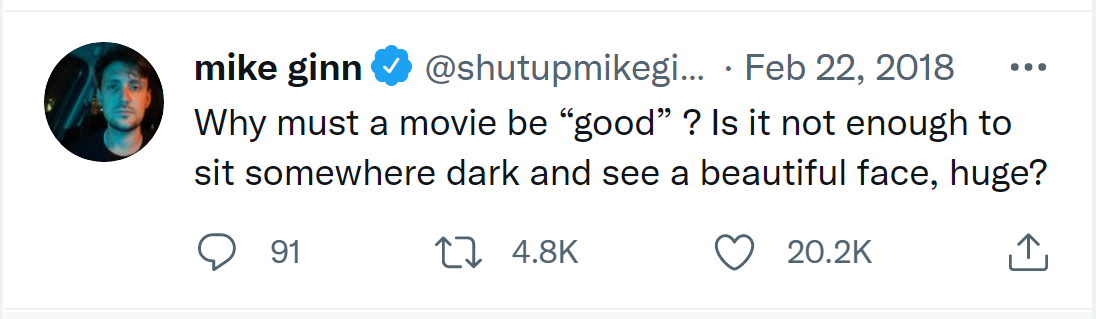
About every 1.6 weeks, someone gets on Twitter and asks some variation of “What’s the best tweet of all time?” There is always of course, the trotting out of the greats, like this one, this one, this classic, this jab, this burn, this zing, mockery of the New York Post, a personal favorite, someone who presumed the universality of a ludicrous idiosyncratic belief and chooses to dickishly ignore that they’re completely wrong, and of course, the truly greatest tweet of all time (and these two, which go out to my friends back home). But what’s “best” anyway? For me, all of these pale in comparison to this tweet, which I think about at least once a week: 

It came to mind again most recently yesterday, as I sat in a movie theater for the first time since Emma., watching Scarlett Johansson and Florence Pugh engage in a car/motorcycle/tank chase through the streets of Budapest and into the city’s subway, exchanging quippy dialogue all the while. In that moment, I flashed back to the similar car chase sequences in Berlin in Civil War, Seoul in Black Panther, San Francisco in Ant-Man and the Wasp, and [Cleveland as D.C.] in Winter Soldier, as well as probably others that I’m forgetting. And although this was another movie that largely stuck to the tried-and-true Marvel formula, I thought to myself, Why must a movie be “novel’? Is it not enough to sit somewhere dark and see a thrilling car chase through a metropolitan area, huge? After all, although this isn’t the first MCU film all about one of our lady heroes, it’s leaps and bounds better than Captain Marvel, which I gave a high star rating to upon release but was largely tepid about it in the review proper (I literally wrote “I’m hot and cold on this one”) and which I look back on now mostly with contempt, as its imperial Yvan eht Nioj underpinnings have only become clearer with the passing of time. 

I’ll admit here that, by and large, it’s pretty easy for a film to manipulate me emotionally (the people would like to enter into evidence my likewise high star rating for 2016’s Ghostbusters), and it’s also not just films that do it. The Alamo Drafthouse has, for the past few years, used the same simple animated introduction before new releases where several colored circles appear, then overlap, then space out to mimic planets orbiting a star, then come back together to embody the six circular cut-outs of the classic film reel canister. My description is overselling the complexity, I think, but I can’t find it online anywhere so forgive me. The sound design of it is fairly simple as well, but this time, after the theater darkened and the traditional Alamo font appeared on screen saying “We missed you,” the pre-show included a montage of clips of characters from the movies at the movies: Amélie, Taxi Driver, Cinema Paradiso, etc., and then the bonging tones of that intro came together, and I was overcome. It felt like coming home, and if I’m warmer to Black Widow than it truly deserves because of it, well, maybe the people will have to enter this review into evidence one day, too, but for now, I have to say, I really liked it. Even my best friend, who is generally apathetic to Marvel movies, thoroughly enjoyed it; immediately afterward, she said she would be willing to pay to see it again, and when we were considering watching another movie back home last night, she said she’d rather just watch television than another movie because she enjoyed Black Widow so thoroughly that she wanted to “marinate” in it a while before another cinematic experience watered it down. Take from that what you will. 

We open in Ohio in 1995, where a young Natasha (Ever Anderson, daughter of Milla Jovovich and Paul W. S. Anderson) rides her bike through suburban streets and into her backyard, where she plays with her younger sister, Yelena (Violet McGraw). When Yelena skins her knee, their mother Melina (Rachel Weisz) attends to her, and there appears to be some tension between Natasha and dear old mom. As night falls, Yelena notes the appearance of fireflies in their backyard, and Melina gives her daughters a little science lesson about bioluminescence. While they set the table, father Alexei (David Harbour) returns home, agitated. He shows Melina a 3.5’’ floppy and notes that “it” is “finally happening.” As Melina whispers a meaningful apology to Natasha at the dinner table, Alexei grabs a rifle and the entire family hops into their SUV and makes haste toward a small airstrip, with S.H.I.E.L.D. agents in pursuit shortly. After a tense shootout, the family manages to make their getaway in a prop plane and land in Cuba, where we learn that the “family” is comprised entirely of Russian agents, even the two children, and that the past three years in America have been part of a long term operation at a secret S.H.I.E.L.D. facility. Natasha attempts to prevent her separation from Yelena, citing that the younger girl is only six years old and too young for training, but Alexei notes that Natasha herself was even younger when she first began, and the two of them are forced apart on the orders of General Dreykov (Ray Winstone). 

After an opening montage (set to a downbeat cover of “Smells Like Teen Spirit”) gives us the general impression of what constitutes a Black Widow’s training in the “Red Room” (it’s not fun!) we move forward to 2016. The rest of the film is set parallel to the events of the aforementioned Captain America: Civil War, following Natasha (Johansson) in hiding after siding with Cap against Tony re: The Sokovia Accords. Elsewhere, Yelena (Pugh) and a team of fellow Black Widows tracks down and ultimately kills a rogue Widow, but not before her former ally exposes her to a red dust that acts as a counteragent to Yelena’s Black Widow programming, which we learn has grown beyond conditioning and brutal training to literal mind control. Natasha makes her way to a safe house in Norway with help from her friend Mason (O-T Fagbenle), who also delivers some things left behind at her last safe house in Budapest, which includes a package from Yelena that contains several vials of the red dust; the dust, in turn ends up drawing the attention of Taskmaster, Dreykov’s right hand killer, who has the ability to mimic the fighting styles of anyone from merely watching a video. Yelena and Natasha reunite and decide to destroy the Red Room once and for all. In order to do so, they must first rescue their “father” from the Siberian gulag to which he has been sent; the former “Red Guardian,” the only successful supersoldier equivalent of Captain America who was produced by the Soviet Union not relives his glory days in stories told to his fellow inmates and is mocked by his guards. He, in turn, leads them to their “mother,” who reveals that she was the scientist who worked on the beginnings of the mind control project. But can any members of this reunited not-really-a-family trust one another long enough to stop Dreykov? 

Look, this is a Disney’s Marvel Cinematic Universe consumable product. You’ve already decided if you’re going to see it or not, and if you’re going to see it, whether you’ll do so on a big screen, fork over an exorbitant amount of money to watch it on Disney+, or wait for a more affordable at-home option. It exists to sell toys, costumes, and trips to theme parks while continuing to build the Disney monopoly that we should all be more worried about since the overseers of antitrust laws are asleep at the wheel, and probably would be more worried about if we weren’t all (a) contemplating our insignificance and powerlessness to stave off the climate disaster that will boil, drown, bury, burn, smother, etc. us all alive, or (b) living in a state of denial of said looming extinction event. Its emotional beats are rote, its storytelling checkpoints are familiar, and the forward thrust of its characters is largely moot considering that, as of 2019, Natasha Romanoff is dead. For what it’s worth, at least Disney isn’t trying to insultingly push Black Widow as “empowering for girls/women” (one can read the text that way, but it’s not part of the metatext for once, and the film itself calls attention to the fact that Natasha’s dark past as an assassin renders her “hero” status among “little girls” problematic, to say the least). This film is also decidedly Not For Children, given its use of the visual language we associate with human trafficking to illustrate the horrors of the Red Room as well as the higher-than-normal profanity and a fairly graphic verbal description of the Red Room’s sterilization procedure. 

I’m sure that there will be some reviews that cite the film’s “heart,” although I would warn readers to take that with a grain of salt. The “reunited family that was really composed of spies but who could be a found family” element is present, and all of the cast (Pugh in particular) sell this angle in their performances, but how much it will resonate with you as a viewer will depend on a lot of factors that are external to the film proper. I wasn’t sold on it, but I still had a blast, and the setpieces here are some of the best that this franchise has brought to the table. Pugh is great in this first entry for her into the MCU, and Harbour brings an effortlessly comedic touch to the proceedings. Weisz has never given a bad performance ever, and her Russian accent here is a delight. It’s a shame that Johansson is finally given a vehicle in this series that is hers and hers alone and it must be an interquel due to the choices made in other films, but she’s been carrying films on her back since she was a literal child, so it’s no surprise that she delivers here in her postscript swan song. If you’re going to see it, see it, before we’re all dead.

-Mark “Boomer” Redmond

Laura Dern’s Oscar Story

Back when we covered Alexander Payne’s abortion-themed political satire Citizen Ruth as a Movie of the Month, it occurred to me that it’s dispiritingly rare to see the great Laura Dern in a genuine leading role. Between Citizen Ruth, Rambling Rose, and Inland Empire, I could only find three feature films in which Dern was top-billed as the lead actor, despite decades of fine work on the big screen. Unfortunately, that means the full power of her consistently compelling screen presence largely goes unnoticed & unrewarded, relegated only to her value as a supporting player. Last year, Dern was at least utilized as a potent supporting actor in two major Oscar contenders: Marriage Story & Little Women – which were, interestingly enough, directed by both partners in a married couple (Noah Baumbach & Greta Gerwig, respectfully). Dern’s efforts have been rewarded with a nomination for Best Supporting Actress for Marriage Story in particular, her first nomination since she was recognized as a potential Best Supporting Actress for Wild in 2015 (a statue she lost to Patricia Arquette for Boyhood). What I find interesting about this year’s Dern nomination is how it’s been framed in some online criticism circles as a career-merit award or somehow just Industry recognition for Dern’s recent work on popular television programs like Big Little Lies & Twin Peaks: The Return. The nomination is being discussed as if Dern’s performance in Marriage Story isn’t especially awards-worthy, that she’s being recognized for her contributions to cinema at large. That’s bullshit.

Laura Dern is genuinely fantastic in Marriage Story, totally reshaping the texture of the entire film with just a few scenes of onscreen dialogue. In the film, she plays a high-priced divorce lawyer who escalates the stakes & tone of the central couple’s painful separation. As the films’ two leads, Adam Driver & Scarlet Johansson are allowed to really pick apart the emotional textures of that separation at length (for which they’ve both been nominated as Best Leads). It’s Dern’s thankless task to establish the much harsher, colder tone of the legal arena where that separation will reach its fever pitch. It’s a world that relies on calm doublespeak & practiced artifice, which clashes spectacularly against the raw, confessional emotions of the star combatants. Other lawyer characters played by Ray Liotta & Alan Alda in the film help sketch out the extreme boundaries of that legal hell world, but it’s Dern’s job to welcome Driver & Johansson’s leads through the hell’s front gates, opening up their intimate detangling to a Kafkaesque legal labyrinth that stretches the entire length of the country. Marriage Story is just as much about the cruelty & confusion inherent to navigating the legal system in the process of divorce as it is an intimate drama about a romantic meltdown. In that way, Dern’s supporting role as the first & most prominent lawyer featured onscreen greatly affects our perception of the battlefield where the central conflict unfolds.

Dern’s self-confident power lawyer enters the film by apologizing for her “schleppy” appearance, despite being dressed to the nines in designer jeans & drastic heels. We’re immediately aware that her words & her body language are expressing an entirely different sentiment than what she’s actually communicating. When she offers Johansson, a potential client, to take home cookies from her office, it’s a sly advertisement for her services, as Johansson will continue to keep her in mind long after she leaves the office as she snacks on those treats. When Dern quotes a Tom Petty song in casual conversation, it’s only so she can advertise that she negotiated his ex-wife’s divorce from the singer for a large sum. Of course, these textual subtleties are largely a result of Baumbach’s sharply written screenplay, but Dern is visibly having fun with the material onscreen, selling the full impact of the role in a way few other performers could. Her performative version of active “listening” while Johansson is recounting the details of her failing marriage is as tense as watching a snake coil in grass, waiting to strike at a potential meal. One of the film’s most outrageous moments is when Dern removes her blazer in court as if she’s overheated, entirely just to distract from the opposing counsel’s arguments by showing some skin. She warns her client that “This system rewards bad behavior,” and over time proves to exhibit most of that bad behavior herself, proudly. Laura Dern makes a spectacle out of this seemingly minor role, drawing subtle contrast between the meaning of her body language and the meaning of her spoken dialogue that only becomes more exponentially significant the longer you dwell on its details.

It might be easy to reduce Laura Dern’s Oscars attention for Marriage Story to a glib assumption that it’s a lifetime achievement award rather than recognition for this performance in particular. Between her limited screen time and her highlight-reel monologue where she rants about how “God is absent father” while the Virgin Mary is unfairly upheld as a maternal ideal, there’s plenty of fuel to feed that kind of cynicism. I just don’t think it’s fair to downplay the impact Dern’s presence has on the film at large. She is a gussied-up power lawyer who shapes audience perception on both the communal vanity of Los Angeles and the cutthroat mind games of courtroom etiquette: two major factors in how the marital drama in the forefront develops. The only truth to the argument that she would have gotten this same nomination for any role (say, her interpretation of a silently angry Marmee in Little Women) based on her career’s work at large is that Laura Dern would have killed any role Hollywood tossed her way. She always delivers. The true shame about her nomination this year is that wasn’t for a Best Leading Performance, since Hollywood so rarely affords her top-bill opportunities that she never really has a chance to earn that accolade. If we’re relegating Laura Dern’s powerful screen presence to Supporting Player status only, she might as well earn her first Oscar for her movie-stealing role in Marriage Story. Hopefully she’ll win, and more prominent lead roles will follow.

-Brandon Ledet

Jojo Rabbit (2019)

Is it okay to admit that I genuinely don’t know what to make of this movie? After Taika Waititi’s hot streak of instant 5-star classics—Hunt for the Wilderpeople, What We Do in the Shadows, Boyit’s tempting to give the writer-director the benefit of the doubt in my unease with Jojo Rabbit’s tone & aesthetic. I especially wish I could celebrate Waititi’s willingness to immediately torch all the money & goodwill he earned making a crowd-pleasing Marvel movie by starring as Adolf Hitler in a pitch-black comedy with wild, deliberately alienating tonal shifts. Still, Jojo Rabbit’s mashup of Cute & Vile sentiments left me more confounded than either frustrated or moved. I suppose that discomfort & unease was largely the point, but it ultimately just didn’t feel as confident or personal as Waititi’s previous experiments in light-and-dark tonal clashes. It’s the first time I can assume one of his films didn’t fully achieve whatever it set out to accomplish.

The titular Jojo Rabbit is a 1940s German boy, Johannes, who is foolheartedly committed to his enrollment in The Hitler Youth. Already a victim to Nazi propaganda before the film starts, Jojo treats The Hitler Youth as a Weekend Fun precursor to The Boy Scouts (which it kinda was). He fully buys into the program’s antisemitic brainwashing that portrays Jewish people as magical, greedy demons with horns, scales, and forked tongues. This naïve, fanatical devotion to Nazi ideology is challenged when Jojo discovers that his own mother is secretly hiding a teenage Jewish girl from the Gestapo in the walls of their house, trapping him between the White Nationalist lies he’s been immersed in and the quiet demonstrations of kindness & charity towards Jews his mother exhibits at home. Naturally, he talks himself through this internal conflict with the help of his imaginary friend – a goofball, superheroic version of The Fuhrer himself, played by Waititi with the same vaudevillian broadness Charlie Chaplin brought to The Great Dictator.

Between the film’s Wes Andersonian visual fussiness, cutesy childhood humor, and ice-cold stares into the depths of wartime cruelty, Jojo Rabbit tosses a lot of clashing flavors into one overflowing gumbo. The not-for-everyone ingredient in that recipe (the okra, if you will) is the film’s peculiar sense of humor, which is broad enough to feel like it was intended for an audience of children despite the thematic severity it’s supposed to undercut. This film is consistently gorgeous as a meticulously tailored art object and seemingly heartfelt in its pangs of familial & genocidal drama, but it’s never quite funny enough to full earn its self-proclaimed status as “an anti-hate satire.” Making Hitler out to be a goofball lunatic who “can’t grow a full mustache” and teasing him with schoolyard names like “Shitler” registers only faintly on the satire scale, a whisper of righteous dissent. To be fair, it’s the kind of humor a school-age young’n might find darkly subversive, which fits the POV character’s mentality just fine. For an adult audience, though, the jokes rarely land with anything more than a droll chuckle of recognition, which to me means this outrageous Hitler comedy is paradoxically playing it safe.

Thankfully, it works much better as a political & familial drama, especially in Jojo’s relationships with the women in his house. Spending time with an actual, in-the-flesh Jewish girl reorients Jojo’s dehumanization of her people as horned demons in the exact ways you’d expect. His relationship with his mother (played by Scarlett Johansson with an SNL-tier “German” accent) is much more complex & capable of surprise, as she grieves for the loss of her sweet, kindhearted son to Nazi propaganda as if he had died in battle. The women’s disappointment in Jojo’s indoctrination into antisemitism and their dismissal of his burgeoning Nazi ideology as “a scared child playing dress-up” registers as the most clear-eyed satirical target in the film – one with undeniable parallels to the resurgence of Nazism among young white men online in the 2010s. The imaginary Hitler device doesn’t lead to anything nearly as poignant as that dramatic anchor (although it is satisfying to see the racist icon portrayed by a self-described “Polynesian Jew”).

If I’m unsure how successful Jojo Rabbit is overall, that unease is mostly due to its middling successes as a comedy. A few jokes land here or there with a light chuckle, but the humor peaks early with an opening credits sequence that reframes Leni Riefenstahl’s propoganda footage of Nazi crowds to play like a precursor to Beatlemania. Overall, the film’s “anti-hate satire” wasn’t nearly as pointed or as ambitious as the 2016 German comedy Look Who’s Back, which amplified tonal clashing in its parody of modern Nazism to the scale of a cosmic farce. For me, Jojo Rabbit worked best as a maternal parallel to the paternal drama of Waititi’s Boy. The difference is that I left Boy marveling at how he pulled off such a delicate tonal balance with such confident poise, whereas I left Jojo Rabbit wondering if I had just seen him lose his balance entirely and tumble to the floor for the first time. The answer remains unclear to me.

-Brandon Ledet

Avengers: Endgame (2019)

Oh boy oh boy oh boy! It’s here! It’s finally here! We’re in the Endgame now. All good things must come to an end, after all.

Speaking of all good things, remember how that was the title of the series finale for Star Trek: The Next Generation? And how that episode showed our dearly beloved Captain Picard visiting the past and the future, solving a mystery that spanned decades and giving the audience a chance to revisit where that series had started and where it could go in the future, while also putting a nice little bow on the journey of Picard and his cohort? Going into Endgame, I had the same feeling, and as it turns out, this was intentional, going as far back as last March, when Marvel Films bigwig Kevin Feige cited “All Good Things … ” as an influence on this latest (last?) Avengers picture. So for once, I’m not just inserting a Star Trek reference where it doesn’t belong; it’s relevant.

Here there by spoilers! You have been warned! There’s virtually no way to talk about this movie without them, so saddle up buckaroos.

The film opens exactly as Infinity War ends, with Hawkeye/Clint Barton (Jeremy Renner) at a family picnic teaching his daughter archery. He turns his back for a moment and looks back, only to find that his entire family has been raptured turned to ash as part of Thanos (Josh Brolin)’s stupid, stupid plan to end scarcity across the universe by killing half of all living things. (This is also the plan of Kodos the Executioner from the classic Star Trek episode “The Conscience of the King,” because you should know by now that you can’t trust me not to insert Star Trek references were they don’t belong from time to time as well.) Three weeks later, the devastated remains of the team, Captain America/Steve Rogers (Chris Evans), Black Widow/Natasha Romanoff (Scarlett Johansson), Bruce Banner/Hulk (Mark Ruffalo), Thor (Chris Hemsworth), and War Machine/Rhodey (Don Cheadle) are joined by the only surviving Guardian of the Galaxy, Rocket (Bradley Cooper) in their existential depression. Luckily, Iron Man/Tony Stark (Robert Downey Jr.) and his companion Nebula (Karen Gillan) are found in deep space by Captain Marvel/Carol Danvers (Brie Larson) just in time to prevent their suffocation, and she brings the two back to earth. With Nebula’s help, they locate Thanos’s little retirement farm and head straight there to retrieve the Infinity Stones and bring back everyone who was raptured dusted. When they get there, however, they learn that Thanos has already destroyed the Stones to prevent exactly this thing; Thor beheads the mad titan unceremoniously.

Five years later, people are still struggling. Struggling with depression, struggling with moving on. Cap goes to group counseling meetings. Natasha keeps the mechanisms of the Avengers in place, coordinating efforts to keep the peace, overseeing outreach and relief. Captain Marvel’s in deep space, helping the planets that don’t have the benefit of superheroes looking after them. Banner has managed to reconcile his two selves and lives full time as an intelligent Hulk. Tony has retired to a lakehouse with wife Pepper (Gwyneth Paltrow) and adorable daughter Morgan. And Ant-Man/Scott Lang (Paul Rudd) is still stuck in the Phantom Zone Quantum Realm until his equipment is accidentally reactivated, popping him back out into the regular world so that he can have a tearful reunion with now-teenage daughter Cassie (Emma Fuhrmann) and heads to Avengers headquarters, where he tells Cap and Natasha that it’s only been five hours for him, not years. With help from a hesitant Tony, the team works out how to use the Ant-Man equipment to stage an elaborate “time heist,” plucking the Infinity Stones out of time to recreate Thanos’s gauntlet and undo the damage he wrought. It’s “All Good Things … ”! But Marvel! And I cried! I really did!

You don’t need the ins and outs of how all this shakes out. There’s that Marvel house style of comedy that you’ve come to know and (probably) love, coupled with the emotional devastation that you would expect in a world where half of the population has disappeared. Clint’s taken on the Ronin persona from the comics (although this codename is never used on screen), tracking down and murdering criminals as the result of having no moral tether after the loss of his family. Scott’s headlong run across San Francisco to try and find his daughter only to discover a memorial to the lost, which he searches frantically in the hopes that her name won’t be there. Natasha puts on a brave face, but you can tell that she counts every life lost as red in her ledger (she clears every crimson drop by the end of the movie, and then some). An unnamed grief-stricken man in Cap’s support group recounts a first date with another man; they both break down in tears over the course of the evening, but this is the status quo now, so they’re seeing each other again (so, you know, the post-snap world isn’t all bad).

The time travel premise lets us revisit past events from new perspectives, which makes for a lot of fun to counterbalance all that drear. This includes contemporary smart Hulk having to act like his brutish past self, much to his embarrassment and consternation. Tony’s interactions with his daughter are adorable, and went a long way toward making him more relatable and likable, especially after I’ve been pretty anti-Iron Man for a while. One of the most moving parts of the movie also comes as a result of its comedic elements; we learn that the remaining refugees from Asgard have set up a “New Asgard,” where a broken Thor has retired and let himself go (he’s got pretty standard dad-bod, but the internet has reacted as if he looks like Pearl from Blade, just in case you were wondering if bodyshaming was still a thing). Once the heist kicks off, this means that Thor and Rocket have to travel to the time of Thor: The Dark World to get the Aether from Jane Foster (Natalie Portman), giving our favorite Asgardian hunk a chance to have an affirming heart-to-heart with his departed mother Frigga (Rene Russo), retroactively adding more depth to her character in a lovely way.

I’m burying the lede, though, since what really matters about all these time travel shenanigans is that we get to see Peggy (Hayley Atwell) again. PEGGY! As soon as there was a wrinkle in the time plan and they mentioned having to go back to the seventies, I knew where we were headed and could barely contain my excitement. If I remember nothing else from this movie on my deathbed, I will remember the thrill of seeing Peggy one last time (and then again). That doesn’t even include the fact that Tony gets to have a nice moment with his father (John Slattery), too, and that there are appearances from every character.

Look, this is the perfect capstone for this franchise. If there were never another MCU film, it would be totally fine, because as a finale, this is pitch perfect. Every important and semi-important character (other than Lupita Nyong’o’s Nakia, because she was presumably busy shooting Us) gets a moment to shine, as the Snap is undone (come on, you knew it would be). There’s even a moment where every living lady hero from the entire MCU is onscreen at once, and it is delightful, although I’m sure the internet is already full of comments about how it was “forced” or “cheesy,” but I don’t feed trolls and I try not to cross the bridges that they live under, so I wouldn’t know. But, as the people behind the MCU have noted, this is a finale, not the finale. We get to say our goodbyes to many of our favorites, but the future is in good hands with Falcon/Sam Wilson (Anthony Mackie) taking up the mantle and shield of Captain America, Valkyrie (Tessa Thompson) taking her place as the new leader of the Asgardians in diaspora, and the possibility of future adventures of Pepper Potts as the heir apparent to Iron Man. The future is now, and it couldn’t be brighter.

-Mark “Boomer” Redmond

Rough Night (2017)

There’s a distinct brand of mainstream comedy that somehow gathers together every single comedic performer you’d ever want to see in a movie, but fails to deliver on the promise of their shared presence. Rough Night is an enjoyable, mildly amusing comedy that’s biggest fault is proving to be less than the sum of its parts. There’s no reason a film helmed by the writers of Broad City that features performances from people as bizarrely funny as Jillian Bell, Ilanna Glazer, Kate McKinnon, and Eric Andre should be half as tame or restrained as this movie often feels. This goes doubly so considering the film’s letting-loose plot of a bachelorette party weekend that turns deadly. There are plenty of violent, absurdist, and over-sexed impulses simmering in the background of this hard-R summertime delight, but none are pushed to the extremes you’d hope for based on the level of talent involved. The result is still amusing, but it’s difficult not to be disappointed over what could have been.

Scarlett Johanson stars as a total nerd running for political office in what seems like a mild send-up of the Clinton/Trump campaign trail (with a little Anthony Weiner thrown in for flavor). She breaks away from her election effort for a single weekend to meet up with college friends she hasn’t see all together in years for a bachelorette party in Miami. While her fiancee’s bachelor party is a hilariously lame, muted affair, her own last gasp of freedom feels like the hedonistic free-for-all we never got to see in Bridesmaids because of the incident on the plane. Cocaine, apple bongs, and gallons of top shelf cocktails fuel the small group’s debauchery while anxieties over past romances & friendship dynamics inevitably bubble to the surface like a loud & proud belch. Eventually, the party spirals out of control when the women accidentally kill a stripper & attempt to dump the body to avoid arrest, making the whole feel a little like a gender-flipped remake of Very Bad Things remake that absolutely no one asked for. It’s all fairly amusing, but also a little over-familiar and, ultimately, disposable.

It’s possible that I would’ve been able to better enjoy the minor successes of Rough Night with a more enthusiastic audience. The crowd I watched it with were quiet enough for me to clearly hear the ceiling leak in the auditorium and the Tupac biopic screening on the other side of the wall. Even with that muted reaction, I especially enjoyed its callbacks to mid-00s pop culture, including Borat Halloween costumes and a dance routine set to Kelis’s “My Neck, My Back,” which were amusing reminders that I am gradually becoming an old man. I’d also consider the film a solid victory in the noble cause Operation: Make Jillian Bell A Star. Her militant distribution of dick-themed bachelorette merch & maniacally sincere delivery of lines like, “It would mean so much to me if we could do a little cocaine together,” made Bell out to be a clear scene stealer, no easy feat considering the talent that surrounded her. Still, Rough Night could’ve reached much more memorable heights if it has just cranked the volume on the violent, dangerously horny, occasionally absurdist touches that were already hiding in the shadows. The movie’s biggest fault is that it sets up jokes & payoffs you can see coming from an hour away and waits until the last possible second to pull the trigger. If its payoffs were more immediate there’d be more room for them to also be more plentiful (more weirdness! more sex! more accidental fatalities!) and the only thing it really needed to be special is more of what it was already working with.

-Brandon Ledet

Captain America: Civil War (2016)

EPSON MFP image

fourhalfstar

Captain America: Civil War was a lot of fun! I went into the film expecting it to be a bit of a letdown after how much I loved Winter Soldier, and while it’s not as good as the last Cap flick, it’s certainly worthy of the positive critical reception that it has been garnering. I expected that there would be more of a backlash against it given that the negative reception of Batman v Superman was characterized by proponents of that film as being the result of a pro-Marvel bias among the blogosphere. Instead, the film’s 90% positive professional critic score and 92% audience score on Rotten Tomatoes reflects a generally positive reaction, and the film deserves it. While there are some detractors who are critical of the film, citing the distinct division between plot lines (one focused on the titular conflict between the different members of the Avengers and one which is devoted to following up on the plotline surrounding the Winter Soldier and his past), I’m in agreement with the general public in that I found this film a worthy successor and a great introduction to the new direction of the MCU as Phase Three revs its engine.

I’ll be saving my comparisons to other films and my discussion of the spoilery elements of the film for our Agents of S.W.A.M.P.F.L.I.X. dual review, but I’ll talk about my favorite elements here. Unlike Age of Ultron, which likewise had a large number of characters and introduced new ones, this film felt neither overstuffed nor imbalanced. There’s more of Cap than anyone else, but that’s to be expected, and every other character gets at least a few minutes of screentime that develops them as individuals and reveals something about their personal philosophy. Notable among these is Scarlet Witch, who is basically filling the Kitty Pryde role on this team as the youngest member/trainee, getting tips on superheroing from Cap and Black Widow in the field. Elizabeth Olsen plays the hell out of Wanda’s insecurities and independence, and it’s a testament to her strength as an actress that the audience fully understands her character after just a couple of films in which she plays a role that doesn’t get a lot of screen time. Although Scarlett Johannson’s role here is much more brief than her meatier presence in Winter Soldier, the Russo brothers effectively understand that her relationship with Steve would be strained by their placement on opposite sides of the Sokovia Accord issue; I won’t get into detail here, but she gets a few scenes that allow the actress to play this conflict, and ScarJo nails it despite being arguably underused. Vision also feels a lot more like Vision this time around: a weird android whose utter incomprehensibility of human social norms is both charming and unnerving at the same time. The movie also gets a lot of subtle comedy out of the character’s uncanniness; there’s something utterly surreal about a blockbuster comic book movie featuring a character whose unusual body shape is covered by the kind of sweater that your grandmother orders out of a J. Crew catalog.

I also really enjoyed that, for the first time in the MCU, we got to see a team fight another group.In most of the films, the final confrontation boils down to a one-on- one fight (Iron Man, Captain America, The Incredible Hulk, Thor, Ant-Man), the protagonist and maybe a sidekick facing off against a single villain and his attendant faceless horde (IM2, IM3, Thor 2), or a group facing off against a single villain and his attendant faceless horde (Avengers, Guardians of the Galaxy, Avengers 2). It’s not surprising that the only film from Phases One and Two that doesn’t fit into one of these boxes is Winter Soldier, which sees the individual members of Cap’s team in different places and fulfilling the roles that were best suited to each. This did mean that we didn’t get to see, for instance, a moment of pure four-color glory like Cap using his shield as a refractor for Iron Man’s blasts like in Avengers; what it does accomplish is raising the emotional stakes when the villains are well-developed and individual rather than being mass market Chitauri, Dark Elves, Ultron bodies, or the Sting-Winger things from Guardians. Here, it’s a full team against a full team, using their powers in new and inventive ways and showing how these personalities play off of each other, especially with regards to the more mature members of each team and their more green teammates. Ant-Man is a particular delight (despite some questionable CGI in a few scenes), with Paul Rudd effectively playing up Scott Lang’s awe at meeting Captain America; the serious affectation he puts into the line “Here’s your shield, Captain America” got the film’s biggest chuckle out of me, although Spider-Man’s sincere fascination with Bucky’s metal arm was great as well.

The fight scenes are frenetic in the best way, and they all push the plot forward rather than simply occurring at the anticipated intervals in which we’ve been conditioned to expect them. That’s not to say that this is a fun movie throughout, however. The length of the scenes featuring Holland’s precocious, quipping Spider-Man are balanced out by a conspiracy plot that reflects the darker elements of Winter Soldier. These revisitations don’t resonate as strongly this time around, but the revelations about the Winter Soldier program and one character’s motivations for wanting to bring this information to light are effective in their Manchurian qualities. This actually leads into the question that the marketing for the film has played up, one that was much more straightforward in the source material (which we’ll talk about in the Agents review): whose side are you on?

Where do I stand? There’s a great underlying throughline in this film that shows that, in a way, Tony Stark is right. It’s almost easy to write off Steve’s motivations as being too personal and lacking in professional distance; his desire to not only save but redeem Bucky may be the most ethical motivation in play, but it’s undeniable that this morality isn’t what motivates Cap. Steve Rogers’s desperate desire not to lose one of the last tenuous connections that he has to a home that no longer exists is understandable. On the other hand, it’s not hypocrisy on Cap’s part that he does not want to defer to the potentially unethical whims of a questionably impartial caucus while engaging in ambiguously unlawful activity himself to defend Bucky. It’s totally in line with what he claims is his goal: assuming personal responsibility. It’s also understandable that Tony would be the person most in favor of the accords: his ego and compulsion to take personal responsibility for protecting the entire earth led to the creation of Ultron. Of course Tony feels more of a need for oversight than Cap, who had heretofore never been on the wrong side of any moral conflict. In the end, however, the stakes become as personal for Tony as they are for Steve, leading him to act out violently using his technological advantage. Further, this conflict comes as a result of manipulation by a basic human for whom the stakes are also too personal. Supersoldier, genius inventor, and haunted family man: all give in to their worst instincts, tearing down empires and threatening worldwide political ramifications of the future because of the limited horizons of their own pain. This movie is both an embodiment of the need for accountability as made manifest in the lives of three different men, but also a demonstration of the infeasibility of the accords themselves.

Some situations require action faster than a committee can authorize it. This is a world where an alien portal can open up over New York or interdimensional monsters could appear in London and end life as we know it while some U.N. page is just trying to get enough people together to make a motion to deploy the Avengers. What if everyone was at lunch? And then, boom, humanity is enslaved to the Skrulls or consumed by Galactus because all they had to do was attack during everyone’s smoke break or a particularly nasty flu season. There really is no side that’s entirely right or wrong, which is the film’s greatest strength. There are a lot of people making comparisons to Batman v Superman and with good reason, considering that there is a weird overlap in some of the plot elements, but what really stands out to me is that BvS has what is essentially a sitcom stock plot where Character A and Character B are in conflict because they don’t communicate with each other. Then things get blown further and further out of proportion while shenanigans ensue, until they realize that, hey, being honest is important and everyone learns a lesson about teamwork and friendship. In Civil War, the conflicts are ideological and thus more rooted in the humanity of its characters. That’s the core of what makes this film work, and it’s a great start for the next wave of Marvel’s flicks.

-Mark “Boomer” Redmond

The Jungle Book (2016)

bear

fourstar

I’ve gone on record as not being a particularly huge fan of Jon Favreau’s Iron Man movies, but it seems the director might’ve learned a thing or two about how to deliver a big budget CG spectacle while helming that franchise. Favreau’s latest effort, The Jungle Book, is a “live action” remake of a Disney animation classic & marks the director’s most impressive work to date. I put “live action” in quotes because there’s really only one live action character here existing in a computer animated world, newcomer Neel Sethi as the protagonist Mowgli, which sort of positions The Jungle Book among nostalgia-inducing titles like Who Framed Roger Rabbit? and, less deservedly so, Cool World. The film intentionally cultivates this nostalgic lens through certain subtle details like a decades-old yellow font for the credits that look like they were lifted straight from an ancient VHS cassette. It’s a smart decision that eases the audience into a certain level of comfort & familiarity despite the state-the-art technical prowess on display. Again, Favreau seems to know exactly what he’s doing here, as if he’s seen it all before.

The story of The Jungle Book may be familiar to many audiences by now, but I’ve personally never read its Rudyard Kipling-penned source material & it’s been a good two decades since I’ve seen the Disney original, so I honestly didn’t remember jack shit about it going in. The only detail of The Jungle Book that was clear to me when I entered the theater yesterday was the character Baloo’s personal anthem “Bear Necessities”. Indeed, the modern version of this story doesn’t truly come alive until Baloo’s personal laid back huckster philosophy enters the scene. Early depictions of the lovable scamp Mowgli interacting with various animals of the jungle (after being raised by a pack of wolves like a little badass) range from cute to terrifying to majestic, but also lack a distinct personality & emotional pallet that Baloo brings to the table. The Jungle Book is a two-fold tale of revenge (one for Mowgli & one for the wicked tiger Shere Khan) as well as a classic coming of age story about a hero finding their place in the world, but those plot machinations are somewhat insignificant in comparison to the emotional core of Baloo’s close friendship with Mowgli (which develops a little quickly here; I’d like to have seen it given a little more room to breathe). So much of that impact rests on the all-too-capable shoulders of one Bill Murray, who delivers his best performance in years here (outside maybe his collaborations with Wes Anderson).

You might think that performance wouldn’t matter so much in a film populated with CG animals, but part of what makes The Jungle Book such a technical marvel is how realistic the animal faces are while still retaining the expressive qualities of the actors who voice them. The film essentially looks like those nature-themed t-shirts you can only seem to buy at national parks & gun shows come to life, but it’s the motion capture technology that adds a whole other layer of awe to the film’s visuals. Lupita Nyong’o is very sweet as the wolf mother Rashka who tells who tells Mowgli things like “No matter where you go or what they call you, you will always be my son.” Christopher Walken is wonderfully bizarre as the mythically gigantic orangutan King Louie (I’m guessing his uncomfortable turn as Captain Hook last year was a kind of dry run?). ScarJo & Idris Elba are both effectively terrifying in their respective roles as a murderous snake & tiger (with Johansson more or less combining her parts in Her & Under the Skin on her end). None impress quite as much as Murray does here as the con artist bear Baloo, however. Just look at his Harry and the Hendersons moment when he has to push Mowgli away despite his deep affection and you’ll find more pathos in those thirty seconds than most of the rest of the film could carry with all the time in the world. Murray has always been exceptional in his interactions with children on camera & his casting here was a brilliant choice that elevated the material greatly in terms of emotional impact.

That being said, I do feel there was somewhat of an emotional deficit at work here that made The Jungle Book more of a technical achievement than an all-around cinematic one. This was the most awe-inspiring depiction of talking animals I can think of since George Miller’s Babe (and one of the best depictions of animal coexistence politics since Babe 2: Pig in the City), but it didn’t quite reach Babe’s emotionally impactful penchant for drama. I could easily recommend The Jungle Book the same way I’d recommend a Hugo or a Dredd. You have to see this movie in the theater. You have to see it in 3D. I just don’t think it commands quite the same emotional weight as some of Disney’s more pointed work, with Zootopia being a great example from earlier this year. I should note that I might’ve been a little distracted by exceptionally poor movie theater etiquette at the particular screening I attended (screaming children, repetitive Facebooking, 4/20 bros acting unruly, the full gamut), but my emotional detachment from the film still remains true. It was beautiful to look at & Baloo made it fun, but I wish it had hit me harder square in the feelings.

It’s also worth mentioning, because it’s such an unfamiliar reaction for me, that the end credits for the film might’ve been my favorite part of the whole ordeal. The obnoxious crowd scuttled out of the theater & left me mostly alone with a beautiful pop-up book animation on a blue velvet background that made excellent use of the 3D technology on hand by playing with depth & scale. Walken’s weirdo performance also returned to serenade the (mostly empty) crowd with more New Orleans-inspired tunage and that oddly nostalgic yellow font returned to make me feel warm & fuzzy for reasons that are difficult to pinpoint. All that was missing was some extra Bill Murray content. It sounds kind of vapid to say, but the end credits in itself seemed to position The Jungle Book as a huge advancement in cinema’s visual tools, with encouraging implications as to how that advancement could be applied in a meticulously manicured art film (once it’s more affordable/accessible). The film was visually fascinating & at times wildly fun, but for the most part it just made me excited about the future of movies in general.

-Brandon Ledet

Thoughts on The Congress (2014) and the Question of What, Exactly Modern Celebrities are Selling

EPSON MFP image

One of the most wildly imaginative sci-fi films in recent memory, for my money, was the often-overlooked, “technophobic” film industry satire The Congress. In the film, Princess Bride actress Robin Wright plays a fictionalized version of herself facing an exponentially shrinking list of potential career options thanks to an industry that has a long history of underserving women as they age past their 20s & 30s. Wright’s agent uses this professional crisis to pressure her into allowing a major movie studio to digitally capture (or, in the movie’s lingo, “hermetically scan”) her very essence, essentially selling her tangible soul to a media conglomerate. This leads to a psychedelic existential crisis involving an animated wonderland of dystopian terror that makes The Congress one of the most visually bizarre films I can remember from the last couple of years.

As eccentric as The Congress‘s visual pallet can be, it isn’t exactly what’s been keeping the film fresh in my mind since I first reviewed it last year. There’s been a recent string of news stories reminiscent of the ways The Congress depicts movie studios owning actors’ likeness that feel oddly off-putting in a way the film seemed to forewarn, keeping it fresh in my mind. For example, during the press tour for the recent Zack Snyder debacle Batman v Superman: Dawn of Justice, eccentric Lex Luthor actor Jesse Eisenberg went into great detail about the fake Michael Shannon body double used in the film. Shannon, who played the villainous Emperor Zod in Snyder’s Man of Steel, didn’t fully reprise his role in the sequel as Zod’s corpse (who could blame him?), but instead allowed the studio to include him via lifeless dummy created based off his headcast. Where it gets really creepy is in Eisenberg’s description of the fake Michael Shannon, which appears in the film completely nude. According to Eisenberg, the Shannon doll was entirely, unnecessarily anatomically correct to the point where the detail was a little disturbing (long story short, he had a penis).

There are, of course, even more direct comparison points to Robin Wright’s fictional plight in the way celebrity actors are being represented & altered digitally. Actors appearing posthumously in commercials for beer, junk food, vacuum cleaners, etc. is crass enough of a concept in itself and has been around long enough to likely have influenced some of The Congress‘s digitizing paranoia. Things have snowballed even since the film’s production, however, including two high profile instances of actors being digitally inserted into feature-length works they didn’t live to see completed (Paul Walker in Furious 7 & Phillip Seymour Hoffman in Mockingjay Pt II). Even actors who did film their role to completion are being subjected to digital alterations in post-production. Sometimes this can be as simple as removing a pimple or a blemish or the effects of aging with computer magic (Paul Rubens in Pee-wee’s Big Holiday is a recent example) or as horrifying as the very recent reports of Paramount & DreamWorks allegedly testing a digital technique to make white actors appear “more Asian” in post-production for the already-controversial live action Ghost in the Shell adaptation starring Scarlett Johansson. Whether or not you agree with the actors’ decision to accept those roles/paychecks in the first place, you have to admit it’s super shady that the studio attempted to dress them in digital yellowface after the fact (presumably without their knowledge or consent).

The question at large here is what, exactly are celebrities selling to movie studios when they sign a contract for a big budget role? In the past (and, indeed, in smaller current productions) actors were strictly selling a performance, a record of work delivered. Modern celebrities, however, seem to be selling much more than that. They’re not selling a record of their work so much as the rights to their personalities & essence. This current era of digital recreation & the ownership of celebrity likeness is on much shakier, creepier ground and it’s difficult not to think of The Congress‘s sci-fi celebrity culture dystopia as each of these news stories crop up. The film didn’t do so well critically or financially upon initial release, but I find that its pointed satire about Hollywood’s future gets more eerily relevant on almost a daily basis. It’s difficult to say for certain exactly why The Congress failed to strike a chord with a larger audience. I’ll admit that it plays a little off-balance & unsure in moments, but if nothing else I greatly respect the film’s tendency to swing for the fences even when what it delivers lands way off target. I also am continuously taken aback by just how much the film has to say about modern celebrity culture, especially when I see modern celebrity culture talking back.

-Brandon Ledet

Agents of S.W.A.M.P.F.L.I.X.: Avengers – Age of Ultron (2015)

EPSON MFP image

Superhero Watching: Alternating Marvel Perspectives, Fresh and Longterm, Ignoring X-Men, or S.W.A.M.P.F.L.I.X., is a feature in which Boomer (who reads superhero comics & is well versed in the MCU) & Brandon (who reads alternative comics & had, at the start of this project, seen less than 25% of the MCU’s output) revisit the films that make up the Marvel Cinematic Universe from the perspective of someone who knows what they’re talking about & someone who doesn’t have the slightest clue.

Boomer: Do you need a history of the Avengers sequel here? The first movie cast such a shadow that it was impossible to escape this film, even if you wanted to (and most people didn’t). Even when it was unclear whether or not director Joss Whedon would return to helm the second film, there were no other potential directors announced before he eventually acquiesced. By the time this movie came out, virtually every blog that is created and consumed by humans had talked about the upcoming film in extreme detail. Next time, when we talk about Ant-Man, there’ll be a lot of production history to discuss, as that film had a long and troubled road from inception to release, but not Age of Ultron. Let’s just get to it, shall we?

EPSON MFP image

threehalfstar

Brandon: When I first reviewed Age of Ultron last summer I had kinda marked it off as a breaking point for the MCU. I enjoyed the film very much as a loud, chaotic action film, but felt like it was stretching itself a little thin trying to please both people like me who (at the time) only casually checked in on the Marvel films every now & then and hardcore fans who had consumed all ten films, three television shows, several DVD-exclusive shorts, and untold amount of tie-in comic books worth of content that preceded it. Age of Ultron was enjoyable to an outsider, but it had to labor fairly heavily to get there & I felt like at some point the franchise would have to leave me behind if it wanted to keep already-established fans engaged in future films. In the past year I’ve since caught up with all of the preceding MCU films & a few of the comic books and it turns out Age of Ultron still feels a little overstuffed & compromised now that I’m somewhat in the know. It’s a sluggish, sprawling mess of an action film that stresses itself out trying to provide significant character beats for each of its many larger than life heroes while also juggling with the introduction of several new supervillains for them to thwart. In a lot of ways Age of Ultron repeats a lot of the highlights and downfalls of the first Avengers films. It’s fun & inspired in moments both big (a stunning slug-it-out fight between Iron Man & The Hulk) & small (the repeated gag with who can/cannot lift Thor’s hammer), but also labored in a way that’s impossible to ignore, especially in its overlong, stop & start exposition.

However, there is a new spark of inspiration at work in Age of Ultron that gives me great hope for where the MCU is headed as a franchise. Now that the individual introductions & character quirks for each Avenger member are out of the way, the series has made a little room for itself to go into unexplored territory beyond the basic novelty of seeing all of these superheroes function as a unit. This development comes twofold. The first & flashiest change afoot here is the breathing space the film allows for its eccentric villainy. James Spader is a total hoot as the titular Ultron, just devouring the scenery at every opportunity he gets (even as soon as his introduction as a disembodied voice). The second development is the very nature of Ultron as a form of artificial intelligence. Thus far, MCU movies have centered on very traditional superhero plots: origin stories, tales of revenge, moral crises over the very nature of heroism, etc. Captain America: The Winter Soldier & Thor 2: The Dark World both promised new lines of narrative with their respective experiments in political thriller & space epic plot lines, but Age of Ultron takes this adventurous genre play a step further. The film’s pedigree as modern A.I. sci-fi makes it surprisingly satisfying & unique as a modern superhero work (and as a result it ranked fairly high on our recent list of the best A.I. sci-fi titles of the 2010s). Age of Ultron may be a little messy in its attempts to juggle so many varied larger-than-life personalities & sidebar plot lines, but James Spader’s over-the-top performance as the central villain & the resulting A.I. sci-fi plot that surrounds him make the film at the very least an interesting, entertaining mess. It’s at least as good as the first Avengers film & promises that there’s even better work to come in the near future (I’m starting to get really stoked about Captain America: Civil War‘s imminent release, as I’m sure most people are).

EPSON MFP image

three star

Boomer: I’m never really sure where to start when talking about this one. Age of Ultron isn’t a bad movie. In actuality, it’s a pretty decent outing for a group of characters that people were losing their minds over the first time we saw them unite. I’d dare say it’s good, if not great. The cinematography is clean, the pacing moves swiftly and cleanly, and the likable characters are terribly likable while the unlikable characters are not.

Buuuuuuuut…. this movie bores me? Maybe “bores” is the wrong word; it’s more that the film just fails to really grab me? Although there are some tonal inconsistencies and narrative problems throughout, the same could be said of Avengers, and I still found that movie enjoyable in spite of its flaws. I’d even go so far as to say that this film might be technically better, but I don’t get the same thrill from it that I still get from the first one. Admittedly, it would have been virtually impossible to capture a second lightning bolt in this particular Marvel-shaped bottle regardless, but I still feel underwhelmed with each viewing. This was my third watch of the film (after seeing it in theatres and then again at Christmas), and this was probably the most rewarding watching experience, but does an Avengers flick need to be the kind of movie that takes multiple rewatches to be fully enjoyed? This isn’t Jacob’s Ladder or Primer that I’m talking about; it’s the eleventh movie in a franchise that walks the thin line between “media made for children” and “media aimed at adults,” a direct sequel to a movie that was so much fun we all willingly ignored the fact that its plot is pretty threadbare and that the villain’s motivations were utterly inexplicable. So how did a follow-up with more explicit character motivation and expanded personal stories for many of the heroes end up being so… blasé?

When Whedon finally announced that he would return to direct Age of Ultron, he said that it was because he “actually started to consider it [and] it became so clear that [he] desperately wanted to say more about these characters.” This is most evident in Jeremy Renner’s Hawkeye, which is ironic given that the actor couldn’t stop putting his foot in his mouth during the press tour. Overall, the film garnered a mixed response among new media outlets: many people interpreted Black Widow’s line about being a monster, a declaration that came on the heels of the revelation that she was sterilized as part of her espionage training, to mean that she considered herself less than a woman because she could not have children (I don’t personally subscribe to this inference, but the placement of that line is unquestionably insensitive and poorly timed). And it’s no real surprise that Whedon got burnt out from working on the film, considering that he was trying to grow the mythology while also being beholden to the Marvel franchise at large. This was a pretty big contributing factor to his eventual departure from social media, which was solidified when people reacted angrily to his accusation that Chris Pratt’s character in the then-upcoming Jurassic World smacked of “seventies-era sexism” (an observation that turned out to be absolutely correct, for anyone keeping score at home).

But those are all things that aren’t specific to the film itself; so, what about the movie? Well… clocking in at 2.5 hours, there are still too many stories that feel unresolved. In my review of Batman v Superman, I mentioned the scene wherein Lois Lane has to retrieve a Kryptonite spear from a flooded building after throwing the damn thing into the water in the first place; both I and the friend with whom I saw the movie immediately referred to this as the “Riker Fights a Monster” moment, referencing RedLetterMedia’s Plinkett Review of Star Trek: Nemesis. In that film, there is a scene in which Jonathan Frakes’s character goes down into the bowels of the ship to fight Ron Perlman’s Nosferatu-esque Reman character for no other reason than to give Riker an irrelevant plot point; as “Harry Plinkett” points out, making a main character run off to engage in hand to hand combat with a monster simply to give that character something to do is a demonstration of utter failure to properly craft a story. The same thing happens here with Thor, who takes off from the Barton farm halfway through the movie to go submerge himself in some magic waters and have a mystical vision, for the sole purpose of getting him out of the way for a little while and providing Thor with the information needed to provide exposition about how the MacGuffins of the MCU are interconnected, even though we kind of already got that explanation from The Collector in Guardians. Because the film has to introduce three new Avengers but Thor is still on the team, he has to be sent off on an irrelevant side quest just to give him something to do.

I didn’t read any books written by men in 2015. The biggest reason for this is that, while I was reading Charles Yu’s How to Live Safely in a Science Fictional Universe last January, I realized I was reading the fifth novel in a row that was about a relationship between fathers and sons, specifically one that was estranged. Like a lot of writers, I also have a strained relationship with my Pops, but I’m sick to death of having to see that narrative device in every piece of media that I consume. It’s been a central thematic element of most of the Marvel films, with Stark having to face off against his surrogate father in Iron Man and Iron Man 2 revolving around him having to finish his father’s work (with bonus daddy issues coming from a parallel story about Whiplash’s own dead father). Thor could have been subtitled “Odin is kind of a bad dad,” and the plot of Thor 2 is basically “Loki has daddy issues some more, and also there are evil elves.” Guardians of the Galaxy has both Nebula and Gamora rebelling against their “father” Thanos, and Star Lord’s father is mentioned several times, setting up more dad-focused shenanigans further down the line. The Incredible Hulk didn’t focus on the patriarch of the Banner family (although Ang Lee’s non-MCU Hulk certainly did), but it did milk drama from the relationship between Betty and General Ross. Even Ant-Man, which I really enjoyed, wrung most of its pathos from the parallel father-daughter relationships between the two Ant-Men and their respective offspring. The only movies that don’t have bad father-child relationships as a central element were the Captain America films. And, hey, I get that, I really do. Assuming that your parents were present in your life, the relationship that you have with them is the first and most formative relationship that you have; further, especially in God-haunted America, the relationship between fatherhood and the divine takes on such familial and social importance that one’s father is often one’s model for how they conceive God. I’m just saying that this is a metaphorical well that has been visited by storytellers so often that they’re hauling up buckets of dust at this point and trying to get us to drink it.

Age of Ultron takes this idea and cranks it up as high as it will go. Wanda and Pietro turned to Baron von Strucker and his experiments as a way of getting back at Stark for the death of their parents. The Barton family farm gives every character the opportunity to reflect on their own place in the world and whether or not that precludes them from starting families of their own: Banner and Widow have a heart-to-heart about how neither of them is biologically capable of starting a family (the idea of adopting, as is so often the case, never crosses anyone’s mind); Stark talks about building Pepper a farm, implying that he is thinking about continuing the Stark lineage (legitimately). Cap’s is a little more subtle, as we see him dreaming about the end of the war and being able to finally dance (and, by implication, settle down) with Peggy, a dream that can never be realized. Even Thor becomes a kind of father by the end, as his lightning gives life to Vision. But, of course, all of this pales in comparison to Ultron and his hatred for his “father,” Tony Stark. It’s thematically connected but ultimately feels hollow.

Where do I even begin with Ultron? For one thing, his design is terrible. The effects team did some excellent work making him look as good as he does, but he still doesn’t quite fit. The Iron Man suits are almost always CGI, but they work for me because they don’t have as many distracting details on them and they aren’t required to imitate real facial expressions; Ultron, on the other hand, has a stupid cartoon face that laughs and speaks and looks absurd. Combined with James Spader’s disarmingly likeable dialogue, this doesn’t work for me at all. I understand that Ultron wants to become more human (even if the film fails to properly explain why this is a goal for him), but he would have been more unsettling if his jokes and attempts to seem more affable had come from a less expressive face. When Ultron first interrupts the after-party at Avengers tower and gives his “I’m alive, father” speech to the gang while inhabiting a broken Iron Legion bot, he’s much more menacing in that moment than he is at any point later in the film, and that’s a problem; a villain should become more frightening as he goes from party-crasher to world-destroyer, but Ultron gets less creepy as the film goes on. If they weren’t going to keep him in a broken robot suit the whole time, the least that could be done would have been to make his face immobile to ramp up the uncanny valley factor.

On top of that, the film sells itself short by having Ultron move into full-blown extinction-event villainy almost immediately. Remember the scene from The Fifth Element in which Leeloo discovers the concept of “War” and briefly has a psychic break before returning to her mission with a renewed vigor? Age of Ultron would have benefited from downplaying Ultron’s maliciousness at the outset. For instance, he could have worked alongside Jarvis for a scene or two, maybe even helping to design the anti-Hulk “Veronica” system, which would have foreshadowed that Ultron would eventually work against the team. Then have him come to the conclusion (after having a Leeloo-like epiphany but with the opposite result) that the world would be better off without humans in general and the Avengers specifically, so that he goes rogue, kills Jarvis, and sets out on his own to unmake life as we know it. This would raise the emotional and thematic stakes without changing the plot all that much, while also making Stark look less foolish by having his “son” turn to evil eventually rather than instantaneously.

All that having been said, do I hate this movie? Not really. I actually enjoyed its mindless summer action flick elements, and I continued to laud the fact that the MCU heroes really are heroic in that they focus their attentions on saving people as much as they do on defeating villains. Compared to the mindless ultraviolence of, for instance, Man of Steel (and the petulantly sarcastic “good thing this island we’re utterly destroying is uninhabited” violence of follow-up BvS), Age of Ultron truly reflects the superheroic ideal in a way that other franchises fail to understand. The trailer for Civil War even shows that there were fewer than 200 casualties in this film, which is mind-boggling, given that an entire city is obliterated in the climax. The action scenes are fun, even if there are so many that the excitement is diluted and diminished (the Iron Man versus Hulk fight is narratively justified but could have been excised with few changes). I also like that the film takes the time to remind us that Tony Stark is a real asshole, and that the character growth he’s experienced over the course of the franchise hasn’t absolved him of the guilt of his past (as evidenced by his recognition of a notable black market arms dealer and the fact that the Maximoffs were orphaned as a result of his company’s war profiteering) or of his pathological egomania (as seen in his accidental creation of what is essentially Skynet and his willful refusal to destroy the experiment that would become Vision, despite all available evidence at the time indicating that this was the best course of action).

Still, the spectacle doesn’t make up for the looseness of the plot this time around, and the film’s thematic focus on progeny and responsibility is neither as strong nor as clever as it tries to be. It’s the quintessential example of a sequel that reduces its narrative world rather than enriches it. It’s a recommended watch, but not a required one.

EPSON MFP image

Lagniappe

Brandon: I’m giving a lot of credit to the character of Ultron here for what makes this film so entertaining as a work of superhero-themed A.I. sci-fi, but Ultron’s philosophical counterpoint Vision is just as fascinating. I know both Ultron & Vision are both inorganic lifeforms entirely dedicated to their respective good & evil plots to “save” the world (Ultron’s Murder Everyone policy is particularly inventive in that regard), but what strikes me most about these two characters is their off-putting sexuality. James Spader has always been something of a creepy sex symbol throughout his career & even though he appears here mostly as a voice, his work as Ultron is no different, so no surprise there, really. What’s really off-putting is the sex vibes I get from his heroic opposite Vision. Vision is creepily sexual in a way that a subtly flirtatious yoga instructor or an enigmatic cult leader would be and it makes me simultaneously super fascinated & super uncomfortable watching him at work. It’s highly probable that this is all in my head, but I still think it was a reaction worth mentioning.

Boomer: As much as I cited the problematic over reliance upon father-child relationship clichés, it is worth pointing out that this is, to my knowledge, the first and only time that anything created by Joss Whedon has a good father archetype. From Buffy (in which literally every single character’s father was either not present, abusive, or both) to Toy Story (in which Andy’s father is notably absent), Joss Whedon has a the same hard-on for bad fathers that Jonathan Safran Foer has for fatherhood in general. Arguably, Fred’s dad on Angel was decent, but Hawkeye is the first good, relevant father that we have ever had in a Whedonverse product.

On a more random note, non-comics character Helen Cho feels like an attempt to fix the comics-to-screen adaptation of Kavita Rao, who was created by Whedon during his Astonishing X-Men run and who was unfortunately ruined by her appearance in Fox’s X-Men: The Last Stand.

I’d also like to point out that I really like Vision. He’s a favorite character of mine from the comics because he’s just such a total weirdo. For those who don’t read the comics, Vision’s neural patterns were based on those of fellow Avenger Wonder Man (who has no analog in the MCU, possibly because he was excised from The Ultimates); when Coulson was killed in the first Avengers film, my theory was that they would bring him back by using his mind as the basis for Vision. I’m not saying that my idea was better, but… okay, I am saying that. Still, I appreciate that the MCU has brought on such a bizarre comic character and I have to admit that I’m really looking forward to seeing what they do with him. I also like that they slyly alluded to his comic-book relationship with Scarlet Witch, with Ultron saying early in the film that she needs something different from/more than a man, and with Elizabeth Olson’s reaction to seeing Vision for the first time (her face basically says “Oh, my, yes”).

Of course, even more than Vision, I love Wanda. She’s a notoriously difficult character to get right, and even though the movie makes some changes for the worse (divesting both Pietro and Wanda of their Roma heritage and instead making them generically Eastern European is unnecessary and insulting, especially considering that you can count the number of Roma comics characters on one hand), her characterization is pretty neat. The Ultimates version of the twins was awful, and the dumbed-down nature of X-Men Evolution meant that she was turned into a pretty generic goth girl with issues, a la Nancy in The Craft. My favorite non-comics version of her is probably from the all-too-brief Wolverine and the X-Men cartoon from five or so years ago; pairing her off on adventures with Nightcrawler made sense thematically (given both character’s connections to the Roma) and making her an ambassador for Genosha allowed her to be involved without making her a part of the team.

As for how this film fits into the wider MCU, we haven’t quite gotten to see the ramifications of these events inform the growth of the franchise in quite the same way as, for instance, the events of Winter Soldier did. When that film was released, it had an immediate and apparent impact on other films, taking away the S.H.I.E.L.D. support system that the characters and the audience had come to rely upon and making Hydra a real threat in the present. This had an obvious and instantaneous effect on Agents of S.H.I.E.L.D., finally refining that program into something worth watching. How does Ultron tie into the program this time around? An off-the-books project is referenced many times throughout the second season, a project so secret that it causes dissension in the ranks (when Ming Na’s Agent May finds out what it is, a few weeks before the audience does, she seems pretty pissed). The big surprise is that this secret project is actually the new helicarrier that is used to rescue the fleeing Sokovians at the end of Ultron, which doesn’t make sense given what Agents showed us and is completely irrelevant to viewers who only follow the films and don’t care about the shows. Ignoring that, it looks like the events of this film will be important in the upcoming Civil War, so that’s something to look forward to. And, of course, we can expect to see more of Andy Serkis’s character when the Black Panther finally gets involved.

EPSON MFP image

 Combined S.W.A.M.P.F.L.I.X. Rating for Avengers: Age of Ultron (2015)

three star

-Agents of S.W.A.M.P.F.L.I.X.