We’ve been singing the praises of the 2010 animated Batman feature Under The Red Hood this month for giving viewers something they’re not used to from most Caped Crusader cinema. Forgoing the obligatory origin story opening that weighs down every other Batman reboot and skipping far enough ahead into the lore that it can support two! Robins the Boys Wonder, Under the Red Hood feels remarkably unique in the modern comic book adaptation zeitgeist for its confidence in viewers’ familiarity with its central characters, allowing it a larger freedom in storytelling. The film feels much less unique, however, when you consider the obvious debt it owes to Batman: The Animated Series, particularly the show’s feature film debut Mask of the Phantasm. I’ve written previously about how Kevin Conroy’s voice work as the Caped Crusader on The Animated Series has been the defining standard for all animated Batmen, leaving Under the Red Hood/Gotham By Gaslight voice actor Bruce Greenwood very little room to leave a distinct mark. (The same could probably be said for Mark Hamill’s deranged voice work for The Joker as well). That’s not where The Animated Series’ looming influence stops, though. For all of Under the Red Hood’s narrative details that feel unique to cinematic Batman storytelling, the broader picture of what it accomplishes more than vaguely resembles Mask of the Phantasm. In fact, it follows Phantasm’s template so closely that you wouldn’t have to change many character details around for it to function as a remake.
To be fair, Under the Red Hood’s story about superhero vigilantism gone too far is a fairly common one within comic book lore. In our initial conversation on Under the Red Hood, I wrote, “Now that there are roughly a dozen major superhero releases annually, the stories are more varied, but for a while it felt as if the majority of them were hinged on the moral conflict of what, exactly, separates the masked vigilantes from the masked criminals.” However, the details of how that story is told onscreen in these two films are similar enough to push Under the Red Hood’s parallels to Mask of the Phantasm beyond general adherence to storytelling cliché. Both the titular Red Hood & Phantasm vigilantes challenge Batman’s moral code by pushing their dedication to crimefighting too far, specifically by assassinating mob bosses that control Gotham’s crime rings. The identities of the mysterious people from Batman’s past who mask as these vigilante personae in both films are also presented as impossibilities, as they are both dead. In Under the Red Hood, we see (the second, younger) Robin murdered brutally at the hands of the Joker in the first scene, but presume that The Red Hood could only be him in disguise, somehow resurrected. Similarly, recognizable voice actor Stacy Keach is obviously voicing The Phantasm in the earlier film, but the character he plays is shown to be dead long before The Phantasm arrives, making it an impossibility. The strange circumstances that make these transformations possible are doled out in staggered flashbacks in both films, one to a story of an early romance and one to Robin’s pre-crimefighting youth. The stories also reach their respective climaxes by deploying The Joker as an outside element of chaos in a last-ditch effort to save mobsters’ lives, creating total chaos that reveals the mysteries of the two vigilantes’ secret identities. Some of the individual characters have been swapped out and the animation style of these productions has changed drastically from the 90s to the 2010s, but in narrative terms The Mask of the Phantasm & Under the Red Hood are practically the same movie.
What’s left to distinguish them, then, is a question of aesthetic, for which I’ll always be biased to affording Mask of the Phantasm the upper hand. The action sequences of Under the Red Hood are an impressively complex mix of traditional and computer animation, but they have nothing on the tactile mat painting backdrops and Art Deco designs of The Animated Series, which is about as gorgeous as crime detective noir ever got. Mask of the Phantasm also drives to a much more distinctive climax than Under the Red Hood, staging the final showdown between Batman and The Joker in a sprawling miniature of Gotham at an abandoned, Atomic Age World’s Fair exhibit. The play with scale in that climactic battle makes the two forever-foes appear to be kaiju-size, which is an absurd effect unmatched by anything mustered in Under the Red Hood (or most live-action Batman flicks for that matter). Mask of the Phantasm is the definitive animated Batman move, its influence looming over every one of its successors. Story-wise, the only notable improvement Under the RedHood holds over it is in skipping the origin story plotlines for Batman & The Joker, which are told uniquely in Mask of the Phantasm, but likely don’t need to be told at all. Otherwise, it follows a very faithful pattern established by that Animated Series offshoot, which becomes blatantly apparent if you ever watch the two films back to back. I don’t intend to point out these similarities to diminish Under the Red Hood’s significance; I was impressed by the film in a way that’s exceedingly rare for DC animated features. I just continually marvel at how influential The Animated Series and, by extension, Mask of the Phantasm were on the entirety of the animated Batman canon. Even one of the most uniquely independent entries into the franchise is still very closely tied to that series, both structurally and tonally, speaking to its staying power as a foundational work.
Roger Ebert Film School is a recurring feature in which Brandon attempts to watch & review all 200+ movies referenced in the print & film versions of Roger Ebert’s (auto)biography Life Itself.
Where Equinox Flower (1958) is referenced in Life Itself: On page 158 of the first edition hardback, Ebert explains his general taste in cinema. He writes, “Of the other movies I love, some are simply about the joy of physical movement.” One of his examples includes the passage, “In Equinox Flower, a Japanese film by the old master Yasujirō Ozu, there is this sequence of shots: a room with a read teapot in the foreground. Another view of the room. The mother folding clothes. A shot down a corridor with the mother crossing it at an angle, and then a daughter crossing at the back. A reverse shot in a hallway as the arriving father is greeted by the mother and daughter. A shot as the father leaves the frame, then the mother, then the daughter. A shot as the mother and father enter the room, as in the background the daughter picks up the red teapot and leaves the frame. This sequence of timed movement and cutting is as perfect as any music any written, any dance, any poem.”
What Ebert had to say in his review(s): Roger never officially reviewed the film, but he does mention it as evidence in his salute to Ozu as “A Master of the Cinema.” He writes, “To love movies without loving Ozu is an impossibility. When I see his films, I am struck by his presence behind every line, every gesture. Like Shakespeare, he breathes through his characters, and when you have seen several of his films you feel as if you must have known him. What is strange, considering that his films were once considered too Japanese to even be shown in the West, is that you also feel you have known his characters–some of them for all of your life.”
I am beginning to accept that, like Andrei Tarkovsky & Terence Mallick, Yasujirō Ozu is one of those incredibly talented filmmakers I’ll never emotionally connect with. I’m too impatient, too scatterbrained to work my way up to Ozu’s quietly reflective, well-mannered wavelength, no matter how much I admire his attention to craft. With long, pensive features stitched together through meticulously arranged static shots, consciously avoiding camera movement, Ozu’s catalog is diabolically designed to make me feel like an unappreciative dolt in well-versed, patient film nerd circles. The delicate dialogue and stoic architecture that fascinates the filmmaker leave me feeling stubbornly stuck in a slow-sinking mud, praying that I don’t give up and fall asleep. This is especially true in Equinox Flower, a film that’s explicitly about stubbornness and inaction. In Ozu’s more devastating dramas like Tokyo Story, there’s at least a heart-wrenching central conflict with an undeniable emotional hook (in that particular case, the way the elderly are left behind by uncaring, selfish youth). Equinox Flower is a much tougher vibe to engage with, as its own conflict is a pensive shift towards enlightenment & understanding, something that doesn’t necessarily make for compelling drama.
Marking a shift in sympathies from valuing the elderly & tradition over the new-fangled youth to a more modern perspective, Ozu’s first color film wrings its hands for two full hours over the dissolution of the arranged marriage as a social institution. Our central character is a middle-aged father fretting over his conflicting feelings on modern marriage. He’s introduced giving a speech in favor of romantic marriage at a colleague’s daughter’s wedding, disparaging the result of the practical, arranged marriage he has with his own spouse. He then later advises a family friend to disobey her mother’s wishes and marry the man she loves. These expressions are explained to be hypocrisies as his own daughter is revealed to be planning marriage with a coworker, without seeking her parents’ counsel. The father apparently prefers the tradition of arranged marriage in his own household, finding it to be a more stable foundation for a partnership, whereas passion fades. He doubles down on his opposition to his daughter’s choice by essentially imprisoning her in their home, fighting off an encroaching modernity that looks increasingly inevitable. The audience knows this impulse to be toxic, and the movie tracks his stubborn drift towards empathy for his adult daughter’s autonomous decision.
My disconnect with Ozu might boil down to just how stubbornly well-behaved he is as a filmmaker and a persona. It’s how I imagine Scorsese & Bergman’s crises-of-Faith films appear to people who weren’t raised Christian. Ozu tells this story of young women leaving home to choose their own professions & lovers with great empathy for the old men who wish to control & stifle them. Arranged marriages are explained to be in opposition to passionate ones, but here “passion” is expressed through polite & mannered conversation, never physical desire. Much like how his protagonist fights the dissolution of arranged marriage traditions, Ozu fought the transition from silent film to talkies in the 1930s and the transition to color that started with Equinox Flower. In both cases he found that new-fangled way of doing things wasn’t so bad (he never returned to black & white filmmaking), despite his stubborn, teeth-grinding resistance. It’s clear he identified with the mental anguish this film’s patriarch goes through as he comes to terms with is adult daughter’s entitlement to romantic freedom. I never shared in that fretting for one minute, so the film mostly played like watching a stubborn bully gradually decide to not be such a rigidly traditionalist brute. It’s an admirable personality shift, but also one that doesn’t earn the long, self-reflective journey it’s afforded.
I do greatly appreciate the visual arrangements of Ozu’s framing. His biggest fans fawn over how his editing room cuts find a peculiar sense of movement within that beautiful stillness. Ebert gushed in particular about a sequence in Equinox Flower that establishes a poetic domesticity through these cuts, which he describes a being one of the most joyous sequences in all of cinema. I’ve been guilty of finding that same poetic joy in the artificial domesticity of a Douglas Sirk picture or two, but Sirk’s melodramas were informed by an emotional passion Ozu had no interest in exploring. It’s likely this feeling of a well-mannered, well-behaved emotional remove is a culturally-informed one, something I should strive to look past in my appreciation for the director’s formalist achievements. I can’t deny though, that I would have been much more enthusiastic about Equinox Flower if it paired its technical craft with genuinely passionate melodrama. It could have at least told its story through the daughter’s POV instead of her stubborn, traditionalist father’s. That might be the crux of where Ozu & I differ in sensibility & temperament.
Avengers: Infinity War offers an interesting conundrum for a movie critic, as it defies consideration as an isolated piece of work. Overall, the film felt to me like the MCU in a microcosm; there were some aspects I really liked mixed with some I couldn’t care less about. Like with the MCU at large, I could’ve done without Stark & Strange, the CGI spectacle could be really numbing, and its absurd length felt paradoxically too short to fully serve its myriad of storylines & too long to maintain constant, undivided attention. The bizarre critical dilemma it presents is that it can’t be separated from the MCU at large at all. Not only does it represent both the highs & lows of its franchise, its impact is meaningless without 18 previous films informing its in-the-moment significance. Considering the merits of Infinity War as an isolated work of art would be like critically assessing a randomly selected episode of a soap opera, a single pro wrestling match from a months-long angle or, perhaps most appropriately, a mid-stream issue of a comic book series. It’s a tough thing to evaluate in isolation, as it’s built on a structure that requires both knowledge of its characters’ previous arcs and acceptance of its medium’s need to never truly wrap up a storyline. This type of storytelling’s endless self-propulsion requires always leaving a door open for The Next Big Show. The tagline for Infinity War is “An entire universe. Once and for all,” but we know as consumers that a more accurate descriptor would be “Once or thrice a year.” It’s difficult, then, to invest any emotional response in the film’s at-the-moment consequences, since they convey a kind of finality that we know will inevitably be undone in the next summer’s sequel(s). Adapting a comic book story structure to blockbuster cinema has created a never-ending franchise that can’t afford to introduce actual stakes to its everlasting gobstopper “plot.”
That’s not necessarily a bad ting, though. I love pro-wrestling. Millions of people watch soap operas every day. Comic books are at least popular enough to have justified this franchise’s launch in the first place. Like with consumers of all kinds of serialized storytelling, MCU fans are entering these films recognizing that their storylines can never fully reach a satisfying conclusion. At the very least, they can assume that the death of a major character who’s already scheduled to appear in an announced sequel will inevitably be reversed through supernatural shenanigans. There’s a surplus of dubious character deaths in Infinity War that anyone familiar enough with the film to be watching it as the 19th entry in a series is going to be skeptical of, if not outright dismissive. The one aspect of the film that helps distinguish it as an isolated work, however, is that it does not acknowledge that inevitable impermanence. It commits to its own tragic consequences by ending on a disaster of mass death & mayhem. All signals of an optimistic future for its doomed characters are extratextual, based entirely on those deranged Disney press conferences where the corporate bully claims future weekend release dates for their bottomless wealth of sequels planned centuries into the future. We can fully expect as an audience that Infinity War’s damage will be undone by the end of the next Avengers sequel, but the film ends without any indication of that impermanence. I mention this because I’ve seen plenty of comic book movies (both in the MCU and outside it) do the exact opposite in the past, to their own detriment. For instance, if Infinity War were an X-Men sequel, its mass death downer of a conclusion would have wrapped up tidily at the climax, then immediately been undone by a convenient, quick denouement. I know this because I’ve seen the X-Men movies do it more than once, most egregiously in its two most recent entries.
I’m about to vaguely spoil two recent-ish X-Men movies, but don’t worry; nothing really matters in that franchise. In just two pictures, X-Men has become the authority on the comic book Reset Button, assuring that its individual battles have no stakes in the context of franchise-wide storylines. The current trajectory of the X-Men series has been a decade-by-decade nostalgia trip. The prequel X-Men: First Class plays like a swanky 60s spy picture. Days of Future Past deals largely in 70s political thriller genre beats. Apocalypse functions as a Ready Player One-style indulgence in 1980s aesthetic. The next film on the docket will presumably push through to touch on 90s grunge or pogs or whatever. Even beyond these temporal divisions, X-Men movies typically feel more independent from each other than MCU entries, with each individual episode resetting the rotary dial for the next adventure to arrive with a mostly blank slate. The most backlash I’ve seen to this repeatedly mashed Reset Button plot structure was in the reaction to The Days of Future Past’s ending. Days is a sci-fi time travel movie that splits its efforts between a possible future reality and an alternate version of the past. The movie largely concerns preventing a grim future by nipping past evil in the bud, which the heroes inevitably accomplish to no one’s surprise. What was surprising is that, after victory, omnipresent series favorite Wolverine awakes in a timeline that ties together both the First Class prequels & the early 00s series that preceded them, undoing many major character deaths through an afterthought shrug of time travel shenanigans. I understand why this tidy conclusion rolled many viewers’ eyes when the film was first released, but I was personally much more annoyed by a smaller moment in the next picture. There’s a scene late in X-Men: Apocalypse where characters with mutant powers stand in an open field with their arms extended, palms open, while their destroyed home base magically reassembles itself. Every broken brick & board smoothly floats back to its proper assembly in a low-rent CGI spectacle, not an inch of the once-destroyed structure out of place or conveying damage. It’s maybe a 20 second clip, but there was something about its magical ease that really irked me. I’ve never seen the impermanence of consequence in comic book movie storytelling represented so succinctly in a single scene before or since.
For better or for worse, the massive, sustained success of the MCU means that more of this serialized blockbuster storytelling is on its way. I found myself watching a trailer for an upcoming Star Wars prequel this past weekend that ends on an action sequence cliffhanger teasing that Chewbacca may or may not die in the film. Everyone who’s ever seen any Star Wars movie before (read: everyone) knows that Chewbacca will not die in that prequel. That momentary crisis has no potential consequence in its larger series, but that’s just how these kinds of stories are told (including the old-timey radio serials Star Wars was originally inspired by). All we can do, if we’re going to continue to tune in for the next episodes in these ongoing series, is celebrate the examples that commit to their consequences in the moment. Avengers: Infinity War might not ultimately mean anything in the grand picture of individual characters’ fates, as it will likely be undone by its successor next summer. At least it committed to its own consequences, though, instead of undoing them on the spot. In X-Men: Infinity War, the mass character deaths would’ve been a climactic crisis immediately undone by the surviving superheroes standing in an open field, arms outstretched, putting their friends’ pieces back together again with their mysterious powers. I only mildly enjoyed Infinity War overall, the way I only moderately enjoy the MCU overall, while recognizing that there are individual elements I’m really into: Captain America, the Guardians of the Galaxy, Thor, Black Panther. I do respect that it didn’t reset its own consequences we know through extratextual means to be impermanent the way a more traditional comic book series entry would have. When I first reviewedX-Men: Apocalypse I asked, “What’s the point of any of this if it can all be fixed & rebuilt with the light shake of a CG Etch-a-Sketch?” By saving its own magical reset for a later date (which I’m sure was announced at a press conference five years ago), Infinity War sidestepped that annoyance completely, even if its in-the-long-run storytelling amounts to the same general effect as what’s undone in Apocalypse: no effect at all.
Neil Patrick Harris wears a daunting number of hats in the show business racket: Broadway entertainer, game show host, sitcom star, children’s book author, etc. He’s one of these well-rounded, over-employed entertainers where you’re never sure how they fit all their various projects in a tenable schedule. One of his regular gigs is voiceover work for various animated projects wildly varying in target demographic, but often hitting that one common denominator in all age-specific marketing: superhero media. NPH has had regular voice acting gigs in the superhero pantheon over the years, even voicing the title role in a long-running animated Spiderman series. He’s only voiced characters in two animated superhero movies, though, both of which fall under the DC Comics brand. That’s maybe not that surprising to most people, as the DC Universe Animated Original Movies brand has dozens of feature-length cartoons under its belt to date. What is surprising, though is that someone as talented & recognizable as Neil Patrick Harris has only played supporting characters in both instances of his movie-length collaborations with DC. Likely a reflection of his busy, no time to dally schedule, NPH’s animated superhero movie specialty seems to be punching up a side character’s dialogue with wry, cocky wit, making them appear more fully developed than they’re written to be. As with many of the projects NPH applies his time to, he’s good at his job.
In our current Movie of the Month, 2010’s Batman: Under the Red Hood, NPH’s sidekick role plays as entirely intentional. He’s cast as just one of two ex-Robins, raised under the Caped Crusader’s tutelage in a movie that’s all about Batman’s struggle with the other. NPH appears in the film as Nightwing, an early adopter of the Robin persona who has since branched out to fighting crime on his own, but still desperately needs fatherly approval from a standoffish Batman. Nightwing is an outsider to the central plot involving a second, younger Robin, but he’s also an essential parallel of it. This requires him to be present, but without enough time to develop his persona. It’s a paradox that’s easily fixed by having NPH on hand to instantly sell the character’s sarcastic, performatively confident personality. It’s the same role he fills as The Flash in the earlier DC animated feature The Justice League: The New Frontier, through for entirely different reasons. The Flash is a sidekick to no one and his storyline is one of the driving plot threads in New Frontier, yet NPH is afforded just about the same amount of screen time & character development there as he is in Under the Red Hood. This is because the film is overstuffed with the backstories & character introductions of a long line of superheroes in the film’s cast, who all divvy up the runtime until there’s barely any left to go around. It’s a frequent problem for anyone who’s familiar with the trajectory of modern live-action superhero franchises, especially the DCEU. It’s also a telling contrast to the intimate story told in Red Hood.
As busy & overcrowded as The New Frontier can feel, it does have an excellent central gimmick. Set in the Atomic Age 1950s, the film feels like a better world where Brad Bird made his animated superhero media in traditional 2D instead of with Pixar. Telling the story of an ancient disembodied force that vows to destroy humanity because of its dangerous nuclear proliferation, The New Frontier is decorated wall to wall with the visual kitsch of a 1950s diner with a sci-fi theme. By setting the clock back to that setting, though, it also requires the Justice League to be a uniformed group of disparate superheroes who spend the entire runtime coming together as a team (and joining efforts of an untrustworthy military) for the first time. Characters like The Flash, Superman, and Wonder Woman already have detailed backstories in place, while more character development is afforded the origin stories of lesser characters like The Green Lantern & Martian Manhunter. It’s likely no accident that more seasoned, well-established voice actors are afforded to the three more static characters (NPH, Kyle McLachlan, and Lucy Lawless, respectively), since their personalities need to be more immediately recognizable than the ones who’re developed through origin stories. The Flash is key to the film’s plot, especially in establishing superheroes as McCarthy Era Others (“What’s with that red costume? Red’s for Commies,”) but he’s afforded almost the same amount of screen time as Nightwing in Under the Red Hood: very little. He’s a well-established superhero reduced here to Superman & Wonder Woman’s de facto sidekick.
From a technical standpoint, the more intimate, self-contained story of Under the Red Hood is more effective as a piece of writing, while the overly busy, origins-obsessed plotting of The New Frontier is indicative of the worst impulses of superhero media storytelling. I enjoyed both films very much, though, believing New Frontier’s narrative shortcomings to be far outweighed by the beauty & charm of its Atomic Age aesthetic. Neil Patrick Harris is employed in self-contradictory roles in both pictures. He is both central to the themes & plots and reduced to glorified cameo roles as sidekick & afterthought. NPH does a great job of making both roles memorable, informing both characters with a punchy, wry sense of humor without fully tipping them into wiseass Deadpool territory. Like The New Frontier, the man’s career is spread into an impossible number of directions and it’s impressive the amount of quality work he produces despite that myriad of obligations.
It’s almost inarguable that the most iconic performance from Divine, the greatest drag queen of all time, was her role as Babs Johnson in Pink Flamingos. John Waters may have later scored a wider cultural impact with Hairspray(his last collaboration with Divine before her death), but if you ask anyone to describe Divine as a persona, it’s the yellow hair, red flamenco dress, and curbside dog shit of Pink Flamingos that most readily defines her in the public conscience. As gloriously filthy as Pink Flamingos is within the John Waters pantheon, though, it’s not the most fully illustrative showcase for Divine’s talents as an onscreen presence. Babs is a kind of static constant throughout Pink Flamingos—hilarious, but unchanging in her filthy, filthy ways. It’s that film’s follow-up, Female Trouble, that really allows the full spectrum of Divine’s version of defiant American femininity to shine. In Female Trouble, Divine charts the moral corrosion of a high school teen turned mass murderer over a decade’s worth of increasingly despicable criminal acts. Pink Flamingos might be Divine’s most recognizable achievement in establishing a tone & defining her look, but Dawn Davenport is her greatest creation as a cinematic performer.
After signing the film’s theme song herself (a preview of her disco career to come), Divine begins Female Trouble as one of the 1960s hair-hoppers Waters lovingly profiled in Hairspray. Dawn Davenport is a bratty teenage delinquent. She smokes in school bathrooms, sneaks eating meatball sandwiches during class lectures, and responds to concerns about schoolwork with sentiments like, “Fuck homework. Who cares if we fail?” This attitude sets her up for failure at a traditional American lifestyle, something that becomes no longer sustainable after her parents refuse to buy the one Christmas present she demands because, “Nice girls don’t wear cha-cha heels.” After destroying the Norman Rockwell Christmas tableau of her parents’ home like Godzilla tearing through Tokyo, Dawn Davenport hits the open road as a teenage runaway. She attempts a mundane life that does not suit her: raising children, waiting tables, gossiping at the beauty salon. The most alive Dawn appears as a young adult woman is when she’s sweatily stripping as a go-go dancer and abusing her hyperactive daughter, both verbally and physically. The first half of Female Trouble is a grimy portrait of American femininity, one frustrated with the prison of boredom & tedium that plagues well-behaved women, especially single mothers. The increasingly violent crimes she commits throughout the film are selfish, hateful, and morally grotesque, but they’re also a political rejection of traditionalist gender roles she’s expected to conform to at all ages in her perversely American life.
The poster for Female Trouble “warns” of (read: promises) “scenes of extraordinary perversity,” the kinds of onscreen stunts both Divine & Waters were largely known for, if not only because of the shit-eating stunt that concludes Pink Flamingos. When Dawn Davenport introduces herself to strangers in the film, she explains “I’m a thief & a shitkicker and I’d like to be famous.” She achieves this fame the way only a thief & a shitkicker would: by impressing the public with the daringness of her crimes. As an adult criminal, Dawn finds wealthy, erudite patrons (David Lochary & Mary Vivian Pearce) who fund her criminal activities for the artistry that they truly are, fanatically believing that “crime enhances one’s beauty.” It’s an ingenious setup that provides Divine a stage to perform various criminal stunts, including smashing her overgrown child (a deranged Mink Stole) with a dining room chair, warring with her leather fetishist neighbor (Edith Massey) to the point of imprisoning her in a birdcage & axing off her hand, and breaking prison rules by entering a long-term lesbian relationship while locked up. In-story, this absurdist crime spree climaxes when a scarred-up Dawn with a protopunk haircut locks a literally captive audience into a crowded nightclub for her Cavalcade of Filth routine and fires a gun directly at them, indiscriminately. If crime enhances beauty, this is Dawn Davenport at her most gorgeous, something she announces upfront in the line “I’m so fucking beautiful I can’t even stand it myself.” The bizarre truth is that the biggest stunt in the film occurs long before the Cavalcade of Filth, though, when Dawn Davenport is still a teenage delinquent. Hitchhiking away from her destroyed parents’ home on Christmas morning, Dawn is picked up by a monstrous drunk played by Glenn Milstead (out of his Divine drag). Upstaging the earlier stunt where Divine is raped by a giant lobster in Multiple Maniacs, Divine effectively rapes herself in this scene. The details are horrendous: a roadside mattress, shit-stained tighty whities, felching. It’s a truly hideous display, a stunt that could only be topped by watching Divine perform mundane domestic work in later titles like Polyester& Hairspray. It’s this hitchhiking sequence where Divine truly outdoes herself (by literally doing herself, appropriately).
Desperate Living is my personal favorite John Waters film, but it’s one that Divine backed out of before production. I’m sure she could have only improved the film with her immaculately trashy presence, but I doubt even that performance would have bested the all-encompassing showcase Dawn Davenport afforded her. Divine’s performances as Babs Johnson, Edna Turblad, and Francine Fishpaw are all flawless, iconic filth, but they only afford her one comedic angle per picture. Dawn Davenport, on the other hand, allows Divine to transform from teenage reprobate/petty criminal to full-blown Charles Manson maniac in 90 wild minutes, taunting her audience from the perch of an electric chair with the speech, “I’d like to thank all those wonderful people who were kind enough to read about me in the newspaper and watch me on the television news shows. Without all of you, my career would have never gotten this far. It is you that I murdered for and it is you that I die for.” Female Trouble affords Divine a stage to perform her most gloriously fucked up stunts on celluloid, then directly comments on our fascination with those wicked deeds and with crime as entertainment in general. More importantly, though, it allows her to perform the full spectrum of American femininity as, to borrow the title of a Lifetime movie, Wife-Mother-Murderer in the post-hippie grime of the mid-1970s. Dawn Davenport is multiple generations & evolutions of the misbehaving woman, a perfect template for Divine to perform a full floor show of varying proto-punk looks & sneering femme attitudes. She may have starred in a few better movies, but few performances ever served her better as a top bill entertainer & the center of attention. Besides, where else are you going to watch Divine fuck herself? It’s impossible to overvalue the novelty of that experience.
I attended many strange pro wrestling rituals when WrestleMania34 descended upon New Orleans like a body odor blanket last month. I watched a cheeseburger/bear hybrid wrestle other kaiju-costumed nerds at a midnight show adorned with cardboard cities. I stood in the world’s longest bathroom line at a Ring of Honor event because the bro-to-lady ratio at indie wrestling shows is way out of hand. I may have even joined in with the “This is awful!” chants that concluded Mania proper, despite the previous seven hours of sports entertainment making me look like an ungrateful turd for doing so (I honestly can’t remember if I participated in that complaint or not, but the show was exhausting). However, no Mania Moment was as strange as watching the raunchy teen sex comedy Blockers with John Cena in a theater packed with his biggest fans, an experience that only feels more bizarre the further I get away from it. This year’s WrestleMania happened to coincide with Blockers’s opening weekend, so a John Cena promotional appearance at a screening of the film makes logical sense from a marketing standpoint, but the event clearly didn’t factor in the nature of Cena’s usual pro wrestling fanbase. Thanks to AMC, John Cena, and the Universal Pictures marketing machine, I watched an R-rated teen sex comedy with a crowd of very young, very impressionable children who only wanted to meet their pro wrestling superhero. It was hilarious.
John Cena’s transformation into R-rated comedy wildcard has been a gradual one. Three whole years ago, I wrote a piece in the wake of Trainwreckanticipating his transition “From the PG Era to a Solid R,” noting how drastically different his comedic presence in films like that Amy Schumer breakout and the then-upcoming Tina Fey project Sisterswas from his usual “Never give up”/”Eat your vitamins” superhero character in-ring. Cena was the face of WWE as it shifted away from the gruesome violence & in-your-face sexuality of the company’s storied Attitude Era to a dedication to producing more child-friendly content. Recently, the attention paid to performers on the roster has spread more evenly, leaving Cena free to develop his comedic persona outside of the ring. Unlike The Rock, however, Cena has never fully detached from the WWE and still regularly appears in-ring as a competitor between film productions (including a squash match with the now-unretired Undertaker at this year’s Mania). This division of his time has lead to some truly bizarre self-contradictions in his public persona, like, say, the superhero to children everywhere butt-chugging a beer and handling Gary Cole’s testicles in an R-rated, femme sex comedy. Nothing has illustrated how absurd that dual career overlap can be to me than AMC’s Q&A screening of Blockers in New Orleans, though, which lured young children into a room to meet their wholesome hero, only to be faced with the raunchiest details of his onscreen career to date (including his naked ass in a final humorous coda).
One of the most charming things about John Cena is his self-aware wit, something he’s likely learned from working crowds of thousands simultaneously chanting & booing his name (older, smarkier fans have long soured on his wholesome superhero routine). His first remark during the Q&A portion of the Blockers screening was that “So many kids have grown up so fast” as his eyes nervously scanned the room. His improvisational crowd-work was continually impressive as he fielded questions about what he likes about New Orleans (drive-through daiquiris), his current opinion of The Rock (left WWE too early), and his decision to appear naked onscreen (“I didn’t think anyone could see me”). It’s honestly less surprising that that he has fit in so well with the post-Apatow style of improv-heavy comedic filmmaking than it is that more pro wrestlers haven’t been tapped for the opportunity, given how life on the road immediately responding to vocal crowds train you for the skill. For my own part, I got to directly ask Cena a question that’s interested me since that eye-opening performance in Trainwreck: why has he been so clearly drawn to R-rated, adult comedies in recent years? The answer, unsurprisingly, was a well thought-out and entirely self-aware history of his career onscreen as a film actor, only confirming that the motivation I inferred was a deliberate, personal choice.
Cena answered the question by dialing the clock back to the early years of WWE Studios in the nu-metal 2000s, when he starred in more straight-forward, The Rock-ish action pictures like The Marineand 12 Rounds (the latter of which was set in New Orleans, appropriately enough). He explained that he participated in those productions to satisfy a desire from his “boss” (presumably WWE owner Vince McMahon) to expand the pro wrestling behemoth’s media brand. According to Cena, those were “bad” movies he filmed as a kind of contractual obligation (I personal enjoy both titles he referenced a lot more than he seems to), while newer projects like Blockers & Trainwreck have been much more personally fulfilling. He’s grateful to have “a second chance”s on the big screen and is finally doing what he wants to do . . . by appearing in R-rated sex comedies? John Cena is a 41-year-old man and, thus, not the clean-cut supehero character he’s developed in the ring. In an effort “to grow up” and “expand” his “depth of character” in his public persona, he’s deliberately choosing projects to challenge the wholesome image he’s developed within WWE in a shrewdly practical (and seemingly fun) way. What he didn’t admit, if you’ll allow me some room for editorializing, is that he’s also damn good at it. His roles in Trainwreck & Blockers especially got a lot of comedic mileage out of contrasting his straight-laced muscle man image with comedically incongruous raunch. It only makes the juxtaposition funnier to know that he’s incredibly aware of that image & how to actively subvert it.
To be honest, having children in the room for a raunchy sex comedy wasn’t even the most absurd touch to the Blockers Q&A. What was really bizarre was the image of a theater full of wrestling fans pawing at Cena for handshakes & autographs once they realized security was not going to impede their approach. It felt like watching the third act of mother!, except most of the admirers were children and a pro wrestler was attempting to maintain control at the godlike center. Children love John Cena and it’s not too difficult to see why. Hell, I think I love John Cena, even though I would have had a much more muted, complicated reaction to his persona just three or four years ago. My own turnaround on his presence is partly a response to WWE’s recent allowance for his spotlight to drift to other worthy performers on their roster, but it’s likely just as much due to his deliberate expansion of “depth of character” by participating in R-rated, horned-up comedies like Blockers. However, unlike The Rock, Cena still wrestles on TV fairly regularly, which means he’s maintaining his younger, more wholesome fanbase at the exact same time. For one wonderfully bizarre afternoon at the start of WrestleMania weekend I got to see both halves of that bifurcated fanbase converge for a screening of a very good, very much adult sex comedy. Only one end of the John Cena fanbase divide could have been corrupted or traumatized by that experience, though: the children. Oh, won’t somebody please think of the children?!
There has only been a handful of actors who’ve played Batman on the big screen over the decades (unless you want to be a stickler and include the 1940s serials), a role that seems like it’s been passed around more from actor to actor than it has. Within that elite club of cinematic Caped Crusaders, there’s a lot of wiggle room in how to interpret the character. Ben Affleck & Christian Bale play him as a gloomy Gus; Adam West & George Clooney lean into his Saturday morning cartoon camp potential; Michael Keaton turned the Bat into a Horned-up weirdo; Val Kilmer played him comatose. It’s a range of variation that’s befitting of Batman’s journey in the comic books, which has taken many different tonal directions over a near-century of different writers & illustrators tasked to continue his legacy as The World’s Greatest Detective. Oddly, that freedom of interpretation is largely missing from the animated versions of Batman, despite their proximity in medium to his comic book form. Kevin Conroy, who voiced the titular vigilante through 85 episodes of Batman: The Animated Series, has become the defining standard of what Batman sounds like as an animated cartoon character. He’s a universally beloved fan-favorite, a status any one of the more divisive live-action performers have yet to achieve. As a result, almost all subsequent interpretations of animated Batmen, no matter who’s writing the text, have felt like faithful imitations of Conroy’s voice work for the character, leaving little room for creative variation. Bruce Greenwood, who voiced Batman in our current Movie of the Month, is just one of these many dutiful imitators, even if a competent one.
Less than halfway into 2018, there have already been three entirely new animated Batman films released, each with a wildly different tone and a different actor voicing the Caped Crusader. As there are now dozens of animated DC movies exploring the usual dynamics of the comic book brand’s more well-known characters, this year’s offerings each rely heavily on a high-concept gimmick to keep their interpretations of Batman relatively fresh. One film explores the possibilities of Batman’s ninja training by translating the character through the anime medium. Another teams up the fearless goth detective with Scooby-Doo in the classic Hanna-Berbera crossover tradition. The gimmick in Bruce Greenwood’s latest Batman project isn’t nearly as interesting as either of those movies sound; it sticks much closer to the Kevin Conroy template than the deviations in either premise. Greenwood reprises his role as Batman for the first time since he played the character in 2010’s Under the Red Hood, our current Movie of the Month, in an animated feature titled Batman: Gotham by Gaslight. Like Batman Ninja and Scooby-Doo! & Batman: The Brave and the Bold, Gotham by Gaslight attempts to keep Batman fresh by viewing him though a gimmicky contextual lens, this time a Gothic murder mystery. The problem is that the gimmick isn’t exactly a deviation at all, but rather a reinforcement of what was already in the forefront in the Kevin Conroy era. Much of the appeal of Batman: The Animated Series was its Gothic literature overtones, which created nice tension with the show’s modern urban crime thriller narratives (borrowing a page from Tim Burton’s book). DC’s animated movies have been chasing that creative high ever since, but Gotham by Gaslight takes the faithful diligence even further than most projects by transporting its narrative to an actual Gothic literature setting, robbing it of all its aesthetic tension.
19th Century Batman is the same philanthropist sleuth as he is in any other timeline, this time dedicated to solving the case of Jack the Ripper. Familiar faces like Harvey Dent, “Constable” Gordon, Selina Kyle, and Poison Ivy (an erotic dancer stage name in this context) populate a From Hell -style story about a mysterious serial killer who targets female sex workers in dank London alleyways. In a way, Batman’s crimefighting presence makes more sense in this world than it does in a modern one. It’s almost expected that a local wealthy eccentric would have the bizarre nighttime hobby of dressing up like a humanoid bat to beat up the local peasants for petty crimes. Many people even suspect him of being Jack the Ripper, recalling the same parallels between masked criminal & masked vigilante that drove Under the Red Hood. Even Batman’s cape & utility belt make more sense in this context, though he is outfitted with a more traditional trench coat collar for flair. The problem is that Batman makes too much sense in this context, especially after the Gothic literature foundation laid about by The Animated Series. Outside a few strong details like a zeppelin-set knife fight and a steampunk motorcycle, Gotham by Gaslight does little to exploit the possibilities of its gimmick and instead plays its material straight. The film occasionally pretends it has larger gender equality issues on its mind (mostly through the crossdressing, sex work-championing exploits of Selina Kyle), but it’s mostly a straightforward murder mystery styled after the literary trappings that define its setting. Batman: The Animated Series made that aesthetic interesting by clashing it against a modern(ish) urban setting. Gotham by Gaslight isn’t sure what to do without their central juxtaposition. Once the enticing gimmick of its Batman vs Jack the Ripper premise settles into a comfortable narrative groove, the film leaves very little room for novelty or surprise.
Batman: Gotham by Gaslight is billed as the 30th film of the DC Universe Animated Original Movies brand, which I don’t think even covers films like the recent animated Adam West campy reboots. That’s a whole lotta Batman content, with only two titles under Bruce Greenwood’s belt as the vigilante weirdo. Much like how Gotham by Gaslight does not do much to separate itself from the previous achievements of The Animated Series, Greenwood mostly serves as an echo of the excellent work Kevin Conroy has achieved in the vocal booth. Being that kind of placeholder in the brand can fulfill a lofty purpose, though, particularly when it anchors a well-written story. The dozens of animated DC movies have filtered through writing teams as frequently as any comic book writing stable would, so a consistency in different actors’ vocal performances as the same character is beneficial to maintaining a calm surface that covers up the movement underneath. Bruce Greenwood has voiced Batman in two animated movies, one great (Under the Red Hood) and one dull (Gotham by Gaslight). The quality disparity between these two pictures is entirely on the writers’ shoulders, as Greenwood’s performance changed very little, if at all, between them. Under the Red Hood is a self-contained narrative that brings a comic book storyline to the screen that Batman fans rarely to get to see in motion. Gotham by Gaslight, by contrast, turned the subtext of an animated show with nearly a hundred episodes into up-front text, making its aesthetic less interesting in the process. Bruce Greenwood was present for both, but had very little effect on their outcomes even as the voice of their shared central character. Live-action Batmen have found plenty of room to leave their marks on their respective franchises over the years, but the animated ones mostly come across as a copy of a copy of a copy of a . . . Bruce Greenwood is just one of many.
Every month one of us makes the rest of the crew watch a movie they’ve never seen before & we discuss it afterwards. This month Boomermade Brandon ,Alli, and Britnee watch Batman: Under the Red Hood (2010).
Boomer: Cards on the table: Under the Red Hood is my favorite Batman movie. Obviously I prefer it over Zack Snyder’s take on the character, but I also find it superior to both Tim Burton and Christopher Nolan’s respective series, although there are elements of both that work well and that I quite enjoy. This may not be my favorite version of Batman (that honor always has been and presumably forever shall be the Bats of Batman: The Animated Series), but it’s the best self-contained feature that both feels like a true standalone while also addressing the character’s long history. There’s no origin story, no belabored backstory showing how and why Bruce Wayne came to be the Batman, no attempts to make the character feel like he fits in a modern context or make the gadgets and gizmos seem “realistic,” and no damned pearls in an alley (note, even Batman v Superman did this, two years after the linked video pointed out that it was a cliche). I said it two years ago and I’ll say it again: Batman has the second most famous origin story in the world, surpassed only by the birth of Christ; we don’t need to see it on screen ever again. Instead, this film jumps in at a point in time pretty far into the detective’s career.
Under the Red Hood opens in Sarajevo, where The Joker (John DiMaggio playing against type) has savagely beaten Jason Todd (Jensen Ackles), the second of Batman’s sidekicks/apprentices to bear the codename “Robin,” nearly to death with a crowbar. Batman (Bruce Greenwood) races to the scene, but arrives too late, as a bomb destroys the warehouse in which Jason was left behind. Years later, The Joker is safely locked away and the majority of Gotham City’s criminal element reports to the Black Mask (Wade Wilson), but the leaders of various crime families are confronted by a new player: The Red Hood. The Hood has knocked off several of the families’ top players to demonstrate his prowess, and his hijacking of a major weapon brings him to the attention of Batman and Dick Grayson/Nightwing (Neil Patrick Harris), the first Robin. Batman realizes early on that The Red Hood knows his true identity and is haunted by his past mistakes and failures, the worst of which was his inability to save Jason. The crime war between Red Hood and Black Mask escalates to the point that the Mask is so desperate he breaks The Joker out to take down his rival, leading to a confrontation that forces Batman to confront his mistakes, morality, and the nature of his war on crime.
This is a grim story, with a bleak ending that gives me chills every time. I’ll not bother with the spoiler alert as this movie is over ten years old and the comic on which it was based was published five years before that, and the film itself does little to disguise the reveal that The Red Hood is, in fact, Jason. This is a departure from the comic, which preserved this mystery for as long as possible, which makes for a richer story as it allows for a deeper rumination on the ways that devotion to an absolute moral code can have unforeseen consequences, and how a bad seed can take root in the soul despite the best attempts to provide a moral compass. As Bruce says in one of his introspective moments, the responsibility for the life and death of Jason Todd falls on his shoulders: “My partner. My soldier. My fault.” How Jason came to be The Red Hood and his motivations are instead the crux of the film’s mystery, and it’s all the more poignant for it. I find myself thinking about the emotional gut punch of the final scene fairly frequently: after the apparent death of Jason (again), violently and pointlessly, we return to the cave and a memory of Jason’s first day as Robin, as he excitedly dashes around with the kind of effortless exuberance that only a child can have, before declaring that it’s the “best day of [his] life.” And we fade out on that image of the hopeful, blindingly optimistic beginning of a journey that we as the audience have just seen come to a brutal, bitterly violent end; it’s a closed, nihilistic loop that gets me every single time.
Comparisons to Winter Soldier were common thirteen years ago when Judd Winick was writing the comic on which the film was based, titled simply Under the Hood. It was a common joke for decades that “no one in comics [stayed] dead except for Bucky (killed in action in 1945, as revealed in Avengers #4 in 1964), Jason Todd (killed in 1988’s Death in the Family storyline by Jim Starlin), and Uncle Ben (killed in the first appearance of Spider-Man, Amazing Fantasy #15 in August 1962).” Winick started building his mystery in late 2004; in early 2005, Ed Brubaker was helming the fifth volume of Captain America, and he, like Winick, introduced a new enemy who proved to be a long-dead supporting character brought back to life. Both have since been adapted, although 2014’s Captain America: Winter Soldier obviously has the higher profile, being a part of the MCU. In that film, however, directors Anthony and Joe Russo preserved the revelation that The Winter Soldier was Bucky until the end of the second act, although given the fact that Sebastian Stan has a memorable face and comic book fans already knew the identity of The Winter Soldier, your mileage may vary based as to how successful that reveal is. Brandon, given that you’ve seen both films and aren’t really a devotee of superhero comics, which approach do you think works better? My money is on Under the Red Hood, but I can’t quite imagine what it would be like to be a first time viewer of either film without the knowledge that comes from the source material. Is it better to not attempt to preserve the mystery? Do you think that one approach or the other is geared towards a different kind of fan?
Brandon: One of my very favorite aspects of Under the Red Hood was, indeed, that the reveal of Jason’s vigilante resurrection as The Red Hood was not saved for a last-minute shock. In my mind, there wasn’t anyone the Red Hood could have been but Jason that would have been satisfying, considering that the movie opens with a lengthy depiction of his murder at the hands of The Joker. Ebert even coined a name for that scenario in his Glossary of Movie Terms. He describes it as “The Law of Economy of Characters”, writing, “Movie budgets make it impossible for any film to contain unnecessary characters. Therefore, all characters in a movie are necessary to the story— even those who do not seem to be. Sophisticated viewers can use this Law to deduce the identity of a person being kept secret by the movie’s plot. This ‘mystery’ person is always the only character in the move who seems to be otherwise extraneous.” As a direct-to-video, animated feature, Under the Red Hood may have had more freedom to play around with extraneous characters than a megacorporate, every-minute-wasted-is-money-lost production like The Winter Soldier, but it would still be odd to waste so much screentime on Jason’s demise at the top of the film if it weren’t going to become significant to The Red Hood’s identity later.
I’d be lying if I said I could exactly remember how that relates to my reaction to the very similar Bucky reveal in The Winter Soldier, since we reviewed that film over two years and nine MCU entries ago. In our Agents of S.W.A.M.P.F.L.I.X. piece, I only mentioned Bucky once, saying that I had spoiled the mystery of his identity for myself by watching the MCU films late & out of order before we had started the project. I can say, though, that on principle I believe revealing the twist early was the smarter move, to Under the Red Hood’s credit. Ebert’s being a little snobbish when he says “sophisticated” viewers will be the ones to see through this kind of mystery before the reveal; I’d be more likely to use the word “seasoned.” I can’t speak for how shocking the Bucky or Red Hood reveals were in the comics, since those characters had ostensibly been dead for decades in the canon. However, anyone who’s seen more than a few movies, which require a much stricter storytelling economy, should see through the “mystery” almost right away. In a cinematic context, I’d say the Winter Soldier approach of withholding the character’s true identity until as late as possible will likely work best for younger fans who haven’t already puzzled their way through similar mystery plots in other works. By contrast, Under the Red Hood benefits seasoned vets who’ve been there too many times before and are eager to move onto the next story beat.
Part of what’s so wonderful about the early reveal of The Red Hood’s past life as Robin the Boy Wonder 2.0 is that it raises questions instead of answering one. Jason’s death at the start of the film is brutal, with a distinct finality to it. The Joker mercilessly beats the poor boy with a crowbar, splattering PG-13 blood & gore around the room. Jason is then subjected to a close-range bomb explosion, with Batman personally carrying his charred body from the rubble. The movie does a decent job of justifying his choice to reemerge as the Red Hood persona, which is explained to be a communal, anonymous part played by many villains in the past, including The Joker himself. It also uses The Red Hood’s predilection for gun violence (he’s essentially a less “Ain’t I a stinker?” version of Deadpool in tactics & design) to establish the classic vigilante conundrum that plagues most superheroes: How far is too far to keep citizens safe? What really separates these masked fighters from their violent opposition.? The questions that remain, then, are not why Robin 2.0 reemerged as The Red Hood, but how. He was established to be very, very dead— a mystery that confounded Batman himself, one of fiction’s great detectives, to the point that he excavates the unfortunate child’s grave for clues. Answering that question is much more complicated & dramatically fruitful than merely waiting for his hood to be pulled off in a climactic confrontation to reveal a character that other movies have trained us to expect.
In general, I agree with Boomer that more live-action adaptations of the Batman comics could learn from Under the Red Hood’s avoidance of an origin-story narrative in favor of a just-another-episode approach. Still, dropping into this particular scenario in medias res was especially jarring to me. There are not only a near-century of Batman comics I’m unfamiliar with, but now also decades of animated DC movies this entry could have been a part of in series that I would have been completely blind to. The Joker beating Robin to death at the top of the film felt like a “Previously on. . .” catch-up reel. Learning later that the dead Robin was actually the second Boy Wonder in a continued lineage was also news to me, since it has yet to come up in the live-action adaptations despite being what I assume is common knowledge to well-read comic book folks. In one way, constantly resetting the rotary dial back to Batman’s origin story is preventing the character’s live-action movies form moving onto fresh, lesser known storylines like Under the Red Hood’s. At the same time, though, the endless soap opera quality of comic book storytelling risks leaving the uninitiated behind by requiring too much knowledge of decades of backstory to get all viewers on the same page. Britnee, how do you feel about the balance Under the Red Hood strikes in giving comic book fans an opportunity to see something other than Batman’s origin story for a change and catching outsiders up on the info they need to understand its basic plot? Were you more baffled or delighted by being dropped midway into a Batman storyline you were wholly unfamiliar with?
Britnee: I don’t really watch many superhero movies or read many superhero comics (I stay within the Elf Quest realm for the most part), so I’m generally unfamiliar with the storylines of Batman, Superman, Captain America, etc. Straight-to-video animated superhero films like Under the Red Hood have always intimidated me a little, as it seems like they are made strictly for the super-fans. There are no big name actors or any substantial marketing behind them like with the live-action superhero films, so there’s really nothing to drive the non-superhero fans to grab a copy.
Under the Red Hood has disproved my assumptions of animated straight-to-video superhero films. It was fantastic! Initially, I felt like I was a little late to the party as the beginning of the film was so fast paced, but it turns out that I wasn’t. I got caught up in trying to figure everything out within the first 5 minutes because I assumed that this was specifically made for those with intense Batman knowledge, but it turns out that the beginning of the film would eventually be thoroughly explained later on. All I needed was a little patience. The film didn’t feel like a dumbed-down version of a Batman story either, as it wasn’t really focused on Batman all that much. This movie was about the origin of Red Hood, so it does offer something exciting to even the biggest Batman fans. It mustn’t have been easy to “get the balance right” *wink to Depeche Mode fans*, so I truly appreciate the thought and work that went into this story.
I love that Red Hood is an antivillain, so his story is much more complex than one of a hero or villain. It’s never obvious which side he’s on or if his next move will be good or bad. The mystery of it all is just so thrilling. Alli, I’m not sure if you’re a Batman fan or not, but do you consider Red Hood to be an antivillain, antihero, villain, or hero? And why?
Alli: I know just enough about Batman to know that I’m not a fan of his persona. I’ll get to that later.
I think of The Red Hood as a hero. I was rooting for him from the very beginning when he commanded that The Black Mask not sell drugs to children. He knew how to better the city of Gotham. He knew how to turn the true criminals against each other and how to control them in general. His plan to save the city was sophisticated, strategic, and effective. In a single crime spree, he totally changed the power structure of Gotham’s criminal element, got major drug lords off the street, and nearly killed The Joker. That’s more than Batman has ever done is his long, long life of “fighting crime.” Jason was a street kid with street-smarts saving his own streets, and he was doing a damn good job of it. The only thing that got in the way was his sentimental, burgeoning on codependent need for his father figure Bruce Wayne to accept his philosophy. Had The Red Hood kept going, crime would be down and there’d be an actual sense of community in this city plagued by extreme class disparity and fear.
On that note, let’s get right down to my dislike of Bruce Wayne. This is a rich, rich guy, rich enough to afford endless gadgets, cars, helicopters, and a literal man cave. Instead of using his money (inherited and presumably acquired through exploitation of underpaid workers) to help end poverty on a mass scale, he just finds an orphaned little boy here and there that just happens to remind him of his younger self, puts the kid in a costume, and trains him to fight crime too. Batman is the neoliberal of superheroes. Honestly, I wouldn’t be surprised to learn that some of these crooks who have chosen a life of crime are working class folks underpaid by one of Wayne Enterprise’s many ventures. He’s a rich guy who takes to streets he’s not even that familiar with to throw people into a prison system that seems even less effective and ethical than the real life American one. He approaches crime fighting like a man drunk with power playing god, which is probably exactly how the heads of his family before him conducted business. He may refuse to kill people or wield a gun, but that doesn’t mean he’s not also just constantly feeding into the cycle of crime. It’s no shocker to me that this capitalistic, neoliberal masked crusader is squared up against a foe of his own making under the moniker “The Red Hood,” a name that brings to mind “The Red Scare.”
Boomer, I’m going to admit upfront that I only have peripheral knowledge of Batman coming from a childhood of weekend cartoons and an adulthood being friends with comic book nerds. Is my characterization of Batman unfair? Do you think The Red Hood’s plan would have worked?
Boomer: I love this question! Your description pretty perfectly encapsulates my mixed feelings both about Batman as a character and as a cultural icon. It’s interesting to me, however, that you mention weekend cartoons; in my opinion at least, Batman: The Animated Series is the default Batman that I think of and is the best version of the character, even more than in the original comic texts. This is a Batman who was born of a perfect confluence of events: the popularity of a darker, more metatextually introspective Batman of the 1980s embodied by (for better or worse) Frank Miller’s 1986 opus The Dark Knight Returns and Tim Burton’s 1989 Batman theatrical release; the rise of merchandise-driven children’s television programming in the 1980s (think Transformers, G.I. Joe, and Rainbow Brite) after Reagan and his raging hard-on for so-called free-market capitalism abolished the regulations from the 1960s that were intended to decrease commercial interest and increase educational content in children’s programming; and the backlash against this deregulation. In 1990, Congress approved legislation to give TV industry officials an antitrust exemption to permit joint meetings to delineate guidelines on TV violence, confirmed in 1992 (the year that Batman TAS premiered). Violence must be “relevant to the development of character, or the advancement of theme or plot”, while it must not be glamorized, excessive, easily imitated by children, or used merely for shock value. As a result, we ended up with a perfect Batman adaptation, one in which the villains were psychologically complex and they were rarely defeated through violence. Instead, more often than not, Bats dealt with his nemeses through the revolutionary idea of talking to them, understanding their reasons for doing what they do (think of the Mad Hatter or Baby Doll) and talking them down from their activities before ensuring that they got the help they needed, not just breaking mentally ill people’s bones and then sticking them into the prison system.
Contrast this to my least favorite Batman adaptation: The Dark Knight Rises. I despise this movie, although not for the reasons that most people do. I think Batman Begins is good, and The Dark Knight is pretty great, but Rises feels like a personal affront. It came out at the height of the Occupy movement, and the first trailer made it seem like the film was poised to directly address the problem of Bruce’s millions, with Anne Hathaway’s Selina Kyle giving a pretty great little speech: “You think this [abundance] can last… there’s a storm coming, and you and your friends better batten down the hatches because when it hits, you’re all going to wonder how you thought you could live so large and leave so little for the rest of us.” I was pumped for this kind of deconstruction, because this was following a few years after my own realization that, as a character, Batman was kind of the worst. You are absolutely correct that there is something not-quite-right about idolizing a man who is the “World’s Greatest Detective” but also has a child’s understanding of crime and criminality. The question of why so much low-level crime exists (that is to say, economic inequality and the often insurmountable barriers to any kind of upward mobility) is rarely addressed in any kind of media, but Batman became a particularly problematic fave as I got older and became more socially aware. His adventures are, after all, those of a wealthy-beyond-measure man who takes to the streets and beats up poor people instead of, as Alli notes, investing in infrastructure or addressing the ways that intense stratification of wealth and the accumulation of great wealth in the hands of the elite are the primary factors in creating the inequality that breeds crime in the first place. And I really thought that Rises was going to tackle that conversation head on! How fucking naive of me.
Instead, Rises is a movie that not only treats the people associated with Occupy as simpletons who would willingly (and in fact gleefully) submit to the will of a terrorist because he gave them what they want, or rather what screenwriter David S. Goyer thought they wanted. Selina’s little friend is perfectly happy nearly starving in what is essentially post-apocalyptic Gotham in that film, content with having nothing, because no one has anything. No doubt Goyer is completely blind to the irony of the fact that, like Batman and his immature understanding of criminality, he outed himself as someone who not only had no clue what Occupy’s purpose and desire was and is while making himself come off as a smug jerk (his net worth is $12M, by the way). He’s not just an asshole, he’s a stupid asshole whose ego is so bloated he has no desire to entertain the possibility that those who disagree with him politically may have valid points; he’d rather just paint them as terrorist collaborators. This not only makes Rises a bad movie, but also morally reprehensible and socially dangerous.
So we have our great Batmen and our terrible Batmen, with decades of storytelling lying in between, with various men (and too few women) articulating a variety of worldviews using the dark knight as their mouthpiece. Sometimes there is a self-awareness of the problematic nature of the character and we end up with something like Batman TAS or even The Brave and the Bold (which is a delight), and sometimes you have an actual monster at the helm and end up with a blindingly ironic situation. Most of the stories fall somewhere in between, and some writers have actually addressed this directly (on more than one occasion, Bats deprived an enemy of his henchmen by referring all of them to Wayne Industries and promising them jobs), but Alli’s point of view is completely valid. I think that part of the appeal of Under the Red Hood for me, and I’m only just realizing this as I write it, is that Jason Todd represents my own personal journey as a Batfan. As I grew up I bucked more and more against his worldview, until part of me wanted nothing more to do with him, but he was still one of my first heroes and thus too important for me to let go of completely. And when I look back at the youngest version of myself, watching Batman TAS every day after school starting from kindergarten and going forward, I see that optimistic little Robin, ready for his first mission, with so, so far to fall ahead of him.
For what it’s worth, I don’t think that Red Hood’s plan would have done much to make Gotham a better place; by wiping out entire crime families and eliminating drug cartels, all that would be left would be a bunch of desperate people and a massive power vacuum. The first few days, when addicts wouldn’t be able to get their fix, would be madness as violence erupted across the city. On The Wire, there’s mention that one corner could pull in $5000 a day, and those slingers are selling heroin at $10 a pop, so that’s 100 people a neighborhood; conservatively, if there’s 500 junkies in just a few of Gotham’s neighborhoods all going through withdrawal at the same time, that’s going to be a disaster. Someone is going to swoop in and take advantage of that to build their own criminal empire. It might seem like a good plan in the short term, but the only real long-term solution is what you previously mentioned: infrastructure improvement. I cou moral quandry he presents feels so at hould be wrong, though.
Brandon, how do you feel that this film’s thesis holds up, especially in comparison to other Batman films, which are much less self-aware and critical of the hero? I’m pretty critical of The Dark Knight Rises, but are there other Batflicks that you’ve seen that you would argue have worse moral or ethical problems?
Brandon: I honestly didn’t dwell for too long on the political ethics at the heart of Under the Red Hood, because they didn’t stick out to me as especially unique within the superhero genre. Now that there are roughly a dozen major superhero releases annually, the stories are more varied, but for a while it felt as if the majority of them were hinged on the moral conflict of what, exactly, separates the masked vigilantes from the masked criminals. The Red Hood is an interesting foil because his Bad Guy status is a grey area, but the “What if Batman, but too much?” moral quandary he presents feels so at home in a superhero storytelling context it would be safe to call it a cliche. As for Batman’s own ethics, it was initially jarring to hear Alli describe him as a neoliberal fantasy figure, since I’m so used to his politics being criticized for their undertones of right-wing fascism. That subtext is likely a stain left on the Batman brand by the Christopher Nolan trilogy (which, as Boomer points out, really went out on a wet fart with The Dark Knight Rises). As perversely fun as Heath Leger’s performance as The Joker can be and as welcome as it was to see Anne Hathaway challenge her usual typecasting as Catwoman, that trilogy has left a sour taste in its wake, especially in the way its been adopted as gospel by the more Conservative, Reddit-flavored corners of the internet. I don’t think the political stance Batman takes in Under the Red Hood is nearly that well-defined and the movie’s moral dilemma is more about the opposing virtues between extremism & moderation than it is about arguing any specific ideology.
I personally don’t need a specific, clearly defined political ideology to enjoy my Batman media, though. My favorite interpretations of the character are when he’s defined mostly as the ringmaster werido at the center of a fetishistic freakshow. Tim Burton & Michael Keaton’s collaborations are the pinnacle of that horned-up werido-pervert version of Batman (which is why Batman Returns has long been my favorite episode in Caped Crusader cinema), but it’s something you can see echoed in plenty kinky Batman interpretations (and real life kink play) elsewhere. I suspect it’s partly why I enjoy the over-the-top Joel Schumacher monstrosity Batman & Robin so much, since it shifts that kinkiness closer to a queer spectrum (while also subversively doubling down on the Saturday morning cartoon kids’ fluff aspects of the material). I didn’t think much about the political quandary at the center of Under the Red Hood, since my own experience with Batman is more as a kinky psychosexual id. As such, I found myself instead fixating on the two former Robins’ relationships with Batman and how they resembled spurned romantic exes. It’s probably best to ignore the usual insinuations about Batman & Robin’s power dynamics as master & ward (though I will say that scenes of a teen Robin running around in little green panties did make me very uncomfortable), but the way the two Robins shed their former identities to don wholly new personas, Nightwing & The Red Hood respectively, felt like watching someone experiment with a drastic haircut or a cross-country move to shake themselves out of the emotional fallout of a nasty breakup. They both still desperately need Batman’s attention & approval, too, despite trying to appear aloof in his presence. There’s always an undercurrent of romantic & sexual power dynamics lurking under Batman’s interactions with other masked weridos, whether friend or foe, and I found his relationships with his ex-Robins here to be a more complex expression of that than most. The movie intends for their relationships to play as entirely paternal, but my growing up with Batman as a horned-up kinkster makes it impossible not to see it through that lens.
Britnee, feel free to ignore my fixation on Batman’s function as a romantic kink icon, but I am curious what you thought of the character’s relationships with his ex-Robins here. Is there anything especially unique about the Batman & Robin dynamic in Under the Red Hood, besides there being more Robins than usual? What do you make of Nightwing & Red Hood’s compulsion to continue to be around a crime-fighting loner weirdo who doesn’t seem to share that enthusiasm?
Britnee: I love that we were introduced to two Robins in this movie. Bringing in Nightwing added so much more to this short, action-packed animated flick. Even though Nightwing has a bigger personality than Batman, their crime fighting guidelines are quite similar. Catch the bad guy without killing him, and let the incompetent justice system take over at that point. Red Hood is the rebel in this unusual family. Sick and tired of the endless cycle of catching a bad guy only to have him escape his confinements, Red Hood kicks it up a notch when it comes to crime fighting. Nightwing and Red Hood have a relationship similar to siblings that are close in age. One always seems to be the goody two-shoes while the other is angsty and misunderstood.
Batman is meant to be seen as their paternal figure, but he comes off more as a “daddy” than an actual father. What I found interesting about Under the Red Hood‘s unconventional family dynamicwas Nightwing’s and Red Hood’s need for Batman’s approval. Both were just waiting for a pat on the back or an “I’m proud of you” to come from Batman, but of course, that never happened. I’m not sure if this is a result of great mentorship or abuse. Speaking of abuse, I have to admit that I too was very disturbed by pre-teen/teen Robin running around in green panties in front of Batman, who does have a bit of a leather daddy vibe. Thankfully, Robin eventually earns a pair of tights to cover up his bare legs, but I’m not sure exactly what he had to do to earn them. This may all be innocent, but if we flip Robin’s gender for a minute, a young girl running around in the bat cave with green panties would 100% make Batman look like a pedophile. I know that this is just a cartoon, but I really disliked those young Robin scenes. This also makes me wonder why he gets a new Robin when one leaves the nest (or the cave). What’s preventing him from keeping a Robin around to assist him with fighting crime? It could be that Batman wants to work alone once his Robins are ready to fight crime on their own, which is ridiculous because two crime fighters working together is always better than one, or it could be that Batman wants to have a younger partner at his side.
Alli, why is it that Batman just can’t hold on to his Robins? Would you prefer a duo with Batman and one Robin until the end of time? Or do you enjoy the process of Robins becoming their own superheros and new Robins filling in their place?
Alli: Gosh, here we get into more of my dislike of Batman, but this time it’s his personality. (And I know the personal is political, but I’ll try to stay on-topic.)
Batman has got to be hard to live with. He broods all day in his batcave. He holds onto a decades-old trauma to the point of exacting revenge on criminals who weren’t responsible for it. He’s incapable of forming any personal bonds out of emotion or affection. And as you said, nothing is ever good enough to warrant praise from him. Of course, as a young sidekick gets older they’re going to figure out how messed up all of this is and, while it’s permanently changed their life, leave to be on their own.
I think this is a lot like the standard idea of parenthood in general. Batman may be a freak in a leather suit with a broody man cave, but by God, he’ll be portrayed as going through at least one of the normal processes of parenthood by having the kids move out. It seems to be a lesson to the audience, of children, that one day they too will have to move out, even if their parents have a massive mansion with more than enough room to accommodate their need for privacy.
Seeking out new Robbins seems like an another aspect of Batman dealing with his trauma. It’s what psychologists call “trauma compulsion,” which is when you repeat the traumatic circumstances over and over again. He relives secondhand the act of losing his parents through these kids over and over again, which explains his actions pushing them away once they become adults as well. He’s stuck in this stage, permanently stunted. Instead of growing and fixing himself, he just gets new boy toy after new boy toy, replaying his fears over and over again. That’s pretty messed up.
So yeah, I like the idea of all the various Robins going out on their own. I think they need to find a new path and learn to appreciate themselves & their own strengths unlike their surrogate father figure. Until Batman grows up, I don’t think he can properly work with anyone who is an independent adult. Two heroes are better than one, but no Batman is also better than one.
Lagniappe
Alli: I was super impressed with the quality of animation and how well this film was made! Usually your expectations of a cartoon Batman movie don’t include well-animated smoke plumes and amazing sound design. I was really blown away by that. This was a technically amazing piece of animation, and it bears being said since we didn’t get to it.
Britnee: Under the Red Hood has sparked my interest in animated superhero films and television series. In an episode of Superman: The Animated Series, Batman and The Joker are present for whatever reason, and there’s a scene where the Joker is hitchhiking and shows a little leg. That image is the first thing that comes to my mind when I think of Batman, and it’s one of my favorite things in the world. If that was just one scene from one episode, imagine all the other funky stuff that is just waiting for my discovery.
Boomer: I’m always curious how other people interpret the Batman/Robin relationship, especially with regards to the appropriateness (or not) of the Robin costume in general. In general, the Robins are young, generally getting started at the cusp of adolescence. For me, though, my first and still-primary image of Robin is of the character as played by Burt Ward in the classic, campy 1960s Adam West era. That costume was the classic, hot pants version, although Ward was given a pair of nude hose to wear, and it was an awakening for young Boomer. (It’s worth noting that Yvonne Craig’s Batgirl outfit was far slinkier and more intentionally titillating despite covering the entirety of her body.) The next Robin to come along was in Batman Forever, when I was eight years old, and that one also leaned hardinto the “sexy Robin” template, and that was only more of an eye-opener. Robin was rarely present in the animated series when I watched it as a kid, and even his first appearance, in the episode “Fear of Victory” (aired 09/29/92), firmly established him as being a college student. Given that Ward was 21 in 1966 when he donned that cape and those ridiculous elf boots and that Chris O’Donnell was 25 in Forever, I never conceived of Robin as being all that young until I got older and started reading comics, at which point Dick Grayson was already active as Nightwing, Jason Todd was dead, and even Tim Drake was presented as being in his late teens; it wasn’t until Damian Wayne was retconned in that there was ever a child Robin in anything that I read. As such, I never read his costume (or relationship with Batman) as being exploitative until later in life, when thinkpieces about the inappropriateness of Robin went through a period of fad intensity. As someone trapped within the horizon of his experiences with the text, I have to admit that I can see how others would read the mentor/ward hero/sidekick relationship as inappropriate or exploitative, I prefer to reject that interpretation, although I admit that part of that is just to keep my Robin crush, developed in childhood toward older actors, intact— without it getting creepy or weird. On the other hand, if finding the subversiveness in everything is your cup of tea, the Venture Brothers episode “Handsome Ransom” inspects that issue with the creators’ trademark acerbic iconcolasm, with Batman TAS voice actor Kevin Conroy (my Batman) in the role of Captain Sunshine, a Superman expy with… questionable predilections.
Brandon: Alli’s criticism of Batman as “a rich guy who takes to streets he’s not even that familiar with to throw people into a prison system that seems even less effective and ethical than the real life American one.” immediately reminded me of a recent SNL sketch about Bruce Wayne being confronted by the community he supposedly protects. The sketch, titled “Wayne Thanksgiving,” is a quick, hilarious watch that feeds directly into the questions of Batman’s political ethics discussed in the conversation above. I highly recommend giving it a look:
Upcoming Movies of the Month June: Alli presents Gates of Heaven (1978) July: Brandon presents Born in Flames (1983) August: Britnee presents Blood and Donuts (1995)
It’s an exciting time to be a film nerd in New Orleans. It feels like our art cinema scene is finally bouncing back from when the AMC Palace megaplexes wiped out smaller independent venues in the 90s & 00s. The Broad Theater, The Prytania, and Chalmette Movies are keeping adventurous arts programming alive on local big screens on a weekly basis. Both New Orleans Film Fest and New Orleans French Film Fest are gaining steam in screening the most exciting films of any given year in a city that would have to wait to catch them on VOD otherwise. Joining this embarrassment of riches is the Overlook Film Festival, a nomadic horror film fest that originated in Oregon and has yet to find a permanent home. Over four beautiful late-April days in the French Quarter, the Overlook festival made its welcome New Orleans debut, making me question what we did to deserve such a magical, unprompted blessing from the indie cinema gods. Like WrestleMania’s recent return, the festival felt like a birthday present to the city on its 300th anniversary, one I very much appreciated even if we ultimately don’t get to keep it.
The tricky thing about holding onto Overlook Film Fest is that it’s young and looking to expand. A four-day festival that originated at Oregon’s Timberline Lodge (which was used for exterior shots in Kubrick’s The Shining, where the festival borrowed its name), Overlook quickly outgrew its original locale in both size & tone. Festival organizers noted in an interview with Indiewire that the theater space was too small to accommodate their planned expansion, but it also seems like their mission statement as “a summer camp for genre fans” was at odds with the hotel’s Shining-rejecting nature as “a family-oriented establishment.” This branding conflict forced the festival to shift its focus away from association with Kubrick’s shooting location to a wider range of “iconic locations that evoke the spirit of the Overlook hotel, horror’s most infamous haunted fictional location.” For its New Orleans debut, the fest landed itself in the Bourbon Orleans, which unlike the Timberline, leans into its spooky reputation by billing itself as “one of New Orleans’s top haunted hotels.” The brilliance of the move is that the Bourbon Orleans’s French Quarter locale opens the festival to several screening venues instead of one self-contained building. It transforms the French Quarter, an area crawling with “ghost tour” tourist traps, into a horror nerd’s playground the fest’s site describes as being “home to countless apparition sightings voodoo legends, and vampire curses.” They also propose that a ghost child spotted at the hotel was likely on influence on the creepy twins in The Shining, which sure, why not? Of course, the French Quarter is a limited space with its own set-in-stone boundaries and the Overlook’s arrival during peak festival season means it might have to fight for screening venues as it outgrows the mere two it reserved this year, but for now the events weren’t at all overcrowded and the city seemed to have the exact vibe they’re looking for. Let’s hope that lasts.
Speaking of gradual expansion, Swampflix was too small to secure a press pass for this year’s festival. I wanted to support Overlook as best as I could to welcome its return, though, so I bought tickets to a few individual screenings and signed up to volunteer for a shift helping organize the fest. By happenstance, my volunteer shift turned out to be a total joy, as I worked the door for live recordings of two podcasts I regularly listen to anyway: Shock Waves and The Canon. Outside taking tickets & headcounts and occasionally providing information to attendees, I mostly just listened in as guests Thomas Lennon gushed about The Exorcist III (and for a brief, glorious moment, my beloved Monster Trucks) and Barbara Crampton discussed the highs & lows of horror as a medium from the POV of a woman who’s lived them at both extremes. I got to have some brief exchanges with guests, like telling Blumhouse producer Ryan Turek how much I appreciate his podcast & wishing a panel-crashing Udo Kier a good morning (he, Lennon, and Crampton were all promoting the festival’s premiere of Puppet Master: The Littlest Reich). The whole event was staged inside the Bourbon’s Orleans’s “haunted ballroom,” the site of frequently reported ghost sightings and, thus, a wonderful podcasting venue. Basically, I’m sure the festival (or, more specifically, the New Orleans Film Society folks who organized the volunteers) appreciated the extra hands, but the whole event felt like something I would have attended for fun anyway.
Since I couldn’t afford an All Access Pass for the festival and couldn’t negotiate my way in as press, I had to be choosy in selecting movies to cover for the site. Major event screenings at the Le Petit Theatre of films I’ve been dying to see like Hereditary, Upgrade, and the Unfriendedsequel were calling out to me like genre film Sirens, but I decided to seek out smaller films instead. I knew I’d be able to see Hereditary on the big screen if I could be patient for a couple more months, but the joy of film festivals is often seeing proper screenings of smaller films that you’ll otherwise only see distributed on VOD (if at all). As such, I watched three foreign language horror films directed by women that I’ve heard heavy buzz behind (on podcasts like Shock Waves) for months, but I suspect might not even make it to venues like The Broad: Blue My Mind, Tigers are Not Afraid, (and my personal favorite) Good Manners. All three films (all screened at Canal Place) were excellent, adventurous participations in & subversion of familiar genre tropes – the exact kind of programming you dream of for a horror-themed festival. The programming of Good Manners & Tigers Are Not Afraid as an effective double bill was especially harmonious, as both films operate on a similar post-del Toro dark fairy tale vibe while still varying wildly in visual & thematic material. The body horror transformations of Good Manners & Blue My Mind were also interesting reflections of each other, as discussing the very nature of their exact creature feature premises could constitute spoilers given their patient reveals (even though seasoned audiences know what monsters to expect long before they arrive). It was an incredibly small sampling of the two dozen features that screened at the festival, but I could not be happier with the titles I saw. At the very least, I expect to be evangelizing for Good Manners as one of the Top Films of 2018 for the remainder of the year.
It’s impossible to tell what the future holds for the Overlook Film Festival as it expands in size & ambition. I doubt even the festival organizers themselves have a clear idea of where they’re going. I can report, though, that the first year in New Orleans was an ooky-spooky delight, an experience I’ll gladly repeat for as many years as they’re willing & able to return. The crowds were simultaneously more laidback and more enthusiastic than what I’m used to seeing at our local film fests, which made for a wonderfully nerdy genre film environment. I hope everyone who traveled here had as rewarding of an experience as I did. I also hope they saw some ghosts.
The most shocking revelation in our Movie of the Month discussion of the Charles Band-produced children’s fantasy film Magic in the Mirror was that I was the only member of the Swampflix crew who found the movie to be a total nightmare. While everyone else found the film’s villains— humanoid ducks who boil children alive to make delicious tea— to be amusingly quaint, I cowered in fear of their menacingly cheap presence. I stand by my description of those tea-slurping murder-ducks as resembling “a D.I.Y. production of the Howard the Duck movie as a stage play in an adult stranger’s basement” and believe a large portion of the movie’s appeal to be the discomfort of their design. Schlockmeister Charles Band’s production company Full Moon has long been fascinating to me for pumping out cheap, R-rated horror films that feel like they were intended for children. In the mid-90s, Band somehow made his aesthetic even more terrifying by deliberately making films for children’s media sensibilities, but still allowing his violent, horror impulses to shine through. If the cheap duck costumes from Magic in the Mirror are not a compelling enough argument that the Full Moon children’s media sublabel Moonbeam Entertainment was more horrifying than most of Band’s deliberately horrific productions, I’d like to submit 1998’s The Secret Kingdom as Exhibit B. The Secret Kingdom follows Magic in the Mirror’s exact formula of infusing a fairly innocuous down-the-rabbit-hole fantasy adventure with truly horrific character design, but its own childhood terrors are much more blatant & inarguable than the ducks that disturbed me so much in our Movie of the Month.
Mysteriously, neither Charles Band nor Moonbeam’s names are listed in the opening credits of The Secret Kingdom. IMDb lists Band as an “uncredited executive producer” on the film, though, and his fingerprints can be found all over the premise thanks to his seemingly lifelong obsession with miniature bullshit (see: Dolls, Demonic Toys, Ghoulies, Dollman, The Gingerdead Man, etc.). In this particular case, a pair of snotty siblings are transported to a miniature, war-torn kingdom located beneath their kitchen sink, due to a magical lightning storm (or some such nonsense). A world of miniature terrors awaits them there, thanks to a maniacal dictator’s obsession with achieving “perfection” through elective surgery. The Minister of Perfection barely fights back his Nazi undertones as he proudly shows off his favorite “perfected” creations: people with smoothed-over flesh instead of eyes, Nazi cops with metal places for faces, a creepy S&M dog-man who aids in hunting undesirables, etc. The Alice in Wonderland-riffing premise of The Secret Kingdom isn’t too far off from the basic plot of Magic in the Mirror. The only differences are in their Mad Libs-style details: instead of a fantasy kingdom the kids are transported to a steampunk metropolis; instead of traveling through a mirror their adventure is prompted by an ancient lighting rod; instead of negotiating a war between two queens they negotiate a war between a surgery-addicted bureaucrat & a band of woodland rebels. The only major difference between them is that the terror of the Minister’s creations are unambiguously horrific, while the menace of the humanoid ducks is vague enough to be debatable. Director David Schmoeller (who also helmed the horror oddities Tourist Trap& Puppet Master for Band) makes his blatant horror intentions clear in jump scares & references in the dialogue to titles like The Bad Seed & The Elephant Man. Charles Band’s stated vision for Moonbeam was to produce children’s sci-fi & fantasy films with “no hard hedge”, but by the time The Secret Kingdom arrived late in the sublabel’s run a glimmer of that hard Full Moon edge reemerged in the work and was all the more terrifying for its contrast with the safe children’s fantasy picture surrounding it.
It’s possible I find The Secret Kingdom more outright creepy than Magic in the Mirror because it hits closer to home. First of all, the non-sink portion of the film is conspicuously set in New Orleans and reminds its audience of that locale often with a slew of gratuitous local details: The St. Louis Cathedral, The Natchez, French Quarter street performers, Mardi Gras parade floats, above-ground cemeteries, street cars, issues of the Times Picayune, etc. More significantly, the tiny-world-under-the-kitchen-sink premise is very reminiscent of the (presumably problematic) film The Indian in the Cupboard, which was a VHS era staple in my childhood. It might seem odd that Band would produce an intentional knockoff of a flop that lost $10mil at the box office, but I suspect that it’s possible he may have felt like he could improve on the premise as the king of miniature bullshit. Even if their similarities are only an instance of parallel thinking, Band’s way of putting his own unique stamp on the premise was hiring a horror director responsible for one of the most disturbing Texas Chainsaw Massacre-modeled 70s slashers in charge of a children’s film and populating it with eyeless, dog-like, Nazi victims of state-ordered surgery. Band may have truly thought of Moonbeam as a way to produce Full Moon-style pictures “with no hard edge” for a younger demographic and that may have been the case with early Moonbeam pictures like Prehysteria!, which sweetly supposed “What if dinosaurs were miniature & danced to rock n’ roll?” By the time he got to the eyeless goons of The Secret Kingdom and the child-boiling duck-people of Magic in the Mirror, though, I believe he lost sight of that mission statement. The children’s film backdrops that clash with these nightmarish monstrosities only make them appear more horrific by contrast and the sensation that dynamic generates just feels plain wrong. I don’t think the Moonbeam catalog necessarily reflects the creative heights of the Charles Band aesthetic in terms of absurdism or novelty, but it did often generate the most legitimately creepy imagery of his schlocky oeuvre, if not only for those creations’ soft-edge context.






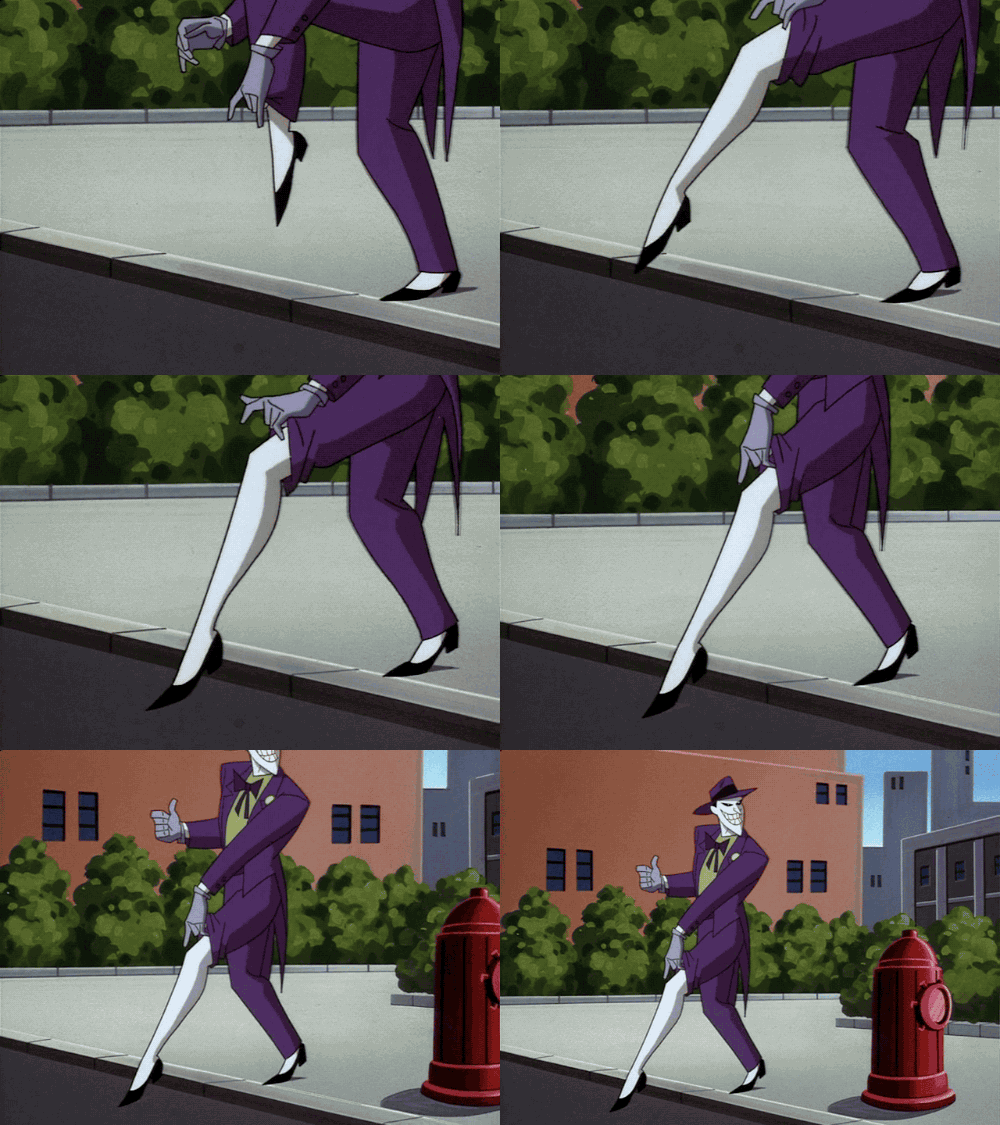

 Swampflix