Roger Ebert Film School, Lesson 35: Royal Wedding (1951)

Roger Ebert Film School is a recurring feature in which Brandon attempts to watch & review all 200+ movies referenced in the print & film versions of Roger Ebert’s (auto)biography Life Itself.

Where Royal Wedding (1951) is referenced in Life Itself: On page 158 of the first edition hardback, Ebert explains his general taste in cinema. He writes, “Of the other movies I love, some are simply about the joy of physical movement.”  One of his examples includes “when Fred Astaire dances on the ceiling.”

What Ebert had to say in his review(s): Ebert never officially reviewed Royal Wedding, but in a 1997 “Movie Answer Man” column he did address a series of Dirt Devil television commercials that appropriated imagery from the movie to sell vacuum cleaners. He complains, “Special effects were used to remove Astaire from Royal Wedding (1951), where he danced with a coat rack, and insert him in a TV commercial, where he danced with a Broom Vac. Rights to use Astaire’s image were sold by his estate. I was reminded that when the late Ginger Rogers was honored at the Kennedy Center, Astaire’s widow refused permission to use any clips of Astaire in the tribute. What would Astaire have thought about those two decisions? A man who could dance on the ceiling would have no difficulty spinning in his grave.”

It’s embarrassing to admit, but the earliest memory I have of watching Fred Astaire dance onscreen was in a series of television commercials from the 1990s, where his image was posthumously altered to advertise Dirt Devil vacuum cleaners. As a child, watching Old Hollywood footage of a man dancing on the ceiling was a potently memorable novelty even with the vacuum cleaner added in, but I assume that same novelty was horrifying for older folks. Evoking one of the world’s most beloved movie stars to peddle digitally-inserted, CGI vacuums was a boldly blasphemous choice from Dirt Devil’s advertising team that I’m sure earned the company at least a decade of cultural side eye. The ugly truth about this transgression, however, is that the ground they were trampling on was far from hallowed. I have since learn to respect Mr. Astaire tremendously for the “Fred & Ginger” musicals he churned out with Ginger Rogers in the 1930s, but, as it turns out, the time the legend danced on the ceiling was far from his creative pinnacle. The majority of Dirt Devil’s digitally-altered Fred Astaire footage pulled from the 1951 musical comedy Royal Wedding. Featuring a . . . seasoned Astaire, the film is at best an entertaining mediocrity, not at all a sacred cow to be protected from the dirty hands of 15-second Superbowl ads.

Fred Astaire & Jane Powell star as a sibling dance team who’re invited across the pond to perform for British royalty at the wedding of Princess Elizabeth & Prince Philip. Besides the complications of maintaining their various bachelor life romances in the pair’s travels to this historic event, Royal Wedding doesn’t have much of a plot beyond that basic premise. Loosely based on Astaire’s relationship with his real life dance partner (and real life sister) Adele Astaire, the film has a kind of rambling, anecdotal quality to it. The dramatic scenes connecting its dance numbers feel like a total waste of time outside providing Jane Powell an excuse to make 10,000 costume changes & proving to the audience that the siblings are not engaged in an incestuous romance. From scene one, it’s uncomfortable that the pair are so closely related, since their dance routines often require them to intimately woo each other with nonverbal body language. The opening dance number, for instance, features Astaire as an idle king ogling Powell as the maid, who tidies up his chamber while flirtatiously revealing her frilly underwear. They eventually dance together in a traditional romantic waltz, only for their sibling relationship to be revealed to the audience as soon as the number is through. To overcompensate for this awkward reveal, Royal Wedding immediately makes it apparent that the two dancers are fucking everyone in the world but each other and most of the movie concerns them juggling potential love interests between dance routines.

As lifeless & belabored as Royal Wedding feels as a 90min comedy, it functions fairly well as an excuse to feature Fred Astaire’s signature footwork. As sullied in the Dirt Devil ads, Astaire dances on the ceiling in one number, Jamiroquai style, as the room rotates but the camera remains fixed. In another sequence, a real life incident of a Fred & Adelle Astaire performance on a cruise ship is recreated with a tilting floor in turbulent waters– the dancers, audience, furniture, and loose objects sliding around the room during the routine as the ship tilts side to side. Astaire also proves he can entertain without those fancy movie magic shenanigans, wowing the audience by performing with a lifeless coat rack for a dance partner (later to be digitally replaced with a much more lively vacuum cleaner). My favorite routine in the film is a vaudeville throwback that “comically” features domestic abuse among impoverished scum. Titled “How Could You Believe Me When I Said I Love You When You Know I’ve Been A Liar All My Life?,” the song features the longest title in any MGM musical and has nothing to do with the plot, but does have a dangerous-feeling mean streak to its scrappiness that I found oddly endearing.

Any of Royal Wedding’s individual dance numbers could be worth seeking out in isolation, especially the ones that have Astaire perform metaphysical, gravity-defying wonders. However, their cumulative effect is only moderately pleasant. I’m not saying it’s right for giant companies to retroactively employ dead movie stars to shill for their products as if we were living in some real world bastardization of The Congress (spoiler: we are). I’m just glad that if Dirt Devil was going to tarnish the memory of a classic MGM musical, at least they picked one that’s so mediocre as an overall product. For every few seconds of Fred Astaire dancing on the ceiling in Royal Wedding, there’s endless minutes of his character rhythmically rubbing bodies with his sister & wasting time between gigs. It’s not too much of a stretch to say that Royal Wedding‘s good name is more tarnished by its incestuous body language and total narrative lack of creative energy than it is by digitally-inserted vacuum cleaners. The only reason the movie is at all entertaining is because Astaire really is that great of a dancer.

Roger’s Rating: N/A

Brandon’s Rating (3/5, 60%)

Next Lesson: True Grit (1969)

-Brandon Ledet

Love It or Hate It, mother! (2017) is the Most Important Major Studio Release of the Year

Darren Aronofsky’s latest go-for-broke provocation, mother!, has already been in wide release for two full weekends, an eternity in the context of internet time. Its already slight box office returns are dwindling; the hot takes have cooled; film culture is desperate to move onto discussing the next big budget comic book adaptation or (I’m not kidding) half-a-year-early rounds of Oscar predictions, already framing mother! discussions in the rearview. It’s been a fun couple of weeks of wildly varied reactions to this aggressively divided work, though. From the rapturous praise to the horror stories of angry, vocal walkouts during the film’s violently bonkers third act, mother! demands discussion & analysis in the way crowdpleaser comedies, superhero action epics, and computer-animated cartoons about talking animals typically don’t. Even the Swampflix crew is harshly divided on mother!‘s merits as a feature film. It’s one of my favorite new releases I’ve seen all year, but Boomer was much less impressed when he reviewed it last week, writing “It aims for the moon and misses, but it doesn’t land among the stars; it plummets back to earth as a fiery wreck, breaking up in the atmosphere and never again reaching the grounding of earth.” However, the important part of that divide is not whether we were individually positive on the film’s handling of its Biblical & environmentalist allegories or the way it makes deliberately unpleasant choices in its sound design & cinematography to get them across. The important thing is recognizing the significance of that “aim for the moon” ambition in the 2010s Hollywood filmmaking landscape. mother! may ultimately make more enemies than it does dollars during its theatrical run, but it’s the most important Major Studio release of 2017 for its ambition alone.

As Boomer wrote, “Good or bad, this one’s going to be on my mind for a while to come.” That kind of stick-with-you effect is invaluable in our disposable media landscape, which is essentially dominated by Superhero of the Week action spectacle & streaming platform “content” binging. Personally, I was much more unambiguously positive on my experience with mother! than Boomer, but just as mentally preoccupied with how it lingered with me after I left the theater. I spent most of my day after watching the film reading over every scrap of impassioned analysis I could find, positive & negative, and was happy to discover that most of the ways I had engaged with the film were already represented in the cultural conversation. I’m of the firm opinion that subtlety is highly overvalued in modern criticism, so I’m tickled that the film is fully committed to its crash course on the entirety of the Bible and (intended or not) Aronofsky’s self-flagellation over the Artist-Muse power dynamics of his own romantic partnerships, a pitch black act of self-analysis that paints the Artist type as much more of a monster than the divine role of the Biblical analogy. I’m also a huge sucker for what I call the “Party Out of Bounds” narrative, where house guests & partygoers are supernaturally compelled to remain in an obviously toxic social environment when it’s clear from frame one that they should leave immediately. On top of his indulgence in religious, environmental, and uncomfortably personal allegories, Aronofsky also uses mother! to experiment with traditional stage play surrealism. Recalling the artificial environments & darkly funny social horrors of surrealist masters like Harold Pinter, Edward Albee, and Luis Buñuel, mother! is on a very basic level a surreally menacing comedy about the horror of having guests over who will not leave, a sentiment I identify with more than I likely should admit. The exciting thing is that all of these tactics & influences have been constantly picked at like scabs over the last two weeks of cultural conversation, along with feminist readings of how its narrative mirrors classic texts like Charlotte Perkins Gilman‘s “The Yellow Wallpaper” and real life horrors like the public’s gendered abuse of Jennifer Lawrence when her nude photos leaked without her consent in 2014. The only person out there limiting the endless possible discussions of mother!’s themes & means is the one person no one should have ever asked: Darren Aronofsky.

For some ungodly reason, several interviewers have asked Aronofsky to explain the (aggressively unsubtle, already blatant) Biblical & environmentalist allegories that drive the film’s lyrical sense of narrative. It was idiotic for him to oblige. I can see how after a week of befuddled theater walkouts & wildly mixed reviews, he’d be tempted to explain himself for those confused or angered by the film, but mother! works so much better as conversation starter without the guiding hand of its creator. Following a summer where many films have (supposedly) financially died by the hands of low scores from critical aggregators like Rotten Tomatoes, movie studios have been very itchy over negative criticism. Low percentages on the dreaded Tomatometer have been a hot topic for studios desperate to explain why “sure thing” releases like Baywatch & The Dark Tower died on the vine (despite, you know, the fact that they looked awful before they were ever reviewed), but what hasn’t been fully dealt with yet is how a high Tomatometer score isn’t necessarily a sign of quality or substance either. Safe, crowdpleasing films from the MCU, Star Wars, and their Disney-adjacent ilk are much likelier to secure a high Tomatometer score than an ambitious, divisive film that splits critics. We need to put more of an emphasis on celebrating aggressive artistic visions that divide opinion and spark contentious conversation. mother!‘s 61% on the Tomatometer means so much more to me than a 90+% approval for safer bet releases like The Big Sick or Spider-Man: Homecoming (both of which we also reviewed positively, mind you). Just because 98% of critics had some degree of a positive reaction to Kumail Nanjiani’s heartfelt, post-Apatow romcom doesn’t mean the film has lingered in their minds the way mother!’s “aim for the moon” ambitions will. Aronofsky would benefit greatly from abstaining from damage control interviews on that critical divisiveness, encouraging people to remain split on his thematic intent & aggressive filmmaking craft. mother!‘s middling Tomatometer score should be a badge of honor for the director, even more so than its already infamous F CinemaScore (which it shares with similarly genius works like The Box & Bug).

mother!‘s thematic complexity, critical divisiveness, and conversation-sparking ambition make it an exciting work to engage with, but they aren’t the reason why the film is culturally important. There were plenty of films released domestically this year I would categorize as just as ambitious & thematically rich as Aronofsky’s work: We Are the Flesh, The Lure, Your Name., Good Time, Get OutRawKuso, etc. What makes Aronofsky’s film important in the context of these admirable go-for-broke works is that it was released & supported by a Major Hollywood Studio. In fact, Paramount Pictures has been infinitely better than Aronofsky himself in handling the negative press over the anger & confusion his film has inspired. In addition to prominently quoting the negative reviews in its advertising, they’ve issued the following statement: “This movie is very audacious and brave. You are talking about a director at the top of his game and an actress at the top of her game. They made a movie that was intended to be bold. […] We don’t want all movies to be safe. And it’s okay if some people don’t like it.” Fuck yeah. In the current cinematic climate, there aren’t nearly enough major player Hollywood studios taking chances like this. Young, promising directors are being snatched up for movie-by-committee superhero pictures before they’re even given a chance to find their own voice (a fate Aronofsky narrowly escaped himself). The most invincibly successful film franchise in the world, Star Wars, is afraid to take risks with directors like Phil Lord & Chris Miller, replacing them with well-behaved, personality-free workmen like Ron Howard at the last possible minute (when that’s who they should have hired in the first place if they just wanted more of the same). Nearly every major release feels like it’s tied to a pre-existing property with a built-in audience, banking on familiarity to coast by as a mild delight. Paramount’s defiant embrace of mother!‘s critical & financial doom is a huge deal. It’s difficult to imagine, for instance, Kubrick films like The Shining & 2001: A Space Odyssey (which were heatedly divisive in their time as well) being released in our current don’t-rock-the-boat climate where every movie has to sell billions worldwide & please 90% of its audience to be considered a success. Paramount daring to release mother! in its current, artistically unmitigated form to such a wide audience and then standing by that decision in the face of critical backlash is a modern movie industry miracle.

Last year, Ben Wheatley’s High-Rise similarly applied Buñuelian sentiments to a “Party Out of Bounds” story turned apocalyptically violent in a blatant allegory about the evils of modern consumerism. It’s a great film and just as worthy of a descendant of Buñuel’s The Exterminating Angel as mother!, but it barely played in theaters before being quietly dumped on Netflix & promptly forgotten. By contrast, mother! is a tonally, visually, and thematically challenging work domestically released almost as wide as a typical by-the-books romcom or superhero action flick (which, again, we generally enjoy as well). That’s an increasingly rare occurrence in the 2010s. Whether you’re as enraptured with its audacity as I am or as conflicted over its allegorical buffoonery as Boomer was, you have to recognize mother!‘s value as a Major Studio risk. I sadly doubt it will change the industry in any significant way, but it’s still a damn important agenda statement from a Major Studio system player, who somehow handled this false crisis of critical division even better than the artist they were supporting.

-Brandon Ledet

Schizopolis (1996) Goes Hollywood: Full Frontal (2002)

When Steven Soderbergh filmed the largely improvised, aggressively irreverent Schizopolis in the mid-90s, he seemed to be deliberately disrupting the flow of his career. After a few consecutive big budget duds failed in wide release, the director returned to the themes & means of his popular debut, Sex, Lies, and Videotape, with the intent of burning them to the ground & shaking himself out of a creative rut. Soderbergh’s one-for-me-one-for-them creative pattern never felt as drastic as when he filmed Schizopolis, which was seemingly made with an audience of one in mind: Steven Soderbergh. The trick worked. The next stretch of the director’s career brought on a string of mainstream successes that made him a formidable creative force within the Hollywood system, instead of a one hit wonder in the 90s indie cinema boom he helped spark. Even success has a kind of complacency to it that begs disruption, however, and early in the 00s Soderbergh returned to the cerebral irreverence of Schizopolis to shake himself out of the comfort of Hollywood System filmmaking.

Following on the heels of major financial successes Traffic & Erin Brockovich, the Hollywood-insider comedy Full Frontal returned to the low-fi absurdism & disjointed structure Soderbergh gleefully turned into a Looney Tunes farce in Schizopolis. Full Frontal is a little less aggressive in its sense of silliness than that 90s work, but is just as prone to jarring non sequiturs, unexplained shifts in form & reality, and playful experimentation with improv. Shot in less than a month on intentionally low quality digital video, the film was called out by contemporary critics for being confusing & visually amateurish, as if those effects weren’t deliberate. For at least the second time in his career, Soderbergh was consciously working in low-fi, anarchic modes of expression to break away from a creative comfort zone that threatened to dull his output. The only difference, really, was that Schizopolis featured mostly non-professional actors (including Soderbergh himself & his real-life ex-wife Betsy Brantley), running amok in the Baton Rouge suburbs, while Full Frontal heavily relies on a vapid Los Angeles movie industry playground for its own hijinks, including public persona-subverting turns from Major Movie Stars like Julia Roberts, Brad Pitt, David Fincher, David Duchovny, etc.

Full Frontal vaguely tackes the shape of many 00s indies with large casts. A collection group of characters weave in & out of each other’s lives in a loose, everything-is-connected narrative over the course of a single day. Actors, producers, public relations drones, playwrights, and every other brand of LA industry type you can imagine entangle and drift apart in various combinations in the day leading up to a mutual friend’s birthday celebration. Occasionally, Julia Roberts poking fun at her America’s Sweetheart™ persona or Catherine Keener asking nonsensical, stream of conscious questions to her employees in layoff interviews will steal the show, but the movie is ultimately more concerned with form than it is with performance. Jarring shifts in visual quality & location of setting will intentionally disorient the audience, especially as (borrowing a page from Sex, Lies, and Videotape) the audio drifts out of sync from the image presented, to a dissociative effect. Sex is blurred & obscured from the camera. Movie within a movie layering & voice-over interviews deliberately confuse what’s “real” within the narrative. Character introductions are presented in headshots before the opening credits (which are actually credits for a non-existent movie Rendezvous) as if they were a playbill in motion. Much like Schizopolis, Full Frontal feels like a filmmaker playing with the basic tools of his craft to reach for freshly innovative effects he could not achieve in the more well-behaved works that preceded it.

There are plenty visual & thematic details connecting Full Frontal & Schizopolis if you intentionally keep an eye out for them. Catherine Keener’s slow-motion romantic breakup with David Hyde Pierce certainly echoes the domestic fallings out between Soderbergh & Bentley’s various doppelgängers in the earlier work. The reality-breaking interview tangents, the drab office place settings (including scenes set in workplace men’s rooms), and Soderbergh’s choice to appear in front of the camera (this time with a blurred-out face, as if he were an episode of Cops) are just a few blatant connectors that run as parallels between the two films. What’s more important is the way the films use an improv-style spontenaity to make the audience feel as if anything could happen. In Full Frontal, a nameless neighbor is shown performing simple domestic chores in a full Dracula costume; an unnamed man crawls across a hotel hallway on all fours in his underwear, unacknowledged; an actor with a Hitler mustache sings the theme song to Cops in a makeup mirror (there’s that show again). This spontenaity revitalizes Soderbergh as a filmmaker, a creator. Instead of shaking up the romantic ennuii of Baton Rouge suburbanites, it disrupts the business-as-usual mundanity of Hollywood’s sycophantic starfuckers & namedroppers, but the intent remains the same even in the transported setting. Unfortunately, these films also share the burden of being overlooked & undervalued for the deftly absurd ways they reshaped & untidied Soderbergh’s career as it evolved into Hollywood-insider status. They’re two of his best films, yet somehow two of his least loved.

For more on August’s Movie of the Month, the irreverently cerebral Steven Soderbergh comedy Schizopolis, check out our Swampchat discussion of the film, this comparison of its romantic doppelgänger crisis to the similar themes of Anomalisa (2015), and last week’s look at how it violently subverted the director’s hit debut, Sex, Lies, and Videotape (1989).

-Brandon Ledet

Schizopolis (1996) Brought Soderbergh Back to Home Base Only to Burn It to the Ground

One of the most exciting aspects of September’s Movie of the Month, the irreverently cerebral Steven Soderbergh comedy Schizopolis, is in trying to figure out exactly who it’s for. As a filmmaker, Soderbergh has consistently maintained a one-for-me-one-for-them creative pattern, balancing out crowd-pleasers like the Oceans & Magic Mike series with head-scratchers like Solaris & The Girlfriend Experience. Few creative enterprises have ever felt as self-satisfying as the deliberately impenetrable Schizopolis, however, which was seemingly made for Steven Soderbergh and Steven Soderbergh alone, an audience of one. What’s interesting is that as insular & self-indulgent as Schizopolis can feel to anyone who isn’t Steven Soderbergh, it also closely resembles the debut crowd-pleaser that jumpstarted his career, a feature that made him a name before he had even fully found his voice. In a way, Schizopolis documents Soderbergh’s return to his creative home base, his professional launching pad, only so he could set fire to the good will it generated and move on with his life. Soderbergh may have built his career on a one-for-me-one-for-them ethos, but Schizopolis is a rare case of the director returning to one of his one-for-them successes with an anarchic intent to explode his own legacy.

Sex, Lies, and Videotape was a Big Deal in 1989. At 26 years old, Soderbergh was the then-youngest director to win the Palme d’Or at Cannes with this debut feature, which then went on to earn great financial success that made a name for the Sundance Film Fest and was a major player in kick-starting the 90s indie cinema boom. That success also weighed heavily on Soderbergh’s shoulders. A film famously written on a legal pad during a week’s worth of travel and filmed in just a month’s time in Soderbergh’s makeshift home city of Baton Rouge, Sex, Lies, and Videotape quickly built the young director up for a massive professional fall, a danger he immediately succumbed to. His three immediate follow-ups– Kafka, King of the Hill, and The Underneath— bombed critically & financially, leaving him dangerously close to becoming an indie cinema one hit wonder. To shake himself out of this professional slump, Soderbergh returned to Baton Rouge as a prodigal son to film another hastily-written, dirt cheap reflection on domesticity & suburban ennui. Where he had formerly crafted a poignant, darkly funny drama that struck a chord with everyone within earshot, he now seemed determined to cut loose with a nonsensical comedy designed to strike a chord with no one. Schizopolis was the inverse, anti-matter version of Sex, Lies, and Videotape, a kind of self-targeting professional blasphemy that set Soderbergh free from the expectations set by his initial success.

Much like Schizopolis, Sex, Lies, and Videotape is about a long-married Baton Rouge couple struggling to maintain intimacy & honest communication as their domestic life loses its initial spark of romance. Andie MacDowell stars as a bored suburban housewife who doesn’t believe women enjoy sex as much they report to while her eternally horny husband cheats on her with her equally oversexed sister. Although she’s never experienced an orgasm and is embarrassed to discuss masturbation even with her therapist, her sexual appetite is seemingly awakened by the arrival of her husband’s old college buddy, a drastically gloomy James Spader. Spader’s lovelorn drifter is an impotent fetishist who can only get off by interviewing women about their sexual past on the titular videotapes, which he watches in isolation. McDowell’s lack of a sexual appetite & Spader’s social impotency amounts to a kind of sexual miscommunication that builds nicely with the ambient tension of Sex, Lies, and Videotape‘s Cliff Martinez score. The film’s payoff is in watching two emotionally wounded animals eventually get on the same page to fulfill their obvious desire for one another, despite the communication breakdown of their sexual language. Paradoxically, Schizopolis would later make this exact kind of romantic miscommunication more literal and more abstract.

Schizopolis may return to the themes & settings of Sex, Lies, and Videotape, but it also feels hostile to the commercial elements that make Soderbergh’s debut a universal success. Themes of romantic miscommunication are made irreverently literal as a husband & wife’s dialogue are overdubbed in two incompatible languages or converted to generic, nonsensical placeholder phrases. Where Sex, Lies, and Videotape was hastily written, Schizopolis is almost wholly improvised, making its spontaneity even more abrasive. In his debut, Soderbergh made sure to keep his Baton Rouge setting mostly confined to interiors, where MacDowell’s thick Southern accent is the only identifying element at play that makes it feel unlike Anywhere, America. By contrast, Schizopolis makes a point to document as many Baton Rouge-specific exteriors as possible, to the point where half our initial conversation on the film was distracted by its tourism of a city where most of us had lived at one time or another in the 2000s. He made the film even less universal by casting himself & his ex-wife (Betsy Bentley) as the film’s romantic doppelgängers; not to mention the lack of commercial appeal inherent to an irreverent film about romantic doppelgängers in the first place. It’s a film that covers the same adulterous, dispirited, emotionally dysfunctional territory as Sex, Lies, and Videotape, but with none of the universal appeal that made that landmark erotic thriller a critical & financial hit, deliberately so. It even forsakes the immediate appeal of its predecessor’s instantly intriguing title.

As disparate as the approaches in Soderbergh’s Baton Rouge-set domestic dramas seem aesthetically, there’s actually a fair amount of Schizopolis’s DNA detectable in Sex, Lies, and Videotape. Besides the obvious overlap in themes & setting, one of the more striking aspects of Sex, Lies, and Videotape is the dissociative disconnect between the movie’s imagery & its soundtrack. From the opening sequence where Andie MacDowell rambles to her therapist about waste disposal while the audience watches James Spader travel to Baton Rouge as a prodigal son to later scenes where her confessions of sexual appetite deficiency overlap with images of her husband’s infidelity, Sex, Lies, and Videotape is playful with the ways the sights & sounds of cinema can manipulate audience perception when out of sync. Schizopolis pushes this dissociative effect to a comedic extreme, jarring its audience out of sync at every possible turn with the irreverence of a feature length Monty Python sketch gone rogue. By returning to his earliest success in filmmaking experimentation, Soderbergh rediscovered the tools & effects that initially excited him in the first place, then decided to push them as far as the medium (and perhaps past where his audience) would allow. He picked apart & set aflame the basic components of his first feature in an eccentrically personal work that seemed to violently shake him out of a five year sophomore slump and led directly to the most successful stretch of his career to date.

For more on August’s Movie of the Month, the irreverently cerebral Steven Soderbergh comedy Schizopolis, check out our Swampchat discussion of the film and last week’s look at how its romantic doppelgänger crisis compares to the themes of Anomalisa (2015).

-Brandon Ledet

Rene Brunet Jr., Hitchcock, and the Prytania’s Classic Movies Series

Oddly, the only time I’ve ever written about recently deceased local legend Rene Brunet, Jr. for this site was when I saw the storied theater operator introduce Cinema Paradiso for the Prytania Theatre‘s 100 Year Anniversary two long years ago. Brunet’s family has been in the business of local cinema operation since the 1900s and, at 95 years old, Rene had owned & operated many local cinemas himself over his seven decades in the profession. Within my lifetime, his name had become synonymous with the Prytania Theatre, which he had operated since the mid 90s. The last single screen neighborhood theater still playing movies in Louisiana, the Prytania is the physical manifestation of Brunet’s love of cinema history, a passion he’d fed into the co-authored book There’s One in Your Neighborhood: The Lost Movie Theaters of New Orleans and, more importantly (to me), the theater’s weekly Classic Movies series. Since the Classic Movies series began almost a decade ago, Brunet had been introducing his old favorites from cinema past every Sunday & Wednesday morning he could physically make it, usually with the same kind of anecdotes he preceded that Cinema Paradiso screening with. I’ve personally become very attached to those screenings over the past few months especially, thanks to the Prytania’s partnership with the New Orleans Film Society. Given that a particular week’s selection looked to be of interest, I’d make those screenings an essential part of my weekly movie-going routine. These aren’t the 35mm prints or 4k restorations of fancier art houses around the country (although the Prytania often programs those as well). Most films that screen for the Classic Movies series aren’t even presented in their intended aspect ratio. Besides the basic thrill of seeing them big & loud with an audience, Rene Brunet, Jr.’s passion for each selection is largely what made those screenings a weekly draw and I never heard him more passionate than he was when he was talking about Hitchcock.

The last movie Brunet introduced at those Classics screenings was The Wizard of Oz, a viewing experience that completely melted my mind in its Technicolor vibrancy, despite having grown up with its eternal repetition in television broadcasts. After a couple behind-the-scenes anecdotes, Mr. Brunet sweetly asked us if there were any bad witches in the audience, admitting that he could only see good ones. He would always deliver these routines from the perch of his wheelchair at the front of the crowd. Then, as he prompted the projectionist to start the feature, he’d be wheeled to the back while reminding us off-mic, as if he’d forgotten, to join him in the lobby for conversation after the movie, where “Coffee and cake are complimentary!” I never spoke to him in the lobby myself, but there was always something adorable about watching him hold court over the older patrons in his Three Stooges necktie as I made my way into the Sunday afternoon sunshine. I’d even come to get used to, if not sadly miss, the loud wooshing sounds of his oxygen tank at the back of the theater during the pictures, which was audible no matter where you sat. In a lot of ways, The Wizard of Oz was the perfect final picture to share with Mr. Brunet. Not only does it encapsulate the Old Hollywood movie magic he attempted to promote with the Classic Movies programming, but the pre-screening music at the Prytania is often a piano rendition it “Somewhere Over the Rainbow,” so that space & that film are already forever linked. I will say, though, that I had come to most closely associate the series with the work of Alfred Hitchcock. I never knew Brunet personally enough to suppose who is favorite filmmaker might have been, but I got the sense that he always treated Hitchcock screenings with a special care & enthusiasm. They were always the highlight of the Classic Movies schedule and it’s downright eerie watching the director’s work at those Sunday morning screenings in Brunet’s absence.

In particular, I’ll always owe Rene Brunet’s enthusiasm in presenting To Catch a Thief for the series, a screening he prefaced with anecdotes about Hitchcock’s hatred of eggs & where to look for that distaste in the film. To my surprise, what’s often dismissed as one of the director’s more frivolous works quickly rocketed up to one of my favorites in his catalog. Surely, the benefit of seeing that Technicolor sex comedy (which is superficially dressed up like a heist thriller) big & loud with an appreciative crowd had a large part in my enthusiasm for the work. However, I’ve been to two Hitchcock screenings since Brunet’s career-concluding presentation of The Wizard of Oz and, while I’m not sure exactly how much the effect of his absence had to do with my reaction, I just didn’t feel nearly as strongly. For the deviously taut thriller Stage Fright, I may have been worried by the video introduction from Mr. Brunet, whose physical absence was alarming, given his age & the appearance of his health. By the time Strangers on a Train was presented, the news he had passed was weeks in the rearview, but still a difficult adjustment. This was the first time I’d ever seen Strangers on a Train, which is just as slyly funny & visually impressive as To Catch a Thief, but didn’t hit me with the same intensity. Several sequences within the film undeniably felt like Best of All Time cinema landmarks: the Love Tunnel stalking, the Life or Death tennis match, the spectacle of the out-of-control carousel crash, etc. I just wasn’t as enraptured with it as I was with To Catch a Thief‘s much cheaper sex jokes & Technicolor pleasures. That likely has a lot to do with my generally trashy tastes and the expectation levels set by the film’s respective reputations, but I’m sure the environment I saw them in didn’t help Strangers much either. With To Catch a Thief I saw a local legend cheerfully introduce a little-loved work from what appeared to be one of his favorite artists. With Strangers on a Train I had to reflect on the reality that I’d never share that experience with Mr. Brunet again, which is a sad enough circumstance to sour any theater-going experience. He wasn’t there to hold my hand through another long-overdue Hitchcock initiation and the absence of his enthusiasm was immediately felt.

While it is emotionally distressing that Rene Brunet, Jr.’s physical presence will no longer be a part of the Prytania or its Classic Movies series, his influence on that New Orleans culture cornerstone is promised to continue in perpetuity. His son Robert Brunet continues on as a co-operator for the theater as it transitions into its second century serving the neighborhood. His portrait that hangs in the lobby has been updated with a plaque commemorating his passing. Even more endearing is the decision to have Rene continue to introduce the Classic Movies series even though he can’t be there to offer complimentary coffee, cake, and conversation after the credits roll. When I saw Strangers on a Train, the feature was preceded with a short video clip of Mr. Brunet speaking to the audience from a seat within the theater, enthusiastically addressing us with a “Welcome to the big screen!” They even retitled the series Rene Brunet’s Classic Movie of the Week, a tweak I pray that sticks indefinitely. Even beyond those weekly screenings and that small brick building on Prytania Street, Brunet’s presence is something that’s going to forever linger in New Orleans film culture. Every time I see a Hitchcock classic for the first time I’m going to hear his excited voice encouraging me to take notice of the tiny details and backstage lore. Every time I attend a local film fest or indie cinema I’ll have to appreciatively keep in mind the loving care he put into keeping that culture alive, especially in a time when it felt like AMC was going to eat this city alive. Rene Brunet, Jr. is already dearly missed, but his near century-long enthusiasm for the local cinema experience means he’ll always be a part of how people in this city watch & appreciate movies, especially the classics.

-Brandon Ledet

The Supernatural Romantic Tedium of Anomalisa (2015) & Schizopolis (1996)

In our initial discussion of our current Movie of the Month, the irreverently cerebral Steven Soderbergh comedy Schizopolis, I asked Boomer how he felt the film’s tale of adulterous doppelgängers differed from the similar themes in Charlie Kaufman’s recent stop-motion drama Anomalisa. In Schizopolis, Soderbergh & (his real life ex-wife) Betsy Brantley play duel sets of doppelgängers who cheat on each other in existential searches for romantic passion, only to find more of the same in their “new” partners. To me, this “Love the one you’re with” messaging felt wildly different from Anomalisa‘s central conflict, in which a traveling businessman sees the entire world outside himself as one homogeneous personality except for the woman he’s currently cheating on his wife with, until she too is absorbed into the society of milquetoast doppelgängers that populate his life once the initial spark is gone. I asked Boomer for insight on this difference because I knew he’d be better at articulating it than I would. He wrote, “Schizopolis is a film about projection, but in a way that explores the various ways that multiple individuals categorize and compartmentalize their interactions between different people depending upon the intimacy (or lack thereof) of their relationship, the difference in their social classes and the power dynamic thereof, the emotional distance between them, libido, and other factors. Instead of Anomalisa‘s Michael facing the difficulty of seeing every person–strangers, his wife, his ex, his boss–as the same, Fletcher Munson’s interactions vary, demonstrating the dissonance between his words and his thoughts in his conversations with various people.” Those differences in varying social interactions & perspectives truly are essential to what distinguishes Schizopolis from Anomalisa. It still surprises me, though, how significantly the two works overlap in form to achieve their respective goals.

One of the most immediately striking aspects of both Anomalisa and Schizopolis is the crudeness of their visual forms. Shot with no solid script while palling around Baton Rouge, Schizopolis has a strikingly informal look to it, approximating the home movies & sketch comedy hybrid that defined the style of The Kids in the Hall. For its part, Anomalisa adopts the medium of stop-motion animation, which inherently has a kind of imperfect crudeness to its motions. Offsetting the leaps made in the medium by studios like Laika, however, this film intentionally shows the creases in its characters’ faces, calling attention to its own seams & artifice. Both films also dwell on the anonymity of utilitarian spaces & the empty babble of corporate speak. In Anomalisa, Michael’s depression is amplified by the doldrums of occupying a hotel room while away on business, with nothing especially exceptional about his transient spacial surroundings. The Baton Rouge office buildings & suburban homes Fletcher Munson drifts through in Schizopolis are just as unremarkable & devoid of personality. Munson’s job writing nonsensical speeches for the L. Ron Hubbard reminiscent cult leader of Eventualism & author of How to Control Your Own Mind is also reflected in the big speech on optimizing customer service efficiency (or some other empty form of corporate chatter) Michael travels to deliver. For two films about supernatural events in which bored businessmen drift into romantic entanglements with physical copies of their partners, Anomalisa & Schizopolis both make a point to keep their visual pallets anonymously bland & unassuming. They both seek to wring the supernatural out of the mundane, which requires the outlandishness of their premises to be rooted in visual monotony. The differences between their achievements have less to do with their respective visual styles than with how one story takes boredom with the hegemony as a freeing opportunity for irreverence while the other allows that boredom to fester into contempt.

As Boomer wrote in our initial conversation, “The biggest difference between the two films is in the fact that Anomalisa only gives us Michael’s point of view and insight into his particular problems with intimacy, communication, empathy, and humanity. […] Shizopolis gives us the points of view of several people, and highlights how each of them have their own problems with communication, which vary from person to person.” It’s arguable which choice of perspective makes for a more rewarding film, but being stuck in Michael’s head certainly makes Anomalisa the more uncomfortable watch. In Schizopolis, Soderbergh casts himself as a bland everyman. Anomalisa envisions a world where every man is bland. Not only is every character outside Michael’s head boring (and vaguely reminiscent of Michael Ian Black); they’re also an annoying, unremarkable sea of braying idiots with nothing unique to offer the world. I appreciate the bizarre accomplishments of Anomalisa from an emotional distance, but never truly fall in love with the film because it feels as if it should display just as much contempt for its villainous protagonist as he does for the rest of the world. Whether or not his perspective is the symptom of a chemical imbalance, the lack of empathy in Michael’s worldview makes him out to be an elitist monster who’s far more difficult to resonate with than Fletcher Munson’s more recognizably common suburban doldrums. Schizopolis is willing to examine its protagonist’s close-minded selfishness in its third act reversal of perspective that replays scenes through Mrs. Munson’s POV, while Anomalisa just dismisses Michael’s cruel boredom as “psychological problems,” as if they’re something universally experienced. The most perspective we get from Jennifer Jason Leigh as Michael’s titular love interest is a sweetly pathetic rendition of “Girls Just Wanna Have Fun,” which is played more for pity than it is for empathy.

As much as I prefer the deranged silliness of Schizopolis to Anomalisa‘s bitter people-watching, Michael’s climactic speech about customer service optimization does devolve nicely into a kind of dual mission statement for both films. He asks himself (and his audience) “What does it mean to be human? What is it to ache? What is it to be alive?” in existential desperation, only to answer those questions with frantic repetitions of “I don’t know, I don’t know, I don’t know.” These films approach that crisis and the oppressive mundanity of modern life from entirely different perspectives. Schizopolis searches for meaning in interpersonal relationships, finding its frustration with the ineffectiveness of language at truly connecting two human souls in a punishingly tedious world that increasingly doesn’t make sense. Anomalisa, by contrast, despairs at the punishing tedium of other people, who are just as uninteresting & personality-free as hotel room furniture. No matter which perspective you find more honest or worthwhile, it’s eerie how much these visually crude doppelgänger narratives overlap in form. Their supernatural romance dramas are rooted in two incomparable philosophies, yet they’re both staged in a common, tedious modern world setting with intentionally limiting means of expression.

For more on August’s Movie of the Month, the irreverently cerebral Steven Soderbergh comedy Schizopolis, check out our Swampchat discussion of the film.

-Brandon Ledet

The Well-Intentioned Letdown of When John Waters Targeted the Art World

Starting with the mid-career course correction of Polyester, cult director John Waters had a kind of creative epiphany. In his earliest works of divine genius (Multiple Maniacs, Pink Flamingos, Female Trouble, etc.), the trash-dwelling provocateur gave life to insular freakshows of over-the-top Baltimore personalities, outsiders who were naturally exuding a punk rock nastiness when hippie feel-goodery still ruled the counterculture. Polyester and its suburban-set follow-ups (Hairspray, Cry-Baby, Serial Mom) found an even more subversive platform for his cinematic freaks, contrasting their outlandish trashiness with the supposedly more well-behaved sect of Proper Society. Hairspray & Cry-Baby were especially adept at exposing suburbia for being a sea of hateful, racist, close-minded assholes in a way that wouldn’t be apparent in more insular settings like Desperate Living‘s Mortville, where the weirdos keep to themselves. After four consecutive films exposed this suburban evil, however, Waters was in need of a new target. Mainstream commercial success had entirely changed his outsider status as a renegade filmmaker & a provocateur by the mid-90s. Waters found himself the toast of both the suburban monsters he’d lampooned for the better part of a decade and the art world snobs who enjoyed his early works for their supposed dedication to irony. With suburbia thoroughly skewered, the director fired off two successive films that targeted the ironic hipsters & mainstream moviegoers who fundamentally misunderstood his passions & his appeal. The intent was admirably calculated, but the results were . . . mixed.

It pains me to write anything even remotely negative about a director I consider to be the greatest artist, if not greatest human being, of all times forever. The nu-metal vibes of the late 90s & early 00s were just poisonous for pop culture in general, though, so it would make sense that Waters would experience the worst creative slump of his career in that era. You can feel him introspectively reaching for something to say in his 1998 comedy Pecker, which continues his childhood period piece navel-gazing in Hairspray & Cry-Baby by centering on a weirdo teen artist who accidentally makes it big just by goofing around with his nobody loved-ones in Baltimore. I think the biggest misconception of Waters’s career, particularly in his early “trash” pictures, is that his portrayals of over-the-top Baltimore caricatures are entirely rooted in a sense of irony. Those pictures are actually coming from a place of feverishly obsessive love. There’s obviously a sense of camp that informs his humor, but Waters also deeply loves & admires early regulars like Divine, Mink Stole, and Edith Massey (as well as his home city of Baltimore) and seemingly only makes his films as a way to document & broadcast their art & their obsessions. Pecker is, above all else, a film about that clash between his intent & public perception of his work. Just as Waters obsessively made movies about his weirdo friends in 1970s Baltimore, he depicts a young photographer (Edward Furlong, the titular Pecker) who obsessively documents his loved ones & their surroundings on the same city streets. That’s why it’s such a betrayal when, in the film and in life, Big City hipsters latch onto those characters only with a sense of irony, laughing at them instead of with them.

Pecker is a film about obsession & authenticity. Even beyond the titular protagonist’s bottomless passion for photography, every character in his social circle has a sitcom-esque dedication to a singular interest: candy, laundromats, shoplifting, clothing the homeless, gay men, pubic hair, ventriloquism, teabagging, etc. These damned souls stay dutifully within their own lanes, only speaking on their one respective topic of interest whenever prompted for dialogue. Pecker finds their passions endearing & documents them within his own sole interest: photography. When his art takes off to an unlikely notoriety in New York City, he assumes everyone championing his photographs is similarly celebrating the beauty of his subjects. Instead, they’re ironically laughing at his “culturally challenged” family & friends for their perceived tackiness. Once this Big City hipster irony is revealed as a real world evil, the film eventually takes the form of a good-natured revenge tale. Pecker invites his new Art World “friends” to Baltimore for his latest show, where they’re given a taste of their own medicine as the derogatory subject of his photographs, a source of mockery. They’re briefly gawked at by Baltimore weirdos as the true freaks for once, until Pecker unites both sides for a climactic party where everyone shares indulgences in each other’s obsessions & collectively cheer, “To the end of irony!” The point being made in that celebration is admirable and I love that Waters took his audience to task for looking down on his weirdo friends as inhuman curiosities instead of genuinely joining in the celebration of their obsessions. The comedy just doesn’t feel as sharp or, frankly, as dirty as it should to match the laugh riot heights of earlier triumphs. Besides a few details involving strip clubs & gay bars (of which The Fudge Palace feels like an obvious ode to New Orleans staple The Corner Pocket), the film didn’t feel very much interested in its own subjects, at least not with the same obsessive intensity they were interested in things like candy & pubic hair. It seems in making a film about art & obsessions, Waters somewhat lost track of funneling his own passionate obsessions into his art.

Cecil B. Demented, the 2000 follow-up to Pecker, feels even more creatively exhausted. Waters shifts his focus slightly from the irony of Art World assholes to the slow death of modern cinema, which he sees as being completely drained of the obsessive artistic passions of his earlier work. Here, the director sides with the artsy types he previously lampooned in order to take aim at the corporate business end of film production. In an opening credits sequence that’s only become more relevant as the years roll on, movie theater marquees are overrun by sequels, franchise titles like Star Trek & Star Wars, comedies starring disposable knuckleheads like Pauly Shore, and art films dubbed from their original languages. As Pecker toasted, “To the end of irony!,” Cecil B. Demented cries, “Death to those who support mainstream cinema!” This is essentially a heist picture where a “teenage” gang (including early appearances from Michael Shannon, Maggie Gyllenhaal, and Adrian Grenier) kidnaps a famed Hollywood starlet (Melanie Griffith, who has no trouble slipping into the role of Terrible Actress) and forces her into a guerilla film production that often borders on outright terrorism. Literally wearing their influences on their sleeves in the forms of tattooed names like William Castle, David Lynch, Herschell Gordon Lewis, and Kenneth Anger, they attempt to disrupt business-as-usual Hollywood filmmaking by bringing artistic obsession back to the forefront of the industry. There’s an unfortunate irony in this intense focus on authenticity, as the movie doesn’t feel nearly as dangerous or as personal as Waters’s own past in guerilla filmmaking. His murderous cinephiles are certainly silly, but you get the sense that he’s on their side, while still failing to live up to their impossible ideals. “Technique is nothing but failed style,” is a great line in isolation, but I’m not sure what it means in a work that’s Waters’s least funny, least stylish, and most obedient adherence to the mainstream technique of its time: the nu-metal Dark Ages.

By the mid-90s, John Waters’s outsider aesthetic had become an essential part of mainstream filmmaking thanks the gross-out comedy boom that followed the success of There’s Something About Mary. There’s an “Okay, what now?” quality to Pecker & Cecil B. Demented that might be a direct result of that assimilation. With a sensibility he was on the ground floor of establishing now the mainstream standard and his own personal obsessions already documented for infamy in previous works, Waters had to find new purpose for his art in a time mired in one of our worst modern pop culture slumps. I admire his ambition in tackling the commercial end of art production in Cecil B. Demented & the earnestness of the art consumer in Pecker, even if I believe those films to represent his worst creative period. Not only is it a half-assed put-down for me to call out a film or two for being the worst releases from my favorite director; this story also has a happy ending in John Waters eventually getting his groove back back in the excellent 2004 sex comedy A Dirty Shame, his most recent (and most underrated) film to date. Having proven himself in so many other titles that transcend these nu-metal era doldrums, Waters’s Art World potshots are worth having around if not only for giving voice to the director’s take on the art & commerce compromises of his industry. Characters describing Pecker’s photography persona as “a humane Diane Arbus” while Cindy Sherman (playing herself) walks around art galleries offering Valium to children or a dangerously horny Michael Shannon shouting “Tell me about Mel Gibson’s dick and balls!” are worthwhile indulgences for their own sake, even if they don’t match the obsessive passion of documenting Divine & Edith Massey’s exploits in the Dreamlanders era. I may wish that the final products were a little funnier & more artistically distinct, but I love that Waters took the time to dismantle art world pretension & empties commercialism once he was done vilifying suburban normies.

-Brandon Ledet

John Waters’s Period Pieces as Punk Culture History Lessons

One of the most fascinating aspects of early John Waters pictures like Multiple Maniacs & Pink Flamingos is how at home they feel with punk culture despite being released well before punk even had a name. Waters’s early 70s freak shows arrived at a time when feel-good Free Love vibes dominated the counterculture, feeling completely out of step in their amoral nastiness & gleeful shock value chaos. The leopard print & leather costuming, bright hair dye, old cars, and return to straightforward rock n’ roll (as opposed to the era’s psychedelic folk & bloated arena rock) of Waters’s early films telegraphed & possibly influenced a lot of what the punk subculture would come to accept as identifiers & badges of dishonor in the years to follow. It’d be easy to think of Multiple Maniacs & Pink Flamingos as being ahead of their time in that way, but a lot of those signifiers of tackiness & bad taste were actually deliberately old-fashioned & out of style holdovers from the 50s & 60s. Waters’s freak show atrocities were poor, degenerate weirdos, conspicuously out of step with the times & repurposing fashion from their parents’ closets and secondhand stores around Baltimore. Waters’s early films suggest that punk culture had existed long before it had a name; watching teen rebels in 1950s garb devour cops alive in Pink Flamingos and defile Catholic churches with blasphemous ass play in Multiple Maniacs bridges the gap between early rock n’ roll rebels & the punk era’s return to that nasty simplicity by skipping over hippie niceness entirely. When the director made his move into mainstream filmmaking with the period pieces Hairspray & Cry-Baby in the 1980s, he made that connection even more explicit, detailing the undercurrent of punk culture rebelliousness that’s always existed among teen outsiders & societal rejects.

Waters often cites Hairspray as the most subversive film of his career. The idea that the unapologetically queer director of some of the greatest shock value films of all time somehow made a massively popular PG-rated comedy about the evils of racism definitely feels like a provocateur getting away with something. Set in early 1960s Baltimore, Hairspray recreates the American Bandstand era pop music mania of Waters’s youth both as a nexus of nostalgia for the time’s tacky fashions & as a platform to discuss the hypocrisy of cultural appropriation. The white teens of the film’s bygone suburbia structure their entire lives around dancing on television to black music, but refuse to integrate socially with actual black people. A baby-faced Ricki Lake stars as Waters’s chief rabble-rouser, who protests Baltimore’s local Bandstand knockoff (The Corny Collins Show) for failing to racially integrate beyond featuring black musicians as performers. This defiance (on top of her default outsider status for being heavier than other teen girls on the show) leads our hero down a back alley world of beatniks, hair hoppers, and black Baltimore teens she didn’t have prior access to at home with her worrisome parents (Divine & Jerry Stiller, history’s greatest power couple). Hairspray somewhat succumbs to the common Hollywood problem of glorifying white people for solving racism, but it also makes it clear that America’s worst monsters are smiling, white, suburban faces. As Edith Massey warns in Female Trouble, “The world of heterosexuals is a sick & boring life.” With the exception of the beatniks, whose portrayal’s even more cartoonish than the Roger Corman take in Bucket of Blood, teen counterculture is presented here as the sane alternative to the hideous norm. Hair hopper fashion is far from the signifiers of punk telegraphed in earlier Waters films, but it is equally garish and designed to outrage parents. The music may also be a much simpler, more soulful version of rock n’ roll, but it’s operating with the same rebellious spirit that punk aspired to echo as a disruption to hippie feel-goodery. Hairspray offers Waters’s tamest (and possibly most subversive) version of protopunk teen rebellion, but its historical sense of outrageous teen fashion & disgust with racial fascism are at least in line with punk ideology.

The punk undercurrent is much more immediately apparent in Hairspray‘s follow-up, Cry-Baby. Flipping the calendar back even further to the teen rebels of the 1950s, Cry-Baby is a movie musical pastiche of teen gang melodramas like The Wild One & Rebel Without a Cause (with a little Jailhouse Rick thrown in for good measure). Johnny Depp stars as the titular Cry-Baby, a teenage delinquent who constantly breaks laws to honor the lives of his dead criminal parents, but then cries for the evil things he has to do in their name. The leather jackets & straightforward rock n’ roll of Cry-Baby‘s world are a clear source of inspiration for punk’s barebones, no frills ethos. Although racism is certainly at play in suburban Baltimore’s hatred of its teen counterculture element, the movie distills its “squares” vs. “drapes” dichotomy by making teenage outsiders’ very existence the scourge that’s being targeted. When a young teenybopper dares to cross the social line dividing squares & drapes (becoming a “scrape” hybrid, according to Ricki Lake’s crony), she completes the transformation with a Bad Girl Beauty Makeover, which is very similar to the way young outsiders are inducted into punk culture with shaved heads, piercings, new names, etc. I’m not a huge fan of the songs performed during Cry-Baby‘s traditional movie musical numbers, but seeing the same mainstream production design from Hairspray being applied to a love letter to teenage delinquency in those moments of Hollywood Tradition feels like yet another subversive act on Waters’s part. Waters looks back to the Elvis musicals of his youth to draw a direct connection from the leather jacket rock n’ roll of that era to the protopunk outsider freaks he previously featured in his early Dreamlanders productions. He may have been ahead of the curve on punk culture, but he’s more than willing to provide historical context on why he wasn’t the first to get there.

Just in case you weren’t already clued in by the teenage delinquency and hair hopping social outrage of his two period pieces as punk culture history lessons, Waters also cast two punk icons in central roles in the films. In Hairspray, Debbie Harry features as the racist, uptight mother of one of the most popular dancers on The Corny Collins Show. Cry-Baby casts Iggy Pop as a wild-eyed societal outcast who never outgrew his rebellious teen spirit (not that he really stood much of a chance in avoiding that). Waters’s early 70s version of protopunk grime feels far less out of nowhere after the historical context laid down in these two period pieces, which is an invaluable history lesson on punk’s eternal spirit in teen awkwardness & angst, political or otherwise. More importantly, though, these two films allow Waters an opportunity to contrast the warmth & righteousness of those outsider communities with the grotesque horrors of straight, square suburbia. Polyester was an epiphanic moment in the filmmaker’s career where the aping of Douglas Sirk melodramas showed him the value of contrasting his societal freakshow outsiders with straight-laced, “normal” settings. Hairspray & Cry-Baby focused more intently on exposing these settings as hateful, destructive forces. By bringing his cavalcade of horrors to suburbia, Waters found a chance to emphasize how mainstream culture was so much worse, from the broken legal system to white women spouting hateful racism in the faces of black youth to the grotesque wet smacks of heterosexual teens making out (which is far more disgusting than watching Divine eat dog shit, to be honest). John Waters’s punk culture history lessons are not only a great reminder of the consistent presence of teenage delinquents & societal outcasts in modern American life, but also a necessary indictment of the hatefully homogenized culture those small scale rebels buck against with their mere existence. The great punchline to that joke, of course, is that the mainstream culture he skewered in those two titles ate up that shit & financially sealed his fate in filmmaking infamy. He not only profiled the evolution of punk spirit through the ages, but also sold that historical glorification to the very people who made punk politically & culturally necessary.

-Brandon Ledet

Movie of the Month: Schizopolis (1996)

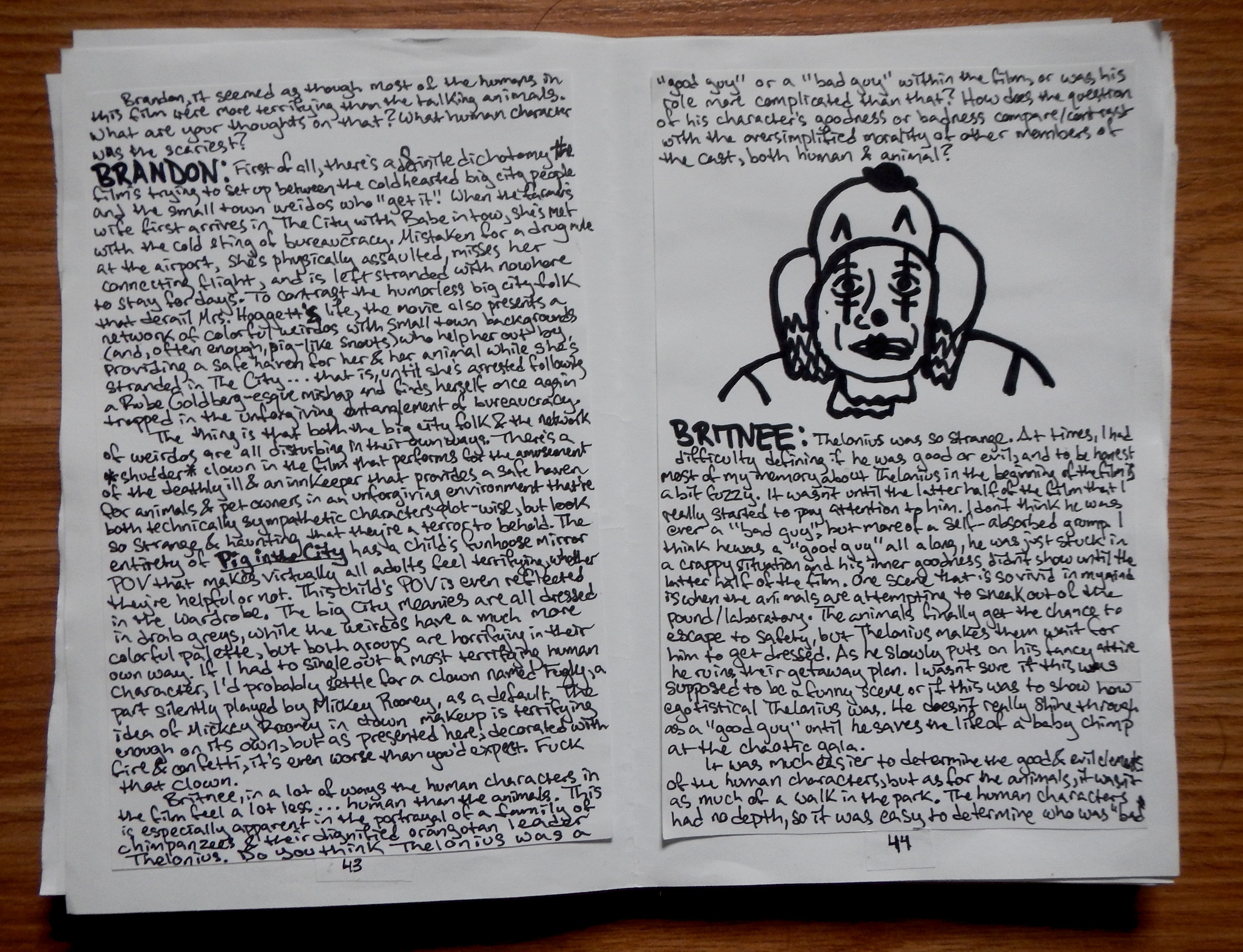
Every month one of us makes the rest of the crew watch a movie they’ve never seen before & we discuss it afterwards. This month Alli made BritneeBrandon, and Boomer watch Schizopolis (1996).

Alli: I spent my teenage years moping away in Baton Rouge. I lived in the thick of the suburban sprawl, I dealt with LSU Tigermania, and I struggled with the boredom of living in a place where the main source of entertainment was trying to learn to be into football or embracing the wacky nature of not really belonging. I didn’t watch Schizopolis until after I had moved to New Orleans, but it just stuck with me how the film doesn’t explicitly say it’s set in Baton Rouge anywhere, yet Baton Rouge is everywhere. All of the city’s most iconic landmarks are onscreen: Louie’s Cafe, the local new age emporium Coyote Moon, Highland Park (which I wonder if they even got permission for the obscene moments they filmed there), and the strip mall where Little Wars, the game store and nerd refuge, is located. Basically, Baton Rouge is integral to me as far as Schizopolis is concerned. Outside of the disjointed narrative and surrealist moments of invented language, it’s basically a movie about how the typical American suburban life with a cubicle office job drives you a little crazy.

The main character played by director Steven Soderbergh, Fletcher Munson, works a boring office job for a self help guru/cult leader reminiscent of L. Ron Hubbard, T. Asimuth Schwitters. (There’s a strong Scientology presence in Baton Rouge in real life.) He wastes his time at work throwing paper balls into a waste basket and literally jerking off. He has a regular wife with a regular daughter. A generic life full of “generic greetings.” His wife is bored and tired of his inattentiveness, so she starts cheating on him with his doppelgänger: Dr. Korchek, a dentist and philanderer. There are many other wild characters who jump in the narrative along the way: Elmo Oxygen, Nameless Numberhead Man, and Attractive Woman #2.  It’s a jumble of varying perspectives, nonlinear storytelling, and basically just nonsense.

Steven Soderbergh filmed Schizopolis in nine months, working whenever he felt like it. It’s a total self-indulgent vanity project. He starred, directed, wrote it (or rather mainly improvised it), was the cinematographer, and even worked in the sound department. But Schizopolis is a very aware kind of self-indulgent. Before the actual movie begins, there’s a prologue that really serves to set the mood, where Soderbergh is in front of a microphone in an empty theater introducing the film. It’s almost a Monty Python-esque sort of dry humor, right down to the intertitle that assures you that no fish were harmed.

In general, I think the writing is extremely funny, especially for having been improvised. The love letter written to Attractive Woman #2 is a really great example: “I may not know much, but I know that the wind sings your name endlessly, although with a slight lisp that makes it difficult to understand if I’m standing near an air conditioner.” Brandon, what did you think of the use of humor in a non linear narrative like this? Do you have any favorite lines?

Brandon: Monty Python is actually a perfect point of reference, since the disjointed nature of Schizopolis reminded me a lot of a genre I love that rarely goes over well with most audiences: the sketch comedy film. Gags in this comedic mosaic often feel like isolated vignettes before they connect to the larger themes Soderbergh is playing with, namely suburban boredom & romantic miscommunication. Because of the cheap, handheld 90s cinematography that feels so firmly nestled in the era’s indie cinema boom, I suppose sketch comedy troupes like The Kids in the Hall or Upright Citizens Brigade would better fit the vibe Schizopolis traffics in than Monty Python or (for a more esoteric example) The Groove Tube, especially since their televised series would often work individual sketches into a larger episodic narrative. There’s a Gen-X slacker quality to Schizopolis that I really appreciated as a contrast to its heady explorations of the flawed nature of language or the faux-spiritualism of its Scientology stand-in, Eventualism. It’s basically the movie equivalent of a late-period Picasso or a 90s low-fi indie rock act like Half Japanese or Daniel Johnston, getting across genuinely intellectual ideas through a formally sloppy mode of expression. Looking at the film from an intellectual distance, many might think that anyone could’ve made it, that there isn’t much craft to its prankish amateurism. I don’t believe that’s true. There are plenty of other low-fi experiments filmed on microbudgets in Nowhere, America that aren’t nearly as watchable or as cerebrally stimulating as this film. Just look to the documentary American Movie to get a taste of what I’m talking about.

For a film about language, however, there aren’t many individual lines of dialogue I can single out as favorites. A lot of Soderbergh’s technique in Schizopolis is dependent on generic placeholders substituting genuine dialogue. The scenes where Fletcher Munson & Mrs. Munson hold entire conversations with phrases like “Obligation” and “Location of offspring” or where the exterminator, Elmo Oxygen, hits on his female clientele with nonsensical gibberish are fascinating improv language exercises, especially when they’re turned back in on themselves from a different character’s POV in the third act. They’re not exactly quotable, though. A lot of my favorite gags were purely visual, like when an entire scene is substituted with a sign that reads “IDEA MISSING” or when the title card is presented as screenprinted text on a man’s t-shirt, only for the man to be revealed wearing only the t-shirt. The stand-out centerpiece of the film might even be the unbroken shot of Soderbergh (as Munson) making goofy Jim Carrey faces in the bathroom mirror immediately after masturbating at work, just because. As big as Schizopolis‘s ideas can be in a larger scope, its scene to scene rhythms function as a series of half-assed pranks, like a highbrow version of Jackass.

Like Alli, I was also thrown off by these highbrow pranks being staged in Baton Rouge, a severely mediocre city I regret living in for as long as I did in the mid 00s. Every now and then a K&B sign or an eerily familiar LSU auditorium would snap me back into awareness of setting in a dissociative way that was just as surreal as any of the film’s play with language or spiritualism. It’s so odd to me that after the massive success of Sex, Lies, and Videotape (which was also set in Baton Rouge) Soderbergh would stave off the major studio career he would later succumb to (in titles like Erin BrockovichMagic Mike, and the Oceans series) by relying on his father’s resources as LSU’s Dean of Education to film the most bizarre, dirt cheap, and, in my opinion, best movie of his career in a place as drab as Baton Rouge. Boomer, you also have a personal connection to the city Alli & I are eager to throw under the bus here. Did Schizopolis’s Baton Rouge setting contribute to its surreality in your viewing? What effect do you think the city had on this picture’s overall vibe?

Boomer: Seeing the city that I knew so well (and have much fonder feelings for than my fellows here, although all their criticisms are 100% accurate) certainly added a layer of surreality to the film that I was not expecting. I know Soderbergh was a longtime BR resident–a friend of mine from college used to live in the Sex, Lies, and Videotape house on Bedford–but I was still taken aback when the intro sequence of Act 1 featured (the old location of) Louie’s, which was never more than a five minute walk from any apartment I occupied in the eight years I lived in Baton Rouge. For me, growing up in the beyond-rural reaches of the 5.5 square mile municipality of Slaughter (now a town as of 2002!), Baton Rouge wasn’t just a city, it was the city. To put this in perspective, my parents still can’t get cable where they live, and a recent AT&T service issue left them without phone or internet for three weeks. As such, even the tiny town of Natchitoches seemed like a thriving metropolis when I lived there for a couple of years for school. Looking back, there’s a certain kind of nostalgic energy that I’ve had difficulty articulating in the past: I have very specific remembrances of passing through parts of BR I had not seen before as a child and recognizing the business signs, like the one for Kelleher in the aforementioned Jefferson Highway shopping center that now contains Little Wars, and getting a thrill that something from TV appeared in my real life. Part of this may have been born out of being fortunate enough to see the travelling Sesame Street show at the old Bon Marché mall as a very young child. When you grow up in a trailer in the woods with no connection to the cultural world other than three TV networks (four and a half on a clear day) and the “local” public library two towns over, there’s no clear distinction between national and regional broadcasts, so seeing a business in the real world that had been advertised in a local commercial was just as magical to tiny Boomer as hypothetically seeing Big Bird wandering the streets or stumbling upon Murphy Brown in a cafe.

Years of living in Baton Rouge killed that magic, although I will readily admit that there were other mitigating factors that led to me disenchantment, most of them concerned with growing up and being forced to participate in the economy, which aren’t BR-specific. On the other hand, I was fortunate enough to live on or near East State for the better part of a decade during the time when it was one of the last bastions of artists and other weirdos left in the city’s culture war against gentrification (which it lost, in case you were wondering), and being a part of KLSU gave me insight into a different, more culturally relevant side of the city. That having been said, seeing The Baton Rouge That Was, the city of my childhood, brought back feelings in me that I wasn’t prepared for, and cast a veil of intimacy over Schizopolis that was both surreal and distracting. I kept thinking of being a kid, and making connections between the on-screen presentation that were probably never intended to mean anything to a larger audience (“The lady on Channel 9 with the big teeth–they’re talking about Donna Britt!”). The part of my brain that still retains its childhood awe of the Baton Rouge of yore was a bit overwhelmed by the input, and by the time that Mrs. Munson meets her French lover in a coffee shop where I used to work, I was close to short-circuiting.

When my brain was working, I kept thinking about Jacques Derrida and his work in Of Grammatology, wherein he espouses a theory of language that prioritizes a kind of Logocentrism that revolves around the conceit that writing is a removed (and thus less pure) form of speech, and that speech is a removed (and, again, less pure) form of thought. In the scene where Elmo Oxygen finally breaks down what he really wants (to have sex with a certain P.A.), he makes the statement that “Language does not always require speech,” which on the surface appears to be the opposite of his personal ideology. Elmo’s speech seems to instead require no language, communicating emphasis and meaning through a form of comically exaggerated aphasia in which words have no objective meaning. I have to ask, Britnee, do you think that this is an intentional inversion, or is there a meaning to his statement that I’m overlooking?

Britnee: Elmo is by far my favorite character in Schizopolis. The moment that funky beat of his theme music starts to play, you can be sure that Elmo and his bug-eye goggles are about to grace the screen. He’s the generic sexy neighborhood “pool boy,” except he’s a lanky, middle aged bug exterminator that doesn’t need to try too hard to seduce lonely housewives. Elmo’s character doesn’t make much sense, but I don’t think he’s supposed to. That’s what makes him so funny. While his bizarre manner of speaking seems to be another one of the film’s hilarious improvisations, the strange language eventually starts to make sense. Elmo’s nonsense words are repeated in multiple scenes (“nomenclature,” “jigsaw,” “beef diaper”), and they actually start to develop meaning. For example, when “jigsaw” is stated, it means something along the lines of a sexy “Alright.” When he does state, “Language does not always require speech,” I thought it was just another comical element to his character and nothing more. It’s interesting that Boomer mentioned this theory of language from Jacques Derrida. I have no idea who Derrida is and I am not familiar with his work. However, it made me look at Elmo’s statement in a different light. It’s quite possible that the statement was a nod towards the art of improvisation, but I’m leaning towards it just being a goofy line for his nonsensical character.

Other than Elmo, one of the more fascinating parts of the film was the relationship between Fletcher Munson and his wife. I love how we are able to see the same scenario repeated through the eyes of each character. When we see Fletcher’s version, everything is very matter-of-fact. When he comes home to his wife and child at the end of the work day, it becomes quite obvious that the two have a lack of communication. Fletcher greets his wife by saying, “Generic greeting,” and she responds with “Generic greeting returned.” It’s actually really sad to see the lack of connection and emotion between the two while they put on fake smiles and pretend to give a shit. Fletcher’s wife’s version of events is a little different. When she hears Fletcher and his doppelgänger, Dr. Korchek, speak, the two speak in Japanese and Italian, further representing the inability for Mrs. Munson and the men in her life to communicate with each other.

I felt so bad for Fletcher’s wife. She gets shut out by both versions of her husband, and she doesn’t even get a name! She’s simply known as Mrs. Munson. Alli, what are your thoughts on Mrs. Munson’s character? Is she supposed to represent the invisible suburban housewife?

Alli: Mrs. Munson does seem to represent the average bored and lonely housewife, jaded and treated horribly by a culture of men who are bored, neglectful spark-chasers. However, much like how Munson has his doppelgänger, she has her own in Attractive Woman #2; still a character without a name, but a character with much more agency. On one hand, we have this maternal and pragmatic woman fed up with her husband and his lack of attention, but then there’s also this woman who just wants a dang dentist and takes a man to court for being a creep. She’s a mother trying to figure out where her life is headed next and an unattainable love interest who has the upper hand, which is slightly more than the Soderbergh character gets, even if it involves less screen time and no first name.

It’s this duality that really creates the central conflict of the film. There’s a dichotomy between the settled American family life, represented by Mrs. Munson and her husband, and the single life, represented by Dr. Korchek and Attractive Woman #2. The question being posed and answered in that dynamic amounts to, “Is the grass greener on the other side?”  And of course, going a little deeper than shallow inspection (Munson peering into Korchek’s windows) and beyond infatuation, the answer is resoundingly “No.” If you’re a normie suburban type, you might as well just embrace it.

The female characters in general do seem to be given a level of inconsideration, however. Like we’ve already mentioned, none of them are given first names. None of them have any obvious occupations. They’re stuck in the stereotypical world of women, gossiping with friends and taking care of children. The men aren’t exactly portrayed favorably, but it doesn’t feel balanced given their female counterparts’ lack of screen time, lines, and story beats. It’s the same sort of attitude that I feel like the film is trying to lampoon, ironically enough, by making all the men boneheads. I don’t want to be too harsh though, because, unlike in real life, being creepy and sexist has noticeable consequences here. Dr. Korchek gets his words thrown back at him by three unamused lawyers, and even gets shot. Munson is unknowingly ignoring his wife into leaving him. All of the men get their due, even Nameless Numberhead Man, who’s constantly and disgustingly shaming his wife for being too thin. He’s made to look like a ridiculous ass, and much like Mrs. Munson with Dr. K, his wife is cheating on him with Elmo the exterminator, who is a weirdo but not a creep. Everything between Elmo and women is consensual.

Elmo is a somewhat main character who isn’t given a double; what you see is what you get with him, although he’s given an alternate life or two. He’s an exterminator, he’s a sexy neighborhood “pool boy” like Britnee mentioned, and eventually he’s sort of a reality TV star. “Meta” is an overused word, but between Elmo’s video life, the intro, and the interview with the guy in the park, there’s this sort of self-aware thread running through Schizopolis. Brandon, how do you feel about that kind of post-modern “This is a movie you’re watching” thing? And what do you think of Elmo’s involvement in it?

Brandon: While it’s true that Elmo Oxygen doesn’t have an exact doppelgänger (at least not in the form of a separate character also played by actor David Jensen), he does have a sort of counterbalance in the cult leader guru T. Azimuth Schwitters (Mike Malone), author of How To Control Your Own Mind & the engineer of Eventualism. The film contrasts Elmo’s aggressively informal demeanor & working class lifestyle distributing Elmo’s Bug Juice throughout Baton Rouge suburbia with Schwitters’s stuffier, self-agrandizing nature as an L. Ron Hubbard stand-in. The way they function within the plot as a unit suggests they might have originally been intended to be cast as a single actor, like Fletcher Munson & the dentist or Mrs. Munson & Attractive Woman #2. Schwitters’s Eventualism lectures have a decidedly more academic air to them than the hypnotic gibberish Elmo employs to seduce the bored housewives of Baton Rouge, but the philosophical sentiment of those monologues mean just about as much as Elmo’s “jigsaw nomenclature” ramblings; i.e. they mean nothing at all.

The dual function of these two characters also operates mostly outside the domestic drama of the doppelgängers, which is more of the film’s A-plot. Elmo & Scwitters are allowed to address the audience directly and reveal the barely hidden mechanics of Making a Movie in a way that points to the self-aware, “meta” nature of Schizopolis Alli was referring to. Elmo’s role in that dynamic seems to be to represent the film’s function as a sophomoric prank with Looney Tunes sound effects, while Schwitters represents its more heady, philosophical aspirations. Both are played for equal, self-effacing humor and anchor other meta elements like the interviews in the park, the diagetic chapter breaks, and Soderbergh’s introductory address to the audience to something more thematically substantial. Usually when movies are this self-aware they fall firmly in the Dumb Comedy genre, where breaking the fourth wall or directly pointing to the artificiality of their own existence is a more widely employed trope. Elmo managed to make a more significant impact than Schwitters in this way, as his prankish existence is much more in line with the cartoonish weirdos you’d likely see in a wacky comedy from the Farrelly Brothers, ZAZ, The Lonely Island, etc., but I found them both about equally fascinating as two sides of the same meta coin.

As fun as the film’s self-aware meta humor is on a scene to scene basis, Schizopolis‘s main concern seems to be the romantic affairs between the various doppelgängers played by Soderbergh & Betsy Brantley. This dynamic, in which spouses cheat on each other with characters who look exactly the same as the people they’re already with, opens the film up to many thematic provocations we’ve already covered: the breakdown of communication, the mundanity of suburban life, the dwindling passion inherent to romantic partnership & domesticity, etc. What I’d like to hear from Boomer is how he thinks that dynamic compares to the similar themes of Charlie Kaufman’s Anomalisa, in which attraction to a new acquaintance makes them appear different from the rest of the world only until time eventually renders them to be the exact same as everyone else: just another body within the dull hegemony. Does that more conspicuously bitter stop-motion drama traffic in the same waters as Schizopolis‘s “Love the One You’re With” domestic strife for you or are they doing entirely different things?

Boomer: What a great question! For me, I see the two as being complementary and compatible, but not really aligned with one another. Within Anomalisa, Michael’s issues appear to stem from a pretty severe mental illness which causes him to see all people as variations on the same archetype of a person; for him, the whole of humanity is a vast sea of individual bodies bearing identical faces and voices, “proving” to him that he is the only unique (and perhaps only real) person in the world. Michael is adrift in a sea of non-persons, circumscribed by his own existence and unable to find value in others, trapped. When he meets Lisa, he perceives that he is like him, an individual, and creates a facade of her with which he falls in love. When the real Lisa does not live up to this false expectation (because no one can), she begins to assume the same face and voice as the rest of the human horde, until Michael can no longer see what attracted him to her in the first place. My reading of the text of Anomalisa is different from my reading of SchizopolisAnomalisa is very much a work about the failures of human interaction, yes, but I interpret its thesis to be a statement about men’s needs to create an artifice of a woman in place of a real person, as this is less complicated than recognizing a person’s individuality, and how that mental circumlocution is supported by predominant social narratives about the gender but is ultimately doomed to failure because it fails to accept that gender is socially created and performative, not a fact of biology. On another level, Anomalisa is about Michael’s particular and idiosyncratic sociopathy when it comes to his lack of recognition of the humanity of others.

My reading of Schizopolis, on the other hand, is more about the relationships between individuals. It is still a film about projection, but in a way that explores the various ways that multiple individuals categorize and compartmentalize their interactions between different people depending upon the intimacy (or lack thereof) of their relationship, the difference in their social classes and the power dynamic thereof, the emotional distance between them, libido, and other factors. Instead of Anomalisa‘s Michael facing the difficulty of seeing every person–strangers, his wife, his ex, his boss–as the same, Fletcher Munson’s interactions vary, demonstrating the dissonance between his words and his thoughts in his conversations with various people. As noted above, his conversation with his wife is like an exchange of placeholder dialogue despite their physical proximity to each other on screen and the intimacy which we would expect based on the fact that they are married; alternatively, his shouted comments to his neighbor, who is placed across the street to imply that the distance between them is personal as well as physical, are too familiar, talking about the man’s wife in intimate (and derogatory) terms.

The biggest difference between the two films, however, is in the fact that Anomalisa only gives us Michael’s point of view and insight into his particular problems with intimacy, communication, empathy, and humanity. We see Lisa’s true face at the end, but only briefly and out of Michael’s sight. Shizopolis gives us the points of view of several people, and highlights how each of them have their own problems with communication, which vary from person to person. I wouldn’t say that makes Soderbergh’s the richer film (it’s too tongue-in-cheek to have the same haunting effect as Charlie Kaufman’s unique brand of melancholy), but it does make it one with more rewatch value.

Britnee, what did you think of the role of (dis)organized religion in this film? Do you think that the director’s choice to mock Scientology over other, more popular and stable religions was designed to prevent offense? What does the film say about cult thinking?

Britnee: Eventualism is always looming in the background of Schizopolis. These sad, lifeless characters (minus Elmo) are products of Eventualism. Much like Scientology, Eventualism dangles the cheese in front of its members, giving them the promise of reaching their full potential, but in all actuality, destroying their lives. Part of me wonders if Fletcher and his wife’s doppelgängers are what they would actually be if they weren’t part of Eventualism. Lately, I’ve become fascinated with Scientology. No, I’m definitely not becoming a member, but the more I learn about the religion the more blown away I am that it exists. On a recent trip to Quebec City, I stumbled upon Eglise de Scientologie on accident (I thought it was a bookstore), and it was quite the experience. Lifeless, robotic individuals were walking up to me and my mother, offering us the “secret to happiness” by trying to lure us into taking personality tests. I couldn’t help but think of these folks when watching Schizopolis. Like Fletcher and his wife, they really aren’t horrible people; they’re just in a horrible situation. Like with many cults, if the members aren’t 100% brainwashed, they’re trapped. Their families are members and it’s become the only life they know, so it’s not easy to leave. Take Fletcher, for instance: he works for the leader Schwitters and his family belongs to the faith, but he’s absolutely miserable. He’s forever doomed and he knows it.

I don’t think that Soderbergh targeted Scientology over other popular religions to prevent offense, as he doesn’t strike me as the type to play it safe. It seems like he chose Scientology because it’s more interesting than boring old Christianity, Buddhism, Islam, etc. Scientology is a little more on the flashy side, as it’s practiced by many celebrities and even advertised on television!

Lagniappe

Alli: As boring and ill-fitting as suburban, domestic life is presented here, ultimately there’s some sort of resolution and acceptance. Fletcher meets with his wife in the end at coffee shop to patch things up. It seems like they’ve had a taste of the other, more adventurous side of life and it fits even less. Hopefully they resolve their communication issues, but overall it’s an ending that says maybe the average American life isn’t so bad. Some people are just born normies, and that’s okay.

Boomer: As for another artistic view on Baton Rouge that is more in line with Brandon and Alli’s feelings about the city, I recommend “Polio Addict” by BR band The Melters. As for other Baton Rouge-iana that permeates the film, I thought that perhaps Soderbergh’s mention of “foot long veggie on wheat” was a reference to Inga’s Subs and Salads, but wanted to make sure that this was possible, timeline-wise. As it turns out, yes! Inga retired a couple of years ago, but her shop is still in existence on West Chimes Street, and I recommend it.

Britnee: I can count the number of times I’ve been to Baton Rouge on one hand, so I didn’t have any nostalgic feelings like the rest of the crew. I will definitely check out some of the Schizopolis landmarks on future trips!

Brandon: Schizopolis was the most important motion picture I ever rented. It is my firm belief that the delicate fabric that holds all of us together will be ripped apart unless every man, woman, and child in this country sees this film and pays full streaming price, not some cut-rate deal. I found certain sequences & events confusing, but it was my fault, not filmmakers’. I will need to see the picture again and again until I understand everything.

Upcoming Movies of the Month
October: Brandon presents Unfriended (2015)
November: Britnee presents Hearts of Fire (1987)
December: Boomer presents Wings of Fame (1990)

-The Swampflix Crew

The Psychic (1977) Goes Southern Gothic in Raimi’s The Gift (2000)

Boomer recently wrote about how August’s Movie of the Month, Lucio Fulci’s paranormal horror The Psychic, was initially confused by audiences to be a rip-off of its contemporary, Eyes of Laura Mars, despite being released in Europe before that American work. Constructing a paranormal murder mystery around a fashion photographer’s visions of crimes from the killer’s POV, Eyes of Laura Mars is widely cited as the only successful attempt to make an American giallo picture (although it’s arguable that the entire slasher genre is built on that same foundation). Eyes of Laura Mars held on tightly to European art horror aesthetics in its own version of a clairvoyance murder mystery, only serving as an American version of The Psychic in the means through which it was produced, not necessarily in its tone or aesthetic. The most fiercely American version of The Psychic wouldn’t come for another couple decades, when Sam Raimi would set a psychic visions murder mystery in the Georgian swamps of the American South. Raimi (working with a script penned by Billy Bob Thornton) would translate The Psychic‘s basic DNA from European art horror to Southern Gothic melodrama. The results aren’t necessarily a clear improvement, but they were undeniably more American.

The Gift (2000) features Cate Blanchett as a Georgian clairvoyant much more genteel in her demeanor than we’re used to from her steeled roles in works like Carol. Unlike in The Psychic (and most other media featuring a woman with psychic abilities), The Gift‘s clairvoyant protagonist is widely respected & believed within her local community, perhaps as a comment on the superstitions of American Southerners. Only a tough as nails sheriff (JK Simmons) & an incredulous lawyer (Michael Jeter) are skeptical of the psychic’s titular “gift” as she attempts to solve the mystery of a murdered local woman. Some even come to her for medical advice instead of consulting with a doctor. This psychic senses violence long before the central murder occurs, focusing on the intense energy of a pencil rolling off a table when she first meets the future-victim (Katie Holmes), much like how the protagonist of The Psychic has visions of the objects that populate a future murder scene: a lamp, an ashtray, a mirror, etc. Unlike with The Psychic, however, the visions frequently occur throughout the picture as she pieces together the image of Katie Holmes being choked to death in a nearby swamp with the other flashes of murder scene details that intrude her idle thoughts. The Gift doesn’t echo The Psychic‘s exact plot or tone, but the similarities are close enough to suggest what a Southern Gothic version of that giallo work might look like.

Something The Gift does share with The Psychic thematically, at least, is the tyranny of men. Like how the protagonist of The Psychic is isolated and made to feel insane by the skeptical men in her life, Cate Blanchett’s similar clairvoyant is surrounded by dangerous men who make her feel vulnerable for a “gift” she did not ask for. The Southern men who surround her are conspicuously abusive, threatening rape & other forms of violence in a way that extends far beyond the mystery of a single murder into a routinely monstrous way of life. This dynamic leaves plenty of suspects for the central murder: an abusive husband (Keanu Reeves) who regularly beats his mousy wife (Hillary Swank) for visiting the psychic, an on-edge mechanic (Giovanni Ribisi) with a deeply fucked up familial past, the victim’s straight-laced husband (Greg Kinnear), her wealthy father, and the various men who participated in her extramarital affairs. Much like with all giallo pictures (and, I suppose, murder mysteries at large), the answer to this question is hinged on a last minute twist (or two) that disrupts the accusation of the most obvious suspect the movie sets up early on. The way The Gift manages to make the images in its protagonist’s psychic visions actually mean something in the film’s final reveal is a narrative feat, however. That’s more than you can say for Eyes of Laura Mars or Fulci‘s other clairvoyance horror, A Lizard in a Woman’s Skin, which use psychic visions mostly for stylistic flourish and a device that obscures the give-away details of the murder.

The Gift is an excellent little thriller, worth seeing for Raimi’s unusual displays of restraint, (not unlike Fulci’s atypically mild-mannered The Psychic) and for novel performances from actors like the surprisingly genteel Cate Blanchett or Keanu Reeves’s Southern fried preview of the monster he would later play in The Neon Demon. Some of the Southern Gothic touches to its paranormal mystery can be A Bit Much (Reeves’s threats to retaliate with Voodoo & witness stand accusations that Blanchett is a witch both border on being outright silly), but the film gets by just fine as a deadly melodrama even with those impulses. I especially believe The Gift is worth viewing as a wholly American contrast to the similar plot filtered through giallo aesthetics in The Psychic. The Gift opens with slow pans of Georgian swamp waters and incorporates lightning storms & visits from the dead into its murder-solving psychic visions in a way that feels distinctly more Southern Gothic than its European counterpart. I’d contend that The Psychic is the better film of the pair, but The Gift is very much worthwhile viewing as as an American counterpoint, maybe even moreso than the directly-linked Eyes of Laura Mars.

For more on August’s Movie of the Month, the Lucio Fulci giallo picture The Psychic, check out our Swampchat discussion of the film, this look at its American counterpart, Eyes of Laura Mars (1978), and last week’s comparison with its hornier Fucli predecessor, A Lizard in a Woman’s Skin (1971).

-Brandon Ledet