Fans of the Raunchy, Sex-Positive Teen Comedy Blockers (2018) Should Double Back to Watch The To Do List (2013)

Listening to an interview with Kay Cannon promoting her film Blockers on Ira Madison III’s Keep It podcast, it was exciting to hear her acknowledge the film’s intended purpose as a major studio femme subversion of the losing-your-virginity teen sex comedy. The teen sex comedy is just dripping with machismo as a medium, as it’s most clearly defined by the bro-friendly boundaries of titles like Superbad, American Pie, and Porky’s. As many of my recent favorite comedies have been femme subversions of traditionally macho subjects (The Bronze & Wetlands being particular standouts), I 100% welcome Blockers as a continued corrective to the exhausting omnipresence of bro sex humor. However, I do wish Blockers wasn’t being critically framed as an innovator within that corrective, since that claim ignores 2013’s already criminally overlooked The To Do List. Another sex-positive, femme subversion of the raunchy, losing-our-virginity sex comedy, The To Do List was critically buried upon its initial release for its perceived overreliance on 90s nostalgia to sell its humor. Every passing year it becomes increasingly difficult to fathom caring about such a triviality, especially when you consider the film’s other virtues. If we can forgive the cult classic Romy & Michele’s High School Reunion for featuring adult comedians reliving their 1980s heyday in extended flashbacks, I‘d like to think we can accept The To Do List expanding that bit into the next decade, especially considering the level of talent on-hand: Bill Hader, Andy Samberg, Donald Glover, Lauren Lapkus, D’Arcy Carden, Alia Shawkat, and (in the starring role) Aubrey Plaza. The To Do List is overdue for critical reappraisal as a modern comedy sleeper, both on its own terms and as an active subversion of the same teen sex comedy tropes challenged by Blockers.

Aubrey Plaza stars in The To Do List as a high school valedictorian who fears her dedication to book-smarts has left her unprepared for practical social interactions. Most significantly, she expects college to be a nonstop orgiastic bacchanal that she will be out of the loop for as a nerdy virgin who hasn’t even shared a kiss. As an overachiever, she attempts to correct this problem by dedicating the entire summer before college to methodical, scientific sexual experimentation. It’s a plan that extends beyond shedding her virginity to include activities most high school students wouldn’t dream of attempting: rimming, motorboating, pearl necklaces, etc. This pursuit of sexual experience leads to inevitable John Hughesian tropes of Plaza’s in-over-her-head protagonist being confronted with the choice between two suitors: the “bad boy” she lusts for and the “good guy” who longs after her. In that moment of crisis, she smartly chooses neither, pointing out the impermanence & ultimate insignificance of most high school flings. Sex is paradoxically explained to not be a big deal, but also requiring careful consideration for your partners’ feelings. It’s a complex, but necessary lesson for high school kids to learn, one coupled with matter-of-fact statements of sexual intent & partners’ enthusiastic consent. A large portion of the plot is also dedicated to three teen girls’ lifelong friendship and their frequently thwarted plans to watch a rented VHS copy of Beaches together at some point during their last summer before college. Blockers explores a very similar friendship dynamic, although it admittedly better spreads the narrative focus around to each member of the group (and the overprotective anxieties of their respective parents). Both films are thoughtful explorations of femme teen sexuality & friendships without feeling at all leering or exploitative, likely in part because they were both helmed by women (The To Do List was written & directed by Maggie Carey).

The charm of both Blockers & The To Do List is that their sex-positive politics & wholesome emotional indulgences are allowed to co-exist with the typical gross-out gags that accompany the raunchy teen sex comedy. Although it tends to cater to straight male sensibilities, this is a genre that owes its space under the mainstream comedy umbrella to the raucous envelope-pushers of John Waters’s early career, particularly Pink Flamingos (even if by way of its influence on the Farrelly Brothers). Blockers goes for broke in its own gross-out moments of teen puke & butt-chugged beers, but The To Do List hits even closer to home in echoing its Pink Flamingos roots by depicting Aubrey Plaza defiantly chomping on a turd. Cinema is beautiful, y’all. Both films also mine a lot of awkward humor from parents being trapped in the same space as their children in the middle of sexual congress, going as far into The To Do List as having them lock eyes with their kids mid-orgasm or shaking the hand of the person currently fucking them. Dismissing The To Do List outright for blatantly adult comedians playing young or for 90s-nostalgic references to things like Hillary Clinton & jean skorts is an oddly reductive way of looking at a comedy that actively challenges the same gendered, double standard sex comedy tropes later subverted in Blockers. It’s even arguable that The To Do List is the more aggressive of the pair in that subversion, as its dedication to gross-out raunch is much more prolonged & pronounced. If nothing else, The To Do List was also prescient of the losing-your-virginity-on-top gag later repeated in the critical darling Lady Bird. That’s gotta be worth something, right?

Blockers is a great film that deserves to be celebrated for its femme subversions of a long-established comedic boys’ club that only gets sourer every passing decade. I don’t at all mean to detract from what Cannon accomplished there. I would just want to stress to anyone desperate to see more of that subversion out in the pop media landscape that The To Do List is well worth a critical reevaluation in the same context (along with the equally underrated The Bronze). If we could be gifted with one heartfelt, femme gross-out sex comedy a year like Blockers or The To Do List, the world would be a better, filthier place. We deserve more movies like them, but in the mean time we should give proper due to the ones we already have.

-Brandon Ledet

Blockers (2018)

Although the recent coming-out melodrama Love, Simon had only a (very) minor impact at the box office, its significance as a safe, middle-of-the-road queer narrative within the larger mainstream filmmaking picture has been discussed at length in nearly all critical circles. An entire episode of the bonkers teen soap opera Riverdale was even dedicated to Love, Simon’s cultural impact on queer visibility, which seem outsized considering the sanitized, post-John Green mediocrity promised in its ads. The consensus argument seems to be that Love, Simon is important because of that mediocrity, that gay teens deserve their own bland popcorn fluff just as much as anyone else. It’s pointless to argue against that perspective, but for anyone who’s not especially interested in that kind of safe, sexless teen romance no matter what its orientation, I’d like to offer the high school sex comedy Blockers as potential counterprogramming. In Blockers, sex is exactly as fun, stupid, silly, gross, and awkward as it should be in a high school-set comedy. The film shifts away from the bro-friendly humor of the teen sex comedy’s American Pie & Porky’s past by approaching the subject from a femme, sex-positive perspective. It even has a remarkably deft coming-out story built into its DNA that matches the sentimentality promised by Love, Simon without the accompanying sexless schmaltz. I don’t mean to suggest that makes Blockers a better film by default or that Love, Simon doesn’t deserve the critical attention it’s being afforded. I’m just saying that if the ads for Love, Simon left you cold, Blockers might just be the trashy teen sex comedy antidote you’re looking for. It might even satisfy your craving for a modernized John Hughes emotional journey in the process.

Set over the course of a single night (prom night!), Blockers details the bungled execution of a “sex pact” between three teen friends who all plan to lose their virginity in tandem. Because they’re young women and not the typical Apatow-modeled dudes who usually helm these pictures, this plan was met with extreme resistance from their snooping parents. Leslie Mann is finally given to something to do for once as a stressed-out Alpha Mom who wants to protect her daughter form repeating her worst mistakes. John Cena, appearing in Pure Dad cargo shorts, is the typical overprotective father who’s terrified of his teen daughter’s sexuality despite his better judgment. Ike Barinholtz is the most nuanced of the three. He generally disagrees with the other parents’ sex-negative paranoia, but also wants to protect his own daughter, who he knows to be a closeted lesbian, from committing herself to a traumatizing heterosexual experience just to feel like she belongs. The heightened delusions & deranged coddling impulses that torment these parents are the butt of the film’s ultimate joke; their fear of young female sexuality is an eternally embarrassing punchline. Meanwhile, the three damsels they attempt to rescue (Kathryn Newton, Gideon Adlon, and MVP Geraldine Viswanathan, who steals every scene she’s afforded) are doing just fine navigating all the awkward, grotesque, humiliating, and absurdly silly pitfalls that accompany pangs of teenage horniness, as countless dudes in losing-your-virginity comedies have in the past. The blatant double standard in question is extensively & explicitly challenged in the film’s dialogue, but Blockers is rarely outright didactic in its sex-positive politics. Moralizing about the policing of femme teen sexuality is instead allowed to be a background flavor that enhances, but does not overpower the usual gross-out gags that steer the genre: butt-stuff, drug-trips, puke, unwelcome nudity – all the standard hallmarks of a post-John Waters mainstream comedy.

Like with most teen movies, the three girls’ personalities are visually established early on by their bedroom décor. The main girl’s bedroom is not as distinctly coded as her two besties’, but it does prominently feature a clue as to where the movie’s heart lies: a Sixteen Candles poster. Both Love, Simon and Blockers are chasing the John Hughes model of capturing the modern teen zeitgeist in a single picture and it’s lovely to see that they both feel the need to include prominent queer narratives in that mission (even if they happen to follow a coming-out misery pattern we’ve seen exhaustively repeated onscreen before). Blockers separates itself from Love, Simon in the open acknowledgment that sex & romance are both hilarious & disgusting, which is always going to be the more attractive route for me as an audience. I don’t think its own mold-breaking challenge to the gendered politics of the typical high school sex comedy are exactly revolutionary. if nothing else, The To Do List already delivered an excellent femme subversion of the trope to a tepid critical response in 2013 and 2014’s Wetlands has set the bar impossibly high for what a gross-out femme sex comedy can achieve. Blockers is a damn fun addition to that tide-change, though, one that’s surprisingly emotionally effective in its own continuation of a John Hughes tradition. Just like how critics are calling for a wave of normalized queer narratives in the Love, Simon vein, I’d love to live in a world where we’re afforded at least one of these gross-out femme sex comedies a year. Continuing to keep prominent queer characters as part of that tradition would also be ideal (which is admittedly something you don’t get in my pet favorites The Bronze or The To Do List), which is partly why Blockers is a shockingly well-considered precedent for how the teen sex comedy genre can remain both modernly relevant and true to its gross-out roots.

-Brandon Ledet

The Death of Stalin (2018)

The Death of Stalin is a historical comedy about a small contingent of serial rapists & mass murderers jockeying for power after its titular Russian political shakeup. Like the British comedy Death at a Funeral, much of its humor is derived from the tension of buffoons fumbling in their duties amidst a dead-serious crisis that requires putting on a stoic, sober face for the public. Every major player in Stalin’s (semi) loyal gang of power-hungry monsters are stripped of any & all mythic mystique in the process, depicted onscreen as dangerous nitwits who are scrambling for a plan (by comedic actors like Steve Buscemi, Michael Palin, real life shithead Jeffrey Tambor, etc.) instead of some strategic masterminds who know exactly how to achieve their goals.  Humanizing these revolting fascists thorough goofball humor is a tonal risk that might invite audience sympathy to people who do not deserve it, but somehow The Death of Stalin achieves the opposite effect. By interpreting Stalin’s cronies as real people, a recognizable boy’s club, the film makes their millions of executions & untold numbers of rapes even more of a shock & a horror. There’s a comedic tension in watching violent buffoons getting in over their head in a tense political crisis, but we always see them as the walking, talking grotesqueries they actually were in the process, perhaps even more so than ever before.

It helps that The Death of Stalin takes its duties as a period film seriously. Its grim color palette & orchestral score recall the Nazi bunker drama Downfall. There’s humor in how Stalin’s kill lists can have names added by one false joke or comment and how they’re casually issued out like office lunch orders, but the brutality they signify is never treated lightly. The film thankfully doesn’t dwell on on-screen depictions of sexual assault, but it’s coldly honest about that evil’s wpervasiveness in this fascist culture. Mass protests recall the incredible large-scale crowd scenes in big budget epics like Doctor Zhivago. When Stalin dies, he soils himself the way any fresh corpse would. The recent German comedy Look Who’s Back was admirable for drawing parallels between Hitler’s fascist ideologies and the recent far-right political swing on issues like immigration, but it was a satirical mode achieved by resurrecting the dictator in an outlandish sci-fi plot and transporting him to modern times (and modern comedic sensibilities). The Death of Stalin reverses that dynamic by exporting modern sensibilities to the historic context of a period drama. Actors speak in their own American & British accents, treating the farcical humor as if it were an (especially violent) exercise in sketch comedy. The atmosphere & dramatic circumstances surrounding those performances are a dead serious contrast that drives the comedic tension by not being comedic at all, a brilliant choice in aesthetic.

You wouldn’t have to squint too hard to draw a parallel between the mass firings & buffoonish disfunction in the current Trump administration and the political chaos left in the wake of Stalin’s death in this film, but I’m not convinced that was entirely its point. If anything, The Death of Stalin is refreshing in its honesty about how much worse the modern-day Trumps, Putins and Kims of the world could potentially be if they continue to drift in their current direction. If there’s any commentary on specific current politics in the film’s central conceit it’s tethered to the idea that the dynamics of men in power never change and only get more dangerous the longer they’re allowed to go unchecked. As amusing as it is to watch these violent dolts assert their authority in a situation where their authority is at best vaguely defined, it’s also outright harrowing to see that recognizable humanity result in so much abuse & bloodshed. The Death of Stalin is a darkly funny historical comedy with political implications that will remain relevant long beyond current, topical concerns. It’s not exactly classroom-friendly material (it’s loaded with “locker room talk,” to borrow a parlance), but it is a great educational tool in establishing the universal, pedestrian traits of the people (as opposed to the mythic figures) who commit the world’s most devastating atrocities

-Brandon Ledet

Game Night (2018)

Along with horror & sci-fi, comedy is one of the few genres where I’m intensely skeptical of initial critical consensus. In the recent Indiewire piece on which largely-derided films will likely become future cult-classics, critic Richard Brody made the strongest case for the Jared & Jerusha Hess film Gentlemen Broncos, which was instantly dismissed by the larger critical community upon its initial release in 2009 but I personally loved so much that a defense of it was my first-ever stab at film criticism and, thus, partially the reason we started this blog. There have been plenty of other well-written, cult-worthy comedies released since Broncos that we’ve raved about here while they’ve been just as readily dismissed by the pro critic community at large: The Bronze, The To Do List, The Little Hours, Ghostbusters, Tammy, Keanu, and so on. That’s why it’s a little hard to stomach the consensus that the recent release Game Night is somehow an almighty savior to the modern mainstream comedy. Now that the improv-heavy, Judd Apatow era of major studio comedies has overstayed its welcome, it’s understandable that critics are hungry for a return to tightly-written, stylistically distinct comedic pieces and Game Night admittedly delivers on both of those fronts. For all of its slick direction style, attention to detail in score & characterization, and avoidance of improvisational looseness, though, the laughs just aren’t big or unique enough to fully earn its reputation as “the comedy knockout we’ve been waiting for.” It’s a fun, technically-accomplished movie that’s afforded enough money to stage a convincingly stylish & distinct aesthetic, but ultimately applies that attention to filmmaking craft to the same kind of pop culture references & physical humor we’re already used to seeing in major studio releases (in the Judd Apatow & Adam McKay era especially). That can make for a good time, but it’s far short of revolutionary for the medium.

Jason Bateman & Rachel McAdams stat as an overly competitive married couple who had their meet-cute at a college trivia night and, now that they’re middle-aged dweebs, host regular “game night” get-togethers with fellow couples. Rounds of Monopoly, charades, Pictionary, and so on are treated with life & death seriousness, but eventually lose their allure after years of repetition. This pattern is disrupted when Bateman’s equally competitive older brother decides to take the games to another level by hiring a company called Murder We Wrote to stage a kidnapping mystery for the couples to solve. This, of course, is complicated by a real kidnapping that upstages the fake one, calling the artifice of the game into question. Middle-age couples looking for a safe thrill are suddenly mixing with real life gangsters, chipperly wielding very real guns, and unkowingly risking death for the sake of being declared the victor. Directors John Francis Daley & Jonathan Goldstein smartly take the crime thriller end of this ever-escalating premise seriously, essentially morphing Game Night into a David Fincher pastiche. The film’s obvious resemblance to Fincher’s The Game is backed up by several extensive references to Fight Club. Violence is abrupt & grotesque. A delicately synthy Cliff Martinez score feels like outtakes from the composer’s work on Drive. Better yet, the film finds its own unique visual language by framing its exterior sets as miniatures, making the city its characters chaotically run around resemble a giant board game. A character announces upfront that “you’re not going to know what’s real and what’s fake” and the movie stays true to that dynamic through several thriller-worthy twists, making its plot a kind of puzzle game for the audience to crack themselves. The way its form matches its subject does for board agames what Scott Pilgrim Vs. The World did for video games long enough ago that its then-young audience might now be old enough to relate these jaded, thrill-seeking adults.

There are two comedic performances that almost elevate Game Night to deserving its “mainstream comedy savior” status. Billy Magnussen (of Ingrid Goes West, speaking of comedies that take their thriller beats seriously) stands out as a buffoonish, Ryan Lochte-style “sex idiot,” earning most of the film’s outright laughs. It’s Jesse Plemons’s performance as a bitterly lonely creep/cop that really elevates the material, though, suggesting a better film where the jokes are actually natural to the thriller plot around them, instead of constantly relying on external pop culture references to earn a laugh. Game Night at least sets up a reason for the pop culture references to be a part of the characters’ daily language, given their trivia nerd pedigree, but the humor derived from that conceit is still well-worn, familiar territory for the modern studio comedy. I’ve gotten much bigger, stranger laughs out of films conspicuously lacking Game Night’s attention to filmmaking craft, recent examples including Girls Trip & Dirty Grandpa, so I have to question if this mainstream thriller pastiche is actually a better comedy just because it’s technically better made. Game Night’s tightly scripted, visually stylish approach might be a breath of fresh air within the modern studio comedy paradigm, but I can’t help but wish that it pushed the uniqueness of its humor as hard as it pushed the technical achievements of its craft. By taking the wind out of the sails of its rapturous critical reception, I’m risking sounding like I did not enjoy the film, which is untrue. I had a lot of fun with Game Night (especially whenever the attention was focused on Magnussen or Plemmins). I just think its praise as the only shining light in a dim comedic wasteland is indicative of how many other well-written, cult-worthy comedies the pro critic community collectively overlooks & undervalues.

-Brandon Ledet

Souvenir (2018)

In Souvenir, Isabelle Huppert boinks someone a third her age and looks damn good doing it. It’s a story we’ve seen told onscreen so many times before that it could be its own genre. Still, I’m not sure it’s ever been this delightfully, delicately sweet. There are shots in Souvenir of Huppert reading on a bus & eye-fucking a young man that look like they were airlifted specifically from 2016’s somber, philosophy-minded Things to Come, but its overall tone is much closer to the tipsy glamour of a Muriel’s Wedding, complete with extensive references to ABBA. Souvenir is a delicately surreal comedy. Decades ago, it would have been referred to as “a woman’s picture.” As such, I suspect it’s unlikely to be as well-respected within the Isabelle Huppert Boinking Younger Men canon as films that strive to be Serious Art, but it’s covertly one of the best specimens of its ilk.

Huppert stars as a pâté factory worker (does it get more French than that?) with a limelit past she’d rather not be discovered. She’s drawn out of hiding when a young coworker/amateur boxer catches her eye with a sweetly innocent line of flirtation. Her young beau may be a loser who lives at home with his parents, but he has a kind of dopey charm & a fearless enthusiasm she cannot resist. He also inflates her own ego, recognizing her from her forgotten past as a finalist in the European Song Contest three decades ago (where she lost to ABBA, no shame in that). She’s terrified by his pleas to relaunch her career, but the excitement of pleasing him overpowers her desire to fade into her drab, solitary work & home life. The stakes of revitalizing her vintage career as a pop singer while initiating a love story with a (much) younger man are low, but painful: televised embarrassments, being stood up for diner, hearing herself described as “like ABBA, but not so famous,” etc. As thematically slight as the dual romance & pop star career revival stories might come across, though, the movie is never short of lovely.

Where Souvenir might feel slight in its narrative, it excels in its candy-coated imagery. The film opens in a bath of CG champagne bubbles and emerges into a freshly manicured, absurdly symmetrical world of bright colors & vintage pop music. Even Huppert’s factory job looks like a delicious dream, including countless primly-staged, bird’s-eye-view shots of pâté that should wear you down, but hypnotize instead. I was struck by the Old Hollywood glamour of certain scenes as well, typified by Huppert’s multiple (!) musical numbers & the rear projection shots of our mismatched couple’s steamy motorcycle rides. Souvenir is an inexpensive, lowkey delight, but looks far more appetizing than many films 10x its budget.

While Huppert Boinking Young’ns is almost enough of a repeated story pattern to be its own genre, the European Song Contest indie comedy is a well-established genre with a long tradition of recognizable tropes & narrative beats. Souvenir has a familiar skeleton, but its sugary exterior makes it an exceptional specimen. First off, Huppert looks incredible. Her first appearance is in the glamour photo lighting of a makeup mirror and it never diminishes form there; the camera loves her. It’s nice to see that quality applied to irreverent humor & playful eroticism for once, instead of the pitch-black descents into ennui & cruelty Huppert is usually cast in. Her gracefully unenthused dance moves, nonchalant pop music vocals, and fierce but delicate sexual humor elevate every frame she touches to the point where a movie that should be pedestrian is instead a kind of wonder. Souvenir is not the type of Huppert Boinking Youngsters picture that tends to score high critical marks or Best of The Year accolades, just like how the similarly femme irreverence of The Dressmaker is not the kind of Western that earns that kind of attention. It’s a gorgeous object & a glamorous heart-warmer, though, a subtly impressive, candy-coated dream.

-Brandon Ledet

True Stories (1986)

The RedLetterMedia boys launched a new series on their youtube channel last year called Re:View, in which they discuss films that hold a special significance for them. One of the episodes I had overlooked on its original upload was their discussion of True Stories, David Byrne’s 1986 film that he wrote, produced, and directed (unlike Adulterers, this turned out to be a good thing) as well as starred in. It’s a forgotten gem, even among Talking Heads and David Byrne fans, despite being the origin of one of their hits, “Wild Wild Life,” as well as being the first major role for John Goodman and also featuring Spalding Gray and Swoosie Kurtz. I was instantly taken with the idea and searched for the movie online in the hopes of finding a cheap copy of the out of print DVD, only to discover that the Alamo Drafthouse was going to be screening it only a couple of weeks later, as part of its Essential Texas Film series. I bought tickets faster than you can say “this is not my beautiful wife.”

Byrne plays a nameless cowboy who visits the fictional town of Virgil, Texas, an eccentric place full of quirky people, like a woman who is an outrageous liar, another woman who is so rich she never gets out of bed, a conspiracy theorist preacher, and a benevolent tech tycoon who hasn’t spoken to his wife in years. The town is preparing a celebration of specialness (the final syllable is stressed by all those who speak the word) in honor of their sesquicentennial, with such features as a mall fashion show, an unusual parade, a lip-sync competition, and the final, strange performance that one could call a talent show, but probably shouldn’t. If there is a main character other than the drifting cowboy, it’s Lewis (Goodman), a clean room technician at Varicorp, the local tech company that employs most of the people of Virgil. Lewis is a man looking for “matrimony with a capital ‘M’” who loves life, country music, and women, although what he wants more than anything is a wife who will appreciate his “consistent panda bear shape” and odd fashion sense.

The lifeblood of Virgil is its motley assortment of citizens, but the town’s economy is supported by Varicorp, manufacturer of microchips and other gadgets. Earl Culver (Gray) is the CEO and a local civic leader who loves the little town, and supports its growth philosophically as well as financially, and delivers some of the more socially intriguing dialogue in the film. Throughout, various characters provide their different viewpoints on (then) modern life, all of it charmingly endearing and prescient, although some monologues (like Culver’s dinnertime speech about the changing economy as the result of technological development, including the announcement that “there’s no concept of ‘weekends’ anymore!”) have aged better than others (like the Cowboy’s musings on the way that shopping malls have replaced downtowns as the cultural and social center of modern life). Many characters lack proper names, like the Nice Lady, who interrupts the parade of newborn babies to coo and fawn over every one of them but cannot tolerate even the mildest shadow of sadness, rejecting Lewis because of the formless melancholy of the country ballad he’s composing for the Celebration. There’s also the Lying Woman, a notable town figure who claims to have been at the center of the conspiracy to assassinate Kennedy, that she rejected Burt Reynolds despite his obsessive devotion to her, and that she has psychic powers born from having spent so much of her time as a child staring at the her own surgically removed vestigial tail (her mother later sold the oddity to LBJ, who in turn sold it to the Smithsonian for a pretty penny, so she claims).

Many would read this description and feel like the film is predicated upon mocking small towns and the people who live there, but the movie is actually utterly sympathetic to every character that appears on screen, even those who are in conflict with others. Byrne has admitted that the film’s inspiration came from reading tabloids while on the road and imagining a place where all the weirdos from these pages lived in a kind of harmony, which would also lead one to think that there would be a maliciousness in the voyeuristic peeks that we get into the lives of the citizens of this town. But no; life in Virgil has a melody and a magic, and no character is ever made out to be a fool or is treated with anything other than genuine respect by other characters as well as Byrne’s lens. Even ugly and featureless housing developments are gifted with an air of mystery and treated with a gentle tenderness. As the Cowboy drives through one and the camera pans slowly past discarded newspaper billowing in the wind like a tumbleweed across several balding lawns in front of featurelessly utilitarian brown brick homes, he asks “Who’s to say it’s not beautiful?”, and the every member of the audience must admit that, when viewed this way, none of them can make such a claim.

Uproariously funny, effortlessly poignant, and endlessly quotable, True Stories is the true celebration of specialness, a time capsule of unapologetic warmth and unconditional fondness for an oft-disparaged way of life. If you can track down a copy, sink your talons into it and never let it go. Watch the trailer here.

-Mark “Boomer” Redmond

Episode #50 of The Swampflix Podcast: Deathgasm (2015), A Gnome Named Gnorm (1990), and Zombie Ass: Toilet of the Dead (2012)

Welcome to Episode #50 of The Swampflix Podcast. For our fiftieth episode, the whole crew gets back together! Britnee joins James & Brandon to celebrate a podcast milestone by doing a full round-table of Movies of the Minute selections.  Britnee presents the buddy cop fantasy comedy A Gnome Named Gnorm (1990), Brandon presents the heavy metal horror comedy Deathgasm (2015), and James presents the gross-out Japanese horror oddity Zombie Ass: Toilet of the Dead (2011). Enjoy!

You can stay up to date with our podcast through SoundCloud, iTunes, Stitcher, TuneIn, or by following the links on this page.

-The Podcast Crew

Toni Erdmann (2016)

The highly lauded German comedy Toni Erdmann has many hurdles to clear in winning over latecomers who didn’t catch it in its early festival & foreign market runs. First, selling anyone on a three hour-long foreign language comedy is a difficult task, which is largely the reason it personally took me over a year to see the film once it was available to stream at home. More importantly, though, the initial hype for Toni Erdmann’s greatness was feverishly enthusiastic. Before it was ever available for American audiences, the film already earned a spot on the BBC’s poll for the hundred greatest comedies of all time, an indication of just how in love the larger critical community is with the film. Still, despite the daunting nature of its massive runtime and the unfair expectation level set by its early critical hype, Toni Erdmann succeeds as a hilarious examination of loneliness & emotional fragility. Building its entire dramatic conflict around a single father-daughter relationship, its emotional beats are intimate in their specificity, but near-universal in their scope, especially relatable to anyone who has ever been driven mad by a barrage of dad jokes. I can’t quite match the depth of love many critics have already flooded the film’s reputation with, but it’s still very much an enjoyable, rewarding watch for anyone with enough free time to give it a chance.

The titular Toni Erdmann is a fictional persona created by a German father to prank his emotionally distant adult daughter. An aging music teacher mourning the recent loss of a pet, the father shows up unannounced for a vacation at the daughter’s work-abroad apartment in Bucharest, Romania. Stressed about an upcoming business proposal she’s preparing for her company’s contractor, she could not be less happy about the intrusion. In turn, he’s disappointed in her success as a business woman seemingly zapping the joy & adventure out of her life. Armed with hideous false dentures & a cheap wig, he creates the persona of Toni Erdmann to prank her out of her uptight doldrums, bringing his weaponized arsenal of lame dad jokes into her place of business, jeopardizing her reputation. They begin the film as opposing forces, the daughter asking her father, “Do you have ambitions in life that aren’t slipping fart cushions under people?” and the father asking her, “Are you really a human?” His pranks and the mounting pressure of her career trigger a mild nervous breakdown, releasing all the tension her emotional fragility builds throughout in a couple cathartic scenes that walk a thin border between hilarious & cruel. By the end of the film, both father & daughter are on the same page, but it’s not necessarily a happy place to be or an easy space to occupy.

As with a lot of classic comedies, the joy of Toni Erdmann is in watching traditional societal barriers break down to make room for chaos. The prankster father’s jokes aren’t especially amusing in and of themselves, but in the context of an uptight business world where any out-of-place gesture can mean loss of money or status they land with full comedic impact. The business world he’s subverting is worthy of the offense too; decisions made in fancy office buildings just outside Romanian slums are determining the future of untold families who have no power or input. The movie doesn’t dwell too much on the practical, devastating effects of unethical, exploitative business world that contrasts its titular buffoon, but that context is always lurking at the edge of the frame, informing the tension his actions disrupt. The most cathartic societal breakdowns are in more intimate social environments: a pair of climactic house parties that devolve into emotionally intense karaoke & sexual chaos. The politeness that builds the tension in those moments is superhuman, which makes its inevitable release more satisfying. The difference between Toni Erdmann & most comedies, though, is its dramatic honesty in detailing the emotional aftermath of those societal breakdowns, which helps explain why it’s so critically lauded.

There’s supposedly a planned remake of Toni Erdmann in the works starring Kristen Wiig & Jack Nicholson; this sounds like a phenomenally bad idea. Not only is the film such a critical darling that any slight changes to its formula will inevitably inspire umbrage, but its overall vibe is so inextricably European that an American context will dilute what makes it special. I’m not only talking about its international corporate culture either. The film’s casual approach to sexual transgression is likely to either be played for Farrelly Brothers-style gross-out humor or to be excised entirely, given the difference in American attitudes toward the subject. Toni Erdmann isn’t exactly Wetlands in terms of shock value sexuality, but it does treat casual nudity & out-of-context sperm-eating with a delicate comedic touch I doubt could be replicated in an American remake. I don’t exactly believe the film to be the infallible Holy Ground its critical reputation suggests; it’s too drawn out & ultimately too well-behaved to earn that distinction. However, I do think that trying to restage its very distinctive charms in another cultural context is a huge mistake, no matter how universal its father-daughter relationship themes might seem from the outside looking in. It really is a special, particular work, even if not the masterpiece suggested by its reputation.

-Brandon Ledet

Lust in the Dust (1985)

Now that Criterion has given Multiple Maniacs a restorative spit shine for a recent BluRay release, there aren’t many unsung movies left featuring a performance from Divine, the greatest drag queen who ever lived. Starring roles from Divine are especially scarce, particularly ones outside the John Waters oeuvre. That’s what makes Lust in the Dust so tempting as a potential off-road gem. Divine stars in a comedy directed by the ever-charming Paul Bartel (Eating Raul, Death Race 2000, Scenes from the Class Struggle in Beverly Hills) and no one ever talks about it? How could that be? The answer, obviously, is that the movie is a bit of a stinker and would likely have been forgotten by time completely if it weren’t for Divine’s name on the poster. Worse yet, it feels like a dilution & cheapening of the John Waters brand, which already suffers from being treated like ironic kitsch instead of what it truly is: a collection of the greatest films ever made. Waters was asked to direct Lust in the Dust, but declined because he did not pen the script. Frequent Waters collaborator Edith Massey was cast as a sleazy bartender (not a stretch for her) but died before filming began. Divine stars opposite Tab Hunter, her onscreen rival/lover in Waters’s Polyester. The film also arrived in the seven-year gap between Polyester & Hairspray, which makes me wonder if Divine’s departure from the Dreamlanders crew to pursue projects like Lust in the Dust & her disco career means there were other John Waters projects in the works that were derailed in the meantime. Lust in the Dust isn’t without its occasional charms, but it feels like a huge roadblock that likely prevented better art from seeing the light of day.

Speaking of daylight, Lust in the Dust is a textbook demonstration of the horrors of day drag. Shot in the sun-drenched California desert, the film is a bawdy comedy masquerading as a cheapie Western. Divine is tasked to flop sweat her way through dust-coated comedy routines as stale as the cowboy backdrop that flavors them. A thin story about buried treasure, bandits, and bar fights drags its corpse across the desert sand as playful music continually elbows the audience as a reminder that “This is fun! So funny!” A few of the gags do work, but they’re the rare exception to the rule. I was particularly tickled by Divine’s tendency to crush the head of any man that goes down on her. Her costar Lannie Kazan (of My Big Fat Greek Wedding fame) also gets in a few great one-liners like, “Freeze, hombre, or I’ll be wearing your asshole like a garter,” that remind you that Bartel is usually a super sharp, crass wit. Most of the bits fall dead flat, though. Divine drunkenly falling off a donkey, the small town they raise hell in being called Chile Verde, Divine bashfully pretending she doesn’t want to be gang raped: Lust in the Dust’s major failure is that it isn’t nearly funny enough to justify its own indulgences as an irreverent comedy. Waters was smart to decline the opportunity to direct the picture himself and I’d never want to see my favorite filmmaker tackle something as tired & pedestrian as a Western, but you could bet that if he did the result would be far more energetic & genuinely humorous. Here, the zaniness feels forced and Divine feels weighed down by being tied to an unfunny script instead of being let loose to cause havoc as the no-holds-barred filth monster she truly was.

Lust in the Dust is only a must-see for Divine completists & the morbidly curious. It’s difficult to imagine Western-friendly audiences getting anything more out of it than I did, coming from the perspective of a Waters devotee. Unless you desperately need to see Divine & Tab Hunter share the screen one last time and your copy of Polyester is damaged or missing, I’d advise you to stay as far away as you can manage. It’s best to keep the better memories of Divine alive in our minds than to dilute them with this labored, unfunny dreck. The same goes with the typically wonderful Paul Bartel, really, but it hurts much less to see a dilution of his divinity.

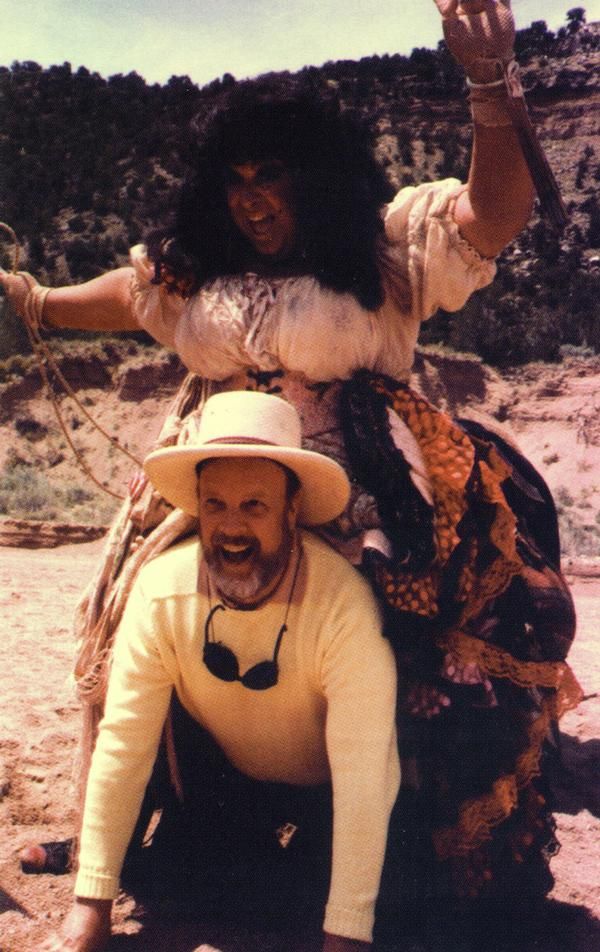
And just so this isn’t a total waste of time, let’s all smile in wonder at the only good thing that came out of this picture: this picture.

-Brandon Ledet

Episode #49 of The Swampflix Podcast: Olympic Comedies & Ice Castles (1978)

Welcome to Episode #49 of The Swampflix Podcast! For our forty-ninth episode, we get in the spirit for the 2018 Winter Olympic Games. Brandon and Britnee discuss five comedies set at the Olympics (or generic, copyright-free substitutes that look a lot like the Olympics). Also, Britnee makes Brandon watch the romantic figure skating melodrama Ice Castles (1978) for the first time. Enjoy!

You can stay up to date with our podcast through SoundCloud, iTunes, Stitcher, TuneIn, or by following the links on this page.

-Britnee Lombas & Brandon Ledet