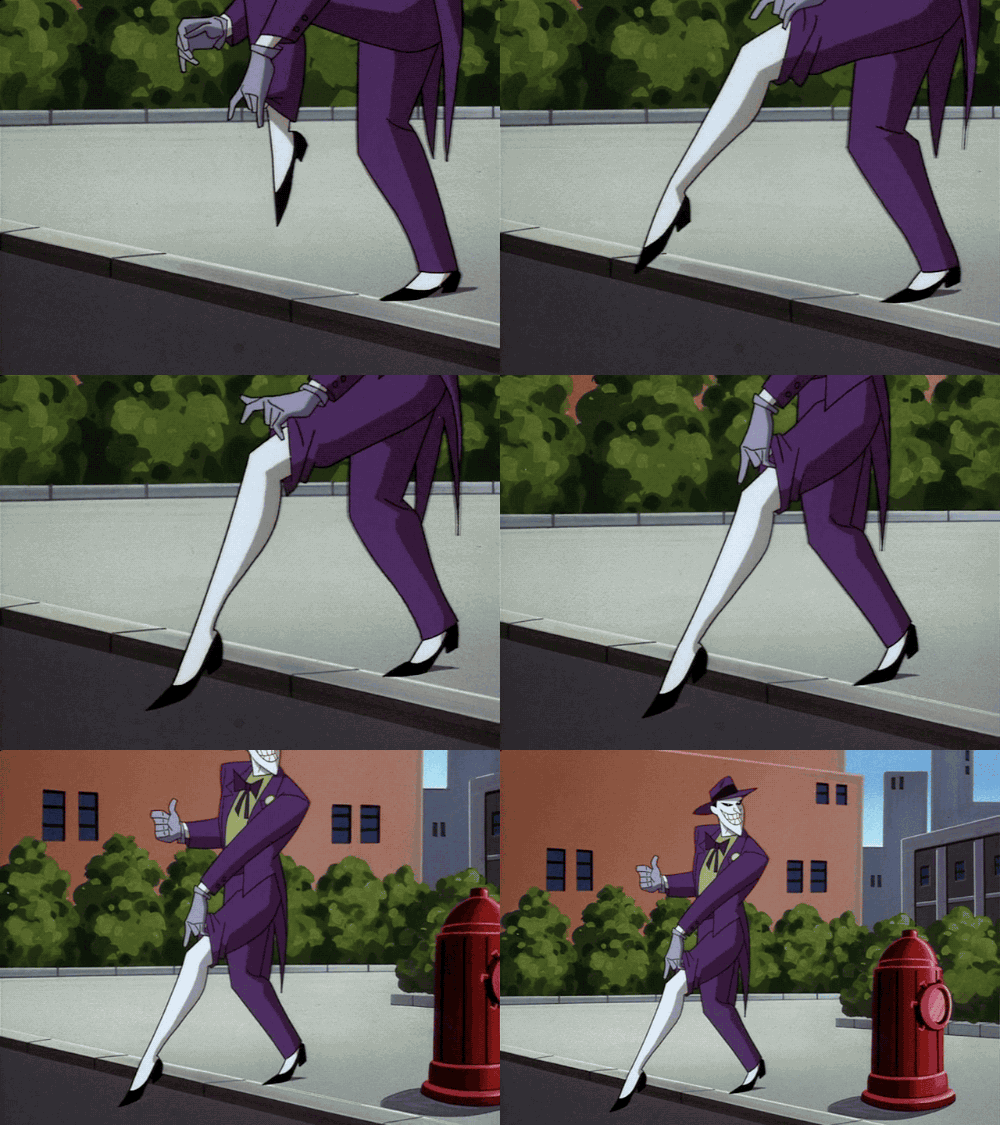
Lagniappe Podcast: The Cat Returns (2002)

For this lagniappe episode of the podcast, BoomerBrandon, and Alli discuss the Studio Ghibli novelty The Cat Returns (2002), an anime fantasy film about a kingdom of anthropomorphic cats.

00:00 Welcome

02:40 My Winnipeg (2007)
03:40 The Twentieth Century (2020)
05:40 The Snyder Cut (2021)
11:30 Hannibal (2001)
13:15 Red Dragon (2002)
14:30 Hannibal Rising (2007)
15:40 The Boy Next Door (2015)
18:20 What Lies Below (2020)
25:00 Godzilla vs Kong (2021)
28:00 Mothra vs Godzilla (1964)
30:15 Godzilla vs Mothra (1992)

32:17 The Cat Returns (2002)

You can stay up to date with our podcast through SoundCloudSpotifyiTunesStitcherTuneIn, or by following the links on this page.

– The Lagniappe Podcast Crew

The Importance of Atmosphere in A Touch of Zen (1971)

Back in 2018, Brandon reviewed A Touch of Zen, a wuxia epic about a warrior noble woman on the run from a corrupt government in Ming Dynasty China. In the review, he appreciates the badass female character and the goofy fun, but laments the film’s epic length and wonders whether all of the nature photography and expository sequences make the payoff of the battles worth it.

Unlike Brandon, I love a good epic. It’s not that I necessarily have the focus and attention span for them, and the fact that so many don’t have an intermission is ridiculous. (When viewing at home, I usually force one in.) But I love the way a long runtime gives the plot room to breathe and lets the audience get a peek at the world building. Movies like Seven Samurai and Solaris are masterpieces to me. The extended editions of The Lord of the Rings trilogy are my cinematic comfort food. Don’t get me wrong; I love a good, fast paced film. I am all about trash. (I do occasionally write for Swampflix after all.) It’s like comparing a 90 page novella with a 1000 page novel. If you like reading, they both have their time and place. A Touch of Zen is an epic and a masterpiece. Without the long run time, we’d never get to see the lush world of the film, which is something I really loved about it.

The atmosphere of A Touch of Zen is critical to the movie. It’s eye candy definitely—almost a travel brochure for China of the early 70’s—but it’s also part of the spirit and the plot of the film. This film isn’t just about a woman on the run finding zen; King Hu set out to translate the feel of zen within the film. He carefully controlled all the details, going so far as to build enormous and elaborate sets. At the beginning, the film takes place in the hometown of the main character Gu Sheng-zhai (Shih Chun). The town is small and sparsely populated, a remote place with an abandoned, rumored to be haunted, military barracks in the middle. This setting is misty and dark and unclear, which is to the advantage of the characters later on. It rains frequently. This early setting is the pre-zen world for our heroine, Yang Hui-zhen (Hsu Feng). It lacks clarity. It’s literally bogged down. The abandoned and derelict surroundings are shrouded by weeds and overgrown grasses, littered with the remains of people long gone.

The area around the Buddhist monastery, however, is bright and stark. It’s smooth rocks, and clear water. Things are clear and visible and the light is blinding. This is where Yang finds her zen. This is where the audience sees other characters grapple with looking at zen straight in the eye, when the head of the Monastery stands tall about a villain and is lit brightly, mystifyingly from behind. Nothing about this space is cluttered with evidence of worldly affairs. It’s beautiful but uncomfortably bare. There’s no place to hide, but there’s a maze of large boulders eroded into curving surfaces with corners to duck behind. It’s a space of contradictions, which is a lot like zen philosophy itself.

Without the time to have a look around at these areas, would there even be a touch of zen in A Touch of Zen? I think if you look at it solely from a plot of the leading lady cloistering herself off from a world where she only has a future as a mother or a fugitive, then yes, but I’m going to say that that would be more of a slight brush against zen.

-Alli Hobbs

Lagniappe Podcast: Picnic at Hanging Rock (1975)


For this lagniappe episode of the podcast, Boomer, Brandon, and returning contributor Alli discuss the Australian New Wave whatsit Picnic at Hanging Rock (1975), which happens to be set on Valentine’s Day.

You can stay up to date with our podcast through SoundCloudSpotifyiTunesStitcher, TuneIn, or by following the links below.

– The Lagniappe Podcast Crew

The Manchurian Candidate (1962)

The Manchurian Candidate is a masterpiece of Cold War paranoia and pro-American propaganda, visually stunning and chilling.  It was talked about a lot these past four years, since during the Trump presidency people were experiencing increased Russophobia and witnessing Eastern European scandals and intrigue.  However, given the film’s message about patriotism and military force, I don’t think it’s the safest comparison to modern events.  Centering around the struggles of two soldiers, Major Marco (Frank Sinatra) and Raymond Shaw (Laurence Harvey) after being kidnapped and brainwashed by Communists, the film mainly concerns the American military and political handling of The Red Scare, taking an inherently critically flawed and culturally problematic viewpoint.  That being said, it has an amazing handle on the psychological power of editing and features wonderful performances by everyone involved.

The film opens with the company of Marco and Shaw at the Chinese/Korean border during the Korean War.  They are a gang of rough and tough men, the typical everymen of the 1960s, cutting loose during wartime: drinking, gambling, and objectifying and exotifying the local women.  However, their leader, Shaw, is a wet blanket.  He is a cold and prim rich boy who thinks they’re all lowly trash. Of course, his fellow soldiers find him intolerable.  During a mission they are deceived and captured by a group of sinister Communist scientists who intensely brainwash them.  Without revealing too much of the plot’s twist and turns, I’ll say that they are returned home suddenly with warm feelings for Raymond Shaw.  Marco gains a high-up position in the military and Shaw works for a newspaper relishing in writing smear pieces against his simpleton presidential-hopeful Conservative stepfather (James Gregory), who is merely a pawn for the domineering Mrs. Shaw Iselin (Angela Lansbury).  Marco is tasked with deprogramming Shaw, who lives a sad and lonely life haunted by his mother’s overbearing shadow.  Eventually, we realize that his mommy issues are the key.

One of the most effective scenes in the film is the demonstration of brainwashing by the Communist scientist.  It cuts back and forth from what the soldiers see (a boring talk from a ladies’ garden club) to the panel of red leaders from all of the world in an amphitheater decorated with huge portraits of Stalin and Moa in the background, in case you forgot what side this sinister cabal was on.  There’s a jarring effect created by the juxtaposition of the mundane droning on of the women’s club and the scientific enthusiasm and twisted plotting.  The clash of the mundane and “the evil” is a chilling way to set us up for constant doubt and paranoia for the rest of the film.

Now, let me get to my real issue with this movie: it reeks of misogyny.  The mother is set up to be the ultimate villain.  The idea that an ambitious woman is more dangerous than world powers that have extreme scientific advances in the realm of psychology is, quite frankly, sickening.  I have no sympathy for Mrs. Iselin.  Angela Lansbury delivers a performance that renders the character utterly reprehensible and unforgivable.  That said, the whole idea of a mother’s failures being the downfall of the country is a special kind of good old fashioned American woman-hating.  It’s really drilled home with the idea that the only way any of this is uncovered is through a team of highly trained military personnel. It just feels a little overkill.  But there is only one thing that pro-military rhetoric in the USA wants to kill, torture, and demean more than a Communist: a powerful woman Communist.  There’s enough analysis of the treatment of women during these wars and missions “to spread democracy” to inspire entire dissertations so I’ll leave that to more skilled folks than I.  Suffice to say, there are serious consequences to this line of thinking.  The only sympathetic women in the film are those who stay on the sidelines being supportive and nurturing.  This includes one whom gets killed off, in an example of an ambitious woman trampling a traditional, attractive feminine figure.  A true 1960s man’s nightmare and the nightmare of many contemporary men as well.

In a political vacuum, I’d say that this is a spectacularly made film, a real classic.  It is technically wonderful, with extremely talented performances.  But we are not in a vacuum.  As a country, if this is the narrative we turn to again and again, we will probably never get over gender disparity.  The Manchurian Candidate is a chilling piece of paranoid propaganda.  It upholds the rhetoric of the status quo: xenophobia, misogyny, and a hyperbolic love and trust of the troops.  It’s an entertaining and effective film, but culturally we need better narrative touchstones.

-Alli Hobbs

Halloween Report 2018: Best of the Swampflix Horror Tag

Halloween is rapidly approaching, which means many cinephiles & horror nerds out there are currently planning to cram in as many scary movies as they can before the best day of the year (except for Mardi Gras, of course) passes us by. We here at Swampflix watch a lot of horror year round, so instead of overloading you with the full list of all the spooky movies we’ve covered since last year’s Halloween report (and the one before that), here’s a selection of the best of the best. We’ve tried to break it down into a few separate categories to help you find what cinematic scares you’re looking for. Hope this helps anyone looking to add some titles to their annual horror binge! Happy hauntings!

Art House Horror

If you’re looking for an escape from the endless parade of trashy slasher movies & want a more formally refined style of horror film, this list might be a good place to start.

Hereditary  (2018) “I wasn’t in ‘critical film theory’ mode while watching Hereditary. From the opening moments, when we swoop in on one of Annie’s miniatures of the home in which the Grahams reside and the tiny dollhouse becomes Peter’s bedroom, the film captivates the width and breadth of your attention. I wasn’t inspecting the music to see if it mixed high and low frequencies to create tension; I was too concerned about the characters and what was going to happen to them to worry about any of those things, and I’ll be processing the ideas and concepts in the film for days to come, but I can’t get into those without telling you too many of the film’s secrets. Just go see it, if you dare.”

Mandy (2018) – “Nic Cage may slay biker demons with a chainsaw & a self-forged axe in his personal war against religious acid freaks in a neon-lit, alternate dimension 1980s, but Mandy is not headbanging party metal. It’s more stoned-and-alone, crying over past trauma to doom riffs metal, where the flashes of fun & cosmic absurdity are only reminders of how cruelly uncaring & meaningless it can feel to be alive.”

Double Lover (2018) – “It’s a narratively & thematically messy film that gleefully taps into sexual taboos to set its audience on edge, then springs a surreal horror film on them once they’re in that vulnerable state. Double Lover is not your average, by-the-books erotic thriller. It’s a deranged masterpiece, a horned-up nightmare.”

Annihilation (2018) – “As a reader, the currency of your imagination is to be spent on giving life to Area X and its beautifully deadly terrain and inhabitants, and using any iota of that brainspace on the members of Expedition 12 is wasted; in this way, the reader becomes the biologist, with a professional detachment that grows more clinical and distant as the plot unfolds (or unravels). That’s something that simply wouldn’t work on screen, and by giving the biologist and her fellow explorers more depth, Garland changes the theme of the novel from that of emotional distance and disconnection, and perhaps the innateness to humanity of that feeling, into a focus on the (perhaps innate) tendency toward self destruction. That compulsion may, and sometimes does, overtake us while in the guise of something more clinically defined, but rebirth requires the complete destruction, the annihilation, of the self that existed before, down to the cellular level.”

Good Manners (2018) – “On a horror movie spectrum, the film is more of a gradual, what-the-fuck mind melt than a haunted house carnival ride with gory payoffs & jump scares at every turn. It’s an unconventional story about unconventional families, one where romantic & parental anxieties are hard to put into words even if they’re painfully obvious onscreen. Anyone with a hunger for dark fairy tales and sincerely dramatic takes on familiar genre tropes are likely to find a peculiar fascination with the subtle, methodical ways it bares its soul for all to see. Just don’t expect the shock-a-minute payoffs of a typical monster movie here; those are entirely secondary, if they can be detected at all.”

Shock Corridor (1963) – “Anything that predated 1975’s One Flew Over the Cuckoo’s Nest generally treated those with these illnesses as villains or obstacles, portrayed asylums as bedlams that protected society from vagrants rather than places where one could ever hope to become well again, and if the protagonist was unwell of mind, such sickness was something that could be overcome with machismo or the love of a good woman, not through medical practice or therapy. Not so in the case of Sam Fuller’s Shock Corridor (released 1963, one year after the publication of Cuckoo’s Nest, although Fuller had been shopping the original screenplay around since the 1940s), in which mental patients are presented as objects not of derision but as people deserving empathy, not as evil madmen but as victims of society who were pushed to the psychic breaking point and beyond.”

Cyber-Horror

The internet is fertile thematic territory for the horrors of the unknown because its mechanics & functions have continued to feel like a novel, depthless mystery to the average user. Here are some above-average horror films that have shrewdly exploited that modern world mystique for eerie scares.

Suicide Club (2002) – “Packed with the creepy atmosphere of haunted hospital ghost stories, the glam rock excess of Velvet Goldmine, the menacing undercurrent of J-Pop & kawaii culture, multiple cults, a river of gore, and my pet favorite subject of the evils of the Internet, Suicide Club feels like three or four imaginative horror scripts synthesized into one delightfully terrifying vision of modern Hell.”

Perfect Blue (1997) – “Unlike other early Evil Internet thrillers like The Net or FearDotCom, it’s remained effectively creepy instead of devolving into a quaint joke precisely because it got the internet exactly right. It perfectly captures our ongoing, collective online nightmare, despite arriving in a time when the internet was mostly a tangle of blogs & message boards.”

Unfriended (2015) – “I’m starting to feel like somewhat of a phony fan of this movie even though I often go out of my way to promote its legacy. I’ve now watched it on the big screen and on my living room television, but I’ve never bothered to screen it with headphones on my laptop for the Pure Unfriended experience, the way I assume it was intended to be seen. This feels like the inverse of the blasphemy of a young brat watching Lawrence of Arabia for the first time on a smartphone. It’s also further implication that I’m an out of touch old man who has no business taking as much pleasure in these teen-oriented, social media-obsessed genre film frivolities as I do.”

Assassination Nation (2018) – “Besides maybe Revenge, I’m not sure I’ve seen another film match the extremity of its gender politics exploration this year, something that feels just as necessary & cathartic as it is unsettling. It’s a topic that’s now inextricable from the tones & tactics of modern life online, something the film was smart to recognize & tackle head-on. Its overall spirit is prankish & prone to bleak humor, but Assassination Nation is less of a comedy than it is a violent uprooting of cultural misogyny & sexual repression in the Internet Age.”

Truth or Dare? (2018) – “As delightfully silly as a haunted truth-or-dare game is for a horror movie premise, though, it’s not the gimmick that most endeared the film to me. It’s Truth or Dare?’s stylistic gimmick as The Snapchat Filter Horror Movie that really stole my trash-gobbling heart. Whenever demonically possessed participants prompt contestants in the titular game to answer ‘Truth or dare?’ their faces are altered with cheap digital effects to display a sinister, impossible grin. It’s a design that unmistakably resembles a Snapchat filter, which is explicitly acknowledged in the dialogue when a character reports, ‘It looked like a messed-up Snapchat filter.'”

Gothic Horror

A literary-minded horror subgenre that’s sadly grown out of fashion in the decades since its heyday in the Hammer horror & the Corman-Poe Cycle era of the 1960s, but still one with a few minor modern attempts to keep its undead spirit “alive.”

Kill, Baby, Kill (1966) – “Like Roger Corman’s intensely colorful nightmare The Masque of the Read Death, Kill, Baby, Kill is an over-the-top stylistic indulgence that plays beautifully into the heightened atmosphere of the Gothic horror template, making the genre appear as ripe for directorial experimentation as any slasher, space horror, or psychedelic subgenre you could name.”

Beast (2018) – “There’s a distinctly literary vibe to Beast, nearly bordering on a Gothic horror tradition, that almost makes its modern setting feel anachronistic. The intense, primal attraction at the film’s core (sold wonderfully by actors Jessie Buckley & Johnny Flynn) and the seedy murder mystery that challenges that passion’s boundaries make the films feel like Wuthering Heights by way of Top of the Lake.”

Marrowbone (2018) – “Because Marrowbone is so obedient to the tropes & rhythms of a long-familiar genre, most audiences will clue into the answers to its central mysteries long before they’re revealed. However, the details of those mysteries’ circumstances and the effect of their in-the-moment dread carry the movie through a consistently compelling continuation of a Gothic horror tradition. Creepy dolls, cursed money, miniatures, bricked-over doorways, a covered mirror, a menacing ghost, a pet raccoon named Scoundrel: Marrowbone excels in the odd specificity of its individual details and the deranged paths its story pushes to once the protective bubble of its central mystery is loudly popped.”

Mainstream and Traditional Horror

It often feels as if we’re living in a substantial horror renaissance where metaphor & atmosphere-conscious indie filmmakers are revitalizing a genre that desperately needs new blood. These films are a welcome reminder that mainstream horror outlets & genre-faithful traditionalists can still deliver just as much of a punch as their art house, “elevated” horror competition.

The First Purge (2018) – “There’s nothing subtle about The First Purge’s political messaging in its depictions of white government operatives invading helpless, economically wrecked black neighborhoods to thin out the ranks of its own citizenry, nor should there be. We do not live in subtle times.”

The Strangers (2008) When asked, ‘Why are you doing this to us?’ the masked assailants only answer, ‘Because you were home,’ a response so succinctly chilling it was eventually marketed as a tagline. That just-because ethos is a powerful source of terror that largely substitutes any need for a fully-developed plot. Likewise, the look of the killers’ masks is distinctly memorable enough on its own to fill in any void left by their oppressively sparse dialogue. The Strangers dwells in the terror of negative space and the absence of intent, a much more satisfactory source of scares than what’s usually achieved with the home invasion template.”

Jennifer’s Body (2009) – “The bond between adolescent female friends drives just as much of the tension in Jennifer’s Body as the kills and the horrors of puberty. That dynamic is not the flashiest or most immediately apparent aspect of the film; it’s often overwhelmed by the demonic kills and leering at Megan Fox’s physique that would typically be expected of most major studio horrors in the film’s position. It’s what makes Jennifer’s Body unique as a feminist text, however, and its positioning as the heart of the film was entirely intentional on the part of Cody and Kusama. They knew what they were doing, even if the studio behind them did not.”

Shadow of the Vampire (2000) – “As an awkward workplace comedy where a madman pervert auteur struggles to maintain order despite his star actor (who may or may not be a vampire) murdering the rest of his crew, Shadow of the Vampire is damn funny. It pretends to deliver the sophisticated, well-behaved tone of a sober biopic, but everything about Dafoe’s squinched-up, bloodthirsty rat faces & Malkovich’s over-the-top exasperation is hilariously absurd.”

A Quiet Place (2018) – “Disregarding Platinum Dunes’s shaky reputation within the horror community and Cinema Sins-style logic sticklers’ nitpicky complaints about its premise & exposition, it’s remarkable how much personality & genuine familial tension Krasinski was able to infuse into this genre film blockbuster; it’s the most distinctive film to bear Michael Bay’s name since Pain & Gain.”

Weirdo Outliers

Halfway between high art & the depths of trash, these titles occupy a strange middle ground that defies categorization. They also are some of the scariest movies on the list in entirely unexpected ways.

Lair of the White Worm (1988) – The Lair of the White Worm is a hallucinatory free-for-all of sex, violence, and religious blasphemy, the only possible outcome of Ken Russell making what’s, at heart, a simple vampire picture. If you want to get a good idea of the director’s aesthetic as a madman provocateur, all you need to do is compare this reptilian, horndog monster movie to any stately Dracula adaptation out there (of which there are too many, whereas there’s only one Ken Russell).”

Upgrade (2018) – Upgrade has an entirely different plot & satirical target than RoboCop, but the way it buries that social commentary under a thick layer of popcorn movie Fun that can be just as easily read at face value is very much classic Verhoeven. It’s a subversive, playing-both-sides tone that’s exceedingly difficult to pull off without tipping your hand, which is what makes the movie so instantly recognizable as a modern genre classic.

Unsane (2018) – “Like Schizopolis & Full Frontal, Unsane is firmly rooted in the required taste end of Soderbergh’s career, far from the bombastic crowd-pleaser territory of an Oceans 11 or a Magic Mike. Respecting its themes of abuse within the bureaucratic capitalist paradigm or of men in power dismissing the claims of women in crisis is not enough in itself. You must also be down with its indulgence in the moral & visual grime of microbudget exploitation horror. That dual set of interests might be a slim column on the Venn Diagram of Unsane‘s genre film experimentation, but I totally felt at home in that position.”

The Children (2008) – “Kids can be cute, but they’re also a nuisance & a terror to anyone who’s looking to have a quiet moment of relief from familial stress. The 2008 British horror cheapie The Children understands that terror deep in its bones and builds its entire story around the evil & the chaos screaming children bring into the already stressful environment of a holiday get-together. It’s not one of the most tastefully considered or slickly produced Christmas-set horror films I’ve ever seen, but it does capture that exact kind of domestic, familial terror better than almost any film I can name, save maybe for The Babadook.”

Ghost Stories (2018) “Following titles like Trick ‘r Treat & Southbound that have been playing with the structure of the horror anthology as medium in recent years, Ghost Stories presents its own disruption of reality by way of disguise. The film boldly masks itself as a middling, decent enough supernatural picture for most of its runtime, exploiting audience familiarity with the horror anthology structure to lure viewers into a false, unearned comfort. I’ve never had a film border so close to outright boredom, then pull the rug out from under me so confidently that I felt both genuinely unnerved & foolish for losing faith.”

Creature Features

Do you want to see some weird/gross/creepy/goofy monsters? Check out these bad boys.

The Fly II (1989) – “Like the better episodes of Tales from the Crypt and other VHS era oddities of its ilk, The Fly II feels like the exact kind of movie that would grab a child’s attention on late-night cable after their parents fell asleep, then scar them for life with nightmare imagery of melted faces, mutated dogs, gigantic bug-beasts, and milk-leaking husk babies. Its tone can be campy at the fringes (as expected, given the material) but it’s also complicated by the severity of its details, especially its dog torture & Eric Stoltz’s lead performance, which is heroically convincing, considering the ludicrous plot it anchors.”

The Shape of Water (2017) – “Although Pan’s Labyrinth wasn’t created with an American audience in mind, U.S. viewers could reject Vidal and his violence as being part of a different time and place, distancing themselves from his ideologies. Not so with Strickland, who lifts this veil of enforced rhetorical distance and highlights the fact that idealizing and period of the American past is nothing more than telling oneself a lie about history. It’s a powerful punch in the face of the fascist ideologies that are infiltrating our daily lives bit by bit to see such a horrible villain (admittedly/possibly a bit of a caricature, but with good reason) come undone and be overcome. It’s a further tonic to the soul to see him defeated by an alliance comprised of the ‘other’: a ‘commie,’ a woman of color, a woman with a physical disability, and an older queer man.”

The Untamed (2017) – The Untamed adopts the gradual reveals & sound design terrors common to ‘elevated horrors’ of the 2010s, but finds a mode of scare delivery all unto its own, if not only in the depiction of its movie-defining monster: a space alien that sensually penetrates human beings with its tentacles. The film alternates between frustration & hypnotism as its story unfolds, but one truth remains constant throughout: you’ve never seen anything quite like it before.”

I Married a Monster from Outer Space (1958) – “The story is familiar, but flows incredibly naturally from scene to scene with an editing room finesse atypical of this genre territory. The special effects also feel above par for the material, from the head-to-toe detail of the rubber monster suits to the distorted faces of the lighting strikes to the weaponized fog the creatures deploy when abducting their victims. All the surface level narrative details of I Married a Monster from Outer Space are exactly what you’d expect from its title; the attention to detail in its craft just happens to be a cut above.”

Blue My Mind (2018) – “If you’re always a sucker for the femme coming of age transformation horror like I am, Blue My Mind is thoughtful & well-crafted enough to earn its place in the pantheon. If you need to see something innovative or novel in your genre narratives for them to feel at all remarkable, you’re going to have to look much closer to find those flashes in its minute details.”

The Giant Claw (1957) – The Giant Claw is a perfect little B-movie gem, an efficient reminder of why throwaway genre trash from half a century ago is still worth digging through. Its creature design is hideous, its dialogue is inane, and its lofty sci-fi ideas aren’t worth even the paper they’re scribbled on, but The Giant Claw is the rare discarded horror schlock that achieves a kind of sublime stupidity that can’t easily be found in its peers.”

Matt Farley’s Backyard Horrors

A microbudget filmmaker who’s been making Roger Corman-style rubber-suit monster movies with friends in New England for decades to little fanfare, despite churning out consistently endearing horror comedies.

Don’t Let the Riverbeast Get You! (2012) “The real centerpiece of Don’t Let the Riverbeast Get You! is not any of its monster attacks in the woods, but rather a lengthy wedding sequence staged in a backyard that starts with a petty argument over potato casserole and ends in a minutes-long dance party. Don’t Let the Riverbeast Get You! is at its core a hangout film, in that it’s a document of friends hanging out & staging gags around the non-existent legend of a non-existent monster & the public triumph of the one man who believed it to be real. It’s the story of Matt Farley’s miniature media kingdom in a microcosm, as it’s the story of a man possessed by a singular obsession finding himself at odds with a world that could not care less.”

Monsters, Marriage, and Murder in Manchvegas (2010) – “The horror genre background setting is a selling point to get eyes on the screen, so that Matt Farley can pursue his true passion with his friends & family (who populate his cast & crew): summertime fun. The slayings are so sparse & delayed that it’s easy to forget you’re watching a microbudget horror film at all. Instead, a weirdly wholesome, D.I.Y. comedy about ‘good natured, harmless pranks’ guide the tone of the film as it gleefully distracts itself with ‘teen’ romances, impromptu basketball games, and frequent visits to the lemonade stand.”

Druid Gladiator Clone (2002) – “A series of non-sequiturs where a shirtless Matt Farley runs wild in unsuspecting New England neighborhoods while trying on various dyed ‘cloaks’ (bedsheets). It’s like an unusually wholesome Tom Green sketch somehow stretched to a 90min runtime.”

Campy Spectacles

If you’re looking for a little irony in your horror comedy yucks, these films tend more towards the so-bad-it’s-funny side of humor, often intentionally. They’re the best we have to offer in terms of bad taste.

Death Spa (1989) – “The movie pushes its evil health spa premise to the most ridiculous extreme it can manage on a straight-to-VHS 80s budget, a dedication in effort & craft I wish Fischer had also poured into My Mom’s a Werewolf. In fact, all movies in all genres could stand to be a little more like the heightened absurdity achieved in Death Spa, not just the ones about health craze fads & pissed-off computer-ghosts.”

Serial Mom (1994) – “There’s a lot to recommend here, but I hesitate to go into more detail for fear of ruining the fun for those who have yet to experience the comic genius. If I had one note to give, it’s that I agree with Roger Ebert’s review of the film; Turner is phenomenal in Serial Mom (that ‘pussywillow’ scene alone manages to be both pure art and pure comedy), but she does play Beverly with such an earnest sincerity that, at times, the sympathy for such an obviously unwell woman supersedes humor, but not always.”

Blood Bath (1966) – “You’d think this cocktail of genres & premises would lead to an incoherent mess, which might partially be true, but the final version of Blood Bath Stephanie Rothman delivered is charming in the way that it’s blissfully insane. Corman threw every one of his tactics on how to cheaply scrap together a picture at the screen in a single go and the result is just as fascinating & amusing as it is creatively compromised.”

All About Evil (2010) – All About Evil is a genuine specimen of gleeful horror fandom. Like with the TV persona of bit part actor Elvira and the stage performances of director Peaches Christ herself, it’s always wonderful when that quality can convincingly intersect with the world & art of drag. For an enthusiastic fan of both like myself, it’s all too easy to get swept up in the joy of that combo.”

She’s Allergic to Cats (2017) – She’s Allergic to Cats hides its emotions behind an impossibly thick wall of ironic detachment. It even goes out of its way to reference infamous so-bad-it’s-good properties like Congo, Howard the Duck, Cat People (’82, of course), and The Boy in the Plastic Bubble to throw the audience of the scent of the emotional nightmare at its core. When its protective walls break down, however, and the nihilistic heartbreak that eats at its soul scrolls ‘I need help’ across the screen, there’s a genuine pathos to its post-Tim & Eric aesthetic that far surpasses its pure shock value peers. It’s a hilarious, VHS-warped mode of emotional terror.”

Mom and Dad (2018) – “Show up for Nic Cage destroying a pool table with a sledgehammer while singing ‘The Hokey Pokey;’ stay for the pitch-black humor about ‘successful’ adults who find their manicured, suburban lives with the right career & the right family bitterly unfulfilling. Nic Cage is literally barking mad in this picture and is destined to steal much of its spotlight, but Selma Blair & Crank director Brian Taylor match his energy admirably at every step. This is a deranged collaboration among that unholy trinity and no family bond, no matter how sacred, is safe in its satirical war path. Mom and Dad may occasionally stumble in terms of pacing or tone, but you have to respect this kind of gleefully taboo social anarchy, especially coming from a comedy.”

Special Features

Every link listed above is for a review we’ve posted on the site. If you’re looking for lists or articles from our horror tag instead, check out our Boomer’s Favorite Horrors by Decade lists, Brandon’s attempt to define the term “A24 horror,” and CC’s comparison of Ken Russell’s Lair of the White Worm adaptation to its Bram Stoker source material.

-The Swampflix Crew


Movie of the Month: Gates of Heaven (1978)

Every month one of us makes the rest of the crew watch a movie they’ve never seen before & we discuss it afterwards. This month Alli made Brandon , Boomer, and Britnee watch Gates of Heaven (1978).

Alli: Told in a series of interviews, Gates of Heaven is about pet cemeteries. Two feuding parties fight ideologically and legally for control over the final resting place of people’s beloved animals. Originally, Floyd McClure, a bleeding heart dog lover, is dead set on his belief that pets deserve better than to just be taken to a rendering facility after he was traumatized living near one in his childhood. He is not a business man. Out of the goodness of his heart, he buys a plot of land with the help of investors, and begins to assist in comforting people as they shepherd their pets onto the next life. Of course, not being a business man, and being totally dedicated to the idea of helping people in their grief, his cemetery goes out of business. All the animals get exhumed in a dramatic spectacle, and are moved to Bubbling Well Pet Memorial Park, upsetting many of the pet owners. Bubbling Well is run by the Harberts. The Harberts are intolerable rich people solely in the business for the money, with two down-on-their-luck, basically loser sons who flock back to the nest to get jobs at the cemetery.

The contrast between these two groups results in a documentary not just about pet death and grief, but about human nature. There are those who are earnestly out to help people, and those who don’t believe in the cause. There’s the genuine and the facade, and the poor grieving people stuck in between.

Gates of Heaven is the first documentary I truly fell in love with. It was the first time I watched people being interviewed on screen, and thought, “This is it. This is what I want to do.” I went to film school, probably because of it. It taught me that you don’t need a big budget, fancy equipment, or A-list stars to make a movie about anything. All you need is some chairs, a few eccentrics, and the time to let them talk. I obviously haven’t done much filmmaking or interviewing of eccentrics (YET!) but my strong love of the documentary format lives on.

Werner Herzog famously dared Errol Morris that he couldn’t make a whole documentary about this “unlikely” subject matter, and that if he did, Herzog would eat his shoe. He lost that bet, and the shoe eating is documented in a short shot by Les Blank. To me, since truth is very often stranger than fiction, this doesn’t seem like that wild of a subject to make a feature-length documentary about. I may be viewing this through the lens of the present where there’s a very great documentary, Helvetica, about the history of a font, but to me, the topic of death as a commercial industry in general is full of possibilities.  Britnee, were you impressed that there’s a whole documentary about the conflict between two pet cemeteries? Or do you, like me, believe in the power of film to bring out the weird in the mundane?

Britnee: Other than the spooky Stephen King film, there’s not much out there in the film world about pet cemeteries, at least not that I’m aware of. Gates of Heaven provides a unique view into the world of pet cemeteries while stirring up loads of thought-provoking questions (“Do dogs really go to heaven?,” “Why are there so many assholes in this world?”). It reminded me of Grey Gardens a bit. Not only were the two films from the same time period, but they both focus on eccentric folks disguised as white-bread Americans. Between the middle-aged woman showing off her chubby, black chihuahua’s talking skills and the twenty-something year old playing his guitar outside with the pet cemetery as a backdrop, there’s never a dull moment. It’s sort of like a Wes Anderson film except nothing is scripted. These are real people talking about real things. I love it all so much!  Needless to say, I was very impressed with Gates of Heaven, and it is definitely one of the best documentaries I have ever seen.

Gates of Heaven changed my perspective of what the average American pet owner was like in the late 1970s. When my family members and friends that grew up during the 1960s/1970s share those back-in-the-day stories, I never once heard of a pet being like a member of the family. Pets were never allowed inside of the house, much less given kisses and snuggles. They were referred to as “animals,” and they were so far below the level of the superior human being. When they died, they were never given a proper burial. The image of a dog on a chain in the backyard with a little wooden doghouse and a cat sleeping under the carport is how I imagined most pets during that era. It was heartwarming to see that there were people who looked to their pets as equals and loved them unconditionally.

Brandon, this documentary was made almost 40 years ago. What do you think today’s version of Gates of Heaven would be like?

Brandon: Besides the insight into historical attitudes towards pets, the most distinctly 1970s thing about this film is the way it avoids contextual narration or exposition. The story is linear and not exactly in medias res, but the most editorializing Morris imposes on the film is in the meticulous composition of individual shots (Britnee’s Wes Anderson comparison is dead-on) and whatever footage he chose to excise in editing. Otherwise, the story is told entirely by its subjects, who speak plainly in oral history-style interviews. This feels true to the matter-of-fact documentary style of the era, considering contemporary works like (to call back to already-cited documentarians) the Maysles Brothers’ Grey Gardens or Les Blank’s Always for Pleasure. If Gates of Heaven were made decades later by a different director, I believe the impulse would have been for the filmmaker to impose their own personality & worldview on the interviews in the name of being ”honest” about how their perspective shapes what’s supposedly documented reality. Think of the way modern Werner Herzog “documentaries” are essentially essay films about how Herzog himself sees the world, more than they are a presentation of unaltered facts. I think keeping a personal distance from editorializing about its subjects was a smart move in this case, as it allows Morris to profile these strange, real-world characters with a clear fascination for their quirks without ever quite leaning into his (possibly ironic) amusement with them. His style was later borrowed for outright comedy by mockumentary goof-em-ups like Best in Show (and every other Christopher Guest joint, really) & Documentary Now, but the tone is much more delicate & distant here, avoiding pure “Getta load of this freak show” cruelty. I suspect a more modern, Herzogian approach with Morris’s authorial voice framing the interviews might have tipped it in the wrong direction.

The question isn’t what Gates of Heaven would be like if Herzog made it in 2005 as a follow-up to Grizzly Man, though; the question is what it would be like if it were made today. I think modern filmmakers have learned a lot form Herzog’s embrace of documentaries’ inherent subjectivity (as opposed to earlier films’ embarrassed denial of it), but they’ve taken the art form in an entirely new direction from his This Is Really About Me philosophy pieces. The most exciting modern examples of the medium, the ones that avoid Wikipedia-in-motion tedium, are the ones that mix performed fictions, found footage abstractions ,and multimedia collage structures to guide their tone. Weirdo art projects like Heart of a Dog, Rat Film, Flames, The World is Mine, Swagger, The Nightmare, and Faces Places blur the line that divides the documentary and the essay film as separate mediums. They’re as heavy on first-person editorializing as a typical Herzog doc, but also include blatantly artificial performance & other forms of stylized artistic expression with their “real life” documentation to the point where what’s real and what’s fiction would be totally up for debate. Gates of Heaven was radical in its time for affording an oddball subject a dry, matter-of-fact academic treatment. If it were to be equally radical in 2018, it’d probably include sock puppet reenactments of interviewees’ anecdotes or Morris himself purchasing a plot for his own dead pet or a lengthy visual essay about the process of physical decay for a small animal body and how that relates to some economic us-vs.-them political philosophy. There’s no telling if it would be nearly as good of a film if it were made with a 2010s sensibility, but I can guarantee it wouldn’t be as dry or editorially distanced. Even Errol Morris’s own recent work on the experimental, LSD-influenced documentary Wormwood hints at that cultural shift.

Boomer, Morris’s style here obviously depends on his interview subjects to tell a compelling story (or at least tell a mundane story in a compelling way), but I found it curious which subjects he chose to afford the most attention. Most of my favorite interviewees in the film were the pet owners who employed the services of the cemetery, but it seems Morris was more personally invested in the conflict between the people who maintained its daily operation (for love or for profit). Do you think the movie could have used more (dead) pet owner profiles or would that have risked tipping it too far in the direction of Christopher Guest quirk humor?

Boomer: I actually feel like there was just enough balance between the proprietors and the patrons of the two pet cemeteries to prevent the film from becoming either too maudlin or too tongue-in-cheek. In general, there was a distinct tendency toward sentiment among the (for lack of a better word) mourners, which is sensible but not exactly what I expected. To me, the very idea of an organized pet cemetery seems incredibly bourgeois, although it makes sense in the context of a more urbanized area than the one in which I grew up. When our beloved eighteen-year-old cat Tabitha died in 2003, we were able to bury her in the back field between two trees next to the pond, but those living in an apartment building like I do now, or in suburban areas with overzealous and overreaching HOAs, don’t have that luxury. And while I would consider the more sensible thing to do would be having a memorial in the home (with or without your furbaby’s cremains), I understand the desire for something more traditional.

The couples who were interviewed were interesting, but the MVPs of those who were on the mourning end are those who were interviewed alone. First is Florence Rasmussen, with her long-winded, meandering, unbroken speech about her son (really her grandson) and his car, which she bought for him (really gave him $400 for, or the equivalent of $1,597.15 in 2018), and her desire to get out and do more (even though she also says that she “gets around pretty well”). Hers is a ramble that is mired in contradiction and a narrative of self-promotion and self-interest that effectively demonstrates the depth of her neuroses (and probably dementia). I also loved the feud between Zella Graham (she of the howling chihuahua) and Lucille Billingsley (her nemesis). The differences between how the two are framed, with Graham and her living pet in a welcoming-if-kitschy dining area in her home against Billingsley in her baroque wingback chair beneath a framed portrait of her departed darling, says a lot about each woman, which is only reinforced by the issues that each takes with the other: Billingsley speaks about larger concerns and barely thinks of Graham at all, while Graham’s diatribe is all about Billingsley’s apparent pretentiousness and flaunting of her wealth, like showing up at the graveyard in her luxury car and adorned with furs (a telling detail in how Billingsley sees the “hierarchy” of animals) to complain about the disinterment at McClure’s failed cemetery. Their pettiness lends the whole affair a surreality that elevates the documentary from simple investigation into something more. The interviews with couples may add to this feeling, especially with regards to the woman who appears on the poster and gives a speech about her idiosyncratic conception of the cosmos and the place of humans and animals within it; unlike a Guest film, however, where the two people on screen would be characters and not real people and thus would be intentionally written more comedically to play off of each other, these scenes are more about two people in parallel than in counterpoint.

Overall, I found the Harberts clan and Floyd McClure more compelling than their customers. Forgive me for not using names as much as I would like to under normal circumstances; the lack of identifying information about who all of these people were was a source of frustration for me over the course of the documentary (not that I didn’t love it overall). Among McClure’s friends and contemporaries, I was never quite certain who was who, or if the minister with whom McClure had a handshake deal that from what I could discern was the root cause of his cemetery’s demise was one of those interviewed or not. Even though my sympathies lie with McClure, as his devotion to his collie led him to spend his life trying to create a space in which pets could be mourned, my investment in both parties was split pretty evenly, although for different reasons. I felt like we got very little information about McClure in comparison the Harbertses, despite him being more open about his feelings, as we saw more of their candid lives. The dichotomy between rich and . . . well, not poor, but middle class was an element of the feud between Billingsley and Graham, and we see that writ large in the difference between McClure and the Harbertses. McClure is a man whose interview occurs in a small home with little decoration, while the youngest Harberts son tells the camera that when he wasn’t sure where his life was going, he knew he could come home and have his own house, even if it is the one by the chicken coop. The elder son’s discussion of his previous work as a motivational speaker is largely done from behind a desk full of trophies and in front of a wall of awards as he talks about how he used to use those same trophies and awards to create a rhetorical space with potential clients, droning on almost hypnotically while demonstrating why he was such a success in that arena, apparently with no intentionality informing his “performance.” There’s so much that’s being communicated in these frames: the banality of wealth, the sumptuousness and self-aggrandizement of his office in comparison to his father’s (which is less ornate on the whole but has that ridiculous name plate done up in Old London Gothic typeface that almost seems to dominate the frame despite taking up so little of it), the look of quiet resignation and resentment on his face when relating that he understand and accepts that he is the “third” (read: last) person in the chain of command at the cemetery.

That is true filmic storytelling, which is notable given that documentaries generally attempt to tell the truth from an unbiased perspective (give or take your Michael Moores and your Dinesh D’Souzas). I found myself truly fascinated by the surroundings of the interviewees, none more so than when McClure was speaking from what appeared to be his den. He never mentions a wife or child at all when relating the oral history of his failed endeavor, which makes the pair of bronzed baby booties behind him a total curiosity to me. The same can be said of the yellow document hanging from the doorknob in Graham’s kitchen and the bizarre red fake flower(?) that foreground the interviews with Mrs. Harberts. For me, these were just as intriguing as the stories themselves. Given that Morris’s intention was to present an unbiased account (to the extent that such a thing is possible), I’m not sure how much directorial input was given with regards to placement when giving these interviews, but some of the locations seem too perfect to be anything other than staged. For instance, both of the Harberts men we see in their offices speak directly from behind the desk as if we are meeting with them, while our “meeting” with the manager of the tallow rendering plant frames the plant itself behind him through his window, giving those speeches a more casual vibe. Alli, as you’ve seen this film more than the rest of us have, what insights do you have into this particular rhetoric in this film: the composition of the mise en scène as it applies to homes and offices as meant to evoke a particular response? What speaks to you, and what doesn’t?

Alli: As far as filmmaking goes, I always assume that everything in front of the camera is intentional or an intentionally included accident. Even a more matter-of-fact documentary is still a controlled and directed piece of art, and some of those backgrounds were a little too composed to be just there. They’re made to be an extension of the interviewee’s character. The rendering plant manager is shown with his life’s work, grotesque as it is. There’s no way for him to put on self important airs with the plant in the background. He’s a link to the reality of the world as opposed to McClure’s idealism and the Harbert’s affected manner. If I had to guess about the baby boots behind McClure, they were a subtle hint at his innocence and maybe even infantilizing this naive man. The fake flower behind Mrs. Harberts is a bit on the nose in this reading.

Despite the matter of fact feel, the whole composition and placement of shots show some editorial bias. There’s a shot of a man that’s from uncomfortably crotch height that feels like it’s highlighting his man of the 70’s masculinity. There’s the scene with the younger Harberts son where you can see his pot plants in the background where you know exactly what kind of lifestyle he leads. So much of Morris’s views are hidden in what’s with the subject in the frame and how they’re placed. Even if there’s no voice-over or direct explanations, he’s manipulating you into drawing conclusions about these people. He doesn’t blatantly try to villainize or place judgement on his subjects, but there are subtle hints at how he feels about them. As far as what affected me most this particular viewing, I got to re-experience my negative feelings for the older Harberts son, but his backgrounds seem the most incidental to me, as if Morris let him call the shots a little bit, because of course this man wants to be seen with the backdrop of his achievements and his swimming pool. And it makes the irony of his unexplained failure in the motivational speaker arena all the more delicious.

Britnee, did you have a favorite or least favorite interview subject?

Britnee: Of all the fabulous interviewees in Gates of Heaven, I would have to say my favorite interview subject was Floyd McClure. He brought so much heart and innocence to the screen. It was endearing to see that he was in the pet cemetery business for all the right reasons. I became so invested in his cause just within the few minutes of him speaking, so my heart was completely broken when it was revealed that he lost his business. There’s no doubt in my mind that he was put on this earth to help bring comfort for those who lose their beloved pets, but the greedy world we live in prevented him from fulfilling his purpose. I hope that when it’s time for me to bury/cremate my pets that there will be someone like McClure to assist me with such a difficult process.

Even though McClure was my favorite interview subject, I can’t help but feel as though I would have the best time hanging out with the pet owners. I can talk about my cat and dog for hours, and sometimes people will give me the “Please shut up” look. Thankfully, New Orleans is a city filled with dog lovers, so more often than not, the stranger I’m talking with will share my enthusiasm. The singing dog lady reminds me of the eccentric folks that I always run into at the dog park and feed stores. Singing Dog Lady would understand me, and I would totally schedule some puppy play dates with her and her dog.

Brandon, you mentioned earlier that you enjoyed the pet owners in the documentary. As a pet owner yourself, did you recognize an similarities between yourself and the pet owners being interviewed?

Brandon: If there’s one major commonality I see in myself it’s sentimentality. I never had pets outside a fish tank growing up and my first pet as an adult, a large black cat, simply disappeared when he died (presumably hit by a car). As a result, I’ve never had to truly deal with the physical remains of a beloved animal that couldn’t be swept away with the flush of a toilet and I can only presume I won’t handle that grief especially well when my dog (who is getting relatively old . . .) inevitably dies. Interviewees singing to their animals or treating them with the same respect they’d extend to a human member of their family is relatable in a broad sense, but what’s more idiosyncratically captured here is the sentimentality pets inspire in their owners. I don’t think I would ever pay for my dog to be buried in a proper cemetery, but I could easily see keeping her skull or ashes or taxidermy model around the house as a visual reminder of her. The result is essentially the same: sentimental clutter. I empathize deeply with the sentimentality that could lead an animal lover to pay extraordinary amounts of money to have their pets buried properly, as opposed to the posthumous disrespect of having their remains hauled off to the dump with the rest of our pedestrian trash. The truth is, though, that I don’t think that impulse is a necessarily healthy one, which is partly why it’s so grotesque that there are people on hand so willing to exploit it. To me, the capitalist villains of Gates of Heaven are the ones profiting off the sentimentality of their customers while pretending to share their emotional investment in the pet cemetery business as a sign of respect for the dead, when it’s really just like any another racket to them.

As such, I find the racket chosen by the rendering plant operator to be less blatantly evil than the one of the wealthy couple who usurp Mr. McClure’s business. You’d think that as a pet owner I’d be offended by the business model of selling off animal corpses as raw biproduct materials, but that honestly sounds more useful & practical to me than allowing the emotional clutter of animals (that are never coming back, nor care about how well you treat their remains) to fill up otherwise useful land. Since Gates of Heaven consciously avoids editorializing, it’s difficult to tell where the movie’s POV falls on this secondary dead animals racket, which is just as shrewdly capitalistic as the pet cemetery business, just with cruder honesty. Boomer, where do you think the rendering plant business lands on Gates of Heaven’s moral compass? Does the movie express an opinion on it either way or does it leave that philosophical quandary entirely to its audience?

Boomer: The biggest parallel that I see between participants in this film is between the rendering plant manager and the elder Harberts brother. Both are professional men in that late-thirties/early-forties stage of life, both with an air of authority despite the area of their respective expertises being either physically gross (rendering animals into tallow) or emotionally manipulative (as Alli notes, capitalizing on people’s grief). The difference is that Harberts has the decency to be embarrassed about his station in life, even if his hand-wringing is about the fact that he now reports to his stoner younger brother. Mr. Rendering Plant, on the other hand, grins like Patrick Bateman while describing how people react when they find out about his line of work, going so far as to recall, with great mirth, how a woman who, despite being unable to see the actual process of rendering from anywhere in their office building, was so “bothered in her mind” by what they were doing that she could not tolerate working there. Perhaps this is a rhetorical cheat as we see him counterposed against Floyd McClure, whose greatest sin in life was loving animals too much and being too trusting in people’s good nature; however, there is something truly unsettling about how defensive the rendering plant manager is when discussing his business and his complete and utter inability to understand how someone could be shocked or disgusted by the fact that he boils people’s dogs and horses until they can be used for glue or candles. I’m not a big fan of people who laugh while reminiscing about lying to the public about what became of the local elephant. 

Lagniappe

Britnee: I had no idea what a rendering plant was until watching Gates of Heaven, and I cannot believe that pet owners were bringing their dead pets to such a terrible place to have them disposed of like garbage. What part or parts of a household animals is being rendered and what is it used for? It’s just so sad and disturbing. By the way it was talked about in the documentary, it seems like taking dead pets to rendering plants was the norm, and I really hope this isn’t a thing anymore. 

Alli: I’m a big critic of the death industry as a whole and Americans’ lack of acceptance of death as a personal expererience. People in this country pay exorbitant amounts of money for strangers to handle and dress their dead, such an intimate process. This isn’t as common in other parts of the world as it is here. I love my cats like they’re my children, so I would never leave their burying and handling to people who run what basically feels like a satire of an actual cemetery. It just goes to show that the predatory nature of the funeral industry, much like death, knows no bounds. No matter what your species, people will try to take advantage of your family’s desire to distance themselves from the grief. One thing that’s always struck me about this documentary is the subtle way it examines the psychology of all of this. Premium spots are glorified over different, cheaper areas of the cemetery, subconsciously telling people, “If you really loved your pet, you’d pay for us to do this.” Basically, the commodification of grief is an extremely, grossly American phenomenon and it’s interesting to see it laid out so transparently in the form of pet grief.

Boomer: The thing that I found most fascinating about the interviewees is that even the most out-of-it like Florence and a sweet/simple country bumpkin like Floyd had such a delightfully flexible and voluminous vocabulary. When Florence states that her pet corpses were moved to “that place that commences with a ‘B’,” I was surprised. It’s amazing how even people that could be considered simple-minded, senile, or even stupid engaged in a level of discourse that’s so much higher than the one in which we live now.

Brandon: Before viewing this film, the Errol Morris documentary I was most familiar with was Thin Blue Line, which absolutely bowled me over with its intense Philip Glass score. It’s appropriate, then, that one of the most memorable moments of Gates of Heaven for me was a musical one. When the cemetery owners’ loser son plays arena rock guitar at the edge of the cliff on his family’s shitty, animal corpse-laden property, the gap between the image in his head and the one we’re seeing onscreen is remarkably vast. It’s a perfect microcosm of the movie’s delicately comical, oddly tragic tone at large, an image that’s stuck with me for much longer than I expected it to when I first met it with a light chuckle.

Upcoming Movies of the Month
July: Brandon presents Born in Flames (1983)
August: Britnee presents The Honeymoon Killers (1970)
September: Boomer presents Live Freaky! Die Freaky! (2006)

-The Swampflix Crew

Movie of the Month: Batman – Under the Red Hood (2010)

Every month one of us makes the rest of the crew watch a movie they’ve never seen before & we discuss it afterwards. This month Boomer made Brandon , Alli, and Britnee watch Batman: Under the Red Hood (2010).

Boomer: Cards on the table: Under the Red Hood is my favorite Batman movie. Obviously I prefer it over Zack Snyder’s take on the character, but I also find it superior to both Tim Burton and Christopher Nolan’s respective series, although there are elements of both that work well and that I quite enjoy. This may not be my favorite version of Batman (that honor always has been and presumably forever shall be the Bats of Batman: The Animated Series), but it’s the best self-contained feature that both feels like a true standalone while also addressing the character’s long history. There’s no origin story, no belabored backstory showing how and why Bruce Wayne came to be the Batman, no attempts to make the character feel like he fits in a modern context or make the gadgets and gizmos seem “realistic,” and no damned pearls in an alley (note, even Batman v Superman did this, two years after the linked video pointed out that it was a cliche). I said it two years ago and I’ll say it again: Batman has the second most famous origin story in the world, surpassed only by the birth of Christ; we don’t need to see it on screen ever again. Instead, this film jumps in at a point in time pretty far into the detective’s career.

Under the Red Hood opens in Sarajevo, where The Joker (John DiMaggio playing against type) has savagely beaten Jason Todd (Jensen Ackles), the second of Batman’s sidekicks/apprentices to bear the codename “Robin,” nearly to death with a crowbar. Batman (Bruce Greenwood) races to the scene, but arrives too late, as a bomb destroys the warehouse in which Jason was left behind. Years later, The Joker is safely locked away and the majority of Gotham City’s criminal element reports to the Black Mask (Wade Wilson), but the leaders of various crime families are confronted by a new player: The Red Hood. The Hood has knocked off several of the families’ top players to demonstrate his prowess, and his hijacking of a major weapon brings him to the attention of Batman and Dick Grayson/Nightwing (Neil Patrick Harris), the first Robin. Batman realizes early on that The Red Hood knows his true identity and is haunted by his past mistakes and failures, the worst of which was his inability to save Jason. The crime war between Red Hood and Black Mask escalates to the point that the Mask is so desperate he breaks The Joker out to take down his rival, leading to a confrontation that forces Batman to confront his mistakes, morality, and the nature of his war on crime.

This is a grim story, with a bleak ending that gives me chills every time. I’ll not bother with the spoiler alert as this movie is over ten years old and the comic on which it was based was published five years before that, and the film itself does little to disguise the reveal that The Red Hood is, in fact, Jason. This is a departure from the comic, which preserved this mystery for as long as possible, which makes for a richer story as it allows for a deeper rumination on the ways that devotion to an absolute moral code can have unforeseen consequences, and how a bad seed can take root in the soul despite the best attempts to provide a moral compass. As Bruce says in one of his introspective moments, the responsibility for the life and death of Jason Todd falls on his shoulders: “My partner. My soldier. My fault.” How Jason came to be The Red Hood and his motivations are instead the crux of the film’s mystery, and it’s all the more poignant for it. I find myself thinking about the emotional gut punch of the final scene fairly frequently: after the apparent death of Jason (again), violently and pointlessly, we return to the cave and a memory of Jason’s first day as Robin, as he excitedly dashes around with the kind of effortless exuberance that only a child can have, before declaring that it’s the “best day of [his] life.” And we fade out on that image of the hopeful, blindingly optimistic beginning of a journey that we as the audience have just seen come to a brutal, bitterly violent end; it’s a closed, nihilistic loop that gets me every single time.

Comparisons to Winter Soldier were common thirteen years ago when Judd Winick was writing the comic on which the film was based, titled simply Under the Hood. It was a common joke for decades that “no one in comics [stayed] dead except for Bucky (killed in action in 1945, as revealed in Avengers #4 in 1964), Jason Todd (killed in 1988’s Death in the Family storyline by Jim Starlin), and Uncle Ben (killed in the first appearance of Spider-Man, Amazing Fantasy #15 in August 1962).” Winick started building his mystery in late 2004; in early 2005, Ed Brubaker was helming the fifth volume of Captain America, and he, like Winick, introduced a new enemy who proved to be a long-dead supporting character brought back to life. Both have since been adapted, although 2014’s Captain America: Winter Soldier obviously has the higher profile, being a part of the MCU. In that film, however, directors Anthony and Joe Russo preserved the revelation that The Winter Soldier was Bucky until the end of the second act, although given the fact that Sebastian Stan has a memorable face and comic book fans already knew the identity of The Winter Soldier, your mileage may vary based as to how successful that reveal is. Brandon, given that you’ve seen both films and aren’t really a devotee of superhero comics, which approach do you think works better? My money is on Under the Red Hood, but I can’t quite imagine what it would be like to be a first time viewer of either film without the knowledge that comes from the source material. Is it better to not attempt to preserve the mystery? Do you think that one approach or the other is geared towards a different kind of fan?

Brandon: One of my very favorite aspects of Under the Red Hood was, indeed, that the reveal of Jason’s vigilante resurrection as The Red Hood was not saved for a last-minute shock. In my mind, there wasn’t anyone the Red Hood could have been but Jason that would have been satisfying, considering that the movie opens with a lengthy depiction of his murder at the hands of The Joker. Ebert even coined a name for that scenario in his Glossary of Movie Terms. He describes it as “The Law of Economy of Characters”, writing, “Movie budgets make it impossible for any film to contain unnecessary characters. Therefore, all characters in a movie are necessary to the story— even those who do not seem to be. Sophisticated viewers can use this Law to deduce the identity of a person being kept secret by the movie’s plot. This ‘mystery’ person is always the only character in the move who seems to be otherwise extraneous.” As a direct-to-video, animated feature, Under the Red Hood may have had more freedom to play around with extraneous characters than a megacorporate, every-minute-wasted-is-money-lost production like The Winter Soldier, but it would still be odd to waste so much screentime on Jason’s demise at the top of the film if it weren’t going to become significant to The Red Hood’s identity later.

I’d be lying if I said I could exactly remember how that relates to my reaction to the very similar Bucky reveal in The Winter Soldier, since we reviewed that film over two years and nine MCU entries ago. In our Agents of S.W.A.M.P.F.L.I.X. piece, I only mentioned Bucky once, saying that I had spoiled the mystery of his identity for myself by watching the MCU films late & out of order before we had started the project. I can say, though, that on principle I believe revealing the twist early was the smarter move, to Under the Red Hood’s credit. Ebert’s being a little snobbish when he says “sophisticated” viewers will be the ones to see through this kind of mystery before the reveal; I’d be more likely to use the word “seasoned.” I can’t speak for how shocking the Bucky or Red Hood reveals were in the comics, since those characters had ostensibly been dead for decades in the canon. However, anyone who’s seen more than a few movies, which require a much stricter storytelling economy, should see through the “mystery” almost right away. In a cinematic context, I’d say the Winter Soldier approach of withholding the character’s true identity until as late as possible will likely work best for younger fans who haven’t already puzzled their way through similar mystery plots in other works. By contrast, Under the Red Hood benefits seasoned vets who’ve been there too many times before and are eager to move onto the next story beat.

Part of what’s so wonderful about the early reveal of The Red Hood’s past life as Robin the Boy Wonder 2.0 is that it raises questions instead of answering one. Jason’s death at the start of the film is brutal, with a distinct finality to it. The Joker mercilessly beats the poor boy with a crowbar, splattering PG-13 blood & gore around the room. Jason is then subjected to a close-range bomb explosion, with Batman personally carrying his charred body from the rubble. The movie does a decent job of justifying his choice to reemerge as the Red Hood persona, which is explained to be a communal, anonymous part played by many villains in the past, including The Joker himself. It also uses The Red Hood’s predilection for gun violence (he’s essentially a less “Ain’t I a stinker?” version of Deadpool in tactics & design) to establish the classic vigilante conundrum that plagues most superheroes: How far is too far to keep citizens safe? What really separates these masked fighters from their violent opposition.? The questions that remain, then, are not why Robin 2.0 reemerged as The Red Hood, but how. He was established to be very, very dead— a mystery that confounded Batman himself, one of fiction’s great detectives, to the point that he excavates the unfortunate child’s grave for clues. Answering that question is much more complicated & dramatically fruitful than merely waiting for his hood to be pulled off in a climactic confrontation to reveal a character that other movies have trained us to expect.

In general, I agree with Boomer that more live-action adaptations of the Batman comics could learn from Under the Red Hood’s avoidance of an origin-story narrative in favor of a just-another-episode approach. Still, dropping into this particular scenario in medias res was especially jarring to me. There are not only a near-century of Batman comics I’m unfamiliar with, but now also decades of animated DC movies this entry could have been a part of in series that I would have been completely blind to. The Joker beating Robin to death at the top of the film felt like a “Previously on. . .” catch-up reel. Learning later that the dead Robin was actually the second Boy Wonder in a continued lineage was also news to me, since it has yet to come up in the live-action adaptations despite being what I assume is common knowledge to well-read comic book folks. In one way, constantly resetting the rotary dial back to Batman’s origin story is preventing the character’s live-action movies form moving onto fresh, lesser known storylines like Under the Red Hood’s. At the same time, though, the endless soap opera quality of comic book storytelling risks leaving the uninitiated behind by requiring too much knowledge of decades of backstory to get all viewers on the same page. Britnee, how do you feel about the balance Under the Red Hood strikes in giving comic book fans an opportunity to see something other than Batman’s origin story for a change and catching outsiders up on the info they need to understand its basic plot? Were you more baffled or delighted by being dropped midway into a Batman storyline you were wholly unfamiliar with?

Britnee: I don’t really watch many superhero movies or read many superhero comics (I stay within the Elf Quest realm for the most part), so I’m generally unfamiliar with the storylines of Batman, Superman, Captain America, etc. Straight-to-video animated superhero films like Under the Red Hood have always intimidated me a little, as it seems like they are made strictly for the super-fans. There are no big name actors or any substantial marketing behind them like with the live-action superhero films, so there’s really nothing to drive the non-superhero fans to grab a copy.

Under the Red Hood has disproved my assumptions of animated straight-to-video superhero films. It was fantastic! Initially, I felt like I was a little late to the party as the beginning of the film was so fast paced, but it turns out that I wasn’t. I got caught up in trying to figure everything out within the first 5 minutes because I assumed that this was specifically made for those with intense Batman knowledge, but it turns out that the beginning of the film would eventually be thoroughly explained later on. All I needed was a little patience. The film didn’t feel like a dumbed-down version of a Batman story either, as it wasn’t really focused on Batman all that much. This movie was about the origin of Red Hood, so it does offer something exciting to even the biggest Batman fans. It mustn’t have been easy to “get the balance right” *wink to Depeche Mode fans*, so I truly appreciate the thought and work that went into this story.

I love that Red Hood is an antivillain, so his story is much more complex than one of a hero or villain. It’s never obvious which side he’s on or if his next move will be good or bad. The mystery of it all is just so thrilling. Alli, I’m not sure if you’re a Batman fan or not, but do you consider Red Hood to be an antivillain, antihero, villain, or hero? And why?

Alli: I know just enough about Batman to know that I’m not a fan of his persona. I’ll get to that later.

I think of The Red Hood as a hero. I was rooting for him from the very beginning when he commanded that The Black Mask not sell drugs to children. He knew how to better the city of Gotham. He knew how to turn the true criminals against each other and how to control them in general. His plan to save the city was sophisticated, strategic, and effective. In a single crime spree, he totally changed the power structure of Gotham’s criminal element, got major drug lords off the street, and nearly killed The Joker. That’s more than Batman has ever done is his long, long life of “fighting crime.” Jason was a street kid with street-smarts saving his own streets, and he was doing a damn good job of it. The only thing that got in the way was his sentimental, burgeoning on codependent need for his father figure Bruce Wayne to accept his philosophy. Had The Red Hood kept going, crime would be down and there’d be an actual sense of community in this city plagued by extreme class disparity and fear.

On that note, let’s get right down to my dislike of Bruce Wayne. This is a rich, rich guy, rich enough to afford endless gadgets, cars, helicopters, and a literal man cave. Instead of using his money (inherited and presumably acquired through exploitation of underpaid workers) to help end poverty on a mass scale, he just finds an orphaned little boy here and there that just happens to remind him of his younger self, puts the kid in a costume, and trains him to fight crime too. Batman is the neoliberal of superheroes. Honestly, I wouldn’t be surprised to learn that some of these crooks who have chosen a life of crime are working class folks underpaid by one of Wayne Enterprise’s many ventures. He’s a rich guy who takes to streets he’s not even that familiar with to throw people into a prison system that seems even less effective and ethical than the real life American one. He approaches crime fighting like a man drunk with power playing god, which is probably exactly how the heads of his family before him conducted business. He may refuse to kill people or wield a gun, but that doesn’t mean he’s not also just constantly feeding into the cycle of crime. It’s no shocker to me that this capitalistic, neoliberal masked crusader is squared up against a foe of his own making under the moniker “The Red Hood,” a name that brings to mind “The Red Scare.”

Boomer, I’m going to admit upfront that I only have peripheral knowledge of Batman coming from a childhood of weekend cartoons and an adulthood being friends with comic book nerds. Is my characterization of Batman unfair? Do you think The Red Hood’s plan would have worked?

Boomer: I love this question! Your description pretty perfectly encapsulates my mixed feelings both about Batman as a character and as a cultural icon. It’s interesting to me, however, that you mention weekend cartoons; in my opinion at least, Batman: The Animated Series is the default Batman that I think of and is the best version of the character, even more than in the original comic texts. This is a Batman who was born of a perfect confluence of events: the popularity of a darker, more metatextually introspective Batman of the 1980s embodied by (for better or worse) Frank Miller’s 1986 opus The Dark Knight Returns and Tim Burton’s 1989 Batman theatrical release; the rise of merchandise-driven children’s television programming in the 1980s (think TransformersG.I. Joe, and Rainbow Brite) after Reagan and his raging hard-on for so-called free-market capitalism abolished the regulations from the 1960s that were intended to decrease commercial interest and increase educational content in children’s programming; and the backlash against this deregulation. In 1990, Congress approved legislation to give TV industry officials an antitrust exemption to permit joint meetings to delineate guidelines on TV violence, confirmed in 1992 (the year that Batman TAS premiered). Violence must be “relevant to the development of character, or the advancement of theme or plot”, while it must not be glamorized, excessive, easily imitated by children, or used merely for shock value. As a result, we ended up with a perfect Batman adaptation, one in which the villains were psychologically complex and they were rarely defeated through violence. Instead, more often than not, Bats dealt with his nemeses through the revolutionary idea of talking to them, understanding their reasons for doing what they do (think of the Mad Hatter or Baby Doll) and talking them down from their activities before ensuring that they got the help they needed, not just breaking mentally ill people’s bones and then sticking them into the prison system.

Contrast this to my least favorite Batman adaptation: The Dark Knight Rises. I despise this movie, although not for the reasons that most people do. I think Batman Begins is good, and The Dark Knight is pretty great, but Rises feels like a personal affront. It came out at the height of the Occupy movement, and the first trailer made it seem like the film was poised to directly address the problem of Bruce’s millions, with Anne Hathaway’s Selina Kyle giving a pretty great little speech: “You think this [abundance] can last… there’s a storm coming, and you and your friends better batten down the hatches because when it hits, you’re all going to wonder how you thought you could live so large and leave so little for the rest of us.” I was pumped for this kind of deconstruction, because this was following a few years after my own realization that, as a character, Batman was kind of the worst. You are absolutely correct that there is something not-quite-right about idolizing a man who is the “World’s Greatest Detective” but also has a child’s understanding of crime and criminality. The question of why so much low-level crime exists (that is to say, economic inequality and the often insurmountable barriers to any kind of upward mobility) is rarely addressed in any kind of media, but Batman became a particularly problematic fave as I got older and became more socially aware. His adventures are, after all, those of a wealthy-beyond-measure man who takes to the streets and beats up poor people instead of, as Alli notes, investing in infrastructure or addressing the ways that intense stratification of wealth and the accumulation of great wealth in the hands of the elite are the primary factors in creating the inequality that breeds crime in the first place. And I really thought that Rises was going to tackle that conversation head on! How fucking naive of me.

Instead, Rises is a movie that not only treats the people associated with Occupy as simpletons who would willingly (and in fact gleefully) submit to the will of a terrorist because he gave them what they want, or rather what screenwriter David S. Goyer thought they wanted. Selina’s little friend is perfectly happy nearly starving in what is essentially post-apocalyptic Gotham in that film, content with having nothing, because no one has anything. No doubt Goyer is completely blind to the irony of the fact that, like Batman and his immature understanding of criminality, he outed himself as someone who not only had no clue what Occupy’s purpose and desire was and is while making himself come off as a smug jerk (his net worth is $12M, by the way). He’s not just an asshole, he’s a stupid asshole whose ego is so bloated he has no desire to entertain the possibility that those who disagree with him politically may have valid points; he’d rather just paint them as terrorist collaborators. This not only makes Rises a bad movie, but also morally reprehensible and socially dangerous.

So we have our great Batmen and our terrible Batmen, with decades of storytelling lying in between, with various men (and too few women) articulating a variety of worldviews using the dark knight as their mouthpiece. Sometimes there is a self-awareness of the problematic nature of the character and we end up with something like Batman TAS or even The Brave and the Bold (which is a delight), and sometimes you have an actual monster at the helm and end up with a blindingly ironic situation. Most of the stories fall somewhere in between, and some writers have actually addressed this directly (on more than one occasion, Bats deprived an enemy of his henchmen by referring all of them to Wayne Industries and promising them jobs), but Alli’s point of view is completely valid. I think that part of the appeal of Under the Red Hood for me, and I’m only just realizing this as I write it, is that Jason Todd represents my own personal journey as a Batfan. As I grew up I bucked more and more against his worldview, until part of me wanted nothing more to do with him, but he was still one of my first heroes and thus too important for me to let go of completely. And when I look back at the youngest version of myself, watching Batman TAS every day after school starting from kindergarten and going forward, I see that optimistic little Robin, ready for his first mission, with so, so far to fall ahead of him.

For what it’s worth, I don’t think that Red Hood’s plan would have done much to make Gotham a better place; by wiping out entire crime families and eliminating drug cartels, all that would be left would be a bunch of desperate people and a massive power vacuum. The first few days, when addicts wouldn’t be able to get their fix, would be madness as violence erupted across the city. On The Wire, there’s mention that one corner could pull in $5000 a day, and those slingers are selling heroin at $10 a pop, so that’s 100 people a neighborhood; conservatively, if there’s 500 junkies in just a few of Gotham’s neighborhoods all going through withdrawal at the same time, that’s going to be a disaster. Someone is going to swoop in and take advantage of that to build their own criminal empire. It might seem like a good plan in the short term, but the only real long-term solution is what you previously mentioned: infrastructure improvement. I cou moral quandry he presents feels so at hould be wrong, though.

Brandon, how do you feel that this film’s thesis holds up, especially in comparison to other Batman films, which are much less self-aware and critical of the hero? I’m pretty critical of The Dark Knight Rises, but are there other Batflicks that you’ve seen that you would argue have worse moral or ethical problems?

Brandon: I honestly didn’t dwell for too long on the political ethics at the heart of Under the Red Hood, because they didn’t stick out to me as especially unique within the superhero genre. Now that there are roughly a dozen major superhero releases annually, the stories are more varied, but for a while it felt as if the majority of them were hinged on the moral conflict of what, exactly, separates the masked vigilantes from the masked criminals. The Red Hood is an interesting foil because his Bad Guy status is a grey area, but the “What if Batman, but too much?” moral quandary he presents feels so at home in a superhero storytelling context it would be safe to call it a cliche. As for Batman’s own ethics, it was initially jarring to hear Alli describe him as a neoliberal fantasy figure, since I’m so used to his politics being criticized for their undertones of right-wing fascism. That subtext is likely a stain left on the Batman brand by the Christopher Nolan trilogy (which, as Boomer points out, really went out on a wet fart with The Dark Knight Rises). As perversely fun as Heath Leger’s performance as The Joker can be and as welcome as it was to see Anne Hathaway challenge her usual typecasting as Catwoman, that trilogy has left a sour taste in its wake, especially in the way its been adopted as gospel by the more Conservative, Reddit-flavored corners of the internet. I don’t think the political stance Batman takes in Under the Red Hood is nearly that well-defined and the movie’s moral dilemma is more about the opposing virtues between extremism & moderation than it is about arguing any specific ideology.

I personally don’t need a specific, clearly defined political ideology to enjoy my Batman media, though. My favorite interpretations of the character are when he’s defined mostly as the ringmaster werido at the center of a fetishistic freakshow. Tim Burton & Michael Keaton’s collaborations are the pinnacle of that horned-up werido-pervert version of Batman (which is why Batman Returns has long been my favorite episode in Caped Crusader cinema), but it’s something you can see echoed in plenty kinky Batman interpretations (and real life kink play) elsewhere. I suspect it’s partly why I enjoy the over-the-top Joel Schumacher monstrosity Batman & Robin so much, since it shifts that kinkiness closer to a queer spectrum (while also subversively doubling down on the Saturday morning cartoon kids’ fluff aspects of the material). I didn’t think much about the political quandary at the center of Under the Red Hood, since my own experience with Batman is more as a kinky psychosexual id. As such, I found myself instead fixating on the two former Robins’ relationships with Batman and how they resembled spurned romantic exes. It’s probably best to ignore the usual insinuations about Batman & Robin’s power dynamics as master & ward (though I will say that scenes of a teen Robin running around in little green panties did make me very uncomfortable), but the way the two Robins shed their former identities to don wholly new personas, Nightwing & The Red Hood respectively, felt like watching someone experiment with a drastic haircut or a cross-country move to shake themselves out of the emotional fallout of a nasty breakup. They both still desperately need Batman’s attention & approval, too, despite trying to appear aloof in his presence. There’s always an undercurrent of romantic & sexual power dynamics lurking under Batman’s interactions with other masked weridos, whether friend or foe, and I found his relationships with his ex-Robins here to be a more complex expression of that than most. The movie intends for their relationships to play as entirely paternal, but my growing up with Batman as a horned-up kinkster makes it impossible not to see it through that lens.

Britnee, feel free to ignore my fixation on Batman’s function as a romantic kink icon, but I am curious what you thought of the character’s relationships with his ex-Robins here. Is there anything especially unique about the Batman & Robin dynamic in Under the Red Hood, besides there being more Robins than usual? What do you make of Nightwing & Red Hood’s compulsion to continue to be around a crime-fighting loner weirdo who doesn’t seem to share that enthusiasm?

Britnee: I love that we were introduced to two Robins in this movie. Bringing in Nightwing added so much more to this short, action-packed animated flick. Even though Nightwing has a bigger personality than Batman, their crime fighting guidelines are quite similar. Catch the bad guy without killing him, and let the incompetent justice system take over at that point. Red Hood is the rebel in this unusual family. Sick and tired of the endless cycle of catching a bad guy only to have him escape his confinements, Red Hood kicks it up a notch when it comes to crime fighting. Nightwing and Red Hood have a relationship similar to siblings that are close in age. One always seems to be the goody two-shoes while the other is angsty and misunderstood.

Batman is meant to be seen as their paternal figure, but he comes off more as a “daddy” than an actual father. What I found interesting about Under the Red Hood‘s unconventional family dynamic was Nightwing’s and Red Hood’s need for Batman’s approval. Both were just waiting for a pat on the back or an “I’m proud of you” to come from Batman, but of course, that never happened. I’m not sure if this is a result of great mentorship or abuse. Speaking of abuse, I have to admit that I too was very disturbed by pre-teen/teen Robin running around in green panties in front of Batman, who does have a bit of a leather daddy vibe. Thankfully, Robin eventually earns a pair of tights to cover up his bare legs, but I’m not sure exactly what he had to do to earn them. This may all be innocent, but if we flip Robin’s gender for a minute, a young girl running around in the bat cave with green panties would 100% make Batman look like a pedophile. I know that this is just a cartoon, but I really disliked those young Robin scenes. This also makes me wonder why he gets a new Robin when one leaves the nest (or the cave). What’s preventing him from keeping a Robin around to assist him with fighting crime? It could be that Batman wants to work alone once his Robins are ready to fight crime on their own, which is ridiculous because two crime fighters working together is always better than one, or it could be that Batman wants to have a younger partner at his side.

Alli, why is it that Batman just can’t hold on to his Robins? Would you prefer a duo with Batman and one Robin until the end of time? Or do you enjoy the process of Robins becoming their own superheros and new Robins filling in their place?

Alli: Gosh, here we get into more of my dislike of Batman, but this time it’s his personality. (And I know the personal is political, but I’ll try to stay on-topic.)

Batman has got to be hard to live with. He broods all day in his batcave. He holds onto a decades-old trauma to the point of exacting revenge on criminals who weren’t responsible for it. He’s incapable of forming any personal bonds out of emotion or affection. And as you said, nothing is ever good enough to warrant praise from him. Of course, as a young sidekick gets older they’re going to figure out how messed up all of this is and, while it’s permanently changed their life, leave to be on their own.

I think this is a lot like the standard idea of parenthood in general. Batman may be a freak in a leather suit with a broody man cave, but by God, he’ll be portrayed as going through at least one of the normal processes of parenthood by having the kids move out. It seems to be a lesson to the audience, of children, that one day they too will have to move out, even if their parents have a massive mansion with more than enough room to accommodate their need for privacy.

Seeking out new Robbins seems like an another aspect of Batman dealing with his trauma. It’s what psychologists call “trauma compulsion,” which is when you repeat the traumatic circumstances over and over again. He relives secondhand the act of losing his parents through these kids over and over again, which explains his actions pushing them away once they become adults as well. He’s stuck in this stage, permanently stunted. Instead of growing and fixing himself, he just gets new boy toy after new boy toy, replaying his fears over and over again. That’s pretty messed up.

So yeah, I like the idea of all the various Robins going out on their own. I think they need to find a new path and learn to appreciate themselves & their own strengths unlike their surrogate father figure. Until Batman grows up, I don’t think he can properly work with anyone who is an independent adult. Two heroes are better than one, but no Batman is also better than one.

Lagniappe

Alli: I was super impressed with the quality of animation and how well this film was made! Usually your expectations of a cartoon Batman movie don’t include well-animated smoke plumes and amazing sound design. I was really blown away by that. This was a technically amazing piece of animation, and it bears being said since we didn’t get to it.

Britnee: Under the Red Hood has sparked my interest in animated superhero films and television series. In an episode of Superman: The Animated Series, Batman and The Joker are present for whatever reason, and there’s a scene where the Joker is hitchhiking and shows a little leg. That image is the first thing that comes to my mind when I think of Batman, and it’s one of my favorite things in the world. If that was just one scene from one episode, imagine all the other funky stuff that is just waiting for my discovery.

Boomer: I’m always curious how other people interpret the Batman/Robin relationship, especially with regards to the appropriateness (or not) of the Robin costume in general. In general, the Robins are young, generally getting started at the cusp of adolescence. For me, though, my first and still-primary image of Robin is of the character as played by Burt Ward in the classic, campy 1960s Adam West era. That costume was the classic, hot pants version, although Ward was given a pair of nude hose to wear, and it was an awakening for young Boomer. (It’s worth noting that Yvonne Craig’s Batgirl outfit was far slinkier and more intentionally titillating despite covering the entirety of her body.) The next Robin to come along was in Batman Forever, when I was eight years old, and that one also leaned hard into the “sexy Robin” template, and that was only more of an eye-opener. Robin was rarely present in the animated series when I watched it as a kid, and even his first appearance, in the episode “Fear of Victory” (aired 09/29/92), firmly established him as being a college student. Given that Ward was 21 in 1966 when he donned that cape and those ridiculous elf boots and that Chris O’Donnell was 25 in Forever, I never conceived of Robin as being all that young until I got older and started reading comics, at which point Dick Grayson was already active as Nightwing, Jason Todd was dead, and even Tim Drake was presented as being in his late teens; it wasn’t until Damian Wayne was retconned in that there was ever a child Robin in anything that I read. As such, I never read his costume (or relationship with Batman) as being exploitative until later in life, when thinkpieces about the inappropriateness of Robin went through a period of fad intensity. As someone trapped within the horizon of his experiences with the text, I have to admit that I can see how others would read the mentor/ward hero/sidekick relationship as inappropriate or exploitative, I prefer to reject that interpretation, although I admit that part of that is just to keep my Robin crush, developed in childhood toward older actors, intact— without it getting creepy or weird. On the other hand, if finding the subversiveness in everything is your cup of tea, the Venture Brothers episode “Handsome Ransom” inspects that issue with the creators’ trademark acerbic iconcolasm, with Batman TAS voice actor Kevin Conroy (my Batman) in the role of Captain Sunshine, a Superman expy with… questionable predilections.

Brandon: Alli’s criticism of Batman as “a rich guy who takes to streets he’s not even that familiar with to throw people into a prison system that seems even less effective and ethical than the real life American one.” immediately reminded me of a recent SNL sketch about Bruce Wayne being confronted by the community he supposedly protects. The sketch, titled “Wayne Thanksgiving,” is a quick, hilarious watch that feeds directly into the questions of Batman’s political ethics discussed in the conversation above. I highly recommend giving it a look:

Upcoming Movies of the Month
June: Alli presents Gates of Heaven (1978)
July: Brandon presents Born in Flames (1983)
August: Britnee presents Blood and Donuts (1995)

-The Swampflix Crew