Welcome to Episode #133 of The Swampflix Podcast. For this episode, Britnee, James, and Brandon discuss movie sequels they prefer to the originals, starting with the shockingly bleak Toy Story 3 (2010).
Welcome to Episode #132 of The Swampflix Podcast. For this episode, Britnee and Brandon investigate the urban legend that Shirley Stoler (The Honeymoon Killers/Seven Beauties) is actually an alias of Shirley Kilpatrick (The Astounding She-Monster), a relic of pre-Internet rumor & speculation.
00:00 Welcome
03:45 Sabrina (1995) 08:30 What Lies Below (2020) 12:50 The Demon Lover (1976) 16:30 Demon Lover Diary (1980)
21:21 Shirley Stoler vs. Shirley Kilpatrick 30:30 The Astounding She-Monster (1957) 40:30 The truth about the Shirleys 43:55 Seven Beauties (1975)
Every month one of us makes the rest of the crew watch a movie they’ve never seen before and we discuss it afterwards. This month Boomer made Brandon, Britnee, and Hanna watch London Road (2015).
Boomer: London Road is a 2015 film about a serial killer. Technically. It’s also a musical about NIMBYism. And a story about community organization and the horizons of understanding, featuring Olivia Colman playing the most hateable character on her CV.
In late 2006, a series of killings rocked the community of Ipswich, England. Five women, all sex workers, were murdered by a man nicknamed the Ipswich Ripper, later found to be 48-year-old Steve Wright, who had moved into a row house on London Road roughly half a year earlier. All of the women he murdered were known in the area for their line of work, and the area had experienced a huge boom in sex work in recent years due to a variety of socioeconomic factors, including the construction of a new stadium. London Road is not actually about Steve Wright; in fact, he never appears in the film, nor do his victims. Instead, the film focuses on Wright’s neighbors and the way that they dealt with the fallout of the murders and the public scrutiny that it caused to fall upon their small community. Through a series of musical arrangements of actual, verbatim quotes taken from Ipswich locals, journalists, police interviews, and other documentational evidence, Adam Cork and Alecky Blythe crafted a stage musical for London’s Royal National Theatre, where it was staged under the direction of newly hired Artistic Director Rufus Norris. Norris also directed the film version of the musical, released in 2015.
I’m one of those people who hates musicals. In any other form of writing, having characters walk around and declare their feelings is Bad Writing, but if you take those declarations and set them to music, suddenly it’s the highest form of theater? Please. The linguistic contortions that the author of the musical has to go through in order to turn dialogue (or more often, monologue) into a piece of music are painful to me. The only musicals that I do like are those such as 1984’s Top Secret, God Help the Girl, or True Stories, in which the music is either farcical (the former) or composed solely by a single band (the latter two). And now London Road. When I first wrote about it back in 2016, I noted even then that what I hated about the platonic Western ideal of The Musical was the “taxing way that exposition is forced to fit into the metrics of a song, the natural and idiosyncratic lyricism of plain speech being inelegantly strangled and forced to fit into a rhyme scheme while also carrying the heavy lifting of outlining a narrative.” By stripping away that level of perfidy to reality but maintaining the inherent artificiality of the musical as a form of media, London Road becomes something greater than its genre peers.
The performative enormity of the platonic Western stage-to-screen musical is mostly absent here. When making that migration from live performance to film, the change in medium is rarely used to enhance the narrative; sure, you might see a dance sequence shot from above in a way that would be impossible to replicate on stage, but in general the staging of the live performance is all-too-often translated directly to screen with as little change as possible. Consider the film version of The Producers, which changed even the dialogue as little as possible, changing Ulla’s line “Why Bloom go so far stage right?” to “Why Bloom go so far camera right?” The line works in the stage version because the narrative is about staging a musical, so in-jokes for the theatrically-attuned crowd work in context, but in the film, which by definition is designed to reach a larger, broader audience, the (barely) re-worked joke falls completely flat. London Road doesn’t have this problem, either, as it uses the medium of film effectively in telling its story, especially in the smaller moments. One of the most striking moments is so small: after the first community meeting post-verdict has concluded, everyone leaves the hall and the organizer of the meeting starts to slowly stack the chairs from the meeting to be stored away. Even though the film isn’t really about Steve Wright, the viewer still feels some elation and vindication when he’s convicted, but that joy is short-lived, and it doesn’t do the work of healing the community. Things won’t simply fall into place and be fine again; the work is real, and it’s long, and it’s often tedious and unrewarding, and stacking chairs is all of those things in a nutshell. It’s a lovely bit of visual storytelling.
There’s also something genuinely striking about the juxtaposition of the rebuilding of the community and the (often frankly horrible) things said by the people within it. With the final garden competition, things take a turn for the saccharine, like a song from a completely different, less dark musical, but it comes almost immediately on the heels of a quotation from Julie, a London Road resident portrayed by Olivia Colman, in which she empathizes with her neighbors, but not Wright’s victims, who are “better off ten foot under.” While the officially recognized community of London Road gathers to socialize in the hall at St. Jude’s, their cheerful voices carry to the industrial structures that loom large and unmistakably over the neighborhood, literally and metaphorically, where the surviving sex workers talk about their lived experience. “It took all of that for anyone to start helping us,” one woman says, referring to the killings, to which another responds “That’s what’s upsetting,” and then they all join in. “Let’s get those girls off the street,” one of them says, quoting a fairweather crusader, but none of them are. They’re still out there, trying to stay alive and get clean. At the end, the residents of London Road have literally covered the past with a fresh coat of paint, but their NIMBYism remains. Most of the neighborhood starts out with nothing but derision for the prostitutes, but it’s unfocused and unspecified; by the end, one of them looks at a makeshift memorial for the victims and remarks that they’re in Heaven now. In death, some of the same people who condemned them in life have made them saints, although many also still share Julie’s sentiments.
I’m going to be honest, I was surprised on the rewatch how much of the film there still is to go after the verdict has been delivered. That first section is much more interesting to me, in which “everyone is very very nervous,” and then they go through a range of other emotions leading up to and following the trial. That ending is the least interesting part to me, until we see the festivities through the eyes of Vicky (Kate Fleetwood), the sex worker whom we’ve seen the most often, as she makes her way through the crowd. We see two reactions to her passing through: a smiling, friendly little girl who gives her a balloon, and a frowning man who glares at her as she departs. These two interactions give the lie to what Julie and her like-minded neighbors keep using as the go-to blanket excuse for their callousness, that they are concerned for the children; the children aren’t the problem here, the adults are. Just as the film seems to be fading out and away from a triumphant moment for London Road, the last face that we actually see is Vicky’s, as she looks down at a world that’s not her own and releases the balloon, while the audio shifts to the real recordings of the sex workers of Ipswich.
I love this movie, and I think that it would be easy to read it as too forgiving of the residents of London Road with regard to their apathy to the fate of the sex workers in their area. I seem to recall that, when I was first reading reviews of it 5 years ago, a few critics mentioned the excision of at least one additional song from their point of view, and that the stage musical had a more sympathetic approach to them, but I can’t find anything that corroborates that. What do you think, Brandon? Would the inclusion of more from their point of view help the film feel more balanced? Does it seem sufficiently critical of London Road’s NIMBYism, or does it send mixed messages about the hard work of rebuilding a community?
Brandon: The overriding thought that lingered with me after this film concluded was “I hate people.” The residents of London Road are exceedingly Normal in their appearance and their interpersonal politics, and I hated those cruel, hideous beasts with all of my heart. I was initially skeptical of a movie about the lethal dangers of unregulated on-the-street sex work that included so little of the actual workers’ input, but as the film unfolds the intent of its POV choice gradually makes sense. Given that these women’s friends & coworkers were recently murdered for participating in their same trade, it makes sense that they’d be reluctant to speak with the interviewers whose transcripts were adapted to the stage & screen in the first place. Beyond that, this movie is specifically about the standard suburban opinion of that profession & those workers, and the longer the neighborhood busybodies muse on the murders & victims the more vile that opinion sounds. London Road digs deep into the ugliness of humanity at our least empathetic just by letting the most callously judgmental among us speak/sing for themselves; a movie from the workers’ perspective could totally be worthwhile, but it’d be a different film altogether.
This is an impressively odd, daring movie considering that it looks like the Dramatic Reenactment portions of an unaired Britain’s Most Wanted spin-off. I was enraged by the plain-text transcripts of the neighborhood interviewees from start to end. Listening to them deride the Ipswitch Ripper’s victims as “curb crawlers” as if they were some kind of pest infestation quickly chilled my blood in the early scenes. It didn’t get any better when they expressed admiration for the killers’ extermination of those women as if it were a morally righteous act of vigilante justice instead of a deranged actualization of their own culture-wide misogyny. Several residents complain that the police weren’t “doing anything” about the neighborhood’s sex work problem before the murders, then Coleman admits in her final speech that she’d like to shake the killer’s hand in thanks, making it crystal clear exactly what they would’ve liked the police to do. It’s a nauseating sentiment to stew in for a feature-length film, much less one that’s performed in sickly sweet song & dance.
The only residents of London Road I wasn’t furious with were the teenage girls, whose collective nervousness over the mysoginistic murder spree is highlighted in a song where they run through town whispering “It could be anyone; it could be him!” over a soft techno beat. There are very few moments where the actual music in this musical stands out to me, as the film’s exact-transcripts conceit homogenizes all of its sung dialogue to fit the meter of natural speech. The teen girls’ song stands out, though, both because it’s easier to sympathize with their paranoia than it is with their parents’ morally righteous fascism and because the soundtrack shifts to a mall-pop texture to match their POV. What did you think of the music of London Road, Britnee? Were there any songs or musical flourishes that stood out to you despite the soundtrack’s general monotony?
Britnee: The majority of the music in London Road wasn’t very catchy. I adore musicals, and I look forward to getting hooked on their soundtracks. Most of my playlists and mix tapes have a musical number thrown in. I’m that person. When I read the description of London Road, which I didn’t know existed until watching if for Movie of the Month, I was thrilled to find out it was a musical. And not only was it a musical, it was based on an actual crime that occurred in recent years. I was basically putting more excitement on my expectations of the songs and performances than the actual plot. This is not something I’m proud of, but I’m being honest. It turns out that majority of the musical numbers involved the cast singing verbatim lines from actual interviews and reports from the Ipswich murders. I found it fascinating, but was slightly disappointed that only one song stuck with me. That song would be “Everyone is Very, Very Nervous”. I sing along to the cast recording while driving to the office some mornings. It’s made it onto one of my musical playlists because it’s brilliant. The fear of the townsfolk really comes through in the way the lyrics are sung. The tone is so dark and depressing, and I love it so much.
London Road didn’t really hold my attention from beginning to end. At times, sitting through some of the duller scenes felt like a chore. I have the same problem with a few other plays that got turned into films. The simplicity of a single stage production being performed live just hits me in a different way than watching it as a film. One of the last plays that I saw live was Come From Away, which is also based on true events. It follows the true story of a plane that had an emergency landing in a small Canadian town during the September 11th attacks. I thought about it multiple times while watching London Road, and I can’t help but think that the stage play version of London Road would be just as fabulous. It’s unique and gives a different perspective on what we expect from true-crime dramas, but I would just prefer to see it on stage than on screen.
Hanna, did you think that London Road worked as a film or do you think it’s better suited as a stage production?
Hanna: I think London Road definitely worked as a film, but (and I’m just guessing) the stage production might be better equipped to exaggerate the seclusion/exclusion of the little row house community, and would have forced a little bit of focus that the film lacked. Musicals and stage productions usually have static prop placement for each location, so every setting in the story (“The Market”, “The Apartments”, “The Town Hall”) looks exactly the same every time it’s used. You get the sense that the residents of London Road inhabit a small community in the movie, but I would love to see all of the residents stuffed into the same claustrophobic sets, pacing around and wringing their hands together. You could also use that limited space to emphasize the exile of the sex workers, by keeping them squeezed around the periphery of the staged Community settings (although I think the film does this pretty well, especially in the final scene).
This is a small detail in favor of the film, but I liked that the actual road could be fully represented in the film in a way that wouldn’t really be possible on a stage. The long shots of nothing but the cold road, or of people wandering up and down the road, made me think about those intrinsically neutral public spaces that become battlegrounds for a community’s identity, especially in terms of who should/should not be allowed to exist there. London Road is first shared derisively between the row home residents and the workers; then shrouded by police tape and Steven Wright’s murders; and, finally, fully reclaimed by the residents (including men who paid the workers for sex) and their overwhelming flower arrangements. The battle for London Road reminded me of the deterrents cities install in public spaces, like bars on park benches or fences installed around old encampments sites; the focus is on restricting access to that public space, physically and socially, as opposed to expanding the definition of the community. I’m not sure if that aspect of the story would have been as salient to me in the stage production.
Lagniappe
Hanna: I went into London Road absolutely stone cold, and I wouldn’t recommend that approach in retrospect. I was VERY confused when the singing began, and I was convinced that the shifty axe-wielding neighbor was the real murderer for the majority of the film (even after Steven Wright is convicted), not realizing that London Road is less a whodunit and more of a community reckoning. I think I might get more out of it on a second watch. I also want to thank Boomer for introducing me to the term NIMBY, which is a term I feel like I’ve been looking for my whole life.
Britnee: I was concerned about London Road being a distasteful film, considering how recent it came out after the actual Ipswich murders and the fact that it’s a musical. It didn’t really go that route as it was more focused on the members of the community than the sensationalism of the murders, but I wondered what the family members of the victims thought of the play and the film. Especially since the play came out less than five years after the murders. It turns out the mother of Tania Nicol (one of the victims) did speak out against the tragedy being made into a production while she was still grieving the death of her daughter. I wasn’t able to find out much about the thoughts of the other victims’ family members, but I think this is definitely something important to consider.
Brandon: We can’t let this conversation go by without acknowledging how absurd it is that Tom Hardy is featured so prominently this movie’s marketing. He’s only in the film for a brief cameo (as a scruffy, super-sus cab driver who’s a little too into true-crime), but you’d think based on the posters and publicity stills that he was competing with Colman for the lead. I guess that sly act of false-advertising does add a little intrigue as to whether he’s a suspect (especially as an addition to the “It could be anyone!” pool of possibilities), but mostly it’s just amusingly pragmatic. A genuine, certified movie star wanted to lend his star-power to a stage drama he admired, and the producers milked that for all that it was worth. Smart.
Boomer: I’m realizing that, for someone who frontloaded their part of the conversation with discussion of how he felt about musicals, I didn’t note which songs on here I really liked. The number one has to be “It Could Be Him,” as I love its frenetic pacing and undercurrent of discomfort in spite of its catchy nature. “Everyone Is Very Very Nervous” is also a lot of fun, as it starts small and builds to a neat crescendo (it’s also the song that was most heavily featured in the trailer, which makes it the default London Road main theme in my mind). But for my money, the song that you’d never hear in a standard musical (give or take the occasional iconoclastic production) is “Cellular Material.”
Upcoming Movies of the Month May: Britnee presents Trouble in Mind (1985) June: Hanna presents Chicken People (2016) July: Brandon presents Starstruck (1982)
Welcome to Episode #131 of The Swampflix Podcast. For this episode, Britnee, James, and Brandon discuss the underappreciated genius of Bob Balaban’s career behind the camera, ranging from the prestige ensemble-cast drama of Gosford Park (2001) to the Lynchian horror comedy of Parents (1989).
01:51 The Toy Story franchise 06:55 The Last Blockbuster (2020) 09:25 Jasper Mall (2020) 14:10 Dead Illusions (2021) 18:50 Bad Trip (2021) 25:00 Another Round (2020) 29:45 Tenet (2020) 32:55 Sound of Metal (2020)
38:00 Gosford Park (2001) 54:30 Parents (1989) 1:06:50 My Boyfriend’s Back (1993)
Welcome to Episode #130 of The Swampflix Podcast. For this episode, Britnee, James, and Brandon discuss over-the-top exploitation thrillers about Evil Twins, starting with the 1981 Italo whatsit Madhouse.
Welcome to Episode #129 of The Swampflix Podcast. For this episode, Britnee, James, and Brandon discuss so-bad-they’re-great children’s comedies about talking cats, starting with the Citizen Kane of the genre: David DeCoteau’s A Talking Cat!?! (2013).
Every month one of us makes the rest of the crew watch a movie they’ve never seen before and we discuss it afterwards. This month Brandonmade Boomer, Britnee, and Hannawatch Home of the Brave (1986).
Brandon: One of the more frequently repeated clichés in the weeks following the January 6th insurrection at the U.S. Capitol was “This is not who we are.” Political pundits & sentimental patriots were quick to distance their own guarded mental image of Who We Are As Americans from the racist, conspiracy-addled maniacs who attempted to thwart the democratic process that day. That’s easier said than done. America is a vast assortment of all kinds of disparate peoples & ideologies, and this recent election cycle has only highlighted what an alarming percentage of the U.S. citizenry are fascism-friendly white supremacists. A distorted, revisionist version of this country’s history and shared principles has been so rigorously hammered into our brains without reckoning with the uglier truths at its core that we genuinely have no idea Who We Are. Our national identity is mostly built on an often-repeated lie, so we have a lot of self-examination left to do if we can ever claim “This is not who we are” the next time far-Right extremists commit an act of domestic terror in an effort to disenfranchise Black voters.
This national self-examination does not have to be an entirely pessimistic or self-flagellating effort, though. One of the more glaring recent examples of popular art grappling with this topic was last year’s David Byrne concert film American Utopia, the kind of political self-reckoning you can dance to. In the film, Byrne’s parade of solo & Talking Heads hits are bookended by short lectures that examine the function & the soul of American culture from an abstracted outsider perspective – a kind of spiritual sequel to his small-town America portrait True Stories. American Utopia is an honest but optimistic temperature check of where America is today, both acknowledging the horrors of racially-motivated police brutality that have long been a stain on this country’s honor and pointing to our current moment of change as a possibly transformative turning point towards a better future. Meanwhile, everything onstage is rigidly uniformed & regimented like a dystopian sci-fi film, with the traditional rock performers’ instruments & colorful costuming stripped away to mimic the minimalism of modern performance art. It rightfully earned a lot of praise for its honest but hopeful examination of modern American culture, but it also reminded me a lot of another, older work that was very dear to me in high school: Laurie Anderson’s United States I-IV.
United States was a four-part, two-night concert series in the early 1980s that combined lectures, performance art, digital projections, and avant-garde new wave compositions in a way that innovated much of what Byrne has been praised for in his own concert films, American Utopia & Stop Making Sense. Unfortunately, that stage show was only officially documented in audio form (on the excellent four-hour concert album United States Live). The closest motion-picture document we have for the series is the 1986 concert film Home of the Brave, which Anderson directed herself. Home of the Brave is a streamlined, 90min distillation of United States I-IV that collects the more polished versions of the show’s compositions that appeared on Anderson’s first two studio albums, Big Science & Mister Heartbreak. In the film, Anderson also observes the soul & structure of America in a series of abstracted, outsider-POV lectures the way Byrne does in American Utopia, but those monologues are interwoven into her avant-garde new wave songs to the point where there’s no boundary between them. It’s an existential “Who are we?” national identity crisis for The Reagan Era, one that still rings true even if our populist politics have only gotten more rabid and our technology has upgraded from landlines to smartphones.
Laurie Anderson begins Home of the Brave with a stand-up routine about the 1’s & 0’s of computerized binary code, then immediately connects that line of thought to America’s national obsession with being #1. From there, she continues to abstract other basic modern concepts to the point where they feel foreign & uncanny: America’s national identity, the nature of rock music, the absurdism of gender performance & 80s workout routines, basic human interactions, technology, language, etc. Musical instruments don’t look or sound the way they’re supposed to, with violins transformed into synthesized samplers and rubber-necked guitars creating hideously distorted waves of noise. Anderson waltzes with William S. Burroughs, calls her keyboardist on the phone to chat mid-set, and at one point transforms her own body into a literal drum machine. It’s difficult to say with any clarity how these individual elements directly comment on the nature & soul of modern America, especially since the screen behind her often broadcasts phrases like “YOU CONNECT THE DOTS” in digital block text. Still, the overall effect of the work is an earnest prodding at what, exactly, we are as a modern society. Instead of declaring “This is not who we are” in the face of repugnant Reagan Era politics, Anderson instead asks “Who are we?”, which is a much more worthwhile spiritual & intellectual response to the hell of modern living.
I know all this abstract head-scratching about national identity and the eeriness of modern technology sounds a little hyperbolic for a concert film, but that’s exactly what Laurie Anderson’s art & music has always inspired in me. Hanna, do you think Home of the Brave has anything direct or meaningful to say about life in the modern Western world, or in America in particular? Or did you experience it merely as a kooky performance of esoteric new wave jams?
Hanna: Both! I think I would have to watch Home of the Brave at least three more times to absorb a thesis about modern intellectual and spiritual identity. However, one of the many threads of thought I really enjoyed was the obsession with categorization to cope with complexity, and how that categorization limits our understanding of our own experience and cannot possibly provide real comfort. In the short song “White Lily”, Anderson misremembers a scene in Fassbinder’s Berlin Alexanderplatz where a man walks into a flower shop and asks the florist for a flower that expresses: “Days go by, and they just keep going by, endlessly pulling you into the future …” Apparently, it’s a white lily. I’ve always liked those moments where somebody asks for a simple representation or expression of something confusing/painful/complex and receives a representation that’s totally insufficient, like the scientists in Vonnegut’s Cat’s Cradle who discover that the secret to life is “protein”. The fact that Anderson uses a white lily instead of the actual flower mentioned in Fassbinder’s film (a white carnation) is especially appropriate: first, because people are filled with little bits of information they’ve reconstructed to suit their needs and memories; second, because it might as well be either flower – both of them “mean” the same thing, which is nothing. We’re all just desperately trying to organize the world through our grossly inadequate schemas and forget that we’re big electric meat bags, pulled endlessly forward by impulses we can’t control (0 … 1 … 0 … 1 …). I don’t think this is a specifically American impulse, but I do think that American culture is especially repulsed by ambiguity—as referenced by Anderson in her opening monologue—and is especially prone to cutting the world up into jarring and unnatural pieces to avoid uncertainty.
Even without the intellectual and spiritual reflections on modern existence, Home of the Brave is a stone cold stunner in the arena of Kooky Jams. I was absolutely reminded of American Utopia and Stop Making Sense, especially because all three concerts host ensembles of incredibly talented people and funky performances abstracting the human condition. I think the biggest difference between Byrne’s films and Home of the Brave is that I could not take my eyes off of Laurie Anderson;she is, without a doubt, one of the most commanding performers I’ve ever seen. Her short spiky hair, wide eyes, and long white silk coat give the look of a mad music scientist; her voice slivers, swoops, shrieks, and howls in the span of a minute; and her performance varies incredibly in tone, both between and within songs. For example, “Difficult Listening Hour” opens with Anderson announcing the start of the aforementioned radio show (the spot on your dial for that relentless and impenetrable sound of Difficult Music!), a concept which I find endlessly amusing; the song takes a menacing turn when the speaker comes home to find a man sitting in their house, with “big white teeth / like luxury hotels on the Florida coastline”, and a mouth like “a big scar.” Yikes! Even the delivery of her prose is mesmerizing – she withholds her speech, slowly releasing phrases one after the other with total control in a way that’s utterly captivating (“and the flame would come dancing out of his mouth … and the woman liked this … very much.”) For the entirety of the show, I had the impression Anderson was interrogating me philosophically with a fun band and big shirts and satellites. Does that make sense? No! As I’m writing this, am I realizing that maybe I have a big crush on Laurie Anderson? Yes!
Boomer, what did you think of the tonal shifts in the songs and skits throughout Home of the Brave? Did Anderson fuse chaos into something meaningful, or was I just hypnotized by her snake monologue?
Boomer: One couldn’t blame you for being entranced by her poems or monologues. Poetry is a peculiar form of writing in that its beauty exists (and one could argue must exist) in two distinct realms, the physical and(/or) the abstract, in the performance or on the page. Even a novel or essay with the most melodic prose elicits something different than the poem, and some poems cannot exist on the page and must exist in the performance. There’s no way that this is a universal experience, but by the time I was seventeen, I thought that there was no better demonstration of fauxlosophical depth than being obsessed with Allen Ginsberg’s “Howl,” and found the exultation of it within my peer group to be annoying, until an undergrad class years later in which a professor played a live audio reading of it, and it just clicked. There’s a division in poetry between what can exist and remain both alive and meaningful on the page (and each person’s mileage on which poets for whom that might be the case) and what demands a performance, requiring bombacity and the meaningful pauses Hanna mentioned.
It’s that same mesmerism of her activity that means that I can’t rightfully say whether or not something “meaningful” was created in this synthesis of images, ideas, and sounds. It may be partially due to the quality of the version I was able to track down, but there are large sections that are verbally focused and wordy (like the discussion of the one-zero dichotomy) and some that are less clear for a first time viewer like I was; I was a little lost during the phone call with the keyboardist and although I feel like I absorbed the essence of the skit, any meaning was outside of my grasp. There’s a certain rhythm to what Anderson’s doing that, stripped of all of the props and projections, there’s a kind of sermon happening before you. I don’t mean that in a derogatory way, but I spent a lot of time in churches in my youth with a lot of “fellowship” that was indistinguishable from the instruction of the week before, and the week before that; as such, my mind often goes into a kind of self-defense mode, where I get absorbed in the melodicism of the language but the words themselves sort of float past me in the stream. Home of the Brave does something similar in parts, as it moves from music to spoken word to skit to music again and so on, all flowing into one another without discrete sections. This is an immersive experience, and a beautiful one, but until I read Brandon’s description of the film, I failed to CONNECT THE DOTS between a philosophical criticism of American opulence/consumption and the specifics of Anderson’s recitations (even though it’s right there in the title).
I do love Anderson’s ear for lyricism in her koans. I’m not familiar with any of the works referenced, but I do know her album Big Science; in particular, the track “From the Air” was in the digital library at KLSU when I was a DJ there, and it got heavy rotation during my three years as the morning drive DJ as both a phone-in request and just because I like it. I always loved the self-reflectiveness of the line “This is the time / And this is the record of the time.” It’s such a pure distillation of the artist’s experience: the semiotic thing that is being signified is the time, but the art which is the signifier is also the sign, and the record of the time, as it both creates and captures. Even though I didn’t digest Home of the Brave‘s intent as well as I might have, I knew what I was in for when I heard that we were watching a Laurie Anderson concert film. Britnee, is she an artist with whom you had prior familiarity? If not, what was your experience going into this “blind’? And if so, where does this work fit into your larger cognitive framework of her art?
Britnee: I wasn’t very familiar with Laurie Anderson prior to watching Home of the Brave. I knew of her, and I knew that she had a very unique music style. When I was younger, my aunt had a wicker basket filled with cassette tapes. I would love digging in it to find new musical discoveries, and I vividly remember picking out a copy of Laurie Anderson’s Strange Angels. The album was mesmerizing, with “Coolsville” being my favorite song from it. I didn’t know what any of the lyrics meant, but it made me happy. This is the same feeling I got from watching Home of the Brave. I didn’t pick up on the meaning behind all of it, but I enjoyed every minute.
Mainly, what I took away from Home of the Brave was admiration for Laurie Anderson as an artist. She’s the total package. Watching her move across the stage with her mad scientist business suit, doing all of her strange choreography, was a real treat. I was way more focused on her than I was on what she was trying to say. One of my favorite stage props was the screen with all sorts of images and messages projected. “What does it all mean?” was a constant question in my mind while watching the wacky journal entries and animal drawings pop up on the screen. I still don’t really understand what it all means, but I found it to be exciting and thought provoking. This is definitely a film I would have to watch a few times to truly get its full effect, but I think that’s more of a personal problem and no fault of Anderson’s.
Lagniappe
Britnee: Anderson’s Nash the Slash style getup at the beginning was such an attention grabbing opener. The voice modulator she used to create this disturbing electronic male voice was both chilling and brilliant. That will forever be the first thing I think about when I think about Home of the Brave.
Boomer: There’s a moment in this film where Laurie Anderson is dancing in her silk suit with her back to the audience/camera and the spotlight on her is a yellow gel, and her body movements are very similar to those of Jim Carrey in The Mask, and she suddenly turns around with a very “large” expression on her face, for lack of a better term. As much as I can’t stand The Mask (I have a Pavlovian dislike of Carrey’s work as the result of having a peer with severe ADHD—before they learned to pacify kids in the classroom—who would endlessly repeat every Carrey film routine on a daily basis in class, with at least one outburst per hour from 1995 until 1999, and only then because Austin Powers started airing on TNT constantly so there was another reference point to beat to death and then some), I wouldn’t be surprised if some of the mannerisms of the character were inspired by elements of Anderson’s performance art.
Hanna: A short stream-of-consciousness from my notes while watching this film:
She pops up through the floor! Squeaky voice! “Bending” the guitar! It sounds terrible! Now he’s hitting it with a mallet! Everybody’s just jumping around! A big fish bowl porthole magnifying her face! Ballerina accordion player! Huge drumsticks! Hitting a ball with the guitar!
So, if that (in addition to abstract new wave) sounds at all appealing, I highly recommend Home of the Brave.
Brandon: I know that Stop Making Sense has been communally anointed as The Greatest Concert Film of All Time, but this movie certainly belongs in that conversation, if not only for highlighting how Anderson’s work pioneered a lot of the more Conceptual Art elements that bolster Byrne’s stage shows. At the very least, it’s outright unforgivable that it never made the format leap from VHS & Laserdisc to DVD or Blu-ray. I would love to see a cleaned-up version in a proper theatrical setting someday, but for now all we’ve got is dead formats & fuzzy YouTube uploads.
Upcoming Movies of the Month April: Boomer presents London Road (2015) May: Britnee presents Trouble in Mind (1985) June: Hanna presents Chicken People (2016)
Welcome to Episode #128 of The Swampflix Podcast. For this episode, Britnee, James, and Brandon discuss the screenplays and adapted novels of author Gillian Flynn, most famous for her breakout best-seller Gone Girl.
Welcome to Episode #127 of The Swampflix Podcast. For this episode, Britnee, James, and Brandon discuss the 80s Nostalgia romcom Music & Lyrics (2007) and other gems in the romantic comedy genre.
Every month one of us makes the rest of the crew watch a movie they’ve never seen before and we discuss it afterwards. This month Hannamade Boomer, Britnee, and Brandonwatch The Match Factory Girl (1990).
Hanna: For this year’s first Movie of the Month, I’m returning to the cinema of my people with a feel-good romp called The Match Factory Girl (1990), which is written and directed by Aki Kaurismäki, arguably the most famous Finnish film director. The Match Factory Girl is the last film in the Proletariat Trilogy, which includes Shadows in Paradise and Ariel. All three films detail the dull lives of working-class people in Finland; they are very Finnish, very dour, and surprisingly funny.
In The Match Factory Girl, Iris (Kati Outinen) works at a match factory. By day, she checks the boxes of matches shooting past her on a conveyor belt for labeling errors; by night, she eats potato stew in silence with her parents (Elina Salo and Esko Nikkari) while footage of the Tiananmen Square protests flickers in the background. Iris eventually finds a man (Vesa Vierikko) to take her home, who assures her that “nothing could touch [him] less than [her] affection”. Even the local nightlife is unusually dreary. In one of my favorite scenes, Iris visits a local club where the band plays a rousing rendition of “Satumaa”, a popular Finnish tango detailing a far-off paradise à la “Somewhere Over the Rainbow.” In keeping with the blunt ennui pervading the Finnish population, the chorus ends, “Unlike the birds, I’m a prisoner of this earth / And only in my dreams can I see that blessed turf.” Bummer! (As a side note, “Satumaa” was one of my dad’s favorite songs, and my sisters and I used to gather together and sing it while he played the piano. I never knew the English translation until I saw this movie, and it now strikes me as a strange song to teach to children.)
I initially feared that this movie would be nothing but a character study in pain, the kind of film where the protagonist suffers and suffers until they’re finally relieved of suffering through death. Instead, the drudgery of Iris’s life is presented plainly, sometimes with comic hopelessness. For instance, I couldn’t help but laugh when Iris visits her brother (who has a very cool black mullet) at his café, and he delivers her the saddest “sandwich” I’ve ever seen: just a piece of bread covered in six cherry tomato slices. Moreover, Iris eventually finds the will to stage her own subdued version of a violent revolution, which is incredibly satisfying (even if morally dubious).
The job market has changed drastically in the last 30 years, and dreadful factory jobs like Iris’s are increasingly automated, but I think this film still captures the basic frustration of laboring for a life that isn’t even fundamentally fulfilling. Britnee, can you still identify with the dehumanization that Iris feels in the match factory? What did you think of this portrait of working-class life?
Britnee: I am so glad you asked me this question! I work in an office job, which is quite different from doing quality control in a match factory, but oh boy, I definitely identified with Iris. There are times where I will think of how I’m working to just keep up with my basic needs (rent, utilities, health insurance, etc.), and I will basically spend my life on Earth working every single day until I die. I come home after work for only a few hours of pleasure, then go to bed early so I can wake up early and do the same thing the next day. When I partake in social events (pre-pandemic of course), I’m mostly too exhausted from work to even enjoy myself. Every day’s the same and there’s little to no opportunity to get ahead. Watching Iris open and close that dreary gate to get into the apartment she shares with her parents reminded me of doing the same to get into my apartment to and from work day after day after day. Thankfully, I don’t have to deal with horrible parents when I get home like poor Iris did. Coming from a working class family, I witnessed this struggle of a life of labor every single day until I was old enough to join in the hell myself. Whether in Finland or the United States, it’s all the same I guess. Thankfully, the film is able to capture that day-to-day working class dreariness while being comical and entertaining.
One of my favorite films of 2020 was Swallow, where I found myself cheering on a bored housewife who found pleasure in swallowing dangerous objects. I did the same for Iris when she secretly started poisoning everyone around her. Instead of being horrified, I was proud of her for taking some sort of control in her boring life. Iris is such a likeable character. She’s a sweet, genuinely good person who is constantly shit on, and I just wanted her to find some sort of happiness. If that meant poisoning the horrible people making her life miserable, then so be it.
Boomer, do you also find satisfaction in Iris’s rat poison rampage?
Boomer: Boy, do I! Maybe I’m just a really twisted fuck, but I was not expecting this movie to go where it did, and I loved it. Although it slots perfectly into my beloved “women on the verge” genre, when those films go on a revenge kick, they rarely do so with such understatement. Most of the time, our character who is Going Through It either manages to pull backfrom the edgeof their cliff, dissolvesin upononeself, or goes flying over the edge into vengeful Falling Down/God Bless America/I Don’t Feel At Home in this World Anymore/Spreeterritory. It’s notable (and more than a little shameful) that most of the films in the last of these three categories are about men while the protagonists of the former two are universally women, but it tells you something about what the filmmakers think about women, their agency, and what warrants a breakdown. The “hero” of Falling Down is a terrible person who takes his anger about exploitation out on the victims of that exploitation (fast food workers and service station cashiers) while being performatively offended by the fact that a white supremacist recognizes a reflection of himself in the protagonist. Iris is a woman exploited by the system on every front. Her employment is dull and unfulfilling employment, and the spoils of her labor are transferred to her mother and stepfather in total. She experiences sexism at the hands of not only Aarne (who thinks she’s a prostitute) and her stepfather (who abuses and steals from her), but also by her mother, who like many trapped in the system of exploitation, becomes the oppressor in her own way (kicking Iris out of the house and only allowing her back in if she plays servant). Although Iris’s vengeance is arguably outsized, as a revenge fantasy, it’s fantastic. And who can blame her, when all the world is full of images of revolution against an oppressive state, as seen in her parents’ constant consumption of TV news.
Speaking of what I expected, I went into the film thinking it would be a version of Hans Christian Andersen’s “The Little Match Girl.” I thought that maybe there would be a pun in the title, but looking at the Finnish title for the fairy tale (“Pieni ottelutyttö”), there doesn’t appear to be one; still, there’s something at play here, I think. Like Andersen’s little match girl, Iris fears her (step)father’s fury with regards to her earnings, all of which go to him, with the implication that the girl is supporting her lazy father’s drinking habit. The difference is that the match girl’s ultimate reward is death and ascension to heaven (it’s Hans Christian Andersen; surely you didn’t expect something different), a transition from earthly misery to paradise in the afterlife. Iris takes more agency in her life and, although the law catches up with her she moves from a prison of economic depression to one of her own choosing, at least.
What do you think, Brandon? Is there a fairy tale element to Iris’s transformation, or am I reading too much into it?
Brandon: I can’t say that fairy tales were at the forefront of my mind, since this takes place in a world so brutally devoid of magic and romance. However, you’re in good company making that connection. In Roger Ebert’s 2011 review for his site’s “Great Movies” column, he wrote, “Growing up in Finland Kaurismäki would certainly have heard Hans Christian Andersen’s story ‘The Little Match Girl.’ It told the story of a waif in the cold on Christmas Eve, trying to sell matches so her father will not punish her. To keep warm she lights one match after another, and they summon visions which give her comfort. She finally finds happiness of a heartbreaking sort.” The parallels are certainly there, if not only in how the two Match Girls are both punished for seeking comfort in an otherwise bitterly cruel world (one in a lonely death and the other in arrest for her crimes), but their stories both still feel like minor personal victories. Our heartbroken factory worker is no longer a “free” woman at the end of this film, but her life before arrest didn’t seem all that pleasurable anyway. At least her poisonous vengeance afforded her a brief moment of selfish satisfaction & comfort before she gets caught, same as her fairy tale equivalent’s brief moment of peace found in a match’s flame before death.
I experienced The Match Factory Girl more as a low-key revenge thriller and a wryly dark comedy than as a modern fairy tale, but any one of those three genre labels would have to come with a warning that it is aggressively muted in its tone. This film is whimsically bleak, a seemingly self-contradictory descriptor that’s somewhat unique to Finnish cinema. It’s patient, largely dialogue-free, and understated in its vintage beauty – like watching a Polaroid in motion. And yet, it’s often laugh-out-loud funny, and the third-act vengeance is just as thrilling as any rowdy big-budget action sequence despite choosing not to directly depict her body count on-screen.
Lagniappe
Britnee: I wasn’t expecting to be so impressed by the soundtrack of this movie. All of the music is really fun, especially all of the club music. I had a lot of head bopping moments during some really depressing scenes. Badding Rockers, Klaus Treuheit, and The Renegades have made their way into my monthly playlist thanks to The Match Factory Girl!
Brandon: I’m a little ashamed of how pleasing I found the opening footage of the matchstick factory machines doing their work. I know its function in the film is to underline how automated factory work has made modern manual labor so impersonal & limiting (especially since the humans operating the machines are cropped out of the frame in that intro). Still, there’s a reason that kind of footage often ends up in Mister Rogers’ Neighborhood field trip segments or YouTube highlight reels with titles like “Most Satisfying Factory Machines and Ingenious Tools 12”. It’s hypnotically beautiful, even if it facilitates a real-life evil.
Hanna: Kaurismaki has been compared to Robert Bresson for his minimalistic directorial style, and to Rainer Werner Fassbinder for his working-class melodramas (in fact, Bresson’s Au hasard Balthazar and and Fassbinder’s Ali: Fear Eats the Soul are two of his favorite films). I think it’s the combination of those influences that makes The Match Factory Girl so compelling to me: Kaurismaki captures exactly how funny, cruel, and unbearably banal it is to be alive.
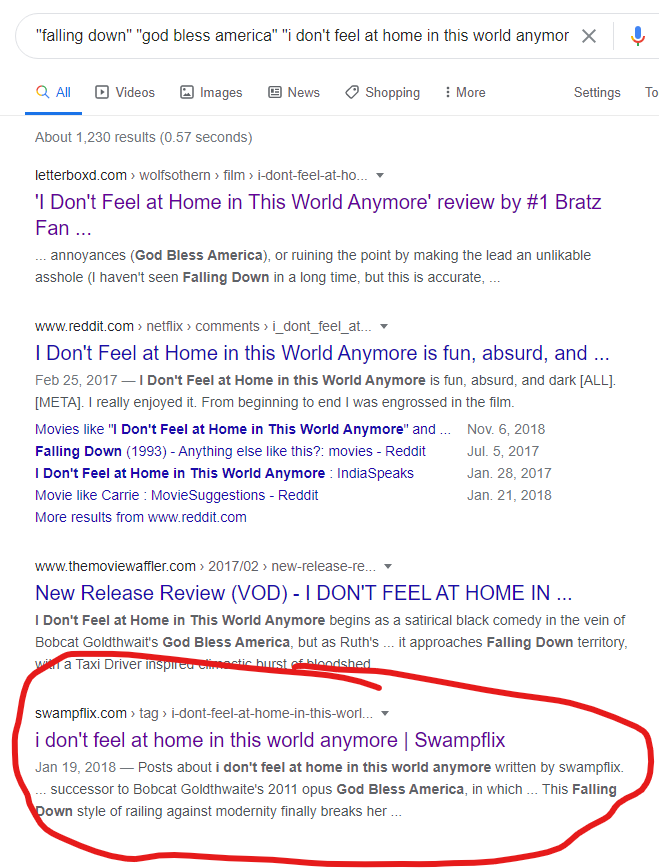
Boomer: I tried to see if there was a more concise term than “Falling Down/God Bless America/I Don’t Feel At Home in this World Anymore/Spree territory,” since they’re all “revenge” films of a kind, but that terminology calls to mind Dirty Harry and Death Wish, which are much more macho and gross than what I’m thinking about. This led me to try Letterboxd for the first time to see if I could look for lists which have those films in common, but I didn’t have any luck. In fact, if you Google those film titles in quotation to see if anyone else is exploring those films in conversation with one another, Swampflix is the fourth example. I guess that means it falls to us to name it, and I propose we call it “Match Factory Girl on the Verge.”
Upcoming Movies of the Month March: Brandon presents Home of the Brave (1986) April: Boomer presents London Road (2015) May: Britnee presents Trouble in Mind (1985)